❌

Normal view

  • βœ‡semi-rad.com
  • My Favorite Things Episode 9: Mike Sowden
      Listen on Apple Podcasts | Listen on Spotify | Listen/Watch on YouTube For My Favorite Things, I’m interviewing people about the books, movies, music, art, and other creative works that have helped shape their lives. My guest for Episode 9 is Mike Sowden, creator of the immensely popular Substack, Everything Is Amazing (I’m a paid subscriber). Mike’s favorite things are: Halloumi The soundtrack to Raise the Titanic, by John Williams Main theme Re-recordings of the s
     

My Favorite Things Episode 9: Mike Sowden

12 February 2026 at 14:44


Listen on Apple Podcasts | Listen on Spotify | Listen/Watch on YouTube

For My Favorite Things, I’m interviewing people about the books, movies, music, art, and other creative works that have helped shape their lives. My guest for Episode 9 is Mike Sowden, creator of the immensely popular Substack, Everything Is Amazing (I’m a paid subscriber). Mike’s favorite things are:

  1. Halloumi
  2. The soundtrack to Raise the Titanic, by John Williams
  1. Microadventures by Alastair Humphreys

Publisher’s page | Bookshop | Amazon

  1. Electric blankets
  2. Distant lights seen at night


  • βœ‡semi-rad.com
  • Friday Inspiration 523
    NEXT WEEK: On Thursday, February 19, at 6:00 p.m. MST, I will be doing a YouTube livestream + Q&A session about this year’s Freeflow Institute Running to Stand Still trail running and writing workshop in June. Sign up here via this link and I’ll send you an email the morning of the webinar containing the link to the livestream and a discount code good for $250 off your course registration. Hope to see you there! — I love that Flea (yes, Flea from the Red Hot Chili Peppers)
     

Friday Inspiration 523

13 February 2026 at 12:00

NEXT WEEK: On Thursday, February 19, at 6:00 p.m. MST, I will be doing a YouTube livestream + Q&A session about this year’s Freeflow Institute Running to Stand Still trail running and writing workshop in June. Sign up here via this link and I’ll send you an email the morning of the webinar containing the link to the livestream and a discount code good for $250 off your course registration. Hope to see you there!

I love that Flea (yes, Flea from the Red Hot Chili Peppers) is still making music, is playing both the bass and the trumpet (his original childhood instrument) on said music, is putting out these funky videos on YouTube, and seems to be doing it in a very DIY style (he has less than 50,000 subscribers right now?), and that he just put out a song like this. (video)

thumbnail from Flea - Thinkin Bout You (Official Visualizer)


It’s probably partly because I haven’t read that much of Charles Darwin’s actual writing, but also partly that he is such a revered titan of science, that I found these snippets from his letters so funny, including the one quoted in the title of this post, “Oh my God how I do hate species & varieties.”

Yesterday an algorithm served me a video titled something like “how to train like [Denver Nuggets star] Aaron Gordon, and I thought, “How dare you think I, a middle-aged dad, would compare myself to a 30-year-old full-time athlete who is paid millions of dollars each year to be good at basketball.” I did not click on the video, but I did click on this link in an email from newsletter sponsor Precision Fuel & Hydration because it was titled “How to balance your training with work, family and life,” and I was not disappointed to see coach Dougal Allan pretty much say, “be reasonable,” and also to think of time commitments to work/family/fitness as investments, instead of the other way around, in which you would think of the “sacrifices” you make when choosing how to spend your time. [clicking on the link to the article will apply a 15% discount to any purchase you make from the PFH website]

I was a little uncomfortable in the first few seconds of this video of this guy who starts out very aggressively wanting justice for the theft of his bike (because that’s usually how videos on social media go), but was quite relieved to see how the situation resolved. (thanks, Joe)

Hilary wrote a Substack essay about riding the bus with our little guy, Jay, and everything she says in the piece is true. She and Jay have also converted me into a fan who is now incorporating it into many bus-there-run-home or run-there-bus-home preschool dropoff/pickup plans. But the essay is of course about bigger things.

This is a 15-second video but a very powerful take on the saying (which is also the title of the video), “Everyone’s living a life you know nothing about. Be kind” (via Kottke)

This feels like a long time ago (even though it was just last summer) but Mountain Outlaw magazine published a profile of me with photos by my friend Bobby Jahrig, and words by journalist Maggie Doherty, who was great to chat with.

My first thoughts when reading this story were 1) “I would never do that to my mom and dad” and 2) “I hope my kid never does that to me,” but thought #3 was “WOW, that’s what I call commitment. Or insanity? Or both.” (thanks, Justin)

And finally, here are some new t-shirts I designed from an idea by Patreon supporter, ultrarunner, and all-around swell guy Ned Abbott (we’re donating 50% of the profits to a nonprofit recommended by Ned):

youre doing great tshirt

  • βœ‡semi-rad.com
  • My Favorite Things Episode 10: Kurt Wikel
    Listen on Apple Podcasts | Listen on Spotify | Listen/Watch on YouTube For My Favorite Things, I’m interviewing people about the books, movies, music, art, and other creative works that have helped shape their lives. My guest for Episode 9 is Kurt Wikel, geophysicist, dad, and brewery co-owner. Kurt’s favorite things are: 1. The Simpsons 2. Daft Punk — Homework Apple Music | Spotify | YouTube 3. Zen and the Art of Motorcycle Maintenance by Robert W. Pirsig Publisher’s P
     

My Favorite Things Episode 10: Kurt Wikel

26 February 2026 at 14:11

thumbnail from My Favorite Things Episode 10 - Kurt Wikel

Listen on Apple Podcasts | Listen on Spotify | Listen/Watch on YouTube

For My Favorite Things, I’m interviewing people about the books, movies, music, art, and other creative works that have helped shape their lives. My guest for Episode 9 is Kurt Wikel, geophysicist, dad, and brewery co-owner.

Kurt’s favorite things are:

1. The Simpsons

2. Daft Punk — Homework

Apple Music | Spotify | YouTube

3. Zen and the Art of Motorcycle Maintenance by Robert W. Pirsig

Publisher’s Page | Bookshop | Amazon

4. A Coconut Named Bob by Austin Weaver

Publisher’s Page | Amazon

5. Dune by Frank Herbert

Publisher’s Page | Bookshop | Amazon

Movie trailer

  • βœ‡semi-rad.com
  • Friday Inspiration 525
    This film is about the Manhattan loft artist Jay Ells has lived in since 1967 (starting rent was $110 a month!), and he says some interesting stuff at the beginning (no hot water in the apartment for the first 35 years), but it gets even more fascinating later on. Also: That view. (video)   At first I wasn’t going to include this, because I don’t know if it will resonate with anyone who doesn’t have nostalgia for the computers of the 1980s and early 1990s, but then I cli
     

Friday Inspiration 525

27 February 2026 at 12:00

This film is about the Manhattan loft artist Jay Ells has lived in since 1967 (starting rent was $110 a month!), and he says some interesting stuff at the beginning (no hot water in the apartment for the first 35 years), but it gets even more fascinating later on. Also: That view. (video)

thumbnail from Inside a Painter's New York Loft that he Moved into in 1967


At first I wasn’t going to include this, because I don’t know if it will resonate with anyone who doesn’t have nostalgia for the computers of the 1980s and early 1990s, but then I clicked on the post and read in the description that its made out of “LEGO-compatible bricks,” which is pretty mind-blowing and I think maybe more universally relevant.

We interviewed journalist and athlete Christie Aschwanden on The Trailhead podcast last week, and asked her a bunch of questions about recovery. She had some interesting takes on cold plunges, sleep trackers, HRV, and the beer mile, but the thing I really wanted to ask her about was a very simple quote of hers, “stress is stress,” which gets into why sitting at a desk all day answering emails and doing work isn’t “rest,” even though it’s definitely easier than, say, working as a carpenter.

I learned some very interesting (and heartening) facts from this story from newsletter sponsor Precision Fuel & Hydration: Detraining: Will I lose fitness by not training for a few weeks? Including how much fitness you lose by taking time off, but more importantly, how much you retain even if you have a week in which you don’t get to do very much of what feels like “training” (like when you catch a gastrointestinal bug or respiratory virus from a three-year-old). [Reminder that clicking on the link to the story will give you 15% off your first 2026 order from PFH, if you choose to buy anything]

I read this piece twice, about this guy spending 4.5 months in federal prison and how it expanded his social circle, and I am still thinking about many things in it, including but not limited to how most of us would do anything to not go to prison because it’s awful but how, paradoxically, this guy seems to be surprised at the quality of the friendships he made in his time there, so what does that say about us in the 21st century? [GIFT LINK] (via Kottke)

I’ve been listening to Japanese chillhop musician Brockbeats since 2017 or 2018, and I have never been able to find out anything about them—no real bio, no photos, nothing besides some videos of human hands tapping buttons on music equipment to make beats. But, they have a new album out this week, and it is just as pleasant as always.

I feel like Megan Amram probably started writing this piece while having a conversation with a friend about how “protein is in EVERYTHING nowadays!” And one of them said, “Wait, it’s not in everything, right?” And then she just took that idea and ran with it as far as she could.

Alex Hutton’s paintings of roller coasters are wonderful to look at, and the type of thing I’d hang on a wall if I had more walls and way more money, but maybe the most interesting thing about them is that he does not actually ride roller coasters.

I follow the r/oddlysatisfying subreddit because, true to its name, it provides images of oddly satisfying things, as well as just plain satisfying, not oddly at all, things. Such as the way snow fell and settled on this person’s pergola, which they then photographed and shared with the rest of us.

I mentioned this new shirt design a few weeks ago, and the [bestselling] coffee mug design below it as well, and I was thinking they’re both quite simply worded, but kind of have a similar ethos: We’re doing OK.

You’re Doing Great shirt

youre doing great tshirt

This F—ing Sucks mug

  • βœ‡semi-rad.com
  • Having The Screen Time Of My Life
      From my aisle seat on our two-hour flight, I glanced over occasionally at the passenger across the aisle as she went from texting on her phone, to flipping down the tray table and watching a news commentary show on her ipad, to switching to playing a game on her ipad, then finally folding up the tray table and texting on her phone for the final descent, landing, and taxiing to the gate, never spending more than a few seconds without interacting with a screen.  “Wow,” I
     

Having The Screen Time Of My Life

5 March 2026 at 12:00

person holding hands with child while thinking about their phone notifications


From my aisle seat on our two-hour flight, I glanced over occasionally at the passenger across the aisle as she went from texting on her phone, to flipping down the tray table and watching a news commentary show on her ipad, to switching to playing a game on her ipad, then finally folding up the tray table and texting on her phone for the final descent, landing, and taxiing to the gate, never spending more than a few seconds without interacting with a screen. 

“Wow,” I thought, “That’s probably what I look like too.” 

When we got home from the airport that evening, I checked the Screen Time app on my phone and realized I had, apparently, spent 2 hours and 27 minutes with my phone screen on that day. I had picked up my phone 70-plus times. 

Is that a lot? Not that much? Below or above average? I googled it, and then realized I actually don’t care how it compares to anyone else’s phone usage. When I think of the holiday cards we send each other at the end of the year and summarize what we’ve been up to, i.e. “Parent 1 started a new job and ran a marathon, Kid 2 is taking tae kwon do lessons and making friends at kindergarten, et cetera,” I don’t want mine to read, “Brendan continues to pursue his passion, which is apparently looking at his phone for a huge chunk of his waking hours and not knowing why he’s doing it.” 

Because yes, I use my phone for certain essential tasks, like maintaining a shared grocery list with Hilary, texting friends and family, taking photos, checking the weather forecast before I get dressed for my run, a few work things. But I am also aware—and have been aware for years now—that a lot of that screen time is spent on total bullshit: I pick up my phone to check the weather, and then I only half-consciously decide to watch three to 17 minutes of standup comedy video reels on Instagram, or get sucked into reading a news story and then another one and then another one. 

bar graph of time used checking the weather vs checking the weather and checking email and checking social media and checking text messages

Sure, I could download an app to help me spend less time on my phone. I could buy a product that promises to help me limit my distraction. I could get rid of my phone and get a “dumb phone.” Or, hear me out: I could just recognize that every time I pull my phone out of my pocket, it’s a conscious choice, and a choice that often results in me being a) not fully present or b) wasting several minutes of my life or c) both. 

I have been through this before, as a person with a tendency toward addiction. I used to smoke, which, as you might know, has been proven to be dumb as shit, but also very addictive. And as a person who smoked 20 cigarettes every day for years, I’ll tell you: One of the worst things about it (besides all the obvious health stuff) was how often I thought about the next cigarette. Sure, smoking one of them took five minutes, but I probably started thinking about the next one 10 or 15 minutes after I finished the last one. Even if you don’t do the math, that’s a lot of thinking about something. 

When I was in treatment for addiction 150 years ago, there was a saying that went something like, “First it’s just fun, then you have fun with problems, and then you just have problems.” A line graph of that might look like this: 

line graph of fun with no problems, some fun with some problems, and no fun with lots of problems

I’m not going to compare smartphones to cigarettes or other addictive substances/habits (although I wouldn’t be the first person to do so). And I’m not saying my phone has caused the same problems I’d have with, say, heroin or alcohol. But maybe it’s worth asking: How much fun am I having? 

Or: How much fun am I missing out on when I’m on my phone? Maybe you can multitask (even though the data says you probably can’t), but I know this about myself: Every minute I’m looking at my phone is one minute I’m not fully present doing something else: having a conversation, playing with my kid, listening to a song, watching a movie, enjoying a cup of coffee. 

I have drunk thousands of cups of coffee in my life and hopefully will be able to drink thousands more, so I’m not that bothered by being a little distracted when I do that, but my kid is only going to be three years old once, and even the most boring thing he does is worth being there for. 

So the day after that flight, I decided to try to keep my screen time under one hour per day—an arbitrary number, but one that seemed prudent enough. Could I fit in all the weather forecasts, texting, photos, grocery listing, social media, banking, and other essential phone tasks I needed in 59 minutes a day? 

Well, I did. Every day for two months, I kept my phone screen time under an hour (except for two days when I went over by four minutes). I did not feel a significant transformation, write a novel, get shredded, learn a new language, or start playing the piano. I don’t even know what I spent that extra time doing. I just felt a little bit … more sane? Better? 

When I sat in the waiting room at the doctor’s office, I just stared at the clock for seven minutes. I went out to dinner with a friend, and when he went to the restroom, I just sat there with my phone in my pocket. I have tried to embrace what it feels like to just sit there, instead of checking the little slot machine in my pocket whenever I’m the least bit bored. 

I have quit many addictive things over the years, and in every case, I have found it much easier to completely eliminate whatever it is from my life instead of trying to moderate my usage of it. I am aware that people can drink just one beer or one glass of wine, or smoke a cigarette now and then, but I am not one of those people. The hard thing with a phone is that you can’t just get rid of it—or at least I can’t, at this point in my life. So I have to figure out a way to moderate it. Which I honestly kind of hate. But maybe this is a little bit of progress. 

If you enjoyed this piece, please consider supporting my work

  • βœ‡semi-rad.com
  • Friday Inspiration 526
    My friend Ed, whose excellent Mountain & Prairie podcast you’re probably aware of if you’ve been following this newsletter for more than a few weeks, and who is also tapped into some Red Hot Chili Peppers content pipeline probably because of our shared love of Flea’s memoir, Acid for the Children, sent me this video this week, and it was a breath of fresh air. (video)   If you missed yesterday’s email, I wrote a piece about getting some time back from my phone,
     

Friday Inspiration 526

6 March 2026 at 12:00

My friend Ed, whose excellent Mountain & Prairie podcast you’re probably aware of if you’ve been following this newsletter for more than a few weeks, and who is also tapped into some Red Hot Chili Peppers content pipeline probably because of our shared love of Flea’s memoir, Acid for the Children, sent me this video this week, and it was a breath of fresh air. (video)

thumbnail from Chad Smith Surprises Drum Students


If you missed yesterday’s email, I wrote a piece about getting some time back from my phone, using a very simple idea/metric, and how it’s been going.

This is super-interesting but also extremely technical: A story about calculating the longest line of sight possible on Earth. As the author states at the end of the piece, visiting the actual spot to confirm the calculation would involve some significant mountaineering—but also at the end, in the footnotes, he says that the inspiration for the idea came from a 2012 forum thread on SummitPost, which warmed my crusty old mountaineering heart. (via Kottke)

I love the Poem of the Day emails, but I love them even more when they give me a poem I can read in less than 60 seconds and then think about for days afterward, like this one, which stuck the line “when you’re broke, everything you touch is artificial” in my head, where it will live for a long time.

Zen and the Art of Motorcycle Maintenance has come up a bunch of times in conversations I’ve had in the past few weeks (including podcast interviews with Brad Stulberg on The Trailhead and the episode with my friend Kurt Wikel on My Favorite Things), so when I saw this piece by Ted Gioia, “The Real Story Behind ‘Zen and the Art of Motorcycle Maintenance’” I of course read the whole thing and learned a lot of the backstory of a book I read/loved when I was 21.

Michelle J’s newsletter isn’t huge, but I read it every time I see a new post pop up. I have technically made a living as an adventure writer, and when I teach writing, that’s kind of where I come from, but I really want to teach people how to do what she does, which is make funny, thoughtful stories out of normal things like, well, this one, The Hidden Power Dynamics of the Office Potluck.

I saw some photos of Kyoto University’s graduation ceremony on a Reddit post saying it was “an art school graduation” in which the school lets students wear whatever they want, but as far as my research has found (someone please correct me if I’m wrong), it’s just the university’s graduation ceremony. Anyway, this article is the most detailed piece I found on it, the costumes are fantastic and I think more higher learning institutions should adopt this idea.

I linked to this article on the Precision Fuel & Hydration website a few months ago, “How to start strength training for endurance,” and I am not trying to be an evangelist, but would like to say that I have been doing the exact two workouts mentioned in that article during my two gym sessions per week since Thanksgiving, and I can’t believe I didn’t start doing it sooner. (Also, if you click that link to read the article, you’ll get 15% off your first purchase of PFH stuff from the website, including this package of my favorite PFH fuel)

I have probably spent 1000 times as many minutes reading about AI than I have using actual AI tools, but it’s always refreshing to read something calm and thoughtful about this whole *gestures at everything* era we seem to be in now. There were a bunch of bangers in this essay by Charles Yu (which was apparently adapted from a lecture he gave at Davidson College), including this paragraph: “But the achievement of a degree does not cover, does not even purport to touch, emotional intelligence. What is a Ph.D. in reading the room? In teaching your kid to ride a bike? In crying because you were moved by a piece of music? We consider elephants intelligent because they mourn their dead. What is a Ph.D. in grief, awe, wonder, curiosity?” [GIFT LINK]

We announced this on social media last week: An alumnus of my Running to Stand Still writing + trail running workshop has offered to provide a full-ride scholarship to this year’s workshop (June 7-12, Homestake Pass, Montana). The deadline is March 28, 2026, and the details and application are here.

And if you’re wondering what it’s like to attend the workshop, this video I made with my friend and Freeflow Institute founder Chandra Brown should give you an idea of our general vibe:

thumbnail from Some Questions About Our Writing Workshop

  • βœ‡The Roaming Civic
  • Henness Ridge L.O.
    Location. Yosemite National Park Status. Abandoned; Currently standing Estimated drive time from Portland, OR. 16 hours Date visited. September 24, 2024 Elevation. 6,339′ National Historic Lookout Register. US 281; CA 15 Trip Report. Our fourth day in the park was spent exploring off the Glacier Point road. We decided to do the hike from McGurk Meadows to Dewey Point in an attempt to avoid the crowds. This ended up being a great option as we ar
     

Henness Ridge L.O.

25 September 2024 at 00:07

Location.

Yosemite National Park

Status.

Abandoned; Currently standing

Estimated drive time from Portland, OR.

16 hours

Date visited.

September 24, 2024

Elevation.

6,339′

National Historic Lookout Register.

US 281; CA 15

Trip Report.

Our fourth day in the park was spent exploring off the Glacier Point road. We decided to do the hike from McGurk Meadows to Dewey Point in an attempt to avoid the crowds. This ended up being a great option as we arrived to an empty trailhead and only saw a handful of people on trail (most were on our way back to the car). It also offered lovely views through forest and meadows before opening up to the valley below. We spent a long lunch enjoying the view and even spotted one of the helicopters in action responding to a fire before hiking out (more than likely deployed from Crane Flat). Strava calculated this at 8.82 miles RT with 1,461′ of elevation gain. We still made the drive out to the end of the road afterwards to see the classic view points, but were quickly driven away by the crowds.

Our last stop of the day was Henness Ridge given its proximity to the Glacier Point road. Once we returned to Wawona Road we turned south instead of heading back the way we came from camp. The Henness Ridge road is the next turn off to the right after the Glacier Point road. This is a residential area now so be respectful of those that are here. Once on the Henness Ridge road you will follow it to the first fork where you will turn left onto Henness Ridge Circle. We made the mistake of bearing right at first and ended up deep in a neighborhood with no lookout in sight. Eventually we realized our mistake and back tracked to the correct road. From Henness Circle keep left at the T-junction and take another left until you reach the dead end of Azalea Lane. There is a gate at the end where the road turns to dirt. This is also a residential road, so make sure to park where you are not blocking a drive way or access to someones house. It felt like an after thought and that we should not be there, but the area behind the gate is technically a part of the park and the Henness Ridge lookout is technically a standing exhibit for those to visit.

We started our hike from behind the gate and took the first dirt road leading right. It was not clear which road at the four way junction was correct, but when in doubt head for the road leading up. This road passed two large water tanks and skirted the edge behind the properties to climb the last bit of the ridge. It’s a fairly short walk and the summit opens up once you come around the last corner. The road continues farther to provide access to a communication tower. The ridge itself is wide and flat with limited views, but the lookout structure is interesting. You don’t typically see 3-story fire lookouts in National Parks. This pocket of the park felt very tucked away and forgotten. We didn’t stay long due to limited daylight and the additional drive time back to camp. Strava calculated this at 1.76 miles RT with 174′ of elevation gain.

History.

Henness Ridge was the second fire lookout built in Yosemite National Park by the CCC in 1934. It is a 3-story rustic National Park style lookout with a 13’x13′ cab and catwalk on top. The first level was used for garage and storage while the second level was the living quarters. The site was actively staffed into the 1980s. Some note it for possible emergency use by the park, but I believe it stands more as an exhibit to what once was here.

  • βœ‡semi-rad.com
  • My Favorite Things Episode 11: ZoΓ« Rom
    Listen on Apple Podcasts | Listen on Spotify | Listen/Watch on YouTube For My Favorite Things, I’m interviewing people about the books, movies, music, art, and other creative works that have helped shape their lives. My guest for Episode 11 is Zoë Rom, journalist, podcaster (Your Diet Sucks, The Trailhead), running coach, elite ultrarunner, and stand-up comedian. Zoë’s favorite things are: Blalock’s Indie Rock Playlist About a Mountain by John D’Agata Publis
     

My Favorite Things Episode 11: ZoΓ« Rom

12 March 2026 at 13:21

Thumbnail for My Favorite Things Episode 11 Zoe Rom

Listen on Apple Podcasts | Listen on Spotify | Listen/Watch on YouTube

For My Favorite Things, I’m interviewing people about the books, movies, music, art, and other creative works that have helped shape their lives. My guest for Episode 11 is Zoë Rom, journalist, podcaster (Your Diet Sucks, The Trailhead), running coach, elite ultrarunner, and stand-up comedian.

Zoë’s favorite things are:

  1. Blalock’s Indie Rock Playlist
  2. About a Mountain by John D’Agata

Publisher’s Page | Bookshop | Amazon

  1. Ways of Hearing
  2. Nathaniel Russell’s Art
  3. Lady Bird

Other things we mentioned:

“Temptation” by Jukebox the Ghost

“Welcome Home” by Radical Face

The Lifespan of a Fact by John D’Agata and Jim Fingal

The Things We Carried by Tim O’Brien

The Perfect Storm by Sebastian Junger

Into the Raging Sea by Rachel Slade

  • βœ‡semi-rad.com
  • Friday Inspiration 527
    I did not expect to get choked up watching this video about basketball player Audi Crooks and her family, but I am also not surprised. (video)   I was not the biggest Star Trek fan but damn do I love a good set of “fictional spaceship cut in half” images, in this case the USS Enterprise D. I am once again doing what some people call “training” (for a big goal this fall) and really enjoying my time on the trails here in Missoula, which are ranging these past few wee
     

Friday Inspiration 527

13 March 2026 at 11:00

I did not expect to get choked up watching this video about basketball player Audi Crooks and her family, but I am also not surprised. (video)

thumbnail from Iowa State star Audi Crooks discusses her upbringing


I was not the biggest Star Trek fan but damn do I love a good set of “fictional spaceship cut in half” images, in this case the USS Enterprise D.

I am once again doing what some people call “training” (for a big goal this fall) and really enjoying my time on the trails here in Missoula, which are ranging these past few weeks anywhere from dry to muddy to covered in snow and/or ice. To keep my toes from getting jacked up no matter how badly I treat them, I have been wearing and loving the Ultra Run Crew from Injinji, who is not only sponsoring this month’s newsletter, but also giving you all 20 percent off toesocks with the code SEMIRADMAR26 for one week only—here’s a link for newsletter subscribers.

You’re probably familiar with the term enshittification  (if not, it’s in the dictionary now), which is kind of not in the purview of this newsletter, which is called “Friday Inspiration,” which is almost entirely made up of positive and inspiring content, because enshittification is kind of depressing. BUT, this video by the Norwegian Consumer Council is inspiring for its originality and tone, as is their quest to fight enshittification.

My Freeflow Institute Grand Canyon 2025 co-instructor Dr. Len Necefer wrote this great piece, A Letter to Those Younger Than Me, and instead of trying to sum it up in a couple sentences here, I’ll just quote my favorite part and recommend you read it:  “There is a difference between earned grief and cheap cynicism. Earned grief comes from engagement. It comes from having tried, from having been in the room or on the ground or in the water, from having put something on the line and watched it not be enough. That grief is honest and I respect it and I carry a lot of it. Cheap cynicism comes from never having tried. It comes from the sideline, from the comment section, from the safe distance of someone who decided early that nothing would work and then arranged their life to prove themselves right. One is a wound. The other is a wall. Learn to tell the difference. Build your life on the wound side.”

The title of this poem, Now You Are Like a God, is perfect, and the poem itself should be required reading, as a sort of palate cleanser, for anyone who has watched TV news coverage that makes them feel that every block of every single city is a crime-ridden hellscape.

John Craigie’s new album I Swam Here popped up on my radar a month ago, and something about it just feels like an antidote to Everything Going On right now—calm, chill, a bit of reverb in the vocals. I’ve been listening to it a lot lately, as well as some of his older albums (enough to where I think Hilary is getting a little tired of it). But if that sounds good to you, here’s the new album (recommendation: start it on the second track, Fire Season).

I forget where I saw a mention of this podcast episode on The Atlantic, How To Age Up On A Warming Planet, but as someone more than a little prone to climate anxiety, last week was perfect timing (even though the episode originally published in May 2025) to hear what Sarah Ray, professor and chair of environmental studies at Cal Poly Humboldt, had to say about staying sane in an uncertain world. To paraphrase (but you should really listen to her say it in more detail): make sure you’re getting together with your community/neighbors, and redirect your attention to the things (and people) you love. [GIFT LINK]

Also: I got to interview my Trailhead co-host, journalist (and standup comedian) Zoë Rom on My Favorite Things this week, and we talked about Nathaniel Russel’s art and flyers, as well as Blalock’s Indie Rock Playlist, John D’Agata’s book About a Mountain, the Ways of Hearing podcast, and Lady Bird:

  • βœ‡Race Ipsa Loquitur
  • Eggs Still on Ice
    I knew what it was before I even opened the envelope. There’s only one thing that comes my way from the Colorado Center for Reproductive Medicine these days, and that’s the yearly storage bill for my frozen eggs.$850 for another year. $850 for one more year of an option. $850 for an option I logically know that I’m not going to take anymore. Yet 10 minutes later I find myself in front my laptop, entering my credit card number, and paying the bill. A slight wave of relief envel
     

Eggs Still on Ice

15 March 2026 at 21:37

I knew what it was before I even opened the envelope. There’s only one thing that comes my way from the Colorado Center for Reproductive Medicine these days, and that’s the yearly storage bill for my frozen eggs.

$850 for another year. $850 for one more year of an option. $850 for an option I logically know that I’m not going to take anymore.

Yet 10 minutes later I find myself in front my laptop, entering my credit card number, and paying the bill. A slight wave of relief envelops me, and I have officially kicked the decision down the road, again.

I publicly grappled with my indecision around having children a few years ago, and in that year, I also did a lot of research. I learned about “childless” vs “child-free”, I read books, I listened to podcasts, I started my own “Women without Kids” group. I learned that I didn’t fall neatly into the dichotomy between childless and child-free, but more in a group of women that I think is larger than we give it credit for, and that’s “childless by circumstance.”

Circumstance. I never faced down the opportunity to have kids with a partner and said no. I never tried to have children and was unable to conceive or give birth. I never suffered miscarriages. I never said no to a partner who asked me if I’d like to have children with them. I, frankly, never had the opportunity.

I recognize some will say that’s not true: I’ve had the option over the past two decades, if I really wanted children, to use a sperm donor and be a single mom by choice. I have the utmost respect for women who choose to do this, but this path never called to me. A lot of complex feelings come with that as well, such as “do I have a right to be sad about not having children if I didn’t pursue the single-mom-by-choice route?”. Am I selfish for feeling that if I was going to have children, I would want to share that experience and joy and responsibility with a partner?

Honestly, I don’t know the answer to that.

What I do know is that these past few years have been a confusing and complicated mix of emotions around children and the growing realization that I will never be a biological mom. And while there is a wonderful movement to expand the definition of “mothering” beyond what we traditionally think of, I still believe women are allowed to grieve not having an experience that is so fundamental to being a woman in our species. With each passing year, I’ve come to acknowledge that yes, I’m sad, and more importantly, that it’s ok to be sad about that. Having children looks extremely hard and exhausting, and also so incredibly fulfilling. And I mourn that I’ll never experience that.1

But these past few years have also been a lesson in learning to hold multiple truths at one time: I can have grief about never being a mother, and I can also be thankful and grateful for the freedom and flexibility that life without children offers me. I can get a pang of jealousy when I see my friends interact with their kiddos, and also be super grateful to give those same kiddos back to their moms after an evening of baby-sitting. I can be angry that I wrote myself off from being a mother because of my eating disorder history,2 and also have compassion for just how many mental health demons I’ve tackled in these years.

For whatever reason, I currently have a lot of friends in their early to mid 30s who are either embarking on their egg freezing journey or wrestling with whether to pursue that option. A lot of times, I send them my old blog post on it, and I think it scares the bejeezus out of them (sorry, all!). I do think it’s a wonderful option and I’m so grateful I had the opportunity, but I also think everyone should go in eyes wide open, knowing that it’s not the iron-clad insurance policy the clinics make it out to be. I also feel some guilt that (1) my employer paid the vast majority of this bill, and there are so many women who would love the option and can’t afford it; and (2) now the eggs are there and I’m not using them. “I am I being selfish?” I find myself asking.

When I started my egg freezing journey, everyone talked about how relieving it was to have that option preserved. But no one warned me about the flip side of that - the definitive choice you will have to make later on at some point. And something that no one talks about, and what I’m facing now, is how egg freezing is just kicking the “do I have children” decision down the road, past the natural biological clock. Every year I pay that storage bill, I delay that decision further. I also delay the grief that comes with it. Instead the grief just sits there undisturbed, lurking in the background. Every so often it breaks through to the forefront, and I break down.

Some year in the next few years, I will have to choose to dispose of my eggs, with my only option being donating to research or straight disposal. I’ll donate to research, but oh how I wish I could donate to someone in need of eggs who may not be able to pay the $20k+ for an egg donor. But because I was over 35 at the time I froze my eggs so could not be FDA screened as a donor, the clinics will not let me donate, even if I make a directed donation to a specific person who would like to use them. I fought this battle once this year and tearfully lost. Clearly as an attorney I’d like to think there is a way around this, but clinics won’t take the liability even with a full release.3 Sigh.

When I get there, I hope that I’ll feel at peace with the decision to stop paying storage fees and to donate/dispose of my eggs. I’m frustrated that I’m not there yet, and that I’m a walking contradiction saying “my time for biological children has passed” while still paying for a very terrible insurance policy. But most likely I’m going to have to accept the fact I will never be fully at peace, and that the day I send in my notice to dispose/donate, will be a day of grief and finality. But perhaps it will also be freeing.

Maybe.
I’m not sure.
I’ll find out when that day comes.

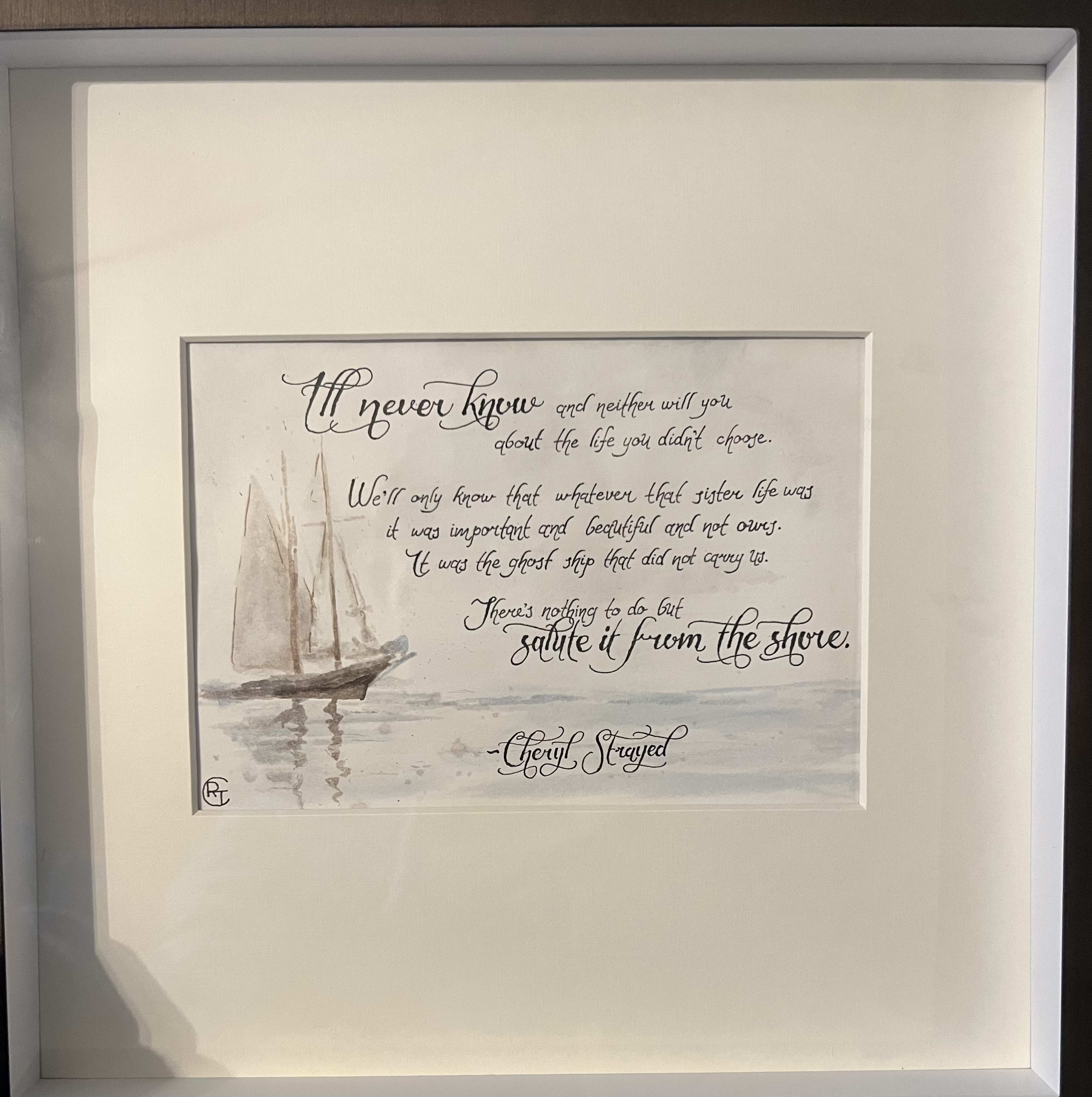
As Cheryl Strayed once wrote (in a piece that I come back to time and time again when I need some comfort): “I’ll never know and neither will you of the life you don’t choose. We’ll only know that whatever that sister life was, it was important and beautiful and not ours. It was the ghost ship that didn’t carry us. There’s nothing to do but salute it from the shore.

This is me saluting.

Wonderful art a dear friend had made for me. It hangs as a daily reminder.

Thanks for reading Race Ipsa Loquitur! Subscribe for free.

1

To preempt many well-intentioned responses I’ll get: yes, I know adoption is always an option. It’s also a very difficult and trying path, and not as simple as the “just adopt!” advice that so many people will offer. I’ve done a lot of research, and while I’m not foreclosing the opportunity, to me it’s similar to when people say “well just freeze your eggs!” or “just have kids on your own!” There’s a lot that goes into these alternative paths, and that deserves respect.

2

This might be a separate post entirely, but I always held the belief that I wanted/needed to be “recoverED” from an eating disorder to have children because the last thing I ever wanted was my impressionable kiddos picking up on remnants of disorder eating habits and mimic those. I don’t know if I’ve ever felt strong enough in my recovery where I could say with certainty I wouldn’t fear this. But I know many others who have started families while in recovery and don’t share the same concerns. So, once again, I don’t know.

3

This isn’t my area of law, so if someone knows a way around this, please reach out and let me know. While it would be a decision fraught with its own complexities, I’m fairly certain I would love for someone else to be able to use them.

  • βœ‡semi-rad.com
  • A Week Of Training: Winter
    I had decided to film all my runs for a week, and exactly one mile into my first run, Jay wanted to get out of the jogging stroller and play in the snow. So we did. I didn’t really have a strong overall vision for the video, but 10 minutes into it, it seemed like an appropriate vibe: not so much “Run Your Fastest Race Ever With This Workout Plan”—more “OK But We Don’t Take Ourselves THAT Seriously Around Here.” I ran the final four blocks to Jay’s
     

A Week Of Training: Winter

19 March 2026 at 11:00

I had decided to film all my runs for a week, and exactly one mile into my first run, Jay wanted to get out of the jogging stroller and play in the snow. So we did.

I didn’t really have a strong overall vision for the video, but 10 minutes into it, it seemed like an appropriate vibe: not so much “Run Your Fastest Race Ever With This Workout Plan”—more “OK But We Don’t Take Ourselves THAT Seriously Around Here.” I ran the final four blocks to Jay’s preschool, dropped him off, and continued my run, clocking a 22:18 second mile. Which felt authentic.

I am aware that being a 1) middle-aged guy 2) raising a preschooler while 3) trying to make a livable income off of writing and art is not probably an ideal path to being a “successful” ultramarathon runner. But I love to run on trails and am grateful that I get to do it most weeks, and I thought I’d attempt to share what that feels like. So there’s no music in this short video, just the sounds of my footsteps on varying surfaces, and they’re all real running routes I do on a regular basis, squeezed in around my family and work life. It’s not flashy, just a kind of tour of the places I run.

The week I filmed was February 23 through March 1, which was more wintry than most of our winter here in Missoula. I’m thinking I might to make one of these videos every season this year—I hope you enjoy this one: A Week of Training: Winter. It ended up being way more fun to make than I anticipated.

thumbnail from A Week of Training - Winter

  • βœ‡The Roaming Civic
  • Smith Peak L.O.
    Location. Stanislaus National Forest Status. Active; Currently standing Estimated drive time from Portland, OR. 14 hours Date visited. September 23, 2024 Elevation. 3,878′ National Historic Lookout Register. US 1188; CA 119 Trip Report. I had planned our trip to have a day to explore most sections of the national park to see as much as possible in our limited time. Our third day was designated to exploring the Hetch Hetchy reservoir. If we had
     

Smith Peak L.O.

24 September 2024 at 00:04

Location.

Stanislaus National Forest

Status.

Active; Currently standing

Estimated drive time from Portland, OR.

14 hours

Date visited.

September 23, 2024

Elevation.

3,878′

National Historic Lookout Register.

US 1188; CA 119

Trip Report.

I had planned our trip to have a day to explore most sections of the national park to see as much as possible in our limited time. Our third day was designated to exploring the Hetch Hetchy reservoir. If we had time we would make a side trip to Smith Peak lookout on our drive back to camp. This area of the park is located in the north western corner. It required leaving and re-entering the park, so it set us up well to visiting a fire lookout just outside the boundaries. The access to the Hetch Hetchy area is off a steep and narrow road with limited trail options. It seemed like most trails were utilized for access to longer backpacking routes. I settled on sticking to the classic hike along the reservoir to Tueeulala and Wapama falls. The biggest downside to visiting Yosemite this late in the season was most of these waterfalls were dry. The trail follows an old railroad cut that is relatively flat, but offers little reprieve from the sun. Despite Strava only calculating this hike at 4.80 miles with 585′ of elevation gain the heat made it challenging. Our energy was tapped by the time we made it back to the car.

I wanted to head straight back to camp afterwards, but we decided to continue to the Groveland Ranger station to buy a map of the area. Garnet was interested in looking at the routes to other fire lookouts, but they were completely out of the map we wanted. After some debate, we decided to continue on to Smith Peak. The access road was located just behind the ranger station and we were already there. We followed the paved road to the Pines Campground and turned into it. The road turned to dirt and continues beyond the campground. We debated parking here and walking the road since it was close enough, but ended up continuing on for the same reason. If we found the road inaccessible we could always turn around. There were some minor hazards to avoid if you are driving a low clearance vehicle but it is passable. After driving for a mile and a half we reached a 5-way intersection. We parked in a pull out here since we figured the remaining distance to the summit was behind a gate. It was not immediately clear which road led to the summit from here. We took a guess and headed left based on which road looked the most used and angled towards the summit. It was confirmed we made the right selection when we reached the gate farther down the road. From where we parked to the summit was less than half of a mile. Strava calculated this at 0.95 RT with 174′ of elevation gain. If we had decided to park at the campground, the hike would have been closer to 4 miles RT with 680′ of gain.

Our biggest surprise after we reached the summit was meeting the lookout attendant onsite. We figured even if it was still staffed the person would have already been done for the season or have had left for the evening. He invited us up to chat, but not all the way on the catwalk. The view from the ground was about the same as it was from the stairs. Unfortunately neither of us can recall his name, but we chatted with him for awhile about lookouts and the surrounding area before heading back to camp for the night.

History.

In 1931, Smith Peak was selected as an administrative site to build a lookout tower. A wooden 2-story tower was built shortly after it’s selection. Old archive pictures show this structure was reminiscent of a national park style cab with slight variations. It is mentioned that the site has been utilized for fire detection as early as 1910 given it’s proximity to the ranger station. The wooden structure was replaced in 1952 by a metal lookout tower and garage. This burned down in 1987 during the Stanislaus Complex fire and was replaced by the existing structure in 1988. This site continues to be actively staffed every season and is one of only two remaining staffed in the Groveland Ranger District.

  • βœ‡semi-rad.com
  • Friday Inspiration 528
    A big thanks to Hilary for sending me this 9-minute skateboard video that’s more of a visual love letter to Paris with some skating by Andy Anderson, the most joyful part of which I believe might be the credits, among many joyful parts (video) Mike Sowden, whose Everything Is Amazing  newsletter I have mentioned here many times, sent me a link to this website with the simple message “Top 100,000 Wikipedia articles of the year….as if they’re skyscrapers in a city.&
     

Friday Inspiration 528

20 March 2026 at 11:00

A big thanks to Hilary for sending me this 9-minute skateboard video that’s more of a visual love letter to Paris with some skating by Andy Anderson, the most joyful part of which I believe might be the credits, among many joyful parts (video)

thumbnail from Andy Anderson The Shape Of Paris

Mike Sowden, whose Everything Is Amazing  newsletter I have mentioned here many times, sent me a link to this website with the simple message “Top 100,000 Wikipedia articles of the year….as if they’re skyscrapers in a city.” I see no need to further elaborate on his words, and if that kind of data visualization sounds fun to you, here’s the link to check out WikiCity. (OK, sorry, I would in fact like to further elaborate, or just ask: Why is the Wikipedia page for the number 4 the 1,100th most popular Wikipedia page?!?!?)

Anne Kadet walked around New York for three days in order to ask 200 New Yorkers to name their worst enemy and collect their responses, which are relatable, touching, funny, quite diverse, and worth reading.

Thanks to Hannah sending me this link, I now know what a nudibranch is, and I am also very happy that artist Arina Borevich seems to have created her own lane in the art world by making felt interpretations of the colorful marine sea slugs, which seem to sell out very quickly on her website.

Reuters spent a ton of time and resources figuring out the identity of Banksy, and if you want to read a super-long piece about how they did it (and who Banksy is), it was published online this week and has MULTIPLE CHAPTERS. I was a bit conflicted about whether or not I wanted to find out, and if you don’t want to know, don’t click the link (although you might have already seen it somewhere else).

This is good advice for (as stated) “if you’re feeling overwhelmed,” and also if you would like a little chuckle.

What happens in this story titled “Sucker: My year as a degenerate gambler” is probably not inspirational in a positive sense, but I thought the writing and research were honestly quite bold: McKay Coppins, staff writer at The Atlantic, practicing Mormon, and married father, takes $10,000 of The Atlantic’s money to gamble with for the 2025-26 NFL season (he OKed it with his bishop since it was a journalistic exercise). I got hooked and read this entire piece in chunks over the past week (if you listen to it, it’s almost 74 minutes), and wow. What happens is maybe not surprising, but illuminating nonetheless. [GIFT LINK]

One more thing: Thanks to a very generous alumnus of my Running to Stand Still running + writing workshop, we are able to offer one full scholarship for this year’s workshop in Montana. So if you’ve thought about joining us but need some help, check out the application here. The deadline to apply is March 28.

Related to that: I took a series of screenshots from Ethan Hawke’s interview on Subway Takes to try to explain why I teach writing workshops (including, of course, this year’s workshop, which has a few spots left):

  • βœ‡Race Ipsa Loquitur
  • Deoptimizing My Life
    I woke up in the Tahoe AirBnB the morning of the 2017 Spartan Race World Championship and, as usual, checked my Whoop readiness score first thing. 3%. THREE PERCENT - and I had arguably one of the biggest races of my life that day, where I was hoping to secure a second Spartan World Championship title. 3%.The number haunted me during my mobility routine and pre-race breakfast of Pop-Tarts (Cinnamon Roll) and peanut butter. I managed to shake it off and forget about it, but I did go on to have o
     

Deoptimizing My Life

25 March 2026 at 10:47

I woke up in the Tahoe AirBnB the morning of the 2017 Spartan Race World Championship and, as usual, checked my Whoop readiness score first thing.

3%.

THREE PERCENT - and I had arguably one of the biggest races of my life that day, where I was hoping to secure a second Spartan World Championship title.

3%.

The number haunted me during my mobility routine and pre-race breakfast of Pop-Tarts (Cinnamon Roll) and peanut butter. I managed to shake it off and forget about it, but I did go on to have one of my worst races ever - failing obstacles, shattering my pinky finger, and, for the first time in my obstacle racing career, finishing outside the top 10 in 11th place. There were a lot of “what happened out there?” questions I faced while I elbowed my way through the crowd post-race to get to the urgent care for them to take a look at my poor shattered pinky finger.

I took my Whoop strap off that day and never wore it again.

That’s not to say I had a healthy relationship with it beforehand. I never sought out a Whoop - one of my sponsors got it for me in 2016 through a pro athlete deal, so I figured “sure, seemed like a smart thing to do.” Smart…maybe for some people. I had a tendency to use the Whoop strap in a perverse way - to just see how high I could get that “strain” score on a daily basis. Anything less than a 20 was a failure. Any day where I was “recovering” was a failure. Leave it to my eating disorder and OCD to take a recovery tool and make it into a perverse torture device.

My Oura ring that I received as a gift later that year didn’t fare much better.

In 2017, both Whoop and Oura were still in their infancy - niche devices used by the tip of the spear. Over the past decade, they’ve become ubiquitous among athletes, weekend warriors, biohackers, and wellness gurus alike. Beyond Whoop and Oura, we now have the ability to track…everything. Our weight, our exercise, our sleep, our blood sugar, our ketones, our sweat rate, our heart rate, our periods1, and even our bowel movements. We track, and quantify, and analyze and stress about how we can optimize..,everything.

I thought about this as a I watched an ex prick his finger every morning, measuring his ketone levels. A CGM slapped to his arm, giving him warnings that the cauliflower he just ate spiked his blood sugar AND kicked him out of ketosis. But he had the personality where he could laugh it off, then say “fuck it” and proceed to eat an entire mini-bar of gummy bears and chocolate chip cookies and go about his merry way. He could check his sleep score, shrug, and immediately go on with his life.

If that Whoop strap taught me one lesson, it’s that I am not that person. I am the person for whom tracking does more harm than good.

Perhaps this is rooted to my history with eating disorder recovery. Unlike many eating disorder sufferers, I never counted calories and I avoided scales with every ounce of my being. I didn’t want to know, because I knew that knowing would only drive me and my obsessive-compulsive tendencies to a very bad place.

So over the past decade, as the world has focused more and more on tracking and optimization, I’ve opted out. I’ve turned off sleep tracking and heart rate on my watch (bonus - it saves batteries!), I rarely wear a heart rate strap while I run, and I actively avoid trying to see my step count for the day. I went from getting blood work done 4x year to once a year (unless there is something seriously off), and I’ve declined bloodwork panels with tons of extraneous tests that may or may not have significance. I don’t want a full body MRI, I don’t want to know my APOE4 gene status despite there being a strong Alzheimers link my family, and I don’t want a Coronary Artery Calcium (CAC) scoring heart test despite LDL that consistently and stubbornly sits just about that 100mg/dL cutoff regardless of what I do.

I realize this flies in the face of “knowledge is power” and “the more you know, the more prepared you can be.” In a world where we have access to knowing so much about our bodies, I may seem like the outlier for saying “no thank you, not for me.” Perhaps I’m leaving performance on the table. Perhaps I’m burying my head in the sand avoiding a potential catastrophic medical issue.

Perhaps.

But perhaps I’m valuing my mental health and my recovery journey with health anxiety and health-related OCD more right now. I’m coming off a rough fall of an extreme OCD health-related flare where I made decisions in a panic I’m not super proud of. It sucks, but I learned some things, including a reiteration of the fact that for me, optimization and the fear of something going wrong with my body may actually lead to more harmful things (such as the mental and physical stress of potentially unnecessary tests and medical procedures).

Beyond just tracking, I’m re-evaluating my relationship with something in our lives that new research has shown is actually pretty terrible for us. As more and more of my friends choose to completely abstain from alcohol, I actually done the opposite: I’ve started having a drink once or twice a week after a few years of complete abstinence. Long gone are my days of beer bongs and shot skis and flip cup, but sitting around at a dive bar with friends and a beer is something I realize I’ve actually missed. Sure, I imagine if I tracked my recovery and sleep score, I’d see the impact there, but the bonding and social experience that comes with hours of meandering conversations over a few drinks with friends on occasion seems a worthwhile trade-off to me.2

Similarly, strict 8:30pm bedtimes have given way to poetry open mic nights that keep me out until midnight, to the aforementioned bar conversations, and to a late-night movie or conversation with a loved one. You’ll still find me crawling into bed at 8pm some nights when needed, but the stranglehold on my sleep schedule has eased in favor of broader experiences and saying “yes” to what life may have to offer beyond the regimented schedule of a training athlete.

My grandma passed recently at the epic age of 102. And she lived to that age doing so many things that longevity influencers would balk at: buttering her toast with lard, eating potato chips for lunch, having 2 martinis every night for decades. She also lived by herself for 35 years after my grandfather’s death, and didn’t really have an active social life (research has proposed that living with a partner and having lots of friends is a key to longevity). She never took a supplement or pill in her life, and only saw a doctor when my dad forced her to. So if you take her n of 1, none of this longevity and optimization shit makes any sense. (I will say she was an extremely low stress person so maybe that had something to do with it. You know what’s not low-stress? Tracking your freakin’ sleep scores.)

Like so many things in life, perhaps it’s the unsexy “everything in moderation” that wins out. And probably so much of it comes down to an individual’s personality. What I have to trust in this day and age of optimizing and maxx-ing everything is that for me, personally, less is more. Doing less, knowing less, testing less, optimizing less.

Cheers to that.

Thanks for reading Race Ipsa Loquitur! Subscribe for free to read some stuff.

1

Ok, this is one thing that I actually do believe in tracking and wish I had done so earlier!

2

There’s actually an entirely separate post about the interplay of alcohol and my eating disorder that’s been sitting in draft form for awhile now, but the tl;dr is that complete abstinence from alcohol for me can actually be an eating disorder behavior that indicates I’m not doing well in recovery (fear of calories, etc). It’s a tricky subject to broach, but definitely curious if others can relate there.

  • βœ‡The Roaming Civic
  • Bald Mountain L.O.
    Location. Inyo National Forest Status. Active; Currently standing Estimated drive time from Portland, OR. 13-1/2 hours Date visited. September 27, 2024 Elevation. 9,104′ National Historic Lookout Register. US 279; CA 13 Trip Report. I felt we were able to get a good overview of Yosemite National Park by spreading out our hikes in each area. We spent our fifth day in the main valley collecting souvenirs and our sixth in Tuolumne Meadows hiking t
     

Bald Mountain L.O.

27 September 2024 at 20:19

Location.

Inyo National Forest

Status.

Active; Currently standing

Estimated drive time from Portland, OR.

13-1/2 hours

Date visited.

September 27, 2024

Elevation.

9,104′

National Historic Lookout Register.

US 279; CA 13

Trip Report.

I felt we were able to get a good overview of Yosemite National Park by spreading out our hikes in each area. We spent our fifth day in the main valley collecting souvenirs and our sixth in Tuolumne Meadows hiking to Cathedral Lakes. We really only missed the most southern section with the Mariposa Grove. Though I hope the next time we get to visit the park will be via backpacking in their expansive backcountry. After our long travel day to the park at the start of our trip, I was happy we opted to take two nights to head back to Oregon. This broke up the drive and allotted us to make some exploratory stops along the way. I thought about trying to squeeze another short hike in before exiting Yosemite, but we both agreed we needed to make progress on our drive time. Especially since we opted to take the scenic route back via HWY-395.

Bald Mountain lookout is just south of where HWY-120 meets HWY-395, or where the eastern exit to Yosemite National Park spits you out. This is a unique stand alone mountain that rises up out of the valley to offer 365 views of the surrounding area. Though we passed on any additional hikes, we figured it made sense to make a small detour here before heading north. Especially since we do not make it down to this area often and this fire lookout stands out by itself from others. Heading south on HWY-395, we kept an eye out for the left turn since we would have to cross traffic and were not sure if it’d be obvious. The road was labeled as 1S05 on the map, but was Bald Mountain Road from the highway and on GPS. There was thankfully a turn lane to avoid blocking any traffic and allowed us to wait for a safe crossing. From there the road turns to a mix of gravel and sand – I was a bit worried about how our car would handle the sand. We followed the main use road and any signs that pointed us towards Bald Mountain. It felt pretty straight forward to us but there are junctions were one could get turned around if not careful.

The scene of the crime

The road was passible to our car up until we reached the gate. There were some squirrely sections in the sand prior, but if you keep your momentum and don’t get too close to the soft shoulders you will be fine. I’d recommend parking and walking from the gate if you are in a low clearance vehicle. Garnet was driving this time and wanted to see if we could drive the remaining distance. This would end up being one of our bigger mistakes visiting a fire lookout. The road started out fine, but it is rocky and narrow. It does not offer room to pass if you meet another vehicle except in an area right before the summit. Unfortunately before we reached that larger pull out the road got worse and I wanted to bail out. We probably would have been fine if we had committed to making it at this point, but instead we tried to turn around to avoid backing all the way down. This area was rockier than the rest of our drive, but it was still a mix of soft sand. Given those conditions, I’m sure it’s no surprise to read that we got ourselves stuck. Not majorly but enough to be concerned about how we were going to get ourselves out. Our wheels were having a hard time finding purchase and we tried adding rocks under the tires to help build traction without digging ourselves deeper. There was potential for high-lining our car or at least cause significant damage to the undercarriage. Eventually someone was driving down from visiting the summit and they stopped to help. They were able to assist Garnet in giving us a good push from the back, while directing us in the front areas we couldn’t see by ourselves. We were extremely thankful and embarrassed at the same time. Once we were back on the road we had to back down all the way to the gate to let them pass. We parked in a pull out just before the gate and walked the rest of the road, as we should have from the start.

It was only a 0.8 mile walk from the gate to the summit with 382′ of elevation gain. Strava calculated the total round trip distance at 1.77 miles, but the additional was due to walking around the lookout. We were greeted by a friendly attendant named Karen that invited us up to take a look around. She told us she was a volunteer from the San Bernadino area and that this lookout was staffed on a rotating basis of volunteers. It was cool to see a new program in action from the efforts of the FFLA to help keep this lookout in service. Karen used to work on Keller Peak LO and was the first woman to repel down El Capitan (so cool!). She told us how we just missed some other visitors that were worried about meeting cars on the road during their drive down and that she had seen a car heading up at the same time but was unsure what happened. We were too embarrassed to tell her that was us, or that we got stuck, or that they had to help us. I felt even worse to hear that we became their worst fear. There was not much we could do about it now except look back and laugh.

History.

Bald Mountain is one of only two fire lookouts still standing in the south-eastern Sierra and the only one left in operation on the Inyo National Forest. The original structure was built in 1943 by the Civilian Public Service (an agency that followed the CCC and was staffed by conscientious objectors of WWII). There is still a log cabin onsite that is believed to be part of the original buildings from this era and is still used as a warming hut for skiers in the winter. In 1963, the current 16′ x 40′ concrete block lookout with 10′ x 10′ steel cab was built. This unique structure includes living quarters, two garages, and a storage room. It was actively staffed by the Forest Service into the 1980s. It was not until recently, in 2024, that it was brought back into service via a volunteer partnership between the FFLA and the Mono Lake Ranger District.

  • βœ‡semi-rad.com
  • My Favorite Things Episode 12: Jonathan Ellsworth
    Listen on Apple Podcasts | Listen on Spotify | Listen/Watch on YouTube The concept for the My Favorite Things podcast is simple: Each guest compiles a list of five books, movies, music, art, and other creative works that have helped shape their lives. My guest for Episode 12 is Jonathan Ellsworth, writer, podcaster, founder of Blister Review, and former philosophy professor. Jonathan’s favorite things are: Old Man and the Sea by Ernest Hemingway Philosophy as a Way o
     

My Favorite Things Episode 12: Jonathan Ellsworth

26 March 2026 at 13:10

Listen on Apple Podcasts | Listen on Spotify | Listen/Watch on YouTube

The concept for the My Favorite Things podcast is simple: Each guest compiles a list of five books, movies, music, art, and other creative works that have helped shape their lives. My guest for Episode 12 is Jonathan Ellsworth, writer, podcaster, founder of Blister Review, and former philosophy professor. Jonathan’s favorite things are:

  1. Old Man and the Sea by Ernest Hemingway
  2. Philosophy as a Way of Life by Pierre Hadot
  3. Pulp Fiction (trailer)
  4. Don Quixote by Pablo Picasso
  5. “Mississippi” by Bob Dylan

Other stuff we talked about:


  • βœ‡semi-rad.com
  • Friday Inspiration 529
    If you watch this video, be warned that a) there are a couple verbal mentions of male anatomy and also an animation of male anatomy, b) that it won Best Nonfiction Short Film at Sundance in 2024, and c) you might cry a little bit. (video)   If you had “Read a brief but wonderful poem about holding an iguana like a baby and feel a tiny bit better about everything” on your to-do list for today, go ahead and cross that off after you click here. Since I 1) am running a lot right n
     

Friday Inspiration 529

27 March 2026 at 11:00

If you watch this video, be warned that a) there are a couple verbal mentions of male anatomy and also an animation of male anatomy, b) that it won Best Nonfiction Short Film at Sundance in 2024, and c) you might cry a little bit. (video)

thumbnail from Bob's Funeral


If you had “Read a brief but wonderful poem about holding an iguana like a baby and feel a tiny bit better about everything” on your to-do list for today, go ahead and cross that off after you click here.

Since I 1) am running a lot right now and 2) have a preschooler who has had a runny nose and a bit of a cough earlier this week, I was interested to read this article on newsletter sponsor Precision Fuel & Hydration’s website: Does exercise weaken your immune system? The answer is: It can, but. [Reminder that clicking the above link will give you 15% off your first 2026 purchase of Precision stuff)

I appreciated this lovely exploration of Robert Redford’s identity through the lens of the movie Jeremiah Johnson, and also appreciated the deftness with which writer David Gessner addresses the fact that yeah, the movie/screenplay/history of the American West is a bit problematic, as is the origin of the character of Jeremiah Johnson. (PS: I only know about this article because of my friend Ed’s Good News from the American West newsletter, which you would probably enjoy too)

I don’t know how much I need to set this up, but this guy got his photo on the front page of the local Lewiston, Idaho, newspaper twice on the same day! But in one of the photos he was committing a crime, so … (via Kottke)

So I co-host a podcast for UltraSignup, which is a trail and ultrarunning company, so you might think our podcast would focus on people who run ultramarathons. But you’d be mistaken! We focus on interesting people who we believe will say things that are relevant to ultrarunning, or at least endurance. And we got a lot of that out of our interview with University of Utah philosophy professor C. Thi Nguyen, who sort of backed his way into studying games (which include, for him, rock climbing and fly fishing). Zoë and I had a blast picking his brain, and at one point in the interview I did compare fantasy football to Dungeons & Dragons, which seemed to go over OK.

Niko Stratis, in this essay, masterfully uses The New Radicals’ 1998 hit “You Get What You Give” to contemplate shitty jobs: “I don’t believe it’s important for your first job to be good, as if there might be some perfect kind of charming labor that teaches valuable life lessons while building sturdy character. I would argue it’s more significant that whatever your first job is, it should be some Pantone code of total shit. It should wear you down a smidge, weigh heavy on the spirit in benign and harmless ways to inspire rebellion against the monotony of life’s tedious little battles. As an introductory course to the lessons of the world, a good and terrible first job is an ideal opportunity to see just how much weight the branches of your sturdy frame can hold before they break.”

Apparently Mexico City’s Biblioteca Vasconsuelos is super-famous, and heavily photographed, and super-famous for being heavily photographed, but I had not heard of it until someone posted photos of it on the r/cassettefuturism subreddit last week. I found a website with way more photos here just in case you, like me, get a special warm human feeling from an absolutely beautiful library.

Finally: March 31 is the final day to sign up for my Running to Stand Still running + writing workshop in June (and tomorrow, March 28, is the final day to apply for scholarships). I have been trying lots of different ways to get the word out, and someone’s Instagram comment inspired this short video I titled “What’s a ‘Real Writer’?”

❌