 Login
LoginYour Takeaways of the Week
|



|
|
|
Hey friends!
I hope you had a good Pi Day (3/14) yesterday! My week was a long one, but it was nice ending it with some tasty pie with friends and family. Let's learn!
Was this forwarded to you? You can subscribe here!
What do coders do after AI?
Too Much Color
The Odometer Effect (without JavaScript)
Trash Talk - Understanding Memory Management (video)
The most exciting thing of the week was my round in the MadCSS tournament! It was very fun. I screamed. You'll see.
I also did a video for work about the GitHub Copilot CLI, and then... I got a stye in my eye. It's relevant because I recorded this video about this newsletter's anniversary and had to wear sunglasses because it is not a cute look.
But anyway! Speaking of that! My newsletter's 9th anniversary is coming up in a couple weeks. Every year I offer giveaways from a variety of companies, from credits to swag to gadgets to tickets to coupons! If your org would like to donate a prize, hit reply here and I'll happily slot you in.
DatoCMS is the headless CMS that won't make you regret your stack choices at 2AM.
GraphQL and REST APIs out of the box, a smooooth content modelling system that actually makes sense, cache tags, great CLI, layered MCP, and an editor experience your non-technical folks will love (we know that's a low bar, but still). Speaking of the box, it comes with all the buzzwords your content team's going to ask for — SEO, i18n, Visual Editing, plugins, modular content, asset optimization, collaboration, versioning... you get the drill. It's bootstrapped, got a great free tier, fast, plays nicely with all your frameworks, is DX-first, and refreshingly AI-light.
Last week, I had you swap characters to get an alternating string. Yayayay David, Ten, Paul, Micah, Amine, Christian, AJ, Matt, Donato, Toni, and the cool kids in the Ruby Users Forum!
This week's question:
You're given a 2D grid representing a city where each cell is either empty (0), a fire station (1), or a building (2). Fire stations can serve buildings based on horizontal + vertical moves only. Return a 2D grid where each cell shows the minimum distance to the nearest fire station.
Examples:
> fireStationCoverage([
  [2, 0, 1],
  [0, 2, 0],
  [1, 0, 2]
])
> [[2, 1, 0],
   [1, 2, 1],
   [0, 1, 2]]

> fireStationCoverage([
  [1, 0, 0, 1],
  [0, 0, 0, 0],
  [0, 0, 0, 0],
  [1, 0, 0, 1]
])
> [[0, 1, 1, 0],
   [1, 2, 2, 1],
   [1, 2, 2, 1],
   [0, 1, 1, 0]]
(you can submit your answers by replying to this email with a link to your solution, or share on Bluesky, Twitter, LinkedIn, or Mastodon)
Keyboard with Black Big Legend Keycaps
Does culture make emotion?
On Neutrinos | Physics Girl | Physics (video)
David Altrath photography diary
Did you know vending machines kill more humans than sharks?
Maybe it's because sharks rarely use vending machines.
That's all for now, folks! Have a great week. Be safe, make good choices, and clean your face!
Special thanks to Ben, Kinetic Labs, and Marta for supporting my Patreon and this newsletter!
cassidoo
website | blog | github | bluesky | youtube | twitch | twitter | patreon | codepen | mastodon
|
|
|
The human being is an enjoyment-seeking creature. There’s a reason people are always trying to restrain themselves from excessive eating, drinking, scrolling, and shopping. It’s perfectly normal to pursue these and other pleasures even to the point of serious problems and early death.
Even though we are born enjoyment-mongers, we tend to overlook the greatest and most reliable source of enjoyment, which is our ability to consciously enjoy the stuff that happens anyway. We barely even talk about it.
For example, you probably sit down in a chair or on a couch ten or fifteen times a day. You can easily enjoy each of these instances of sitting down, if you make a point of it. It can feel great to relax into any decent chair. But how many times do you sit down without relishing it even a bit?
The pleasure of relaxing into a chair isn’t as intense as the pleasure of chocolate-coated hazelnuts or rapid-fire video memes. But it’s still more than worthwhile, and it’s free. You don’t have to go out of your way to access this source of pleasure, and it doesn’t gradually kill you or make you depressed. (I suspect it does the opposite.)
As far as I can tell, virtually every moment offers many such sources of enjoyment, if you can learn to enjoy things consciously and voluntarily. You can, if you intend to, enjoy the dappled light on the breakfast table, the gentle hug of your socks on your feet, or your smoothly-running vehicle — any aspect of the moment you recognize as welcome, helpful, pleasant, or beautiful.
Indulging in these pleasures does not require a special sentimental mood, or the conditions of your life to feel favorable in general. They only require a moment of voluntary appreciation for a single good thing.

You already know how to do this: you know how to enjoy a good stretch, to bask in the sun, to savor the smell of fresh bread. But we don’t make great use of this talent, for some reason. I think there’s something about our modern consumer-brains that regards pleasure as a thing to be acquired and consumed, often in such concentrated doses that conscious intention isn’t needed. Chocolate cookies, social media notifications, and Scotch whisky are so intensely dopaminergic that they dominate your attention the moment they enter your experience. The pleasures offered by the other 99% of life – the gleaming sky, the softness of your mattress, the hug of your scarf – have to be attended to on purpose or they usually don’t register.
Sometimes life’s more subtle pleasures do force your attention this way, because of the circumstances of the moment. If you come in from the cold, and someone offers you a steaming cup of tea, it’s hard not to notice how great it is. Everything about it seems wonderful: the rich color, the scent of bergamot, the bloom of steam that warms your face when you take a sip.

A cup of tea always offers these same pleasures, but in most circumstances they won’t grab you by the lapels like that. In such a case, it only takes a small but conscious intention to look for its rich color and feel for the bloom of warmth rising up your face. The tea’s gifts are there already, awaiting your attention.
This sort of latent enjoyability often gets revealed whenever you slow down your consumption speed. I’ve remarked before on how elastic the enjoyability of food is, for example: if you eat at half the speed and pay more attention, you get far more enjoyment out of the same amount of food.
Enjoyment always requires attention. It’s just that some pleasures force your attention to them, and most don’t. Depending on these attention-forcing sources of pleasure leads to a preoccupation with the more intense ones, which tend to be sugary, intoxicating, mind-rotting, or costly in some other way.

When you learn to cultivate enjoyment voluntarily, you don’t need to depend so much on those intense and costly pleasure sources. That’s because literally every moment offers many sources of enjoyment, if you’re looking for them.
Bare sense pleasures are a more obvious kind – the warmth in the room, the caress of clothing, the bright sky, the heat of fresh coffee. But you can also appreciate more subtle aspects of the moment in the same way: the presence of a person you trust, the great selection of books on your shelves, the full water bottle you have with you, your ability to read and write, your back being free of pain today. Even though they are subtle, they are concrete experiences that can be noticed and enjoyed, and they are abundant at all times.
Here’s one reliable way to practice voluntary enjoyment. This was the most popular exercise in the recent Raptitude Field Trip group:
At any moment you can ask yourself: what is happening here and now that’s pleasant, beautiful, or helpful?
Don’t just identify it. Find the experience itself — the actual sight, sound or feeling, and consciously enjoy it.
This might sound like another dull gratitude exercise, but it’s not. You’re not just identifying a “positive” thing and telling yourself you’re lucky to have that. You’re locating the good feeling on offer in the present, and enjoying it on purpose.

Again, you already know how to do this. You know how to let the sunlight massage your skin. You know how to relish the feeling of pulling a blanket around your shoulders. You know how to appreciate the presence of a loved one.
You can do the same thing with ten thousand other things: your ability to stand up without pain, the multi-monitor setup that makes work so much easier, the walls keeping out the cold, the Zenlike presence of your cat, the incredible gang of smart colleagues in your Rolodex, a deep breath, a photograph on your wall, a window in your line of sight, and countless other gifts.
I reiterate that identifying these gifts is not enough. After you recognize one, you then consciously experience and enjoy it. You really can enjoy that you have a cup of water next to you. You can enjoy having clothes on your body. You can enjoy that you could text Jim any time and he’d try to help you.

Notice that your ability to appreciate these gifts does not depend on mood, or on any other condition being favorable in your life. You are always surrounded by countless favorable conditions that can be relished and enjoyed, regardless of the presence of unfavorable ones.
When you do this exercise, don’t try to appreciate every single favorable thing (not that you ever could). Just enjoy one or two of them and move on. It takes seconds.
But do it frequently. Become this more skillful kind of pleasure seeker, an enjoyer of the stuff that happens anyway. Never go to bed without properly basking in the glorious pleasure of lying in a bed under the covers. Everything is like that, all day long.
***
You can still join Raptitude Field Trip 2 if you want to learn this and other Raptitude exercises. The main group has finished but you can do it on your own. The forum is still open and some of us are always hanging around.
|
|
Current Location: Milwaukee, WI
Reading: Catastrophe by Christopher Ferguson
Listening: What Do I Know by Deep Sea Diver
If you have a moment, reply with your own 3-Item Status.
This week’s Let’s Know Things is about Better Batteries
This week’s Brain Lenses essay is about the Tocqueville Effect & the pod is about Mental Fatigue
I recently updated the operating systems on my iPhone and Macbook Pro, as usual waiting a while because the folks behind some of the software I use drag their heels on getting confirmed-compatible versions of their offerings out the door. I also try to the avoid the worst of the new-release bugs that hide in every OS upgrade across every possible computing platform, these days.
The new versions of both OSes are pretty terrible. I’m sure this feeling isn’t universal, but the general consensus seems to be that Apple stumbled on this, producing strangely ugly, slow, disarrayed base-layers for their two most important platforms.
Some of the apps I use every day are now borderline unusable, lagging and sputtering under the weight of all the unnecessary decorations and doodads that have been crammed into this “upgrade.” My outdated phone, after years of amiably puttering along like a fresh device, is suddenly acting its age, creaking and sighing every time I ask it to perform even the simple of tasks.
If you couldn’t tell, I’m not happy with all this. And the incessant insistence that I upgrade—please upgrade, don’t you want to upgrade, you must upgrade now—delivered by popups and other dark pattern elements splashed across my screens, only add insult to injury.
They forced this on me, and I’m irritated about it.
That said, in these sorts of moments I try to remind myself that new stuff will almost always be irritating or terrifying at first, at least to some portion of the intended audience. And the older we get, the more likely we are to be thus disarrayed by novelty, because we become more set in our ways, more prone to exploit rather than explore, and more latently skeptical of the unfamiliar (on average, at least).
I also try to remind myself that truly wonderful next-step evolutions seldom arrive fully baked and perfectly conceived. In most cases they’re partway there; an interesting vision bundled up in an annoying, detrimental, maybe even confoundingly bad wrapper. It can take a while for the good to be identified and amplified, and the bad whittled away.
This isn’t just true of tech giants and their products. Every good thing I’ve ever made, all the incredibly valuable, fulfilling, healthful next-steps I’ve ever taken, have been processes, not one-shot pivots. And almost always we have to break things in order to make things: we can patch and suture the old for a long while, iterating on what works. But at some point that awkward collage of ideas will need to be reassessed and, ideally, reborn as something new; a fresh canvas to tweak, refine, and over the course of years revise into its own patchwork masterpiece (which will then be destroyed and replaced).
This isn’t always a fun thought, but it’s this or stagnation.
That’s what I tell myself, anyway, as another app fails to load and another digital tool I rely upon to do my job stutters and shuts itself down, the machines running them collapsing under the weight of un-asked-for tacky UI elements and yet another, buggy software update.
If you enjoyed this essay, consider supporting my work by becoming a paid subscriber, buying me a coffee, or grabbing one of my books.
Colin Wright's Newsletter is a reader-supported publication. To receive new posts and support my work, consider becoming a free or paid subscriber.
If you want more links to interesting things, consider subscribing to Aspiring Generalist.
After a couple of 70-ish degree (F) days, during which everyone was outside, in shorts, getting sunburned, the state of Wisconsin just basically shut down in the face of an historic blizzard. The weather whiplash is real up here, folks.
In other news, I’m in the process of revising my Truly Simple Tools app portfolio (lots of updates already released) and outlining/planning some new apps I’ve been thinking about for a while, but haven’t had the time to hunker down and tackle.
I’m also about a fifth of the way through a new, major (4th) draft of Methuselahs, which is just such a fun story and I can’t wait to share it with beta readers after this (and then a comparably quick spelling/grammar/etc) draft.
New here? Hit reply and tell me something about yourself!
You can also fill me in on something interesting you’re working on or something random you’re learning about.
I respond to every message I receive and would love to hear from you :)
Prefer stamps and paper? Send a letter, postcard, or some other physical communication to: Colin Wright, PO Box 11442, Milwaukee, WI 53211, USA
Or hit me up via other methods: Instagram, Threads, Twitter, Facebook, YouTube, or ant scan.
Dyslexia and the reading wars.
We all play a part, or I suppose, more accurately, we have the opportunity to play a part. Some take that opportunity, some don’t. This became especially apparent to me last week while Dawn and I were rambling around Ireland for a week. Those that shared a bit of their time, shared a bit of themselves, took it upon themselves to play their part…they made our trip.
Thinking back to the various characters that played their part, that made our trip, makes my heart swell and my eyes well a bit. It also makes me realize that maybe I could do a better job of playing my part here in Rapid City. A better job of openly welcoming and being curious about the lives of those that, of all the places in the world, have chosen to visit the place I get to call home. Once tourist season rolls around, we’ll see if I have that part in me?
It had been 17-years since Dawn and I first visited Ireland, and although I have been fortunate enough to make several visits since then, this was Dawn’s first time back. Of all the places in the world, why Ireland again? If you really want to experience the music you have to go where it began, you have to go where the tunes are played and the songs are sung. Played and sang by those who have never known life without that music in it. That’s one reason, and for me, reason enough.
There’s always a risk going back to a place you have been before. A risk that whatever it was you found there is gone, or that it’s still there, but you are different. Maybe not better, maybe not worse…just different. So it goes. On this trip, when I found myself wishing things to be this way or that, I tried to just be. Not back, not forward, but right where I was, because I will never get to be right there, right then again.
When invited to play a part, play it. It will make all the difference for you and for everyone else sharing that particular scene, that particular time, that particular place. Because, “Quoth the Raven “Nevermore.” Nevermore is much more likely than evermore. While Dawn and I stood atop Mt. Brandon, chilled to the bone, engulfed by a thick shroud of mist and pummeled by a relentless Atlantic gale, a raven reminded me, “Nevermore”, and I couldn’t help but smile and sing.
That’s what you do in Ireland. You smile and you sing.
As we departed Dublin airport, as we climbed and banked towards the west, I watched as the many shades of green passed below. Johnny Cash found inspiration for his song Forty Shades of Green from this same vantage point.
“Again I want to see and do. The things we’ve done and seen. Where the breeze is sweet as Shalimar. And there’s forty shades of green.”
Ireland is a beautiful site from above, but you got to get your feet wet and lean into the wind to really see it, to hear it, and to feel it.
Happy St. Patrick’s Day my friends.
Good News from the American West: From Colorado wildlife areas to Olympic Peninsula dream jobs Land protected, art worth your time, and one very calming trip to the Tetons
|
|
My poor Sony a6100 camera (with a Sigma 30mm lens) died on me this week. It served me well for over 6 years! I replaced it with my husband’s a6400 that he wasn’t using anymore, and because of various adjustments on my desk that I made at the same time, I ended up having to swap lenses too.
So, this is now my current video setup:
Setting up my camera was a pain because I couldn’t pull in settings (or even see them) from my older camera, so I had to do it all from scratch. This is me writing everything down for any pour soul who also has to deal with this… which could also be future me.
I copied this man’s video for a lot of my settings.
I set the camera mode to Video Mode (the top wheel on top of the camera, not any of the photo modes or manual modes).
After that, settings time, hit Menu and then:
The 30mm lens was wonderful, I liked it, but with the way I had reconfigured parts of my desk, it was just a bit too zoomed in on my face. I couldn’t get everything perfectly framed again, for some reason.
So, with the 16mm lens, it worked, but it was VERY wide and you could see too much of my room. Sony has a really great built-in feature to their cameras called Clear Image Zoom that crops things while continuing to output 1080p resolution.
To set that up, press Menu, then go to the purple Camera Settings 2, then page 5 of that page. Select Zoom Setting and change it to Clear Image Zoom, and then select Zoom to adjust the zoom. Blammo!
I could not get my colors to be what they were on the previous camera, but it got close! I had to go to the red Camera Settings 1 page 11, and then poke around with the White Balance (NOT auto, auto made it change too much) and Creative Style (…my very boring setting there is Standard but there were some nice other ones, too).
This was my a6100 setup with the 30mm lens:
And this is my setup now with the a6400 and 16mm lens!
This took me hours, so I am hoping if you out there need to do a similar setup, it will only take you mere minutes. Toodles!
|
|
|
|
(Hi! This is a bigger-than-usual edition of Everything Is Amazing, and it probably won’t fit in your Inbox, so you’ll have to click through to see the whole thing. Just click on the title and it’ll open the Web version for you.)
Well, it’s official - the Ig Nobels are leaving the United States, at least for now.
I’ve written before about my love of these satirical science awards - particularly how they invite winners in to share the joke, like lab colleagues good-naturedly ribbing each other while respecting the important work they’re doing:
In 2000, Sir Andrew Geim was joint-awarded the Ig Nobel for Physics, along with Michael Berry, for their work in levitating a frog using diamagnetism. Ten years later, Geim would joint-win the actual Nobel Prize for Physics for his work with the carbon allotrope Graphene, a material that’s currently making headlines for how it’s unlocking all sorts of new scientific breakthrough.
But the Ig Nobels are also intentionally daft. They make a priority of aiming for a LOL - like how, in the very first ceremony in 1991, then-US-Vice-President Dan Quayle won in the Education category “for demonstrating, better than anyone else, the need for science education.”
(I also love their description of him: “consumer of time and occupier of space.”)
That’s the other side of the awards, the utterly merciless roasting - and it’s just as fun.
The 1991 Ig Nobel Prize for PEACE: awarded to Edward Teller, father of the hydrogen bomb and first champion of the Star Wars weapons system, for his lifelong efforts to change the meaning of peace as we know it.
The 1996 Ig Nobel Prize for MEDICINE: awarded to James Johnston of R.J. Reynolds, Joseph Taddeo of U.S. Tobacco, Andrew Tisch of Lorillard, William Campbell of Philip Morris, Edward A. Horrigan of Liggett Group, Donald S. Johnston of American Tobacco Company, and the late Thomas E. Sandefur, Jr., chairman of Brown and Williamson Tobacco Co. for their unshakable discovery, as testified to the U.S. Congress, that nicotine is not addictive.
The 2009 Ig Nobel Prize for MATHEMATICS: awarded to Gideon Gono, governor of Zimbabwe’s Reserve Bank, for giving people a simple, everyday way to cope with a wide range of numbers — from very small to very big — by having his bank print bank notes with denominations ranging from one cent ($.01) to one hundred trillion dollars ($100,000,000,000,000).
The 2020 Ig Nobel Prize for MEDICAL EDUCATION: awarded to [BRAZIL, UK, INDIA, MEXICO, BELARUS, USA, TURKEY, RUSSIA, TURKMENISTAN] Jair Bolsonaro of Brazil, Boris Johnson of the United Kingdom, Narendra Modi of India, Andrés Manuel López Obrador of Mexico, Alexander Lukashenko of Belarus, Donald Trump of the USA, Recep Tayyip Erdogan of Turkey, Vladimir Putin of Russia, and Gurbanguly Berdimuhamedow of Turkmenistan, for using the Covid-19 viral pandemic to teach the world that politicians can have a more immediate effect on life and death than scientists and doctors can.
(Wince.)
Now the Ig Nobels will be held in Zurich, beginning with this year’s ceremony on the 3rd September - and although the official (and perfectly believable) reason for this is the increasing difficulty in getting nominees to attend, I wonder if this isn’t going to feature in the awards? If so, I can understand the organisers not wanting to be in the U.S. when that’s announced….
So - for whatever reason, it’s all change after 35 years. And as a fan of the Ig Nobels and of utterly shameless listicles, I can’t resist the call here.
Here’s the first part of a roundup of thirty-five Ig Nobel Awards that tickle me no end.

You know when you’re on a Zoom call and the other person isn’t using headphones and hasn’t muted their audio, so you’re met with a slightly delayed version of your own voice every time you speak?
More than a decade ago, Kazutaka Kurihara and Koji Tsukada first discovered what we’ve all now learned from bitter experience - that it’s incredibly annoying when this happens, and can instantly derail your train of thought.
The device they used to demonstrate this is called the SpeechJammer, and it was built with a noble purpose in mind:
“This technology ... could also be useful to ensure speakers in a meeting take turns appropriately, when a particular participant continues to speak, depriving others of the opportunity to make their fair contribution.”
This also made me realise we can do this manually!
Is someone in your already tedious work Zoom meeting just droning on and on, and you’re ready to ask them to finish their contribution before somebody dies? Simple! Just slyly unplug your headphones, nudge your speakers up to full volume and SpeechJammer the wretch until they splutter to a halt.
Oh dear, sorry about the technical difficulties, you say with hand-wringing contrition. But I think it’s fixed now. So, where were we?
(NOTE: you probably only get to try this once, or twice if your acting skills are up to the challenge. Choose your moment wisely!)
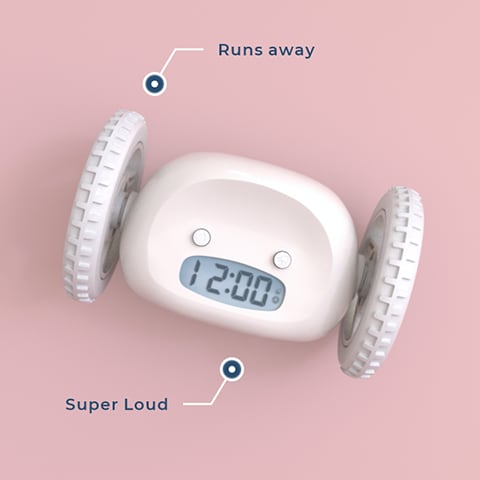
How much do you rely on the snooze button on your alarm clock or phone to get you up in the morning?
I’m not here to judge you either way - although it seems that repeat snoozers suffer no ill effects and may even have slightly sharper minds than instant-arisers.
However, if you’re in the latter category as I am, and you want your alarm clock to absolutely, unambiguously get you out of damn bed the very first time it goes off, maybe you need the clock invented by Gauri Nanda of the Massachusetts Institute of Technology two decades ago.
It’s called Clocky, and it has one job - to infuriate you awake in the shortest time possible. Yes, it has a snooze button, but it also has wheels, and when that alarm rings, off it scarpers across your room in as fast and as random a path as possible…
Alas, there’s only one way to shut it up.
Thus its mission is accomplished, maybe adding hours of productivity to your workday - or even helping you meet the love of your life!

If you’ve been reading me for a while, you’ll know my soft spot for the human visual bias called pareidolia - which is how you can see Marlene Dietrich, Gillian Anderson or the Virgin Mary in the grilled cheese sandwich that Diana Duyser sold to GoldenPalace.com for $28,000 in 2004.
It’s also how you can see this aggressively drunk octopus:
But in 2014, the international team of Jiangang Liu, Jun Li, Lu Feng, Ling Li, Jie Tian, and Kang Lee, went deeper - asking what is actually happening in the brains of people who can see the face of Jesus in a piece of toast.
As I said in my original write-up:
“There’s a region of your brain called the right fusiform face area that’s strongly associated with processing the patterns of human facial features, letting us spot the faces of our loved ones in a sea of strangers. And when it gets activated, it so easily drowns out other conflicting messages. It’s like a megaphone at a town hall meeting.
Only problem is: like every other process, it’s working with the same “corner-cutting” visual guesswork inputs. And it’s easily tricked into making mistakes, as with Upside-Down Adele.”
More recently, researchers from the University of Queensland in Australia found that pregnant women and new mothers seem to have hightened sensitivity to face pareidolia - perhaps to help with social bonding between mothers and infants, perhaps facilitated by increased levels of the hormone & neurotransmitter oxytocin.
There’s clearly much more work to be done here. But any mechanism in the brain for heightening emotional connections to parts of the world around us - for making us care about it, in a way that motivates us into acquiring a sense of stewardship around it - is well worth learning more about.
Coming up after the paywall:
Dodgy car manufacturing…
madly excessive co-authorship…
an inventive (if highly inadvisible) way of tackling a snakebite…
the remarkable minds of taxis drivers…
the best way to beat procrastination…
…and other lovable madness.
