 Login
LoginYou Can Choose Right Now
|



|
|
|
|
(Hi! This is a bigger-than-usual edition of Everything Is Amazing, and it probably won’t fit in your Inbox, so you’ll have to click through to see the whole thing. Just click on the title and it’ll open the Web version for you.)
Well, it’s official - the Ig Nobels are leaving the United States, at least for now.
I’ve written before about my love of these satirical science awards - particularly how they invite winners in to share the joke, like lab colleagues good-naturedly ribbing each other while respecting the important work they’re doing:
In 2000, Sir Andrew Geim was joint-awarded the Ig Nobel for Physics, along with Michael Berry, for their work in levitating a frog using diamagnetism. Ten years later, Geim would joint-win the actual Nobel Prize for Physics for his work with the carbon allotrope Graphene, a material that’s currently making headlines for how it’s unlocking all sorts of new scientific breakthrough.
But the Ig Nobels are also intentionally daft. They make a priority of aiming for a LOL - like how, in the very first ceremony in 1991, then-US-Vice-President Dan Quayle won in the Education category “for demonstrating, better than anyone else, the need for science education.”
(I also love their description of him: “consumer of time and occupier of space.”)
That’s the other side of the awards, the utterly merciless roasting - and it’s just as fun.
The 1991 Ig Nobel Prize for PEACE: awarded to Edward Teller, father of the hydrogen bomb and first champion of the Star Wars weapons system, for his lifelong efforts to change the meaning of peace as we know it.
The 1996 Ig Nobel Prize for MEDICINE: awarded to James Johnston of R.J. Reynolds, Joseph Taddeo of U.S. Tobacco, Andrew Tisch of Lorillard, William Campbell of Philip Morris, Edward A. Horrigan of Liggett Group, Donald S. Johnston of American Tobacco Company, and the late Thomas E. Sandefur, Jr., chairman of Brown and Williamson Tobacco Co. for their unshakable discovery, as testified to the U.S. Congress, that nicotine is not addictive.
The 2009 Ig Nobel Prize for MATHEMATICS: awarded to Gideon Gono, governor of Zimbabwe’s Reserve Bank, for giving people a simple, everyday way to cope with a wide range of numbers — from very small to very big — by having his bank print bank notes with denominations ranging from one cent ($.01) to one hundred trillion dollars ($100,000,000,000,000).
The 2020 Ig Nobel Prize for MEDICAL EDUCATION: awarded to [BRAZIL, UK, INDIA, MEXICO, BELARUS, USA, TURKEY, RUSSIA, TURKMENISTAN] Jair Bolsonaro of Brazil, Boris Johnson of the United Kingdom, Narendra Modi of India, Andrés Manuel López Obrador of Mexico, Alexander Lukashenko of Belarus, Donald Trump of the USA, Recep Tayyip Erdogan of Turkey, Vladimir Putin of Russia, and Gurbanguly Berdimuhamedow of Turkmenistan, for using the Covid-19 viral pandemic to teach the world that politicians can have a more immediate effect on life and death than scientists and doctors can.
(Wince.)
Now the Ig Nobels will be held in Zurich, beginning with this year’s ceremony on the 3rd September - and although the official (and perfectly believable) reason for this is the increasing difficulty in getting nominees to attend, I wonder if this isn’t going to feature in the awards? If so, I can understand the organisers not wanting to be in the U.S. when that’s announced….
So - for whatever reason, it’s all change after 35 years. And as a fan of the Ig Nobels and of utterly shameless listicles, I can’t resist the call here.
Here’s the first part of a roundup of thirty-five Ig Nobel Awards that tickle me no end.

You know when you’re on a Zoom call and the other person isn’t using headphones and hasn’t muted their audio, so you’re met with a slightly delayed version of your own voice every time you speak?
More than a decade ago, Kazutaka Kurihara and Koji Tsukada first discovered what we’ve all now learned from bitter experience - that it’s incredibly annoying when this happens, and can instantly derail your train of thought.
The device they used to demonstrate this is called the SpeechJammer, and it was built with a noble purpose in mind:
“This technology ... could also be useful to ensure speakers in a meeting take turns appropriately, when a particular participant continues to speak, depriving others of the opportunity to make their fair contribution.”
This also made me realise we can do this manually!
Is someone in your already tedious work Zoom meeting just droning on and on, and you’re ready to ask them to finish their contribution before somebody dies? Simple! Just slyly unplug your headphones, nudge your speakers up to full volume and SpeechJammer the wretch until they splutter to a halt.
Oh dear, sorry about the technical difficulties, you say with hand-wringing contrition. But I think it’s fixed now. So, where were we?
(NOTE: you probably only get to try this once, or twice if your acting skills are up to the challenge. Choose your moment wisely!)
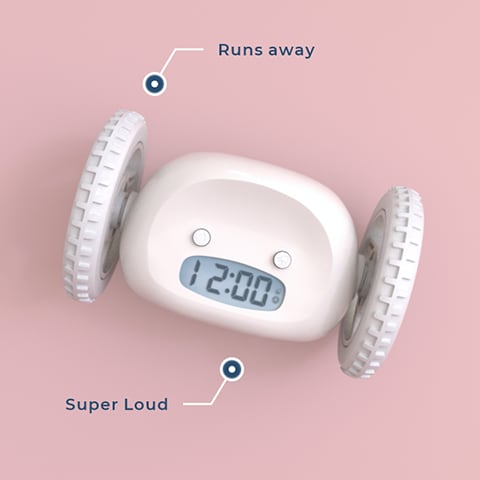
How much do you rely on the snooze button on your alarm clock or phone to get you up in the morning?
I’m not here to judge you either way - although it seems that repeat snoozers suffer no ill effects and may even have slightly sharper minds than instant-arisers.
However, if you’re in the latter category as I am, and you want your alarm clock to absolutely, unambiguously get you out of damn bed the very first time it goes off, maybe you need the clock invented by Gauri Nanda of the Massachusetts Institute of Technology two decades ago.
It’s called Clocky, and it has one job - to infuriate you awake in the shortest time possible. Yes, it has a snooze button, but it also has wheels, and when that alarm rings, off it scarpers across your room in as fast and as random a path as possible…
Alas, there’s only one way to shut it up.
Thus its mission is accomplished, maybe adding hours of productivity to your workday - or even helping you meet the love of your life!

If you’ve been reading me for a while, you’ll know my soft spot for the human visual bias called pareidolia - which is how you can see Marlene Dietrich, Gillian Anderson or the Virgin Mary in the grilled cheese sandwich that Diana Duyser sold to GoldenPalace.com for $28,000 in 2004.
It’s also how you can see this aggressively drunk octopus:
But in 2014, the international team of Jiangang Liu, Jun Li, Lu Feng, Ling Li, Jie Tian, and Kang Lee, went deeper - asking what is actually happening in the brains of people who can see the face of Jesus in a piece of toast.
As I said in my original write-up:
“There’s a region of your brain called the right fusiform face area that’s strongly associated with processing the patterns of human facial features, letting us spot the faces of our loved ones in a sea of strangers. And when it gets activated, it so easily drowns out other conflicting messages. It’s like a megaphone at a town hall meeting.
Only problem is: like every other process, it’s working with the same “corner-cutting” visual guesswork inputs. And it’s easily tricked into making mistakes, as with Upside-Down Adele.”
More recently, researchers from the University of Queensland in Australia found that pregnant women and new mothers seem to have hightened sensitivity to face pareidolia - perhaps to help with social bonding between mothers and infants, perhaps facilitated by increased levels of the hormone & neurotransmitter oxytocin.
There’s clearly much more work to be done here. But any mechanism in the brain for heightening emotional connections to parts of the world around us - for making us care about it, in a way that motivates us into acquiring a sense of stewardship around it - is well worth learning more about.
Coming up after the paywall:
Dodgy car manufacturing…
madly excessive co-authorship…
an inventive (if highly inadvisible) way of tackling a snakebite…
the remarkable minds of taxis drivers…
the best way to beat procrastination…
…and other lovable madness.
Howdy howdy howdy!
I hope you had a good week! I enjoyed time with friends and family, ate some good food, and built some fun things too. Let's get into it!
Was this forwarded to you? You can subscribe here!
contrast-color() beyond black & white
Stuff Everybody Knows: A guide to the rest of your web development career
Comprehension Debt - the hidden cost of AI generated code.
Two React Design Choices Developers Don’t Like—But Can’t Avoid
This week I replaced a bunch of parts in my PC as well as my camera, and it took some effort. Desk configuration is always more annoying than you expect. I ended up blogging about my camera setup after tweaking it a bunch, and these are my latest PC parts!
Video editing has gotten MUCH faster already, which saves me a lot of time at work especially. I recorded this one about using GitHub Copilot to help me update parts of my app todometer that I had put off for literally years (I was so excited)!
Last thing: newsletter anniversary is coming up. If you want to offer a giveaway, respond to this email to let me know!
Mux is video infrastructure for developers. When you upload a video to Mux, you don't just get playback. You get building blocks like transcripts, storyboards, thumbnails, and clips. The pieces are just there. Feed them into whatever you're building: search, summarization, content moderation, or anything else you can dream up.
Mux also stewards Video.js, the web's most popular open source video player. Video.js v10 is a full architectural rebuild with the beta now available at videojs.org. It's worth a look and trying out.
Trusted by Patreon, Substack, and Cursor. Get started free, no credit card required →
Last week, I had you get distances to fire stations! Great work Amine, Dan, Christian, Paul, Matt, Donato, Toni, Micah, David, Ten, and the delightful folks in the Ruby Users Forum!
This week's question:
Given a text string and a pattern, implement a fuzzy string search using the Bitap algorithm that finds all positions in the text where the pattern matches with at most k errors (insertions, deletions, or substitutions). Return an array of objects containing the position and the number of errors at that match.
Example:
> fuzzySearch("the cat sat on the mat", "cat", 0);
> [{ position: 4, errors: 0 }]

> fuzzySearch("cassidoo", "cool", 1);
> []
(you can submit your answers by replying to this email with a link to your solution, or share on Bluesky, Twitter, LinkedIn, or Mastodon)
The Day I Discovered Type Design
Old Pops Sheet Music Digital Collection
CannonKeys x Fnctl.co Wood Bakeneko65 with GMK Ursa
I'm OK being left behind, thanks!
What do you call a pig who does karate?
A pork chop!
(Thanks, Lynelle, for this one!)
That's all for now, folks! Have a great week. Be safe, make good choices, and do some jumping jacks!
Special thanks to Ben, Kinetic Labs, and Marta for supporting my Patreon and this newsletter!
cassidoo
website | blog | github | bluesky | youtube | twitch | twitter | patreon | codepen | mastodon
|
|
|
|
Good News from the American West: Public lands, working lands, and clear thinking A 14er access update, Texas conservation done right, and lessons from the mountains
|
Current Location: Milwaukee, WI
Reading: The Alternative by Nick Romeo
Listening: Running/Planning by CMAT
If you have a moment, reply with your own 3-Item Status.
This week’s Let’s Know Things is about the Cuban Oil Blockade
This week’s Brain Lenses essay is about Cognitive Shuffling & the pod is about the Region-Beta Paradox
I’ve also recent completed an update of all my iOS/macOS apps, if you’re interested in checking out the Truly Simple Tools portfolio :)
I have a general sense that—wherever we end up next, however our technologies and politics evolve, and whatever shapes our communities and systems and social norms and economic realities are nudged into as a consequence of those evolutions—it’ll still be beneficial to have a keen sense of self-knowledge.
By self-knowledge I mean an understanding of who we are, what we want, what we care about, our relative advantages and disadvantages in different spheres of life, a rough comprehension of our capacity to suffer and sacrifice and love and give and gracefully receive, and the priorities (and variables) that underpin and inform all of these things.
Beyond providing us with a more thorough awareness and appreciation of our own uniqueness (and consequently, that of everyone else on the planet), self-knowledge also contributes to our capacity for self-expression.
As our self-understanding grows, so does our ability to share that cognizance via conversations with our partners and friends, through our votes and other efforts to influence society, law, and governance, through our art, and even through what we’re willing to do to pay the bills (and the nature of the entities we’re willing to do those things for).
Going deeper than the superficial on this can require a fair bit of work, in part because much of what we think we believe or care about, what we consider to be “us,” isn’t actually fundamental to who we are. Throughout our lives, all sorts of (often well-meaning) entities give us templates and scripts to work from, and we adopt these beliefs, rationales, and routines because, well, why not? What’s the alternative? This lending of philosophical motivation starts young and never really stops.
Peeling off those outer layers to figure out what’s beneath them can be the effort of a lifetime, and it can be disorienting making progress, because rather than discovering some latent, long-suffocated belief system or portfolio of goals underneath all those inherited worldviews, many of us will instead discover a whole lot of nothing, not second, complete and more perfect self that’s been hidden away, waiting for us to uncover it.
From there, our second effort of a lifetime is to fill that nothing with something; but this time, we ideally opt for something more us-shaped.
I think a lot of people, by adulthood, has at least a shadowy sense of this undertaking, and has probably even taken a few steps toward figuring out who they are, sans all those external doctrines and dogmas.
Something that I’ve personally found to be helpful in this effort is semi-regularly stepping back and imagining that the forces that shape my life, my decisions, my sense of the possible and impossible, today, are no longer there.
Money is gone, politics have become unrecognizable (or unnecessary). Maybe we no longer need our bodies, or we’ve discovered other intelligent life that maybe has some answers (about the big questions) for us. Maybe we’ve achieved world peace and post-scarcity and now we just have to figure out what to do with all our free time.
If things were to be shaken up in fundamental ways, who would I be? What causes, what goals would be important enough to me that I would want to invest myself in them? What would shape my actions, my overall trajectory, for the balance of my life?
Then, stepping back to now, to this reality: what does that tell me about who I actually am, what I should actually be doing, and what I should actually be working toward?
If you enjoyed this essay, consider supporting my work by becoming a paid subscriber, buying me a coffee, or grabbing one of my books.
Colin Wright's Newsletter is a reader-supported publication. To receive new posts and support my work, consider becoming a free or paid subscriber.
If you want more links to interesting things, consider subscribing to Aspiring Generalist.

I’m heading back out to Seattle in about a week and a half, and I’m already preparing for that, which mostly means doing double the normal amount of work so that I can really be there while I’m there, with as few deadlines and external responsibilities pulling me away from family time as possible.
I do have some fun meetups and other little social get-togethers between now and my departure, though, which should serve as nice pressure valves on what might otherwise be a too-aggressive work schedule.
New here? Hit reply and tell me something about yourself!
You can also fill me in on something interesting you’re working on or something random you’re learning about.
I respond to every message I receive and would love to hear from you :)
Prefer stamps and paper? Send a letter, postcard, or some other physical communication to: Colin Wright, PO Box 11442, Milwaukee, WI 53211, USA
Or hit me up via other methods: Instagram, Threads, Twitter, Facebook, YouTube, or yoghurt delivery.
Writing factory: notes from a life on China’s assembly lines.
|
I recently updated my app todometer to be styled with pure, native CSS!
Changing the CSS libraries in todometer has been a real reflection of CSS styling history.
When I first built it more than 9 years ago now, that first initial commit had React, Electron, and Less for CSS. Less at the time was great for what I wanted (Node-based styling with nesting). It let me use variables (like this) and nesting (like this), and got the job done with some global styles.
Eventually in 2020, I wanted more encapsulated styles, thus I wanted to use CSS Modules. Also at the time, wanting to keep my variables and nesting where I could (but also modernize), I switched to node-sass. When you look at the commits here and here, you can see the variables switching from starting with @ to $, and how I moved everything everything to their respective *.module.scss component (ultimately only keeping variables at the global level). The behaviors all stayed the same, just was more modern under the hood!
Yet another big refactor was due in 2023, when I got rid of all Sass and used plain ol’ CSS files, and postcss for transformations. node-sass had been deprecated, which really led me to reevaluating the styling stack, and CSS variables existed natively, so that was one less thing needed! That led me to where we were until earlier today, postcss-nested.
postcss-nested vs. postcss-nestingThese libraries sound almost exactly the same, but act different, and Chris Coyier talks about it a bit here. To save you a click, postcss-nested has syntax like Sass, and postcss-nesting has syntax like the CSS spec!
Given the history above, it makes sense how the transition happened here. Moving from Less to Sass to a more vanilla CSS approach, all while keeping the core of variables + nesting, is all I really wanted. The nested library back in 2023 let me keep styling almost exactly the same when I transitioned away from Sass, with the exception of variables (see the commit).
I switched in this commit today to postcss-nesting mostly to make sure that everything transitioned smoothly. It involved a laughably small change list, to just add & nesting selectors across some files.
The transition to fully native CSS for the entire app is possible now because CSS nesting is natively available! I probably didn’t actually need to do the “switch to postcss-nesting” step, but it felt like a good iterative one.
And since I did that iterative step, the only changes I did for a “fully pure” CSS solution was to simply delete the postcss files!
Look at that diff. So much red!! So nice!!
It’s really amazing to see how far we’ve come in browsers to be able to do these things without any libraries at all. Yes, I don’t have the most complex styles in the world, and yes, I’m really “only” using variables and nesting, but it’s cool that a “quality of life, nice to have” thing that I enjoyed nearly a decade ago is now a standard. Look at us go!
Anyway, you can check out the repo for todometer here, with a new version being properly cut soon!
|
|
I talked about building my Micro Journal in the past here, and how much I like having a distraction-free writing device for blogging, drafting things, and just getting ideas out.
Well… I liked it so much that I got another one! This one is called the BYOK (the Bring Your Own Keyboard). I got it on Kickstarter and it’s cool! It’s more portable than the Micro Journal in that it’s the size of your phone (and has a magnet in the back for stands that are compatible with MagSafe stands), and you can connect most keyboards to it (via cable or Bluetooth). I may or may not be typing on it right now, heh.
Here’s how it works!
It’s been a cool little device. I like that it’s mostly toddler-proof so far, and I’ve had fun trying it out! I think I prefer the syncing I have set up on my Micro Journal more so far, but the portability of the BYOK is pretty nice, and I like how much the team has been updating the firmware.
Here’s some resources for it:
|
|
My sister got me a rainbow cardigan sweater a couple years ago for Christmas that is very fluffy and floppy. It doesn’t have pockets, it doesn’t have buttons, it just kind of drapes on me and is like a small blanket with arms. It’s not a practical sweater, but it’s cozy.
Because it’s not practical, I always have to remember to, for example, wear only pants that have pockets with it, so that I can put my stuff (phone, lip balm, etc) somewhere. I always have to wear certain shirts that don’t bunch up in a certain way when the sweater is feeling extra floppy. It’s just… not the most convenient sweater.
But hoo boy, my babies love my rainbow sweater. My oldest loves to sit on my lap and have me envelop her in it in a hug. My youngest loves to bury his face in it when he’s sleepy. Both of them love to pet it because it’s so soft. They admire the colors. They tangle their fingers in it and hold on tight to the loops. They flop with the sweater, and with me, and it’s the coziest thing in the world.
I love, love, love putting on this sweater. I get a little giddy thinking about how the babies will gravitate towards it as soon as they see the thick loops plopped across my shoulders. It’s impractical, and it’s weird, but it brings me the best warm cuddles ever.
