 Login
LoginThere Will Always Be People Who Don’t Get It
|



|
Good News from the American West: Public lands, working lands, and clear thinking A 14er access update, Texas conservation done right, and lessons from the mountains
|
Current Location: Milwaukee, WI
Reading: The Alternative by Nick Romeo
Listening: Running/Planning by CMAT
If you have a moment, reply with your own 3-Item Status.
This week’s Let’s Know Things is about the Cuban Oil Blockade
This week’s Brain Lenses essay is about Cognitive Shuffling & the pod is about the Region-Beta Paradox
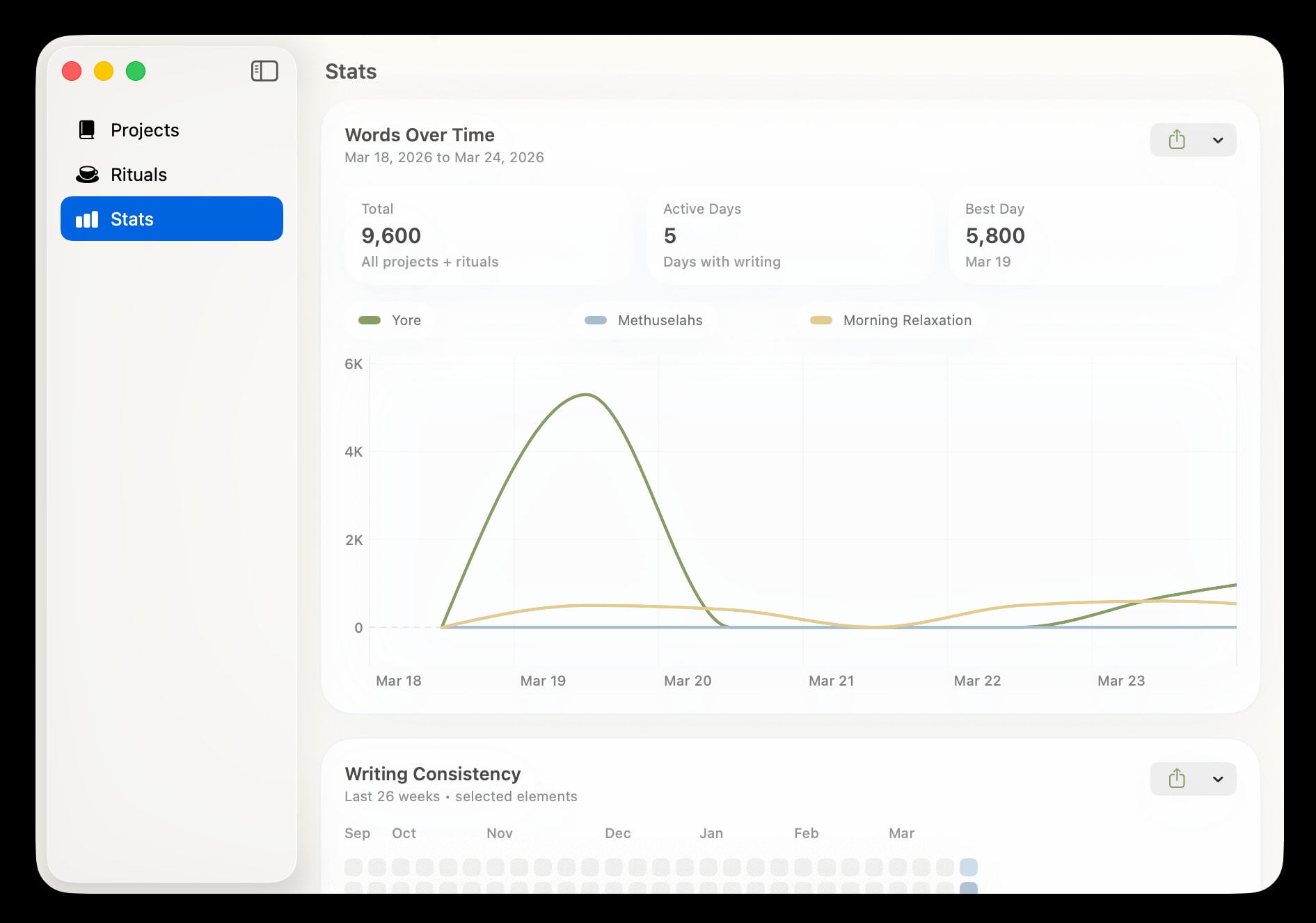
I’ve also recent completed an update of all my iOS/macOS apps, if you’re interested in checking out the Truly Simple Tools portfolio :)
I have a general sense that—wherever we end up next, however our technologies and politics evolve, and whatever shapes our communities and systems and social norms and economic realities are nudged into as a consequence of those evolutions—it’ll still be beneficial to have a keen sense of self-knowledge.
By self-knowledge I mean an understanding of who we are, what we want, what we care about, our relative advantages and disadvantages in different spheres of life, a rough comprehension of our capacity to suffer and sacrifice and love and give and gracefully receive, and the priorities (and variables) that underpin and inform all of these things.
Beyond providing us with a more thorough awareness and appreciation of our own uniqueness (and consequently, that of everyone else on the planet), self-knowledge also contributes to our capacity for self-expression.
As our self-understanding grows, so does our ability to share that cognizance via conversations with our partners and friends, through our votes and other efforts to influence society, law, and governance, through our art, and even through what we’re willing to do to pay the bills (and the nature of the entities we’re willing to do those things for).
Going deeper than the superficial on this can require a fair bit of work, in part because much of what we think we believe or care about, what we consider to be “us,” isn’t actually fundamental to who we are. Throughout our lives, all sorts of (often well-meaning) entities give us templates and scripts to work from, and we adopt these beliefs, rationales, and routines because, well, why not? What’s the alternative? This lending of philosophical motivation starts young and never really stops.
Peeling off those outer layers to figure out what’s beneath them can be the effort of a lifetime, and it can be disorienting making progress, because rather than discovering some latent, long-suffocated belief system or portfolio of goals underneath all those inherited worldviews, many of us will instead discover a whole lot of nothing, not second, complete and more perfect self that’s been hidden away, waiting for us to uncover it.
From there, our second effort of a lifetime is to fill that nothing with something; but this time, we ideally opt for something more us-shaped.
I think a lot of people, by adulthood, has at least a shadowy sense of this undertaking, and has probably even taken a few steps toward figuring out who they are, sans all those external doctrines and dogmas.
Something that I’ve personally found to be helpful in this effort is semi-regularly stepping back and imagining that the forces that shape my life, my decisions, my sense of the possible and impossible, today, are no longer there.
Money is gone, politics have become unrecognizable (or unnecessary). Maybe we no longer need our bodies, or we’ve discovered other intelligent life that maybe has some answers (about the big questions) for us. Maybe we’ve achieved world peace and post-scarcity and now we just have to figure out what to do with all our free time.
If things were to be shaken up in fundamental ways, who would I be? What causes, what goals would be important enough to me that I would want to invest myself in them? What would shape my actions, my overall trajectory, for the balance of my life?
Then, stepping back to now, to this reality: what does that tell me about who I actually am, what I should actually be doing, and what I should actually be working toward?
If you enjoyed this essay, consider supporting my work by becoming a paid subscriber, buying me a coffee, or grabbing one of my books.
Colin Wright's Newsletter is a reader-supported publication. To receive new posts and support my work, consider becoming a free or paid subscriber.
If you want more links to interesting things, consider subscribing to Aspiring Generalist.
I’m heading back out to Seattle in about a week and a half, and I’m already preparing for that, which mostly means doing double the normal amount of work so that I can really be there while I’m there, with as few deadlines and external responsibilities pulling me away from family time as possible.
I do have some fun meetups and other little social get-togethers between now and my departure, though, which should serve as nice pressure valves on what might otherwise be a too-aggressive work schedule.
New here? Hit reply and tell me something about yourself!
You can also fill me in on something interesting you’re working on or something random you’re learning about.
I respond to every message I receive and would love to hear from you :)
Prefer stamps and paper? Send a letter, postcard, or some other physical communication to: Colin Wright, PO Box 11442, Milwaukee, WI 53211, USA
Or hit me up via other methods: Instagram, Threads, Twitter, Facebook, YouTube, or yoghurt delivery.
Writing factory: notes from a life on China’s assembly lines.
|
I recently updated my app todometer to be styled with pure, native CSS!
Changing the CSS libraries in todometer has been a real reflection of CSS styling history.
When I first built it more than 9 years ago now, that first initial commit had React, Electron, and Less for CSS. Less at the time was great for what I wanted (Node-based styling with nesting). It let me use variables (like this) and nesting (like this), and got the job done with some global styles.
Eventually in 2020, I wanted more encapsulated styles, thus I wanted to use CSS Modules. Also at the time, wanting to keep my variables and nesting where I could (but also modernize), I switched to node-sass. When you look at the commits here and here, you can see the variables switching from starting with @ to $, and how I moved everything everything to their respective *.module.scss component (ultimately only keeping variables at the global level). The behaviors all stayed the same, just was more modern under the hood!
Yet another big refactor was due in 2023, when I got rid of all Sass and used plain ol’ CSS files, and postcss for transformations. node-sass had been deprecated, which really led me to reevaluating the styling stack, and CSS variables existed natively, so that was one less thing needed! That led me to where we were until earlier today, postcss-nested.
postcss-nested vs. postcss-nestingThese libraries sound almost exactly the same, but act different, and Chris Coyier talks about it a bit here. To save you a click, postcss-nested has syntax like Sass, and postcss-nesting has syntax like the CSS spec!
Given the history above, it makes sense how the transition happened here. Moving from Less to Sass to a more vanilla CSS approach, all while keeping the core of variables + nesting, is all I really wanted. The nested library back in 2023 let me keep styling almost exactly the same when I transitioned away from Sass, with the exception of variables (see the commit).
I switched in this commit today to postcss-nesting mostly to make sure that everything transitioned smoothly. It involved a laughably small change list, to just add & nesting selectors across some files.
The transition to fully native CSS for the entire app is possible now because CSS nesting is natively available! I probably didn’t actually need to do the “switch to postcss-nesting” step, but it felt like a good iterative one.
And since I did that iterative step, the only changes I did for a “fully pure” CSS solution was to simply delete the postcss files!
Look at that diff. So much red!! So nice!!
It’s really amazing to see how far we’ve come in browsers to be able to do these things without any libraries at all. Yes, I don’t have the most complex styles in the world, and yes, I’m really “only” using variables and nesting, but it’s cool that a “quality of life, nice to have” thing that I enjoyed nearly a decade ago is now a standard. Look at us go!
Anyway, you can check out the repo for todometer here, with a new version being properly cut soon!
