❌

Normal view

  • βœ‡Spencer H Fry
  • What to expect when your team grows from 10 to 20 people
    I've been a guest on a few podcasts recently and one of the things that keeps coming up are the changes a company goes through when growing from 10 to 20 people — which is exactly what happened at Podia during 2019 (well, 9 to 19 people to be exact 😉 ). I’d like to share a few of the things that happened during this time and what you can expect if you’re experiencing similar growth. You're going to need to give things up Throughout my career as an entrepreneur, I've
     

What to expect when your team grows from 10 to 20 people

16 December 2019 at 15:03

I've been a guest on a few podcasts recently and one of the things that keeps coming up are the changes a company goes through when growing from 10 to 20 people — which is exactly what happened at Podia during 2019 (well, 9 to 19 people to be exact 😉 ).

I’d like to share a few of the things that happened during this time and what you can expect if you’re experiencing similar growth.

You're going to need to give things up

Throughout my career as an entrepreneur, I've gotten my hands dirty in every area of the business: product, marketing, support, community, success, and so on, but at 19 people, I just haven't had the time to be everywhere at all times.

I have to pick and choose what I do and what I don't do. I've chosen to continue to lead product, but I've given up almost all of my responsibilities in regard to marketing and support.

Part of that change is due to the fact that we've hired great people to fill those roles, including a Chief Marketing Officer who runs our 7-person marketing team and a Lead Support person who runs our 4-person support team.

At our size, it just makes sense for me to give up control over things that I can't spend a lot of time on — such as marketing and support — and give those responsibilities to people who are focused on doing them and doing them well.

Management is a necessity

When we were under 9 people, we skated by for quite some time with no real managers. In fact for a long time, it was just me running all departments, but as we began to grow, that broke down quickly.

Our individual departments got bigger. There were questions that needed answers more quickly. New hiring responsibilities. Individuals on a team needed a leader to help guide them. Strategy needed to be set for each department.

We needed to organize. We needed a leader to run the various departments. Things were breaking down without them. Who is responsible? Who owns the success here? Who owns the failure?

At 9 people, everyone could manage themselves and their own projects without stepping on anyone's toes, but as the product got bigger and as we got more customers, we needed to better coordinate across the company and the various departments.

We now have three managers (marketing, support, and development) who each run their own teams and their own 1:1s and are responsible for their “area” of the company.

We've always been an extremely productive company, but adding a management layer has allowed us to continue to be extremely productive as we've grown. A lot of companies get bogged down as they grow, but we haven't.

Company policies are a necessity

We've gone from informal, never written down HR policies to a dozen thoughtfully crafted, Podia-specific policies we now post in our new company wiki.

This lets everyone in the company be on the same page about how we do things from compensation philosophy to what kind of side projects are acceptable.

Policies written too early often won't match the vibe of the company you're trying to build, so waiting until things "break" is a great forcing function to know what's important and what isn't. I'm really happy we waited until we passed ten people before writing all of these down, but I'm glad we didn't wait any longer than that.

Knowledge sharing is harder

With more people working at Podia, it's harder to keep everyone up-to-date with everything that's going on.

We continue to have our Monday meeting that gives almost everyone a chance to talk about what they're working on for the week, but it's definitely more difficult for everyone to have a deep understanding of all that's happening. It's even difficult for me at times as the CEO.

It's also more difficult for individual departments as they grow. We now have 6 product developers — if you include our CTO — and they're often working on different projects. It's common that all product developers won't know every part of our codebase as well as they might have when our team was only two or three people.

Continuing to learn and grow is key

As a founder — and as a company — you need to continue to learn and grow every day. The skills you had at ten people are not going to be the same skills you need at twenty people.

You'll need to learn, listen, read, and adapt to the new situations that are thrown your way or else you're going to be behind.

I've been thankful to have a CEO coach this year who has helped me talk through lots of different situations we've had as a company throughout the past nine months, but if you can't afford a CEO coach, find CEOs who are at your stage or one or two stages above you and talk to them about how they got to where they are and what advice they can give you as a founder.

Learning shouldn't stop when you graduate (or don't graduate) college. You need to continue to exercise your brain and take in as much information as you can as your company continues to grow.

More people challenges

As you grow from 9 to 19 people as we did, you'll find that there are new people challenges. I think it's mostly because there are just more people on the team with different personalities, needs, and wants, but it's also because there's a new guard vs. an old guard mentality that you need to work through.

The early folks will always be the early folks, and you need to make sure you're integrating the new people as best you can.

Along with that, more people = more room for things to go wrong. You have to keep track of everyone's likes, dislikes, how they prefer to communicate, what's the best tone to take with them, and many other things.

People will continue to be the hardest part of the job for any CEO, but it definitely only gets harder as you grow.

That's why having great managers is so key when you grow. See above.

Plan, plan, plan

Lastly, with a growing team, it’s important to keep everyone on the same page, which can be accomplished by being really thorough with your company's plans. Whether that's the broader company strategy, the product strategy, the marketing strategy, or whatever, it's important to lay things out in a clear and concise way so that everyone understands what's happening.

While you could get away with not writing down a lot things when you were small, you need a "source of truth" for everyone to be able to refer to as you grow. You won't be able to have individual conversations with everyone as you grow, so having a really well-thought-out plan can do the talking for you.

  • βœ‡Anthony's Notes
  • allow the time that it takes
    There is this constant pressure in life to change how things are so that they’ll be how they can be. Looking back on the last decade of my life, I wouldn’t say I exactly had a plan, but I never went long without a side project or some adventure. I’m not sure if the drive to always have a side-hustle came from my discontent with how things are and a desire to build a different existence, or simply my broad diversity of interests.Either way, I’ve never felt content just do
     

allow the time that it takes

14 February 2017 at 06:13

There is this constant pressure in life to change how things are so that they’ll be how they can be. Looking back on the last decade of my life, I wouldn’t say I exactly had a plan, but I never went long without a side project or some adventure. I’m not sure if the drive to always have a side-hustle came from my discontent with how things are and a desire to build a different existence, or simply my broad diversity of interests.

Either way, I’ve never felt content just doing one thing. Mastery really was never a consideration for me, at least until recently–I have always been incredibly engaged until the moment the learning curve starts to taper. Once I have a foundational understanding of something, I’m pretty much ready to move on.

These days I find myself thinking more about how a two-pronged needle doesn’t pass through fabric. One hundred shallow wells will produce no water, yet a single deep one is much more likely.

Removing distractions and focusing on our goals is a beautiful thing and it allows us to make some serious progress towards the life we want. But that isn’t to say that it should be rushed–allow the time that it takes. Most things in life could be considered a practice, a daily one at that, one that we simply get better at slowly as time goes on. This is what most paths to mastery look like, slow, steady, intentional practice and honing of craft.

These things don’t have to be rushed, we don’t have to scramble to get to a place where we aren’t already. Perhaps much of contentment comes from appreciating and simply existing where we are while honing our practice for continual improvement. Finding that balance between pushing forward and sitting still.

Somewhere in there, lies the secret to happiness and contentment, that balance between personal growth and achievement, and seeking bliss within our current beings. So instead of rushing forward, perhaps we may allow the time that it takes and enjoy the journey along the way.

  • βœ‡Anthony's Notes
  • Looking Beyond The Surface of Entrepreneurship
    I remember when I decided that I wanted to be an entrepreneur–it was the day I realized that no job I could ever get would keep me engaged in a meaningful way. Unless, I suppose, I was able to work at a company that offered unlimited flexibility and creative control.In my early 20’s it always happened around my six month mark, when I’d start to feel the boredom strike. If the job was simple enough and I couldn’t find any particular ways to improve the processes involved,
     

Looking Beyond The Surface of Entrepreneurship

4 July 2017 at 06:29

I remember when I decided that I wanted to be an entrepreneur–it was the day I realized that no job I could ever get would keep me engaged in a meaningful way. Unless, I suppose, I was able to work at a company that offered unlimited flexibility and creative control.

In my early 20’s it always happened around my six month mark, when I’d start to feel the boredom strike. If the job was simple enough and I couldn’t find any particular ways to improve the processes involved, it felt very empty to me. In my younger days, that meant disengaging with the job and eventually, just not doing the job very well.

Starting a business changed all of that–all of a sudden there was no end in sight, no limit on the processes that I had to master. The work was never done and there was always some aspect of learning curve to tackle. It opened up an entirely new world of what work could look like for me.

Up until that point, I had learned that the way I did things, often quite differently, was completely wrong. School taught me this–I found myself only ever wanting to fit in, to look the same as the people around me, and just do what I was told. Because I wanted to fit in, I’d just sort of follow along with the way my teachers told me to think, accepting that it was the right way to do things.

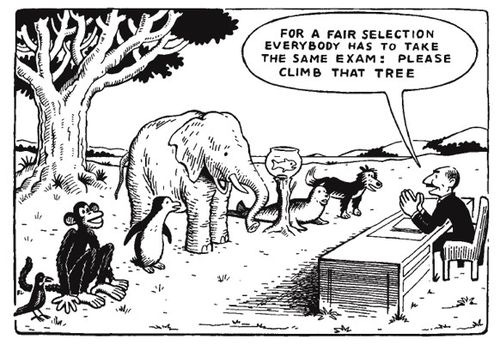
You may be familiar with the below cartoon–in this case, I felt like the elephant.

College helped further affirm that I wasn’t very good at climbing trees. I remember sitting in lecture halls during my freshman year wondering how any of it was going to work–things just weren’t clicking for me.

Entrepreneurship is a mold-breaking opportunity–it widened the playing field to where I saw that the tree I was continually asked to climb was just one small part of life as a whole. It was just one test of a particular type of intelligence, one that largely reflected learning how to follow directions really well.

In business, you have to do the opposite.

If you do the exact same thing as everyone else in your field, you have no competitive advantage. When it comes to marketing a business, blending in is the absolute last thing you want to do. In almost every area of life oddities are rewarded–they’re what makes us stand out from the rest and allows us to be chosen over others.

Those oddities may provide a strategic advantage over our peers, even though it may be initially perceived as a flaw.

The Struggles Are Amplified

The hardest thing about being an entrepreneur is that the things you struggle with are amplified. If you thrive within a structured environment, you’ll be required to create your own that meets your needs. There is no longer anyone to tell you that you’ve done a good job for the day, you can head home content with your work complete. There’s no one to decide how productive you are, no quarterly review to determine your eligibility for a raise.

There is only your effort, your goals, and your definition of what a successful day looks like. How much is enough? When can we be done for the day? If you struggle with figuring these things out in a day job, taking the leap will blow these struggles wide open.

If You Want Something Different

If the structure that society has set up for gainful employment isn’t working for you, if you want something different, you should build something. Something you care about, something you’d like to see in the world if it doesn’t yet exist. If the “correct” way to do something isn’t the way you’d do it, but you got the answer wrong on the test anyway, try making your own test instead.

You don’t have to quit or take the salto mortale right away, but start building something and see where it goes. It takes a very long time to undo the damage done to our psyches throughout our lifetime. I’m only just beginning to learn that I can challenge authority when I don’t believe something is right. Just because someone says that’s the way it is, doesn’t mean that’s actually the case.

Do what feels good, do what feels right.

  • βœ‡Anthony's Notes
  • On Side Projects & The Tipping Point
    Avoiding burnout on a project is a very real issue that must be dealt with in a variety of ways. In the last three years of writing my blog Break the Twitch, I’ve hit burnout a few times but most recently, I have only been writing once or twice per month for the site in the early months of 2017.It doesn’t feel good to produce such a small amount of stuff for a project I believe in so much. There is a lot of negative self-talk that goes along with that as well–it’s easy t
     

On Side Projects & The Tipping Point

5 July 2017 at 19:27

Avoiding burnout on a project is a very real issue that must be dealt with in a variety of ways. In the last three years of writing my blog Break the Twitch, I’ve hit burnout a few times but most recently, I have only been writing once or twice per month for the site in the early months of 2017.

It doesn’t feel good to produce such a small amount of stuff for a project I believe in so much. There is a lot of negative self-talk that goes along with that as well–it’s easy to beat ourselves up over a lack of production. But inspiration ebbs and flows–we’re not robots and we simply can’t do the same thing over and over without stopping.

That is a recipe for disaster, we’re just not built to operate that way.

After a few months of writing but not putting out much content, I started working on a side project with Amy called Minimalism Books–a simple little microsite that lists my favorite books about minimalism. I figured it could be helpful for people that are searching for that particular term.

Amy and I spent about 8 hours over two days building out the site and I felt a surge of inspiration and fulfillment with working on it. In a way, completing that little project helped jump-start me on writing again, as I’m doing here right now.

My daily writing requirement has jumped from 250 words per day up to 500, which is substantially harder. Not just 2x harder, but actually several times harder–not because of the word count, but because of the expectation when you start.

Resistance wise, it’s much easier to sit down with the expectation of only having to write 250 words. Typing starts more fluidly, knowing that it’s only about half as much as this article ended up being. It isn’t some big project, some instead a small step to accomplish your goal each day.

As I sit down to write 500 words for today, I feel a heavier weight on the first words as I begin. This article better not suck, as it has to make it to 500 words instead of just 250 today.

Going in with the expectation of having to hit a certain milestone, a certain quality mark, is exactly what prevents us from doing our best work to begin with. When we can simply let the words flow, unedited, we have much more to work with.

I often compare this to the idea of trying to sculpt a bust out of clay without taking the clay out of the container. The container of clay represents a blank page with no words on it–there’s nothing to work with, nothing to edit, to mold and shape into what will become your work of art.

Writing unedited, allowing the words to flow is like scooping the unformed clay out of the bucket and putting it onto the table. The unshapely ball that somewhat resembles a head and face slowly get worked into what looks slightly more like a human face.

We know where to take it if we have clay on the table–take what doesn’t look like a nose and shape it into what does. It turns all of that potential creative energy into kinetic creative energy.

So find the number that allows you to get past your tipping point, where the weight of an idea will carry itself once you lift it high enough into the air, and then do that almost every day.

  • βœ‡Anthony's Notes
  • Instagram and Homogenization Of Culture
    I’ve been sitting in a cafe looking out onto a downtown Chicago street, watching people pass by and trying to think what to write about for the last hour and a half. As I watch hundreds of people walk by, I can’t help but notice something–almost everybody looks similar, within their chosen “performance of self” categories as they do in Minneapolis.I’ve noticed the same thing during recent trips to Los Angeles and New York.Now, I’m certainly no sartorial
     

Instagram and Homogenization Of Culture

8 July 2017 at 17:03

I’ve been sitting in a cafe looking out onto a downtown Chicago street, watching people pass by and trying to think what to write about for the last hour and a half. As I watch hundreds of people walk by, I can’t help but notice something–almost everybody looks similar, within their chosen “performance of self” categories as they do in Minneapolis.

I’ve noticed the same thing during recent trips to Los Angeles and New York.

Now, I’m certainly no sartorialist myself, but I can’t help but think about why this might be. With the age of the internet and mobile devices, specifically apps like Instagram, we’re seeing a broader perspective than we ever have before. We’re getting a direct feed from people all over the world as to what they think is cool and interesting.

Location is no longer a consideration when it comes to fashion, as you could see a really interesting outfit worn by a guy in Japan while scrolling through Instagram on your lunch break. If it is deemed worthy by Instagram’s algorithms, then tens of thousands of people will see that same image all over the world.

While inspiration likely previously came from traveling, or perhaps just walking down your own block and seeing what your friends were wearing, we’ve centralized a place where the coolest trends can exist. Where around the world, if something is cool, it can instantly be picked up in New York, Los Angeles, or wherever.

It seems to me that this would kill the phenomenon of regionalized style–Los Angeles having a “look” that is different from New York, or even Japan.

But as our feeds become filled with references from around the world, we become influenced by all of the same things. It becomes like one giant neighborhood where people get to experience and see what they like and want to imitate.

I would imagine that this substantially reduces the number of different styles in different regional areas as everyone has access to every different region now, and instead of dressing a certain way because our friends, neighbors, or community dresses that way, we can reflect what we see at much higher level.

In terms of business, I find this interesting because it provides a marketplace where companies could potentially tap into a global market instead of being more of a niche market–the trends will change as time goes along, just as fashion always has. But now the market for that type of fashion is massive, created by the centralized model of Instagram.

This also means that in terms of a broader market, more companies have to compete within the broader categories, looking for ways to stand out from other labels, etc. I find this particularly interesting with the trend towards no/low branding on apparel. The giant Abercrombie logo on t-shirts is generally found to be tacky now and most modern clothing only subtly features branding of that type.

Perhaps a small pelican logo or something like that. In a way, this might drive fast fashion, cheaply made clothing that costs less than competitors, as people try to find a way to stand out while still buying clothing that generally looks like this centralized, world-wide style.

I have to question whether this will have the same affect on culture in general, I imagine that it will. As we’re all able to see and access aspects of world culture through our phones, we naturally will adapt certain aspects of those cultures.

In 100 years will this mean that we are a global culture, as we become more connected across the continents and eventually unify as a single species? I’m not sure, but I can tell you that there are a whole lot of people that look a lot alike walking past this window I’m looking out of.

  • βœ‡Anthony's Notes
  • One Simple Trick To Achieve Overnight Success In Just Three Years
    Success, or at least the way we perceive it, is quite a tricky phenomenon these days. Media consumption is part of daily life for most of us, whether it’s through a television, smartphone, tablet, or at a gas pump. It seems like everyday there is a new pop star or starlet gracing these screens, with their screaming fans in tow.It’s really easy to think that these people came out of nowhere, rocketed to stardom, and were made into an overnight success.But this situation rarely exists
     

One Simple Trick To Achieve Overnight Success In Just Three Years

14 July 2017 at 07:58

Success, or at least the way we perceive it, is quite a tricky phenomenon these days. Media consumption is part of daily life for most of us, whether it’s through a television, smartphone, tablet, or at a gas pump. It seems like everyday there is a new pop star or starlet gracing these screens, with their screaming fans in tow.

It’s really easy to think that these people came out of nowhere, rocketed to stardom, and were made into an overnight success.

But this situation rarely exists, for a multitude of reasons–but yes–every now and then someone that hasn’t done much does get famous overnight, but that’s usually about as long as it lasts.

There are several thoughts I have around this and what is actually happening when it comes to fame and fortune.

Fame that is quickly attained most often disappears equally fast.

Imagine you go from living a relatively normal life to suddenly having the attention of millions of people. Getting a lot of attention for a moment isn’t actually all that hard–it’s keeping it that’s the trick. It’s nearly impossible to maintain a momentum you never had to begin with.

People often wish for big jumps in “success” but aren’t ready for it.

For example, if you are terrible at managing your money while making $50,000 per year, why on earth would you think that life would get easier making $500,000? It’s likely that you’ll simply buy things that are 10x as expensive and make 10x more expensive of mistakes. Much of life is setup to foster mistakes and learning experiences as we grow into higher incomes, allowing us to make mistakes.

The same goes for things like an email list–if you have 100 people on your list and it makes you anxious to have a few people unsubscribe every time you send out an email, but wish you were able to suddenly get 100,000 people on your email list, what do you think would actually happen? It’s likely that you’d be so anxious about losing potentially thousands of people that you’d never even send an email out. The big numbers don’t come until we’re truly ready for it.

Lots of people had leaked sex tapes–but Kim Kardashian turned hers into a global empire over the following years. Very few people can do what she did, whether it was through the people she surrounded herself with or under her own merit. I’d say it’s a sign of great business sense to surround yourself with capable people, rather than just try to be capable yourself.

It is daily practice and growth that prepares us for lasting success.

Opportunities are often not easy to come by, but they are there. The key, is being able to deliver as soon as the opportunity presents itself. Having the tools to be able to say, “Yes” and then figure it out later based on your knowledge of past experiences. It is this ability that allows you to excel to higher levels than you’ve ever been at before.

If you’re not practiced, or if you haven’t put in your hours, you likely won’t be able to deliver when those opportunities arise. It’s as simple as that. A slow burning rise will last much longer than one that happens seemingly overnight.

  • βœ‡Anthony's Notes
  • Do Not Be Afraid Of Work That Has No End
    While attending World Domination Summit today, Scott Harrison, the ceo and founder of charity: water, said this quote. Originally stated by Avot de Rabbi Natan, it struck me as an important message across the board.In his context, he was talking about doing charity work that works on a problem that may never be fully eradicated. If he’s able to bring water to every person on earth, there will always be another problem to solve after that.“Once everyone has fresh drinking water, it&r
     

Do Not Be Afraid Of Work That Has No End

16 July 2017 at 07:41

While attending World Domination Summit today, Scott Harrison, the ceo and founder of charity: water, said this quote. Originally stated by Avot de Rabbi Natan, it struck me as an important message across the board.

In his context, he was talking about doing charity work that works on a problem that may never be fully eradicated. If he’s able to bring water to every person on earth, there will always be another problem to solve after that.

“Once everyone has fresh drinking water, it’s not like I’m going to go get a job at a bank.” – Scott Harrison

I think too often we focus on the next stage of life or imagining ourselves after the work is done. Seeing ourselves as having been changed or somehow different once we’ve reached the end of the work. Our life’s work really has no end, at least until we die. That’s the only true end I know.

While we’ll complete various things over our lifetimes, really the growth can continue onward forever.

In addition, I think there is a general fear around attempting to tackle a problem with no end. We want to strive for completion, for impact, and to finish the work that we do in a substantial way.

The truth is, the most impactful work likely has no end. According to Scott, 662 million people in the world don’t have access to clean drinking water. Over the last 10 years, his organization has helped about 7 million people gain access to fresh water through community wells and other strategies.

So in 10 years, his organization has raised over a quarter of a billion dollars and helped 1/100th of the people in need across the globe. It seems like such a small dent, but the impact is significant for so many people.

This situation reminds me of the story of the young boy walking down the beach, digging up starfish as he went. There were thousands of them, stranded all over the beach but he’d pick up one at a time and throw them back into the water.

Eventually, someone noticed what the boy was doing, looked over, and said, “Don’t you realize that you can’t help all of these starfish? You’re not really making much difference, there are thousands of them stranded here!” and as the boy throws yet another starfish into the ocean he responds, “It made a difference to that one.”

This is why we need people to step up and do work that potentially has no end, as intimidating as it can be. We can make a difference in the lives of individuals across the globe by doing important work.

I’m feeling particularly inspired, seeing the link between The Hope Effect and Charity:Water and the opportunity to create change through those organizations. As Break the Twitch grows, I’d like to explore my own giving opportunities to see what causes I want to work on bettering the world with.

I would greatly regret living my life without seizing the opportunity to make a meaningful impact when I’ve been given so much in this life already.

  • βœ‡Anthony's Notes
  • 3 Steps of Successful Investing
    After the recent explosive growth in cryptocurrency, I can’t help but reflect back on my experience mining altcoins back in 2013. Bitcoin had become somewhat well known and was floating in the $500-$1,200 range and many alternate coins (altcoins for short) started popping up all over the place.The concept seemed interesting, so I built a few computers that were designed to “mine” some of those currencies started learning as much as I could.I sold much of the currency that I ac
     

3 Steps of Successful Investing

4 January 2018 at 06:24

After the recent explosive growth in cryptocurrency, I can’t help but reflect back on my experience mining altcoins back in 2013. Bitcoin had become somewhat well known and was floating in the $500-$1,200 range and many alternate coins (altcoins for short) started popping up all over the place.

The concept seemed interesting, so I built a few computers that were designed to “mine” some of those currencies started learning as much as I could.

I sold much of the currency that I acquired through mining to cashflow the operation. It ended up being several bitcoins worth of currency at the time, but was sold off mostly in the $600-700 range in 2013. At a certain point, the mining I was doing was no longer profitable, as my computers used more energy than new technology that was constantly being developed.

So we turned off the machines and on one of my computers kept some bitcoin and dogecoin (one of the currencies we mined at the time).

Four years later, we see bitcoin rocketing from $1,300/BTC to over $17,000. I can’t help but think about what I might have done differently knowing bitcoin’s potential for growth. Realistically, there are three steps to any hugely profitable investment:

1 / Have A Great Idea or Think of Something Interesting

To start out, you have to have the idea that others might not have yet. A piece of information, some intel, or perhaps just a thought while comes to you while showering that makes you think getting into something might be a good idea.

Once you have the idea, you can research it a bit, find out as much as possible and then move on to the next step.

2 / Execute On Great Idea

This is a critical stage of the process, where you actually have to execute the great idea. 99.9% of people fail here when it comes to investing—they never take action on an interesting idea they had. Perhaps they don’t have the funds to invest or fear losing money on such a thing.

In this step, you have to actually buy the stock/coin, make the bet, or figure out a way to leverage a potential outcome over a period of time. Doing this, moves you on to the final step.

3 / Have Patience

This step is the difference between making 10% on a decent trade or investment and making 2,500%—having patience enough to let your idea fully play out and see where it could take you.

A big part of this is being financially stable enough to not need the money you may make in the short term and to just keep on holding. Part of the reason I kept my own bitcoin for so long was that it was inaccessible—on a computer in the basement, disconnected, for almost four years.

When bitcoin started rising rapidly, I figured I should at least figure out how to control the money I had stored.

If the idea was great, and you executed on it, and you have patience enough to wait for it to potentially come true, you will be a successful investor.

If you only have two of these things, it’s likely that you won’t get very far at all.

  • βœ‡Anthony's Notes
  • The Process
    The most important thing I’ve learned about reaching goals in life is just how unimportant the actual goal is.It represents something we want to achieve, something we don’t have, or a milestone we’d like to hit. But it says nothing about the underlying lifestyle changes that would make that goal achievable. And once we hit it? What then?Sure, there are goals that are one time things. A sprint to get a project done, graduate from university, finals week, things like that. But f
     

The Process

23 February 2020 at 21:22

The most important thing I’ve learned about reaching goals in life is just how unimportant the actual goal is.

It represents something we want to achieve, something we don’t have, or a milestone we’d like to hit. But it says nothing about the underlying lifestyle changes that would make that goal achievable. And once we hit it? What then?

Sure, there are goals that are one time things. A sprint to get a project done, graduate from university, finals week, things like that. But for things like health, eating well, mastering a craft, the moment we stop practicing the things that got us there, we begin to lose them.

The process of getting there is 99% of the point—the process is how we live our lives day in and day out. The process is the goal.

So why wait until we accomplish what we set out to do to enjoy it? To celebrate it? A life that only celebrates the achievement of a goal is a life with little celebration.

  • βœ‡Anthony's Notes
  • Deeper
    We spend so much of our lives skimming across the surface of the water that we forget that the best things are often below us.Slow down, take a breath, and dive.
     

Deeper

24 February 2020 at 18:18

We spend so much of our lives skimming across the surface of the water that we forget that the best things are often below us.

Slow down, take a breath, and dive.

  • βœ‡Anthony's Notes
  • The Turning Point
    After 25 months of building a workout habit, there are a few things I’ve noticed.The first is that maintaining my weight is much, much easier now. Even if I completely go off my regular eating over a holiday like Thanksgiving, it takes about 2-3 days to return to my normal weight afterwards.The second is that we often tend to focus on the wrong habit. I often joke that I do not have a workout habit but in fact, I have a going to the gym habit. Some days are great workouts, others are not,
     

The Turning Point

25 February 2020 at 19:14

After 25 months of building a workout habit, there are a few things I’ve noticed.

The first is that maintaining my weight is much, much easier now. Even if I completely go off my regular eating over a holiday like Thanksgiving, it takes about 2-3 days to return to my normal weight afterwards.

The second is that we often tend to focus on the wrong habit. I often joke that I do not have a workout habit but in fact, I have a going to the gym habit. Some days are great workouts, others are not, but if I walk in the door of the gym, I’ve continued my habit.

The third is that eventually, we hit a turning point where our identity becomes wrapped up in the habit. There’s a point where it’s hard to imagine yourself not doing that thing. It becomes so deeply ingrained in who you are it’s not even a habit anymore. It’s just something you do.

The goal of any new pursuit that requires a lifetime of maintenance should be to reach that point—realistically, results are nice because they help you stay motivated—but none of them actually matter so much as staying long enough to change who you are.

  • βœ‡Anthony's Notes
  • Notes on a focused life, mindful entrepreneurship, and personal health.
    We can all appreciate long-form written and video content similar to what I create over on Break the Twitch. But sometimes, we just need a daily dose of inspiration to carry us through the day. Maybe just an idea is all it would take to change a perspective in a way that impacts us positively.Welcome to Anthony’s Notes—on living a focused life, mindful entrepreneurship, and personal health.
     

Notes on a focused life, mindful entrepreneurship, and personal health.

26 February 2020 at 05:50

We can all appreciate long-form written and video content similar to what I create over on Break the Twitch.

But sometimes, we just need a daily dose of inspiration to carry us through the day. Maybe just an idea is all it would take to change a perspective in a way that impacts us positively.

Welcome to Anthony’s Notes—on living a focused life, mindful entrepreneurship, and personal health.

  • βœ‡Anthony's Notes
  • Owning Choices
    It’s wild how easy it is to dismiss accountability without even realizing it. Speaking passively about things that happened or situations that changed is a way of blaming those situations without admitting one’s role in them. It’s a defense act.Well, this happened and then that happened and that’s why it didn’t work out. The business environment has changed, and what I did before isn’t working anymore.Compare that to:I made the wrong choice and it didn’
     

Owning Choices

26 February 2020 at 16:35

It’s wild how easy it is to dismiss accountability without even realizing it. Speaking passively about things that happened or situations that changed is a way of blaming those situations without admitting one’s role in them. It’s a defense act.

Well, this happened and then that happened and that’s why it didn’t work out. The business environment has changed, and what I did before isn’t working anymore.

Compare that to:

I made the wrong choice and it didn’t work out. I’m struggling to navigate the current business environment and I feel like I don’t know what I’m doing.

There’s an obvious vulnerability in owning the things that didn’t go (or aren’t going) well. But is the discomfort of owning a bad choice worse than the thought of not having any control of that result?

It’s the difference between the world happening to you and for you.

“It’s safe to say that growth is an uncomfortable process
And pain is a necessary investment for progress
I stress that if you ever get ill or hurt against your will
It’s just a quiz from God, this is our test, ah, yes.”

- D Smoke (Last Supper)

Thanks to my friend for bringing more clarity to this for me.

  • βœ‡Anthony's Notes
  • Habit Lessons From My Dog, Rocky
    Our dog Rocky is a pretty smart pup. He can ring a bell when he wants his food, do all kinds of tricks, and generally seems to read the mood of the household pretty well. If you’re stressed he somehow finds his way onto your lap. I think that might be called emotional intelligence? But there’s one thing I realized about him that I hadn’t given much thought to previously.Rocky is a habit master.This dog absolutely loves food, as I imagine most dogs do. But this dog likes weird
     

Habit Lessons From My Dog, Rocky

27 February 2020 at 17:20

Our dog Rocky is a pretty smart pup. He can ring a bell when he wants his food, do all kinds of tricks, and generally seems to read the mood of the household pretty well. If you’re stressed he somehow finds his way onto your lap. I think that might be called emotional intelligence? But there’s one thing I realized about him that I hadn’t given much thought to previously.

Rocky is a habit master.

This dog absolutely loves food, as I imagine most dogs do. But this dog likes weird food—one of his favorite treats is a spinach leaf. Being food motivated, he has developed certain habits around the kitchen.

Every time he hears the fridge open, or the ‘pop’ of the spinach greens plastic tub we get from the grocery store, he comes running.

And then he sits. Waiting.

It doesn’t matter what I’m making, how long it takes, or if the food being prepared is one that he might even want. He waits.

90% of the time, he gets nothing. 10% of the time, he might get a piece of my banana, a spinach leaf, or some lost relic from the meal prepared that fell on the floor.

And despite that epic failure rate, he still shows up every damn time. And he gets 100% of the food that is made available to him because of it. This dog is a habit consistency master.

Perhaps the biggest part of the habit equation—the thing that turns nice ideas into owned identities, is just the showing up part. Not running, but stepping outside. Not exercising, but walking into the gym. I know that if I achieved a 90% failure rate in most things, I’d have a hard time continuing on.

Which is why my dog Rocky is a habit master.

“You miss 100% of the food drops for which you don’t wait.” - Rocky Ongaro

  • βœ‡Anthony's Notes
  • That With No Purpose
    Some of the biggest revelations can come in the smallest of ways. This time, a trip to the post office.For the last two weeks, Amy and I have taken an hour-long walk together every day. The habit started after I completed a two-week-long 40K running challenge, which got me running outside instead of on a treadmill.Getting outside and moving around the world on my feet really improved my day a lot—but the running was not working very well with my ankles and knees. Despite a lot of consiste
     

That With No Purpose

28 February 2020 at 17:15

Some of the biggest revelations can come in the smallest of ways. This time, a trip to the post office.

For the last two weeks, Amy and I have taken an hour-long walk together every day. The habit started after I completed a two-week-long 40K running challenge, which got me running outside instead of on a treadmill.

Getting outside and moving around the world on my feet really improved my day a lot—but the running was not working very well with my ankles and knees. Despite a lot of consistent foam rolling, icing, and a pretty good build-up to the challenge, I kept having on and off issues.

So instead of running four times per week, I thought I could accomplish similar caloric burn (and enjoyment) by just walking every day for about an hour, which at my pace usually comes out around 5K or 3.11 miles.

After two days, Amy joined me and we’ve been walking together ever since.

Some amazing things have happened from when this started:

  1. I’m getting 10,000 steps done every day without having to try

  2. I’ve gotten noticeably leaner while maintaining the same other aspects of diet/lifting

  3. Amy and I have had some incredibly deep (and helpful) conversations that we didn’t expect or plan on having

The walks have had no particular agenda or destination, we usually walk from our house to downtown, loop around different places and make our way back. There is always something magical about it that I had a hard time explaining. Beyond the purpose of being outside and getting some calories burned, there really was no purpose at all.

Until we decided to walk to the post office.

It was a matter of efficiency and “Hey, why not?” so we took our letters to mail. There wasn’t much else different—it was even in the same general direction as our other walks.

But about 20 minutes in, Amy looks over at me and says, “Huh. This feels different, doesn’t it.”

It did.

We were walking faster, felt more hurried, and generally weren’t talking much. It seemed we were focused on the destination—getting to the post office. Walking back felt rushed as well—even though we were spending the same time walking as we would have any other day.

While this could be a 2,500-word blog post, I’ll wrap it up here. Last night, I met someone who confirmed my suspicions (more on that later) and got me thinking.

There is immense joy in doing things with no purpose, no destination—which is impossible to do if we are overburdened with end goals. The more we can reduce responsibilities and commitments (to a reasonable balanced extent) the more opportunities we have to create and exist from a place of now. The moment.

And life feels very, very different when doing that.

Just something to consider as you head into the weekend.

  • βœ‡Anthony's Notes
  • The Worst Pen
    Five years ago, I found the greatest pen in the world—until four months ago, when I found an even better one. Except, this new pen is technically worse, which is also what makes it better. Weird, right?As the Marketing Director of a nonprofit in Minneapolis, I worked in some pretty tight quarters. The building could barely accommodate us when I started, but a year and a half into my tenure it was bursting at the seams.As people were shuffled around and new positions were added, I ended up
     

The Worst Pen

29 February 2020 at 21:01

Five years ago, I found the greatest pen in the world—until four months ago, when I found an even better one. Except, this new pen is technically worse, which is also what makes it better. Weird, right?

As the Marketing Director of a nonprofit in Minneapolis, I worked in some pretty tight quarters. The building could barely accommodate us when I started, but a year and a half into my tenure it was bursting at the seams.

As people were shuffled around and new positions were added, I ended up sharing an office with my friend, Tony.

Yep, Anthony and Tony.

Before moving in with me, my new officemate spent the majority of his career as an Architect. It was he that introduced me to the greatest pen in the world—the Paper Mate Flair Felt Tip M. Apparently, a pen commonly used in his former career.

The pen is fast, dynamic, doesn’t bleed through unless the paper is thin, and has the perfect tip-to-paper friction. It was able to create that crisp architecture writing style if you took your time with it but it could take a beating, too. If you needed to write fast, the felt tip could take the pressure without much compromise.

I used that pen for five years—and they were a great five years.

Four months ago I found myself meandering in a Houston, TX art store and decided to get a little crazy—after testing about 45 different pens, I bought seven of them, all different. I was determined to see if the Flair M could still carry its weight in my writing life.

After a month of rotating through the new options, I found it. The Pentel Sign Pen (SES15N). It took about a week of using it to completely fall in love. I ordered a box of 12 just three weeks later. It was perfect—but in some ways, at least looking at the stat chart, was arguably worse.

The small brush tip made it much more delicate than the Flair M’s felt. You couldn’t write as fast or press as hard when jotting notes. If you did press hard, you’d smash the tip onto the page creating a thick line of ink. I’ve purchased brush tip pens before, ones that were too delicate for my less-than-steady hands, but this one was different.

The perfect combination of line variance, strength, and aesthetic that really makes writing stand out. Writing with it became a mindfulness practice, slowing me down, creating each letter with more intention. Don’t get me wrong, you can write quickly with it—it just won’t be as forgiving as the trusty Flair M.

With a gentle touch, the line is tiny and delicate. As you push harder, it thickens beyond what you’d expect from a seemingly ordinary pen. It completely changes the writing experience, and I love it dearly.

With some resonance to my last post on that without purpose, perhaps there is more to writing than getting the words down. Even deeper importance than the actual words being written, but in fact, the process of how they are written. Call me crazy, but slower might just be better.

And that’s the story of how I found the best (slightly worse) pen in the world.

  • βœ‡Anthony's Notes
  • The Myth of Screen Time
    It’s a common practice for articles to quote average screen times for different age groups or the “Average American” in order to make a point about our excessive consumption.Today is day three of our “low consumption challenge” and I’ve had a thought—that number is an absolute lie. It may be technically accurate, but it doesn’t properly reflect the actual time “lost” and the impact intermittent screen use has on our lives.48 hours into
     

The Myth of Screen Time

2 March 2020 at 16:57

It’s a common practice for articles to quote average screen times for different age groups or the “Average American” in order to make a point about our excessive consumption.

Today is day three of our “low consumption challenge” and I’ve had a thought—that number is an absolute lie. It may be technically accurate, but it doesn’t properly reflect the actual time “lost” and the impact intermittent screen use has on our lives.

48 hours into this experiment, there’s one thing I’ve noticed the most: how much easier it is to focus on a single task for longer periods of time. After day one, I stopped picking up my phone (and finding nothing to do on it because I blocked everything).

Instead of reading or watching something while on the couch, I just sat there. I did a Sudoku. I finished random projects around the house. I played with our dog. I drew a face on our Google speaker. My brain just kept coming up with things.

The takeaway is this: we can go into our settings and see that we have two hours per day of average “screen time,” and yes, this demonstrates how much time we’re actually using the phone.

But I’d personally add at least 25-50% to whatever number that says to determine its true effect. The small interruptions impact far beyond the time your eyes leave the screen. Intermittent checks filling the in-between moments with data and videos and texts and emails never allows our brain to process its own data. And there’s a lot of data to process. Probably a backlog from somewhere around 2007 when the iPhone came out.

So don’t let that screen time number fool you—its impact is far greater than the number it reads.

  • βœ‡Cait Flanders
  • Free Mindful Budgeting Templates (+ Update on Planners)
    Hi friends! I’m going to keep this short, because I can only imagine you’re feeling maxed out on content consumption right now. A few people have asked if I still have the old Mindful Budgeting print templates that I used to sell here, and the answer is yes! If you’re looking for a tool that can help you take control (or at least take stock) of your finances right now, in this time of uncertainty, I’ve uploaded the files so you can download them for free. Here are the tw
     

Free Mindful Budgeting Templates (+ Update on Planners)

21 March 2020 at 22:41
Free Mindful Budgeting Templates

Hi friends! I’m going to keep this short, because I can only imagine you’re feeling maxed out on content consumption right now. A few people have asked if I still have the old Mindful Budgeting print templates that I used to sell here, and the answer is yes! If you’re looking for a tool that can help you take control (or at least take stock) of your finances right now, in this time of uncertainty, I’ve uploaded the files so you can download them for free. Here are the two links:

Some of my personal story is outdated (for example: no longer working full-time for a company, as I am now self-employed) but that’s not the content that matters. If you want, skip ahead to page 9 of the program PDF to learn how to use the templates. There are weekly spending sheets, a monthly budget, a monthly calendar to stay organized, and two exercises to help you do monthly check-ins to see how you’re feeling + quarterly check-ins to ensure your spending aligns with values.

UPDATE 3/23: After receiving a number of emails asking about the physical Mindful Budgeting Planners, I have decided to re-upload everything to the print shop—and sell them at cost. That means I’m not profiting from the sale. The price you pay is what it costs the company to print + ship them to you.

I hope this is helpful and feels supportive right now. Love you, thinking of you, and sending so much strength!

Be kind and be safe,

xx Cait

The post Free Mindful Budgeting Templates (+ Update on Planners) first appeared on Cait Flanders.

  • βœ‡Cait Flanders
  • My New Book: Adventures in Opting Out
    Hi friends :) A few months ago, I received a couple messages asking why I wasn’t promoting my new book more. The most honest thing I can say: I was scared to promote something that wasn’t done yet. Some of you had found it online, but the book itself wasn’t done going through its rounds of copyediting, proofing, etc. And at every stage of this process, I thought, “I won’t believe it until I see it.” Now, I see it. It’s a real thing that will be i
     

My New Book: Adventures in Opting Out

13 July 2020 at 18:29
Adventures in Opting Out Available for Pre-order Now

Hi friends :)

A few months ago, I received a couple messages asking why I wasn’t promoting my new book more. The most honest thing I can say: I was scared to promote something that wasn’t done yet. Some of you had found it online, but the book itself wasn’t done going through its rounds of copyediting, proofing, etc. And at every stage of this process, I thought, “I won’t believe it until I see it.” Now, I see it. It’s a real thing that will be in our hands in just TWO months! Today, I am finally ready to introduce you to: ADVENTURES IN OPTING OUT.

Amazon (US) | Barnes and Noble | iBooks | IndieBound

Amazon (CA) | Indigo | Powell’s | Book Depository

I first came up with the idea for this book while hiking the mountain in my backyard. It was one of those hikes where every step up was more of a mental challenge than a physical one; where I had to talk myself into carrying on, rather than giving up and turning around before reaching the summit. It wasn’t just a voice inside my head. I was saying the words out loud. “Keep going, Cait. You’ll be glad you did.” And then I thought, I bet people don’t know that this is what most hikes feel like for me.

Despite what you might think when you look at my Instagram account, I am not a confident hiker. I don’t always trust that my body is capable of doing what I want it to. And for most of my life, I was afraid of taking a wrong step, and risking slipping or falling down. It’s not that I was afraid of hurting myself. I was afraid of failing. And I was especially afraid of daring to stand out, and letting anyone see me take a risk and fail.

That same fear is one that has crept in, every single time I’ve thought about changing paths in life. Before doing something big, like quitting drinking or giving up my home to travel. But also before making some of the seemingly smaller lifestyle changes, like becoming a vegetarian or doing that shopping ban we’ve talked about a few times before. ;)

When you decide to step off the path you’re on and go down a different one, it’s scary. It’s especially scary when you don’t have anyone in your life who has made the same choice as you. Who has somehow quieted the messaging they’ve received since they were a child. Who has walked away from what is expected of them or what they think they should do. Who has actively chosen to brush up against the situations you will face when you decide to hike your own hike in life, so to speak. And who can tell you if it will “work” or not.

What I have noticed in the months and years since publishing my first book is that this is a conversation that’s missing from the minimalism/intentional/simple living space—and really most of the self-help books I see and read. We are so quick to share overly simplified statements about how “letting go” or following a few steps will magically make everything better. But in that process, we send you off with no warning of the kinds of tougher situations you might find yourself in when you’re out there on your own, or how to work through them.

That’s why I wrote this book. We need to have more conversations about what really happens when you decide to do something different than everyone around you.

I’ve gone through this process a few times, as you know. But it wasn’t until I quit drinking that I started hiking more regularly. Using my two feet (and occasionally my hands for help) to walk off the main roads and out into nature. And what I have come to learn over the years is that there is an incredible parallel between taking a different path in life and the psychological work it takes to summit a mountain—especially when you decide to go solo. What’s often missing from the beautiful images, and the conversation about both opting out and hiking, is the truth about how hard it is.

To opt out is to step off the path you’re on and start doing what feels right for you. To do it, you have to embrace the fact that it will be an adventure, filled with risks and uncertainty, but also rewards and lessons that could potentially change your life in ways you have never imagined. It will be hard. You might make mistakes. You could even lose friends along the way. This is not an easy journey to go on. Personally, the only reason I keep lacing up and doing both is because I know I will never regret trying. You won’t just be rewarded with a view. You will return feeling a little bit more like yourself.

ADVENTURES IN OPTING OUT isn’t another memoir or a self-help book filled with steps that take you down one particular path. It’s a field guide filled with stories (mine + stories shared by some of my friends) about how to lead an intentional life. I wanted it to feel like a conversation between two people: you and me. And while it’s not a traditional choose-your-own-adventure book, it will help you choose your own adventure. I hope this book leaves you more equipped for your own journey and that you pick it up whenever you feel alone out there. :)


HOW PRE-ORDERS HELP AUTHORS

This book only exists because a handful of people could envision what I wanted to create. In a way, its undertaking was an opt-out of its own. I proposed to write a book in a style I hadn’t seen before and couldn’t provide any clear examples of what to compare it to. Few people understood the idea, let alone trusted that it would sell. But Little, Brown Spark could see the path I was already on, and offered to help me carve out the next section of it. That’s how we got here, and I am so grateful.

When my editor sent back notes on the first draft of this book, she said: “It was such a pleasure to read and edit ADVENTURES IN OPTING OUT. It’s meditative and thoughtful, yet also lively and engaging. I love that you try to meet readers wherever they are in their opting out journey and also don’t sugarcoat the rough spots they are likely to encounter.” My friend Alanna witnessed me reading this email for the first time, with tears in my eyes and a smile on my face. This is exactly what I wanted to create for us.

ADVENTURES IN OPTING OUT will be released in North America* on September 15th. Yes, THIS YEAR! And in this pandemic. Which has been about as confusing to navigate, as you can imagine!

If you’re as excited about it as I am, I hope you’ll consider pre-ordering a copy of ADVENTURES IN OPTING OUT. Pre-orders help bookstores decide whether or not to carry your book, and help publishers calculate how many copies to print. It’s also a vote with your dollars, and a way to signal that you believe in an author—which helps them write more books in the future. There’s no “one right way” to pre-order. Through your local bookstores, online retailers, etc. It all counts. Here a few links that might be helpful:

Amazon (US) | Barnes and Noble | iBooks | IndieBound

Amazon (CA) | Indigo | Powell’s | Book Depository

*Note: We are still waiting to hear from publishers in the UK and Australia, so I will send you more information + release dates as soon as I have it!


That’s all for now, friend. Thank you for being so patient while I worked on this. That is one of my favourite qualities in a friendship: trusting that you might spend some time apart, but you will always come back to each other when the time is right.

Please let me know if you have any questions! I can’t wait to chat more soon. Until then—

Be kind and be safe,

xx Cait

PS – My new book cover was created by the talented Amanda Sandlin! If you love her work, you might also love following her on Instagram. I know I do. <3

The post My New Book: Adventures in Opting Out first appeared on Cait Flanders.
  • βœ‡Keep Thrifty
  • The Missing Year
    What have we been up to over the past year? Our last post was in June 2019 and we dropped off the blogging world as we packed up our belongings, moved out of our apartment, and started a new season of our life. We had planned to move straight from our apartment to our new home - The Little White Shack, but our house wasn’t ready. So we moved our stuff into the basement of the house, flew out to Alaska (our 49th state), lived with family and friends, Chris ended up in the ER, and we final
     

The Missing Year

12 August 2020 at 00:58

What have we been up to over the past year? Our last post was in June 2019 and we dropped off the blogging world as we packed up our belongings, moved out of our apartment, and started a new season of our life.

We had planned to move straight from our apartment to our new home - The Little White Shack, but our house wasn’t ready. So we moved our stuff into the basement of the house, flew out to Alaska (our 49th state), lived with family and friends, Chris ended up in the ER, and we finally moved into our home on Memorial Day 2019.

Alaska was amazing. We hiked, walked on a glacier, and visited dogs who run the Iditarod. The highlight of the trip was hanging out with one of the kindest families ever - Northern Expenditure. We shared our life over dinner and our kids played. I couldn’t be more excited to have a friend in Alaska. I want friends in all 50 states. So if you want to be friends with someone in Wisconsin, email me!!

Have you ever lived with loved ones? I was worried about overextending our welcome or my introverted self going crazy, but our time with my family was great. My mom and I would chat over wine, the girls would play with their cousins, and we helped my parents get a much needed vacation since we were with their elderly dog.

Our builder had to rush Chris to the ER. While carrying our refrigerator into our home with our builder, Chris lost his grip. The refrigerator caught his lip and blood gushed from his face. I got a text from Chris: split lip, on way to ER. I was binge watching Netflix and hiding ice cream bar wrappers from my kids so I mindlessly responded: OK. Then the episode ended and I realized he said ER. Oops! I scooped clothes and toothbrushes off the counter into a bag, grabbed the girls, drove an hour to the ER, and found Chris sitting outside the hospital with 10 stitches in his lip.

We almost sold our home before we moved in! Two weeks before moving into our home, we moved in with our best friends. We all figured this would either destroy our friendship or bring us closer. After week one, I realized the joy of living in a commune. We were all in this life together. Our kids played, we sat around the dinner table together, Chris and I helped with cooking and laundry, and we shared how our days went every evening. Thinking about leaving made me sad. It sounded lonely! The day after we moved out, Gretchen and I went grocery shopping together! (Ok, confession, we didn’t almost sell our home, but it did cross my mind, lol)

The Little White Shack became a reality. I dreamed and drafted every detail of this home! The south side is mostly windows so we have great natural light. In the winter we cuddle on the couch with the coziness of the fireplace. In the Summer we enjoy bug-free days and nights on our screened-in-deck. We are coming up on a year in this home and we wouldn’t change a thing. Well, I could go a bit smaller, but there’s always my next dream home: The Mini White Shack.

We’ve missed the personal finance community and we are excited to be back. We plan on sharing our ongoing thrifty journey with you on a monthly basis. Now that I’ve caught you up, catch us up on your life in the comments! We can’t wait to hear what you’ve been up to!

Blessings,

Jaime + Chris

❌