❌

Normal view

  • βœ‡Daring Fireball
  • β˜… Squashing
    MacKenzie Sigalos, writing for CNBC, under the misleading headline “Tim Cook Squashes Retirement Rumors, Says He ‘Can’t Imagine Life Without Apple’”: Asked about reports that he was preparing to step aside, Cook told ABC, “No, I didn’t say that. I haven’t said that. I love what I do deeply. Twenty-eight years ago, I walked into Apple, and I’ve loved every day of it since.” He added that he “can’t imagine life without A
     

β˜… Squashing

17 March 2026 at 23:47

MacKenzie Sigalos, writing for CNBC, under the misleading headline “Tim Cook Squashes Retirement Rumors, Says He ‘Can’t Imagine Life Without Apple’”:

Asked about reports that he was preparing to step aside, Cook told ABC, “No, I didn’t say that. I haven’t said that. I love what I do deeply. Twenty-eight years ago, I walked into Apple, and I’ve loved every day of it since.”

He added that he “can’t imagine life without Apple.”

The Good Morning America interview was with Michael Strahan, in a five-minute segment for the show. Strahan actually did a decent job. He asked Cook if Apple expects to be reimbursed for the $3+ billion dollars they spent on Trump’s tariffs last year, now that the Supreme Court has ruled them invalid. (Cook says they’re waiting to see what the courts say about getting that money back.) Strahan then asked a pretty pointed question about Cook’s high-profile appearances alongside Trump — attending the inauguration (Strahan didn’t mention that Cook paid Trump $1 million for the honor to attend), the 24-karat-gold Apple-logo trophy, attending the White House premiere of Melania. Cook answered by saying he’s not political and only cares about policy, which makes sense only if you believe government policy decisions aren’t political — which is to say it makes no sense. But Strahan asked, and Cook’s answer speaks for itself.

But to the point of Sigalos’s report on the interview for CNBC, Cook didn’t “squash” anything related to his tenure at Apple in that interview. Watch for yourself. Cook correctly points out that he himself has never said anything (in public, at least) about being tired or wanting to “step back a little bit”, as Strahan claimed he had read. But Cook does not refute that he might soon step aside as CEO, nor does he say he intends to remain CEO for the foreseeable future. It’s an incredibly deft non-answer that would remain true if Cook steps down as CEO in two weeks, on April 1 (Apple’s anniversary), and would remain true if he’s still CEO five years from now. (The “can’t imagine life without Apple” comment would fit like a glove if, say, he steps aside as CEO but becomes executive chairman of the board.)

This headline is journalistic malpractice from CNBC.

The rest of Sigalos’s report is even worse:

The comments come after a turbulent stretch for Apple’s C-suite. In December, the company lost AI chief John Giannandrea, its top lawyer and a key design executive in a single week — while chip guru Johny Srouji reportedly signaled he might leave, too.

The departures raised pointed questions about whether Cook’s operational leadership style is the right fit for the artificial intelligence era.

Where to even start with this? Jiminy.

Giannandrea was shown the door after he blew it with Apple Intelligence. Cook took Giannandrea’s responsibilities away almost a year ago, weeks after the company’s embarrassing admission that next-generation Siri would be delayed by at least a full year. The December news was that Giannandrea was officially “retiring”, but that was just Cook allowing him as graceful and dignified an exit as possible. He was effectively fired back in April or May.

Kate Adams, Apple’s general counsel, just plain old retired in December after a successful nine-year stint in the role. Lisa Jackson announced her retirement as VP of environment, policy, and social initiatives, alongside Adams. Zero drama around either of their departures — just, for Apple, coincidentally bad timing.

The Alan Dye leaving for Meta thing, that was unexpected, and, to some degree, turbulent. But I have yet to speak to a single person within Apple, nor a single UI designer outside Apple, who thinks it’s anything but good news for Apple that Dye jumped ship for Meta. Not just that Dye is a fraud of a UI designer. Not just that he and his inner circle have vandalized MacOS, the crown jewel of human-computer interaction. Not just that he and his team are given — or have taken — credit for innovative, high-quality work on VisionOS that really belongs to the interaction team Mike Rockwell put together for VisionOS. Not just that Dye left Apple for a rival company, period — something unheard of amongst Apple’s bleed-in-six-colors executive ranks. But that he left for Meta, of all fucking companies? That’s the proof that Dye (and his urban cowboy magazine-designer cohort) never belonged at Apple in the first place.

And then there’s the Srouji thing, which was reported only once, by Mark Gurman at Bloomberg, and then effectively retracted two days later after Srouji shot it down with a meant-to-leak memo to his staff. My own reporting, talking to several sources close to and in some cases within Apple’s executive ranks, is that there is no truth to Gurman’s Bloomberg report that Srouji threatened Tim Cook that he was considering leaving Apple for a competitor.

To believe that report, you need to believe not only that Srouji is unhappy while seeing his life’s work flourish, leading what is inarguably one of the most successful silicon design divisions in the history of computing, and but also that at age 62, he would consider leaving Apple not to retire but to head up chip design at another company — any of which possible destinations being a company that is years behind Apple in chip design. And you have to believe that it’s a successful tactic for senior executives at Apple to get what they want from Tim Cook by threatening him with poaching offers from competing companies. And that Johny Srouji would either personally leak this to Mark Gurman, or loose-lippedly blab about it to someone who would leak it to Mark Gurman. And that Gurman reporting the already-very-difficult-to-believe story at Bloomberg, making private negotiations public and embarrassing both Cook personally and Apple as a company, would lead Tim Cook to cave in and do whatever it took to make Srouji happy enough to stay at Apple and write that memo refuting the report.

That does not sound like Tim Cook.

Is that report, and all that it implies, possible? Sure. It’s also possible that monkeys might fly out of my butt. It’s also possible that the Srouji story was bogus, seeded by a company that had just poached an Apple executive, and had successfully spun that story in their favor to such an extent that Bloomberg called it a “major coup” in its headline, and their intention with the bogus Srouji story was to put the narrative out there to seed doubt about Apple as a company and Cook’s leadership, personally.

Mission accomplished, at least with the gullible reporters and editors at CNBC.
  • βœ‡Daring Fireball
  • David Zaslav Set to Receive Up to $887 Million if Paramount Acquisition of Warner Bros Closes
    Jake Conley, reporting for Yahoo Finance: If the deal closes, Zaslav will receive $517.2 million in equity that would trigger if and when the sale goes through, along with roughly $34.2 million in cash and $44.2 million in benefits tied to the value of health coverage reimbursement. The Warner Bros. CEO will also get roughly $335.4 million in tax reimbursements. ** Just before the end of February, Warner Bros. agreed to a full acquisition by Paramount Skydance at $31 per share in a deal va
     

David Zaslav Set to Receive Up to $887 Million if Paramount Acquisition of Warner Bros Closes

18 March 2026 at 18:30

Jake Conley, reporting for Yahoo Finance:

If the deal closes, Zaslav will receive $517.2 million in equity that would trigger if and when the sale goes through, along with roughly $34.2 million in cash and $44.2 million in benefits tied to the value of health coverage reimbursement. The Warner Bros. CEO will also get roughly $335.4 million in tax reimbursements. **

Just before the end of February, Warner Bros. agreed to a full acquisition by Paramount Skydance at $31 per share in a deal valued at about $110 billion.

The cash and equity are outrageous enough, but what in the everlasting fuck is “$44.2 million in benefits tied to the value of health coverage reimbursement”? They might as well pay Zaslav an extra $40 million for reticulating splines while they’re at it.

[Update: Variety reports that Zaslav is getting $44,195 in “continued health coverage reimbursement benefits”, which suggests that Conley at Yahoo incorrectly assumed a couple of extra zeroes on the health coverage number. Which would be a reasonable mistake to make — who but a total asshole would give a shit about $44,000 in insurance benefits as part of a $550 million heist? Assuming that was a mistake, Conley’s error wasn’t assuming the extra zeroes, it was forgetting that Zaslav is, quite obviously, a total asshole.]

“Hayden”, on Twitter/X:

The man redesigned the HBO logo five times, the company lost 50% of its value, and he made $887 million. We might be looking at the greatest businessman to ever exist.

The greatest something, for sure. I wouldn’t use the word “businessman”.

  • βœ‡Daring Fireball
  • Meta Is Dropping VR Support From Horizon Worlds
    David Heaney, writing for UploadVR: Meta Horizon Worlds is dropping VR support in June, meaning it will only be available as a flatscreen experience for the web and smartphones. By March 31, Meta says the Horizon Worlds app will be delisted from Quest’s store, and key first-party worlds such as Horizon Central, Events Arena, Kaiju, and Bobber Bay will no longer be accessible in VR. Then, from June 15, the Horizon Worlds app will be removed from Quest headsets, and all worlds will no
     

Meta Is Dropping VR Support From Horizon Worlds

18 March 2026 at 18:53

David Heaney, writing for UploadVR:

Meta Horizon Worlds is dropping VR support in June, meaning it will only be available as a flatscreen experience for the web and smartphones.

By March 31, Meta says the Horizon Worlds app will be delisted from Quest’s store, and key first-party worlds such as Horizon Central, Events Arena, Kaiju, and Bobber Bay will no longer be accessible in VR. Then, from June 15, the Horizon Worlds app will be removed from Quest headsets, and all worlds will no longer be accessible in VR.

Yours truly, three months ago: “Meta Says Fuck That Metaverse Shit”.

  • βœ‡Daring Fireball
  • The Talk Show: β€˜The Pogue Feature’
    Special guest David Pogue discusses his excellent and amazingly comprehensive new book, Apple: The First 50 Years. Sponsored by: Notion: The AI workspace where teams and AI agents get more done together. Squarespace: Save 10% off your first purchase of a website or domain using code talkshow. Factor: Healthy eating, made easy. Get 50% off your first box, plus free breakfast for 1 year, with code talkshow50off.  ★ 
     

The Talk Show: β€˜The Pogue Feature’

18 March 2026 at 21:57

Special guest David Pogue discusses his excellent and amazingly comprehensive new book, Apple: The First 50 Years.

Sponsored by:

  • Notion: The AI workspace where teams and AI agents get more done together.
  • Squarespace: Save 10% off your first purchase of a website or domain using code talkshow.
  • Factor: Healthy eating, made easy. Get 50% off your first box, plus free breakfast for 1 year, with code talkshow50off.
  • βœ‡Daring Fireball
  • β˜… β€˜Your Frustration Is the Product’
    Shubham Bose, “The 49MB Web Page”: I went to the New York Times to glimpse at four headlines and was greeted with 422 network requests and 49 megabytes of data. It took two minutes before the page settled. And then you wonder why every sane tech person has an adblocker installed on systems of all their loved ones. It is the same story across top publishers today. This is an absolutely devastating deconstruction of the current web landscape. I implore you to pause here, and re
     

β˜… β€˜Your Frustration Is the Product’

18 March 2026 at 23:39

Shubham Bose, “The 49MB Web Page”:

I went to the New York Times to glimpse at four headlines and was greeted with 422 network requests and 49 megabytes of data. It took two minutes before the page settled. And then you wonder why every sane tech person has an adblocker installed on systems of all their loved ones.

It is the same story across top publishers today.

This is an absolutely devastating deconstruction of the current web landscape. I implore you to pause here, and read Bose’s entire amply illustrated essay. I’ll wait.


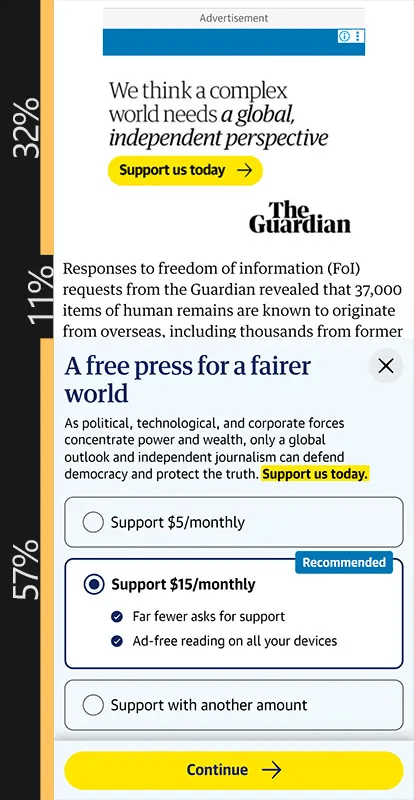
Even websites from publishers who care about quality are doing things on the web that they would never do with their print editions. Bose starts with The New York Times, but also mentions The Guardian, whose web pages are so laden with ads and modals that their default layout, on a mobile device, sometimes leaves just 11 percent of the screen for article content. That’s four lines of article text.

Bose writes:

Viewability and time-on-page are very important metrics these days. Every hostile UX decision originates from this single fact. The longer you’re trapped on the page, the higher the CPM the publisher can charge. Your frustration is the product. No wonder engineers and designers make every UX decision that optimizes for that. And you, the reader, are forced to interact, wait, click, scroll multiple times because of this optimization. Not only is it a step in the wrong direction, it is adversarial by design.

The reader is not respected enough by the software. The publisher is held hostage by incentives from an auction system that not only encourages but also rewards dark patterns.

I disagree only insofar as the reader isn’t respected at all. Part of my ongoing testing of the MacBook Neo is that I’ve been using it in as default a state as possible, only changing default settings, and only adding third-party software, as necessary. So I’ve been browsing the web without content-blocking extensions on the Neo. It’s been a while since I’ve done that for an extended period of time. Most of the advertising-bearing websites I read have gotten so bad that it’s almost beyond parody.

And even with content blockers installed (of late, I’ve been using and enjoying uBlock Origin Lite in Safari), many of these news websites intersperse bullshit like requests to subscribe to their newsletters, or links to other articles on their site — often totally unrelated to the one you’re trying to read — every few paragraphs. And the fucking autoplay videos, jesus. You read two paragraphs and there’s a box that interrupts you. You read another two paragraphs and there’s another interruption. All the way until the end of the article. We’re visiting their website to read a fucking article. If we wanted to watch videos, we’d be on YouTube. It’s like going to a restaurant, ordering a cheeseburger, and they send a marching band to your table to play trumpets right in your ear and squirt you with a water pistol while trying to sell you towels.

No print publication on the planet does this. The print editions of the very same publications — The New York Times, The Guardian, The Wall Street Journal, The Atlantic, The New Yorker — don’t do anything like this. The print edition of The New Yorker could not possibly be more respectful of both the reader’s attention and the sanctity of the prose they publish. But read an article on their website and you get autoplaying videos interspersed between random paragraphs. And the videos have nothing to do with the article you’re reading. I mean, we should be so lucky if every website were as respectfully designed as The New Yorker’s, but even their website — comparatively speaking, one of the “good ones” — shows only a fraction of the respect for the reader that their print edition does.

Without an ad-blocking content blocker running, one of the most crazy-making design patterns today is repeating the exact same ad within the same article, every few paragraphs. It’s hard to find a single article on Apple News — a sort of ersatz pidgin version of the web — that does not do this. The exact same ad — 6, 7, 8 times within the same article. How many 30-something blonde white women need hearing aids? It’s insane.

People are spending less and less time on the web because websites are becoming worse and worse experiences, but the publishers of websites are almost literally trying to dig their way out of that hole by adding more and more of the reader-hostile shit that is driving people away. The Guardian screenshot Bose captured, where only 11 percent of the entire screen shows text from the article, is the equivalent of a broadcast TV channel that only showed 7 minutes of actual TV content per hour, devoting the other 53 minutes to paid commercials and promotions for other shows on the same channel. Almost no one would watch such a channel. But somehow this strategy is deemed sustainable for websites.

The web is the only medium the world has ever seen where its highest-profile decision makers are people who despise the medium and are trying to drive people away from it. As Bose notes, “A lot of websites actively interfere the reader from accessing them by pestering them with their ‘apps’ these days. I don’t know where this fascination with getting everyone to download your app comes from.” It comes from people who literally do not understand, and do not enjoy, the web, but yet find themselves running large websites.

The people making these decisions for these websites are like ocean liner captains who are trying to hit icebergs.

  • βœ‡Daring Fireball
  • β˜… AppleScript: β€˜Save MarsEdit Document to Text File’
    Here’s a simple AppleScript I wrote this week — one that solves a minor itch I’ve had for, jeez, 20 years. Almost every item I post to Daring Fireball goes through MarsEdit, the excellent Mac blogging client from Red Sweater Software (my friend Daniel Jalkut). MarsEdit has a built-in “local drafts” feature, where you can save unpublished drafts within a library in MarsEdit itself. It doesn’t happen often but I occasionally wind up with partially
     

β˜… AppleScript: β€˜Save MarsEdit Document to Text File’

19 March 2026 at 16:46

Here’s a simple AppleScript I wrote this week — one that solves a minor itch I’ve had for, jeez, 20 years. Almost every item I post to Daring Fireball goes through MarsEdit, the excellent Mac blogging client from Red Sweater Software (my friend Daniel Jalkut). MarsEdit has a built-in “local drafts” feature, where you can save unpublished drafts within a library in MarsEdit itself. It doesn’t happen often but I occasionally wind up with partially written posts that I don’t publish, but don’t want to throw away. But I don’t really want to keep them in MarsEdit. I want them saved as text files. For me, those text files go in a folder in Dropbox. For someone else, maybe they go in iCloud Drive.

I write my longer posts in BBEdit, and then copy them into a MarsEdit document when they’re ready to publish. My shorter posts — which is most of them — are usually entirely composed in MarsEdit. Any abandoned drafts that I might return to, I probably want to compose in BBEdit, because the reason they’re abandoned is that they need to be longer. Or they need to be shorter. But either way they need more thought, and BBEdit is where I go to do my most concentrated thinking.

MarsEdit doesn’t have a built-in way to save a document window as a text file. Just its built-in “Save as Local Draft” feature. I didn’t merely suspect but knew that it’d be relatively easy to write an AppleScript to add a “Save as Text File…” feature to MarsEdit, which I could invoke within MarsEdit from FastScripts, the system-wide scripts menu utility that is also from Red Sweater/Jalkut, and, using FastScripts, I could even give the script the standard keyboard shortcut Option-Command-S. (Or is it Command-Option-S?)

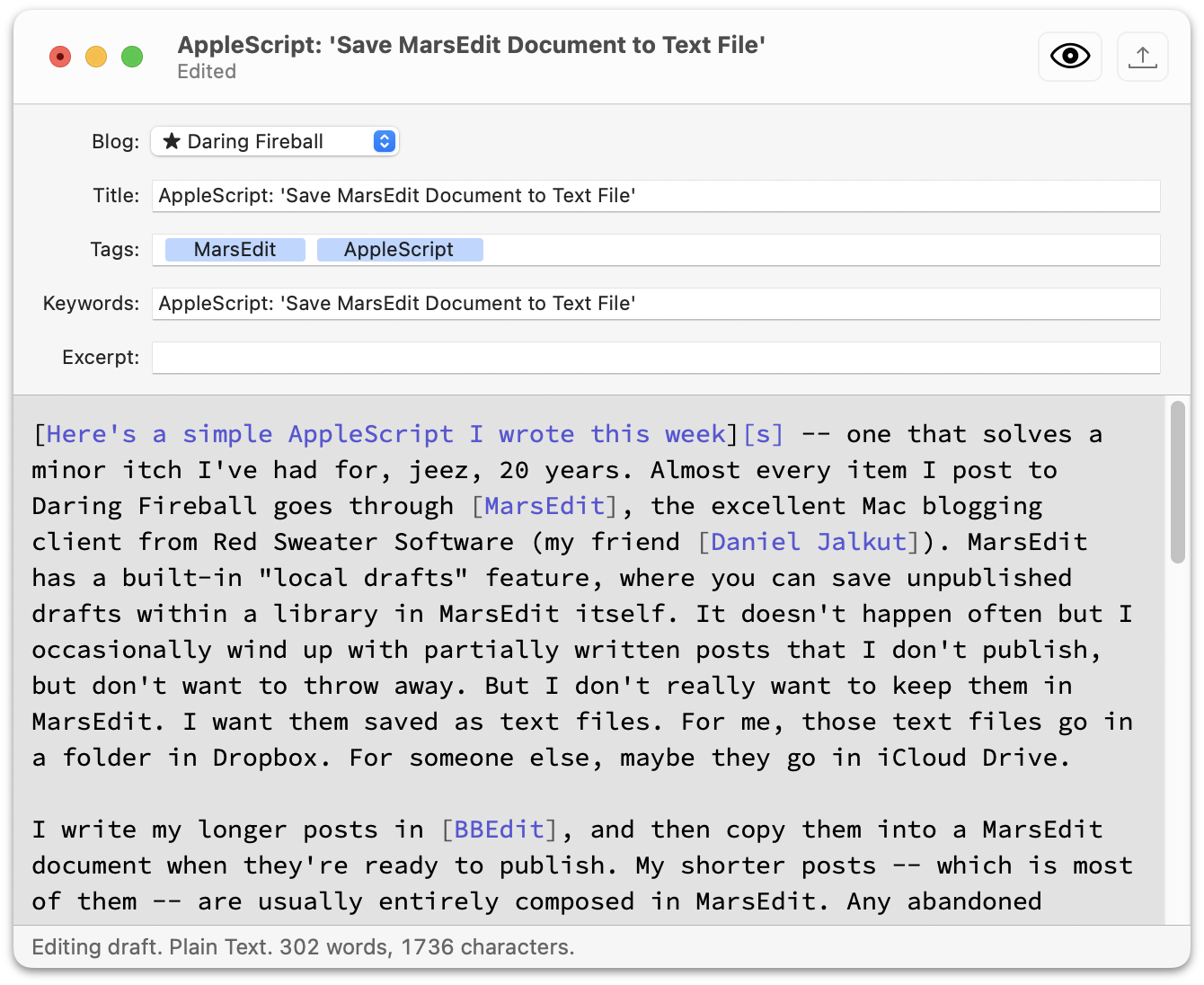
It’ll take a window like this:

Screenshot of the MarsEdit document window for this very post. Sort of meta.

and then prompt you with a system Save dialog to enter a filename (defaulting to the Title field contents, if any, in the MarsEdit document) and location to save the text file. AppleScript even conveniently remembers the last place you saved a file, so it defaults to the same folder the next time you invoke it, without the script doing any work to remember that. The text file looks like this:

Title:  AppleScript: 'Save MarsEdit Document to Text File'
Blog:   ★ Daring Fireball
Edited: Thursday 19 March 2026 at 12:16:29 pm
Tags:   AppleScript, MarsEdit
Slug:   AppleScript: 'Save MarsEdit Document to Text File'
Excerpt: 
---

[Here's a simple AppleScript I wrote this week][s] -- one that
solves a minor itch I've had for, jeez, 20 years. Almost every
item I post to Daring Fireball goes through [MarsEdit], the
excellent Mac blogging client from Red Sweater Software (my
friend [Daniel Jalkut]). ...

That’s it. If you use MarsEdit, maybe it’ll help you. I picked the document fields in MarsEdit that I use (Title, Tags, Excerpt, etc.). One potential point of confusion is that while MarsEdit has an optional document field named “Slug”, I don’t use it. For historical reasons, I use Movable Type’s “Keyword” field for the words I want to use for the URL slug for each post. So in my text files, where it says “Slug:”, the text after that label comes from MarsEdit’s Keywords field. And I keep MarsEdit’s actual Slug field hidden, because I don’t use a field with that name in Movable Type. Your mileage, as ever, may vary. But this makes total sense to me.

Anyway, this script helped me clean up 29 drafts, some of them years old, that had been sitting around in MarsEdit, bugging me. Now my “Local Drafts” library in MarsEdit is empty, and those drafts are safe and sound in text files in Dropbox. When something in your workflow is bugging you, you should figure out a way to address it. Why I didn’t write (and share) this script years ago is a mystery for the ages.

  • βœ‡Daring Fireball
  • Hacker News Discussion on Shubham Bose’s β€˜The 49MB Web Page’
    One of the most controversial opinions I’ve long espoused, and believe today more than ever, is that it was a terrible mistake for web browsers to support JavaScript. Not that they should have picked a different language, but that they supported scripting at all. That decision turned web pages — which were originally intended as documents — into embedded computer programs. There would be no 49 MB web pages without scripting. There would be no surve
     

Hacker News Discussion on Shubham Bose’s β€˜The 49MB Web Page’

19 March 2026 at 17:31

One of the most controversial opinions I’ve long espoused, and believe today more than ever, is that it was a terrible mistake for web browsers to support JavaScript. Not that they should have picked a different language, but that they supported scripting at all. That decision turned web pages — which were originally intended as documents — into embedded computer programs.

There would be no 49 MB web pages without scripting. There would be no surveillance tracking industrial complex. The text on a page is visible. The images and video embedded on a page are visible. You see them. JavaScript is invisible. That makes it seem OK to do things that are not OK at all.

In my piece riffing on Bose’s “The 49MB Web Page” yesterday, I reiterated my also-longstanding argument that publications with print editions do things with their websites that they’d never in a million years do with their print editions. The way The New York Times uses JavaScript to present popovers that obstruct reading the actual article text would be the equivalent of them gluing pages together in the print edition, using tape labeled with an advertisement. They wouldn’t do that. But they do the equivalent, using JavaScript, on every page of their website.

  • βœ‡Daring Fireball
  • Google’s New Sideloading Restrictions for Android Include a 24-Hour Waiting Period
    Adamya Sharma, reporting for Android Authority: When Google execs previously said sideloading would become a high-friction process on Android, they really weren’t kidding. The company is finally sharing what Android’s new sideloading flow will look like in practice, and if you’re someone who installs apps outside the Play Store, you’re going to feel it immediately, and you’re going to feel it deeply. [...] When Android’s new sideloading rules come into f
     

Google’s New Sideloading Restrictions for Android Include a 24-Hour Waiting Period

19 March 2026 at 19:03

Adamya Sharma, reporting for Android Authority:

When Google execs previously said sideloading would become a high-friction process on Android, they really weren’t kidding. The company is finally sharing what Android’s new sideloading flow will look like in practice, and if you’re someone who installs apps outside the Play Store, you’re going to feel it immediately, and you’re going to feel it deeply. [...]

When Android’s new sideloading rules come into force, installing apps from developers without Google verification (more on that later) will become extremely tedious by design and require a 24-hour lock before users can install them.

Here’s Google’s own explanation of the new restrictions. “Open always wins”, baby.

Would be interesting to hear Tim Sweeney’s thoughts on this, but he took a sack of cash in exchange for agreeing that whatever Google does with Android hence is “procompetitive” until 2032.

  • βœ‡Daring Fireball
  • The Day Mark Simonson Discovered Type Design
    Mark Simonson: Just by coincidence, I discovered a copy of U&lc magazine in the graphics classroom. U&lc was published by ITC, the International Typeface Corporation, a typeface publisher, and the designer and editor was the legendary Herb Lubalin. I’d never seen such beautiful typography and design. It was a motherlode for an aspiring typophile like me. [...] I decided right then that someday, somehow, I wanted to design typefaces.  ★ 
     

The Day Mark Simonson Discovered Type Design

19 March 2026 at 19:15

Mark Simonson:

Just by coincidence, I discovered a copy of U&lc magazine in the graphics classroom. U&lc was published by ITC, the International Typeface Corporation, a typeface publisher, and the designer and editor was the legendary Herb Lubalin. I’d never seen such beautiful typography and design. It was a motherlode for an aspiring typophile like me. [...]

I decided right then that someday, somehow, I wanted to design typefaces.

  • βœ‡Daring Fireball
  • β€˜Everyone but Trump Understands What He’s Done’
    Anne Applebaum, writing for The Atlantic (gift link): Specifically, they remember that for 14 months, the American president has tariffed them, mocked their security concerns, and repeatedly insulted them. As long ago as January 2020, Trump told several European officials that “if Europe is under attack, we will never come to help you and to support you.” In February 2025, he told Ukrainian President Volodymyr Zelensky that he had no right to expect support either, because &ldqu
     

β€˜Everyone but Trump Understands What He’s Done’

19 March 2026 at 20:09

Anne Applebaum, writing for The Atlantic (gift link):

Specifically, they remember that for 14 months, the American president has tariffed them, mocked their security concerns, and repeatedly insulted them. As long ago as January 2020, Trump told several European officials that “if Europe is under attack, we will never come to help you and to support you.” In February 2025, he told Ukrainian President Volodymyr Zelensky that he had no right to expect support either, because “you don’t have any cards.” Trump ridiculed Canada as the “51st state” and referred to both the present and previous Canadian prime ministers as “governor.” He claimed, incorrectly, that allied troops in Afghanistan “stayed a little back, a little off the front lines,” causing huge offense to the families of soldiers who died fighting after NATO invoked Article 5 of the organization’s treaty, on behalf of the United States, the only time it has done so. He called the British “our once-great ally,” after they refused to participate in the initial assault on Iran; when they discussed sending some aircraft carriers to the Persian Gulf conflict earlier this month, he ridiculed the idea on social media: “We don’t need people that join Wars after ​we’ve already won!”

Meanwhile, Irina Slav at Oilprice.com writes that oil — which was trading around $60 per barrel before the war — might soon be headed to $150–200 per barrel. $200! Energy Common Sense reports “This is now a multi-month, likely rest-of-year story of elevated prices and elevated risk.” Axios reports that most Americans will soon be paying over $4/gallon for gasoline, but I walked by Center City Philly’s lone gas station at lunch, and regular gas remains under $4 and premium under $5 — both with an entire one-tenth of one cent to spare.

The Economist quips:

Although President Donald Trump says he has “destroyed 100% of Iran’s Military Capability”, the 0% that remains is playing havoc with the global economy by choking off 10-15% of its oil supply.

This whole dumb fiasco might go down as the canonical example for the phrase “hoist with his own petard”. You just hate to see it.

Actual Headline in the Actual New York Times: β€˜Trump Jokes About Pearl Harbor in Meeting With Japan’s Leader’

19 March 2026 at 21:01

Javier C. Hernández, reporting for The New York Times:

He was responding to a question about why Japan and other allies had received no advance notice of the U.S.-Israeli assault on Iran.

“We didn’t tell anybody about it because we wanted surprise,” he said. “Who knows better about surprise than Japan, OK? Why didn’t you tell me about Pearl Harbor, OK? Right?”

There was some laughter from the officials and journalists gathered in the room. “You believe in surprise, I think, much more so than us,” he added.

As Trump sinks further into dementia and his presidency slides further into disarray, his administration, in a sick way, gets funnier and funnier.

  • βœ‡Daring Fireball
  • StopTheMadness Pro and StopTheScript Extensions for Safari
    Jeff Johnson, linking to my “Your Frustration Is the Product” piece: My browser extension StopTheMadness Pro stops autoplaying videos and hides Sign in with Google on all sites. It also hides sticky videos and notification requests on many sites. For more extreme measures, try my Safari extension StopTheScript. It kills JavaScript dead on websites you select. For example, from the blog post, it makes The Guardian readable. These are both great extensions, and I have both inst
     

StopTheMadness Pro and StopTheScript Extensions for Safari

19 March 2026 at 21:09

Jeff Johnson, linking to my “Your Frustration Is the Product” piece:

My browser extension StopTheMadness Pro stops autoplaying videos and hides Sign in with Google on all sites. It also hides sticky videos and notification requests on many sites.

For more extreme measures, try my Safari extension StopTheScript. It kills JavaScript dead on websites you select. For example, from the blog post, it makes The Guardian readable.

These are both great extensions, and I have both installed for use in Safari on all my devices. StopTheScript is a bit peculiar, by nature of how it does what it does, but Johnson has a great illustrated tutorial for it and a good blog post explaining which sites he uses it on and why.

Over on the Chrome/Chromium side, there’s a very slick extension called Quick JavaScript Switcher. It’s free, but the developer (Maxime Le Breton) asks for a 5€ donation. QJS adds a simple JS on/off switch to the toolbar.

A lot of stuff doesn’t load when you just completely disable JavaScript for a site. You might be surprised just how much of that stuff is shit you don’t want or won’t miss.

Or, you can go the other way, give in, stop fighting the man, and install OnlyAds — an extension that hides everything on a website except the ads.

  • βœ‡Daring Fireball
  • Quiche Browser
    Quiche Browser is a rather astonishing app from the one-man indie developer Greg de J./Quiche Industries. (What a killer domain name that is.) Quiche Browser is a very robust, exquisitely designed, stunningly handsome web browser exclusively for iPhone. Just iPhone — although an iPad version is currently in beta. I switched to it as my default iPhone web browser last summer, thinking I’d only stick with it for a day or two before going back to Safari, and I wound up st
     

Quiche Browser

20 March 2026 at 15:38

Quiche Browser is a rather astonishing app from the one-man indie developer Greg de J./Quiche Industries. (What a killer domain name that is.) Quiche Browser is a very robust, exquisitely designed, stunningly handsome web browser exclusively for iPhone. Just iPhone — although an iPad version is currently in beta. I switched to it as my default iPhone web browser last summer, thinking I’d only stick with it for a day or two before going back to Safari, and I wound up sticking with it for a few weeks. I did go back to Safari, but it was a remarkably close call. So close that, today, I’m going to give it another try. (And I was so enamored during my month-long affair with Quiche that I gladly subscribed to Quiche Plus for $27/year to support such a remarkable app.)

Out of the box, every single aspect of Quiche Browser’s UI and feature set is designed with obvious thought and care. But it also supports a rich array of settings to tweak the design. You can customize the appearance style of the toolbar, the location of the toolbar, the buttons on the toolbar. Quiche brings to iOS something very much akin to AppKit’s Customize Toolbar from the Mac, but if anything, what Quiche implements is more customizable. The typography throughout the app is exquisite. It doesn’t support Safari extensions but it has its own built-in content blocker. And, of course, it has built-in support for Kagi, the world’s best search engine.

What got me thinking about Quiche Browser again today was this tweet on Mastodon from the developer:

One of the many reasons I made Quiche Browser was to get a per-website JavaScript kill switch in my toolbar.

But these days I’m even tempted to disable JavaScript everywhere and enable it only where needed.

A simple one-tap “JS” button you can toggle on any website. I missed this button when I was test-driving Quiche a few months ago. Every browser should have this button. It’s almost unbelievable how much it improves so many websites.

That “JS” button alone isn’t why you should check out Quiche. It’s the whole thing. It’s just so thoughtful. So utterly modern in its appearance and features, but old-school in its hyperfocus on serving you, the user, through craftsmanship.

  • βœ‡Daring Fireball
  • Bluesky Raised $100M a Year Ago but for Some Reason Only Disclosed It Now
    Bluesky: In April 2025, Bluesky raised $100 million in Series B funding led by Bain Capital Crypto, with participation from Alumni Ventures, Anthos Capital, Bloomberg Beta, Knight Foundation and True Ventures. In the months since, we’ve focused on scaling our team to meet the rapid growth of both the AT Protocol (atproto) and Bluesky app. We’re excited to share more as we move into a new era of leadership and further growth. This raise was led by Bluesky founder Jay Graber, who
     

Bluesky Raised $100M a Year Ago but for Some Reason Only Disclosed It Now

20 March 2026 at 16:46

Bluesky:

In April 2025, Bluesky raised $100 million in Series B funding led by Bain Capital Crypto, with participation from Alumni Ventures, Anthos Capital, Bloomberg Beta, Knight Foundation and True Ventures. In the months since, we’ve focused on scaling our team to meet the rapid growth of both the AT Protocol (atproto) and Bluesky app. We’re excited to share more as we move into a new era of leadership and further growth.

This raise was led by Bluesky founder Jay Graber, who recently transitioned to Chief Innovation Officer to focus on building the future of open social infrastructure.

I didn’t post about Graber’s stepping aside as CEO earlier this month because I didn’t make much of it. I’ve been bullish on Bluesky since its inception, but I haven’t been thrilled by it of late. I don’t think it’s gotten any worse, but its growth has stalled, leaving it in the limbo between ghost town and boom town. For many products/services/businesses/publications, a sustained popularity that’s less than booming is fine. Niches can work, or thrive even. Daring Fireball is clearly a niche publication. But for social networks, two decades of evidence suggests that anything less than booming is a problem.

But what the hell are we to make of a $100 million funding round that wasn’t announced for 11 months? Is this commonplace, and I just somehow never before took note of a company keeping a large funding round secret for a year? Or is this as weird as I’m thinking it is? I always thought big funding rounds were things companies wanted to immediately promote, not hide. This roundup of links at Techmeme suggests I’m not alone.

Update, 2 hours later: The explanation I’ve now heard, from a source in a good position to have an informed take, is that it is unusual. But basically it’s a unique series of events, at a unique time (post–2024 election, when Bluesky experienced a nice surge), for a unique company. So: weird, yes. Cause for alarm, probably not.

See also: This follow-up post.

Perhaps Bluesky’s Revelation of an 11-Month Ago $100 Million Investment Was, in Fact, an Act of Transparency

20 March 2026 at 20:49

Regarding my earlier post expressing confusion/discomfort with Bluesky announcing a $100 million funding round almost an entire year after it closed, I had an interesting back-and-forth with Adam Vartanian on Bluesky (natch), where he wrote:

If you see press reports that says a company “has raised” some money but no date on when the round closed, it probably happened some time in the past. Bluesky is actually unusual in disclosing a date that’s so far in the past.

I kept thinking that I must be missing something in this story, and this feels like it must be exactly that something. If true, it’s not unusual these days for a company to announce a seeding round long after it actually closed. What’s unusual in this case with Bluesky is that when they finally did announce it, they revealed the long-ago date it closed, too. That it was, in fact, an act of transparency, at least in comparison to many other venture-backed companies today.

  • βœ‡Daring Fireball
  • Google Search Is Now Using AI to Rewrite Headlines
    Sean Hollister, The Verge (gift link): After doing something similar in its Google Discover news feed, it’s starting to mess with headlines in the traditional “10 blue links,” too. We’ve found multiple examples where Google replaced headlines we wrote with ones we did not, sometimes changing their meaning in the process. For example, Google reduced our headline “I used the ‘cheat on everything’ AI tool and it didn’t help me cheat on anything&
     

Google Search Is Now Using AI to Rewrite Headlines

20 March 2026 at 21:00

Sean Hollister, The Verge (gift link):

After doing something similar in its Google Discover news feed, it’s starting to mess with headlines in the traditional “10 blue links,” too. We’ve found multiple examples where Google replaced headlines we wrote with ones we did not, sometimes changing their meaning in the process.

For example, Google reduced our headline “I used the ‘cheat on everything’ AI tool and it didn’t help me cheat on anything” to just five words: “‘Cheat on everything’ AI tool.” It almost sounds like we’re endorsing a product we do not recommend at all.

What we are seeing is a “small” and “narrow” experiment, one that’s not yet approved for a fuller launch, Google spokespeople Jennifer Kutz, Mallory De Leon, and Ned Adriance tell The Verge. They would not say how “small” that experiment actually is. Over the past few months, multiple Verge staffers have seen examples of headlines that we never wrote appear in Google Search results — headlines that do not follow our editorial style, and without any indication that Google replaced the words we chose. And Google says it’s tweaking how other websites show up in search, too, not just news.

This is way past “jumping the shark” territory. This is Jaws 3-D totally-lost-the-plot territory. Jesus H. Christ.

  • βœ‡Daring Fireball
  • Reuters: β€˜Amazon Plans Smartphone Comeback More Than a Decade After Fire Phone Flop’
    Greg Bensinger, reporting for Reuters: The latest effort, known internally as “Transformer,” is being developed within its devices and services unit, according to four people familiar ​with the matter. The phone is seen as a potential mobile personalization device that can sync with home voice assistant Alexa and serve as a conduit to Amazon customers throughout the day, the people said. [...] As envisioned, the new phone’s personalization features would make buying
     

Reuters: β€˜Amazon Plans Smartphone Comeback More Than a Decade After Fire Phone Flop’

22 March 2026 at 00:52

Greg Bensinger, reporting for Reuters:

The latest effort, known internally as “Transformer,” is being developed within its devices and services unit, according to four people familiar ​with the matter. The phone is seen as a potential mobile personalization device that can sync with home voice assistant Alexa and serve as a conduit to Amazon customers throughout the day, the people said. [...]

As envisioned, the new phone’s personalization features would make buying from Amazon.com, watching Prime Video, listening to Prime Music or ordering food from partners like Grubhub easier than ever, the people said. They asked for anonymity because they were not authorized to discuss internal matters.

The problem with this pitch is that it’s not hard at all to buy from Amazon.com, watch Prime Video, listen to Prime Music, or order food from Grubhub using the phones we already have. All of those things are ridiculously easy. I mean, I get it. On an Amazon phone, your Amazon ID would be your primary ID for the system. So those Amazon services would all just work right out of the box. But you can’t get people to switch from the thing they’re used to (and, in the case of phones, especially iPhones, already enjoy) unless you’re pitching them on solving problems. No one has a problem buying stuff or using Amazon services on the phone they already own.

A key focus of the Transformer project has been integrating artificial intelligence capabilities into the device, the people said. That could eliminate the need for traditional app stores, which ​require downloading and registering for applications before they can be used.

This is just nonsense. No matter how good Amazon’s AI integration might be, it isn’t going to replace the apps people already use. If you use WhatsApp, you need the WhatsApp app. If you want to watch video on Netflix, you need the Netflix app. If you surf Instagram and TikTok, you need those apps. If Amazon tries shipping a phone without any of those apps — let alone without all of them — this new “Transformer” phone will be a bigger laughingstock than the Fire phone was a decade ago. And we’re all still laughing at the dumb Fire phone. Which means they can’t eliminate “traditional app stores”.

People aren’t clamoring for the elimination of app stores. People like app stores. If Amazon, or anyone else, is going to introduce a new type of “AI-first” phone to disrupt the iPhone/Android duopoly, it has to offer something amazingly appealing. Nothing in Reuters’s description of Transformer fits that description. Also, it’s not like Amazon has market-leading AI. At the moment that feels like a three-way game between OpenAI, Anthropic, and Google.

  • βœ‡Daring Fireball
  • Mux — Video API for Developers
    My thanks to Mux for sponsoring last week at DF. Video isn’t just something to watch; it’s a boatload of context and data. Mux makes it easy to ship and scale video into anything from websites to platforms to AI workflows. Unlock what’s inside: transcripts, clips, and storyboards to build summarization, translation, content moderation, tagging, and more. Mux stewards Video.js, the web’s most popular open source video player. Video.js v10 is a complete architectural rebu
     

Mux — Video API for Developers

22 March 2026 at 16:30

My thanks to Mux for sponsoring last week at DF. Video isn’t just something to watch; it’s a boatload of context and data. Mux makes it easy to ship and scale video into anything from websites to platforms to AI workflows. Unlock what’s inside: transcripts, clips, and storyboards to build summarization, translation, content moderation, tagging, and more.

Mux stewards Video.js, the web’s most popular open source video player. Video.js v10 is a complete architectural rebuild, with the beta now available at videojs.org.

Mux is video infrastructure trusted by Patreon, Substack, and Synthesia. Get started free, no credit card required. Use code FIREBALL for an extra $50 credit.

❌