
 Login
Login
Our Solar System Is Way Too Big
Hello! This is Everything Is Amazing, a well-meant word salad newsletter about curiosity, science, attention and wonder.
Sign Me Up For Whatever This Thing Is!
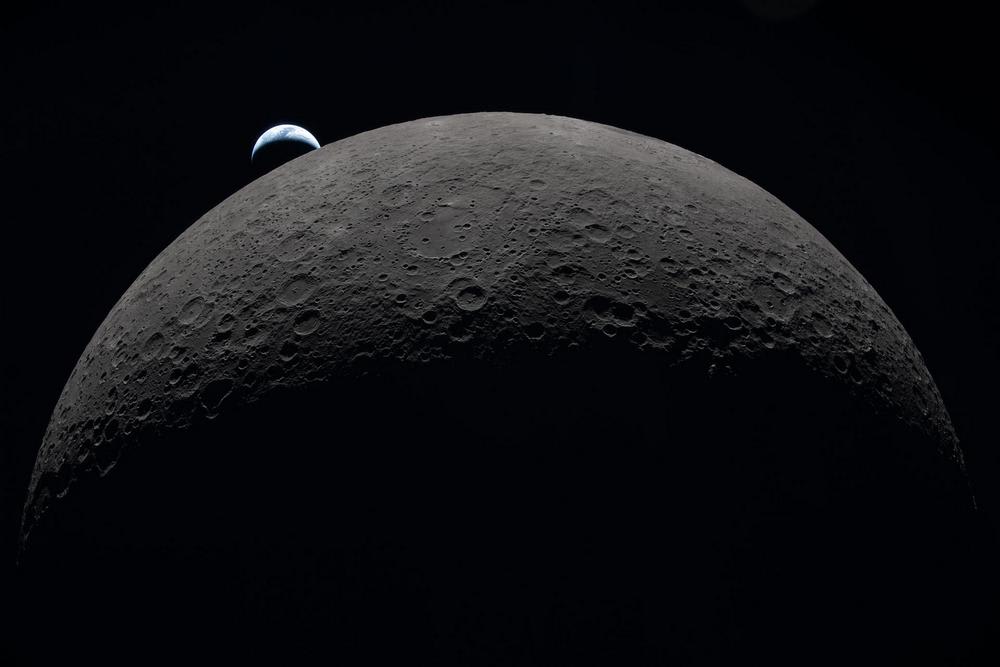
I’m currently writing something new about our Moon - that thing in the sky that’s still so hard to imagine as a real place that four remarkable humans just took a trip around, even after seeing sanity-warping photos like this one:
That piece is coming your way shortly - but as sometimes happens with this newsletter, it needs a bit more time to hit the right trajectory for splashdown [✅ obligatory super-weak orbital mechanics pun].
In its place, but staying with the theme of solar system exploration, here’s a piece from 2023 on just how terrifyingly big stuff is up there.
Let’s start with a question that really belongs in the 4th season of this newsletter, when we looked at the 71% of our planet we tend to overlook - and it’s prompted by a throwaway line from astrobiologist Lewis Dartnell in his marvelous book Origins, which we were all reading together a while back:
“So the water that fills our oceans arrived after the Earth was born.”
Adam Bodensteiner of commented:
“This is fascinating! And I know we’re talking about GEO-logy here, but I can’t help but think about how if our water here on earth came to us from space, how that undoubtedly happened on many other exoplanets!”
I hadn’t stopped to really think about the implications here. But Adam did - and his “wow!” pulled me in.
Now, I might not be the right person to investigate this. I’m sure Phil of the Bad Astronomy newsletter or Tad of First Excited State would do a far more competent job, and get all the math correct. But, here goes.
The questions I tried to answer:
Precisely how much water is there on our planet?
Does it really have extraterrestrial origins, as Dartnell claims, and how do we know? (“…brought by a bombardment of icy comets and asteroids from the colder, outer regions of the solar system - like a blizzard from deep space…”)
How much water is out there, beyond the Earth - and will future astronauts, off-world colonists and solar system explorers ever be in danger of running out of it?
How Much Water Does The Earth Have?
Lacking the time to measure it all by hand, I’m forced to rely on a credible source of data - and few scientific agencies are more trustworthy than the United States Geological Survey, which has been tackling some of the biggest questions in biology, geography, geology, and hydrology over the last 146 years.
It notes that 96.5% of our planet’s water supply is in our oceans. The rest - what we call freshwater (shorthand for “doesn’t contain enough dissolved salts to render it undrinkable”) is held in water vapour, in rivers and lakes and icecaps and glaciers, in the ground, via soil moisture & aquifers, and in living creatures including us humans (we’re 55-60% bags of water, with the remainder comprised mostly of carbon, nitrogen, caffeine, pizza and anxiety).
Since we very quickly sicken and die without adequate hydration, our continued existence as individuals, communities and as a species depends on adequate water supplies.
At first glance, these stats are heartening: oh wow, so the tiny fraction of the world’s freshwater that we draw upon is just a vanishingly small part of just 3.5% of the supply we could get from the sea? That’s basically endless!
Well, yes and no!
There’s a good reason that we satisfy less than half a percent of human water needs with desalinated water: energy. In a practical sense, it still costs too much to process it at scale. To that end, energy generation (clean energy, avoiding creating pollutants that end up back in the water supply and render the whole thing a bit pointless) needs to get a lot cheaper.
And - it is getting cheaper! To an quite astonishing degree, as Bill McKibben explained here.
(2026 UPDATE: this is another exciting plot twist!)
Nevertheless, in pragmatic terms it’s still largely impractical. In time, perhaps?

So, uh - that doesn’t look like a lot. Seriously? All the water in that single blue drop?
Firstly, it’s not a drop: it’s a sphere, with a diameter of 860 miles.
That means there’s around 332 million cubic miles of water in that thing.
Yes, I know that’s just a number, but - you can see how big it is compared to the United States (if it “popped” and emptied all its water onto the U.S., the layer of water would be over a hundred miles deep).
And if it was hovering over Europe, it’d stretch from London to Rome.
A fact I found surprising, via the USGS page:
“Of the freshwater on Earth, much more is stored in the ground than is available in rivers and lakes. More than 2,000,000 mi3 (8,400,000 km3) of freshwater is stored in the Earth, most within one-half mile of the surface.”
So in theory, even if we ran low on freshwater from lakes and rivers - which is frequently the case in many parts of the world, and the subject of a few environmental disasters, like this one - there is still plenty of water locked up not-too-far underground (including under our oceans!).
If there was an environmentally responsible and cost-efficient way to reach it, we wouldn’t need to rely on processing any seawater to meet our needs?
That’s a lot of “if”s there, and a lot of over-idealistic uses of the word “we”, but - good to know, I think?
Did All Our Water Come From Outer Space?
Dartnell’s statement is solidly on the side of extraterrestrial origins - and it reflects what was until recently the agreed-upon model.
But geologists have been poking at this for decades. What’s the actual evidence for such a thing being true?
One indicator is an isotope of hydrogen (deuterium) that goes into making so-called “heavy water” - which is well-named, because if you freeze a sample of it and drop that lump of ice into normal water, it’ll sink to the bottom. The modern ratio of heavy to “light” water on our oceans has the potential to tell a story about where Earth’s water came from (because, for example, many comets seem to be unusually rich with deuterium, so bombardment with similar forms of space-ice could throw that ratio out of whack over time).
It’s an extremely complicated piece of detective-work, with many researchers (like astronomer Karen Meech) dedicating much of their careers to untangling it.
Meanwhile, as this 2020 study concluded, water may also have been present in the materials that formed the inner solar system - namely, the stuff that collided and melted together to form the Earth in the first place.
A form of meteorite called an enstatite chondrite has been found to contain enough hydrogen that, if it was of equivalent accumulated size, it could create the water in our planet’s oceans three times over.
At first glance this might look like more evidence for extraterrestrial origins, but the hydrogen and nitrogen isotopic compositions of these meteorites also match those of the Earth’s mantle, which has been mostly locked away underground since our planet formed.
It suggests that the vast reservoirs of water under our feet were an innate feature of the material that came together to create the Earth. If true, some of that water - in the form of hydrogen, since the early days of the planet were much too hot to hold water - was here from the start.
Neither model is exclusive of the other. And in the way of these things, a mix of the two seems…not outside the realm of possibility?
But no, it doesn’t look as simple as “all our water came from space”.
(Sorry, Professor Dartnell.)
So Exactly How Much Water Is Out There?
“Exactly”? Oh come on. Are you trying to give me a headache?
On the one hand, we certainly know that water is all over our solar system. In 2018 the Indian Space Research Organisation’s Chandrayaan-1 lunar probe confirmed the existence of ice in the shadowed areas of the Moon - and in 2020, NASA announced the discovery of water on the sunlit side.
(In the case of the latter study, it’s roughly enough to fill a 12oz bottle for every cubic metre of lunar soil.)
Further afield, Cassini probe data suggests Saturn’s moon Enceladus has “curtains of vapour” erupting out of cracks in its surface (some of which are up to 75 miles long), suggesting an ocean under the surface that’s up to 6 miles thick.
Plus there’s Europa, with its proposed liquid ocean that descends a truly abyssal 90 miles, as I wrote about previously.
Relatively speaking, our seemingly unremarkable solar system should be pleasantly awash. In 2016, Scientific American writer Shannon Hall reported there’s at least 50 times more water that is found on Earth - and that’s just based on the small amount of confirmed evidence to date.
This isn’t to say it’s going to be easy to tap, as the Moon water example suggests (processing a cubic metre of soil just to get enough water to fill a can of Coke is not getting us very far).
Nevertheless, technical challenges notwithstanding, our interplanetary future should (🤞) be more than adequately hydrated if the right technology is put in place.
But I’d like to use all this as a super-thin excuse to talk about my favourite part of our solar system. You know, the really, really insane part.
Welcome to the sublimely distant edge of our planetary neighbourhood.
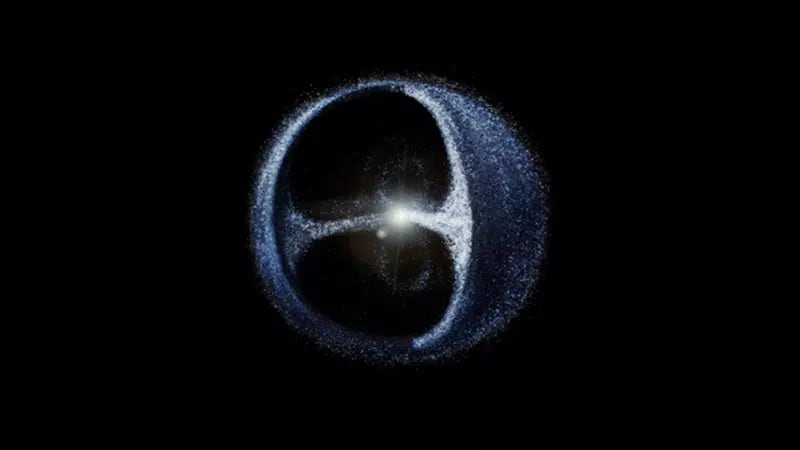
There’s no real way to visualise this wider structure of our solar system, but here’s one artist’s attempt to at least get the idea of it across in a way that fits into our brains.
The utmost rim, more or less everyone agrees, is the point where the Sun’s gravitational pull is negligible compared with that of the other stars in our galactic neighbourhood.
Within this boundary should be drifting an essentially unimaginable expanse of fragmented rock and ice, forming billions of comets and trillions of asteroids.
All this stuff drifts around according to the mathematical elegance of the laws of gravitational force. You can see them at work in the image above: an inner “cloud” in the form of a faint torus (or upended infinity-sign, appropriately enough), surrounded by a far larger outer bubble.
It’s called the Oort Cloud, after the Dutch astronomer Jan Hendrik Oort - and nobody has directly seen it yet, even though its existence is not currently in dispute.
As to how far away it is, the best measure is the AU (Astronomical Unit): roughly the distance from the Earth to the Sun, around 93 million miles (150 million km). The inner Oort Cloud begins at 2,000 AU - and its outer edge is anything up to 100,000 AU away.
These are stupid, ridiculous numbers, so here’s another way of thinking of it.
Since 1977, the Voyager 1 space probe has been tirelessly hurtling towards the rim of the solar system. The inner planets and the warm light of our Sun are now far, far behind it - and it’s travelling over a million miles every day into that profound blackness.
At its current velocity, it’s going to take Voyager another 300 years before it reaches the inner edge of the Oort Cloud - and then it’ll need tens of thousands more years to get out of it again.
Ooof.
But wait - the Oort Cloud is mostly ice? Isn’t that even more water for future explorers to draw upon?
Okay, firstly, you read the bit about how far away it is, right? Just checking. And here’s something that really needs emphasizing: it looks like there is nothing else out there. This is otherwise empty space.
(There was a highly controversial theory that the Oort Cloud contains a gas giant several times the size of Jupiter, called Tyche - a so-called “extra planet” of our solar system - but in 2014, the findings from NASA’s Wide-field Infrared Survey Explorer found absolutely nothing to suggest it exists.)
Secondly: the Oort Cloud, in a tangible sense, is itself a whole lot of nothing. We’re talking about a staggeringly vast number of bodies spread out over a space that is itself staggeringly vastly more staggeringly vast. It’s incredibly diffuse.
Based on the mass of comets, one estimate for the combined mass of everything within the Oort Cloud is just five times that of Earth. Five Earths, pulverised and scattered over that utterly terrible volume of space…
So no - future astronauts aren’t going to be taking trip to the Oort Cloud to refill their water-bottles.
It’s also possible no human being will ever see it up close - partly because it’s simultaneously too big and too small to see, and partly because the trip isn’t (currently) survivable. Even Voyager 1, when it reaches it in the 24th Century, will be long drained of power. It’s just too far for everything.
For now, humanity’s best bet is to look after the plentiful supplies of water it has at home - and learn to share them properly in a spirit of respectful cooperation, assisted by all the new technology we can bring to bear. If we did that, there should be more than enough for everyone.
So hey, maybe we should get on with doing that?
Images: USGS; Gatis Marcinkevics; Cristofer Maximilian; Pablo Carlos Budassi/Wikimedia Commons; NASA.
