In this Issue of the Statesider 2022 travel: still complicated. Trees from outer space, bad architecture, cinnamon rolls, weird Disney, more fun with fonts, tunnels that united a nation, and piñatas you won’t want to break, no matter what’s inside.
How to Think About Travel in 2022
The annual “where to go in 2022” lists are out. Yeah, we want to go to the Cook Islands as much as the next cabin-fevered traveler, but “where” is the wrong q
In this Issue of the Statesider 2022 travel: still complicated. Trees from outer space, bad architecture, cinnamon rolls, weird Disney, more fun with fonts, tunnels that united a nation, and piñatas you won’t want to break, no matter what’s inside.
How to Think About Travel in 2022
The annual “where to go in 2022” lists are out. Yeah, we want to go to the Cook Islands as much as the next cabin-fevered traveler, but “where” is the wrong question if you can’t (or shouldn’t) get there. We’re much more interested in “how” to travel — or even “if.” Read our take in this Statesider editorial
The Lost National Park: Years of drought in the West are revealing the glory of Glen Canyon, America’s “lost national park.” Don’t miss the visuals on this one. Nathan Rott, NPR
Where to Find a Moon Tree: In 1971, the Apollo 14 mission brought a variety of tree seeds into space to see if they would germinate when they returned to Earth. They did, and there are still “Moon Trees” growing all across the US, some probably not far from where you are right now. Twitter thread, Kat Long. Google Map by Heather Archuletta.
Goodbye, Mansplaining: Six days exploring the Alaskan wilderness. What adventure travel could look like with no men involved. Maggie Shipstead, Outside
Sure, lots of women are terrible, and men contain multitudes, but I don’t think it’s out of line to say that women, left to their own devices, tend to be more cooperative and supportive than all-male or mixed groups.
How Kansas City Rolls: So you like cinnamon rolls. Do you like them the way Kansas City likes them? Baked, fried, round, square, iced, plain, even served with chili? Gina Kaufmann, KCUR
Not like this. No.
Lemon Pepper City: The story of Atlanta’s love of lemon pepper chicken wings, and how some of the city’s best-known versions come from an unlikely culinary destination: strip clubs. Eric Kim, New York Times
The peach is famously the state’s fruit, but lemon pepper is the city’s soul.
A Time for Change: Poet Maya Angelou will become the first Black woman to appear on a US quarter, one of five new designs coming out this year. The coins will be in circulation early this year. Nora McGreevy, Smithsonian Magazine
Can’t Improve This Headline: “Lee surrenders again as New Orleans renames boulevard for Allen Toussaint.” Sarah Ravits, Gambit
Cat Island: The reintroduction of wolves to Yellowstone has received a lot of attention, and stirred up a lot of passions, in recent years. Cumberland Island, a barrier isle off the Georgia coast, is home to a different and reintroduction experiment: bobcats. Ben Goldfarb, National Parks Conservation Association
Tunnels to the Past: The tunnels cut through Donner Summit built by Chinese immigrants in the 1860s helped unite our country. Today, with no active protection, the tunnels are a magnet for adventure seekers and graffiti artists. Shoshi Parks, Smithsonian
Donner Summit Tunnel, man with warm hat for scale (Photo: ChiefRanger, CC-BY)
Atchafalaya Mud: One thing is clear: the Atchafalaya Basin, the largest river swamp in the United States, needs help. But in a place where change is constant, no one can agree on what it is supposed to look like. Boyce Upholt with photos by Rory Doyle, Bitter Southerner
Early European settlers saw the Atchafalaya Basin as a nearly impossible landscape, a place where “the inexperienced traveler would require the thread of Ariadne in order not to wander forever,” as one 1803 visitor suggested.
Outdoor Access: Blair Braverman developed multiple tick-borne illnesses and her body has not been the same since. “Disabled” can mean many different things to different people, but if the goal is to enjoy the outdoors, these tips can improve your experience. Blair Braverman, Outside
Tasty Tucson: The headline “Is Tucson the best city for Mexican food in the US?” is designed to provoke a strong reaction. Here’s ours: We need to eat our way through Tucson to test the hypothesis. It’s the least we can do. Abbie Kozolchyk, National Geographic
Dallas Arts: Meet the piñata master whose creations are so beautiful that you won’t want to smash them open with a stick. José R. Ralat, Texas Monthly
Build Back Weirder
Have Fun Buying the Castle! This castle in Connecticut that looks straight out of a Disney movie is hunting for a buyer with $35,000,000 and very specific tastes. This might take a while. Rebecca Makkai has the backstory in this remarkable Twitter thread. Here’s the Zillow listing.
New Deal Disney: The Haunted Mansion at Disneyland was supposed to capture a New Orleans aesthetic, but was instead modeled after a real house in Baltimore — all thanks to the Index of American Design, a New Deal effort to catalog the art and design of America. Jason Schultz, Disneyland Nomenclature
Fun With American Fonts
The Statesider’s own Doug Mack accidentally blew up on Twitter after buying a font based on National Forest and National Park signs and then creating his own versions (there are many more, touching on everything from bears to Pop-Tarts to anxiety, if you click through to the thread):
Way Too Interested, by Gavin Purcell. Are you weirdly interested in a specific topic? Maybe even a little too interested? Yeah, us too. Gavin Purcell’s recently started podcast pairs a person with specific passion with an expert in that field, and it makes for some fascinating listening. The most recent episode is tailor-made for Statesider readers: it’s all about the interstate highways of America. Anil Dash, CEO of Glitch and highway superfan, talks with Dan McNichol, former White House appointee and author of The Roads That Built America: The Incredible Story of the U.S. Interstate System about the past and future of America’s road system and bold infrastructure projects. (Also, don’t miss food writer Helen Rosner talking about her obsession with moss.)
If you enjoy The Statesider newsletter, please forward to a friend or two. Word of mouth is our favorite way to grow, which means we depend on your mouth and the words emerging from it. There was probably a better way to say that.
The annual barrage of destination lists filled with tips on where to go in 2022 is here. We’re travelers, so we love those things. When we’re not inspired by them, we love to argue with their picks and ogle the pretty pictures.
But we are where we are: in a pandemic in the midst of a wave of infections from a dangerously transmissible variant. We’re all tired of Covid’s looming presence and effect on every aspect of life, but it’s no good pretending things
The annual barrage of destination lists filled with tips on where to go in 2022 is here. We’re travelers, so we love those things. When we’re not inspired by them, we love to argue with their picks and ogle the pretty pictures.
But we are where we are: in a pandemic in the midst of a wave of infections from a dangerously transmissible variant. We’re all tired of Covid’s looming presence and effect on every aspect of life, but it’s no good pretending things are back to normal. A destination list is of no use if you can’t get there — or if you’re being irresponsible in doing so.
Instead of creating our own list, or giving advice on what to do to get past the various and shifting COVID requirements of different destinations, we offer our thoughts on how to approach travel in a year of deep uncertainty.
Obviously, we’re going to tell you to take a domestic trip, so yeah, do that.
Try somewhere within a day’s drive, somewhere self-contained and self-catered. There will be moments for long-distance flights to other parts of the world, but today is not that day. Plus, it’s our raison d’être to remind people how fascinating the US is for travelers. Whether you’re looking for food, history, nature, adventure, sports, or the International Banana Museum, we’ve got it all. Don’t think of this travel as a substitute for the trip you actually want to take — one place can never be a perfect stand-in for another — but as a chance to see something genuinely cool and journey-worthy that you might not have seen otherwise.
Put a trip on the calendar, but not the big dream trip.
Maybe things will look great for travel in the Summer! Or maybe they won’t! It’s probably not the year to put all of your hopes and dreams into one big trip. Getting a trip on the calendar is still a good plan. Having something to look forward to is a great way to lift your pandemic-sagged spirits. And short trips — in distance or duration — can be as satisfying as the biggies. Research backs us up on this: the main effects of a vacation on your health and wellness come from experiences, not from the length of your trip.
Finally take the time to explore that town you always drive through on the way to somewhere else.
A lot of those towns you blow by on the freeway today were more bustling back when transportation was different, in the days when cars got fewer miles per gallon and more people traveled by train. Those little one-time hotspots continue to be interesting in their own right if you give them a chance. The lodging is cheaper, the demand is lower, and if you’re trying to minimize your exposure to crowds, well, why go where the crowds are? Plus, you get to learn about a new place.
Risk tolerances will vary. Take other people into consideration.
As the LA Times’ Matt Pearce recently tweeted: “Everyone taking masking less serious than me is a maniac putting us all at risk and everyone taking masking more serious than me is a threat to our proud social fabric.” Point being, your risk tolerance is just that: yours. Keep in mind that some people are very concerned for their own safety and the safety of their kids and loved ones, while others are ready to jump aboard a maskless Bikram yoga cruise. Wherever you are on that spectrum, don’t forget that others around you might see things differently.
Check before you book and before you travel to see if locals really want you to come.
In 2021, Hawai‘i experienced a spike in infections, an overwhelming crush of mainland tourists, and a labor shortage all at once. The Governor asked people to stay home. Travelers, by and large, did not. If you’re still thinking, “But I really want to go there!!” we’d suggest getting a bit more context by reading this Afar story on Hawaii by Chris Colin. Headline: “Hawai‘i Is Not Our Playground.” This isn’t just a Hawaii issue. Wherever you’re wanting to go, if the locals say no, make new plans.
Expect labor shortages, and understand that might affect you. Tip service workers generously.
It might take longer for your food to arrive or for your vacation rental to be ready. Everyone is doing the best they can under less-than-ideal circumstances.
Speaking of service workers, order takeout.
New Yorkers had this dialed in well before the pandemic, with that pile of menus on top of the microwave. That new place you’ve been wanting to try will pack your food to go, and some places have the reheating instructions right there in the bag. Tip delivery folks well, too, if you go that route.
Step away from the savior complex. It’s just a trip.
If your goal is to help the local people of a destination thrive, find an organization that supports those in need — including when you’re not there in person. Yes, travel is a huge industry and it supports a lot of people, but don’t fool yourself that you’re saving a place by visiting, or that tourism is necessarily a net good even in non-Covid times. Travel economies are complex, and your presence as a traveler can both benefit and endanger the people and the place. You already know this.
Staying home is always an option.
Look, we’re a travel-focused site, but we’re not travel promoters. Exploring America is a wonderful thing to do, but not at the expense of your safety or the safety of others. If travel is going to ratchet up your anxiety, or if it just doesn’t seem advisable to do, that’s okay! Now’s a great time to catch up on your movie-watching, your book-reading, or, if you really need to see the world, your Google Street View explorations (if you need inspiration, try finding a random city using Earth Roulette). And if you’re struggling to find an excuse to say no to travel, The Onion has you covered: What To Say If You’re Not Comfortable Traveling During Covid-19.
This too shall pass. We’ll meet you for breakfast tacos when it does.
In this Issue of the Statesider America’s best food city (maybe), Olympic history, disrupted travel plans, clammers gone wild, visiting JFK’s secret island bomb shelter, America’s Switzerland, North Carolina’s disappearing coast, breakfast pizza and Chinatown gowns.
Statesider Takes
We have a Statesider editor double-header for this issue. First up: Pam Mandel, who, like most of us, had travel plans that got disrupted by a highly inconvenient global pandemic.
In this Issue of the Statesider America’s best food city (maybe), Olympic history, disrupted travel plans, clammers gone wild, visiting JFK’s secret island bomb shelter, America’s Switzerland, North Carolina’s disappearing coast, breakfast pizza and Chinatown gowns.
Statesider Takes
We have a Statesider editor double-header for this issue. First up: Pam Mandel, who, like most of us, had travel plans that got disrupted by a highly inconvenient global pandemic. Plans are good! But plans are also hard when they keep changing and getting canceled. Travel plans today are an exercise in learning to accept that some things in our lives are not in our control. Read “I Had Plans” on Nerd’s Eye View
I’m supposed to fly out in just over a week. I’ll believe it when the wheels touch the tarmac at my destination.
Doug Mack, on a very different topic, got some foodies riled up in advance of the Super Bowl by claiming that Cincinnati is America’s best food city. He was mostly joking, but people took this claim seriously. What are we doing when we try to compare one city’s food scene with another? And why is the Midwest is so often misunderstood? Read “Cincinnati is the best food city in the USA. Maybe.” on Snack Stack
Too often, the same people who rightly celebrate large cities’ culinary diversity and complexity forget that diversity and complexity exist in other places, too.
Vaccination Destination: Thinking of heading back out there? Here are the most vaccinated places in the United States. Nathan Diller,Washington Post
Vanishing North Carolina: North Carolina’s coastal Highway 12 is disappearing. Megan Mayhew Bergman went on a road trip to see what has changed from her childhood — and what may never be there again. Megan Mayhew Bergman, The Guardian
Dressed to Thrill: For 40 years, the Tams have sold traditional attire to San Francisco residents, visitors, and beauty pageant royalty at their Chinatown custom dress shop. A beautiful photo essay. Carolyn Fong, SF Chronicle
Gas Station Nation: The 2,000 word explainer on Midwestern culture, gas stations, and breakfast pizza we’ve all been waiting for. Lyz Lenz, Men Yell at Me
Bomb Shelter: A bunker built for JFK on Peanut Island will offer public tours once the restoration is complete. We hope there’s a bar. Danielle Seat, WPTV
Bivalve Bonanza: A productive clam flat in Maine is at risk from overharvesting because of (checks notes) poor meeting attendance? Turns out if the flat isn’t managed locally, its administration will go back to the state and the state is a lot more generous with its licensing requirements. Ethan Genter, Bangor Daily News
“The only good meeting is a canceled meeting.” — These guys
Don’t Turn Your Back on the Ocean: Living in Miami is a constant reminder that sea-level rise is changing everything — and that “resilience” may be the wrong word. Mario Alejandro Arizo, Believer (and a reading on This American Life)
You might not think, at first, that my constantly getting the crap kicked out of me has anything to do with climate change or sea-level rise or the death of my city at the hands of an angry, swollen ocean. Yet when state and federal governments ignore the greater structural issues at play, the prevailing doctrine of adaptation starts to closely resemble the national discourse of “toughen up” and “pull yourself up by your bootstraps,” and it’s worth taking a moment to check in with the folks who don’t have any boots.
Hard Pass: A 600+ acre plot of undeveloped land is earmarked to become a Disney-themed residential community. There will be cast members, a 20-acre lagoon for swimming, and supposedly, a plan to mitigate the substantial impact the community will have on the groundwater supply. Our take? Themed living or not, stop building projects with huge water features in drought-impacted regions. Sherry Barkas, Desert Sun
Gary, Indiana, Gary Indiana. If you’d like to have a logical explanation how we happened on this elegant syncopation, we will say without a moment of hesitation: Here’s a locals’ guide to Gary, Indiana. Belt Magazine
Tuning Bork: On a PNW road trip? A subset of Seattle area drivers complain that their car radios are completely stuck on the local NPR affiliate. [Seattle editor’s note: F*x N*ws did call us a Socialist Hellhole some time back so this seems…on brand.] Casey Martin, KUOW
The History Department
Olympic History: Nearly all of the historic landmarks are gone, upgraded or demolished, but Pallisades Tahoe (the name was finally changed in 2021 from Squaw Valley) played an essential role in turning this California mountain town into a winter sports destination. Chloe Veltman, KQED
But what tends to get lost in accounts of the 1960 Olympic Games is the fact that they took place on unceded Indigenous lands — stolen land that had belonged to Native people for thousands of years.
Almost Heaven: But not quite Switzerland. A historic marketing campaign claimed West Virginia to be “the Switzerland of America.” Um, no. John W. Miller, Moundsville
Earthbound Issues: Not everyone in America backed the space race. “Black publications like the New York Amsterdam News and civil rights activists like Ralph Abernathy argued that such funds—$25.4 billion, in 1973 dollars— would be better spent alleviating the poverty facing millions of African Americans.” Bryan Greene, Smithsonian
Band on the Run: A group of seven outlaw Koreans found refuge — and an audience for their singing — at Howard University. In 1896. What? Karis Lee, Boundary Stones
Family Photos: A collection of old pictures ties a Texas immigrant mercantile owner to a Mexican revolutionary. Maybe. Stacey Ravel Abarbanel, Zocalo Public Square
Who was Sam? And how did this Jewish immigrant from Lithuania land in a dusty border town and get tangled up with Villa, one of Mexico’s most notorious figures?
What We’re Reading
South to America: A Journey Below the Mason-Dixon to Understand the Soul of a Nation, by Imani Perry. Perry’s book is a classic American road trip memoir in many familiar ways: the oddball characters, the road food, the feeling of displacement. But Perry never skims over our history, she does not let us forget who built this country and who profited from that work. It’s from South to America that I learned of the protests against American spending in the space race (link above). I am continually surprised in how much we Americans are denied in the retelling of our history; Perry’s book fills in some of those stories. Buy Now from The Statesider Bookshop
In this Issue of the Statesider In the footsteps of TJ, American pizza tales, Atlanta biscuits, Moe’s Tavern goes global, how to identify a Texas taqueria, the North Carolina sound, the immigrant experience in National Parks, whole-hog traditions, and the deeper meaning of cheap cake.
On the Road with Thomas Jefferson
The new history-rich travelogue In Pursuit of Jefferson follows in Thomas Jefferson’s footsteps around Europe (as well as Monticello and other areas of the
In this Issue of the Statesider In the footsteps of TJ, American pizza tales, Atlanta biscuits, Moe’s Tavern goes global, how to identify a Texas taqueria, the North Carolina sound, the immigrant experience in National Parks, whole-hog traditions, and the deeper meaning of cheap cake.
On the Road with Thomas Jefferson
The new history-rich travelogue In Pursuit of Jefferson follows in Thomas Jefferson’s footsteps around Europe (as well as Monticello and other areas of the USA), learning how the founding father’s journeys abroad connected to his life and leadership back home. We talked to author Derek Baxter about his book and his journeys, which were at times quite humorous and at other times decidedly somber. (Also we learn if Thomas Jefferson was a cake guy or a pie guy. Place your bets now.) Read The Statesider interview with Derek Baxter
I really did come to understand that slavery was intertwined with everything he did. I mean, it’s how he’s paying for his travels and for just about everything — it came mostly came from his tobacco, which was grown and picked and packed by enslaved workers on his plantations.
The Midwest, but Realistic: Why do TV and film struggle to accurately depict the Midwest? HBO’s new show, Somebody Somewhere somehow gets Kansas right. Sara Smarsh, The Guardian
Taco Spotting: News you can use — The 12 types of Texas taquerias and how to spot them. José R. Ralat, Texas Monthly
Follow Your Moe’s: Bootleg Moe’s Taverns from The Simpsons have popped up all over Latin America. Tamlin Magee, Eater
Multinational Parks: A group of first-generation Indian migrant workers visit Yosemite, and it’s not quite a rapturous John Muir experience. Who is really welcome in America’s parks? Torsa Ghosal, Catapult
When I visit the outdoors with other migrants, I feel connected. It takes only an encounter with white aggression to overturn that feeling.
Bonnie and Clyde…and Grandpa Chuck? Lauren Hough travels to the old family hometown in the Texas Panhandle to investigate a family legend. Did Grandpa Chuck really help Bonnie and Clyde evade the law? Lauren Hough, Texas Highways
American Tune: North Carolina’s experimental folk scene is creating a new American sound. Harris Wheless, NPR Music
Vegan Trigger Warning: The South Carolina farm that is maintaining the ritual of hog slaughters, a disappearing tradition of Black agrarian life. Kayla Stewart, New York Times
Yeah, we’ll be right there. (Photo from Erika Council’s @bombbiscuitatl on Instagram)
Biscuit Jedi: Atlanta’s biscuit master Erika Council is on a mission to spotlight the contributions of the Black women bakers who came before her. And also to make anyone who reads this want to book the next flight to Atlanta. Jasmin Pittman Morrell, Bitter Southerner
Bukharian Queens: Meet the Bukharian women of Rego Park. “In addition to speaking Russian, they have their own language, Bukhari, a Judeo-Tajik dialect of Tajik and Persian with some Hebrew.” Liana Satenstein, Vogue – no really, Vogue
Butter Emails: After 50 years of carving butter sculptures at the Minnesota State Fair, you’d probably have a lot of stories to tell. Enough to fill a whole book. That’s precisely what butter-carving legend Linda Christensen did: filled a book with butter carving stories. Richard Chin, Star Tribune
A Slice of Long Island: On the passing of Charles E. Entenmann, the patron saint of American supermarket pastries, and what his products meant to so many. Dan Barry, New York Times
Long Island working-class families like mine believed that a box of Entenmann’s conveyed class. It would be on proud display in the kitchen, prominent on the refrigerator or displacing plastic flowers as the table centerpiece.
Following the Water Masters: Since the 1800s, zanjeros have been responsible for managing the flow of irrigation water to where it’s needed. Times and technology have changed, but zanjeros still ply their trade along the canals and borderlands of southern California. Marcela Davison Avilés, Alta California
That’s So Arvin: Arvin Temkar had never been a fan of his first name, Arvin, but a trip to the most Arvin place of all, Arvin, California, gave him a new perspective on Arvin-hood. Arvin Temkar, Zócalo Public Square
It was like seeing your name on Broadway, if Broadway was in the middle of nowhere and you’d never heard of it.
March Murkiness: Where did the tradition of betting on the NCAA basketball tournament bracket come from? This unassuming Staten Island bar. Maybe. Not sure we’d bet on it. Sara Kugel, CBS Sunday Morning
These Are Not the Hotel Rooms You’re Looking For: For some unknown reason, Disney World is having trouble booking $5000 hotel rooms at the new Star Wars hotel. Katie Dowd, SFGATE
La Grange Legacy: Rumors spreadin’ ’round, in that Texas town, about that bakery in La Grange. (And you know what I’m talkin’ about.) Just let them know, if you wanna go, to bake kolaches at 2 am. They got a lot of nice rolls. Have mercy, did we stretch this joke out too long. La Grange bakery seeks an apprentice to continue its 75-year legacy. Lisa Bubert, Texas Monthly
Tales from the Pizza Parlor
The Leaning Tower of Pizza, Green Brook, New Jersey
It’s Hip to Be Square-Cut: The Statesider’s own Doug Mack traces the roots of square-cut pizza in America. It somehow ends up involving pipe organs. Doug Mack, Snack Stack
Pulling Out All the Stops: No, really, pipe organs and pizza were once a joint attraction. Here’s the history of the “pizza and pipes” craze that gripped America. Heather Arndt Anderson, Taste
Maine’s Maineiest Pizza: Brian Kevin drove 450 miles to eat a pizza you will only find in Maine. Yes, this is click bait. No, we won’t judge you if you’d actually eat one. Brian Kevin, Down East Magazine
Never-Ending Story: Peter Reinhart is one of the world’s leading authorities on bread baking, but he’s also totally obsessed with pizza. Since 2010, he’s been exploring the US in search of the best pizzerias — you can follow his explorations on his Pizza Quest website, or grab his new book “Pizza Quest: My Never-Ending Search for the Perfect Pizza.”
Call for Pitches
We know a lot of you out there aren’t just readers — you’re writers, artists, photographers and creators of all stripes. Perhaps you would like to apply those talents to The Statesider?
Spring 2022 Call for Pitches: We’re looking for new creative pitches on US travel and culture for The Statesider, and while we still want written stories, we’re also interested in maps, infographics, graphic stories/comics/illustrations, and photo essays. If you read us regularly, you’ll have a sense already about what we like, but we spelled out the full details here.
We’ll be collecting pitches until April 30, 2022 (or until our inbox explodes).
Thomas Jefferson is famous for many things, but writing a travel guidebook to Europe doesn’t usually make the list. In 1788, though, he did just that, in the form of a 5,000-word letter to two young acquaintances who wanted his recommendations. Jefferson’s Hints to Americans Travelling in Europe drew on the future president’s experiences on the continent. More than 200 years later, it also helped inspire a new travelogue, In Pursuit of Jefferson: Traveling Through Europe with
Thomas Jefferson is famous for many things, but writing a travel guidebook to Europe doesn’t usually make the list. In 1788, though, he did just that, in the form of a 5,000-word letter to two young acquaintances who wanted his recommendations. Jefferson’s Hints to Americans Travelling in Europe drew on the future president’s experiences on the continent. More than 200 years later, it also helped inspire a new travelogue, In Pursuit of Jefferson: Traveling Through Europe with the Most Perplexing Founding Father, which is just out from Sourcebooks. The Statesider‘s Doug Mack talked to the author, Derek Baxter, about the book and his journeys in the footsteps of one of the nation’s most famous historical figures. This interview has been lightly edited for length and clarity.
I know every interviewer asks this of every author, but I think it’s a useful starting point, so … Where did your interest in Thomas Jefferson begin, and how did it lead to this book?
Thomas Jefferson is very present here in Virginia. I played him in the fourth-grade class play. I went to the school he founded, the University of Virginia. I saw him as my favorite founder because he seemed like he could do everything. He could write brilliantly in the Declaration of Independence and invent things and play the violin. He just seemed like the kind of person I wanted to be.
When I reached my late thirties, I felt that maybe my life was, in a way, getting a little quiet. It wasn’t quite what I had envisioned it or, you know, maybe I was missing out on some things that I had really enjoyed, especially travel—I had previously done some backpacking through Europe, but now I was set in a career that didn’t really involve travel and it like part of me was missing and, and maybe some of the creative side of me was missing. I was kind of looking for a challenge when I came across this guide that Thomas Jefferson had written. And it just seems to speak to me like, well, here is something I could do. And so, over a few years, mostly with my family but occasionally solo, I took these trips and actually followed this guy just to see what would happen.
It sounds like you had a lot of fun. I mean, especially at the beginning of the book, you’re running in costume through vineyards or you’re talking about Jefferson smuggling rice back into the USA.
Right. It was mostly fun throughout. The first trip that you mentioned was, was maybe the craziest one. It was this marathon that they run in Bordeaux, where people run in costume and you actually get to drink wine along the way. That was one of the things in Jefferson’s guide: go to Bordeaux and try the wine there. It seemed like this was kind of like a great way to get in there and see it. This was 2012 and the theme that year was history, which also seemed to me like a bit of a sign in a way because I think that’s the only time they’ve had that particular theme. So I thought, okay, they’re not going to give me any side-eye if I’m dressed as Jefferson. My wife and I went and we ran and it was amazing — it was a fun time, but it also gave me the sense, like, okay, this is a good idea. I think we should, we should continue.
Yeah, it’s a great scene of you lining up with some Romans and Napoleon. It just gets you right into the mood. At that point, were you thinking book or were you just thinking this would be a fun activity to do?
Not necessarily a book. I did take notes and I was trying to record my impressions and I wanted this to be a transformative experience, but I wasn’t thinking about it as a big, elaborate book—but that grew on me as I did more trips. I was learning things and I wanted to share them.
The book is fairly light at the beginning, but it does get into some more serious themes later. There’s a poignant line about being at Monticello and seeing “a brick with a handprint left in it: the marker of an enslaved artisan’s humanity, fingers splayed in the read clay, frozen in time.” This chapter is clearly a tonal shift in the book, and you handled it beautifully. Can you talk a little bit about how you were experiencing that shift in perspective yourself sort of in that moment or in this accumulation of moments?
Jefferson’s guide talks about many subjects — you know, architecture, agriculture, food and wine, gardens, all these interesting themes that I was learning about and experiencing. But the one thing it doesn’t talk about that was massively important to Jefferson was slavery. Obviously, everybody knows Jefferson was a slave owner and I knew some about that as I started off; I kind of thought at the beginning, well, this is the unfortunate part of Jefferson. But at that point, I didn’t think, “This is going to be a real focus of my journey and of this book,” because this was about his travels and the wine and the architecture. But as I went on, I really did come to understand that slavery was intertwined with everything he did. I mean, this is how he’s paying for his travels and for just about everything — it came mostly came from his tobacco, which was grown and picked and packed by enslaved workers on his plantations.
Jefferson had a government salary as well, but it was really tobacco that paid the bills. And he sold 31 enslaved people while he was in France, because he was in debt. When I learned that, it just really bothered me. When I was traveling in Europe, I kind of spaced these trips out roughly once a year, and the rest of the time I was here in Virginia, and I would take some trips to Monticello, and I would learn more about how he put his ideas into practice. And when you’re there and you learn about architecture and landscaping and all the rest, it was always enslaved people, obviously, who did the work. He was completely reliant on enslaved people for everything.
I started to start to kind of veer off. I start to, first of all, wonder whether this whole project was worth doing and whether it was really worth adding more attention to Jefferson. I had put him on this pedestal, but should he be there? It led to some introspection and eventually I wound up spending a lot more time kind of off the regular itinerary and looking more into the lives of some of the enslaved people who lived at Monticello.
Monticello
I really appreciate books that balance the serious and the fun. I think the lighter parts help show the depth of humanity, but then they make the really awful things all the clearer and more stark.
Right. There is such a deeper story about how enslaved people weren’t going on the trips with him in Europe, back at the plantations, wondering if Jefferson was ever going to come back from France. If he hadn’t — if he died in some accident over there or something like that — they might have been sold, with mothers separated from children. That happened quite a bit. So, yes, there are lots of moments of joy, but it’s always tempered by this deeper story. And it’s the story that’s kind of been… not hidden, but not fully emphasized in the past.
Throughout the book in these chapters in USA, but also in Europe, you try to capture the sense of place and get into the small details. Can you talk a little bit about how Jefferson brought the ideas of landscape and architecture that he saw in Europe back to the USA and how those travels affected the built environment around him?
Jefferson had read books about landscape garden and about architecture back home, but I think it was very different when he actually got on the road and saw things with his own eyes. So for landscaping, he went to England. Obviously, wasn’t a big fan of the king, but the one thing he loved about England was the gardens, which are very different from the more formal gardens they had at Versailles and other places in France. And that was absolutely what he wanted to do. He visited 19 of these gardens and took very practical notes because he was already thinking about how he could landscape back home.
And at Monticello, he developed this series of roundabout roads, which kind of encircle his mountain through the woods. So there was actually a road that could go just very directly through the farms, straight up to the house, but instead he would prefer to take visitors who were going there for the first time on these, on these roads that would kind of spiral up the mountain through these, these very wild woods. You would emerge and you’d see Monticello at the top of the hill, which is beautiful, of course. And you’d see all these pastures. It was kind of this bucolic vision. And I think he was trying to tell the story about, you know, how he had mastered the mountain and you could look out to the west and see this American land landscape that was out there.
As for the architecture, that was even more influential. The house was half built by both enslaved and free workers. Before Jefferson went to France, Monticello looked totally different than the current Monticello. It didn’t have a dome for one thing, and the design was copied from books, kind of like a paint-by-numbers thing. But then he traveled to Europe and he came back with these French neoclassical ideals. He saw a building in Paris, which you can still see, and he got the idea for the dome. He loved the trend in Paris to make mansions look like they were only one story, even though they were really, say, three stories. So there were little tricks he picked up.
Are there places or things that you wanted to include in the book, but you weren’t able to?
Yeah, I could keep writing this book forever. We had one final trip planned for, it was for the summer of 2020, so you can kind of guess what happened to that one. I traveled to a lot of places that Jefferson went to here in the US, just for background and context for the book.
There were some less obvious ones like the Peaks of Otter, which are these mountain peaks in central Virginia, which Jefferson visited, I think when he was 71. He surveyed the peaks, which kind of just showed that he never gave up on traveling. There are so many other places as well that my family and I went to — Williamsburg, Philadelphia. You can see some historical traces of Jefferson in New York City and throughout new England.
What are the traces in New York City?
So in New York City, he lived on Maiden Lane, which is down in the Wall Street area. And there’s Fraunces Tavern, which is still open as a tavern. I also just like walking around lower Manhattan and seeing Trinity Church and some of the other historic places as you go further uptown.
There’s always one question that we end with at The Statesider: Cake or pie? For you and also for Thomas Jefferson.
I would definitely answer pie for myself. I think Jefferson would’ve gone pie, too. There were a lot of desserts at Monticello. I think they did serve something like an apple custard pie. He loved apples. I think he’d go for some kind of fruit pie.
In Pursuit of Jefferson: Traveling Through Europe with the Most Perplexing Founding Father, by Derek Baxter is available now from Sourcebooks. Pick up a copy now through the Statesider bookshop, which supports local independent booksellers.
In this Issue of the Statesider Corned beef and sauerkraut in the Delta, tanking in Nebraska, Moses in Missouri, and pancakes at midnight for Ramadan. Also, the history of sushi in America, Orange County’s buried secrets, and MMMBop badu ba bop oh great, now that’s stuck in our heads.
Midnight Pancakes
We always say that there’s no sweeter phrase than “all-day breakfast” — even better when it’s all night as well. Who’s at the IHOP
In this Issue of the Statesider Corned beef and sauerkraut in the Delta, tanking in Nebraska, Moses in Missouri, and pancakes at midnight for Ramadan. Also, the history of sushi in America, Orange County’s buried secrets, and MMMBop badu ba bop oh great, now that’s stuck in our heads.
Midnight Pancakes
We always say that there’s no sweeter phrase than “all-day breakfast” — even better when it’s all night as well. Who’s at the IHOP, Waffle House or any 24-hour restaurant in the middle of the night during Ramadan? Muslim Americans chowing down on an all-American breakfast. Hira Qureshi, Courier Post
It’s Dolly’s World: What Dolly Parton wants us to know about the Smoky Mountains. Amy Alipio, National Geographic
We should pay more attention. We’re just mistreating Mother Nature — that’s like being ugly to your mama.
We’ll Take Them All: A mouth-watering look inside Lady Wong, the East Village dessert shop specializing in the colorful world of Southeast Asian kuih. John Tsung, Eater
Peeling Orange County: A new atlas reveals the history of California’s Orange County buried beneath the amusement parks and citrus groves. Laura Bliss, Bloomberg CityLab
Tanks for the Memories: At the annual Polar Bear Tank Race in Mullen, Nebraska, contestants hit the river in an unusual boat: a metal cattle tank. Carson Vaughan decides it’s time to give “tanking” a try. Carson Vaughan, Outside
I’ve spent most of my career in journalism trying to complicate the popular perception of the Great Plains, especially my home state of Nebraska, and tanking seemed to reinforce just about every hayseed stereotype we’re associated with.
Courtesy of the Mississippi Department of Archives and History
Corned Beef in the Delta: In the Mississippi Delta town of Greenville, a community meal that brings together Jews and gentiles from all over the Delta has been serving up to corned beef on rye for the past 130 years. Southern Foodways Alliance
A nearby bakery makes the rye bread, and Leanne Silverblatt, whose family has lived four generations in the Delta, makes the sauerkraut using Betty Goldstein’s recipe. Some say, though, it’s not as good as Betty’s because it’s missing the ash that would accidentally fall in the pot from her cigarette.
Native Photography: Images of Oklahoma from Jennie Ross Cobb, the first-known Native American female photographer. Will Chavez, High Country News
Sushi History: Sushi is a relatively recent phenomenon in the US, right? Wrong. Learn about the first sushi restaurant in America (it lasted one day) and the Great Sushi Craze of 1905. H.D. Miller, An Eccentric Culinary History
New Orleans, Old Myths: How a racist old textbook lodged itself in the heart of New Orleans’ self-mythology. Jordan Hirsch, Slate
Making Room on the Slopes: A Latina writer finds her identity in snowboarding, even though winter sports have long disregarded marginalized peoples. Stephanie Jimenez, Sierra Magazine
Travel by Tiny Library: The Little Free Libraries are all across the US now, and nobody ever said they just had to be for books. Creative variations feature puzzles, yarn, and even a Little Free Peep Show? Austin Graff, Washington Post
Or, Let the Library Come to You: The Brooklyn Public Library is giving any teenager (ages 13-21) in America a free Brooklyn Public Library card to combat rising attempts to ban books around the country. Brooklyn Public Library
Remember the Dismal: The push to bring the historical significance of the Great Dismal Swamp to light — including the parts of the history that some would rather avoid telling. Lex Pryor, The Ringer
Vulture Culture: Kimberly Coburn visits the raptor rehabilitation center at Callaway Gardens in Pine Mountain, Georgia. Can these unappreciated feasters on the dead teach us something about mortality? Kimberly Coburn, and *stunning* photos by Fernando Decillis, Bitter Southerner
In the slantwise, sackcloth logic of grieving, I decided to learn all I could about the turkey vulture, the disparaged buzzard. Maybe these bald-faced undertakers knew something I didn’t.
Is This Americana?
Ear Worms of America: 25 years ago, a band of brothers from Oklahoma released a single that took the planet by storm. The oral history of Hanson’s MMMBop. Kevin E. G. Perry, Independent
Not the Wreck Bar.
Mermaid Trouble: A mermaid at a bar famous for “America’s only underwater burlesque show” finds herself being stalked by a witch with a grudge and an aggressive County Sheriff’s lieutenant, and we don’t even have to tell you what state this is in. Bob Norman, New Times
Podcasts We’re Listening To
Exodus in the Ozarks: It’s a travel story, it’s a Passover story, it features Pam Mandel in Branson, Missouri, eating massive pancakes? Sign us up. Pam Mandel, There She Goes
Trapped in the Ethnic Aisle: There’s nothing we like more than exploring the world through supermarkets, but it’s not without controversies and complications. The history of the “Ethnic Aisle” at US grocery stores — and the bizarro world of American aisles around the world. Shirley Wang, 99% Invisible
4/20 with Willie: In which Kacey Musgraves tells the story of the lucky joint given to her by Willie Nelson (and much more). One By Willie
America’s Greatest Idea: A conversation with the Ojibwe writer David Treuer, who asked in an Atlantic article last year: Should we return the parks to Native Americans? The Experiment
In this Issue of the Statesider Sounds of Chinatown, 683 bike share stations, revisiting the Oregon Trail, UAPs not UFOs, documenting today’s Native Americans, fading barn signs. Giant hibiscus and giant sea snails. Plus, a borrowed motorcycle and the healing power of pie.
Taking the Pie Road
Even caregivers need to be taken care of sometimes. For John McMahon, care came in the form of a surprising offer from a neighbor. A gorgeous motorcycle, a winding road, and a slice
In this Issue of the Statesider Sounds of Chinatown, 683 bike share stations, revisiting the Oregon Trail, UAPs not UFOs, documenting today’s Native Americans, fading barn signs. Giant hibiscus and giant sea snails. Plus, a borrowed motorcycle and the healing power of pie.
Taking the Pie Road
Even caregivers need to be taken care of sometimes. For John McMahon, care came in the form of a surprising offer from a neighbor. A gorgeous motorcycle, a winding road, and a slice of legendary pie were just what the doctor ordered. Read this Statesider Original Story
400 Nations and Counting: Matika Wilbur has spent 10 years documenting Native American life. Read this interview with her, then go spend some time with the work. Edward Curtis can take a seat. Shane Mitchell, New York Times
“Our Indigenous TikTok stars will often put on regalia and dance, and it gathers a lot of likes,” she said. “But what about a Native doctor in a suit? Because seeing is believing, and our young children deserve to see themselves as they are.”
The Science is Out There: They’re called Unidentified Aerial Phenomenon now, not UFOs. And there are a handful of places you can visit to get closer to the truth about them. Jill Robinson, National Geographic
D.C. By Bike: Sure, going to every country is a feather in your travel cap, but have you been to all 683 Capital Bikeshare stations? Luz Lazo, Washington Post
Runaway Brides: They wanted out and they had few options. So they hightailed it to North Dakota, where divorce, while still complicated, was at least possible. April White, Smithsonian
Friday Kneads: Challah means something different — or maybe more — in Ames, Iowa. Benjamin DuBow, Longreads
What’s the Deal with Mudflap Girl? We wondered this question aloud, and, lo and behold, this article answers it quite bluntly: “Mudflap Girl Was This Guy’s Mom.” Keith Barry, WIRED
“Why do so many people feel the need to display it? What does it say about us?”
Queen Conch: A hatchery in Naguabo, Puerto Rico, hopes to hold back the impact of overfishing. But overfishing isn’t the only thing depleting giant edible sea snail populations. Cynthia Barnett, Hakai
Tsunami Zone: You have 15 minutes to run for high ground when the sirens sound. A visit to Washington’s Long Beach peninsula. Aube Ray Lescure, Dispatches
Whatever, Google. It must be true because it’s on an arch.
Trans American: This Alabama dad is leaving the place he loves for something he loves more: his trans kid. Will anti-trans laws mean a new kind of refugee and the stifling of dissent? Maybe that’s the point. John Archibald, AL.com
We’ll Pass: Local police say it’s not enforced but we’re going to give a wide margin to this town. It has a law on the books requiring every head of household have a firearm. Omar Jimenez, CNN
Statesiders of the Month: The horrific murders in Uvalde and Buffalo (and and and) are a uniquely shameful American phenomenon. We salute the protesters at the NRA convention in Houston, we salute their righteous anger and their strength. We don’t move forward by being silent. Reuters
Department of Disappearing Destinations
Trial by Fire: “Is this it? I wondered. Is this dull, lifeless pallor the future of summer in the West? Should I just cut my losses, turn around, and head home to the Bay Area? But the smoke was in the Bay Area too. Its drifting ash reached all the way to Minnesota, Toronto, Philadelphia. There was literally nowhere to go.” Shoshi Parks, Hidden Compass
It’s the Bonneville Dam now. The Falls don’t fall here anymore.
Underwater History: Climate change means Jamestown, the earliest known English settlement in the US, is at risk of being destroyed by rain and rising water — and quickly. Jane Recker, Smithsonian
Follow the Barns: Bleached by sun and battered by the weather, the barn billboards are disappearing. You can use GPS to get to Rock City, but barn directions are way more fun. Caroline Eubanks, Atlas Obscura
It wasn’t easy: there was the risk of falling from the roof, and over the course of his career, he was chased by dogs and even a longhorn steer.
Hibiscus Tea: “Hibiscus grandiflorus … is rarely seen by humans because it grows only in a particularly secluded habitat and its blossoms open only at dawn and dusk, closing against the stifling heat of the summer sun for all but a few hours each day.” Jim Barger Jr. | Philip Juras | Ben Galland, Bitter Southerner
What We’re Listening To
Listen Here: Composer George Tsz-Kwan Lam is gathering stories about New York’s Chinatown immigrants and setting the stories to music. He hopes the new layer of sound will help people find deeper ways to connect to these locations. Jennifer Vanasco, NPR
Have you read a great US travel-themed book recently? Let us know! We’re always adding titles to the The Statesider shop on Bookshop.org and looking for new titles to review and authors to interview.
Thousands of miles from home, caring for his father during his final days, John McMahon got a surprising offer from a neighbor he barely knew: a ride on a beautiful high-end motorcycle and slice of pie that just might change his life.
A long motorcycle ride can be a cure-all. It’s a great release for pent-up worry or fear or stress. To get away from traffic onto a twisting road with no lights or stop signs. Roads where the bike can wind out in the upper gears and you can take corne
Thousands of miles from home, caring for his father during his final days, John McMahon got a surprising offer from a neighbor he barely knew: a ride on a beautiful high-end motorcycle and slice of pie that just might change his life.
A long motorcycle ride can be a cure-all. It’s a great release for pent-up worry or fear or stress. To get away from traffic onto a twisting road with no lights or stop signs. Roads where the bike can wind out in the upper gears and you can take corners from the high side. To focus all attention on what’s coming on the road ahead, knowing you have to make the right decisions because the wrong one might mean your ass. It clears the mind of life’s malarky and lends a truer proportion to daily problems. It’s a unique experience and one I have taken comfort in for a long time.
Over the last ten years, I’ve been called with the news that my father was dying four times. I should come to see my parents, to help my mother out, and be there for his last days. Each call was a false alarm. My father was in the late stages of Parkinson’s when I got the last call, and at 84, after a long life of hard work, his abused body had fallen apart. He hadn’t walked in years and needed full-time assistance. When my sister-in-law called, she thought I might not have time to make the ten thousand mile trip from my home in Pak Nam Pran to my parents’ in Encinitas, California.
I live in Thailand, where I have done the majority of my riding over the last two decades. I ran a motorcycle tour business there for five years and have visited every province in Thailand and a great deal of the neighboring countries as well. I haven’t done a lot of riding in the US, and a last-minute trip to see my dying father certainly didn’t seem like the right opportunity.
Ted must have recognized my condition from afar since, as he told me, he had played caregiver to both his parents while they died. So he prescribed the pie as part of the treatment he was offering.
When I arrived at their generic retirement community home six days after I got the call, my father was still alive but only just. He was greatly diminished even from a few years earlier. He had been hospitalized for the two previous months with a serious MERS infection and pneumonia. The hospital decided there was no getting better for him and sent him home to spend the last of his days in hospice.
My mother wouldn’t consider sending him to a care facility, so between her, a daily caregiver, and myself, we took care of him from early morning till bedtime, moving him from bed to shower to easy chair with a rolling hydraulic lift. He was no longer strong enough to sit up in a wheelchair. We fed him and took turns toileting him and took his blood pressure and filled in charts. There was a paper bag in the refrigerator that held all kinds of opioid-based drugs for the final days, including four bottles of hospital-grade morphine. The message was pretty clear that this was for assisted suicide when it came to that.
At least once a day, it seemed he would die. He refused to talk and was unable to eat. He was so weak we were spoon-feeding him. Then he would wake up from a night of drugged sleep in his hospital bed demanding four pancakes and sausage, which he would eat along with his morning coffee, fruit, and all the different potions and pills he took each morning. Sometimes he would hold on to some level of interaction throughout the morning, but it was just as likely he would fall asleep while still drinking his coffee and spill it all down himself and across the table.
One morning, as I was walking my parents’ one-eyed rescue poodle, their neighbor, Ted, stopped me and asked — as if we were old friends — if I could make time for a ride up to Julian with him for some pie. I didn’t know where Julian was or the significance of getting pie there, but I accepted the offer like a thirsty man would a cup of cool, clean water.
Early the next morning, Ted’s garage door was open for the first time in my memory. The garage had been converted into a little workshop and was set up neat as a pin. Front and center sat an Aprilia Mana 850 automatic and a Triumph Bonneville 800 with most of the excess flash stripped off it. They were both great-looking bikes, but there was no doubt as to which I would ride.
I had never owned a Bonnie but I had owned many like motorcycles so the familiarity of sliding my leg over it, rocking it onto its center stand, and firing it up to give it a check over was immediate. I was sure we were going to get along beautifully.
Four-wheeled traffic all but disappeared, but the tribe on two wheels became more and more regular. Coming and going, they dropped the two-finger salute.
Thailand scores in the top ten worldwide every year in road casualties. Twenty years of riding a motorcycle there, both rural and through the choked streets of Bangkok, has made me a highly defensive driver. Unfortunately, this style isn’t any good for the US. I don’t trust others to stop, or turn or even come up from behind me when I’m riding alone. Riding behind a local, though, I can switch off most of that defensiveness and just follow that rear tire and never fear speeding or passing illegally or, forgetting where I am, switching over on a turn to ride on the wrong side of the road.
Ted is a perfectionist and expert rider who went over each bike in detail. The chains were lubed, the tires filled and the oil checked. He set me up with riding gear and we were on the road. I felt nervous for a tic but it soon enough came rushing back to me. The pull of the throttle and that beautifully coordinated clutch in-shift-clutch out rhythm filled my fingers with their vibration. I let my knees relax and followed just on Ted’s six out of the tangled Boulevards and Avenues of Encinitas and into the valleys around where the roads got narrow and traffic lighter.
I kept pace about four lengths behind Ted’s Aprilia, working with my bike to follow the curves and twists of the road as we began to ascend Palomar. Four-wheeled traffic all but disappeared, but the tribe on two wheels became more and more regular. Coming and going, they dropped the two-finger salute.
Two fingers down — it means keep the rubber on the road. It means they wish you a safe ride. But whoever they are under all the carbon and kevlar, they also understand the need to feel the edge, to tempt the fates, to choose two wheels knowing full and well the repercussions. It doesn’t matter if it’s a crotch rocket, a chopped hog, a weekend show-off machine, or a hardtail bobber, being on a bike is the important thing.
Going to Mount Palomar might mean a weekend camping trip in the park for hiking and picnicking at Doane Pond. Palomar is one of the most popular weekend ride-outs in the San Diego area. Saturday and Sunday every weekend, hundreds of bikers come to comb through the twists and turns of Rt 78 and 76 to catch the vistas of Cleveland National Forest below. Not many were headed for the Palomar observatory that day, but Ted and I were.
Ted is a musician and inventor, a bit of a DIY geek. So am I, with different goals. The Palomar observatory interested us both for different reasons, but we were both eager to tour it. Ted was into the minute details of the instruments, but for me, the 1950s “World of Tomorrow” design of the place had my attention. The observatory also supplies excellent views of the surrounding hills.
We headed through farm country up to Julian. Before that day I didn’t know San Diego county had horse farms. I never suspected the hills and mountains that separated the commercial spread of the coast from the desert were going to be so rugged, so completely different than all the stucco strip malls and housing estates of the suburbs. The air had cooled to a chill and there was the sharp tang of pine and the scent of cedar in it.
Julian is an old gold mining town hanging onto existence as a tourist attraction for the curious who want to see how people used to break their backs in the streams and shafts for a trace of yellow sand. There’s a diner, a hardware store, a general store where you can get everything from souvenirs to saddle rope, and, of course, the Julian Pie Company.
That afternoon, motorcycles filled the streets of the little town, cruising at idle as riders checked each other’s bikes out; many of them recognized each other, some of them were old friends. We met an 80-year-old man in overalls who owned more than a hundred bikes. He was riding an ancient Harley Knucklehead worth as much as a Porsche. I talked to a middle-aged woman on an Endsfield Himalaya who claimed she had just ridden across the continent on it, and a German professional rider who was out for a cruise on a terrifying-looking superbike that could top 200 miles per hour.
Ordering pie was a must, according to Ted. I wasn’t particularly hungry. Adrenaline was running through my veins. Getting out of my parents’ house for an afternoon riding was like having a yoke lifted from my shoulders. Ted must have recognized my condition from afar since, as he told me, he had played caregiver to both his parents while they died. So he prescribed the pie as part of the treatment he was offering.
Julian has been famous for its apples since the late 1800’s when a would-be horse rancher from New Orleans named Madison recognized the fertility and put in 500 trees. Named the apple belt of the world by 1890 apple orchards cover the area growing a range of varieties. From this abundance, there are many apple pies made in Julian but there is only one Julian Apple Pie Company.
We had our pie on the wooden porch of the pie company with a cup of coffee. All around bikers were talking about tire specs, epic rides, and describing near tragic accidents. The parking lot was full of bikes and pick-up trucks and American flags flew from the roof of the overhang. A man walked across the parking lot kicking up dust wearing cowboy boots with a matching hat. I thought it might be the most American scene I’d ever been involved in.
Is Julian pie really that good? I don’t know, I like tarts. I always thought apple pie, American icon that it is, is too much. It wants to do too much, and then people add raisins to it and top it with a piece of cheddar cheese and ice cream — well, now this is a 3,000 calorie meal. I don’t eat much apple pie, but I certainly never had a better piece than I did that afternoon.
The sun was setting out beyond the Lake Hodges viaduct as we rode down out of the hills. I didn’t recognize the backroads we took back into the burbs so coming up on Encinitas Boulevard and its choked traffic was like a slap in the face. We were suddenly back into the honeycomb of my parents’ cookie-cutter retirement complex with its meticulously maintained golf course and beds of generically planted flowers.
People say that riding a motorcycle is pure foolishness and that riders have a death wish. It is certainly dangerous; there are no fender benders on a motorcycle. I think all motorcyclists recognize this — and it is just that danger that rejuvenates the desire to live.
How do we cross the United States? Not just by car on a classic road trip or by train in decades past. Not just for pleasure. How do you journey north and south, east and west across the continent if you’re an indigenous person thrown off your land or an escaped slave seeking freedom?
The Newberry Library, the storied research institution in Chicago, delved into its huge collection of historic guidebooks, maps, postcards, diaries, and much more to mount a special exhibition Crossings:
How do we cross the United States? Not just by car on a classic road trip or by train in decades past. Not just for pleasure. How do you journey north and south, east and west across the continent if you’re an indigenous person thrown off your land or an escaped slave seeking freedom?
The Newberry Library, the storied research institution in Chicago, delved into its huge collection of historic guidebooks, maps, postcards, diaries, and much more to mount a special exhibition Crossings: Mapping American Journeys. The exhibit presents the ways people have navigated the US, from Lewis and Clark through the first vacationers packing up the Rambler and heading out on a new Interstate freeway in the 1950s.
Beauty, detours, discrimination, natural barriers, and wanderlust are just some of the influences and considerations covered in the extensive exhibits, which will beguile anyone fascinated by the ways we navigate the nation.
The show runs until June 25 at the library on Chicago’s Near North Side, but since we know a lot of our readers won’t make it to Chicago in time, we spoke with Jim Akerman, the Newberry’s curator of the exhibition and the library’s curator of maps, to understand what the exhibit has to teach us about American journeys, both in the past and the one’s coming down the road. It has been lightly edited for clarity.
What’s the genesis for the show? Where did the idea come from and how long ago was that?
I have been researching the history of American travel mapping for about 30 years. I trace the origin of the show with the Newberry’s acquisition of the Rand McNally Company archives around 1990, and similar acquisitions of the archives of the H.M. Gousha Company and the General Drafting Company, which were rivals to Rand McNally in the publication of automobile road maps from the 1920s to the 1980s. I published some articles on the history of road maps and curated an exhibit on road maps in 1996 called Paper Trails: Mapping American Journeys in the Twentieth Century. Among other things, that exhibit probed the relationship between automobile tourism, road maps, and American identity. One entire section dwelt with how maps and travel publications portrayed American history. So I had been thinking about the themes developed in Crossings for a long time.
Over the intervening 25 years, I became interested in American travel mapping during the nineteenth century. The library has fine collections documenting the history of migration and transportation since the American Revolution.
Rand McNally began its map publication history with, among other things, maps, guidebooks, and atlases for railroad companies, travelers, and shippers. I became particularly interested in the development of guides produced for immigrants to the US and internal migrants to the Midwest and Far West. They come in an almost endless variety documenting the geographical expansion of the United States and, by implication, the destruction and displacement of Indigenous communities. These include guides for travelers on the Ohio and Mississippi Rivers and on the Oregon and California Trails; general guides to railroads, canals, and road systems; guides to specific regions, states, and cities for tourists and migrants; and promotional maps and guides published by and for railroad companies. The railroad maps are especially interesting because they adopt a rhetorical approach to promoting their lines and, in the Midwest and West the lands granted them by the federal government. I had written previously about the role of automobile road maps in promoting the development of automobile highways, and I was interested in the same activism adopted by the sponsors of travel maps and guidebooks in the nineteenth century. It seemed to me that they were part of the same story. I wanted to find a way to tell a unified story of travel mapping
More generally, the breadth of the exhibit geographically, chronologically, and thematically allows us to showcase the strength of the Newberry’s map and travel collections, which is something I very much wanted to do.
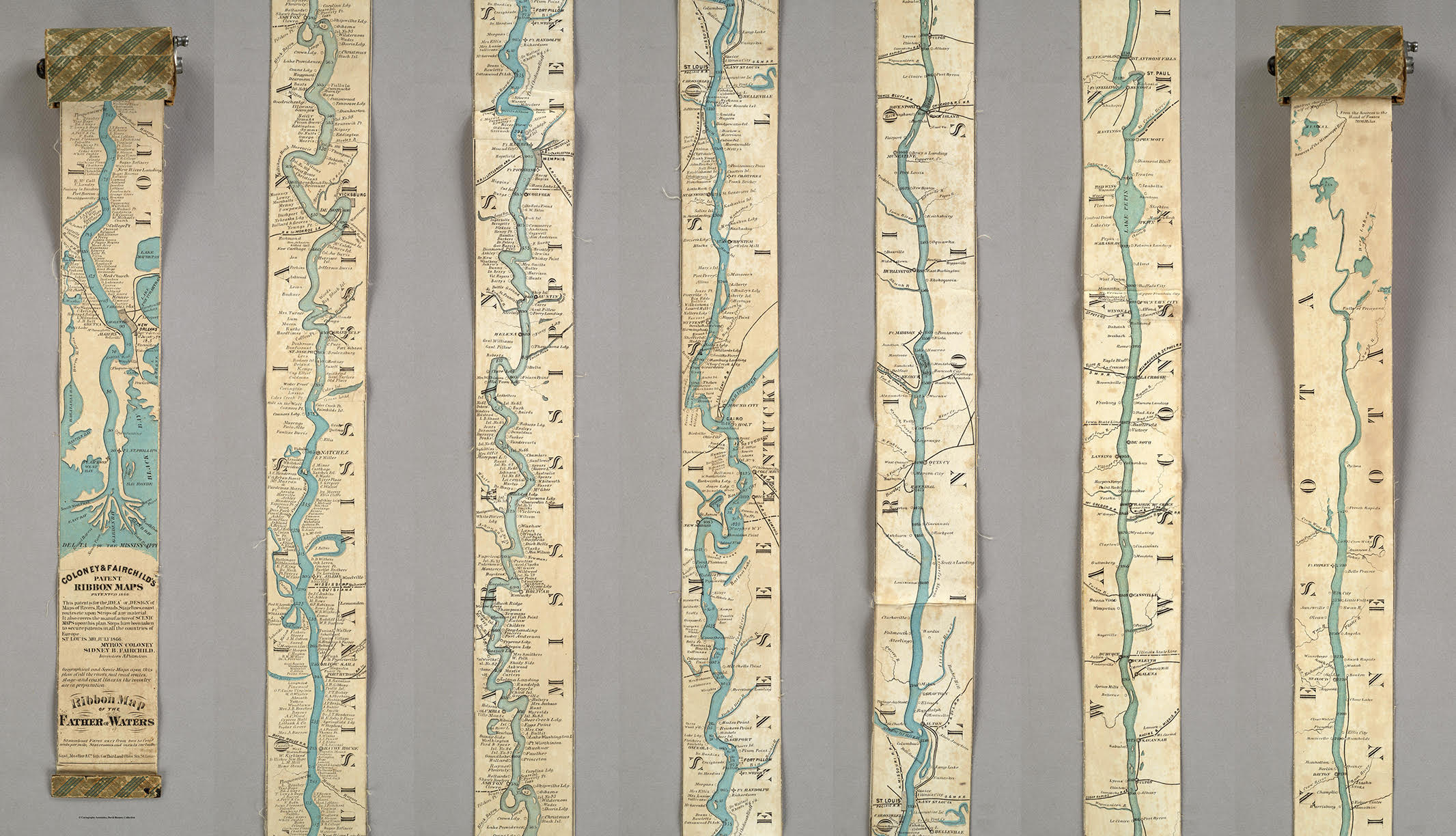
Ribbon Map of the Father of Waters, an 11-ft. ribbon map of the Mississippi River from the 1860s, sold to steamboat tourists. Photo courtesy of the Newberry Library.
The exhibit is organized around four broad routes across the US. How did this come about?
I am a geographer, so to start with, I think spatially more than chronologically. It just made sense to me to arrange the material geographically. This allows comparison of maps over time and allowed us to compare the perspectives of immigrants and settlers—say in the northern Great Plains—with the realities of the Native people who were displaced by them. It was very important to me this time around to move beyond tourism to a more inclusive idea of American travel to embrace not only of “voluntary” migration but also enforced migration and displacement and the restrictions on travel imposed on enslaved people.
The title “Crossings” expresses both the durability and salience of certain pathways across the country and the notion that travel can be a passage from one stage of life to another.
How did you finally settle on what to include, as you pondered the vast holdings of the Newberry?
That’s a messy process. There were perhaps 10 to 15 objects that I felt I had to include. The Owens 1936 map of California was one as it shows the state at a time it was a destination for so many. The Lewis and Clark manuscript was another. Beyond those, there were classes of maps I felt needed to be in there and places (like New York City, Chicago, and Los Angeles) that had to be represented somehow. So it comes down to this: from 30 to 50 good candidates for a particular place, which ones tell the story best, which are understandable with little commentary, which are eye-catching, and which are in good shape.
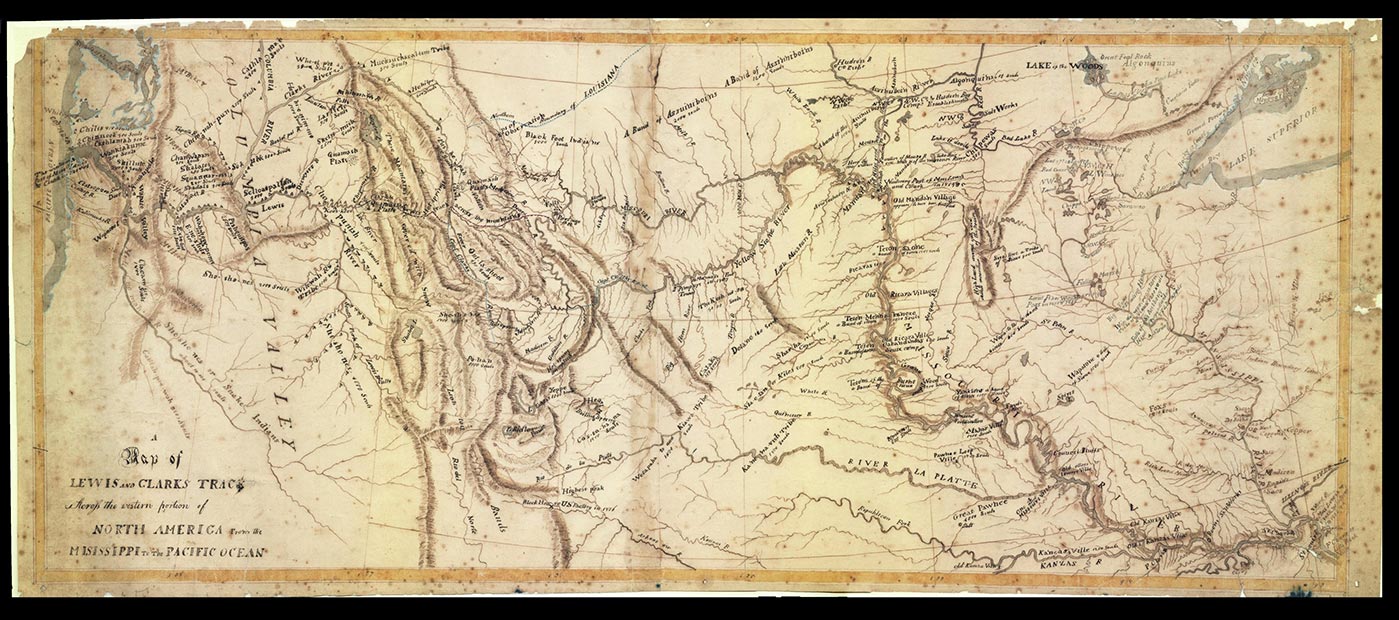
Map of Lewis and Clark’s route across North America from the Mississippi west, 1814. Photo courtesy of the Newberry Library.
Do you have a particular favorite item on display?
Early on I decided that I wanted to include a couple of large maps representing the view west from the Atlantic seaboard and the view east from the Pacific. One of the advisors to the exhibit advised Aaron Arrowsmith’s map of the United States in 1808, which only shows the country as far as the Mississippi. I wasn’t very familiar with the map, but I was surprised and thrilled when I discovered that the original owner of our copy had drawn in — perhaps around 1825 — canals that had come into existence since the map was published or which were proposed or under construction. It’s a great example of how dynamic the US transportation system was in the early 19th century.
There are several other maps in the exhibit that are annotated, and these are among my favorites. One of these is a guidebook to navigating the Ohio River that was annotated by a tourist from Connecticut about 1815. He noted each day where he stopped. There is a similar item a few feet away that was annotated for a gold prospector going to California in 1852.
Part of the reason I like these items is that I worked so hard to find them. Our catalog doesn’t always indicate whether an item is annotated. Several years ago, while researching a paper on map annotation, I found I had to locate items in our collection by spending many hours in the book stacks going shelf by shelf looking for likely candidates. Tedious, but very rewarding. Geeky too, I guess.
What items will visitors find the most surprising? For me, it was the explicit way that California’s tourism promotion in 1935 told people NOT to head to the state looking for work.
People seem to find that California map you mention very surprising. While people may have read The Grapes of Wrath and about the Dust Bowl, I think it is a shock to some that the rhetoric of this welcoming tourist map would be so explicitly unwelcoming to migrants. And of course, its resonance with the issues today is profound.
California in 1935: Tourists yes, migrant workers no.
A second example would be the pairing of the map of Minnesota and eastern Dakota Territories published in 1863 — in the wake of the US-Dakota War of 1862 — with the map issued by the Northern Pacific Railroad to entice German settlers to the same area barely ten years later. People who have been on tours with me have responded very strongly to that. It shows such profound change in the perceptions of that region in a very short time.
The grid on the earlier map shows the lands that were being surveyed for sale to white colonizers while showing the reservations that Indians had been forcibly removed from. So, though it makes no specific reference to the war, the lines on the map are, in effect, the imprint of the effects of the war — or rather of the larger, longer processes of removal and colonization of which the US–Dakota War was just one (very important) contributing event.
Ten years later, the railroad map shows the territory already being promoted for sale to one group of potential immigrants from Germany. This map barely recognizes the existence of the Indigenous inhabitants of the region, not only in Minnesota but across the entire line of the railroad (still under construction until the 1880s). For example, no Indian reservations are shown on the map, even though many tribes still lived in the region (as they do today).
Though the maps are 10 years apart, I think it is better to think of them not so much as a change in attitude — there was no fundamental change in attitude here — as two slightly different ways in which the process of removal/colonization is represented. One deals directly, and a larger scale with the details of removal for settlement. And one promotes colonization more directly by misleadingly showing the northern plains as a space largely devoid of indigenous people.
A third example is the Go Guide, a guidebook for African-American travelers during a time when prejudice was one of the greatest obstacles to travel in the US. Despite the brief fame of the Green Book,I think a lot of visitors find the Go Guide to be a surprise. It’s one thing for people to be vaguely aware of these types of prejudice, but for people who have not had this experience, it is a bit of a shock to be confronted with a publication that directly responded to the problems of Jim Crow travel. I’d like to think that several of the displays force people to be confronted with these realities.
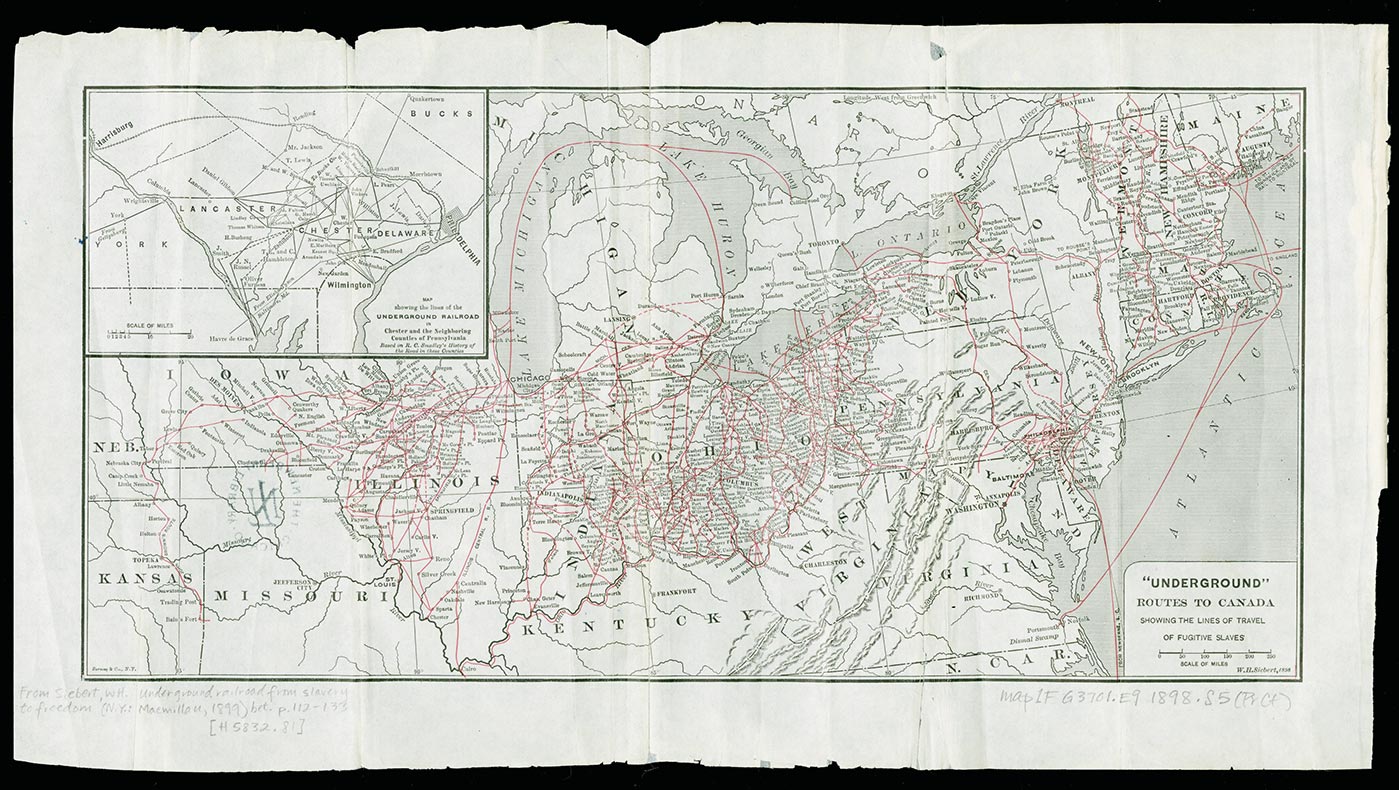
Map of Underground Railroad routes from Wilbur H. Siebert’s The Underground Railroad from Slavery to Freedom, 1899. Photo courtesy of the Newberry Library.
Can you give me an example of some content inside the Go Guide that may not be seen during the exhibition but which speaks to the experience of the travelers using it. How does it address prejudice in showing its readers where to stay and eat and how to travel safely?
Interestingly, the Go Guide doesn’t explicitly address prejudice. It adopts a more positive approach — just simply listing what is available and providing listings. There are several recent books that deal with the subject of travel in the Jim Crow era that cite personal accounts of the difficulties of travel in the Jim Crow. Of these, the best is Mia Bay’s Traveling Black.
If you were doing this exhibit in 50 years, what’s something relevant to the travel experience now that might be a core part of the exhibition?
Fifty years from now… a good question: In ways we cannot fully comprehend now, but which would be clear by then, the exhibit would probably be dealing with two ongoing events that are changing travel. One is the effect of climate change, which may seriously affect both the attitude towards travel and limit our ability to travel. Second, the limitations on mobility placed on us by Covid may not be temporary. It will be interesting to see whether the evolution of virtual travel may impact our desire to physically travel.
I’d like to think that our historical understanding of Native, African, and Chinese Americans in the story of American travel will have changed, but given recent attempts of politicians in some places to turn back the clock, I’m not confident of that.
How do you keep loving America when it seems to be doing everything in its power to be unlovable? The Statesider’s Pam Mandel finds herself thinking back on Palestinian dessert in the middle of Nevada, cowboy poets, a really big rock with a really problematic backstory, and why America is worth loving even when it hurts.
Some years back I went to Mount Rushmore. You know what I loved about it? Everyone was there. Big South Indian families spilling out of minivans. Black Americans,
How do you keep loving America when it seems to be doing everything in its power to be unlovable? The Statesider’s Pam Mandel finds herself thinking back on Palestinian dessert in the middle of Nevada, cowboy poets, a really big rock with a really problematic backstory, and why America is worth loving even when it hurts.
Some years back I went to Mount Rushmore. You know what I loved about it? Everyone was there. Big South Indian families spilling out of minivans. Black Americans, often wearing some kind of indication they’d served in the military. Amateur historians talking too loudly about the Crazy Horse monument down the road. Road-tripping Germans who just wanted to get a look at this thing. People like me, squinting in the bright summer light at the weirdness of those four huge heads blasted out of the side of a mountain.
Mount Rushmore was a terrible idea, a desecration of stolen Native American land. Yet what a thing it is to stand there among the visitors who are curious enough to drive out to the middle of South Dakota. How conflicting it is to be an American, to love so many aspects of our country while watching us eviscerate from our national character the very things that make us, well, great.
Last week’s Supreme Court ruling on abortion rights had all of us … I struggle to find the words and that’s rare for me. We were not surprised, no one who’s been paying attention should be surprised. I think my dominant emotion was anger. This ruling was followed by another ruling with equally foundation-shaking implications, the ruling on school prayer. This was more surprising to me than the abortion ruling, though again, no one who’s been paying attention thinks that this is about anything more than elevating Christianity, a thing that was never at risk. All this in the wake of another devastating school shooting, and yet another Supreme Court ruling limiting the ability of states to regulate firearms. Now, my dominant emotion is fear. I am afraid for our future.
When I am feeling particularly despairing about America, I go back in my mind to Elko, Nevada, where we came up with the idea for The Statesider. In Elko, we had an excellent Palestinian dessert and heard stories from Brooklyn Jews turned cowboys. Miss Elko, an immigrant from Sierra Leone — she worked as a mining engineer — read a Maya Angelou poem off her phone at the high school poetry slam. We learned about Basque farmers and had coffee with Becky and David from Wyoming. I bought a pearl snap cowboy shirt in a store that had been in business for more than 100 years. How surprising to find the best things of America represented in this place that feels, at first, like a freeway bypass with casinos and midrange hotels.
I don’t have any brilliant calls to action right now. Give money to places that support abortion rights, religious freedom (and freedom from religion), gun control; that’s the best I can offer today. I wish we could all meet in Elko, 2019. That we could take a minute to look at America, to remember what we love about it. I fear we will forget, and if we do not look back now, we will not come this way again.
If you’ve taken road trips around the US, chances are good that you’ve seen a cross on a hill. A single man from West Virginia erected nearly 2000 of them around the country. For a time in her life, Robin Caldwell had to drive past the 65 ft.-tall Nelsonville Cross near Athens, Ohio, but what was a symbol of love and peace to some was a source of fear and menace to her, until she came to see it — and the people of southeastern Ohio — in a new light.
The Nelso
If you’ve taken road trips around the US, chances are good that you’ve seen a cross on a hill. A single man from West Virginia erected nearly 2000 of them around the country. For a time in her life, Robin Caldwell had to drive past the 65 ft.-tall Nelsonville Cross near Athens, Ohio, but what was a symbol of love and peace to some was a source of fear and menace to her, until she came to see it — and the people of southeastern Ohio — in a new light.
The Nelsonville Cross in Nelsonville, Ohio, sits on top of a hill. A very high hill. Daytime or night, it was the scariest thing to witness, especially if you were a heathenish Black teenager from Cleveland, Ohio. A real city girl who rarely attended church and didn’t want to be reminded of Jesus or lynchings. I was enjoying the freedom of freshman year at neighboring Ohio University, and that cross only served to kill my vibe. If it didn’t involve shaking my behind at Black frat and sorority dances, eating pizza every other day, and hanging out at “Boy Central” or the College Green, I wanted nothing to do with it.
But I had received “The Talk” at home, and Black upperclassmen shared enough lore about that cross, the Klan, and how to move about in the county. I understood the parameters of my freedom.
According to my granddad, there was one road I needed to know: the road that would lead me home alive. That would be US-33 West. He believed that was the safest way, with a multitude of places to stop before taking a northern route to Cleveland. The only problem with his plan was that I had to go through Nelsonville and see that cross.
On the way home to Cleveland for a weekend visit, you would have thought we were being hit by a hailstorm of bullets, when a car backfired. I yelled “Shit!” and thought “sniper” as I hightailed it out of a gas station in Nelsonville with my boyfriend and his cousin, the driver. From my crouched position in the backseat, I looked up at the hill bearing that cross, wondering how something so precious to my religious great-grandma could also symbolize harm and hatred.
That was at 17. Fast forward to several years later, when I was a graduate student, driving that same road in and out of that same town. More mature and armed with a few “big girl” experiences in the city, such as suffering through the telling of cringey jokes in the workplace, training supervisors with less education, and overhearing a waitress whisper “n—r” under her breath after I politely asked her to service my table. Little did I know there would be more of that later in life, but at the time of my return, these interactions led me to pursue better.
Some of that better was found in the quiet hills off of SR 32. I lived in a four-unit apartment building, an anomaly surrounded by farmland, a few houses and the woods. It was part sanctuary and part remedy for any distracting temptation I had in town. The peace and quiet were welcome. I’d only drive out of those hills to go to class, to work, to hang out, to shop and to leave town.
Regularly, I’d drive from Athens through Nelsonville to study in Columbus on The Ohio State University campus. I also taught at a prison near the state capitol, which made driving past the cross unavoidable.
The Nelsonville Cross (Photo: Hoosier Boo)
Though I was no longer a heathen by my best estimation (Jesus was now my friend), that cross continued to make me feel a bit uneasy. The people, though, did not, because by that time I had pretty much figured out that humans were complicated. Some could be kind just because and a few were just outright insufferable. Plus, there was the issue of my own issues, which enabled me to extend a grace that could be both dismissive of the ignorance and somewhat tolerant, knowing I would some day leave.
From my undergraduate days, I remembered a rumor that the Grand Dragon of the KKK lived in Nelsonville. I knew they had a branch office or rally bureau — whatever they call it — nearby, because I’d seen them passing out propaganda to the students.
One spring quarter, I attended a Klan rally in Parkersburg, West Virginia, just over the state border, under the ruse of getting video footage for class. My friend D, a classmate and an experienced videographer who shot footage in Gaza with bullets flying over her head, and I romanticized what it would be like to be on the frontlines of a hot racist mess. In truth, there was no class assignment; we were both simply curious and decided to go as a team.
We were nervous on the way to Parkersburg. We discussed everything from protecting our eyes in the event we were bombed by teargas, to finding each other if pandemonium broke out, to “tell my family I love them” instructions should one of us perish. We also knew that I would be the first one to freeze up when it was time to run, so I had to promise to let her lead.
We pulled up at the site of the rally, parked, looked around and quickly realized all of our jitters, planning and dreams of a Pulitizer were for naught. It was one of the most uneventful rallies ever.
I expected — and wanted — drama like Oprah found in Forsyth County, Georgia, replete with confederate flags waving and “Go back to Africa” signs and lots of venomous yelling. There wasn’t one thing that looked like we’d ever seen on television, not even a Bull Connor. If the rumored Grand Dragon was there, he was unrecognizable. The only other Black person at the rally, who appeared to be leaving, told us that Parkersburg law forbade the Klan from wearing hoods and regalia during rallies. They had to show their faces. The only person I recognized was a white anti-Klan protester suspected of being a Vietnam draft dodger hiding in Athens County. He called me and my friend “ignorant,” because we dared to engage a Klansman in conversation. He smelled like onions. I had to politely tell the “ally” that he was out of line and insulting. Hell, I’m being nice. I told him to step off.
The Klansman was young and relatively easygoing. He answered our questions like a champ. I asked him everything but “Who’s your mama?” Curiously, he volunteered that he joined the Klan because he didn’t like that all the jobs were being taken by immigrants and “the coloreds.” I asked him what he did for a living and he said he was a farmer.
“Is an immigrant or a ‘colored’ trying to take your farm?” He said no. Did any immigrants or coloreds actually own farms in the area? Most of the immigrants and “coloreds” I knew in the region worked at the university or were students and professors. There were a few others working at hotels and stores in low-paying jobs. A handful owned little restaurants, and I knew he wasn’t trying to cook Mexican, Thai or Greek food. That child made me tired.
Map of southeastern Ohio (1827)
I stood there, feeling a bit childish for wanting that rally to be a spectacle, while pondering something one of the Black elders at my church in Athens shared about the region. Parkersburg along with Marietta and Belpre, Ohio were stops on the Underground Railroad. Adam Clayton Powell, Sr. and Booker T. Washington spent time in the region. Powell preached at my church as a young man while Washington married a woman from Athens County. This was not the Appalachia of Lil’ Abner and every conceivable stereotype.
My thoughts were interrupted by the young Klansman saying something about “Americans,” and that’s when it hit me. I am an American. Born and raised in the United States. A voter. A taxpayer. Most of the men in my family served in the military.
“Do you know the words to the Star-Spangled Banner?” I asked.
He chuckled and said no. Mind you, I didn’t know all of the words to the Star-Spangled Banner, but I’d mouth it as needed.
“Look, you seem like a decent man,” I said. “I bet if you saw me lying on the side of the road, you’d check on me and help. Am I right?”
He said yes.
I thought, young and dumb, which is what that protester thought of me. The Klansman knew his own mind like I knew my own, so I stopped selling him short. His decision to belong was as willful as my decision to be all peace, love, and Soul Train. After I sighed and surveyed the scene, I noticed that the oniony draft dodger was staring in our direction, as were the Klanspeople. It was our cue to leave.
D and I thanked him for his time and honesty, wrapping up my first and last Klan rally experience. We didn’t have much in the way of video footage but we had a story to tell. We also had a lot to process during our drive back to Ohio and Athens County. Thankfully, this experience was between the two of us, more about our own ambitions, so we owed no explanations.
But we certainly had a lot of questions. How could someone promote something that warred against his own goodness? What made the Klan equate American nationalism with white skin? And, why didn’t we just leave when the other Black person left?
A few weeks later, my grandmother died. It was sudden. It was heartbreaking and after the funeral I sojourned back to Athens not the same.
Life was a series of blurry vignettes. I recall smiling and laughing. Falling into a crying, heaving heap in the grocery store, staring at a shelf of canned soups. Sleeping in the middle of a day only to wake up in the middle of the night, gasping for air. Breathing, not breathing. Living but dying on the inside.
That’s grief.
Have you ever been lost, but know exactly where you are?
That’s grief in Southeast Ohio. Appalachian grief. My grief in a place that had become home, albeit a temporary home.
I would be in the middle of a crying fit, when I’d have to stop my car on a back road to pick up a turtle and move it out of my way, or painfully wait at a crossroad to let two dogs finish having “relations” from one side to the other. One time I was coasting down a hill and my car rolled right over a water moccasin. (It was fine. I was not.) Coming home to find a raccoon resting in front of my door answered a lifelong question: yes, I can scream like they do in the movies. Grief keeps going, even through animal encounters, because God knows my human encounters were limited due to self-isolation.
But not forever. One pitch-black evening, I was bending over to gather groceries off of my backseat, and was nose-goosed by the dog who lived down the lane. He was saying hi. I could hear toads and crickets but I hadn’t heard my neighbor’s black lab-St. Bernard mix, Claymore, walking across my driveway’s gravel. After he goosed me, I jumped into the car and saw nothing but yellow eyes until mine focused. Bless him, that sweet boy resuscitated my broken heart, a heart that had leaped into my throat, still pumping.
As the days and weeks passed, I started socializing with humans more. I needed them too, right? The problem was I was stuck way past the 21 days to make or break a habit phase and Elisabeth Kübler-Ross’s Five Stages of Grief. Grief was my new normal and hanging around people who were happy made me uncomfortable…for them.
There were four women — two Black and two white — who showed me the generosity often expressed in the region though not often received by outsiders. In a way I can’t describe, it was easier to be around them and not feel like a burden or energy zapper.
Three were Appalachian born and bred, and one was a transplant who was more town than gown yet affiliated with the university. The four friendships — unlikely relationships — left me with more than I could ever return.
My Appalachian pals taught me about the culture and how to appreciate everything from its endogamy (everyone seemed related) to its foodways to hidden histories to how to empathize with the people. It was almost like my grandmother willed them to me. Some years later, I would learn that my grandparents had kin in Athens County, and that I was a cousin to some of the white and Black residents. It all made sense. The hospitality shown to me was what I’d grown up witnessing and living. We didn’t identify as Appalachian, never said it out loud, but those roots showed up in earthiness, warmth and comfort. It was simpler to say we were Northerners with Southern history, but my DNA and family tree said “Appalachia” from the hills of Virginia to Ohio to Tennessee, Kentucky and West Virginia.
Lori, a white woman of Scottish descent, often had me ride with her to the small towns enveloping Nelsonville, and we had to pass that cross. I told her how I felt about it and how it scared me, and she laughed.
“The Klan didn’t have anything to do with it. A man built that for his late wife,” she said.
She took the time to drive me up there. The grounds were idyllic and lovely. Relief washed over me when I figured out it would be next to impossible to go all sniper from the foot of that cross. It would take a couple of hours for it to register, but it was the first time I enjoyed a good belly laugh at myself without stifling the joy.
Plaque at the Nelsonville Cross, dedicated to Betty Schwartz by her husband Bud Schwartz. The Nelsonville Cross is thought to be the only large cross dedicated to a woman. (Photo: Hoosier Boo)
Suzanne, a woman who lived on a small farm down the lane, also showed me great affection and care. Besides handing me a business card for grief counseling services, she gave me other gifts like long morning walks throughout the countryside and experiences like riding a horse and driving her tractor. Thanks to this lady, I learned how to crawl underneath barbed wire to avoid cow chips in a pasture. I also learned how Quakers worship and would attend meetings with her. The physical activity became enough for me to sleep better at night.
Violet and Irene were my Black elder friends. One look at Violet and I would remember all that I’d lost. She looked like my grandmother, my great-grandma and aunts — the women who formed me and taught me that it’s okay to be me. One conversation with Irene, reminded me of the simplicity of smelling rain in the air, listening to birds chirp and sitting still to catch a breeze. Violet grew up in Athens and attended the university. Irene lived up in Kilvert, a community of WINs (white, Indian, Negro) people or what we now call tri-racial isolates. Both taught me what it was like to be Black in rural Appalachia. The two were even related by marriage. Irene was old enough to be my mother and Violet was like a surrogate grandmother to me. Between them I learned local Black history, about family connections, and how they as Black women negotiated racism in the region.
Lori, Suzanne, Violet and Irene were my safe spaces as I started to manage my grief better with counseling.
And just when I was depending on my four friends the most, my time was up. I had to leave Athens to pursue work and become my grandfather’s caregiver in Cleveland.
Just before leaving town, I drove up to that cross, all by myself. I walked around, examined the enormity of the structure, and sat a spell to meditate. The man who built it had no idea that it would be the focus of conjecture and defamation. That a Black girl — now a woman — would ever be afraid of it, thinking she could potentially swing from it. That people could look at the same thing, in the same place, and see it in such different ways. That I would ever question if I’d stop for that Klansman to help him on the side of the road. His decency was no longer a concern, but my own decency needed examination. Yet, he would be comforted knowing that the thing he endeavored, the giving of hope and peace, I would receive one day.
At the cross, at the cross where I first saw the light, And the burden of my heart rolled away It was there by faith I received my sight, And now I am happy all the day!
Happy-ish. Most days.
Top image: Vintage postcard from Nelsonville, Ohio, with a double rainbow over the train depot (c. 1910). See the full image.
In this Issue of the Statesider Roadside crosses, crossing America, and what to do when America makes you cross. Plus: noodling with King Catfish, Filipino Virginia, Black rodeo in photos, an ode to Costco, a chewy story from the Jersey Shore, Juneteenth in context, and the people who are rethinking Native art and cuisine.
Cross-eyed in Appalachia
The Nelsonville Cross, Ohio
There are thousands of roadside crosses across America, but for Robin Caldwell, one looms large: the 65-fo
In this Issue of the Statesider Roadside crosses, crossing America, and what to do when America makes you cross. Plus: noodling with King Catfish, Filipino Virginia, Black rodeo in photos, an ode to Costco, a chewy story from the Jersey Shore, Juneteenth in context, and the people who are rethinking Native art and cuisine.
Cross-eyed in Appalachia
The Nelsonville Cross, Ohio
There are thousands of roadside crosses across America, but for Robin Caldwell, one looms large: the 65-foot tall Nelsonville Cross she regularly passed on her way in and out of Athens, Ohio. For some, the cross gave comfort, but for a young Black woman in a county with a visible KKK presence, it did quite the opposite — until she learned the real story. Read this Statesider Original Story
How have people crossed America in the past? A recent exhibit, Crossings: Mapping American Journeys, at Chicago’s Newberry Library, told the story of various crossings, from the underground railroad to early road tripper in a series of historical maps. Ryan Ver Berkmoes spoke with the curator, Jim Akerman, about how the maps were selected and what we can learn about the future of American travel. Read this Statesider Interview
Stories Across the US
Topless in Nantucket: There once was a man from Nantucket, who said prudish laws should go suck it. “Just take off your shirt, no one will get hurt. Tradition? I say…” Zac Thompson, Frommer’s
Puerto Rico’s Complicated Rebound: A nuanced look at Puerto Rico’s tourism recovery, what it means for locals, and the lessons for other destinations. Dennis Schaal, Skift
Gone Noodlin’: Stick your hand in a catfish’s mouth with Oklahoma’s Catfish King. You go first. Matt Carney, Outside
All You Can Eat: The decline of one of the US’s great culinary innovations: the all-you-can-eat buffet. Addison Del Mastro, The Bulwark
Black Fishing: A Puget Sound fishing trip inspires a look back at the connection of Black Americans to fishing and boating. Nneke M. Okona, Charlotte Observer
For us, when we take to the water, it is not only to delve into leisure and slow the pace of our lives and center it in gratefulness; it is also active reclamation.
Black Rodeo Rides Again: A new photographic book follows America’s only touring Black rodeo. Lauren Moya Ford, Hyperallergic
Native Foods: The renaissance — and reimagining — of New Mexico’s Pueblo cuisine. Tag Christof, Fifty Grande Magazine
Laffy Taffy: How salt water taffy became a Jersey Shore staple. Warning: includes hypnotic taffy pulling video. Kae Lani Palmisano, Philadelphia Inquirer
Jersey Gulls: Ocean City, New Jersey cleared the gulls from its boardwalk by looking to an ancient art: falconry. Andrew S. Lewis, New York Times
Tasty Juneteenth Reads: The Oxford American pulled together an impressive collection of 10 original stories for Juneteenth this past month, with a strong lean into the culinary traditions of Black America. Take your time with this one. On Jubilee: A Juneteenth Series, Oxford American
Costco Love Song: The power and the glory of Costco, and its lasting influence on immigrant families in the US. Yuxi Lin, Longreads
More than anything, I lust after the microwavable cheese-filled pierogies. “Trash food,” my mother calls them. I tell her that I aspire to be a trash can.
Caribbean Soul Food Queen: The story of “Queen Trini’s” ascension to the throne of New Orleans’ Caribbean soul food kingdom. Tami Fairweather, Very Local
A Sea By Any Other Name: Are the Great Lakes really “inland seas”? Do you love a delightfully pointless nomenclature argument? Us too! Gemma Tarlach, Atlas Obscura
Hummingbird Detectives: Meet the elite group of licensed hummingbird banders who are trying to figure out why certain species are declining across the US. Jessica Bradley Wells, Bitter Southerner
What is Native Art? Cannupa Hanska Luger is making the art world rethink what Native American art can be — and why there has been pressure for it to look a certain way. Joshua Hunt, New York Times
Filipino Virginia: Exploring the history and the current food scene in Norfolk and Virginia Beach, which has one of the largest populations of Filipino Americans on the East Coast. Norie Quintos, National Geographic
The Tough Love Department
Where Do We Go From Here? It’s been a tough month in America for women’s rights, gun safety, climate change, and faith in the grand American experiment. What is an America lover to do when it’s behaving so unlovably? The Statesider’s Pam Mandel finds herself thinking back on Palestinian dessert in the middle of Nevada, cowboy poets, and one of our most divisive landmarks: Mt. Rushmore. Read Pam’s Essay
What We’re Listening To
Strong Sense of Place: The folks from the travel podcast Strong Sense of Place are always worth listening to, but we love when they bring their world-roaming ways back to American destinations. In their recent episode, “Appalachia: Buttermilk Biscuits, Bluegrass, and a Big Blue Moon,” they celebrate Dolly Parton, dive into regional folklore, and daydream about banana pudding — which is exactly what we’re doing now, too.
Happy Family: A fictional (but very recognizable) story of lost childhood, a struggling restaurant, and a bygone era of Chinatown. This story can be enjoyed in multiple ways — as an audio reading with original music, or as a beautifully illustrated story. William Pei Shih, Ursa
In this Issue of the Statesider An ER doctor learns to hunt, tourists clamor for swimming horses, really big trees you can see (and ones you can’t), solo trips into the wilderness, and other stories of camping and the great outdoors. Plus: Weird Al fans marvel at a ball of yarn, accurate New Jersey, glowing Florida, and everyone fries chicken in their own way. Also: we love delis. So much.
Life in the Crosshairs
What happens when an ER doctor who spends his days saving liv
In this Issue of the Statesider An ER doctor learns to hunt, tourists clamor for swimming horses, really big trees you can see (and ones you can’t), solo trips into the wilderness, and other stories of camping and the great outdoors. Plus: Weird Al fans marvel at a ball of yarn, accurate New Jersey, glowing Florida, and everyone fries chicken in their own way. Also: we love delis. So much.
Life in the Crosshairs
What happens when an ER doctor who spends his days saving lives goes to hunting school in eastern Washington and learns how to kill? Ramesh Reddy goes all in to learn the art of the hunt — and what it means to be a meat eater in the modern world. Read this Statesider Original Story
Weird Al Wanderlust: Darwin, Minnesota is home to a very large ball of twine. It also attracts visitors with a deep love of the music of Weird Al Yankovic. Charlie Gillmer, Medium
Follow Your Dreams, People: Colorado Springs man becomes the fourth person to push a peanut up Pikes Peak with his nose. That’s right: fourth. Abigail Beckman, Colorado Public Radio
What You’re Missing When You’re Not Watching Stickball: Did you miss the World Series Stickball Championships, the pinnacle of the centuries-old, full-contact Native American sport? Or the crowning of the new Choctaw Princess? Here’s your update. Lukas Flippo, Mississippi Free Press
Superheroes, Seedy Cities: Hollywood rarely captures things in a perfectly realistic way. One writer from Jersey City wishes the latest big-screen depiction of his hometown was, well, a bit less nice. Aymann Ismail, Slate
Global Gentrification: The pandemic created a whole new generation of American digital nomads: tech and knowledge workers cut free from the office. But what are all those Americans abroad doing to the local economy in places like Mexico City? Yeah, it’s… not great. Mary Steffenhagen and Alana Casanova-Burgess, The Takeaway
The Great Outdoors
The Not-So Lone Rangers: The six rangers of the Maryland Assateague Island state park have a lot on their hands: 85 wild horses…plus 2 million tourists. The magic of the island from the perspective of those who know it best. Mickie Meinhardt, Bitter Southerner
Good to Glow: We’re suckers for the eerie glow of bioluminescent waters, but there can be too much of a good thing. At Florida’s Indian River Lagoon, the colorful nighttime show is a warning sign. Terry Ward, National Geographic
Among Giants: The location of the Grove of Titans was secret. Until it wasn’t. Now Jedediah Smith State Park in Northern California has opened a new elevated walkway to the grove of ancient redwoods to let visitors enjoy the massive trees without tearing up the forest floor. Christopher Reynolds, LA Times
Just Not This Giant: Hyperion, the tallest of the redwoods — in fact the tallest living thing on the planet — has also been suffering thanks to an internet doxxing, but instead of a new elevated walkway, there’s a new $5000 fine plus the possibility of 6 months in jail if you try to go see it. We’ll pass. Juliana Kim, NPR
Messy Conversations: Mountain towns of the West may profess a “Good Vibes Only” attitude, but they still struggle to deal with racism. It’s easy to pretend it’s a non-issue unless you’re affected. Emilé Zynobia Newman, Outside
I’ve lived in the Mountain West for close to 20 years now, and I’m telling you I’ve never felt more unsafe in my lifetime than I do now. It’s all around our liberal mountain bastions.
After the Floods: The recent flooding of Yellowstone ruined some vacation plans, but it also breathed new life into Yellowstone’s natural ecosystem. Nick Mott, High Country News
Solo, So Good: What is it about solitude in the wilderness that leads to moments of self-discovery? A personal tale and a look at the science. Wudan Yan, Sierra Magazine
Are You Gonna Eat That?
We Were Born Ready: Get ready for Indian fried chicken. Jaya Saxena, Eater — part of the larger package of drool-inducing stories, The United States of Fried Chicken
The Great Iowa-Japan Bacon Connection: The American embassy in Tokyo has a whole section on its website dedicated to connecting Japanese and American cultures, including plenty of food stories. Our favorite: the tale of how an Iowa pork-booster organization helped establish the Japan Bacon Festival. American View (published by the American Embassy)
In a Pickle: “I would get so hungry at this exhibit, I wouldn’t be able to take it.” Statesider editor Andy Murdock on a traveling (should we say wandering?) exhibit about Jewish delis. Adam Nagourney, New York Times
Mac Salad, Protein, and Two Scoops of Rice: A whole lot of Hawaiian-style plate lunches come out of the L&L plus, 20,000 Spam musubis a day. But the L&L started as a tiny family-run place in Honolulu. Christine Hitt, SF Gate
What We’re Reading
The High Sierra: A Love Story, by Kim Stanley Robinson. If you know Robinson from his long science fiction (and climate fiction) career, including Ministry for the Future, New York 2140, and the Mars trilogy, this one will come as a surprise. Since a life-changing trip in 1973, Robinson has returned to California’s Sierra Nevada over 100 times, and he’s still backpacking at 70. This book is unlike others you’ll see on hiking the Sierra: it weaves personal stories with philosophical essays on the value of wild spaces and their effect on the human psyche, and even includes practical tips on hiking the Sierra gleaned over a lifetime of exploration. If you’re feeling burned out by city life or too much time in front of a flickering screen, this book is a reminder that there are still places that can wash that all away. Buy a copy today through the Statesider shop
Hunting school in eastern Washington isn’t the first place you’d think to find an ER doctor. But Ramesh Reddy, who usually spends his days trying to save lives, was driven to learn what it feels like to take one — and to truly understand what it means to be a meat eater in the modern world. (Illustrations by Peter Striffolino)
My ears popped as we descended into the twinkling lights of Spokane.
I felt both a sense of unease and excitement. Traipsing into the wi
Hunting school in eastern Washington isn’t the first place you’d think to find an ER doctor. But Ramesh Reddy, who usually spends his days trying to save lives, was driven to learn what it feels like to take one — and to truly understand what it means to be a meat eater in the modern world. (Illustrations by Peter Striffolino)
My ears popped as we descended into the twinkling lights of Spokane.
I felt both a sense of unease and excitement. Traipsing into the wilderness to camp, let alone hunt, was something so foreign and unknown to me that it might have been an expedition to another planet. Brown people like me didn’t camp or cavort in the wild.
My colleague and friend Kyle and I set out by car for our destination, the Human Nature Hunting School. A three-hour trip on long winding roads led us from civilization to increasingly remote and mountainous terrain. To the north of us was the Canadian border, to the east was Idaho.
As I drove this endless two-lane highway, my mind drifted to the events leading up to this moment. Twelve months earlier, I had discovered Steven Rinella, the celebrated American hunter and author. I devoured his book, Meat Eater, and became obsessed with the idea of learning to hunt.
Speaking to a vegan at a book signing, Rinella once mused, “I admire the idea of deer more than the individual deer, and I can assure you that I know more about deer than you ever will, and I’ve learned that through hunting for them, and I probably care for them in a way that is deeper than anything you will experience from having a more removed perspective on it.”
This philosophy encapsulated everything I wanted out of hunting. I didn’t want to be distanced from my food, sheltered from the reality of what it means to eat meat. I longed to pay the karmic price for a meal.
I’m an emergency physician, and against all logic, I was about to wade knee-deep into a pursuit where success is measured by an outcome that I try to prevent on a daily basis: death.
I had recently started to wonder about the ethics of food — not only the environmental impact but the moral one. Should something die so I could slather it in ketchup and wedge it between two buns? Particularly when I had options that didn’t require something to meet an untimely demise?
Vegetarianism was starting to creep into the outer perimeter of my brain, but I quickly banished the idea. “For god’s sake man. Don’t you enjoy feeling full!?” I scolded myself. Somewhere deep down, I felt, teleologically and anatomically, humans were meat-eating creatures. Humans have been hunting for hundreds of thousands of years.
Eating meat had always been something reflexive, necessary almost. A meal divorced from meat felt naked and hollow. For some, simply giving it up is a straightforward answer to this dilemma, but the truth is, I didn’t want to give it up. Hell, I wasn’t going to give it up. So, how could I bridge this cognitive dissonance? In my mind, there was one answer. Hunting. I would kill my own meat, and in doing so earn the right to eat it.
For a while, I dismissed this bizarre pre-occupation as some fleeting mid-life crisis, but the urge to learn this ancient skill only became stronger.
The irony of this pursuit did not escape me. I had spent the majority of the last 15 years trying to save people’s lives. I’m an Emergency Physician, and against all logic, I was about to wade knee-deep into a pursuit where success is measured by an outcome that I try to prevent on a daily basis: death.
I approached hunting like I did everything else in my life — full-on. I read everything I could get my hands on and was fortunate to have some guidance from a local hunter, Nick, who took me under his wing when he could. Nick and I had many conversations about killing and its meaning. Nick explained that it was nothing he looked forward to; it was just a necessary part of the harvest. Unlike most of us, Nick looked his meat in the eye and took ownership of its death. For the average meat-eater, there is no consideration that the Saran-wrapped, red slab sitting on white styrofoam was once a living, breathing animal.
It took a few months, and a few uncomfortable stares as the lone brown guy at the range, but I got my gun license and learned enough archery to hit a target reliably from inside 20 yards. I decided my intense self-study would culminate at the “Awaken the Hunter” program offered at the Human Nature Hunting School, one of the few hunting schools in the world.
I redirected the drifting car back off the rumble strips as I snapped out of my daydreaming. Kyle gave me a look of fleeting consternation as I straightened the car out. Kyle, an emergency physician like myself, had also recently become curious about hunting and decided to join me on the journey.
Mountain ranges jutted out all around as we turned into a winding unmarked dirt road that carved its way into a clearing, a timber-frame cabin at the base of the valley. We parked our car next to a sizable fenced-off vegetable garden. We unbuckled ourselves, exited the vehicle, and stretched like cats.
We were surrounded by an expanse of pine, fir, and larch. It rose from the clearing in all directions. A tapestry of green, capped by the blue sky. The air felt cool, and it had a sharp bite. It was noticeably less dense, unencumbered by human pollution. I felt my palate reset.
We were met by Bruce, the bearded and languid camp leader in his mid-forties who strolled out with his hand extended.
“You made it, guys! And earlier than we thought,” Bruce said, welcoming us to the camp.
He looked like a cross between John Wayne, Hemingway, and a yogi. I’d heard him on the phone previously. Still, it didn’t register until I met him in person that his slow, deliberate cadence meant I was never sure when he was finished speaking. Bruce was a structural engineer, but his real passion was hunting, so he set up a parallel career helping people reconnect with nature through hunting for food. This was the mission of his school. He’d built a cabin with his bare hands on 330 secluded acres of family-owned property. He was joined by an assistant and our camp cook, Mr. T, a giant Danish Viking who trained as a classical chef and worked in Seattle.
Our classmates arrived one by one, a motley crew of middle-aged professionals brought together in the middle of nowhere from different corners of North America. We engaged in small talk and exchanged introductions.
The Engineer was funny and eccentric. He was dressed in hardcore camo. A jiu-jitsu black belt and an amateur comedian, he was an avatar of Joe Rogan, only smaller. The Financier was an aspiring survivalist who wanted to add hunting to his repertoire of skills. He was a single dad living in Atlanta, who I suspected had some money to burn and adventure in his soul. He had his blood type displayed on his backpack.
The Architect was the most perplexing. Pleasant enough, but distant. He had a hipster vibe and had done a lot of interesting things, including studying Chinese holistic medicine. He had moved from Brooklyn to the West Coast for a high-profile design job with a major corporation. He mentioned that he was a new father, and he was looking to connect with nature. Maybe he would show his son this type of lifestyle someday. We were all there to learn the ancient art of the hunt, but part of me wondered whether we were all just working out our demons in the woods.
Since the weather was agreeable and there was plenty of daylight, we decided to camp outside. I was embarrassed to admit that I had never camped before, but Kyle gave me some tips. Some were immediately useful — avoiding condensation in the tent, sleeping in dry clothes, going to the outhouse twice before bed to avoid midnight trips, keeping your light and water bottle right by your head — for others, it was too late. “You should have brought a warmer sleeping bag,” he said, showing me the temperature ranges on it, and I had no pad to protect me from the bumps and chill of the ground. Nevertheless, I managed to set up a tent in a valley of birch trees below the cabin. It was amazing to me that an entire human shelter could fit in a backpack. Once assembled, I wondered what it would be like to sleep with just a thin, water-resistant polymer sheet between me and the elements.
We reconvened at the cabin, and Bruce began the first meeting. We had a packed schedule over the next few days. It wasn’t hunting season yet in Washington, and none of us had Washington state hunting licenses except him. The goal was for the group to learn enough skills to head back home and hunt in our local areas.
Bruce began with an exercise. “I want you to close your eyes and imagine a bubble around you, just around your body. Now expand and push it in all directions 10 yards.”
For a second, I thought “Is this guy fucking serious? A bubble?” But that feeling evaporated quickly. Nobody laughed or rolled their eyes. When you are out there away from civilization you start to feel it in your soul. I decided to go with it, bubble and all.
“Now expand it another 50 yards,” he continued, our invisible bubbles growing with his words. “Picture your bubble stretching deep into the ground, integrating with the land. Now imagine your forcefield extending hundreds of yards into the forest. Feel the connection with the trees, the birds, the animals. Now open your eyes and get ready to go.”
Later, Bruce led us on a hike into the mountains, showing us how to use binoculars to “look through the forest,” how to estimate your yardage — your distance from a target — and read deer signs, the tracks, the scat, the scrapes against trees and bushes. Finally, after about 45 minutes, he took us to a location in the forest and left us there. We weren’t sure how long we would be there, but we would sit quietly and write down everything we heard, saw, or smelled.
I’d been practicing this even before the bubble exercise, and I found my senses were heightened for this moment. I recorded the patterns of the wind, the shadows created by the sun, the scamper of squirrels, different tracks in the mud, even the types of birds.
“Everyone, set your hands on the animal and take a moment.”
Bruce eventually returned and took us further into the forest where he had strategically placed replica deer and conducted an exercise to see if we could identify where they were. This took surprisingly long and emphasized how difficult it is to make out a deer or elk in the woods. We humans may have our own camo, but theirs is better. We also conducted our own exercises to identify each other moving in the wood. This was extraordinarily easy. I realized how obvious and clumsy we must appear to the animals.
We swung back and hiked to camp. Bruce disappeared while we sat on the deck of the cabin. The sun was descending. One of the things I had never considered in my modern daily life was daylight. How precious it is. Out in the woods, you race against the sunset. After the sun went down, I became keenly aware of how much I could not see in the forest at night. Humans are not creatures of the night, but others are. I gripped my headlamp tightly.
“Gentleman, there is an animal down, and you need to follow a blood trail,” Bruce said.
An animal that has been shot often bolts away, leaving a blood trail, only to lay and rest in its final spot as it succumbs to the bleeding. The skill of following a blood trail is one of the essential components of a hunt.
We followed a blood trail created by Bruce to a clearing deep in the forest. He showed us how the blood trail disappeared, then reappeared—forcing you to explore and connect the dots. We tracked the trail into the forest, and then there it was, not a deer or another wild animal, but a freshly killed hundred-pound sheep on the ground.
“Everyone set your hands on the animal and take a moment,” Bruce solemnly said.
In the frigid cold at twilight, all of us placed our hands on this literal sacrificial lamb. Bruce procured this animal for the course, and it was dispatched just shortly before we were to find it. He set the whole thing up. Fresh death feels eerily close to life. The heartbeat and respirations cease, but the heat is still trapped. It was a sadly familiar feeling. As an Emergency Physician, I’ve had patients suffer cardiac arrest right in front of me. I’ve felt the lifelike warmth of their skin even after the heart has stopped.
“Let’s go over how to process the animal,” Bruce said.
We proceeded to gut the sheep. Neither Kyle nor I had ever butchered an animal. We had both dissected cadavers in medical school and done surgical rotations, not to mention the invasive procedures we do for work. It felt familiar enough that Kyle and I went to work automatically, with Bruce kneeling beside us. We started by removing the intestines as a whole. It has to be done carefully. If you puncture the bowels, you will contaminate the meat. Then we started to remove the solid organs, heart, lungs, liver, kidneys, and spleen.
I cut the heart out and handed it to the Architect. Wide-eyed and pale, he stood there partially repulsed. “What do we do with this?” he said. “I’m pretty sure we are going to eat it,” I said with a hint of uncertainty. But, as we would find out later, the heart is surprisingly tasty once you cut out the valves. All students took turns taking out the internal organs, then we dragged the sheep to the cabin and raised it on a large hook — horror movie stuff to the unsuspecting onlooker.
We skinned the animal before darkness completely engulfed us and left the remainder of the carcass hanging outside high in the air where other animals couldn’t get to it. It was cold enough that the meat wouldn’t spoil. Finally, we took in some lamb organs, which Mr. T prepared for dinner.
I noticed Kyle was not himself after supper.
“What’s wrong?” I asked.
“It felt like I was mutilating something, man. It made me feel like a serial killer,”
I thought of the sheep. That sheep had died for us — for me. But for what? I wasn’t so sure anymore.
That night was freezing. I put on every layer I had and was still shivering in the tent. With no floor pad, I felt every bump and rock in the ground beneath me, but it was oddly spiritual being so connected to the environment and surrounded by the sounds of the night. I drifted off into a broken sleep.
The next day, a light snow began to fall. The weather could change at the drop of a hat at this altitude. Snow or no snow, we had work to do. We practiced firing rifles at long-range targets. We worked on archery skills. Then we got to work on the sheep hanging on the hook. We took it down and butchered every part of the animal. This took us hours. Bruce showed us where each cut of meat came from. We even saved the hide to tan. No part of the animal was wasted. It was snowing more heavily, and our hands started to freeze and become clumsy. We had to light a fire to keep warm. We thawed our hands as the smoke blew in our faces. From that point on, everything smelled of an intense combination of smoke, lamb, and death.
The third day was spent going over gear and hiking in the mountains, spotting herds of elk and deer. Bruce also placed targets at various spots on our hike, and we practiced shooting at them from different locations. During four hours of climbing steep terrain, as snow changed to rain, we took in the beauty of this special place, pausing to discuss hunting and some of the skills we had learned. We were exhausted and freezing by the time we returned to camp.
That night, as the darkness approached, the temperature plummeted. Everything started to freeze. Throughout the forest, branches buckled and broke under the weight of snow and ice. Kyle and I decided to move to the small shack built in the woods, which Bruce provided. It had a solid roof and offered some protection from falling branches and debris. The others moved into Bruce’s cabin as it was unsafe to camp in a tent.
We both lay in the pitch dark as freezing rain and snow belted our structure. Branches cracked throughout the forest like small explosions, some hitting our roof. The forest canopy sounded to be collapsing all around us. Perhaps it was the combination of sleep deprivation, cold, and the complete darkness, but that night felt psychedelic.
“Where are you at with all this? I’m not sure, man. I have a lot to think about when I get back,” I said.
“I don’t know. A lot is going on in my head. It feels like a lot of death,” he responded.
“Put the crosshairs on it and see how it feels.”
We awoke in the morning to snow and ice covering everything. Trees had collapsed all around us. Coming out of the shack to the scene of destruction felt like emerging from a bomb shelter, grateful for the silence and the blue of the sky. Perhaps what we all needed was more exposure to austere conditions to appreciate our lives.
We gathered by Bruce’s cabin to survey the scene and the damage. A large tree had fallen right by the house. The road from the camp was littered with trees and snow. I was ready to head home, but I wasn’t sure how we would get out.
Suddenly, I spotted a white-tail doe a mere seventy yards away trotting through the snow in plain sight. I signaled the others.
“A natural hunter,” Mr. T whispered with pride.
“Put the crosshairs on it and see how it feels,” Bruce urged. He handed an unloaded rifle to me.
This was a test in my mind. I stood with the rifle butt buried in my shoulder and my hand on the trigger guard. I centered the deer between the crosshairs. I could feel my adrenals squeeze — sweaty brow and heart racing. The doe turned to look in my direction.
When two eyes look back at you, you see life behind them, no matter how basic the organism is. I briefly locked eyes with this creature through the scope of the rifle. I saw its soul and, with it, my humanity.
I saw the countless patients that died a violent death, almost like a montage in my mind. The wife stabbed 20 times by her husband in a fit of rage. The young boy shot on his way to school. A litany of tragedies all came back to me in that instant.
I had always wondered who was on the other side of the equation I was trying to solve in the ER. Who was the person that plunged the knife or pulled the trigger? Well, that person was me now. As I followed the deer with the scope, a tiny fawn appeared. They both stood together and quickly trotted to the edge of the forest. Then, they turned back to look at us one last time and disappeared like ghosts.
I lowered the rifle. I knew at that moment that I would never cross the line. I didn’t have it in me. I felt the dueling emotions of disappointment and relief. When I started this, I wanted to believe that any self-doubt about killing would be overridden by my belief that hunting was imprinted somewhere deep in my DNA. Where did this leave me? I wasn’t sure.
I know that if success in this endeavor is measured by death, I am an abject failure.
Shara Johnson knows where to find some of Colorado’s most spectacular wildflower spots. What she doesn’t know is whether she should tell you — or anyone — where to find them.
I believe you can tell a lot about a person by the way they roast their marshmallow. Are they the kind who carbonizes it in an instant ball of flame leaving the middle cold and the exterior disintegrating, or the kind who rotates it slowly at the edge of the coals to achieve a crispy golden o
Shara Johnson knows where to find some of Colorado’s most spectacular wildflower spots. What she doesn’t know is whether she should tell you — or anyone — where to find them.
I believe you can tell a lot about a person by the way they roast their marshmallow. Are they the kind who carbonizes it in an instant ball of flame leaving the middle cold and the exterior disintegrating, or the kind who rotates it slowly at the edge of the coals to achieve a crispy golden outside so the inside is gooey but not quite gooey enough to fall off the stick? Or have they never (gasp) roasted a marshmallow? If I could give everyone a Marshmallow Test at my fire pit before talking about wildflowers, I feel I’d have a better idea of whom I could trust.
You may raise a skeptical eyebrow that this topic warrants such a high level of confidentiality, but recent experiences have proven to me the need for such prudence when I find a place like Columbine Heaven.
The purpose of our visit to the highest incorporated town in the United States — Leadville, Colorado, at 10,150 feet above sea level and about a two-hour drive from where my husband and I live in the Rocky Mountains — was to check out 4×4 trails and ruins left from the late 19th and early 20th century gold and silver mining booms.
This is our summertime hobby — driving our 1999 4Runner or our 1973 Pinzgauer around the vast mazes of 4×4 roads in the Colorado Rockies, many of which are old mining roads, stagecoach routes or railroad grades, and as such, often have old cabins, mills, mines and mining equipment along them.
We explore with a sense of urgency these days. So much has been reclaimed by the earth working in tandem with the harsh high-altitude climate. Most structures were made of wood and it’s remarkable that so many remain, but there are fewer and fewer standing each year.
We’d stopped in Leadville for an afternoon here and there over the years, as it lies along the route to many other points of scenic interest and outdoor recreation, with a backdrop of the highest mountain peaks in Colorado. It’s home to an excellent mining museum well worth the modest entrance fee, several period houses maintained by the historical society that are open to visitors, the historic Leadville Colorado & Southern Railroad, and the famous Matchless Mine. The mine’s caretaker was Baby Doe Tabor, once the belle of high society living in opulence. She died alone in a cabin in abject poverty while following her deceased husband’s reputed last words: “Hold onto the Matchless.”
On this trip, we bypassed the historical sights of the town to explore the history lingering beside the network of 4×4 roads. We headed toward Mosquito Pass — the former stagecoach route now a 4×4 route not for inexperienced drivers or people afraid of heights and sheer drop-offs. The challenging trail crosses a rocky pass well above tree line with narrow stretches that leave no room to pass another vehicle. We did not plan to traverse it, but instead had decided to take a side trail, when we were waylaid by the expansive flower field preceding it.
It looked as though nature had set off fireworks that exploded from the ground up. It was so stunning and festive we couldn’t pass it by. We walked through it, laid down in it, drank beer in it, took a hundred photographs. Yellow balsamroot and red paintbrush dominated the landscape as the tallest flowers, but beneath them thrived a floral kingdom spanning the spectrum of the rainbow. White and purple penstemons, harebells, pink buckwheat, purple aster, and many more flowers I don’t know the names of. It was tricky to walk, kneel and especially lie down without trampling a flower or ten. But we made an honest effort, tiptoeing and jumping from rock to rock.
The most prized flower in that mix was the blue columbine, Colorado’s state flower, with five white petals inside five blue or purple long-spurred petals, and yellow-tipped stamens shooting out from the middle. It’s a high altitude flower that typically likes moist soil and shade. Aspen groves are common places to find them. I was surprised to see so many scattered in this field at tree-line fully exposed to the sun. The blue columbine is a protected flower in Colorado, and it’s illegal to pick them. They aren’t the rarest flower in the state, but they’re so showy and elegant that they’re always a joy to find.
This is why we seek out high altitude meadows, particularly the ones accessible only by high-clearance 4×4 vehicle: we often have these unspoiled places to ourselves. I’ve heard Crested Butte, several hours southwest of us, has been granted the official title, “Wildflower Capital of Colorado.” But I had heard nothing about the caliber of wildflower fields in Leadville, possibly because I had not put much research into our trip. We came armed with COTREX (a free website and mobile app that’s a repository of recreational trails for public use in Colorado) on my cell phone, a cooler to pack lunch and happy hour beers in, cameras, and that’s about it. We are wanderers, wherever we go in the world. We mostly find what we stumble across rather than what we set out to look for.
When we returned, I raved about the sublime meadow on Facebook, in a post on my travel blog, shared photos on Instagram, and now I’m regaling you. I’d like for other wildflower lovers to experience the magic, and a pretty heavily-trafficked road skirts it, leading to the pass, so there is no keeping it a secret in any case, but it’s not always clear whether these spots should be shared, and with whom.
We have our favorite spots closer to home, as well. One of them along the Peak to Peak Highway we refer to as “Cow Palace” on account of an old cow patterned mailbox that used to be near the turnoff. The flower field resides within an area of National Forest land where dispersed camping is allowed at numbered campsites. For many years we’ve generally had the meadow to ourselves and often pack dinner or happy hour to have a picnic, sometimes bringing friends or family. I’ve counted over 20 different species of flower in bloom at the same time some years.
I’ve not been shy about sharing this place. When I’ve posted photos of it online and someone has asked me where it is, I’ve been willing to disclose. It’s a calculated risk, I know, but like the field in Leadville, it’s on public land and many campers are in the area anyway. There are a few jerks in the world that go out of their way to destroy beautiful places in the world, but I like to think no one who follows me on social media would be such a jerk.
On a Facebook group for travel bloggers and writers, a writer recently asked this worthy question: If you travel someplace and once you are there, you discover how fragile the place is — something you weren’t aware of before going there — should you write about it or keep it to yourself? I was surprised by some of the responses. Apparently many people don’t appreciate “gate-keeping” by travel writers, which makes it seem as if the writer is trustworthy enough to go there but no one else is. Her point, though, wasn’t to protect it for herself at the exclusion of others. She didn’t know ahead of her own visit how fragile it was. Now that she knows, is she obliged to guard it?
This question becomes even trickier when rarity is involved. Near my home, I’ve calculated the risk of sharing with others the locations I know of one wildflower classified as “threatened” and another quite uncommon wildflower, and decided it’s not worth it. I know there are flower lovers out there who would delight in seeing them, and over the years I’ve shown a handful of people who asked. Then two years ago at one of the locations, the threatened flower species didn’t appear. Someone had dug them up and carted them off.
I already knew that unscrupulous people did that with this flower and therefore I never record the GPS coordinates in my camera if I take a picture, and I talked openly only about the ones near the public trail that a lot of locals already knew about — none of us saying explicitly where they were. Now we all mourn the absence of the flowers.
But just before the theft, I had given in and shared my very secret “garden” of the two special flower species with two people who I met through our small community’s nature Facebook page.
I chatted with one while we were photographing the uncommon calypso orchids I’d shown her. “Do you know if you can transplant them?” she asked. This question worried me; I searched her face for some clue to her intentions and felt a gnawing in my stomach. I said I didn’t know, but that I doubted it.
The following year, I looked for the orchids at their usual blooming time and they were not to be seen. I didn’t even see their leaves protruding from the ground. My heart sank and I began plotting my tirade against this woman, how I would call her out publicly on Facebook. But everything was late blooming that year, so I kept my anxious peace a while longer, checking every day for signs of sprouting. I cursed myself over and over for entrusting someone new with this knowledge.
Then, one glorious day, I saw the tips of the leaves poking through the pine needles on the forest floor.
Eventually all the locations bloomed and I was deeply relieved — and glad I had refrained from accusing that woman. But the anxiety I felt that I may have been responsible for the wild orchids being removed was nearly unbearable. And now that I know thieves of the other threatened plant have been operating in the area, I would never survive the anxiety every summer of waiting for them to bloom, counting them as I do every year to make sure none are missing, if I showed them to someone new. It’s just not worth the risk. If they disappear now, at least it won’t be my fault.
The day after we found the meadow near Mosquito Pass, we set out again, wandering with COTREX. At some point, we found ourselves driving on a trail that was not in its database. We had made a turn somewhere and were now driving in the wild blue trackless yonder according to the app, yet we were on a clear trail. We decided to stay on it as long as it wasn’t too difficult. As we descended a hill above tree line, we spotted flowers on the hillside that looked like columbines from a distance, but they were growing in clumps like flower-covered bushes rather than the single stalks I’m used to. A vast mass of blooming bushes, which couldn’t be columbines … that would likely be more than I’ve seen in my entire half-century of life in Colorado. So what were they?
We drove closer and I got out of the truck to inspect them.
I knelt down next to the plants lining the road beside our 4Runner. “Well I’ll be,” I said as I cradled a blue columbine flower in the palm of my hand. I still was reluctant to believe that the entire hillside was covered in them. Surely there were other species contributing to this great blue carpeting.
My husband and I began wading through the flowers, careful not to trample any, and called out confirming to each other they were all, except for a few red paintbrushes boldly thrusting up, blue columbines — a veritable sea of them above tree line.
We calculated that there must have been as many as 2,000 blooms fully open. The typical plant had around 20 blooms, more of a columbine shrub than a flower, and we estimated at least 100 such shrubs on the open hillside to the right of the truck. There were some more on the other side of the road, too. It was, as we came to call it, “Columbine Heaven.”
We were the only people there, witnessing a site so magical that I half suspect that after we left, the sea of blooms evaporated, as if we had parted the curtains into a mystical realm that vanished behind our backs, and that we could never find it again. Perhaps some locals know about it, this unreal ocean of wildflowers on an unmapped trail, but it seemed as if the world there had been created just for us — my husband and me — just for those moments. We lingered for a long time, not wanting to break the spell.
We came home from Leadville on a wildflower high. Now our meadow at Cow Palace seemed puny, but we were still anxious to see who had come into bloom in our absence. We arrived and gasped in horror. Somebody had driven straight across a portion of the flower field. And then others had followed.
In recent years a company started renting side-by-sides (they look like dune buggies) and directing their clients to national forest land, and the tell-tale tracks pointed to these as the culprits. My husband and I spent weeks fantasizing about having signs made and putting them up at both ends of the wildflower massacre — Massacre Lane, we call it — demanding the code of conduct of the Gambler 500 rallies we attend that promote responsible off-road driving: “Don’t Be A Dick!!” We might still do it.
Nature is supposed to be relaxing, but there are days now when I storm around like a lunatic, wound-up and cursing humanity because of how wrongly people are treating Her lately.
I know there are respectful travelers, hikers and off-road drivers (like me). You are probably one of them. You might even carbonize your marshmallows and still be a responsible fellow. The Marshmallow Test, after all, is only a broad indicator, and I haven’t put it through the rigors of a full-fledged scientific study.
I think now, with fresh tire tracks criss-crossing my favorite local wildflower patch, the answer to the travel writer’s question is no. As a writer you shouldn’t write about very fragile places. As a visitor, you shouldn’t post to your Instagram and other social media about them either. Such places shouldn’t have to suffer because of our egos. What I don’t know is when a place crosses over to that category of “too fragile” to share. Where is that line?
I don’t regret telling the people I’ve told to date about Cow Palace, but I think I’ve told my last person. The endangered-flower line for public discourse was drawn the first time I read an article about how people dig this precious species up. I’m not even going to name the flower in this article, as some reader might find out where I live and go hunting for it.
There is no shortage of things on this side of the line, the sharable side, to make our passions or professions worthwhile; the entire world can’t be a secret. But some parts have to be.
Summer is at my doorstep again, people have been cooped up and want to get out in some nature. Newspapers, television newscasters, guidebooks, visitor magazines, travel bloggers, everyone gets in on the fray each year broadcasting where to go for wildflowers, all vying to be the trusted source of insider information divulging the “undiscovered,” the “best,” the “secret.”
Now I’m beginning to wonder what ethic other travel writers have chosen, have they drawn lines of their own? When they purport to be divulging the best undiscovered locations, the best-kept secrets, are they telling the truth? Is there something better they’re keeping a secret? Or are they truly encouraging crowds of people into places crowds maybe shouldn’t be, trusting more people than they should to be responsible?
My secret flower treasures will remain just that: secret. I will climb inside my secret like a space suit and enjoy it in my personal bubble. As a traveler, I of course want to know other secret places because I know I will take impeccable care of them and respect them as I would my own home and my own secrets. So it’s hard not to feel offended being excluded from places and experiences because other people don’t know me and therefore, naturally, can’t trust me. You guys, I’m not a dick (or dickette)! But you can’t know that.
The best secret ever imparted to us was by a guy my husband and I had been drinking with all afternoon at a pub in Ireland. After many shared beers, as a sort of gift to us, he said he would share a secret place with ancient ruins. He drew a map on a napkin and said once we’d gotten there we must destroy the napkin and never tell a soul where it is. We saw the ruins. We also saw fairies in them. We ripped the napkin to tiny shreds before throwing it away, and have never told a soul where it is, and never will. But that guy took a chance on us. Should he have? Maybe other locals would have been mad at him for doing so.
In the end, perhaps the best thing about Columbine Heaven is I genuinely do not know how to get back there. Sometimes I feign forgetfulness on posts I make about well-preserved mining sites and remnants of the past we come across while wandering that are really cool, and I want to share photos on sites like “Abandoned Colorado,” but I don’t know who I can trust. It’s a relief with Columbine Heaven that I don’t have to make a judgment call about who to share it with. It exists for its own sake, not for ours.
In this Issue of the Statesider Releasing the river, saying no to cruise ships and yes to canoes, replanting cacti, heading to the diner, and letting dead whales lie. Plus, a Colorado wildflower field that’s going to stay a secret.
The Road to Columbine Heaven
Who can you trust with your travel secrets? Should writers stay quiet about some places in order to save them? If you stumble into an unmapped wildflower Shangri-La in the Rocky Mountains of Colorado, like Shara Johnso
In this Issue of the Statesider Releasing the river, saying no to cruise ships and yes to canoes, replanting cacti, heading to the diner, and letting dead whales lie. Plus, a Colorado wildflower field that’s going to stay a secret.
The Road to Columbine Heaven
Who can you trust with your travel secrets? Should writers stay quiet about some places in order to save them? If you stumble into an unmapped wildflower Shangri-La in the Rocky Mountains of Colorado, like Shara Johnson did, what should you do? Read this Statesider Original Story
Stories Across the US
A Cruise Story Worth Reading: It’s rare that we come across a story set on a cruise that really catches our attention, but this Letter to a Stranger is such a gorgeous coming-of-age story. It just happens to be set on a cruise ship. Erika Veurink, Off Assignment
Key West Says No: Cruises? No thanks. Key West is done. The cruise industry thinks otherwise. Ryan Krogh, Outside Online
Or maybe *don’t* come again.
Can We Save the Saguaro? The Forest Service is replanting an ecosystem populated by cactus never meant to withstand fire. Elizabeth Miller, bioGraphic
Black History Train: Black Pullman porters paved the way for the Civil Rights movement — while logging thousands of hours and miles on the rails. Sojourner White, Travel + Leisure
Changing Park Culture: A tweet and a photo help this Chicano writer find a deeper connection to Texas nature. Bobby Alemán, Texas Highways
Marble Madness: The world’s biggest marble treasure hunt, and event that gives new meaning to the phrase “taking home all the marbles.” (Also perhaps “losing your marbles.”) Stephanie McGeary, Lost Coast Outpost
Grab a Seat at the Counter: It’s Diner Week. “12 essays by the Autostraddle team all about memories and meanings of diners.” Silence our phones, set us to away on Slack. We’re reading — and ordering the biscuits, of course. Autostraddle
Where is “The South”? A definitive map that everyone will agree with. No arguments will erupt from this. Not a one. Andrew Van Dam, Washington Post
Wheelchair Air: What it’s like to travel by plane in the US for people in wheelchairs. Spoiler: It’s not easy. And it’s worse than that. Amanda Morris, New York Times
Wish you were here?
Dead Whale Etiquette: Hey you over there with the dead whale — you want to dispose of the body? You’re probably doing it wrong. Ben Goldfarb, Nautilus
Too Dangerous for Dangerville: We’re suckers for an Action Park story; now there’s a book. In this excerpt, Frank gets in the ball, the ball rolls down the track and… Andy Mulvihill with Jake Rossen, Slate
Frank was apparently an employee of the resort’s wintertime operations. I had never seen him before. Depending on what my father had planned, I might never see him again.
Okay, Fine: A Listicle. The only good news about flying right now is that you can eat really well during that 37 hour unanticipated delay. Gabe Hiatt, Natalie B. Compton, Hannah Sampson, Amanda Finnegan and Katty Huertas, Washington Post
Unleashing the Mississippi: “…we’ve often failed to imagine the delta of the present. Despite all the focus on land loss and land building, we rarely pause to discuss what we mean by land. And here in Louisiana, land—and who should control it—is a sometimes squishy idea.” Boyce Upholt, Hakai
Absolutely wish we were here!
Hawaii’s Legendary Third-Gender Nightclub: In the 60s and 70s, The Glade was a refuge for Hawaii’s third-gender performers, the mahu. They defied over a century of missionary oppression — and apparently put on a helluva show. Christine Hitt, SF Gate
Bubbie, this is an Arby’s: “With their military experience and ivy league educations, the brothers were primed for professional success and immediately set their sights on becoming big names in food service.” Wait, what? Joanna O’Leary, My Jewish Learning
New Hood Just Dropped: It seems impossible that this Anaheim, California neighborhood is the first officially Arab American cultural district. Meet us there for all the pastry. Hossam Alattar, Voice of OC
With a Paddle
Brave Canoe World: A woman must have a canoe of her own if she is to complete the Seven Carries. Megan Mayhew Bergman, The Guardian
Rio Not-Quite-So Grande: Stretches of the Rio Grande are so dry that they’re now “more of a hike than a boat trip.” David Courtney Texas Monthly
Having a Gourd Old Time: This guy is floating down the Missouri River in (checks notes) a pumpkin.
there is currently a man floating down the Missouri River in a pumpkin attempting a 38 mile journey to break the world record pic.twitter.com/8pkX70zF8G
KosherSoul: Michael Twitty’s newest book about food, being Black and Jewish, about history and racism, and oh so many things has me experiencing all kinds of Big Jewish Feelings about identity, chosen family, and what’s for dinner. It is a Passover Haggadah of a book, a story of oppression and joy and lovingly prepared meals; it makes me want to cook at cry at the same time. Life goal: Seder at the Twitty table. Buy a copy today through the Statesider shop
In this Issue of the Statesider Diving into the foggy history of Black American ancestry, the problem with the best place on Earth, sketching in Alaska, recreating Ferris Bueller’s day off, trains with teens, grass court obsessions, a dubious deli fad, so many jackalopes, and different sides of Martha’s Vineyard.
Tracing a Trail of Black Rebellion
How do Black Americans discover their family history when there are no records, no monuments, no answers? Writer Jalen Coat
In this Issue of the Statesider Diving into the foggy history of Black American ancestry, the problem with the best place on Earth, sketching in Alaska, recreating Ferris Bueller’s day off, trains with teens, grass court obsessions, a dubious deli fad, so many jackalopes, and different sides of Martha’s Vineyard.
Tracing a Trail of Black Rebellion
How do Black Americans discover their family history when there are no records, no monuments, no answers? Writer Jalen Coats visits the site of the Stono Rebellion in South Carolina, near where her ancestors may have first set foot on US soil, and finds how challenging ancestry travel can be for Black Americans. Read this Statesider Original Story
Stories Across the US
Statesider of the Month: Celebrating the life of Gwendolyn Midlo Hall, the Louisiana historian who helped recover the identities of more than 100,000 enslaved people. John Pope, NOLA.com
Bueller? Bueller? Could ‘Ferris Bueller’s Day Off’ really be done? This Washington Post team recreated the full day, complete with costumes (but without destroying a classic car). Leigh Giangreco, Washington Post
The Best Place on Earth: “This is the place. Why would I want to live anywhere else?” says a man in a remote corner of northeastern California. That’s his own best place on Earth; you probably have your own. Jon Carroll, SFGATE
Learning to See Alaska: You have to go 60 miles down a gravel road in Alaska’s Wrangell-St. Elias National Park & Preserve to join the field-sketching workshop at the Wrangell Mountains Center. There’s a bigger problem for writer Jenna Schnuer: she can’t draw. Jenna Schnuer, New York Times
Field sketching pairs illustrations with notes about weather, location, animal behavior and even the journal keeper’s mood that day, offering more context than a stand-alone photo. It’s also a powerful tool for travel, one that forces you to slow down, to take things in, to simply look.
Fill ‘Er Up: How much gas money do you need to drive cross-country in 2022? A travel journal that might make you want to go electric. Rachel Lerman, Washington Post
Entranced by Trains: Writer Chris Colin and his teenage daughter take a trip on Amtrak’s Coast Starlight, where they encounter a Mike Tyson impersonator and embrace the trance-like nature of a train journey. Chris Colin, Afar’s Travel Tales (Podcast | Transcript)
The Last Frontier of State Fairs: Hot seal meat. A topiary named “Hershell P. Monster.” Photo-ops with mini pigs. A democratic socialist named Santa Claus running for office. The Alaska State Fair is a scene that could only make sense exactly where it is — and we want to go. Christina Cauterucci, Slate
There are just so many unwanted mini pigs out there.
Let’s Do This: “Foreign candy puts American candy to shame,” says Amanda Mull. We say, “Send us a whole bunch of it so we can test this scientifically.” Amanda Mull, The Atlantic
Jackalopes Before Jack-O’-Lanterns: One of our favorite podcasts dives deep into one The Statesider’s favorite pieces of Americana kitsch. Tune in for the story of the jackalope and how Wall Drug brought it to fame. Fil Corbitt, 99% Invisible
If You Manicure It, They Will Come: A beautiful story of a grass tennis court in Charles City, Iowa — that you tennis buffs out there can reserve — and the dedication to a green dream. Rachael Wright, New York Times
Mark pointed out a dandelion they had all missed. He had managed to out-perfect the perfectionists, and the evidence was flown across the Atlantic to live in the Kuhn family freezer. He gazes at it with reverence: his little green miracle in a Ziploc bag.
After the Burn: An artist takes a summer hike through the burn zone of the central Sierra Nevada, in a place he hikes every summer. Depictions of the scenes used burned willow as charcoal. Tucker Nichols, The New Yorker
Alleged River: The Flint River is Georgia’s second-longest river, but it’s nearly invisible underneath the development of Atlanta. How do you define the headwaters of a river that can’t be seen? Hannah Palmer with photos by Virginie Kippelen, Bitter Southerner
When I take people out to visit the headwaters, we start at the source, on a street formerly known as New Spring Street in East Point. I stop passersby and security guards, people walking their dogs or exiting the MARTA bus. Did you know this is the Flint River?
Delicore? Look, we’re excited when anyone discovers that old-school delis are amazing, but what is happening here? Katz’s is the new “hot girl hangout”? The “Delicore style trend”? Maggie Hennessy, Bon Appétit
Welcome to Martha’s Vineyard
Sanctuary Island: The history of how Martha’s Vineyard became a Black summertime getaway. Lavanya Ramanathan, VOX
Oak Bluffs: The Martha’s Vineyard neighborhood that has been welcoming Black travelers for over 125 years. Nicole Taylor, New York Times
Signs of the Times: The effort to revive a 200-year-old sign language developed on Martha’s Vineyard. Brittany Bowker, MV Times
Déjà Vu All Over Again: In 1962, in retaliation for the Freedom Rides of the previous summer, White segregationists bussed Black families to Cape Cod with promises of work and housing. Sound familiar? Gillian Brockell and Jodie Tillman, Washington Post
What We’re Reading
New Jersey Fan Club: Artists and Writers Celebrate the Garden State. Depending on who you ask, New Jersey is either a punchline or a paradise. This new anthology featuring essays, interviews and comics from an array of writers and artists — including writers we have featured before right here in The Statesider — presents a solid argument that New Jersey is lots of things to lots of different types of people, and maybe we should go experience them all. Buy a copy today through the Statesider shop
If you’re enjoying The Statesider, please share it with friends! Every time you do, a baby jackalope gets its antlers.
Where did Jalen Coats’s ancestors first set foot on US soil? It might have been Charleston, South Carolina. As with so many Black American families, there is no way to know. No record. Not even a monument to their history. As Jalen found on a trip to visit the site of the Stono Rebellion, “ancestry travel” can provide some answers, but it also raises new questions.
“Should I be worried about alligators?” I ask the desk attendant after skimming exhibits about
Where did Jalen Coats’s ancestors first set foot on US soil? It might have been Charleston, South Carolina. As with so many Black American families, there is no way to know. No record. Not even a monument to their history. As Jalen found on a trip to visit the site of the Stono Rebellion, “ancestry travel” can provide some answers, but it also raises new questions.
“Should I be worried about alligators?” I ask the desk attendant after skimming exhibits about slave trade routes flanked by taxidermied otters. She and I are alone in the only staffed building at the Caw Caw Interpretive Center, a former rice plantation turned wildlife preserve that spans over 600 acres of swampland outside of Charleston, South Carolina. She hands me a brochure and says, “If there are alligators, they’ll hurry off the path when they hear you coming.”
About a quarter mile into the hike, the map and I agree to disagree and I fold it into my pocket. I follow the dirt trail damp with quiet onto the crunch of gravel before turning into an aperture framed by tall grass. Ahead, a kiosk reads, “The 1739 Slave Rebellion occurred here.” There’s a diagram of the probable layout of the main house and outbuildings based on the elevation. I look out to the absent space where willows hover over lush meadows and picture a stately white house with chipping paint and sheer curtains peering through half open shutters — the kind of place I’ve seen in movies — as if from memory.
I’m just minutes from Charleston’s port where my Black ancestors likely landed on this country’s shores in bondage. But standing in the stillness of this bog, surrounded by the algae-coated waters of cypress swamps — it almost feels like another country. I’d come to the Caw Caw Interpretive Center for the same reason I’d come to South Carolina: in search of clues to my Black ancestors’ stories; in that mire, I felt like I was stepping into one. Were the vultures as hushed and the lichen as bright on the eve of what would become the largest slave rebellion in the thirteen colonies? I imagined people who were, or nearly were, my ancestors, wading through the neon green film in the pitch black of night. I imagined they knew exactly which way to go.
A section of swamp at Caw Caw Interpretive Center (Photo: Jalen Coats)
It turns outthat the Stono Rebellion was almost nothing like I’d imagined. Where there’s now dense brush, 283 years ago would have been wide open. Now, you can’t see very far in any direction without having to peer between tree trunks; then, your view would have been unobstructed for miles. In addition to the fact that white European settlers wanted land cleared for rice cultivation, timber was a busy industry. Enslaved people were tasked with cutting down thousands of acres of longleaf pine and cypress trees using axes and hand saws, and the timber was used to build structures on the property or, among other things, ships for transatlantic trade. Where I had pictured shadows slipping from behind the cover of one tree to another, there had been a movement unfolding out in the light of day, more like a celebration than a secret, more like a riot than a tryst.
Though clearly the result of meticulous planning, the Stono Rebellion — once underway — was not an exercise in stealth. The dozens of rebels shouted chants and drank booze. They carried guns and a banner that read “LIBERTY.” At different points in their revolt, they played drums: the echo an invitation to potential comrades to join the fight for freedom. The goal was seemingly to make it to St. Augustine, Florida, where the Spanish were antagonizing the British by promising freedom to enslaved people who reached their territory and accepted the Catholic religion. But it does not appear to have been a single-minded mission. At one point, the rebels marched north toward Charleston, where they killed a white slaver and his family, before pivoting south. “They must have had some kind of vendetta,” says Thomas Thornton, the Caw Caw Interpretive Center’s facility manager and a retired high school teacher. “Because that was the wrong direction.”
On the acreage where the Caw Caw Interpretive Center now sits, on that specific Sunday in September of 1739, there were two plantations belonging to the Rose and Elliott families. In this part of the Lowcountry, enslaved people could typically spend Sundays tending to their own gardens, hunting, fishing, and working on crafts. White plantation owners did not generally live in the rural areas where rice fields were year-round, because their odds of surviving the conditions that plagued summers in the swamp were low. In fact, that September of 1739, the Charleston area was still reeling from a dangerous bout with yellow fever that Lieutenant Governor William Bull estimated killed six people a day.
The relative independence of Africans and their descendants in coastal South Carolina is thought to be a primary reason for the richness of the Gullah Geechee culture: the distinctive language, food, crafts, and customs of the Black Carolina Lowcountry. But despite being more independent, they weren’t left alone. “Key men,” so-called because they typically had access to several plantations in an area, would ride from plot to plot, working as satellite managers for absentee slavers. There was also the slave driver: an enslaved person assigned with keeping their fellow enslaved people on task in exchange for privileges like less back-breaking work.
The Stono River, Boones Island and Charleston, from “A compleat description of the province of Carolina in 3 parts” by Edward Crisp, c. 1711 (Source: Library of Congress)
The 1739 Slave Rebellion occurred here. “Occurred here” is a bit of a generalization. The rebellion had started “down the road a bit,” says Thornton, off what is now Highway 17. The rebels marched to present-day Caw Caw, where there ensued not a quiet conspiracy but a shootout. A Black man named July hid the white family who enslaved him, and defended their plantation with gunfire, killing one of the rebels. Later, a legislative committee recommended that the governor grant July his freedom, “as a reward for his faithful Services and for an Encouragement to other Slaves to follow his Example in case of the like Nature.” In addition, they suggested he be gifted “a Suit of Cloaths, Shirt, Hat, a pair of stockings and a pair of Shoes.” We do not know if July was a slave driver, but we know he would qualify as the kind of archetypal character inspired by the slave driver. The Uncle Ruckus of The Boondocks, the Stephen of Django Unchained.
I do not know for sure that my family was in South Carolina, having only been able to trace us back to Murfreesboro, North Carolina in 1867 on one side and around that same time in Caroline County, Virginia on the other. About 40 percent of captive Africans brought to the US entered through Charleston. Over the next 200 years of what’s been called the slave-breeding industry, the Black population in South Carolina quadrupled, leaving some historians to conclude that as many as ninety percent of African Americans in the US today can trace an ancestor back to the busiest port of the time. So there are odds, and odds are information. I’d followed generations of research before hitting what genealogists call the “1870 brick wall” — so named because it was the first year that Black people who were enslaved in this country were counted on the census as people rather than property. Prior to 1870, most Black Americans were identified only on slave schedules, as a check mark, maybe an age, and, rarely, a single name.
Several years ago, in Marseille, a boy with charcoal-colored hair and an Algerian father asked me where my people were from. “We’ve been in the USA for centuries, as far back as I can go,” I told him. “No, but where are you really from?” he asked. I searched his face for any sign of disingenuousness; found his large eyes looking back at me curiously. “You have heard of slavery in the Americas — you do know what happened, right?” I asked. “Sure.” “Ok, so that means I don’t know where my family is from.” He looked almost incredulous at the literalness of it all. Did he think I was exaggerating?
How do you explain just how literal not knowing is?
Of course, some Black people in America do manage to recover their histories despite the dearth of resources and lack of official support. But most hit a brick wall somewhere in the Lowcountry or the Delta, left to seek the story from the whispers of the water, the rustling of the leaves.
Toni Morrison said she wrote Beloved to stand in for the monument to enslaved people that didn’t exist. “There is no place you or I can go, to think about or not think about, to summon the presences of, or recollect the absences of slaves,” she said in 1988; “nothing that reminds us of the ones who made the journey and of those who did not make it. There is no suitable memorial or plaque or wreath or wall or park or skyscraper lobby. There’s no 300-foot tower. There’s no small bench by the road.” Twenty years later, the Toni Morrison Society dedicated the first “bench by the road” on Sullivan’s Island in South Carolina. The New York Times covered it in an article titled “Bench of Memory at Slavery’s Gateway.”
“Finish this thought,” says the bench by the road. “Imagine what I mean.”
Nearly 30 miles east of Caw Caw, I spent about an hour searching for the bench on Sullivan’s Island, which was not by the road at all, trying to piece together its location from tidbits on the internet. I eventually found it: a little black steel thing sitting on a slab of concrete, a small plaque on its back and a large one at its feet, the latter of which quotes Morrison’s musings. I sat for a while and looked out at the water. At that site, Africans had been forced to quarantine in “pest houses” upon their arrival, to ensure that any diseases they may have had would either dissipate or kill them before they could spread. The bench was not a book, but still struck me as an object that was standing in for something else. An invitation to consider a narrative that wasn’t being told. An opportunity to contemplate the lives sacrificed to the land and to the ocean with its endless horizon and its shore just steps away. An ellipsis.
Mary Oliver calls the ellipsis “a construct of weakness.” The ellipsis, she writes, is “trying to imply a weighty ‘something’ that has not been said but that the poet wants felt.” It would be, seemingly, less weak to try to express that weighty something. Oliver is talking about poetry and not about the utilitarian ellipsis used to indicate omitted text, nor about gestures or symbols–though the ellipsis of Oliver’s ire is a kind of generalized symbol for “but there’s more…” Those three dots say: “imagine what else I might mean.” In poetry, where finding the right word is half the point, that may not be very desirable, but off the page, in the world of gestures, it might be rather productive. “Finish this thought,” says the bench by the road. “Imagine what I mean.”
At the Maison des Esclaves on Gorée Island, Senegal, nearly 4100 miles east of Sullivan’s Island, I saw the chains, isolation chambers, and torture implements that were used on enslaved people. Originally built around 1776, slavers imprisoned Black captives in dank cells throughout the maison before forcing them onto ships headed for the New World. I peered at the Atlantic Ocean through a rectangle carved into the side of the red clay-colored house. The sky looked faintly warm with sunlight at the horizon while the waves lapped the rocks just below. A beautiful site? The last sight so many Africans would have seen from the vantage point of their homeland.
The Door of No Return on Gorée (Photo: Jalen Coats)
When I looked out from the Door of No Return, I didn’t know that some historians had decided it, too, was a symbol. The result of a “sincere fiction” and subject of heated debate since at least the 1980s, the House of Slaves, some argue, was most importantly the private residence of a wealthy family. Some argue that a relatively small percentage of enslaved Africans disembarked from the location, while others argue that the House never contained “slaves of trade” at all. The reigning narrative, which claims enslaved people passed through the House in the millions, is thought to be the work of Léopold Senghor appointee, Boubacar Joseph Ndiaye. Ndiaye served as curator to the site for decades, shaping its interpretation amid the affirmation of diasporic blackness emanating from Senghor’s negritude movement, and “remembrance” recommendations from UNESCO. These were among the factors that led to the crystallization of the whole idea of a “gateway” to the New World — in Gorée, but also at Elmina Castle in Ghana and Ouida in Benin. Duly influential was Alex Haley’s Roots, which was published as a novel in 1976 and adapted into a widely-watched television miniseries the following year. Haley’s story is partly responsible for the boom in heritage-based tourism that saw Black Americans crossing the Atlantic due east in search of more information about where their people came from.
I can’t claim to have chosen a trip to Senegal based on any particular desire to discover more about my family’s history. It was, of course, in the back of my mind that this location was not insignificant to the slave trade, but I was not knowingly engaged in what’s come to be known as ancestry travel. I was compelled by a confluence of impressions I couldn’t quite name: the poetry and political theories of black Francophone thinkers who I imagined convening in the walled-in gardens of Dakar, legs crossed, cigarettes-in-hand, discussing African independence and black power; photographs of seemingly-secret swimming holes off the rocky coast; videos of black people in dark suits and bright dresses gliding through the sand-dusted alleyways that snaked between skyscrapers by the sea.
The year that Roots aired on ABC, the Caw Caw Interpretive Center was managed for hunting. The acreage that became the park started as Native American territory, then was colonized in the early 18th century with land grants: that nifty government-backed wealth transfer that encouraged Europeans to settle in what would become the US by essentially giving them land for free. After that, there was a series of hand-changings and property-line-shiftings due to purchases, marriages, inheritances and the like. Over the course of hundreds of years after the Stono Rebellion, the land was used for rice fields, a tea farm, vegetables, livestock, hunting, and, finally, an interpretive site. It was almost a golf course. But hired consultants advised Charleston County that anything other than an interpretive site would be contrary to the land’s best use. The area is too unique historically and archaeologically, they said; plus, it holds all the coastal plain habitats within one square mile.
When I looked at the “occurred here” kiosk again, off the edge of the meadow where the main house and outbuildings would have been, I noticed a section of the rendering labeled “Cemetery.” I walked over to the area that I thought the map was referring to. What was, on the map, a cream-shaded open space next to a bush was, in real life, a piece of land where grass was growing in the same way that grass was growing indiscriminately throughout the reserve. There were no headstones or indications otherwise that there were bodies buried beneath the earth.
Thinking about it now, I ask myself: Was the cemetery a symbol? A “memorial” like the Door of No Return? A bench by the road? I do not personally know the people who are buried there; I do not even know for sure that they are buried there. But at the same time, I know. I know that if not there, then here; if not in 1776 then five years later; if not in Charleston, then in Murfreesboro. Intuition. Imagination. These have to be as important to me as information. How else would I even attempt to answer the question I asked myself as I looked out onto the seemingly mundane, comparatively small section of the park that was the “cemetery”: What does this mean?
(Top photo: Toni Morrison’s “Bench by the Road” on Sullivan’s Island by Ron Cogswell)
In this Issue of the Statesider American elections as tourist experience, tornado tourism (but safe), tortilla masters, not flying (and not caring), Chicago time travel, mushrooms take over Puerto Rico, why we love big red barns, Fire Island memories, the whitewashing of American music, and a visit with our oldest living things.
The Tornado Map You Never Knew You Needed
A close call left Rachel Heston Davis with an obsession for tornados. She’d prefer to be nowhere near t
In this Issue of the Statesider American elections as tourist experience, tornado tourism (but safe), tortilla masters, not flying (and not caring), Chicago time travel, mushrooms take over Puerto Rico, why we love big red barns, Fire Island memories, the whitewashing of American music, and a visit with our oldest living things.
The Tornado Map You Never Knew You Needed
A close call left Rachel Heston Davis with an obsession for tornados. She’d prefer to be nowhere near the megastorms, but she can’t quite look away. Her compromise? Find the monuments built after the storm.
“If you, like me, are transfixed by these beautiful cones but also sort of want to kill them with fire, I have found a way to satisfy my curiosity without risking my life in a tornado chase: tornado memorials. Our great nation is freckled with tornado memorials — monuments, plaques, even statues — commemorating tornadic events throughout history.” Read this Statesider Original Story — And, Of Course, Check Out the Delightful Map
Vote Early, Vote Often (For Us)
Did you read a Statesider Original this year that just stuck with you? Please submit it for the Reader Favorites of 2022 on Longreads! Here’s the form, and yes, you can submit more than one story.
Staying Grounded: Meet some of the hundreds of Americans who quit flying for the sake planet. Spoiler: they’re still traveling and doing just fine. Jen Rose Smith, Sierra Magazine
Democracy Inaction: We are all aware that American elections are a bit of a spectacle, but elections as a tourist attraction? One company offers a 6-day tour of the American political landscape to travelers from abroad. Gwen Snyder, Jezebel
Bringing Masa to the Masses: Meet the chefs bringing heirloom corn tortillas to the people of Texas. Who’s up for a research trip? José R. Ralat, Texas Monthly
Under the Branson Sun: The Washington Post sends their theater critic on safari the entertainment hub of the Ozarks. Peter Marks, Washington Post
“Sir, are you carrying a concealed weapon?” asks the front-door attendant at “Dolly Parton’s Stampede,” a show complete with a gut-busting chicken dinner, during which 1,000 guests sit around a rodeo-style ring for a pageant of horsemanship, real live buffalo roaming and agility dog contests.
Time Travel to the White City: Chicago’s famed 1893 World’s Fair is being brought back to life with augmented reality. Andy Koval, WGN Chicago
Cruising with Ancestors: Crossing the Atlantic on a luxury cruise may be relaxing for some, but for Nylah Burton, it was a reminder of what her ancestors endured on these same waters. Nylah Burton, Sweet July
What Could Go Wrong? A new entry into the Darwin Awards travel category could be coming to a city (and emergency room) near you. Who’s ready for personal helicopters for sightseers? Ben Brachfeld, AMNY
The Patience of Pines: Two visits to California’s trees — not the big ones, but the old, gnarly, twisty ones. One bristlecone pine, the oldest tree on Earth, has survived for 4800 years. Naturally, we’re mucking things up. – In California, Where Trees Are King, One Hardy Pine Has Survived for 4,800 Years — Soumya Karlamangla, photos by Adam Perez, New York Times – Why Mystery Surrounds What May be Earth’s Oldest Tree — Erik Ofgang, Washington Post
Fire Island Fantasies: The history and significance of New York’s Fire Island to the queer community. Jack Parlett, GRANTA
Betting on Mushrooms: Why Puerto Rico is having a mushroom boom, and what it means for the future of Puerto Rican cuisine. Alicia Kennedy, Foreign Policy
Doggy Diner: This is the way the world ends. Not with a bang, but a whimper. And a $75 tasting menu for dogs. Soleil Ho, San Francisco Chronicle
American Barns: The history and symbolism of the big red barn in America, where big red barns are becoming a thing of the past. Joshua Mabie, Places Journal
What’s the Buzz? A visit to Beaufort, South Carolina, the kazoo capital of America. Stephanie Burt, Thrillist
The Oregon of Our Minds: A typical Friday in Oregon, as imagined by my East Coast friends. Gracie Beaver-Kairis, McSweeney’s
What We’re Listening To
Black Roots. In this limited series for BBC Radio 4, musician and historian Rhiannon Giddens explores the history Black roots music and how it was whitewashed from the story of American folk and country music. A mix of music and interviews, Giddens pays homage to the forgotten pioneers we have to thank for influencing generations of later musicians across America. Listen now
For a time, Rachel-Heston Davis suffered from lilapsophobia: the unhealthy fear of tornadoes. (If you had asked her at the time, she would’ve told you it was quite healthy, in fact totally rational, to fear tornadoes.) That fear turned to fascination over time, and a particular fascination with the many memorials to historic tornadoes across America. There are a lot of them.
On the day I thought I would die, the western sky glowed a watery shamrock green. Everything else was black.
For a time, Rachel-Heston Davis suffered from lilapsophobia: the unhealthy fear of tornadoes. (If you had asked her at the time, she would’ve told you it was quite healthy, in fact totally rational, to fear tornadoes.) That fear turned to fascination over time, and a particular fascination with the many memorials to historic tornadoes across America. There are a lot of them.
On the day I thought I would die, the western sky glowed a watery shamrock green. Everything else was black. I crouched in the dark with the rest of the senior class, our foreheads pressed to metal lockers while the skylights rattled above us in the roaring storm.
The latches holding the skylights gave way and the panels crashed open, drawing a collective scream from the student body and showering us with hail pellets.
Outside, a state trooper watched a funnel cloud spin lazily over the school. It hesitated, deciding whether to drop and finish us, but finally moved on. It left power lines in the road and a tree on my best friend’s house.
Just another day in Middle America.
If there’s anything more American than apple pie, it’s tornadoes. The U.S.A.’s weather patterns and topography make us a tornado manufacturing plant. Each year we produce about 1,200 twisters (the runner-up, Canada, clocks in with a paltry 80–100). This surplus of cyclones is either the best news or the worst news, depending on how you feel.
I was fascinated by tornadoes as a kid, terrified of them after that high school encounter, and gradually came back around to liking them as an adult. But my fondness is mixed with wary caution. I’m the first to the basement when a storm gets rowdy.
If, like me, you are transfixed by these beautiful cones but also sort of want to kill them with fire, I have found a way to satisfy my curiosity without risking my life in a tornado chase: tornado memorials. Our great nation is freckled with tornado memorials — monuments, plaques, even statues — commemorating tornadic events throughout history. Some of these events are straightforward, others bizarre, but each guaranteed to intrigue.
Midwest Tornado Memorials
Some people call the Midwest the “Flyover States,” which is fair considering that tornadoes do, indeed, fly over us all spring and summer. But when it comes to tornado memorials, you absolutely don’t want to sail past this region.
If you dare visit sites that have attracted multiple twisters, start with the late, great Irving, Kansas, home of the real-life Dorothy Gale. Today it’s an eerie ghost town of old roads and building foundations, but in 1879, Irving was a sleepy prairie settlement like any other—until the night when it was blasted by two twisters in a row.
Among the dead was a girl named Dorothy Gale. Years later, author L. Frank Baum would read about her in an old newspaper clipping. Struck by the cruel irony of a girl named Gale being killed by a windstorm, Baum borrowed her name for his literary heroine.
If you’re inclined to pay homage to either Dorothy at the Irving tornado memorial, leave a note at the mailbox next to the plaque.
Four decades after Irving suffered two tornadoes in a row, the community of Codell, Kansas said “Hold my beer!” and went for a three-twister streak. Tornadoes struck Codell in 1916, 1917, and 1918, always on May 20. Spooky, right?
Codell dubbed May 20 as Cyclone Day and erected a 15-foot metal sculpture of a twister. This metal cyclone is definitely worth the visit (but maybe not on May 20).
In Oklahoma, you can find the site of the very first tornado forecast in history. In March of 1948, a tornado damaged Tinker Air Force Base in Oklahoma and prompted officials to ask the base’s military weather officer to develop a tornado forecasting method. In trying to suss out which weather patterns contribute to twisters, the weather officer realized the same patterns that preceded the first tornado were developing again, in the same place, just five days later.
It seemed outlandish, but he predicted a second tornado in the same spot less than a week after the first. Sure enough, a second tornado tore across the base that night, making this the first successful tornado prediction in meteorological history. The freakishly fantastic occurrence is forever memorialized on a plaque at Heritage Airpark on the base, where you stop and salute the memory of this intrepid weatherman.
Midwestern Nightmare Fuel
I’m sorry to inform you that fire tornadoes are a thing. A fire tornado is exactly what it sounds like. “Firenados” happen amidst large wildfires when the fire produces a quickly rising column of heated air, and cool air rushes toward it to fill the vacuum. This creates a dust-devil effect, but with flames instead of dust. Even worse, heat from very large fires can sometimes generate a pyrocumulonimbus cloud — a fire-produced storm cloud capable of triggering a firenado on the ground.
On October 8, 1871, the town of Peshtigo, Wisconsin was barbecued by this phenomenon. Major wildfires swept the upper Midwest that day, killing thousands. In his book Storm Kings: America’s First Tornado Chasers, author Lee Sandlin uses historical survivor accounts to reconstruct the scene at Peshtigo:
…a gigantic funnel cloud of fire extend[ed] up from the burning forests to the sky. Its heat was so intense that everything around it instantly exploded…on the riverbanks, as the funnel passed directly overhead, may people were consumed where they stood and were instantly reduced to ash. Others were found dead, apparently untouched, but with every coin in their pockets melted.
People above the water burned, people in the water scalded, and at least one survivor was blinded by looking at the funnel.
Today, Tornado Memorial Park in Williamsonville stands as a testament to the indomitable spirit of the survivors. Despite its dark history, it’s a pleasant road trip stop with landscaping, picnic tables, restrooms, and a cobbled walkway, reminding visitors of the beauty of Mother Nature in addition to her power.
Even less pleasant is the event memorialized in black stone outside of El Reno, Oklahoma. It marks the spot where three talented storm chasers died pursuing the El Reno, Oklahoma tornado of May 31, 2013.
The El Reno tornado was the largest tornado ever recorded at 2.6 miles wide. Professional storm chasers Carl Young, Tim Samaris, and Samaris’ son Paul were chasing this behemoth when it unexpectedly changed directions and caught them in its fury.
Images of the three men are engraved in white on the black memorial stone. This tragic incident serves as a reminder that not even cautious and knowledgeable chasers can guarantee safety near a cyclone.
Although the El Reno tornado was the largest ever recorded, it wasn’t the deadliest. That title belongs to the Tri-State Tornado of 1925. This monster dropped into Missouri on the afternoon of March 18 and didn’t leave the ground for over three hours, incredible considering that most tornadoes last just a few minutes. It killed 695 souls and set the record for the longest tornado damage track, tearing across 219 miles through Missouri, Illinois, and Indiana.
Before it finally vanished, the Tri-State Tornado demolished the town of Griffin, Indiana in Posey County. An Indiana State historical marker in Griffin memorializes the event. Eastern and Southeast Tornado Memorials
It may not pack the punch of the windswept Midwest, but the eastern third of the United States holds its own when it comes to erecting monuments for twisters.
Massachusetts is known for historical sites important to the American Revolution, but it’s also home to lesser-known memorials of extreme weather. The pleasant seaside community of Revere, Massachusetts, home to an international sand sculpture competition, has a meteorological claim to fame, too. On July 28, 2014, a brief but extremely ambitious tornado mowed down two miles of Revere homes and businesses in under four minutes, but miraculously no one was killed. A twister that size is no small occurrence in a state far outside of Tornado Alley, and it earned the tornado its own plaque at the Revere City Hall.
Forty miles west of Boston, Quinsigamond Community College in Worcester bears witness to the 1953 tornado that killed 94 people and was on the ground for a whopping 90 minutes. You can find the memorial on campus listing the names of those killed in the storm.
Perhaps one of the most haunting tornadoes of the eastern U.S. was the Rye Cove Cyclone, which hit the Rye Cove, Virginia school in May of 1929 and took the lives of 12 students and one teacher. The school was destroyed, so Rye Cove built a memorial high school in 1930 bearing a plaque with the names of the dead. You can visit it today outside the Rye Cove Intermediate School. The small memorial structure also houses the bell from the original school building destroyed in 1929.
Twisters Out West
Tornado from 08/16/2020 east of Loyalton, California and west of Cold Springs, Nevada, Wikimedia
It’s harder to find good twister stories out west because the majority of U.S. tornadoes happen east of the Rocky Mountains. But if you research diligently you’ll find them!
The Pacific Northwest is not prone to deadly windstorms, but on April 5, 1972, the neighboring cities of Portland, Oregon and Vancouver, Washington were hit by the same twister. Six were killed, 300 injured, and millions of dollars were accrued in property damages. In the immediate aftermath of the tornado touchdown, students and teachers of the Vancouver High School sprang into action to help their fellow citizens recover. Their selflessness moved the community to dedicate a monument stone in their honor, one of the more uplifting tornado memorials you’ll find in the U.S.
A similar testament to the power of a post-storm community can be seen in Salt Lake City, Utah. In 1999, Salt Lake City’s downtown park was badly damaged when a tornado ripped up dozens of trees in the park’s Memory Grove, destroying what had been a beautiful expanse of shade in the city center. Hundreds of residents descended on the park after the disaster to plant new trees. The new Memory Grove is still thriving today. While not a traditional tornado memorial, it is a reminder that life goes on after disastrous storms.
If you’re up for a longer jaunt into the beautiful wilds of the western states, visit the Nature’s Destruction plaque in Bighorn National Forest, Wyoming. The marker can be found along the Bighorn Scenic Byway — and boy, is it scenic! Gaze down into the large canyon where a 1959 tornado twister cut down a huge swath of trees. Decades later, the clearing is still a visual demonstration of the size and scale of tornado damage.
Find Your Own
This atlas is by no means an exhaustive list of tornado memorials in the U.S., but it is a starting point for the curious. These swirly murder clouds can show up in any of the 50 states and often shape the collective memory of a community for decades. When you visit tourism centers, historical societies, and museums, ask around for the tornado stories that may not be plastered on a sign or made immortal in a statue.
And if on your journeys you see the sky melt into green and the clouds begin to swirl, just remember: you’re witnessing a very American phenomenon.
(But seriously, get to a basement.)
Map of tornado memorials across the US. Click for larger image.

 Login
Login
 In this Issue of the Statesider