Jeurgen “JT” Turner remembers when the first whale watching charter started up in tiny Depoe Bay, Oregon, in the 1970s. Back then, “the world’s smallest navigable harbor” — Depoe Bay’s claim to fame — was home to a mix of commercial fishing enterprises and fishing excursions geared toward tourists. And while whales can be easily spotted from Depoe Bay’s shoreline during migration season, no one had latched onto the idea of taking visitors ou
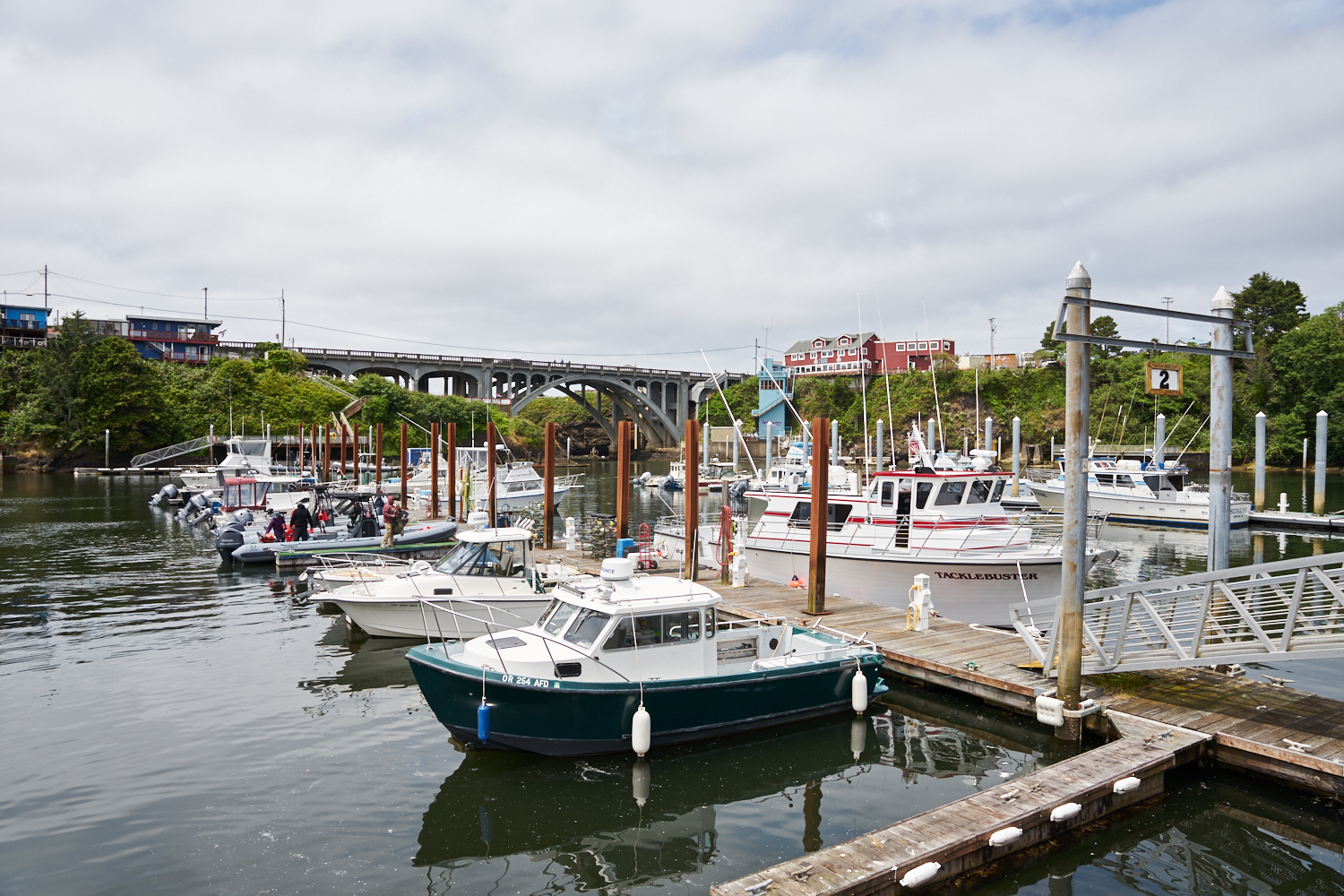
Jeurgen “JT” Turner remembers when the first whale watching charter started up in tiny Depoe Bay, Oregon, in the 1970s. Back then, “the world’s smallest navigable harbor” — Depoe Bay’s claim to fame — was home to a mix of commercial fishing enterprises and fishing excursions geared toward tourists. And while whales can be easily spotted from Depoe Bay’s shoreline during migration season, no one had latched onto the idea of taking visitors out on the water to watch them by boat. JT says that first season with one vessel was so successful, the company he worked for invested in a second boat for the following season, and grew from there. “Now everybody around here has a whale watching operation,” he says.
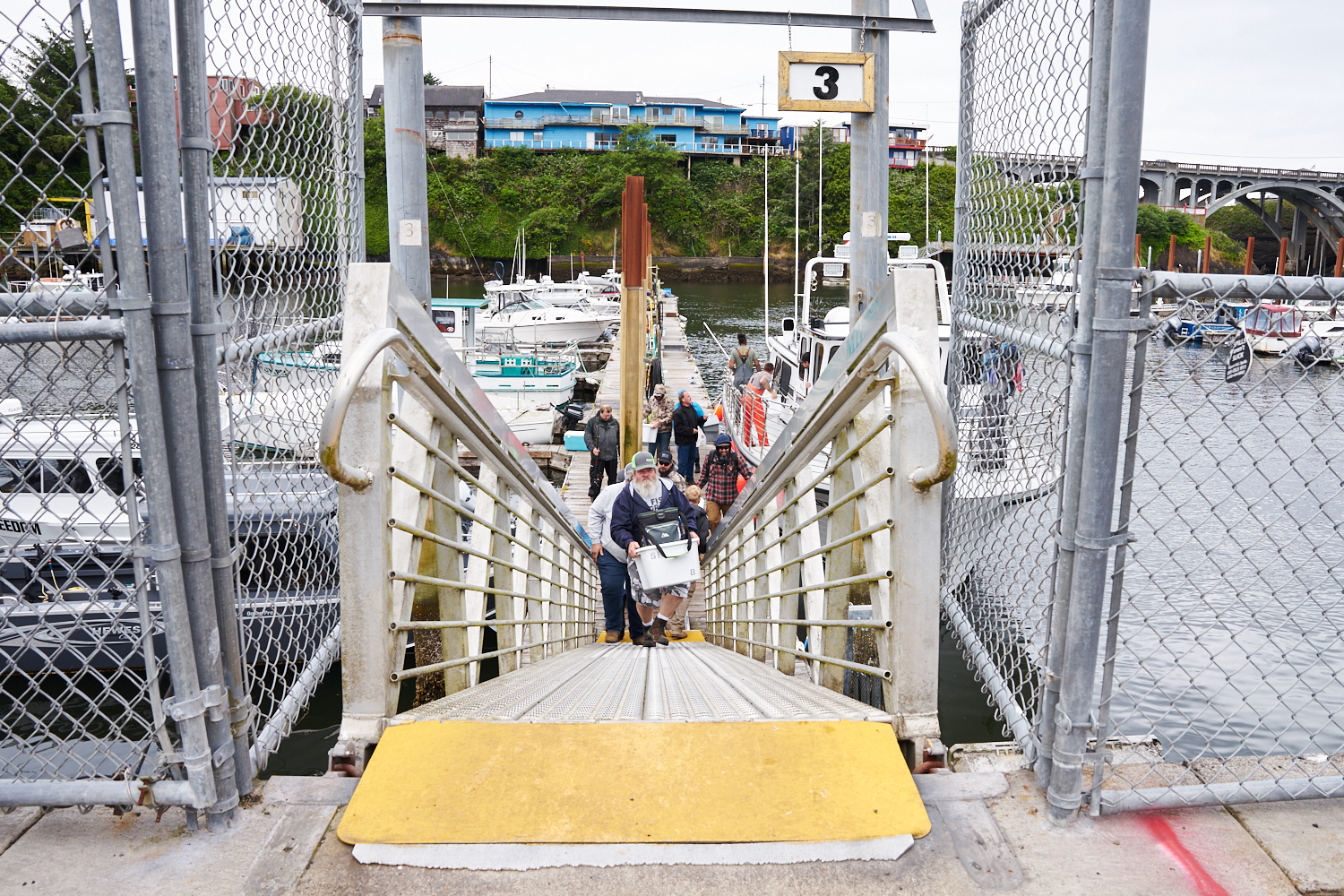
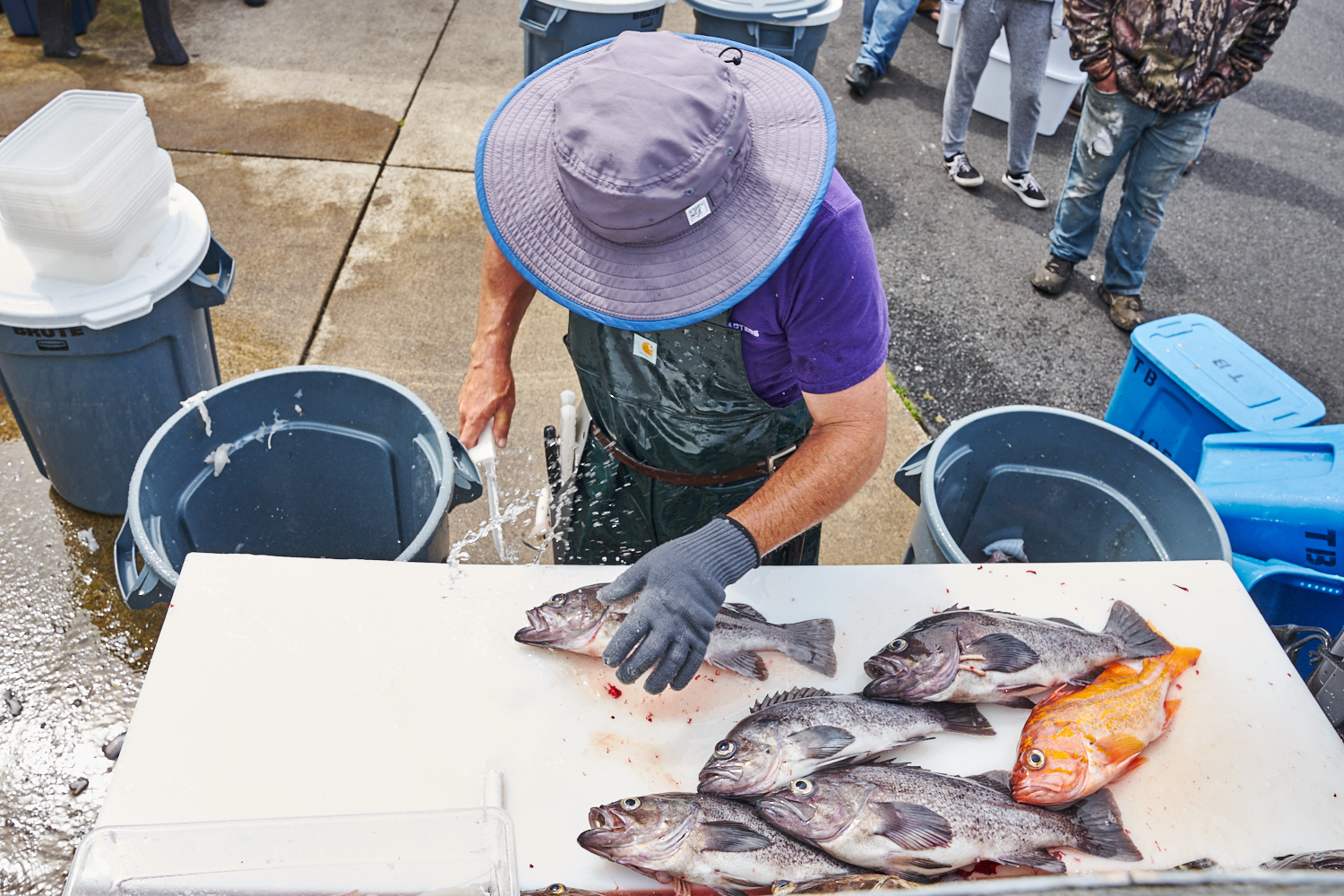
Depoe Bay, tucked into the Oregon coast west of Salem, has always been a popular spot for charter fishing. Its small, sheltered harbor and proximity to the open ocean make it a fishing destination rivaling its much larger neighbors, the hub of Newport to the south and the beach town of Lincoln City to the north.
Both charter fishing and whale watching have been a boon to Depoe Bay’s economy. Fishery collapses in the late 90s and early 2000s shuttered commercial fishing operations and processing plants all along the Pacific Northwest coast, forcing many life-long fishermen to take other paths. Although fish populations have rebounded significantly in the past 25 years, tourism is now the occupation of choice for most of the vessels docked in Depoe Bay’s harbor.
One such operation is Dockside Charters, owned by JT’s son, Tyler Turner, who has embraced both charter fishing and whale watching with his fleet. He says that while he can accommodate a lot of people on a charter fishing excursion, the overhead is higher than whale watching. Fuel especially has been a major concern this summer with diesel prices skyrocketing. This is where Depoe Bay’s unique geography particularly favors whale watching tours.
“In other ports, like Newport, you have to go 10, 15 [miles] out before you hit open ocean,” Turner says. “Here, we can stay close, and we use less fuel.”
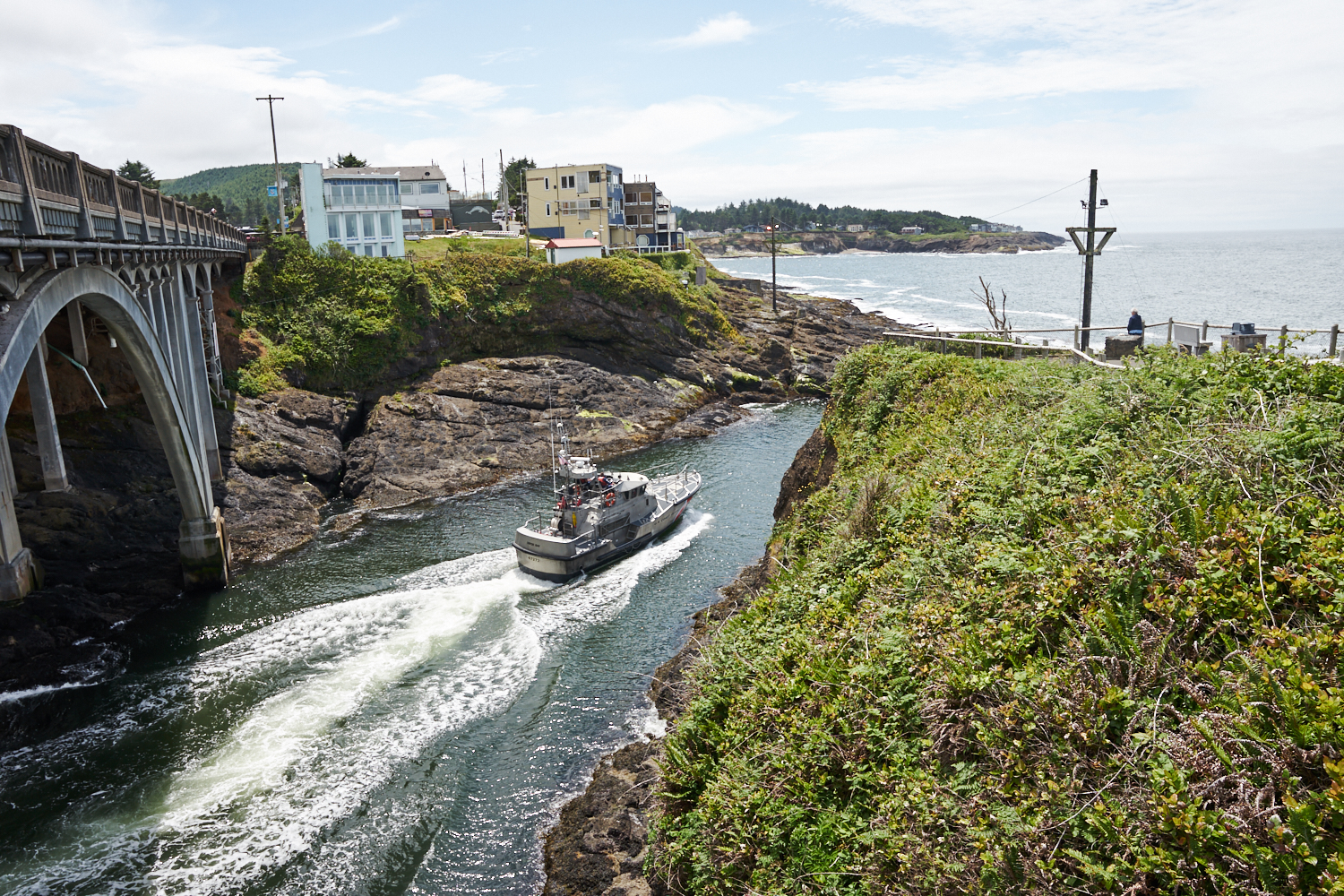
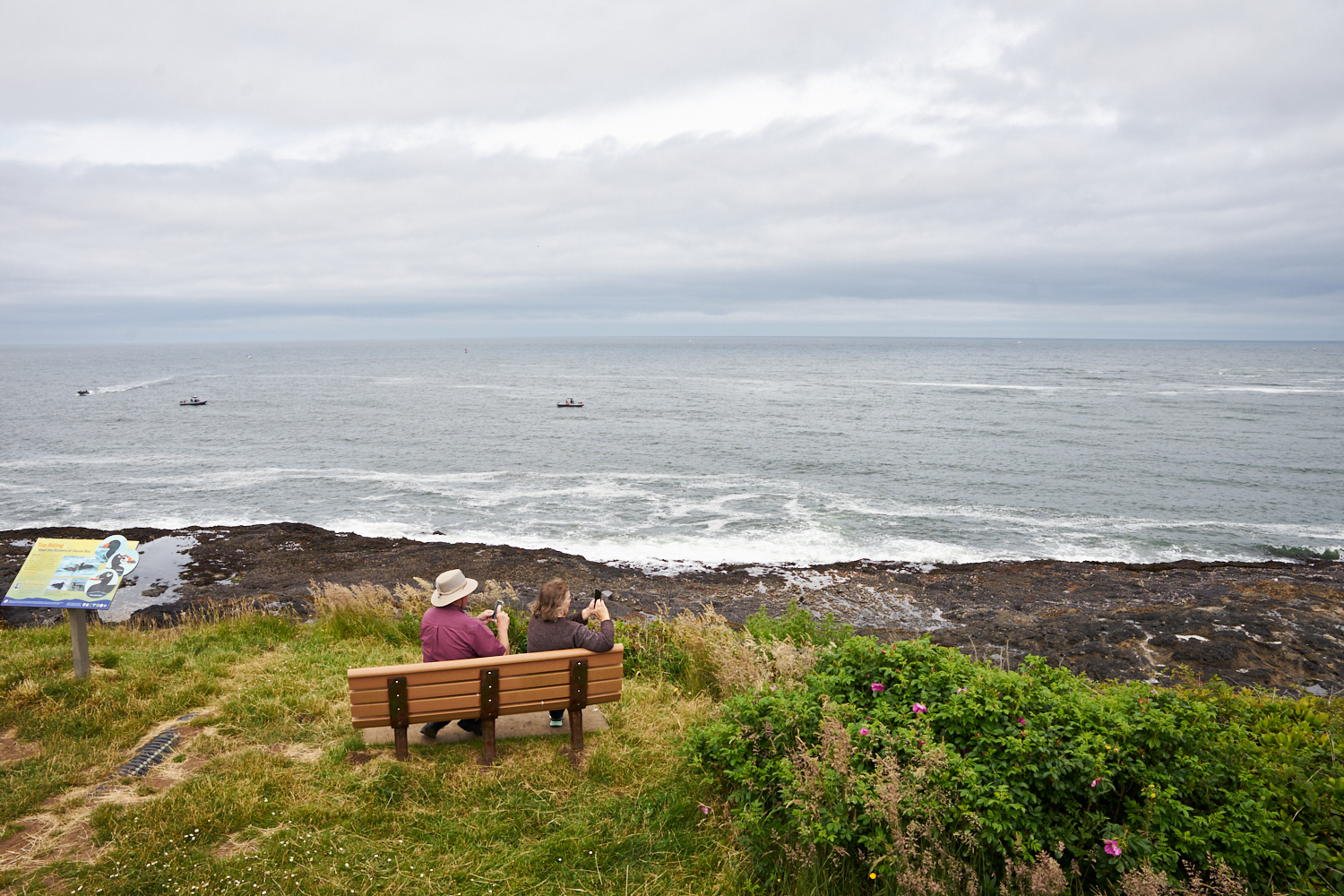
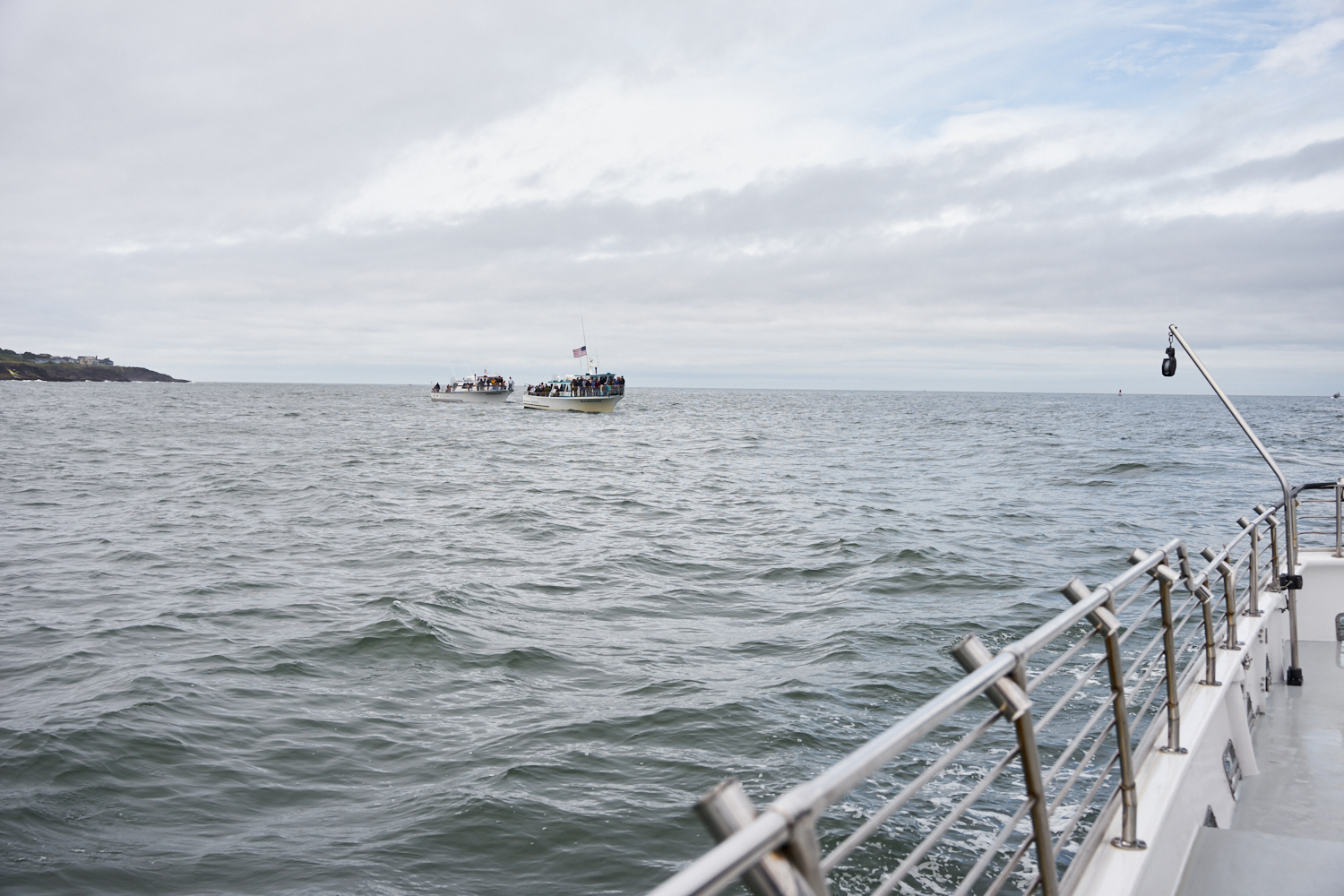
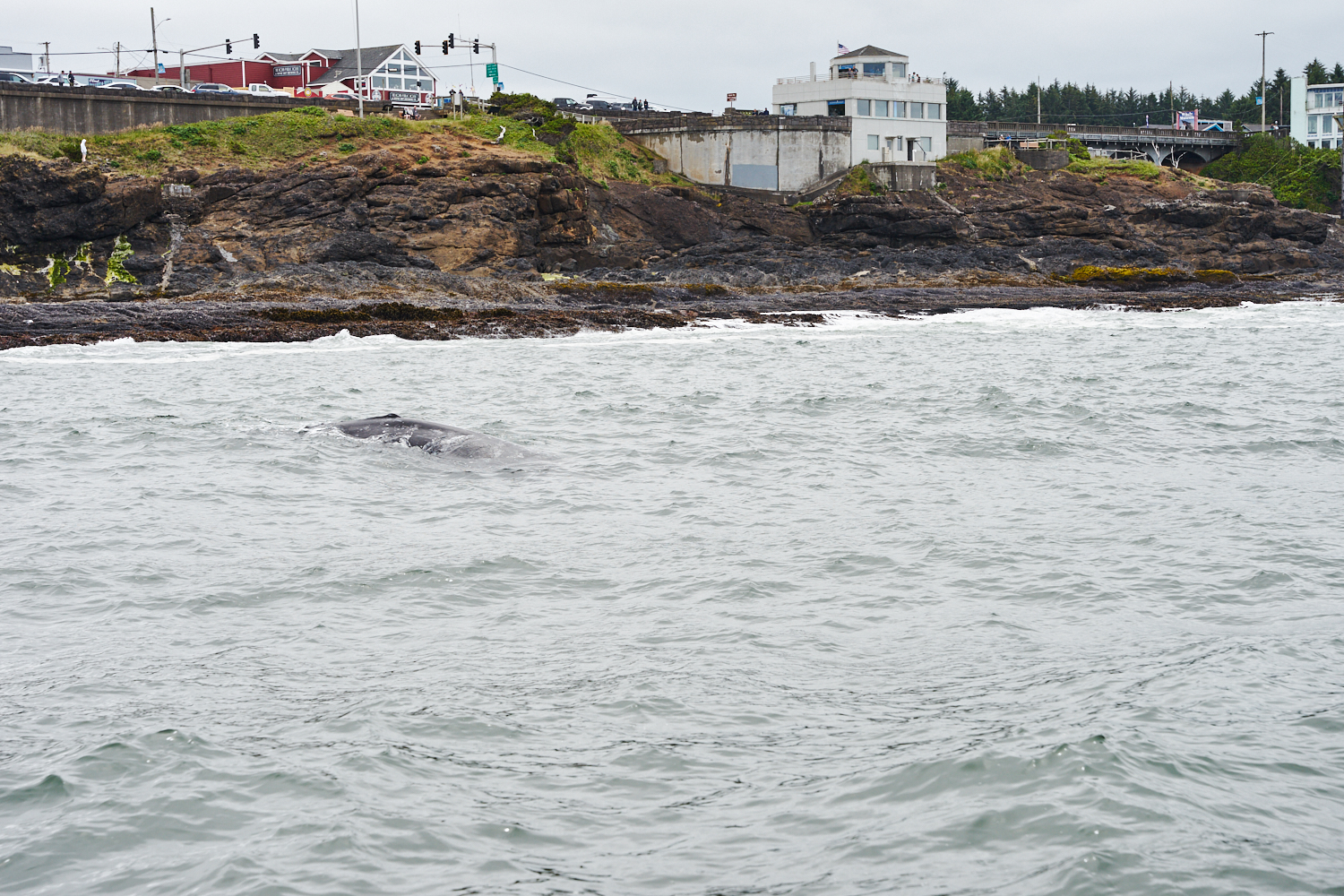
He’s not kidding: The narrow channel leading out of Depoe Bay’s harbor opens right into water deep enough for whales to swim. During feeding season, gray whales pop up just yards from the rocky coastline, much to the delight of visitors on the decks of Turner’s boats.
“I still get excited every time I see a whale,” says Turner, who grew up in Depoe Bay. “If my dad could go whale watching from 8 a.m. to 5 p.m., he would.”
Like many small towns transformed into tourism hotspots, it hasn’t always been smooth sailing for Depoe Bay. Housing has become much more expensive for the local population of just over 1600. Property management companies have gobbled up many single-family homes and turned them into vacation rentals. Wealthier retirees from outside the area have chosen the town as their golden-years homestead, and building new affordable housing has become a contentious political topic. But despite the rough patches, Turner and his partner Eva, who runs much of the administrative side of Dockside, say that they are in favor of enticing visitors to Depoe Bay as much as possible. And for gray whale spotting, JT says there’s no place for tourists like Depoe Bay.
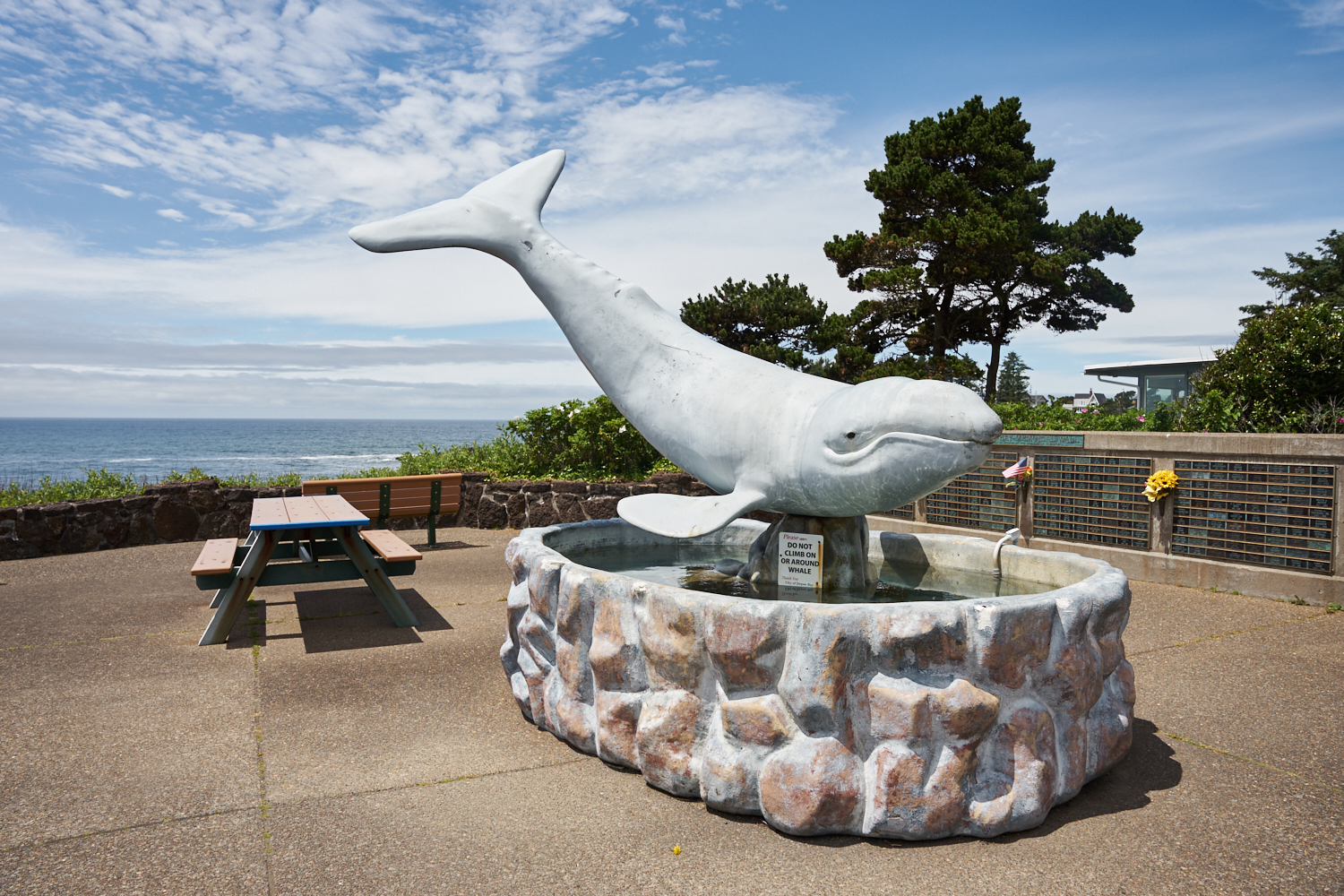
“Down in San Francisco, the Bay Area, they have a lot of tours but they are mostly staying within the bay,” he says. “Seattle has a lot of whale watching but they are looking at orcas. Depoe Bay—we’re the gray whale capital.”
In this Issue of the Statesider Big whales, small harbor, Native control of national parks, hot potatoes, wayfinding, surfing for everyone, Black Wall Street reborn (twice), and a major find in the world of pants archaeology. Also: give us a piece of your mind in our reader survey!
The Gray Whale Capital of the West
Depoe Bay, Oregon, is known for two things: the smallest navigable harbor on the West Coast and whales. Lots of whales. Once a productive fishing port, now the town
In this Issue of the Statesider Big whales, small harbor, Native control of national parks, hot potatoes, wayfinding, surfing for everyone, Black Wall Street reborn (twice), and a major find in the world of pants archaeology. Also: give us a piece of your mind in our reader survey!
The Gray Whale Capital of the West
Depoe Bay, Oregon, is known for two things: the smallest navigable harbor on the West Coast and whales. Lots of whales. Once a productive fishing port, now the town is navigating the sometimes choppy waters of transitioning from a working fishing town to a tourism-focused economy. Earlier this year, photographer Sarah Arnoff Yeoman paid a visit to the Gray Whale Capital for the Statesider. Take a photographic visit to Depoe Bay
Tell us what you really think
We’re wrapping our fourth year here at the Statesider, and we want to hear from you. Is once a month enough Statesider? Do the Statesider Originals stick with you? Do they stick with you enough that you’d be willing to help pay for them? (We remain completely reader- and self-funded and all donations go to pay our contributors.) Are there too many stories in each issue, or not enough? Got any ideas about what we should or should not do going forward? We’d love to know what’s missing, what’s what’s working, and hey, we just like hearing from you. Really. Take our short survey
Oh, yeah, we ARE on Mastodon, since you asked. Here.
Stories Across the US
This is Our Love Language: Trips don’t have to be long to be meaningful. The unsung joy of short trips. Sara Benincasa, Pipe Wrench
Finding Your Way: Essays don’t have to be long to be meaningful, either. The art of wayfinding in the mountains of Colorado — and in middle age. Claire Boyles, Sierra Magazine
Rosin Potatoes: The elusive roots of rosin potatoes. What are rosin potatoes, you ask? Imagine that you have a boiling pot of pine rosin and you drop a potato into it. Ta-da: rosin potato. It’s a thing in parts of the Southeast — but where did it come from? Caroline Hatchett, Bitter Southerner
Iowa Hummus: Growing up Palestinian in Iowa — and finding community through food. Khalid El Khatib, Food52
Strangers in a Van: After their flight got canceled, 13 strangers rented a van and drove 652 miles together. Cathy Free, Washington Post
I Just Wanna Surf: A new book of photography focuses on surfers who are regularly left out of the surfer culture and narrative: Black women and nonbinary surfers. Photographs by Gabriella Angotti-Jones, Story by Leah Asmelash, CNN
Native Management: The US Government has a long history of stealing land from Native tribes. Is co-management of land the way forward? Len Necefer, Outside
With, Not Without You: Joshua Tree National Park will be co-managed by California’s Twenty Nine Palms Band of Mission Indians. Mary Beth “Mouse” Skylis, Backpacker
The Next National Monument: Spirit Mountain, Nevada, May Be the Next National Monument. “Avi Kwa Ame (pronounced Ah-VEE kwa-meh) is the place of origin for ten Yuman-speaking tribes of the Mojave, as well as a sacred site for the Hopi and Chemehuevi Paiute people.” Emily Pennington, Outside
Black Wall Street(s): Two new efforts to create Black Wall Streets pop up in Hattiesburg, Mississippi (Stacy Jackson, Black Enterprise) and Baltimore, Maryland (Niko Mann, Black Enterprise).
Via LeviStrauss.com where there’s a cool collection of ghost signs.
Pants in the News: An anonymous pants collector bought a pair of pants recovered from a shipwreck for $114,000 at auction. They *might* have been made by Levi Strauss. Amanda Holpuch, Seattle Times
Hey Siri, Show Me the Most Statesider Headline Possible: “Gay Montana Moose Comes Out in Bozeman, Celebrated on Holiday Pie Crust” Moose Radio
This year’s pie commemorates a very special occasion that took place about a week ago. I’m honored that Bullwinkle chose to come out right here in my yard. Thanks, Mother Nature, for the reminder about all that’s good in the natural world.
What We’re Reading
The Cassandra by Sharma Shields. A young woman who has disturbing visions of the future goes to work on a secret research project at the Hanford Research Facility in Eastern Washington. It’s the 1940s and, as readers, we know what she’s working on. Ultimately she does too — because her visions show her the results. A disturbing and compelling read not just about the nuclear arms race, but about how little society listens to women sounding the alarm. While the main character is fictional, the setting and the Hanford project are very, very real. The long-term results from Hanford dumping on the surrounding area are still a threat to wildlife, the water supply, and the community. Buy a copy today from the Statesider bookshop
In this Issue of the Statesider Back “home” in Boston, park overpopulation, getting down in Puget Sound, and looking up at an icon. Plus, a newly public archive from the Smithsonian and a primate park-and-ride.
Back to Beantown
After an extended stint outside the US, Melissa Watkins returns to a city and a history that was never hers to begin with. To understand her new city, and confront her growing unease with American culture, she goes looking for the Boston bey
In this Issue of the Statesider Back “home” in Boston, park overpopulation, getting down in Puget Sound, and looking up at an icon. Plus, a newly public archive from the Smithsonian and a primate park-and-ride.
Back to Beantown
After an extended stint outside the US, Melissa Watkins returns to a city and a history that was never hers to begin with. To understand her new city, and confront her growing unease with American culture, she goes looking for the Boston beyond the city’s own myths. Read “A Repat’s Guide to Boston”
I’m from Denver. I’m also Black. Boston is full of history, but it doesn’t feel like mine. Every other block there’s a giant statue of a guy who fought in the Revolution but also owned slaves.
Stories Across the US
The Desert, Not Deserted: Nowhere is immune from the national park boom. Joshua Tree’s delicate ecosystem is another victim of overcrowding. Brad Rassler, Alta Journal
Guilty as Charged: Statesider editor Pam Mandel is snowbirding right outside Joshua Tree National Park right now. She’s been up early, camera in hand, lots. Asked about crowds she said, “Not at 5 am, nope.” Nerd’s Eye View
Get Ready for Death Valley: The summertime extremes of Death Valley feel like a dangerous dare today, but what if they are the new normal of tomorrow? Chris Colin, Alta Journal
Like wildebeests trudging off to Masai Mara each year, a distinct breed of tourist makes this summertime Death Valley pilgrimage.
Geezer Happy Hour: At Ann Arbor’s coolest rock show, almost everyone is over 65. Also, it starts at 6:30 and ends at 9:00 because people gotta sleep. New York Times (free)
That’s Deep: Washington State’s peaks get all the love, but it’s got remarkable depths, too. No one has ever been to Washington’s lowest point. John Ryan, KUOW
Mystery Monkeys: We missed this story when it originally ran, but we couldn’t help but share a story about the mystery of the monkeys that have lived at a park & ride lot by the Ft. Lauderdale airport since the 1940s. Go monkeys. Suzanne Rowan Kelleher, Forbes
Birding in Alabama’s Black Belt: A third-generation Black farmer has made it his mission to welcome everyone into the wonders of nature of his home region. Jennifer Kornegay (words), Wes Frazer (photos),Bitter Southerner
Here Today, Gone to Maui: Writer Jennifer Billock ponders why Hawaii seems to inspire her to reexamine her relationships. Jennifer Billock, Shondaland
The superstitious side of my personality blames my two disastrous marriages on Hawaii.
Pie, Charted: Ours is not to question why, but to say “Damn, that’s a lotta pie.” NYC Slice, Liam Quigley
Location, Location, Location: In Hollywood of the 1920s — and pretty much ever since — California was a stand-in for anywhere around the world. Spain, Wales, the South Seas. Where to find the rest of the world without leaving California: Brilliant Maps
An Icon Deconstructed: Well, that’s cool. 11 minutes with architect Michael Wyetzner on why the Chrysler Building matters. YouTube
Over Austin: The Texas capital of weird is just another sprawling western city now. Texas Monthly
Who’s Tom McCleod? A mystery billboard on California’s Interstate 5 and various Tom McCleod’s are not saying. Joshua Bote, SF Gate
What We’re Spending Too Much Time Looking At
The Smithsonian made over 4.4 million images open access to the public, so of course the first thing we did was go search through postcards from the National Postal Museum and the National Museum of African American History and Culture, like this one from Deadwood, South Dakota:
On the back: “Dear Mama, You will see by this that I am in Deadwood. I am attending Grand Lodge. Am having a fine time. Wish you were here. The scenery here is just beautiful. Emma.” May 20, 1909
When Melissa A Watkins moved back to the US, she chose Boston, a city deeply woven into American history. But she wasn’t content with the story that Boston tries to tell, she wanted to see behind the veil — the Boston beyond the myth.
I left America 15 years ago. I never intended to come back. After 15 years in Europe and Asia, I became so accustomed to things like affordable health care and reliable public transportation that the comparative merits of police violence and fun
When Melissa A Watkins moved back to the US, she chose Boston, a city deeply woven into American history. But she wasn’t content with the story that Boston tries to tell, she wanted to see behind the veil — the Boston beyond the myth.
I left America 15 years ago. I never intended to come back. After 15 years in Europe and Asia, I became so accustomed to things like affordable health care and reliable public transportation that the comparative merits of police violence and fundamentalist Christianity lost their luster. While I was gone, America changed. The more it changed, the more confused and angry and frustrated I became.
But despite that, America is still my home, the place where, to paraphrase Robert Frost, they have to take me in when I have to go there. In 2021, I decided it was time to return and see what was happening to my country up front.
I choose Boston as my point of return. I wish I could say there was a logical reason, like a job or a romance, but the truth is, I decided if I was going to go back to America, I was going to go back to America. In the movies, America is New York or LA, but in the history books that nerdy elder millennials were forced to read as kids, America is Boston, and so there I went.
I’m not from there, of course. I’d visited the city twice before on long layovers and managed to hate it both times. All I’d gotten to know of the place was Irish-Italians, Fenway Park and sharp, nasal accents. Oh, and apparently, it’s the birthplace of American history, at least the parts that begin with British colonization.
I’m from Denver. I’m also Black. Boston is full of history, but it doesn’t feel like mine. Every other block there’s a giant statue of a guy who fought in the Revolution but also owned slaves. Every white Bostonian I meet immediately tells me whether they’re Irish or Italian, not realizing that they probably wouldn’t get a warm welcome in either country (I’ve been to both, and the key word in Europe is American. Nobody in Europe cares where your grandmother was from unless they’re her.). I don’t expect I’ll get a warm welcome here. That, to me, seems like the standard for whatever America’s becoming. But not only is home the place that has to take me in, it’s the place I have to go, sometimes.
I’m from Denver. I’m also Black. Boston is full of history, but it doesn’t feel like mine. Every other block there’s a giant statue of a guy who fought in the Revolution but also owned slaves.
I decide that my approach to understanding Boston will be the same as it has been in many other cities across the globe. Basically, I’m going to make friends. There’s nothing better than having a local show you what makes their life great. It worked for me in Ubud, in Vilnius, in Ulaanbaatar.
It eventually works in Boston. My new friend’s name is Tristan, and he’s a historian, an anthropologist, an Irish guy with a Spanish surname who speaks fluent Cantonese.
Like most people that are interesting, he’s a teacher. So am I. He leaves a few too many “r”’s off of his words in casual conversation in the break room and with every broad ‘a’ sound, I can see my way into understanding the city opening up. I ask him what’s good to do in Boston, if he knows what the deal is with all of the colonial statues everywhere, and why Dunkin’ Donuts has such a stranglehold on the local coffee market.
He blinks his big blue eyes at me, then tells me he can just show me around if I want to know so much. Suddenly, I’m glad to be back in America again.
The real history of Boston, peaking through the veil. (Photo: Melissa A Watkins)
The first thing Tristan tells me is that Boston is a city that doesn’t really know what it is. He calls it a place of imagined history. To the tourists of the world, it’s a place of history and prestige with a little fun on the side. In reality, it’s a former company town that is defined by the constant struggle of different groups of people to settle down and belong to a place that isn’t really theirs. Because of its position in American legend, the Boston that exists now is just as much myth as metropolis.
I’ve already done some of the normal tourist things on my own. I’ve seen the harbor, the sports venues, and the museums. I’ve gone up to Cambridge, which is where two of Boston’s most famous places — Harvard and MIT — actually are. All of these places are nice, but a little too manicured to connect to.
So, when Tristan asks me what I want to see in Boston, I tell him that I want to see the places that are real, not imagined. We walk the city for hours on two separate occasions. A few places in particular stand out.
The first is in Boston Chinatown.
Thirty years ago, Washington Street, which runs through Chinatown and across the city, was considered the worst area in the Northeast. Locals knew it as the “Combat Zone,” a notorious red-light district.
Boston Chinatown in the 1950s
Right in the heart of it is an old grocery store with a sign in the window spelling out Jia Ho in English and Chinese characters. Above it is a place called Empire Garden. For a little over 90 years, it was a theater —first for vaudeville, then for films. In 1995 it was turned into a lavish dim sum restaurant. On weekends it’s packed, filled mostly with visiting Chinese families and Asian-American locals, as well as Bostonians of other backgrounds with good taste in dumplings. The place is beautiful — the tables are all set out on the old mezzanine and the kitchen is hidden away somewhere in the walls, like in most Boston restaurants. The domed, vaulted ceiling is painted with clouds and eating here feels far removed from the city streets below.
Empire Garden has a character to it that is uniquely Chinese and American. It wouldn’t fit in anywhere I’ve been in the Chinese world. It doesn’t quite fit in America either according to some. But it occupies a space that combines the two wonderfully well, and the food is delicious, to boot.
It’s also very Bostonian. There’s a clear effort here to preserve a gilded, cloud-topped history. In Empire Garden, there’s never been a combat zone.
We leave Chinatown and head towards the North End. Boston is definitely a walking city. If you’re willing to wear good shoes and wander you can get to know it well, quickly. Walking is the only way to really see where we’re going, in this case. The North End has narrow streets and is tricky to drive in, by design. If you turn the wrong way, you’ll wind up having to leave the neighborhood and get on the highway to get back to where you started.
This is part of the well-kept, old-fashioned look of the area, due to its historical status in the city. There are no Starbucks or Dunkin’ Donuts in the neighborhood, and when I point that out, Tristan wonders if that level of preservation will ever be expanded to Chinatown or historically Black Roxbury.
The North End is a very Italian community, but specifically Italian-American. Unlike a lot of other places in Boston, it’s more or less what it says it is.
It’s an Italian neighborhood, but a large portion of it is dedicated to a long-dead son of a Frenchman, Paul Revere. A statue of him stands in the Paul Revere Mall, right in the center of the neighborhood. At the far end of the mall is the North Church, where Revere famously kept watch for “one if by land, two if by sea” if Longfellow can be believed. In between Paul and the church where he got the signal to start the Revolution, there’s a joint memorial for local veterans of the Korean and Vietnam Wars tucked into a corner.
There’s a similar, but much larger memorial for Korea and Vietnam a few miles away, near the famous Fenway park. I ask Tristan if he knows why these war memorials are in pairs and why the Korean side is better kept in both places, but someone else answers. There’s an elderly man walking up the stairs towards the church behind us and he throws a glance and a sentence over his shoulder, pausing at the top to make sure we’ve heard him.
“Because,” he says, “One of those wars wasn’t popular.”
It’s news to me that either of them were, but this is just another piece of the view of American history that Boston represents, another reminder that what is remembered and what is taught are often not the same.
Polcari’s Coffee. (Photo: Melissa A Watkins)
When you get deeper into the North End, things look less preserved and more lived-in. A lot of the places tourists are told to go in Boston look a bit artificial, like the plastic cover was taken off before company came over. The North End, however, is much more comfortable, like the couch the whole family piles onto to watch the game. This shows best in a place called Polcari’s.
It’s a dusty coffee shop that first opened in the 1930s. Sweets and spices in jars line the shelves, and everything is carefully labeled in blocky black marker. There are old books displayed in the windows that were clearly printed a few decades ago and have the campy illustrated covers to prove it. A hand-lettered sign advertising Italian lemon slush hangs on the open front door. The newest thing inside, or at least the best-kept, is a shiny espresso machine. It’s not crowded, but there’s a steady line of customers the entire time we’re in there, all buying small things — a packet of licorice, a few ounces of oregano, a coffee, a box of tea.
Around the corner is Galleria Umberto, a tiny hole-in-the-wall Italian joint. It’s not quite as old as Polcari’s, but it’s just as genuine. There’s no frills, no imaginary history, no performances for the tourists. There’s just startlingly cheap eats, long lines, and quick service. Their pizza is good and costs two bucks, even in this economy. Their arancini, washed down with a cheap local beer, is better. Munching on a slice and an arancini while perched at a wood-topped corner table makes me feel about as Bostonian as I’ll ever get.
Galleria Umberto (Photo: Melissa A Watkins)
The last place Tristan shows me is Boston Common. Not the whole thing, of course. There’s a specific monument he wants to show me, because I’ve finally gotten frustrated and asked him, point blank: “Where are all the Black people in this town?”
I’m Black, of course, but that doesn’t make me qualified to speak on, or understand Blackness in Boston because I’m not from here. What we hear in the rest of the country is that Boston is racist. What you hear in Boston is that it isn’t: the city is liberal and open and was a stop on the Underground Railroad long ago. What you see is a steady wave of gentrification and erasure. I live across the street from a busy construction site that used to be the Harriet Tubman Center, in an area that used to be all Black. Now it’s all white, and the local who tells me about the old Tubman Center is tickled by my presence. He calls me a Black gentrifier, which I guess I am, unintentionally.
Leaving was surprisingly easy. Coming back is hard.
I’m not qualified to speak on Blackness in Boston, but the ingrained segregation of the city is one of the first things I notice when I arrive. As Black people in the US have been saying since forever, there’s a deep structural racism throughout America that manifests in separation and ignorance long before it gets to violence. That makes it all the harder to combat.
It’s with this in mind that I follow Tristan to the corner of Boston Common directly across from the Massachusetts State House. Facing the street is a memorial to Robert Gould Shaw, the guy Matthew Broderick played in the film Glory. Shaw famously led the first battalion of Black soldiers into combat during the Civil War.
The memorial is awful. During the Movement for Black Lives protests in 2020, it was defaced with red paint and flour. Even though the paint is gone now, I think that it must have been an improvement.
The main frieze of the memorial depicts Shaw, large and proud in bronze, surrounded by a crowd of marching Black soldiers, all of whom seem to be nameless and story-less. The text underneath only describes Shaw.
It’s not until you walk around and down to look at the lowest point of the monument’s back that you see the names of those Black soldiers, carved into the stone. There are precious few identifying details, and unlike Shaw, they don’t get any poetry. The monument was cast and installed in 1897. The names of the Black soldiers weren’t added until 1981.
In its defense, showing Black men in any sort of heroic light was quite progressive at the time. By all accounts, Gould was a decent guy, and even a hero. But he wasn’t the only hero, just the one who fit the imagined history of the war.
The memorial doesn’t end my tour of Boston or define my entire experience of the city. But it does remind me that even though I came home to see what was really happening in my country, there’s no way to guarantee that what I’m seeing now is the whole story, even if I am where so much of it began.
Later, in my Black, gentrified, Boston apartment, I spend a little time thinking of what I’ve seen and learned. Tristan left me with a few parting words about how much he and every other locally-bred Bostonian want to leave and find their fortunes elsewhere, but it’s clear that he loves the city, especially in the places like Polcari’s where reality pokes through the mythical veil. I’m not sure I’ll ever have that love.
In fact, I’m not sure I’ve ever had that love for any part of America, not even my own hometown. Leaving was surprisingly easy. Coming back is hard. My tour of the city in all its historically significant glory hasn’t convinced me that it’s a place I should plan on committing to long-term, and hasn’t given me the best of impressions of the country I’ve returned to.
Whether or not I should stay in Boston or by extension in America is not a decision I’ve come to yet, and what I’ve seen so far leaves me with far more questions than answers. Should I choose to stay, I’ll have to do what works for the people who seem to understand this place best do; focus on the metropolis, and criticize the myth.
In this Final Issue of the Statesider Lessons learned, meals eaten, roads traveled. And our thanks.
In 2021, Randall Munroe at XKCD published a funny-because-it’s-painfully-true cartoon “Types of Scientific Paper.” Much internet riffing ensued, giving the XKCD comic new life as a social meme. In our Statesider Slack channel, we immediately started toying with a travel version.
Boy, was there a lot of material.
With our combined years of experience in and aroun
In this Final Issue of the Statesider Lessons learned, meals eaten, roads traveled. And our thanks.
In 2021, Randall Munroe at XKCD published a funny-because-it’s-painfully-true cartoon “Types of Scientific Paper.” Much internet riffing ensued, giving the XKCD comic new life as a social meme. In our Statesider Slack channel, we immediately started toying with a travel version.
Boy, was there a lot of material.
With our combined years of experience in and around the travel industry, we knew just where the tender spots were — we had become fairly cynical about the state of the industry as it exists in the 2020s. Clueless colonialism: check. Callous environmental damage: check. Whitewashed racism: so much check. Advertorials and feature articles completely indistinguishable from each other: check — and it never ends.
We ended on a particularly dark note for anyone who has worked in travel publishing — or media at all: “This Is Our Publication’s Last Issue.”
We were not unaware that we were also writing our own eventual obituary.
Which is to say: This is goodbye for The Statesider. After four years of operation, we’re turning the sign (and please picture a hand-carved wooden sign held by a chainsaw art bear) to “CLOSED.”
Our end, as a publication, is not the result of the typical reasons that travel publications wink out of existence. We didn’t go bankrupt (we never made money to begin with, which is a funny way of insulating yourself from worrying about bankruptcy). We did not get bought and killed by a multinational media conglomerate (but we’d be willing to try it once, what the hey). We didn’t fail in any standard way — or at all.
This was, from the beginning, a labor of love started when all three of us were in very different places in our lives, and now we’re somewhere else — somewhere with not enough time to devote to keeping The Statesider running.
Before we sign off, we wanted to share some things we learned along the way. The experience of launching the Statesider and running it through a global pandemic changed how we view digital media and the act of travel. Despite the cynical, snarky perspective in that graphic above, we do see reason for hope or something like it.
The narrative about our national character is inadequate.
One of the subjects we kept coming back to over the last few years was the incredible breadth of the USA’s many cultures and threads of history, even when considered through the lens of standard-issue Americana. Take cowboys, that classic archetype. Beyond all the John Wayne/Clint Eastwood/Marlboro Man tropes, there’s also a rich history of Black cowboys and Jewish cowboys and trans cowboys and LGBTQ rodeos and Native American rodeos and Mexican-American rodeos and women riding the range and playing essential roles in the Old West. It’s not just that so many myths about American identity and “exceptionalism” are bullshit — it’s just as important to understand what stories have been left out of the collective narrative.
It takes the most trivial of effort to find stories about our history written by people who are not straight white men, and the history of the people who were here before any Europeans arrived, and it is such a worthwhile pursuit. Plus, taking a more expansive view of the American experience, past and present, leads to so many interesting chapters. Like, there’s a prevailing colonialist narrative around the establishment of the US as a country, but there was a hotel operating in Santa Fe before the pilgrims landed at Plymouth Rock! That’s fascinating!
Put another way: Read the plaque, but also question the plaque.
We also don’t think enough about the USA as a travel destination with endless intrigue. It’s easy to aggrandize the museums of Paris or the temples of Southeast Asia, but all too many Americans act as though we can’t find great cultural or historic iconography right here in the US.
The national parks and state parks (and local parks, for that matter) offer more than enough wonders to fill a lifetime, and even as a relatively new nation, we have a richness of architecture, art, music, and history. “Hamilton” is an American production. Helen Frankenthaler is an American artist. Chicago has world-class architecture and so does Columbus, Indiana. Dearborn, Michigan has all manner of remarkable Middle Eastern food, and you could spend a week in Philly eating nothing but sandwiches and never eat the same thing twice (see also: tacos in Los Angeles, Cubanos in Miami, barbecue in Kansas City, etc). You do not have to go abroad to have a remarkable cultural experience.
When considering places you’ve never been, let curiosity, not half-formed assumptions, be your guide. National publications are forever “discovering” that there are immigrant communities outside New York and Los Angeles, or expressing surprise that places are more than just the stereotypes. But across the nation, you’ll find immigrant communities and cultural enclaves that play an essential role in local life, from the Marshallese residents of Springdale, Arkansas to Hmong farmers in Walnut Grove, Minnesota to French-speaking families in northern Maine to, lest we forget, the many tribal nations with their own remarkable history, language, and cultures. For that matter, you can find a mermaid bar in Montana or amazing prosciutto in Iowa or the second-oldest synagogue in the Western hemisphere in the US Virgin Islands, none of which is “surprising” if you know the backstory. So … learn the backstory!
Okay, we’ve all been fans of the mall food court as a travel destination, which is part of why we came together to make Statesider. The food is affordable and fresh and the people-watching is top-notch. But we learned that strip malls are community hubs camouflaged in boring architecture and shadeless parking lots. Truck stop plazas are object lessons in our changing demographics and yes we have had excellent Indian dinners at Punjabi truck stops, including one in a restaurant with a giant sign reading “MARISCOS” but with no seafood (or Mexican food) to be found. The biggest tourist traps in the world take on an entirely different mood if you pay a bit less attention to the kitschiness of it all and a bit more attention to the people who are there, having a grand old time. Go to Wall Drug or Times Square or the Mall of America and strike up a conversation with your fellow tourists. You may be utterly jaded, but try seeing it from their perspective and see if that shifts things at all.
One of the things we never wanted to try to do at the Statesider was to provide travel advice. There’s plenty out there already. The web is awash with listicles and best-things-to-do-in articles. Some of these are great — but often they’re just rewrites of the same things, a problem that is just about to get infinitely worse thanks to AI tools. We set out to help people find great writing about the US, writing that’s out there, but often hard to find, tucked away in corners of the internet that don’t get a lot of attention. Much of the time, it’s not exactly travel at all, it’s just good writing about our country, the culture, the food. You’re just as likely to find it in a sports section as you are in a popular science magazine, but the core of the story is someone going out and experiencing the many sides of the US and telling a great story. Capital-t Travel Writing is less and less its own thing, but great writing continues, and it’s coming from more perspectives than ever before.
There was a brief blip of good news during the pandemic where emissions from air travel dropped precipitously, Venice’s murky canals became clear, and wildlife wandered into cities. We got a glimpse of a future we can make, and make quickly if we wanted to.
But now we’re busy erasing those gains and forgetting what we saw. The notion of “revenge travel” is surely one of the most infuriating artifacts of travel’s revival after the worst part of the pandemic, and something that could only emerge from a self-centered, entitled group of people. We were prevented from spreading disease and advancing climate change and we’re… mad about that? So we’re going back to taking mileage runs and spewing carbon to get back at… who, exactly? The world’s resources are not our playground, nor are we doing anyone a favor by insisting that visiting is to their benefit.
Yes, we need systemic change, but it’s a cop-out to wait for corporate and government actions to address climate change. Air travel has an outsize impact on the climate, and only a small fraction of the world’s population is responsible for that impact. Look in the mirror. We refuse to take responsibility for the impact of our travels, acting as though we are being wildly deprived of something when really, we are exercising a tremendous privilege. There is so much to see and do and experience right here in our backyards. It’s not a sacrifice, it’s a gift to learn this about ourselves as Americans. Internalizing that has been, we think, our favorite — and hardest — lesson from working on The Statesider.
Our mission has always been to find ways to think differently about the United States. We started The Statesider in an Elko, Nevada Denny’s over midnight breakfast and ended it at a Punjabi truckstop over saag paneer and samosas in California’s Central Valley. So, yeah, mission accomplished.
With gratitude to our contributors, supporters, and readers,

 Login
Login