❌

Normal view

A tale from β€œye olden days” of graphic design that taught me to love and embrace constraints β€” Rohdesign

22 May 2024 at 01:01

A tale from “ye olden days” of graphic design that taught me to love and embrace constraints — Rohdesign

It was an earlier time filled with layout boards, non-repro blue pencils that made lines invisible to production cameras, technical ink pens to create registration marks, and typography and photography output on photo paper.

It was hardcore analog, with nearly everything done manually.

What we believe in.

  • βœ‡The Cramped
  • The five-year journey to make an adventure game out of ink and paper
    The five-year journey to make an adventure game out of ink and paper I couldn’t walk away from the pen and ink thing,” says John Evelyn, creator of The Collage Atlas, a dreamlike storybook adventure recently released on Steam. The entire game is hand drawn, from tiny flowers and insects to huge buildings and the clouds that float over them.
     

The five-year journey to make an adventure game out of ink and paper

22 May 2024 at 17:30

The five-year journey to make an adventure game out of ink and paper

I couldn’t walk away from the pen and ink thing,” says John Evelyn, creator of The Collage Atlas, a dreamlike storybook adventure recently released on Steam. The entire game is hand drawn, from tiny flowers and insects to huge buildings and the clouds that float over them.

  • βœ‡The Cramped
  • They Just Work
    They Just Work — From the Pen Cup But then I had to reconnect ALL THE THINGS to the network as the settings had changed — the desktop computer, my Kindle, the Sleep Number bed, the Ring doorbell, the Generac generator, and probably some things that I haven’t discovered yet. Oof—everything is complicated and connected!! Except for pens and paper. I’ve been thinking about writing a little piece similar to this one the last few days. I won’t now, because the abo
     

They Just Work

10 June 2024 at 19:15

They Just Work — From the Pen Cup

But then I had to reconnect ALL THE THINGS to the network as the settings had changed — the desktop computer, my Kindle, the Sleep Number bed, the Ring doorbell, the Generac generator, and probably some things that I haven’t discovered yet. Oof—everything is complicated and connected!!

Except for pens and paper.

I’ve been thinking about writing a little piece similar to this one the last few days. I won’t now, because the above says it all well, but I will add that lately I’ve been noticing how often modern digital technology just doesn’t do what it’s supposed to. Twice in the last few weeks my Apple Watch has stopped syncing messages with my phone, for example. As I type this, my MacBook won’t sync messages, either. I’ve had to reboot my laptop once today. My iPhone 15 Pro’s keyboard lags intermittently in every app.

My Kaweco Brass Sport, though, writes beautifully and smoothly every time I want to use it—as long as I keep it inked.

  • βœ‡The Cramped
  • The Encyclopedia Project, or How to Know in the Age of AI
    The Encyclopedia Project, or How to Know in the Age of AI | Public Books It took two weeks for the World Book Encyclopedia to arrive at our doorstep in two thick cardboard boxes. A full, 24 volume set, its spine is decorated with a futuristic spacescape: an inviting swirl of purple, turquoise, and pink that beckons us to ask, open, and learn. “Look it up,” I explain, now means “look through these pages.” Online searches are banished from the dinner table and school proje
     

The Encyclopedia Project, or How to Know in the Age of AI

19 June 2024 at 21:39

The Encyclopedia Project, or How to Know in the Age of AI | Public Books

It took two weeks for the World Book Encyclopedia to arrive at our doorstep in two thick cardboard boxes. A full, 24 volume set, its spine is decorated with a futuristic spacescape: an inviting swirl of purple, turquoise, and pink that beckons us to ask, open, and learn. “Look it up,” I explain, now means “look through these pages.”

Online searches are banished from the dinner table and school projects alike. Instead, my children can go to the encyclopedia for any question they can think of. And I promise to read them any entry they choose. They are fast learners, soon navigating the obscure alphabetical sorting of knowledge and the index volume, hopping easily from one topic to another. One bleary Saturday morning I find several volumes cracked open on the couch, my eldest nestled among them, who explained, “I’m just looking up Dubai.”

What we believe in.

  • βœ‡The Cramped
  • There’s No Such Thing as a Blank Page
    But despite the influence of Locke’s metaphor, there is no such thing as a blank page – not only because claims of blankness miss the watermarks or the fibres or the chain-lines or the imperfections: presences which mean that writing is always an interruption of something already there, a disturbance in an existing order; it is never the beginning. But also because to insist on blankness is to erase the labour, and the history, etched into paper, a history of centuries of use, devel
     

There’s No Such Thing as a Blank Page

26 June 2024 at 20:00

But despite the influence of Locke’s metaphor, there is no such thing as a blank page – not only because claims of blankness miss the watermarks or the fibres or the chain-lines or the imperfections: presences which mean that writing is always an interruption of something already there, a disturbance in an existing order; it is never the beginning. But also because to insist on blankness is to erase the labour, and the history, etched into paper, a history of centuries of use, development, and refinement, in China, the Middle East, North Africa, Europe, and beyond. And as the poet and environmental activist Mandy Haggith reminds us, conceiving of paper as blankness means also forgetting the resources and the environmental costs on which paper depends: ‘We need to unlearn our perception of a blank page as clean, safe and natural and see it for what it really is: chemically bleached tree-mash.’ We need also to remember the ingenuity and work that lies behind, or within, or across, each page. As the print historian Jonathan Senchyne puts it, ‘Every sheet of paper is an archive of human labor.’ The story of Nicolas-Louis Robert – which is the story of someone being forgotten, of a presence fading to something like a watermark that can be glimpsed only with care, and in the right light – might serve as an enjoinder to look at, rather than through, paper.

From The Book-Makers by Adam Smyth, which I’m currently reading and a little more than halfway through. It’s an engaging, beautifully word-painted tour through the history of bookmaking, including some of the lesser-known innovations and figures.

Also, side note: I’m reading the physical edition of this book (and so should you, because to read an ebook version would be giggle-inducingly ironic), as I do with pretty much all books these days. But I used the Live Text feature on my iPhone to copy and paste the above passage for posting here, with very few errors that I needed to correct. Features like this—features that make it easier to interact with, share, and talk about the creative work of real humans, and to allow us real humans more time to do the real, physical creating—are what I want more of from AI. These are the technologies I was promised when I was introduced to Star Trek as a ten-year-old kid. I don’t want to send “delightful” AI-generated images “created just for me” to people in my text messages. I don’t want AI to make my writing “better” (I want reading, and sitting in the chair, writing, every single day that I can, for hours at a time, because I’m not distracted by algorithmically recommended content and incessant notifications and podcasts and videos full of pseudo-intellectuals and grifters trying to make a buck, to make my writing better). And I don’t want to interact with large language models trained on the scraping of unlicensed works of my fellow artists.

  • βœ‡The Cramped
  • Printernet
    Printernet Your reading list, periodically shipped to you in a beautiful print issue… Each issue includes five slots for reading. You can pick an article, essay, interview, recipe, blog post, or almost any text-based content for each slot. Or you can connect your Twitter + Newsletter subscriptions and let us pick for you. An interesting idea. Sure, you could print things yourself. But, likely not with the layout and binding this service provides. Might be worth trying with those really l
     

Printernet

26 August 2024 at 15:02

Printernet

Your reading list, periodically shipped to you in a beautiful print issue… Each issue includes five slots for reading. You can pick an article, essay, interview, recipe, blog post, or almost any text-based content for each slot. Or you can connect your Twitter + Newsletter subscriptions and let us pick for you.

An interesting idea. Sure, you could print things yourself. But, likely not with the layout and binding this service provides. Might be worth trying with those really long reads I’ve have stored in Instapaper that have been guilting me forever.

  • βœ‡The Cramped
  • The Benefits of Analogue Bleeding Back into Digital
    After a year of exclusively using fountain pens and paper for my handwriting needs and foregoing any sort of digital tablet, I got an iPad Pro again a few days ago, with the intent to use it mostly for reading comics, academic papers, and the New York Times. Today, I found myself using it to take notes during an impromptu meeting. While I am alarmed at how easily, and usefully, the digital tool slotted itself back into my workflow, I was pleasantly surprised to see that my handwriting, which I
     

The Benefits of Analogue Bleeding Back into Digital

27 August 2024 at 02:44

After a year of exclusively using fountain pens and paper for my handwriting needs and foregoing any sort of digital tablet, I got an iPad Pro again a few days ago, with the intent to use it mostly for reading comics, academic papers, and the New York Times. Today, I found myself using it to take notes during an impromptu meeting. While I am alarmed at how easily, and usefully, the digital tool slotted itself back into my workflow, I was pleasantly surprised to see that my handwriting, which I spent months diligently practicing last year because I wanted to learn cursive again, was much more fluid on the tablet than it used to be—and more easily recognized and parsed by the software because of this, too. (Also, wondrously, I wrote this very post by hand, with the Apple Pencil, right into WordPress’s text editor.)


  • βœ‡The Cramped
  • On Keeping a Notebook by Joan Didion
    On Keeping a Notebook by Joan Didion (PDF) But our notebooks give us away, for however dutifully we record what we see around us, the common denominator of all we see is always, transparently, shamelessly, the implacable “I.” We are not talking here about the kind of notebook that is patently for public consumption, a structural conceit for binding together a series of graceful pensees; we are talking about something private, about bits of the mind’s string too short to use
     

On Keeping a Notebook by Joan Didion

27 August 2024 at 03:03

On Keeping a Notebook by Joan Didion (PDF)

But our notebooks give us away, for however dutifully we record what we see around us, the common denominator of all we see is always, transparently, shamelessly, the implacable “I.” We are not talking here about the kind of notebook that is patently for public consumption, a structural conceit for binding together a series of graceful pensees; we are talking about something private, about bits of the mind’s string too short to use, an indiscriminate and erratic assemblage with
meaning only for its maker.

A wonderful essay about the what and why for the author, Joan Didion, of keeping a notebook. Which may be different than the what and why you may have. And it is a point she writes so eloquently about here.

I may have to copy this whole delicious thing into my commonplace book.

  • βœ‡The Cramped
  • A good assistant to your future self – Austin Kleon
    A good assistant to your future self – Austin Kleon He touches on why I keep a diary, why I keep it on paper, and the magic of keeping a logbook. The mundane details can bring back sublime memories, and what you think is boring now may be interesting in the future: “What seems bland when you write it down… will seem epic in thirty years.” What we believe in.
     

A good assistant to your future self – Austin Kleon

28 August 2024 at 00:50

A good assistant to your future self – Austin Kleon

He touches on why I keep a diary, why I keep it on paper, and the magic of keeping a logbook. The mundane details can bring back sublime memories, and what you think is boring now may be interesting in the future: “What seems bland when you write it down… will seem epic in thirty years.”

What we believe in.

  • βœ‡The Cramped
  • Notebooks I have known – Typewriter Revolution
    The Typewriter Revolution blog: Notebooks I have known Bob Sassone was curious to know more about the notebooks I use. So here is a rundown—of interest, maybe, to readers who love to write by hand (I suspect there’s a significant overlap with typewriter lovers). A nice rundown or interest to readers here. Also highlighting because Typewriter Revolution is a blog worth following a well.
     

Notebooks I have known – Typewriter Revolution

5 September 2024 at 16:04

The Typewriter Revolution blog: Notebooks I have known

Bob Sassone was curious to know more about the notebooks I use. So here is a rundown—of interest, maybe, to readers who love to write by hand (I suspect there’s a significant overlap with typewriter lovers).

A nice rundown or interest to readers here. Also highlighting because Typewriter Revolution is a blog worth following a well.

  • βœ‡The Cramped
  • Recommended: Two NYC Stationery Shops Worth Your Time
    I was in New York City recently. It was mainly to tour area colleges and see a few Broadway shows in the evening but we did manage to get one day of shopping in and it was during this time I was able to sneak a visit into two stationery stores that are worth a check out. Goods For The Study has two locations and is a nicely curated selection of both pens/pencils and notebooks/paper. The location I visited actually has these divided between neighboring storefronts with the writing utensils on o
     

Recommended: Two NYC Stationery Shops Worth Your Time

5 September 2024 at 18:39

I was in New York City recently. It was mainly to tour area colleges and see a few Broadway shows in the evening but we did manage to get one day of shopping in and it was during this time I was able to sneak a visit into two stationery stores that are worth a check out.

Goods For The Study has two locations and is a nicely curated selection of both pens/pencils and notebooks/paper. The location I visited actually has these divided between neighboring storefronts with the writing utensils on one side and the paper goods on the other. Everything was nicely organized and I was a bit enamored with the fact the notebooks/paper goods area was organized by color versus brand.

Measure Twice is in Brooklyn and is absolutely adorable. Less of a straight ahead stationary shop and more of a gift shop, there is a little bit of something for everyone. Owned and operated by a warm and lovely husband and wife team (who I have a personal connection to), it is the sort of place that you could browse through a few times (as I did) and have something new and interesting catch your eye each time. Looking for an unusual gift or card? They have everything to fit any occasion. Plus, they have their own book publishing imprint, mainly specializing in poetry which is worth a browse all on its own.

So, if you happen to be in or visiting NYC, make some time for both. You won’t be disappointed.

  • βœ‡The Cramped
  • Thinking Analog – The Brooks Review
    Thinking Analog – The Brooks Review It’s possible that this is the best ‘hack’ I have. The way this works is simple: use a notebook and a pen when you need to work through a problem of any kind. Not a tablet with a stylus. Not a notetaking app. Not a pencil. Paper and pen. What we believe in.
     
  • βœ‡The Cramped
  • Explained: how you will get into vintage fountain pens | Extra Fine Writing
    Explained: how you will get into vintage fountain pens | Extra Fine Writing You will not intend to buy Old Pen. You will attend the pen show intending to buy ink and washi tape, but you will wander too close to Old Man’s table and become ensnared in his web. He will ply you with a haunting rime of days long past, its lilting melody transporting you through the mists of time to a simpler era, and before you know what is happening you are holding Old Pen, Old Man encouraging you to “j
     

Explained: how you will get into vintage fountain pens | Extra Fine Writing

9 October 2024 at 18:14

Explained: how you will get into vintage fountain pens | Extra Fine Writing

You will not intend to buy Old Pen. You will attend the pen show intending to buy ink and washi tape, but you will wander too close to Old Man’s table and become ensnared in his web. He will ply you with a haunting rime of days long past, its lilting melody transporting you through the mists of time to a simpler era, and before you know what is happening you are holding Old Pen, Old Man encouraging you to “just try it out” with a twinkle in his eye.

Yep.

  • βœ‡The Cramped
  • Crosswords
    A few months ago, my partner Mallory and I somewhat accidentally started doing the New Yorker crossword puzzle together. Fairly quickly, we were hooked, and now we do the New York Times crossword together most days. It’s been a fun way to get our dopamine hit—much better than scrolling social media or binging Netflix, neither of which hold much appeal for either of us. It’s a particular kind of rewarding seeing ourselves getting better at solving with each passing week (w
     

Crosswords

20 October 2024 at 19:58

A few months ago, my partner Mallory and I somewhat accidentally started doing the New Yorker crossword puzzle together. Fairly quickly, we were hooked, and now we do the New York Times crossword together most days. It’s been a fun way to get our dopamine hit—much better than scrolling social media or binging Netflix, neither of which hold much appeal for either of us. It’s a particular kind of rewarding seeing ourselves getting better at solving with each passing week (we can solve Monday through Thursday puzzles fairly easily now; Friday through Sunday still require some assistance).

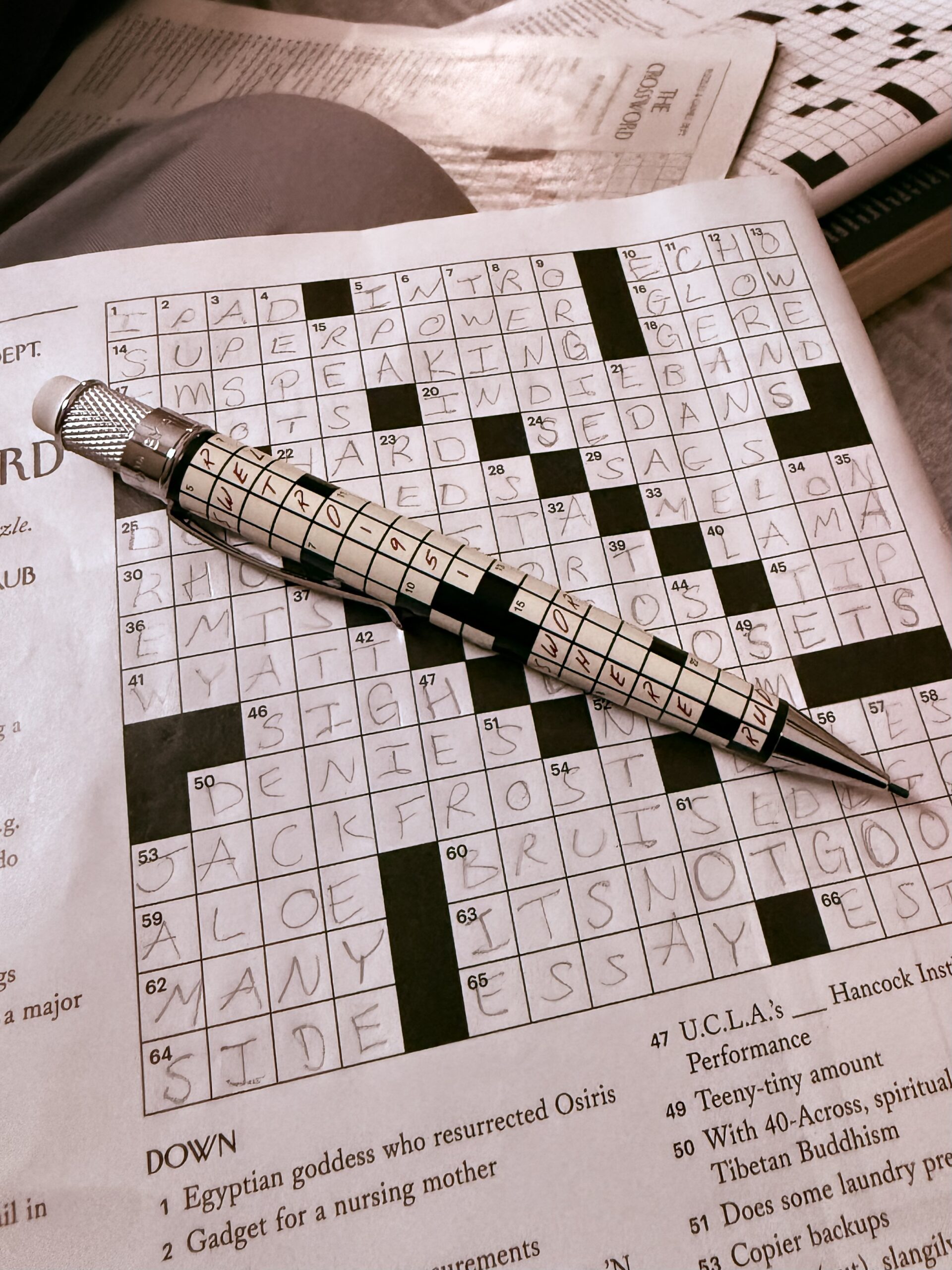
We solve the NYT crossword digitally (I’ve tried getting the paper delivered to my door, but in the apartment complex where I live, it turned out, sadly, that neighbors couldn’t be trusted to not steal it before I could grab it from just inside the gate, even though I’m up at 5 a.m.), but we still solve the New Yorker crossword in the print magazine. So it was with no small measure of joy that I found the following Retro 1951 Tornado pencil at FLAX Pen to Paper yesterday:

Needless to say, purchasing it was a no-brainer.

  • βœ‡The Cramped
  • Seeking β€˜Warmth and Personality’ in the World of High-Priced Pens
    Seeking ‘Warmth and Personality’ in the World of High-Priced Pens | New York Times Nice write-up about the London Pen Show in the New York Times: The consensus among these attendees was that putting pen to paper is more meaningful than typing on gadgets. “I feel more disconnected from the information that I’m trying to capture when I’m typing it versus when I’m writing it,” Ms. Staton said. The pen dealer Roy van den Brink-Budgen, 40, said there i
     

Seeking β€˜Warmth and Personality’ in the World of High-Priced Pens

21 October 2024 at 21:56

Seeking ‘Warmth and Personality’ in the World of High-Priced Pens | New York Times

Nice write-up about the London Pen Show in the New York Times:

The consensus among these attendees was that putting pen to paper is more meaningful than typing on gadgets. “I feel more disconnected from the information that I’m trying to capture when I’m typing it versus when I’m writing it,” Ms. Staton said.

The pen dealer Roy van den Brink-Budgen, 40, said there is “real warmth and personality” to writing by hand. “I think even if you don’t submerge yourself in it from a collecting point of view, I think writing with a fountain pen adds maybe that extra few percent to even the most mundane writing.”

Agreed. Wholeheartedly. However, I do have to disagree with the following:

Mr. Minhas, 53, has been collecting pens for more than 25 years and owns so many he is known by some in the international pen community as “the one-man pen show.” He believes that some pens are meant to stay on display, preserved as heirlooms for the next generation. “Pens of this quality you don’t really write with,” he said. “This is art of the highest quality.”

I love Sarj Minhas’s collection (and I came this close to buying a couple Montblancs from him at the California Pen Show earlier this year—and plan on actually doing so next year, because, seriously, his collection is beautiful), but I have to respectfully disagree with him here. All pens are for writing. Even the most beautiful, artistic, expensive, hand-crafted ones are still tools for writing. Pens are for writing.

  • βœ‡The Cramped
  • I Write Novels with Fountain Pens
    Ricardo, over at Extra Fine Writing, asks the question “Does anyone actually use a pen to write a novel?” When I hear that some famous author drafts their novels with a fountain pen, or when I see that in film or TV as a visual trope, my immediate instinct is to absolutely believe that they are lying.… Do any of you actually do this? Like, do you sit down with an unlined, blank piece of paper and start writing the first line of a novel, longhand, perhaps at an ornate desk in
     

I Write Novels with Fountain Pens

15 December 2024 at 21:47

Ricardo, over at Extra Fine Writing, asks the question “Does anyone actually use a pen to write a novel?

When I hear that some famous author drafts their novels with a fountain pen, or when I see that in film or TV as a visual trope, my immediate instinct is to absolutely believe that they are lying.…

Do any of you actually do this?

Like, do you sit down with an unlined, blank piece of paper and start writing the first line of a novel, longhand, perhaps at an ornate desk in front of a fireplace? Do you crumple it up and throw it out when you don’t like what you’ve written and start over with a fresh sheet, because you have an endless supply of both time and paper?

I do. Of the seven novels I’ve had published in the last twelve years, one of them, The Assured Expectations of Things Hope For, was first-drafted entirely by hand. Granted, it’s probably my shortest book, at only around 17,000 words. But about a month ago I finished a new novel, also entirely first-drafted longhand, with a fountain pen (mostly a Pilot Custom 823), and I intend to write long-form prose this way for the rest of my life (although the pen, at least for the foreseeable future, will be the exquisite Montblanc Meisterstück 149 100th Anniversary Edition I recently acquired).

Ricardo writes:

I did use pens—and used them heavily—to plan, organize, and manage the work. I used them for creating characters, connecting plot points, doing research, laying out timelines, making to-do lists for revisions and edits, sketching cover designs, and so on. I have pages and pages and pages of this stuff; some days this was all I did. Literally everything related to the book except actually writing it was done by hand, because that was heavy-duty, nonlinear thinking work that benefited from slowing down.

Actually drafting the book, though? I like the idea of doing this by hand a lot, but I gave up after a couple days of trying. It was tiring enough to do on a computer, and the computer has the benefit of a “find” feature for when you decide a character’s name is not dumb enough and change it in the middle of revisions.

I think drafting the book—that is, crafting the sentence—is the part of writing that benefits most from slowing down. Sentences should not be rushed. They should be carefully, delicately considered—“word by word,” as Verlyn Klinkenborg put it in his excellent book Several Short Sentences About Writing. Plus, more importantly than ever in this era of AI-generated slop, writing by hand allows us writers to show our work.

Of course, if you write your first draft by hand, you’re probably going to need to type it up at some point. But this is great. This is not extra, unnecessary work. This is the work, because this is where you get to make your first edits. Don’t want to type a sentence up? Then don’t type it up! Leave it out. This is where you get to make your first deletions and rewrites: in the transcription process. If you write your first draft by hand, on paper, and then transcribe your second draft, you’re likely to create a much stronger second draft than if you started at the computer in the first place.

And if you can’t bring yourself to sit down and transcribe your handwritten writing, if that sounds too exhausting, then it probably wasn’t compelling work in the first place.

❌