
❌

Normal view

  • βœ‡Do You Even Blog
  • Blogging Productivity 101: Where Should Your Time Be Spent?
    Here’s what us bloggers spend time on: creating content promoting back-end administrative The 1,028 items on our to-do lists can be put into those broad categories. The question is… How should we split up our time working–so as to MAX out our blog growth potential? As new bloggers? As experienced bloggers? Where should we focus our time and energy and resources? Here’s Heidi’s original question: read her responseHere’s the rest: With
     

Blogging Productivity 101: Where Should Your Time Be Spent?

15 October 2019 at 18:00

Here’s what us bloggers spend time on:

  • creating content
  • promoting
  • back-end administrative

The 1,028 items on our to-do lists can be put into those broad categories.

The question is…

How should we split up our time working–so as to MAX out our blog growth potential? As new bloggers? As experienced bloggers? Where should we focus our time and energy and resources?

Here’s Heidi’s original question:

blog productivity question
read her response

Here’s the rest:

With 35 posts–how should she be spending her time?

Note: what follows is absolutely my opinion.

Other blogging influencers might tell you something completely different. You should always judge for yourself and find what works for you!

You can also listen to this post in podcast format!

or listen on Apple Podcasts \\ Google Podcasts

Advanced or Experienced Bloggers: Here’s how you should be spending your time:

If you have more than 100 total pieces of content published–you automatically fall under this category.

If you have less than 100 total pieces of content but feel you’re ready–use your best judgment.

experienced blogger productivity'
  • creation = 20%
  • marketing = 75%
  • admin = 5%

If this time split sounds stupid or unreasonable, here’s my rationale.

If you’ve been blogging a while have a body of work built up–there is oftentimes NO reason to publish new content.

Every blog post you write has the POTENTIAL to be evergreen. Updated, revamped, and republished.

Experienced bloggers have the option to revamp and repurpose old, existing content.

In fact, not only do they have that option, but it is Pete’s personal opinion that they SHOULD make this “repurposing” cycle a larger and larger part of their content strategy.

Robert at The College Investor (who has hundreds of old posts) publishes 5x a week.

  • M, W, and Fri = new content
  • Tu and Thurs = old content, revamped.

Brennan Dunn has a year-long email funnel that walks new subscribers through all of his best content.

So–if you have loads of content already–you can easily update and revamp it–and re-release! This takes a fraction of the time as opposed to starting from scratch.

Experienced Blogger Admin & Marketing

There’s another benefit to NOT being a newbie–you’ve likely already started to solidify a marketing strategy.

  • you’ve found your tribe (at least a little)
  • you’ve nailed down your social channels
  • you’ve built some relationships

Once you have a body of content–my semi-pro opinion would be to focus more on marketing.

  • continue guest posting
  • (for media features & backlinks)
  • double-down on preferred channels
  • build more partnerships and collaborations

What about 5% of the time spent on admin? Like, wtf?

This is a tough one…

It’d be easy to say “At this point, you should hire your first virtual assistant!” or something–but I don’t think that’s entirely doable for many bloggers.

Experienced bloggers CAN start to systemize and create scalable processes for engaging with and managing their community (email, FB groups, etc).

Rather than respond to every single question–write a post about it (example: this post), or do a Facebook live. Then you can simply reference the post anytime you get the question again.

That, and you’ll hopefully start to get better at creating your own systems to save time in email, responding to comments, working on back-end website stuff.

This stuff takes a TON of time as a newer blogger just starting to get traction.

Beginner Bloggers: Here’s how to spend your time for max productivity and ROI:

First–there’s no magic number to go from “beginner” to “experienced” blogger. It’s different for everybody.

However…

If you don’t have a ton of “passive” traffic–your traffic tends to die off a few days after each new post, etc–or you don’t have a lot of old content to work with (less than 50 posts)–you qualify for the following recommendations.

Here’s my recommend time split for newer bloggers:

new blogger productivity
  • creation = 75%
  • marketing = 15%
  • admin = 10%

Why it’s vital for new bloggers to spend MOST of their time on the creation process.

Two huge reasons…

  1. to get better and more efficient at it
  2. with no following, your content IS YOUR BEST MARKETING.

When you first start–it takes a super long time to develop your “content muscles.”

There’s a reason I can sit down and record a decent podcast episode in one take, and publish it 10 minutes later–I’ve done it a lot (and I’m lazy).

The more time you can spend focusing on the creation process–the quicker you’ll find your voice, and the more efficient you’ll get at creating.

And the marketing time?

When you have massive organic traffic, 30,000 email subscribers, etc–you can hit publish, email your list–and watch the traffic roll in.

Not so for newbies.

new blog traffic
anddddddd…no traffic.

You can spend all the time in the WORLD on various marketing strategies only to see small ROI.

The biggest marketing ROI for new bloggers? Really, really, really remarkable and useful content.

Let’s talk about things that matter–and stuff that doesn’t.

  • a pixel-perfect website
  • 300 more twitter followers
  • learning advanced technical SEO
  • rock-solid branding across every pixel of your blog

There are tons of bloggers who have this stuff–and as a new blogger, you’re competing with all of them! (for attention btw).

Until you have a body of work–spend your time obsessing over producing quality content consistently.

Quality content consistently.

Also, it’s never too early in your blogging career to utilize tools to save time…

Even in month zero–there are definitely “must-have” tools. The trick is learning when enough is enough–for now.

A new blogger shouldn’t spend hours on hours learning 15+ WordPress plugins.

If you’d like a run-down on my tried-and-tested blogging tools, read this guide.

Conclusion:

New blogger?

I believe with all my heart that you should spend a LARGE majority of your time on the creation process.

  • brainstorming remarkable content ideas
  • writing writing writing
  • learning how to produce images and graphics that engage
  • learning about headlines and intros
  • making engaging and interest posts that people talk about.

This will grow your following more than tricks or tactics for more Pinterest followers or nit-picky SEO optimization. You’ll get better at that stuff in time.

However…

If you have a nice body of work built up, and have a decent flow or passive/organic traffic–it’s time to explore more advanced marketing tactics.

  • Go deep on technical SEO. Use a paid tool to track your posts across the first few pages of Google–then update, revamp, and re-release.
  • Go back through your Pinterest boards and clean up crappy or outdated content.
  • Focus on influencer outreach and use your time finding strategic ways to grow your blog and business.

You can afford to spend less time creating original content–until you just want to again 😉

*

The post Blogging Productivity 101: Where Should Your Time Be Spent? appeared first on Do You Even Blog.
  • βœ‡Do You Even Blog
  • The 12-month New Blogger Case Study – Traveling Tanya
    It’s been a DREAM of mine to release a long-form case study that takes place over 12 months, and I’m excited to present part 2! Please meet Tanya from Traveling Tanya! She’s a brand new blogger (at the time of this post), and we’re going to be following and picking apart her journey over the next year. This is part 1 of 4! Here are links to the updates: October 2018 – 1 month in January 2019 – 4 months in April 2019 – 7 months in September 2019 &nda
     

The 12-month New Blogger Case Study – Traveling Tanya

15 October 2019 at 18:55

It’s been a DREAM of mine to release a long-form case study that takes place over 12 months, and I’m excited to present part 2! Please meet Tanya from Traveling Tanya! She’s a brand new blogger (at the time of this post), and we’re going to be following and picking apart her journey over the next year. This is part 1 of 4!

Here are links to the updates:

This case study is currently in progress! I’ll be updating this page as we go along 🙂

Here’s how we’re going to cover each part of this series:

Rather than craft an entire blog post based on the podcast episodes–which is normally what I do for podcast episodes–we’re going to keep things simple and straight forward.

We’ll structure each part of the series like this:

  1. the facts
  2. the questions & answers
  3. Tanya’s progress
  4. Tanya’s “to-do” list
  5. Big Takeaways

Got it? good.

Side note for brand-spanking-new bloggers reading this: Please check-out my comprehensive guide to starting a blog in 2019 and beyond. This should be your blueprint for the first year.

1 Month in: The Facts for Traveling Tanya.

Listen to my interview with Tanya – Part 1 (Months 0-3)

FYI – you can also listen to all four parts on these channels (maybe just search for “Tanya” 🙂 Apple Podcasts \\ Google Podcasts

Website: https://travelingtanya.com/

Started: September 1, 2018

Experience: None before this blog, 1 month as of the time of podcast recording.

Niche: Travel, specifically for “busy people.”

Big Goal(s): To EXIST a year from now, cultivate a tribe to help, an eye for monetization in some form.

The Q&A’s from Part 1: “I don’t know what I don’t know”

“I have Google Analytics installed on my new site–but how can/should I use this information right now?”

You shouldn’t–like at ALL.

You simply don’t have the data to make this information useful, and seeing 5 visits a day is not going to bring any joy after week 1.

New Blogger Takeaway: Please DO install the Google Analytics (and FB ad) pixel on your site–then forget about it!

“I’ve heard that I need plugins, and have downloaded a few–which ones should I spend time learning? What more do I need right now?”

Keep it as simple as humanly possible!

As a new blogger, please do NOT concern yourself with learning 3+ plugins. You simply don’t need to right now. Focus on publishing good content consistently and learn plugins as the needs arise (and they will!)

Grab these in your first 3 months:

  • A plugin for Mailchimp just to get a form up! https://wordpress.org/plugins/mailchimp-for-wp/
  • A plugin for connecting analytics: https://wordpress.org/plugins/google-analytics-dashboard-for-wp/
  • A plugin for share buttons: https://sumo.com/ maybe–else just search for a social sharing plugin and pick one.

The trick is to NOT waste time right now. Don’t think you have to learn everything overnight.

“Do I need a freebie or lead magnet to grow my email list–at this stage of my new blog?”

Absolutely not.

Not only is this going to take time to learn how to do–but you probably don’t have a great idea of WHAT your audience really wants right now anyways…

…plus, ya know–you don’t have traffic (which you’ll need for optins).

Here’s what new bloggers should do to get people on their email list:

In short, write out 1-2 small paragraphs on WHY they should join.

Specifically, read this post on the WHAT-WHY-WHAT formula–then do that.

Example:

Hi! I’m Tanya, and I help busy adults find the time and money to travel the way they dream of!

Join my newsletter, and I’ll send you less than 3 emails a month with my very best travel tips, deal alerts for hotels and airfare, and general inspiration to travel better (and more often!)

🙂

Tanya’s Progress: Month 1

After exactly one month with a brand-new site–Tanya’s blog is looking great!

tanyas travel blog after 1 month

Also, she already has posts up. Sweet!

I’d call this a winning month 1, and a great springboard to jump off from.

New Blogger To-do List for months 2-5 (the 3 months before our next check-in):

1 – Fight to produce “good” content–consistently.

This is priority #1. It’ll take a long time to figure out what “good” is for her writing skills–and also her audience, but it’s what she should focus on for the 1st 3 months.

2 – Ignore tech stuff for 3 months.

She already has the site set-up w/ some plugins, and should not concern herself with anything further at this time–at all.

3 – Go BROAD on her marketing channels.

As in, a new blogger should probably experiment across all the big channels, and post everywhere to begin with.

After time and analysis–Tanya will probably be able to figure out exactly where she is getting the highest ROI for her time spent marketing–and then focus almost exclusively on those channels.

4 – Build a loyal following above all else (specifically for monetizing later!)

Monetizing a blog is 100x easier with a built-in audience–specifically a loyal and trusting audience. Courses like EBA, 10K Subs, Blogger U, etc–and promote the “get to 1,000 subscribers then test products) formula–and I’m no different.

Build tribes. Monetization is a byproduct of that.

Part 2 – 4 Months in as a New Blogger:

Listen to part 2 with Tanya

The Q&A’s from part 2 – The honeymoon phase is over 🙂

The idea of starting a blog is often intoxicating–it seems like so much fun, and often seems sooo easy at first!

Until you realize how hard it is and how much time it takes ?

Tanya’s main questions in month 4:

  1. The “newness” is wearing off; How do I persevere and thrive? (specifically balancing time and a posting schedule?)
  2. The blog growth vs. time spent spectrum. How do deal with?
  3. Google Analytics – What good is it? How do I use it?

Let’s dive in.

1 Key to conquering the “marriage phase” of publishing.

Publish less, but publish better.

*gasps

Oh no you DIDN’T PETE. You’re constantly yelling at new bloggers that “consistency is key key key!”

It’s true.

Publishing blog content consistently is key to growth–but not at the expense of stress, unhappiness, a feeling of “the grind” leading to burnout, etc.

And here’s the thing...

There are different ways to “publish” consistently–including revamping old blog posts, introducing different–and quicker–formats, and more. These will help struggling bloggers persist.

Here’s the thing…

Tanya’s blog isn’t new anymore. She’s been publishing several posts a week for 3-4 months now. (40ish total posts)

That’s a nice body of content to work with!

My personal recommendation to bloggers in this situation: You shouldn’t feel pressured to keep hitting publish 3x a week.

Question:

What do you think the difference would be if Tanya continued posting 3x per week–vs 2x per week–over the next 3 months?

Huge difference? No difference?

Think about it.

Instead of a publishing goal–adopt a writing goal.

Or a “creation” goal, including videos, podcasts, images, etc.

Instead of “I want to post 3x a week,” the goal becomes something like “I want to write 250 words every single day.”

The benefit of this is 2-fold:

  1. It removes deadline pressure while maintaining a personal productivity pressure
  2. It aims to make you equally prolific

250 words a day.

You can use something like this to write better, longer, in-depth posts–or simply get ahead on content.

This little switch in attitude can help new bloggers overcome that feeling of “oh this is starting to become a grind.”

Introducing the blog growth spectrum.

blog growth spectrum

At some point you have to make a decision: Where do I want to shoot for on this spectrum?

Example – Pete McPherson

I could probably grow DYEB and BU quicker if I worked more–and sometimes I do want to work more.

But I can’t.

I’m married with two kids–and frankly, I don’t like working for more than 6-8 hours a day. I’m not willing to give up the hours of 5pm to midnight, which I usually devote to kids, my wife, and to my hobbies.

Will I grow slower than if I gave up those hours to work on my blog/business?

Possibly.

Where do you want to be on the spectrum?

  • Some bloggers don’t have full-time jobs and don’t need a steady income like you do.
  • Some bloggers have 50-70 hours a week to blog–and do.
  • Some bloggers don’t have 4 kids and 2 jobs.

You can’t always control your circumstances–but you can choose where you want to aim for on the blog growth spectrum based on reality.

Re-read that.

Choose where you want to aim for. Make a decision and be comfortable!

When it comes down to how much time you spend working on your blog–embrace your decision and embrace the resulting growth curve you can expect.

?

Part 3 – April 2019, 7 months in as a new blogger:

Blog Tribe–if you’re still reading, can you drop a tip for new bloggers in the comment?

What do bloggers in months 0-3 NEED to realize? What should they focus on?

Leave a comment below!

Part 4 – September 2019, 12 months in as a new blogger:

Woooo the final chapter in a new blogger’s journey!

Listen to my FINAL episode with Tanya

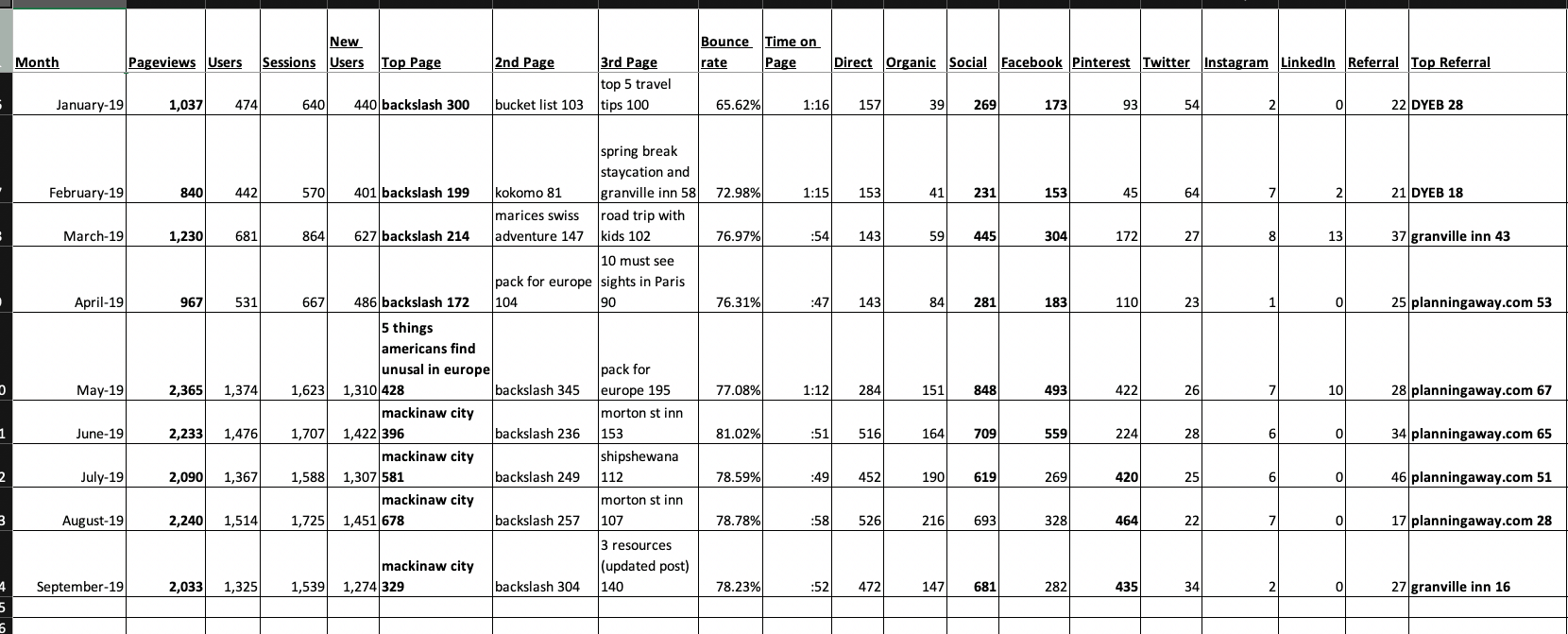
Here’s a screenshot from the blog tracker Tanya mentioned in the episode:

Click for larger view

There were a few big takeaways from Tanya’s one-year mark:

1. After a while–you should probably CHANGE how you spend your time blogging.

Actually, I wrote an entire post on this: Blogging Productivity 101: Where Should Your Time Be Spent?

The gist of that post is this: Once you have a respectable body of published content–you can probably start to spend less time creating new content, and more time marketing (and/or updating existing content).

Spending a ton of time on SEO and list-building with a new blog that has less than 20 posts is fairly low ROI.

Once you’ve been at this for a while, you’ll begin seeing a higher return on time spent marketing! (optimizing your site, finding partnerships, updating and republishing old content, etc).

2. Finite vs Infinite Games (like blogging)

There’s no “winning” your blog.

  • There’s no cap on traffic
  • There’s no “end” of any kind
  • There’s no “Well I finally hit THIS metric and now I’m DONE.”

Blogging is not finite.

Note: Some strategies are finite, though. There is a CAP on how many people are searching for one of your keywords in Google. There’s a number there. It’s not infinite. Trying to rank for that keyword in SEO is a finite game you’re playing with your “competitors.”

But the overall blogging game you are playing is infinite: Once you hit your own defined “success,” the definition changes.

Why this matters:

You can and should set goals for growing your audience and making money. 100%.

But if ever find yourself feeling like you’ve lost–you haven’t. You’ve just failed, experienced set back, etc…

and you need to CHANGE THE RULES of the game you’re playing.

Move the goals. Redefine your timeline for “success.”

Learn, move on, and get better. ALWAYS.


The real strategy in the blogging game is to do whatever it takes to be able to CONTINUE playing the game.

👍

Thoughts?

Watching Tanya go in and out of the “honeymoon” phase of blogging has been incredibly interesting to me.

It’s now one year in, and she seems to be having fun, growing slowly but steadily, and even getting some monetization benefits!

Did you get anything from this little case study?

Please drop us a comment below!

The post The 12-month New Blogger Case Study – Traveling Tanya appeared first on Do You Even Blog.

❌