❌

Normal view

  • βœ‡Do You Even Blog
  • How to Be a Confident Podcast Host – Joe Saul-Sehy
    “I could never be a podcast host.” – loads of bloggers everywhere. Or maybe… “I don’t have a good voice.” “I don’t know what to say.” “I don’t even know where to start.” Fam, I got you. Actually NO. Joe Saul-Sehy has you! You’ll know him from the Stacking Benjamins (and Money With Friends!) podcast(s), and I’d argue he’s a bonafide expert when it comes to running a microphone. So if yo
     

How to Be a Confident Podcast Host – Joe Saul-Sehy

6 November 2019 at 10:03

“I could never be a podcast host.” – loads of bloggers everywhere.

Or maybe…

  • “I don’t have a good voice.”
  • “I don’t know what to say.”
  • “I don’t even know where to start.”

Fam, I got you.

Actually NO. Joe Saul-Sehy has you! You’ll know him from the Stacking Benjamins (and Money With Friends!) podcast(s), and I’d argue he’s a bonafide expert when it comes to running a microphone.

So if you’re curious about starting a podcast (or already have one), Joe is here to help us…

  • Run engaging interviews
  • Create interesting content that keeps listeners coming back for more
  • Generally be capable of producing quality audio content.

It’s good. I’m excited for you to listen & learn.

Listen to my episode with Joe Saul-Sehy

or listen on Apple Podcasts \\ Google Podcasts

Fun quotes from Joe:

I would tell anybody that wants to go into podcasting–Don’t worry about getting it right, get started! We started roughly eight years ago, and we should have started nine years ago. Had I started a year earlier, we would have made the mistakes earlier that everybody makes and we’d be further ahead.

and one more…

Make the show you’d want to listen to.

💪

How can I get more comfortable & confident in front of a microphone?

From Joe…

You’re going to mess it up. You’re going to hate your voice.

It’s going to really sound like nails on a chalkboard and you’re not going to be good because it is a 10,000 hours kind of thing.

So, Realize you’re going to make mistakes, and the only way NOT to–is to start talking, because you will figure things out as you go along!

You get on the microphone, and you evaluate yourself. I think the important question is: “Can I constantly sharpen your saw and think about how can I get better?”

How can I “get better” as a podcast host?

Joe brings up two points:

1. Think in terms of stories:

Think in terms of Stories.

Podcasts are phenomenal story vehicles, and instead of trying to get facts–try to get stories!

Facts are fantastic if you’re in listicle world and blog world–but facts suck on a podcast. Our eyes are designed for factual stuff. Our ears are designed for storytelling.

Further reading? Check out my blog post: How to tell marketing stories!

2. Put away the overused questions and focus on the conversation:

For a new podcaster, those pre-arranged questions can actually be a crutch.

As a host, you WILL probably have a few huge points, lessons, and topics that you want your guest to get to–but those are just lead-off topics.

You’ll want to simply kickstart that conversation, story, example, etc, and have your guest do most of the storytelling and explaining!

While YOU listen attentively with the goal of understanding and staying involved in the conversation for proper follow-ups, etc.

Do you INSTANTLY feel more confident about producing podcast content?

Or still “meh?”

Drop me a comment below!

I’d love to hear if podcasting is even on your radar, and if you found this chat with Joe Saul-Sehy helpful 👍

The post How to Be a Confident Podcast Host – Joe Saul-Sehy appeared first on Do You Even Blog.

  • βœ‡Do You Even Blog
  • How to Use Research to Quickly Grow Backlinks and SEO Traffic – Kyle Byers
    If you hate SEO traffic and generating quality backlinks in a short time frame–this chat with Kyle from Growth Badger isn’t for you. Kyle started his site about a year ago and has since SKYROCKETED a few posts using a very specific strategy. (utilizing surveys & research & other unique approaches to content). holy SEO batman!We’re talking thousands of shares, 100+ referring domain, and an 843% increase in traffic–from one blog post. In this post &
     

How to Use Research to Quickly Grow Backlinks and SEO Traffic – Kyle Byers

13 November 2019 at 10:00

If you hate SEO traffic and generating quality backlinks in a short time frame–this chat with Kyle from Growth Badger isn’t for you.

Kyle started his site about a year ago and has since SKYROCKETED a few posts using a very specific strategy.

(utilizing surveys & research & other unique approaches to content).

holy SEO batman!

We’re talking thousands of shares, 100+ referring domain, and an 843% increase in traffic–from one blog post.

In this post & podcast, we’re chatting about…

  • Using data-driven content to grow your SEO
  • How to run effective surveys
  • Other ways to produce unique content for SEO that DOESN’T require a huge audience already.

Enjoy 😉

Listen to my episode with Kyle from Growth Badger:

or listen on Apple Podcasts \\ Google Podcasts

Want to grab Kyle’s freebie where he walks you through his Double Survey techinque step-by-step? You can grab that here!

Survey resources & more:

Other highly relevant content:

The “Double Survey” Technique (the quick version)

In short, here’s the formula

  1. Choose a topic you feel would be interesting to do research on.
  2. Poll or survey your audience (or conduct research another way)
  3. Share THOSE findings with other influencers in your space.

The first step is actually tougher than it seems…

Let’s say you run a personal finance blog, don’t have a huge audience, and want to start ranking for budgeting related keywords in Google.

So you’re into budgeting worksheets, templates, planners, etc. Great!

But how to turn that into original content backed by data or research?

  • Poll your audience on what makes worksheets good/bad to them?
  • Download and personally analyze as many budgeting worksheets as you can get your hands on?
  • Something different?

If we’re shooting for some quick shares, backlinks for SEO, etc, I might choose the 2nd one–ESPECIALLY if we don’t have a huge audience to survey.

The goal:

  1. Do original research around budgeting worksheets, and come up with SOME finding, interesting tidbit, anything.
  2. Present your findings to other personal finance bloggers, podcasters, and YouTubers, asking for their opinions.
  3. Present the findings AND the influencer opinions in one blog post.

Yes, even this small-scale data-driven blog post would take a bit of time–but doesn’t that sound like a MUCH more interesting piece of content than a super-standard budgeting worksheet blog post?

THAT’S the kind of content that Kyle has used to generate backlinks and SEO wins.

Some other approaches to “unique” content for backlinks:

Like I mentioned above, you don’t necessarily need a mega-huge audience to use research, polls, etc.

How about the “Myth Busters” approach?

“bust” other people’s research/data

The idea is simple.

Since you don’t have access to a huge audience in which to poll or survey–you can test other people’s data, findings, research, etc, and report on it.

Bust that myth and present your findings (and make sure to tell the original researchers about your detailed work!)

Or do your own original research.

Run an experiment about a topic in your niche.

Use yourself as a guinea pig.

Example:

Let’s say you run a health & fitness blog.

Here are a few made-up headlines that would be based on your original research:

  • “I did 500 situps every day for 60 days, here’s what happened [Case Study]”
  • “I ate pizza for every meal for a week, here’s what happened [Case Study]”
  • “I asked 373 people in my hometown about their biggest weight-loss challenges. Here’s what they said.”

Run your own experiements.

The bottom line: this content is great for backlinks & SEO

Let’s not forget WHY we’d be doing this: It’s to bump our SEO traffic.

Unique, original content gets shares and backlinks–even if it doesn’t rank for anything!

Boom.

The post How to Use Research to Quickly Grow Backlinks and SEO Traffic – Kyle Byers appeared first on Do You Even Blog.

  • βœ‡Do You Even Blog
  • We asked 100 bloggers about blog income reports: Here’s what they said.
    If you’ve been in blogging for a while, you’ve seen ’em. A detailed blog income report detailing how “Bloggy McBlogga” made over $79,940.12 in her 1st month blogging! Inspirational, motivating, and interesting! (Impressive Mr. McBlogga!) However… If you been a blogger for more than 48 hours, you’ve also seen the dark side of these reports… The “look how much money I made this month neener neener” income report. Ok,
     

We asked 100 bloggers about blog income reports: Here’s what they said.

14 November 2019 at 20:40

If you’ve been in blogging for a while, you’ve seen ’em.

A detailed blog income report detailing how “Bloggy McBlogga” made over $79,940.12 in her 1st month blogging!

Inspirational, motivating, and interesting! (Impressive Mr. McBlogga!)

However

If you been a blogger for more than 48 hours, you’ve also seen the dark side of these reports…

The “look how much money I made this month neener neener” income report.

Ok, so they don’t have the “neener neener” part, but still.

For better or worse, blog income reports are an A+ marketing tool.

Why?

Because we all want to make crazy revenues from our blog, and when we see other bloggers making serious cash from their RV somewhere…

We want to know how.

So we click through. And subscribe to their email lists, and leave comments like this…

But here’s the kicker…

I’m tired of monthly income reports. Even my own.

(hey gimme a break. It’s only my 4th month).

  • Do you really receive value from these posts?
  • Do they legit help your blogging efforts?
  • Which bloggers produce the most valuable income reports?

Well, the DYEB team (there are technically 2 of us now yippee!) set out on a mission to answer these questions.

First, the results of the survey. Monthly Income Reports: How useful are they?

Here’s the choices:

I got 87 responses from a few tweets, emails, and post to 2 different Facebook groups.

(Nice engagement Pete! Thanks Tribe member!)

Here are the broad level results:

mostly as expected?

The takeaway:

For the most part, bloggers approve of monthly reports, and find them useful.

Very few people found them not useful at all, but a HUGE majority agreed on one premise: blog income reports should be detailed, and provide MORE than just the numbers.

Specifically,

  • lessons learned
  • wins, losses
  • strategies
  • a detailed breakdown of affiliate income,
  • etc.

Though I definitely include goals, wins, fails in my own reports, even from the get-go (here’s my first month for $51, woot!), I’m not planning on doing even more of this.

It’s clearly the value proposition with these reports. The more we can provide actual, concrete insights, the better.

In addition, I also asked the Do You Even Tribe what they thought…open-ended style.

Several folks responded with some reallllly great points.

If you publish income/blog reports of any kind, these will definitely help you make em even more appealing and valuable 🙂

Eric at High Five Dad

I LOVE them with one caveat. As a newbie knowing there is a pot at the end of rainbow is super exciting. I’m super analytical (my wife hates it), so I look at their income report and then scrub their website/ emails sent through their list to figure out HOW they did it.

The one caveat that I wish more bloggers would include is expenses.

It does me no good seeing someone saying they made $3500 on Bluehost when in reality they spent $2400 on Facebook ads or used an affiliate service so their profits really was 1100. Way more transparent.

One of the reasons bloggers quit before the first year is they never peek behind the curtain or never connect the dots. They see huge income reports and think I’m a failure because I’m not there. What they fail to realize is that those bloggers are networking, paying for ads, building connections and creating affiliate partners that help pitch their product.

Okay rant over. Income reports good just be transparent. Mic drop

Mandi from Big Tiny Steps

A lot of income reports spread “noise” about what blogging is really like and can be discouraging to new bloggers.

Also, larger sites that make a ton don’t say their cost of running the blog itself so that can be misleading. And I have also seen people who list their side jobs and stuff that is totally unrelated.

(Pete’s note: note a trend from these already? Seeing huge $$$$$ can be super discouraging for new bloggers)

CJ at CJ The Money Guru

They mostly make me feel like s**t.

We’ve been blogging for almost 3 months now and we haven’t made a dime yet. When I see bloggers pulling in thousands of dollars every month, it makes me feel bad about myself.

I will read the reports and see if I can do what these other people are doing so I can start making money. But so far I just can’t replicate even a fraction of their results.

I really don’t want to be a statistic and quit after 9 months ( I learned that from your podcast), but hopefully reading these income reports will encourage me to keep going instead of giving up.

That’s my rant.

Lee from Bald Thoughts (also an upcoming guest on my podcast)

I don’t always read them, but blog income reports add value to other bloggers.

Like one of your recent guests said, by inspecting the income reports of blogs in your space and that you admire, you can see where their revenue is coming from and seek to duplicate that success.

And if you follow a blog and want to support them, you can see how you can best do that by supporting companies that provide revenue to the blog.

Kiwi and Keweenaw (great name)

I definitely don’t think everyone should write monthly blog income reports!

They need to add something to the conversation, provide valuable information for other bloggers, and not replace better content. I think they are definitely appropriate for a blog like yours! But there are lots of blogger that publish monthly income posts in the personal finance field, so I wouldn’t choose to do that on my site.

Cato at The Dollar Build

As a blogger I’ll occasionally read other people’s income reports to learn a few tips and tricks about how to make it in the blogging world. I find it encouraging to read about other bloggers having success.

However, I’ve decided not to publish income and traffic reports for my blog for a couple reasons.

It’s not what my readers want. (I’m assuming this, of course. My blog has only been live for a month, who knows what they really want. Or if they even exist.) I assume those who visit my site are there to learn about personal finance – not about page views.

If my blog were about blogging (like yours), then sharing site traffic and income makes sense. It’s proof of authority.

What bugs me most is when it crosses the line into a heavy-handed or semi-misleading sales technique. Too often, I see bloggers who say straight up “It’s easy to start your own blog.” That’s true, but they leave out “…but it takes a ton of hard work to make money from blogging.”

I know this sounds a bit rant-ish. I hate to sound like an old curmudgeon. You know, the ole’ “get off my lawn” type thing. Overall, I don’t mind income reports when done tastefully.

Really. I swear.

Shivika at Dirt Cheap Wealth

My main gripe with monthly blog income report is – meh! they mean nothing and add absolutely zero value. Here is why:

  • you undermine your true blog audience (remember, not everyone who comes to your blog wants to become a blogger, since you may have some really kick-ass content)
  • you get into unnecessary competition with self, and assume things for other bloggers based on superficial information you see
  • the reports never ever calculate the value of time, which when calculated correctly, will always negate your reports

Lisa at Mad Money Monster

I like income reports. They’re motivating and informative. I like to gauge how other bloggers are making their money. In my opinion, they have their place in the blogging community, but I’m sure they’re not enjoyable for most readers.

Kathy at Baby Boomer Super Saver (A+ blog name!)

As someone who is new to blogging, I have found the monthly blog reports to be very inspiring. I don’t read them all anymore, but it was great to see the financial growth so many different bloggers were able to achieve. It opened my eyes to possibility and opportunity, always a cool view!

(Pete’s notes: me thinks this: Income Reports are more useful the EARLIER you are in your blogging journey, yes?)

Jenny from Good Life Better

I haven’t read a ton of these but the ones I have read I don’t really find that helpful for a number of reasons:

For people in my niche, they are often not specific enough to guide what I might want to pursue (e.g., “$XXX from affiliate income” vs. “$XXX from my affiliate contract with Bluehost that is a mix of 500 ongong clients and 8 new ones.”). I would especially find helpful the new and reoccurring client info because that lets me know how much readers value that product now.

I think I would actually prefer quarterly statements or year over year statements. Blogging is seasonal so let me compare an April to an April vs. an April to a September. And with a quarterly summary, it can even out a product lunch that inflated income and visitors.

Maybe I am being naïve but I am enjoying blogging for me. I want people to read my blog and I want to make money from it but I think I would do it anyway if those things never happened. Income statements make me question the satisfaction I get from just hitting “publish.”

Linda from She Climbs the Ladder

I think they were interesting and actually sparked my interest into blogging as a real side hustle.

It might be nice to see a mix of them though so it’s not just those people that are like ‘hey I make $$$$ blogging every month.’

Jeff Proctor from Dollar Sprout

I have a love/hate relationship with them.

If more than 20% of it is copy and pasted from the previous month, I hate them. If you are sharing original content and REAL business insights and it’s simply delivered as an income report, I absolutely love them.

Pee Hermanos (I have NO idea who this guy is, but he’s in the DYEB Facebook group >_< )

nooooo income reports are great! it’s something to relate to and take inspiration from, also a great way to spark a convo. The only time I don’t enjoy them is when the income is super huge as its no longer personal or relatable.

(Pete’s note: Rosemarie Groner’s income is also totally unrelatable, but she decided to publish OTHER blogger’s reports that ARE relatable for her audience. Brilliant.)

Physician on Fire

I think bloggers like looking at income reports. I’m not sure how the non-bloggers feel about them.

Some might be curious, but I would guess the interest level drops off for those who don’t have sites of their own.

Araminta from Financially Mint

I think they’re really helpful because not only do they give you an idea of how much blogger earn, but I also find them very motivating, it’s easier for me to see myself in the future earning that kind of money.

Chris from Keep Thrifty (also a former guest on my podcast)

I LOVE income reports (even though I don’t publish my own). Please keep em going!

Veneta from Becoming Life Smart

I actually like looking at them because it gives me an idea of how bloggers earn money. Before I stumbled on them, I didn’t realize how much money can be made from blogging and how it’s done.

Barnabas from The Dad Wallet

But for me, they can be useful if done correctly, but I do not think monthly reports are useful once you hit like 10k/month as it becomes either so far out there that people get this idea they can do the same easily. Or for people who have been around awhile, it becomes oh well I bet they spent 5k as well on costs. Just my two sense.

***

Our all-time favorite monthly blog reports

Note: Some of these have very little to do with blog income, but rather traffic, marketing, etc!

Those insights are actually more relevant to more bloggers, as some bloggers seriously couldn’t care less about replacing full-time incomes.

Rosemarie Groner from The Busy Budgeter (Here’s the latest report).

Why it’s awesome: Rosemarie is a rockstar for sure, but she actually doesn’t publish her own reports. She publishes other beginner bloggers, and produces amazing feedback for them! It’s. so. good.

Loads of value here. (She’s also gave a killer podcast interview here)

Pat Flynn from Smart Passive Income (Here’s the latest report).

Why it’s awesome: Pat is skill a king of blogging for good reason: He really does have valuable content. Plain and simple.

His income reports are the best of the best. Inspiring and motivating, but also really well designed, personal….and he shares a detailed breakdown of expenses as well.

Mrs. FAF from Frugal Asian Finance (Here’s the latest report)

Why it’s awesome: She isn’t concerned about blog revenues per se, but her traffic stats and strategies are compelling, engaging, smart, and useful.

Highly recommended.

Lily from The Frugal Gene (Here’s the latest report).

Why it’s awesome: The exact same reason Ms FAF’s is. She goes deep into her traffic stats and sources, and generally just produces incredible fun and engaging content.

These two were on the podcast as well, found here. Might seem like I’m just plugging podcast guests, but that’s because I am. They give extremely valuable income reports. So they deserve to be plugged.’

JLD from Entrepreneur on Fire (Here’s the latest report).

Why it’s awesome: Well laid out, transparent, includes accounting and legal tips, and very personal and engaging. A+.

Youuuuuu guessed it. Also had him on the podcast.

(Internal link madness!!!)

***

What are your thoughts? Anything surprising here?

If you publish regular blog reports, did this give you any insights as to how to make them better?

The post We asked 100 bloggers about blog income reports: Here’s what they said. appeared first on Do You Even Blog.

  • βœ‡Do You Even Blog
  • How the Flea Market Flippers Built a Crazy Profitable Blog
    Rob and Melissa, from the Flea Market Flipper, almost didn’t have a blog. After a few months of documenting their flipping lifestyle (they made over $80,000 flipping items last year) and trying to sell an online course, they quit. For months. They didn’t see immediate results, lost focus, and decided it wasn’t worth it. Luckily–for them and us–they did return to their blog and have managed to build a&nbs
     

How the Flea Market Flippers Built a Crazy Profitable Blog

15 November 2019 at 15:45

Rob and Melissa, from the Flea Market Flipper, almost didn’t have a blog.

After a few months of documenting their flipping lifestyle (they made over $80,000 flipping items last year) and trying to sell an online course, they quit.

For months.

They didn’t see immediate results, lost focus, and decided it wasn’t worth it.

Luckily–for them and us–they did return to their blog and have managed to build a budding flipping empire!

Want to listen to my chat with the Flea Market Flippers?

or listen on Apple Podcasts \\ Google Podcasts

Really quick, lemme hit you with my 2 huge takeaways from this chat with Flea Market Flipper:

1 – How much free content do you give away–before charging?

There are two types of thinking about this:

  1. Give away as much as humanly possible for FREE. It’s great marketing for you.
  2. Give away a lot for free, but some/most of your content deserves to be behind a paywall.

What do you think?

Where’s the line?

Note: I don’t have an answer for YOU here. You’ll have to figure it out for yourself!

Here’s something important to keep in mind though.

When people pay for things–they are “enrolling.”

I.e. voluntarily committing, to themselves and sometimes others, that they will use your product.

A payment is a commitment.

When you charge for your content (via courses or otherwise), your students who DO end up in front of the content–are far more likely to take action based on what they’ve learned.

This helps both parties.

I’d be curious to hear your thoughts on this.

Drop me a comment below?

Is there a great way to KNOW when you’ve given away too much for free?

2 – What’s the “right order” to build your monetized blog?

Should you monetize your blog in month one?

Should you build an audience first and foremost before even THINKING about selling courses, etc?

Sadly, there’s no “right” answer for all of us…

but…

95% of bloggers should seek to grow an audience that knows and trusts them–before monetizing *heavily,* especially with their own products.

Note the word “heavily.”

Ads and affiliate marketing can and should be utilized as soon as you can reasonably expect to get some views and click-throughs.

*opinion alert.

But in order to really get a high-ROI from your time, I’d personally recommend waiting to launch your flagship courses, books, products, etc, until you have an audience!

It simply won’t be worth your time until then.

?

One more secret to the success of Flea Market Flipper, specifically…

They are DOERS.

They LIVE the life that they teach others how to do.

Honestly–Rob was a master flipper before they started this brand. This is actually a big takeaway for building “authority.”

  • Do things
  • Show how you did them

That’s an incredible recipe for a successful blog. Kudos to the Flea Market Flippers for, ya know–actually flipping stuff.

That’s obvious, but powerful.

What do you think? Drop us a comment below!

Is there a good way to tell when you’re ready to start monetizing? Launching courses? Switch to meta-blogging?

The post How the Flea Market Flippers Built a Crazy Profitable Blog appeared first on Do You Even Blog.

  • βœ‡Do You Even Blog
  • How to Get Podcast Sponsorships (Even With a Tiny Show) – Andy Hill
    If there’s one area of podcasting that I haven’t done much with, it’s this: Book podcast sponsorships 💰 That’s why I ended up attending my buddy Andy’s presentation at FinCon–where he laid out a nice little system & strategy. Andy runs the Marriage, Kids and Money podcast, and has had some incredible success booking podcast sponsorships–starting when he had 500 downloads a show! His show is not so tiny anymore 😎 For co
     

How to Get Podcast Sponsorships (Even With a Tiny Show) – Andy Hill

20 November 2019 at 10:00

If there’s one area of podcasting that I haven’t done much with, it’s this:

Book podcast sponsorships 💰

That’s why I ended up attending my buddy Andy’s presentation at FinCon–where he laid out a nice little system & strategy.

Andy runs the Marriage, Kids and Money podcast, and has had some incredible success booking podcast sponsorships–starting when he had 500 downloads a show!

His show is not so tiny anymore 😎

For context, 500 downloads/episode is technically right around podcast “averages,” but I know a ton of people with more downloads–who haven’t been able to do what Andy has. The DYEB podcast averages around 2k downloads/episode in the first few weeks and I definitely haven’t done what Andy has lol.

In this show we chat about 👇

  • How to FIND podcast sponsors (specifically where to look and figure out who is paying)
  • Putting together the proposal
  • Media Kits!
  • Turning getting sponsorships into a repeatable system.

Enjoy. I have just a weeeeeeee few takeaways in text format just below.

Listen to my episode with Andy Hill from Marriage, Kids, and Money.

or listen on Apple Podcasts \\ Google Podcasts

Show Notes:

Here are some tips for booking podcast sponsorships:

These are my personal takeaways & reminders from this episode:

1 – Build long-term relationships with these brands.

Psst. This tip applies to WAY more than just podcast sponsorships. Blog sponsors, partnerships, guest post outreach, etc.

You WILL hear “no” a lot.

It’s vital to remember to keep the relationship open at all costs. You may have plenty of different opportunities to partner up in the future–even if they turn down your sponsorship!

True story: I just booked about $2,200 in freelance work from a long-term brand relationship that initially started with a “no” outreach!

2 – Be persistent

This also applies to any other blog/podcast strategy that involves outreach.

Just because they don’t reply, doesn’t mean it’s a no.

  1. Follow up with unread emails
  2. Try different channels (Instagram or Twitter direct message)
  3. Do it again.
  4. But be professional!

You don’t have to be nagging or annoying or spammy. You do have to be persistent.

The difference is how professional and respectful you are.

3 – Start your search with brands how have advertised on podcasts before.

Go check out other podcasts in your niche (the large and medium-sized ones) and see who is sponsoring their shows.

It will be a LOT easier to pitch sponsorships to companies who know what podcast advertising actually looks like.

It’s a different beast than other types of PPC advertising to these companies.

Podcast sponsorship track records. Go find those brands.

4 – Create a snazzy media kit

This doesn’t have to take you days and days and a professional design team.

Brands care less about that, and more about “will this show give us sales?”

Here’s a handy article on creating media kits, and I’ll also throw out this media kit from Podcast Junkies as an example.

It’s spot on!

5 – Deliver value beyond “live reads.”

In Podcast Junkie’s sponsorships packages (shown above), you’ll notice they add additional benefits other than “live reads.”

Live reads = you reading your sponsor’s ads on your show in audio format.

  • Banner ad on your site?
  • Social media promotions on show day? Every week?
  • Email mentions?
  • You’ll run an ad campaign with your money? (I know people who do this as part of their package).

No need to get super creative either, just try to get your sponsors a great deal!

Sending referral traffic and/or direct leads is a great additional benefit.

6 – Grow your podcast (and don’t give up)

If you’re just starting a podcast and have little “existing audience,” you might only get 50 downloads the first month.

You might actually be too small to start booking sponsorships. Don’t you worry!

With more downloads comes more opportunities.

Yes, I’m aware this is a cop-out, but it’s also a vital thing to remember.

Grow your show. The sponsors will follow.

Questions? Tips? Drop a comment!

I’d love to hear from you! Did you enjoy this episode w/ Andy?

The post How to Get Podcast Sponsorships (Even With a Tiny Show) – Andy Hill appeared first on Do You Even Blog.

  • βœ‡Do You Even Blog
  • Blogging Taxes: What to deduct to save money!
    Yes, taxes are uber boring (even blogging taxes). But you know what’s NOT boring? Saving money. 💰 Bad news = any income your blog produces is taxable Good news = you can TOTALLY offset that income with your blog-related expenses! But the best news of all? All the money-saving & blogging tax tips in this post do NOT just apply to those making $100k/month from their blogs! I’d argue these strategies are actually more important for those of us not earning ANYT
     

Blogging Taxes: What to deduct to save money!

24 November 2019 at 21:44

Yes, taxes are uber boring (even blogging taxes).

But you know what’s NOT boring?

Saving money. 💰

  • Bad news = any income your blog produces is taxable
  • Good news = you can TOTALLY offset that income with your blog-related expenses!

But the best news of all?

All the money-saving & blogging tax tips in this post do NOT just apply to those making $100k/month from their blogs! I’d argue these strategies are actually more important for those of us not earning ANYTHING yet.

Today we’re going to dive into:

  • What blogging expenses can/should you deduct?
  • How non-accountants can organize your businessy-stuff year-round without wanting to scream.
  • LLC? Sole-proprietor? S-corp? What should you do and why?
  • and more.

Let’s blog like a business.

Disclaimer: All tips, tactics, strategies, advice, etc that appear in this blog post and podcast–are MY OPINION, not professional legal or accounting advice. Consult your lawyer and CPA, please. I can’t be held responsible 😉

I also have a podcast on blogging taxes, featuring another accountant, Eric Nisall!

or listen on Apple Podcasts \\ Google Podcasts

What blogging expenses can I deduct come tax time?

A lot.

Anything that you have to spend in order to make money.

Here’s a more specific list of stuff I know that you probably spend money on.

Deduct the basics for starting up a blog:

  • Domain name
  • Hosting (lol)
  • Premium WordPress themes
  • Paid plugins
  • Logos you had designed

If your blog makes any money, or you plan on it making money in the near future–you can deduct these expenses!

Deduct educational expenses:

If your learning expenses are related to your business, deduct.

Deduct blog marketing expenses:

  • Your paid SEO software
  • Facebook ads
  • Social Media software (Buffer, SmarterQueue, Tailwind, etc)
  • Your ESP (Mailchimp, ConvertKit, Drip)
  • Anything other product you pay for to run the blog

As long as these things are “directly related to your business” and you plan on making money from your blog–deduct ’em.

deduct facebook ads
keep the receipts though (more on that below)

Sell stuff? Deduct processing fees and CC interest:

Misc. deductions for bloggers, contractors, freelancers, solo entrepreneurs:

Note: Calculating the following can be a bit tricky. Again, we suggest speaking to your accountant officially and reading up on the “work-at-home” specifics here from Turbotax.

  • Home office expense (proceed carefully here. Further tips)
  • Daycare or storage expenses (see above link for more)
  • business cards
  • conference expenses (coming to FinCon? Deduct the tickets, as well as travel and meal expenses
  • Podcasting mic. DSLR & Laptop (if NEEDED for your business, etc)

Does the IRS want me to prove that my blog is a “legit” business? Yes.

From this Intuit Turbotax article:

The IRS will disallow your tax deductions if your blogging business is categorized as a hobby. To claim your deductions, you must demonstrate to the IRS that you are running a bona fide business. The most obvious way to prove this is to earn a profit. If you have a profit in at least three of the most recent five tax years, you can usually qualify your business as legitimate.

Other things the IRS may consider are the time and activity you put into the business, whether or not you depend on income from it and if you can reasonably expect to make a profit in future years.

The bottom line?

Yes, you should be prepared to prove that your business is legitimate–and this is done via demonstrating profits, as well as how much time you spend on your blog!

And also demonstrate that you can reasonably expect profits in the future (as your site grows).

Neato.

So I can deduct stuff. How do I organize these expenses and receipts?

You could pay for fancy-pancy receipt software like ShoeBoxed, but I personally don’t think it’s needed for most bloggers.

Here’s what I’d recommend:

  • A separate Google Drive folder
  • A separate Dropbox folder
  • A separate label/inbox in Gmail

Notice how I used “separate” 3 times? Hint hint. That’s key to this process!

Choose your “one stop” to house all your receipts–digitally–and make it a routine to automatically send your receipts there throughout the year. Come tax time–double-back and add them up!

Here’s my process over here at DYEB:

I house everything in a separate label within my personal Gmail.

how i manage blogging receipts
I set-up a “rule” to have stuff sent here. More below.
  1. Physical receipt? Snap a photo with my phone and email to pete+receipts@doyouevenblog.com
  2. Digital receipt? Email to the same address, or drag-n-drop to that RECEIPTS label if already in the inbox.
  3. Wait until tax season
  4. Create a Google Sheets and list every expense out, 1 by 1 (doesn’t take that long surprisingly)
  5. Categorize expenses (marketing, advertising, processing fees, software expenses, education)
  6. Calculate home office and travel expenses
  7. File taxes

Gmail Pro Tip: Set-up a “skip the inbox” filter for receipts:

Watch the gif below:

gmail filters for receipts

This allows me to email receipts, etc, to “pete+receipts@doyouevenblog.com” and Gmail will have them skip the inbox and move straight to my little “folder,” i.e. Label.

Handy!

You can also add to Dropbox and Google Drive folders from just about anywhere as well (including from inside Gmail for emailed receipts).

Should you incorporate your blog? What business entity should you choose?

The short answer?

Consult a lawyer! This is mainly a legal decision, not a tax and money-saving decision (for the most part. See below).

Here’s a brief rundown of the legal entities 97% of bloggers will likely consider:

Disclaimer: I, Pete McPherson, am not a lawyer. These are just my opinions based on limited knowledge!

Sole Proprietorship

I like to consider myself a Soul Proprietor. #dadjokes.

Unless you’re hiring employees are your lawyer thinks there is a risk to your personal assets (house, cash, cars, anything)–this is the choice for most solo bloggers.

Also, there is NO DIFFERENCE between a single-member LLC, as far as taxes are concerned. You’ll simply deduct expenses on your personal tax return (specifically on the Schedule C for self-employment income!)

Plus, you don’t have to register anything with the state.

Want your blog to be a business? Say the words and it’s done. Boom.

FYI, the only downside is that if you DID get into legal trouble, your personal assets would be put at risk.

Limited Liability Company (LLC)

This is the most blogger-friendly “separate entity” option, meaning your personal assets would have limited liability!

From a tax perspective, it’s essentially the same thing as a sole proprietorship though.

(You can actually choose to be taxed like a partnership or a single-member entity. Pretty neat.)

While an LLC does require registration with your state, it’s generally fairly simple and cheap (compared to the options below)

C-Corporation

This means your blog/business would be a completely separate entity from you.

This means your personal assets would be separate–but you’d also be subject to double-taxation (meaning your sweet blog revenues would get taxes TWO TIMES, one for your business return, and again when your business pays you. Ew)

This isn’t necessary for most bloggers.

S-Corporation.

This has the same limited liability as the C-corp, but your income would NOT be subject to double-taxation. Woot!

Why shouldn’t bloggers do this? Because they’re expensive to create, and you also have to file paperwork, comply with corporate formalities like creating bylaws and holding board and shareholder meetings.

Um, no.

DYEB Recommends:

First, consult your lawyer, not me.

Second, if you’re not doing anything risky (legal-wise) or otherwise require a separate entity for other reasons, stick with a Sole Proprietorship and deduct blogging expenses on your personal return (Schedule C)

That’s it.

Over to you. Do you deduct blogging expenses? Did I miss any opportunities to save?

Drop me a comment below!

The post Blogging Taxes: What to deduct to save money! appeared first on Do You Even Blog.

  • βœ‡Do You Even Blog
  • 22 Perfect Gifts for Bloggers & Podcasters (Updated for Christmas 2019)
    Gifts for outdoorsy folks? Grab them a fleece. Knitting enthusiasts? Grab some crazy yarn. But what about gifts for bloggers? Podcasters? WordPress nuts? SEO slaves? Side hustlers? (It’s ok if you don’t know what these words mean. We’re here to help!). Here are some solid gifts for bloggers: Pro Tip to save cash: Make sure you’re using Ebates to save money while shopping online. You can often get up to 20% cash back from places like Amazon, Wal-Mart,
     

22 Perfect Gifts for Bloggers & Podcasters (Updated for Christmas 2019)

29 November 2019 at 20:00

Gifts for outdoorsy folks? Grab them a fleece.

Knitting enthusiasts? Grab some crazy yarn.

But what about gifts for bloggers? Podcasters? WordPress nuts? SEO slaves? Side hustlers?

(It’s ok if you don’t know what these words mean. We’re here to help!).

Here are some solid gifts for bloggers:

Pro Tip to save cash: Make sure you’re using Ebates to save money while shopping online. You can often get up to 20% cash back from places like Amazon, Wal-Mart, and more.

Click here to get $10 extra when you sign-up for Ebates!

Blogging gifts under $25-$50

1 – Books ($)

There are plenty of amazing reads for bloggers to help them grow their audience and learn!

Can’t go wrong with those 👍

2 – A GOOD set of Earbuds or headphones ($)

Anyone who works at a computer should invest in a decent pair of earbuds or headphones. Good news is….you CAN get a decent pair for less than $9.

The Panasonic Ergofit Earbuds ($9) are absolutely incredible, but if you feel like splurging a bit more, go with the Audio Technica M20x.

I use the big brother M50x myself 🙂 🙂

December 2019 Update: Better Ways to Charge Gadgets!

I’m not joking when I say that a good portable charger can change your life. I HIGHLY recommend these as Christmas gifts–they’re incredibly useful for everybody and affordable!

  1. Jackery 6,000 mAh Portable Charger – If you can spend $10 more–upgrade to the 10,000 mAh version. It’s what I have and I LOVE IT.
  2. 2-port USB Wall Charger (3-pack for $11!)
  3. POWRUI Multi-Wall Outlet Surge Protector – 4 USB plugs? Yes please.

3 – Laptop stand ($$)

For laptop users, the computers overheat on your lap and can get uncomfortable. Laptop desk and lap stands are affordable and effective.

The Amazon Laptop Stand ($19) is super easy, but the Rain Laptop Stands are bar-none. (It’s also rated 5/5 stars on Amazon, which is rare).

4 – A sturdy laptop bag ($$-$$$)

Laptop bloggers often carry around a LOT of stuff. Journals, USB drives, External SSDs, Miss, Webcams, Chargers, and more. Their gear is expensive, so a solid bag is essential.

For podcasters, or anybody with lots of gadgets (mics, webcams, etc), the Case Logic DSLR bag ($63) should do the trick.

If you’re looking for something more snazzy, I love all the CoolBELL bags I’ve tried over the years. (try this messenger bag)

5 – A WordPress theme ($)

First, ask your blogger if they’re on WordPress. If so, write “5 Pro WordPress Themes” on a piece of paper and wrap it. Sit down together with your blogger and pick out the themes!

Let him or her choose why they want. It’ll be fun for you too 🙂

I HIGHLY recommend a StudioPress Genesis Theme. There are loads to choose from.

They make beautiful themes at a great price.

6 – A productivity app designed for digital creators (bloggers and podcasters) ($$)

Distractions stink when you’re trying to get stuff done! Our personal favorites are Freedom.to ($30/year) and Hey Focus ($20) (Mac only).

Both of these can block social media sites, etc to force your blogger into, ya know…blogging.

Then there’s TextExpander–one of the most useful and time-saving tools ever. 😃😃

TextExpander Price: $30-40 Easily insert text snippets in any application from a library of content created by you! A HUGE time-saver for anybody who does stuff on the computer! Buy Now TextExpander

You could grab a year’s worth for LESS than $40–and it’s an amazing gift for any blogger.

7 – Coffee! ($)

No explanation needed, right? May we suggest Death Wish, The World’s Strongest Coffee ($19)? Or for mere mortals, how about a tea variety box ($11)?

8 – USB Flash Drive ($-$$)

These are pretty handy for everyone, but especially those of us constantly creating images, graphics, videos, and content for our blogs. These are incredibly cheap these days. Grab a metal Samsung 32gb for $14. This is an excellent gift idea.

9 – A Writing and Organization App ($-$$)

Bloggers = writers, and getting an app specifically designed to enhance the writing process can make a world of difference.

We use Bear Pro ($15/year and FREE!) for all-things brainstorming and writing, but Evernote ($40/year and FREE!) is still the gold standard for organizing notes, to-do lists, writing, and pretty much everything you can think of.

10 – A Journal ($-$$)

This might seem like an odd gift for a digital-enthusiast, but a physical journal provides a much-needed break from computer screens.

You can start basic with an Amazon Basic Journal ($9), nerd out with the Traveler’s Notebook ($25), or grab a more guided journaling experience with The Freedom Journal.

Medium-sized Blogging gifts $50-$100

11 – Gift Cards ($$-$$$) Let’s be honest, this is the easy AND effective route.

You can never go wrong with an Amazon gift card.

Is it kinda lame? Only from your point of view as a gift-giver? I personally love getting gift cards lol.

12 – Personalized Mouse Pad

This is more fun and quirky, but we’d sure love a Do You Even Blog Podcast mousepad. Shutterfly is easily the fan-favorite for customized…well, anything really.

13 – A Pro upgrade to their favorite Social Media Management Tool ($$)

Managing social media can be a pain, but luckily there are fantastic (and affordable) tools to help with this.

Buffer ($120/year) is widely-used, but SmarterQueue ($20/month) is actually our platform of choice. It has just as many features as MeetEdgar ($50/month, it’s arch rival), but at half the cost. Click here to get a double-length free trial!

If your blogger uses Pinterest, grab them Tailwind. It’s the gold standard.

14 – ConvertKit Subscription ($$-$$$)

This is the single most valuable SOFTWARE blogger gift idea in this entire guide.

Email marketing is crucial to the success of any blogger, and while there are dozens of platforms on which to host your newsletter, ConvertKit ($29/month) is the only one specifically made with bloggers in mind.

If you really to support your blogger loved-one, grab her a ConvertKit subscription, a book, and one of the online courses below.

You’ll be her favorite relative by FAR.

THE hot tool for bloggers right now.

Ok, now for some audio and video focused gifts!


Gifts for Podcasters and YouTubers!

Podcast & YouTube gifts under $100

Podcasting books! ($)

There is only ONE book on podcasting I really recommend, and it’s So You Want to Start a Podcast by Kristen Mienzer.

I listened to this one on audiobook a few months back, and it’s solid 👍

USB Microphone ($$-$$$)

If your blogger creates any kind of webinar, YouTube videos, podcasts, etc, a decent microphone goes a long way.

The Blue Snowball ($49) and Blue Yeti ($129) are great choices for bloggers, along with the Audio-Technica ATR2100 ($65, definitely better for podcasters).

Oh, and here’s the desktop mic stand ($30) we use for the ATR2100.

It’s amazing.

Podcast & YouTube gifts over $100+

A decent Webcam (and/or a light!) ($$-$$$)

If there’s ANY video involved, a decent webcam is mandatory. The Logitech C920 ($49 on sale at the time of this writing!) is the only choice.

It’s the gold standard, and it’s affordable.

If you’re doing any YouTube work, you’ll also benefit from some light! It helps more than you’d think.

The tiny Neewer LED ($33) is fantastic, as are the LimoStudio Umbrella 2-kit ($52).

Recommended cameras for YouTubers. ($$$)

I personally recommend Canon! I’ve been using them for years, and have had ZERO disappointments.

There are 2 cameras I’d recommend for aspiring YouTubers, and these are both in the YouTuber gift price range as well 🙂

  1. Canon SX740 (above)
  2. Canon Rebel T7i (below)

Both of these have HD video quality (up to 4k), dual-pixel autofocus (a MUST for YouTubers), and are generally awesome.

A new Laptop ($$$$$)

Mac-fanatics love their upgrades, and this very blog post is being written from a high-powered MacBook Pro w/ Touch Bar ($2,300). Expensive but worth every penny.

But you don’t NEED to spend $2k+ on a computer!!

The big thing every blogger should care about is the processor, and thankfully you can grab a Window’s based Lenovo Thinkpad for around $600, and an Ideapad for under $250.

That is more than enough!


Online courses your blogger is sure to love (and find immensely valuable)

Blogging is hard, and courses (both free and paid) are the QUICKEST way to help you blogger grow their audience!

FREE – My mega-guide to starting a blog.

If you’re loved one doesn’t actually have a blog yet, there’s no need to spend any money–I’ve put over 100+ hours into that guide above, and it covers EVERYTHING they’d ever need to know for their first year!

$197 – Michelle Schroeder’s Affiliate Marketing Course ($$$)

Michelle makes over $100,000 a month from her blog. Yes, you read that correctly. Her course, Making Sense of Affiliate Marketing ($197), is a crash course on using affiliate marketing, in connection with a blog, in order to generate side-income (or full-time income!)

It’s highly regarded as one of the best online courses for monetizing a blog.

Membership to Online Impact (a private community of experienced bloggers and podcasters) $50/month

This program is game-changing for bloggers.

There are over 15 full-sized courses.

  • SEO
  • Affiliate Marketing
  • Blog Traffic
  • Website Design.

Everything’s in there!

Sadly, this membership community is only twice a year, but if you email me, I can let you pre-purchase access as a gift for when the membership community opens up again.

So that’s that. What gifts are you getting your internet-obsessed love one?

The post 22 Perfect Gifts for Bloggers & Podcasters (Updated for Christmas 2019) appeared first on Do You Even Blog.

  • βœ‡Do You Even Blog
  • Inside Brendan’s Updated SEO Strategies for 2020
    It’s been a wild year for SEO traffic. Algorithm updates More competitors than ever Everybody following the same ole’ SEO tips and strategies, yada yada. SO MUCH ADVICE TO SIFT THROUGH. What do experienced bloggers need to know about SEO for 2020? How about newer bloggers? This episode answers that question for BOTH of you. I thought it high time we get Brendan Hufford (SEO for the Rest of Us, 100 days of SEO, etc) on the podcast again. (1st episode here). We chat abou
     

Inside Brendan’s Updated SEO Strategies for 2020

4 December 2019 at 10:00

It’s been a wild year for SEO traffic.

  • Algorithm updates
  • More competitors than ever
  • Everybody following the same ole’ SEO tips and strategies, yada yada.

SO MUCH ADVICE TO SIFT THROUGH.

What do experienced bloggers need to know about SEO for 2020? How about newer bloggers? This episode answers that question for BOTH of you.

I thought it high time we get Brendan Hufford (SEO for the Rest of Us, 100 days of SEO, etc) on the podcast again. (1st episode here).

We chat about…

  • 2020 SEO Strategies (for both newbies and experienced bloggers/sites)
  • What’s changed/new for 2020?
  • How can new blogs start building links quickly?
  • and more SEO goodness.

I’d trust Brendan 100% with my SEO–and with my life.

Or at least the SEO part 😉

Listen to my episode with Brendan on 2020 SEO Strategies:

or listen on Apple Podcasts \\ Google Podcasts

Brendan’s SEO link-building advice for new-ish blogs:

  • Focus on “linkable content.”
  • Get off your own site (and get on other people’s)

“Linkable content” really just means “content worthy of linking back to.”

Copycat or “Skyscraper Technique” content generally doesn’t fit into the “linkable” category anymore (unless it is TRUTHFULLY 10x quality, which is tough in 2020).

Rather, try doing something unique (that word has lost a lot of meaning, but I mean it in the true sense of the word).

NON-copycat content.

Start there.

Then, do more guest posting, freelance writing, etc.

As a new blogger, you don’t have access to 1,000s of readers and/or blogging influencers to get backlinks.

Guest posting then, is indeed, factually, ACTUALLY–not dead.

Especially for newer folks who literally have less than 15-20 referring domains.

  • Get guest posts
  • Get freelance writing clients
  • Write on Medium (not exclusively though. Maybe just once or twice).
  • Write for your company
  • Get in front of students at a local university (and try to get on their blog).
  • More more more more more.

Get off your own site (once you’ve reached a small body of QUALITY content). Get backlinks 🙂

What do experienced bloggers need to know about SEO in 2020?

Search intent is still the name of the game (now more than ever I’d argue).

That, and if you already have a decent body of blog content–keep updating and optimizing your blog posts for SEO.

Resource: How to update old blog posts for SEO.

This practice takes less time than producing new content and is great for keeping your site fresh in the eyes of Google (AND READERS).

Heck, even if your older audience has already seen one of your older posts–chances are high they’ve forgotten about it (or need a refresher anyways).

Then?

Leverage your audience, connections with other influencers, etc, to keep up the never-ending game of building quality links.

  • Get on more podcasts
  • Pursue media opportunities
  • Do even more quality guest posting (I can feel you shuddering right now).

SEO in 2020 = a more competitive 2019…

Plus

  • Original/unique content that is linkable…
  • that satisfies user intent
  • a cohesive site strategy
  • quality, relevant links

Done and done, blogger!

Question/comments?

Ask away in the comments 😉

The post Inside Brendan’s Updated SEO Strategies for 2020 appeared first on Do You Even Blog.

  • βœ‡Do You Even Blog
  • How to run a crazy successful blog giveaway [case study]
    This post will teach you how to create and run a blog giveaway to grow your email list. Specifically, we’ll walk through my own giveaway results, then we’re diving deep into strategy and set-up! A quick warning: The case study you’re about to read was only accomplished thanks to a personal skill I have: pitching and negotiating. Thanks to these, the $1,600 Do You Even Blog Giveaway cost me $350. But there’s good news. We’re going to look at how I ma
     

How to run a crazy successful blog giveaway [case study]

20 December 2019 at 13:10

This post will teach you how to create and run a blog giveaway to grow your email list. Specifically, we’ll walk through my own giveaway results, then we’re diving deep into strategy and set-up!

A quick warning:

The case study you’re about to read was only accomplished thanks to a personal skill I have: pitching and negotiating.

Thanks to these, the $1,600 Do You Even Blog Giveaway cost me $350.

But there’s good news.

  1. We’re going to look at how I managed that
  2. You might not need these skills at all 🙂 🙂

First, what’s the point of running a giveaway? Why is this important?

Bloggers run giveaways to build their email list, which is a key channel for marketing their blogs. The rest of this article assumes you already recognize the great value of your email list.

Let’s break down the numbers:

  1. Beginning email list – 421
  2. Ending email list – 980ish (a few unsubs during the giveaway)
  3. Emails added – 579
  4. Cost of giveaway items to me: $300ish
  5. Facebook Ads campaign for Giveaway: $100
  6. Real ending email list, 1 month later – 940

Given the newness of this blog, I considered this giveaway to be a massive success, and definitely plan on doing them again soon.

The last 3 months of email list growth lol

That said, let’s break this thing down like a fraction.

Inside the Do You Even Blog Giveaway

1 – Generating giveaway ideas, etc

Step #1 in this process is probably the single most important part of running the giveaway: Choosing the thing you’re giving away.

This point cannot be overstated. This is important for a few reasons:

  1. (Good) blog giveaways cost time and money
  2. You NEED these costs to be considered an investment, rather than an expense.

If Mike from NinjaBudgeter.com were to give away his favorite recipe book, the cost of that book would be an expense.

Why?

Because the resulting email subscribers wouldn’t be in his target market.

However, if Mike had given away a lifetime subscription to Personal Capital (a personal finance app), chances are good the giveaway entrants are more aligned to his target market.

Huge Pro Tip #1 – Choose a giveaway prize only your target audience would enjoy. Simply speaking, the item needs to fiercely attract people directly in your niche.

Given my audience is bloggers, I choose a suite of blogging courses and paid blogging tools. Roughly $1,600 worth if someone paid retail prices, which leads us to…

Huge point #2 – Choose a giveaway prize that is really, really, really, really, really, really desirable. Like, something your audience would kill for.

The level of “success” you see from a blog giveaway is directly related to the desirability of the prize. $1,600 worth of blogging tools is better than $1,500 worth. Both of which are infinitely better than $400 worth.

Good news: It’s not actually about the monetary cost. It’s about the value.

Josh Earl is famous for growing his list over 3,000% from a $30 giveaway. How?

That $30 product (Sublime Text pro) is something any developer in those days would kill for. It wasn’t even a huge upgrade. Just “one of those things” that hit Josh’s audience with “Ugh YES that’d be so nice. I’m entering.”

Additional tips for choosing your giveaway item:

  • Include more than just your own info products. Please. No more “win a free copy of my $9 ebook!” That’s not an effective prize on it’s own.
  • Ask yourself: What paid products do my audience usually spend a lot of money on?
  • Ask yourself: What subscription/service does my audience usually think they need?
  • Which of these items could you barter for? (See below)
  • Make it bigger. Just, bigger.

If you truly want your giveaway campaign to go “viral” (whatever that phrase means to you), the prize you giveaway needs to turn heads.

You’ll be spending time, energy, and money for the giveaway anyways, don’t skimp on the prize.

Make it count.

2 – Obtain as much of the prize as you can…discounted or free.

This point is going to be a bit controversial.

Also, you might not need this section at all if…

  1. You’re loaded with cash and can pay retail for your giveaway item
  2. Your giveaway item doesn’t require loads of cash

If you’ve already got this down, skip to the next bullet point. If not, let’s proceed.

If you’ve been in the Do You Even Tribe for long, you probably noticed something in the giveaway…

Many of the prizes are from former podcast guests and other blogging friends of mine.

This was just a coincidence.

#jokes

When setting up the prizes, I hand-selected these products and reached out to their owners to pitch them a barter. Bartering in the blogging world is SO underrated.

Here’s an email I sent to Monica Louie bartering for a coupon to Flourish.

trading a coupon for promotion!

Here’s the email I sent to ConvertKit bartering for a 3-month credit to include:

Again, bartering.

Annnnd with my buddy Jeff (who would LOOOVEEE you to visit his new site, DollarSprout.com lol)

saaaaamee thing. Thanks Jeff!

IMPORTANT NOTE: Very little of this outreach was “cold.” Rather, I have spent a great deal of time building friendships with these other bloggers and influencers.

Remember the first words of this blog post? You might not have these relationships in place for your blog. If this is the case, you should:

  1. Start building relationships YESTERDAY. It’s so vital.
  2. Choose different giveaway items.
  3. Pay retail for giveaway items.

Technically set-up the giveaway

(Edit: After publishing the post, I reached out to Sumo.com and got a discount code for 20%off  this Kingsumo plugin! Use DOYOUEVENBLOG at checkout 🙂 🙂 🙂 )

There are entirely too many giveaway tools and software to choose from, all of which are ludicrously priced in my opinion. (It’s the simplest software, why do they cost so dang much??)

Boggles my mind.

Still, I used KingSumo, and would therefore recommend it for a few reasons:

  1. I’ve used Interact and Rafflecopter before, and DID NOT enjoy them at all.
  2. Both of those (and most other) giveaway tools require monthly subscriptions. (Really people?)
  3. Kingsumo is incredible easy to set-up, and only requires a one-time payment.
  4. Kingsumo comes w/ built-in social sharing vitality (You can make it where when an entrant shares their “unique URL,” they can get more entries. Basically just an incentive for them to share your giveaway. It works.

If you plan on running more than one giveaway ever (and I think you should), grab Kingsumo.

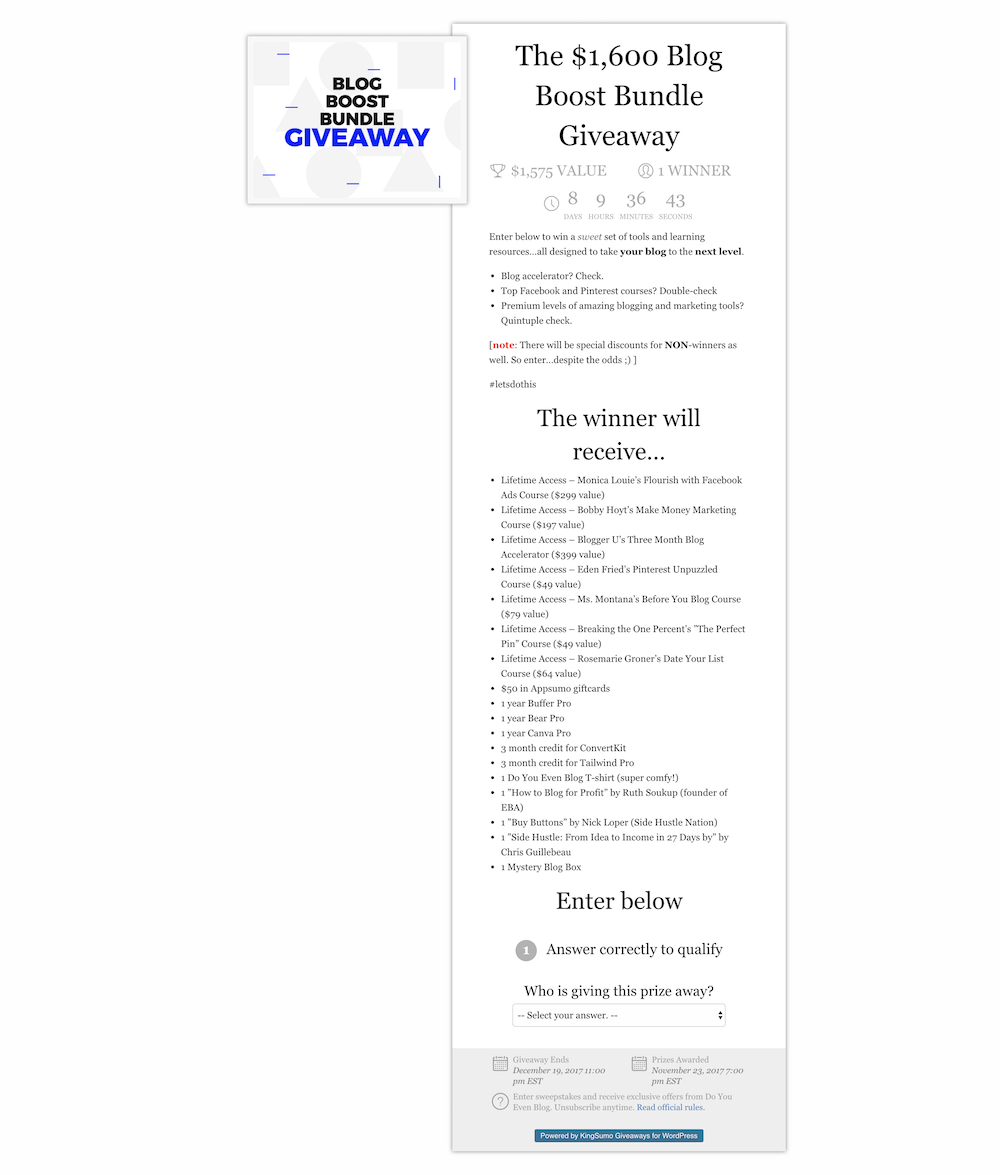
Here’s what my giveaway page looked like:

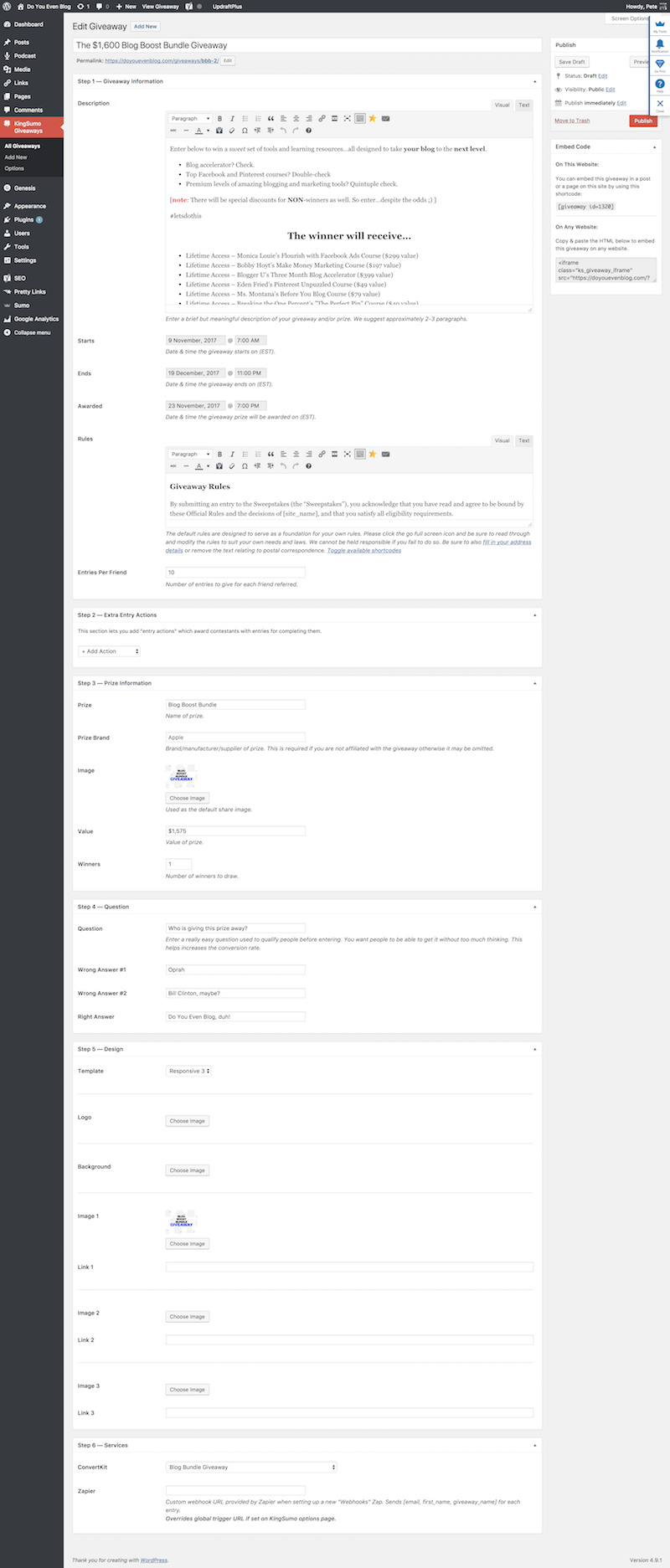
And here’s what the backend looked like:

Click to view larger image

What should I include on the giveaway page?

There are only a few required things:

  1. A detailed list of giveaway prizes and their value.
  2. Terms and Conditions (see below)
  3. Minimal sales copy.

That’s it.

The truth is…nobody cares about the copy, they care about the prizes. That’s what they’re looking for when they land on the page.

Therefore, they shouldn’t have to go looking for the prizes.

Keep intro copy short, and exciting! Giveaways are fun, so your copy should be too! As far as the list of prizes, be detailed! The more you can show off what the winner’s will win, the better. This includes retail/cost of the items if they’re available. Just don’t inflate.

Terms and Conditions —> This is important for legal reasons! Let’s not get sued, ok? I went to RocketLawyer, signed up for the free trial, made the giveaway terms, then canceled the free trial. (You’ll actually still have the document to reuse in your account, even after you cancel the trial!)

How long should I run my giveaway for?

7-10 days. That’s just enough time to let social shares run their course, while still maintaining a sense of urgency for contestants to enter and share.

Next question.

Small Pro Tip for your Blog Giveaway – When it doubt, keep everything as simple as possible. Do NOT hold yourself back from launching or taking action because you’re obsessing over the background image on the page, or the copywriting to describe the prizes, or anything else for that matter.

Keep images simple, and keep the giveaway page simple. People understand what they’re signing up for. Show them what they’ll win; that’s what they’re there for!

Blog Giveaway Phase 2 – Promoting and enhancing virality

First, here’s a broad but important summary of what makes a giveaway go blog-viral:

An incredibly desirable prize (that specifically attracts your target readers), combined with your giveaway software’s built-in share incentives…is what forms viral giveaways.

However, strategic promotion is still important to get the very first batch of entrants and sharers!

Here is the bare minimum of promotion:

1 – Announce the giveaway….BEFOREHAND.

Tease it to your email list, Twitter followers, etc. Mention it in a blog post. The point of this is to build anticipation so when you send the first “Hey my giveaway is live!” email….that email will have a massive open rate.

Tease us.

2 – Send to your email list

We’re all bloggers by this point right? This should be a “duh” moment for you. Send a very brief note to your list informing them the giveaway is live, and include a partial (or complete) list of the prizes in the body of the email.

This will drive click-throughs.

3 – Schedule, IN ADVANCE, tweets, posts, pins, etc.

Hopefully, you’re already using a tool like SmarterQueue or Buffer to automate social media posts…so queue a few up for the week of your giveaway. Pin on Pinterest as well. (Tailwind)

IMPORTANT: Frequent communication and ongoing engagement is vital to keep new subscribers on your email list. If I’ve heard one question the most, it’s “doesn’t everyone who signs up just leave after they hear they didn’t win?”

Some do. Most don’t….are there are definitely actions you can take to minimize subscriber churn.

Pete’s “secret sauce” of continued promotion without annoying your list.

Here’s a common dilemma: Whenever bloggers launch products, conduct giveaways, have special promotional periods, etc….it usually leads to a huge spike in emails sent.

People don’t like to be spammed.

It’s my personal opinion (watch out world) that even loyal followers can start to lose interest in your brand during periods of high email frequency or intensity

That said, here’s what I came up with…

Find really good excuses to email your list. That’s it.

Emailing all your subscribers five times throughout the span of the giveaway simply asking them to share….is stupid. It’s been done way too many times to boot.

Huge Pro Tip #3 – Add additional prizes in the middle of the giveaway period.

This is a solid tactic for several reasons:

  1. It keeps people interested and engaged, without being spammy.
  2. Your followers/entrants care about this.
  3. There’s a psychological factor that makes the giveaway seem even more enticing.
  4. It “warms up” brand-new email subscribers that just joined your list.

That last point is crucial.

During my campaign, I sent out segmented emails to different parts of my list, including a completely separate email to NEW subscribers that just joined.

For example…

  1. Average Susie enters your giveaway, now she’s on your email list.
  2. She gets a confirmation email.
  3. She receives your normal weekly newsletter (I hope it’s a good one!)
  4. She thinks “Ugh another email list. I just wanted in for the giveaway I think. I don’t KNOW this blogger at all.”

Susie didn’t sign up for your newsletter, she signed up for the giveaway.

So the question is, how do we convert Susie from a “cold” subscriber, to a “warm” one, to a raving loyal fan?

Slowly and carefully.

You MUST show new subscribers that you are fully capable of adding value to their lives (specifically whatever you’re blogging about).

For my own example… I added new products to the giveaway on three occasions during the actual giveaway, and maintained frequent (but relevant and useful) email contact with my segmented groups.

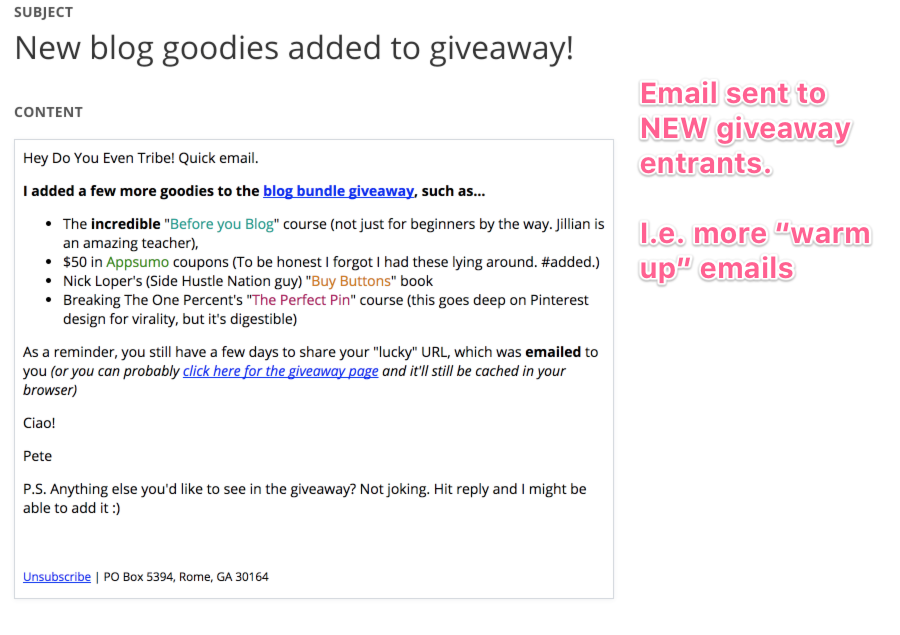
Below is the first warm-up email I sent to new subscribers, about halfway through the giveaway.

keep people engaged, and adding more value

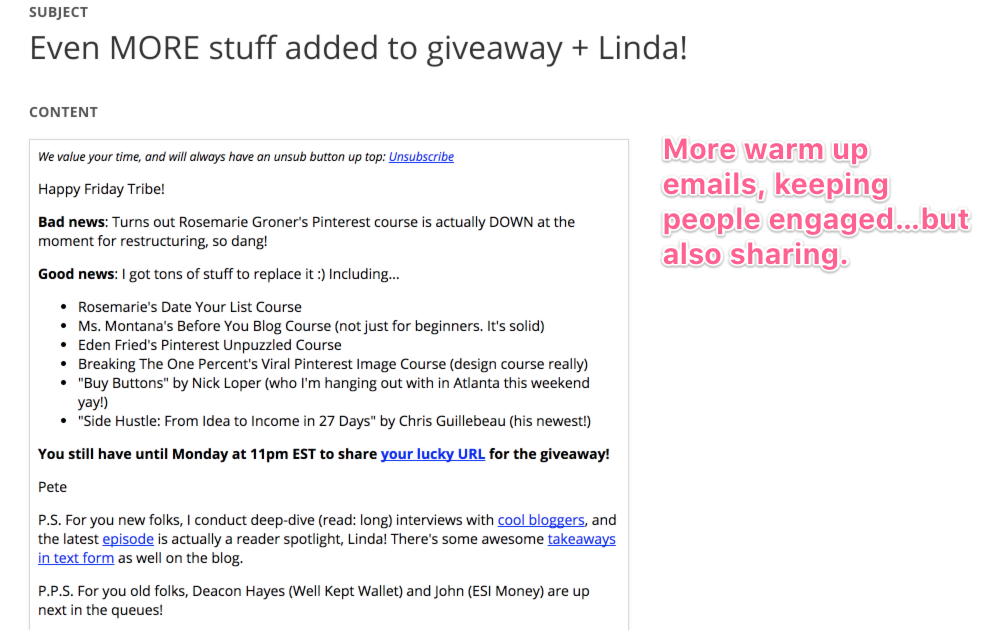
And here is the SECOND warm-up email (included the entire list this time): Again, updating people and keeping them engaged, and also delivering value where I can!

The point of these emails was to:

  1. Keep people updated on the giveaway (they’re still invested in the outcome, so they open the emails for sure).
  2. Show them, however possible, that your content and emails is worth sticking around for.
Huge Pro Tip #4 – Give something to non-winners. (It should probably be something scalable, like a discount coupon code or something)

In both my emails and on the actual giveaway page, I mentioned there would be discounted products/services available for NON-winners as well! These included discounts I had acquired through the blogging course creators previously…as well as a few new opportunities I specifically asked for.

Again, the point is to prove to NEW subscribers (heck, old subs too) that you can add value to their lives.

Here’s the somewhat massive email I sent to announce the winner.

click to view larger image

Yes, I also timed it so that this announcement email would land on Black Friday, leading to even MORE deals available to all my email subscribers.

Optional: Running paid ads to your giveaway (I <3 Facebook)

It’s funny, 1/3 of my total investment to run the giveaway was actually Facebook ads. (Half of which were terrible).

Given the viral nature of the giveaway (I.e. entrants will share to get more entries), the potential ROI of a paid campaign can be massive…

…just don’t start like I did.

My ad campaign started off terrible. I spent a good $50 (half my allotted budget) and got ZERO SUBS. Like, actually none.

The reason? Though I had already signed up for Monica Louie’s FB ads course (she was also on the podcast here)….I hadn’t actually gone through it yet lol.

I created my ads based on the first module only (which doesn’t even hit copy and images yet), and those ads did NOT convert.

Luckily, Monica’s course also has group coaching calls, and she let me jump in the “hot seat” to assess my campaign performance.

Everything changed. Copy, images, emojis, everything. We spent a good hour going through and changing stuff.

After that? I converted like crazy.

I was averaging less than $1 a sub ($0.73/sub), which I’m told is great, and I’m pretty sure I could’ve got it much lower with a bit larger budget.

woot! (and derp)

If you’re thinking of going for paid reach, here are few small tips:

  1. Use bright, relevant images that grab attention. Not cat pics, they need to be somewhat relevant.
  2. Use emojis. Everyone likes emojis, and they grab attention.
  3. If driving traffic to a blog post, keep copy short in the ad. For the giveaway, however, longer copy converted for me. People need to know what they’re clicking for! They’re not clicking to read a post, they’re clicking to sign up for something.
  4. Split test audience first. I used an email list lookalike vs. a pixel lookalike.
  5. Minimum of $5/day budget per ad.
Huge Pro Tip #5 – If you do run ads to your giveaway, you MUST track your conversion rate somehow! This is vital to determining ROI and not wasting money.

In order to track the ad performance, I duplicated my entire giveaway. Two completely separate giveaways.

This made it super easy to track performance, conversions, etc, though still not 100% optimal.

For example, when I sent emails encouraging people to share their lucky URLs, I was then dealing with two different URLs….This was, hard.

Additional fun tips for your giveaway

1 – Give a prize to the person with the most referrals.

Offer fun extras to those who earn the most referrals. It’s a fantastic way to encourage sharing. (Again, KingSumo makes tracking this super easy)

2 – Inform creators/owners of the prizes, hopefully they’ll share!

Hopefully, you’re giving away sweet prizes produced by other people or companies. Do inform these entities that you’re featuring them!

3 – Fairly choose a winner, and deliver what you promised.

This can’t be understated. If you don’t know already, supreme honesty, authenticity, and transparency are THE biggest tools for a successful blogger.

KingSumo (and most other giveaway tools) automatically calculate a winner for you. Given I technically had two separate giveaways, I had to export to .csv and do some combining and annoying finagling to randomly pick a winner.

You can also use free tools like a Random Name Picker.

Summary, and my personal swipe files for pitching people for free products, discounts, etc:

  1. Choose a giveaway prize that is SUPER desirable for people in your specific target market.
  2. Schedule and automate social media posts before the launch.
  3. Tease the giveaway a few times to build anticipation (and the probability that people will open your giveaway announcement email)
  4. Inform prize creators/owners that you’ve included their product in the giveaway.
  5. Share like crazy.
  6. Add additional prizes throughout the giveaway, and inform your old and new subscribers of such!
  7. Think of something useful and scalable you could provide to EVERYONE who enters the giveaway, not just the winner.
  8. Brainstorm additional ways to incentivize additional shares (such as creating a reward for someone who generates the most referrals).

That’s it folks.

Hopefully I’ve got you fired up for running your own blog giveaway for list-growth? I really do believe it’s an AMAZING tool to grow quickly, with relatively low cost.

It’ll still cost you something, but it’ll be worth it 🙂

The post How to run a crazy successful blog giveaway [case study] appeared first on Do You Even Blog.

  • βœ‡Do You Even Blog
  • How β€˜Create and Go’ Earns $154,793 a Month [Marketing Funnels]
    Yes, making money from your blog is pretty simple. I could teach you the basics of affiliate marketing, launching courses, etc, in about 20 minutes. But putting it into practice and actually seeing success?? That’s–tougher 😃 Luckily, we have people like Alex Nerney (Create and Go) to help us out. Aside from having 2 blogs that produce over a million dollars a year at this point (#jealous), he’s also an incredible teacher! And today, we’re talkin
     

How β€˜Create and Go’ Earns $154,793 a Month [Marketing Funnels]

1 January 2020 at 05:11

Yes, making money from your blog is pretty simple.

I could teach you the basics of affiliate marketing, launching courses, etc, in about 20 minutes.

But putting it into practice and actually seeing success??

That’s–tougher 😃

Luckily, we have people like Alex Nerney (Create and Go) to help us out.

Aside from having 2 blogs that produce over a million dollars a year at this point (#jealous), he’s also an incredible teacher!

And today, we’re talking blog monetization.

  • Marketing funnels (sounds fancy–but what does that mean for me??)
  • How to tell your story (so people listen)
  • Why that’s important for making money 🙂
  • and way more.

Listen to my episode with Alex from Create and Go

or listen on Apple Podcasts \\ Google Podcasts

Here are my personal notes from this episode!

1 – Qualify people.

Whether you’re selling your own courses, hoping to attract folks to your membership site, or just selling affiliate products…

It’s vital you be attracting the “right” sort of people in the first place.

Think of this as your “top of funnel” activities.

  • The content you produce
  • The way your blog looks
  • The freebies you offer
  • The channels you reach people on

Are you attracting people who are already good fits for your products?

2 – Tell your story

Building trust is key to making money on the oversaturated internet.

People don’t buy from businesses, they buy from people!

–Somebody trying to sell you a sales course

One of the best (and quickest) ways to build trust is to tell YOUR story.

(Just make sure to be intentional about what you tell–it should serve to build trust and authority with your audience).

I have an entire post on how to tell marketing stories. Enjoy 😉

3 – Optimize the “when” and “how.”

Ahhhh yes. The hard part.

Let’s break this into a few parts.

Optimize = “figuring things out” and making things better.

You can’t/won’t hit home runs every time, and you don’t need to.

What you DO need to do is keep at it–trying to intentionally analyze what is working (and what isn’t)–and keep making things better.

Optimization is a process.

When do you do *what* in your funnel?

How much time do new (cold) leads need?

  • In order to buy?
  • In order to book a call?
  • In order to do the next step in the funnel?

Same day? 3-4 months?

Obviously everybody is slightly different, but you’ll need to test/analyze some different timeframes for pushing people down your funnel.

  • How much is the product?
  • How quickly are new subscribers getting to know you (and trust you?)
  • B2B or B2C? (B2B sales generally takes less time, but are more expensive from an acquisition standpoint).

Etc.

How do you sell your product to your audience?

The million-dollar question.

Do you need another step between a freebie–and an online course?

  • webinar?
  • phone call?
  • etc?

Can you get away with slapping up some sales emails?

Do you need to get on video to build trust faster?

Do you need long-form sales pages? Product demos?

How do you sell your thing?

(Again, there’s no right answer anybody can tell you–it’s something you have to figure out and optimize for yourself).

4 – Learn how to sell

It’s super easy–you just create really great products.

(yeah no 🤦‍♂️)

  • Copywriting
  • Persuasion
  • Testimonials (you’ll probably need some)

You don’t need to get a job selling encyclopedias to get better at this–you just need to dedicate time and brainwidth to figuring out…

  • What your audience wants, desperately.
  • What are the problems/challenges they have trying to get that?
  • How you can show them your product helps them get there.

Sweet. I just saved you $1,500 in copywriting courses and books!

#joking.

Learning how to sell things is yet another process that’ll take a while–but it’s worth it 🙂

More here: How to Get People to Want What You Sell (via Copywriting & Persuasion)

Did you enjoy this chat w/ Alex from Create and Go?

What was your biggest takeaway from all this funnel chat?

Drop me a comment below!

The post How ‘Create and Go’ Earns $154,793 a Month [Marketing Funnels] appeared first on Do You Even Blog.

  • βœ‡Do You Even Blog
  • SEO Category Pages – WHY they’re important and HOW to optimize them.
    Yesterday I chatted with SEO guru and millionaire blogger Grant Sabatier about the HUGE role that site structure plays in Google SEO, and he gave solid tips for optimizing your SEO category pages, site taxonomy, WordPress category page descriptions, etc. This post shares WHY it’s important, and WHAT you can do to better organize your site! Grant dropped an SEO bomb on me yesterday. I haven’t stopped thinking about it, and I’ve been itching to dive into my own blog an
     

SEO Category Pages – WHY they’re important and HOW to optimize them.

6 January 2020 at 16:39

Yesterday I chatted with SEO guru and millionaire blogger Grant Sabatier about the HUGE role that site structure plays in Google SEO, and he gave solid tips for optimizing your SEO category pages, site taxonomy, WordPress category page descriptions, etc.

This post shares WHY it’s important, and WHAT you can do to better organize your site!


Grant dropped an SEO bomb on me yesterday.

I haven’t stopped thinking about it, and I’ve been itching to dive into my own blog and implement it.

The big tip? Set-up your blog…correctly.

Specifically, optimize your site structure, content structure (tag and category pages) specifically for SEO purposes.

*yawns

Yes, I know it doesn’t sound particularly exciting, but before I lose you, let me take a few minutes to explain WHY this is so important for organic blog traffic.

Why does site structure matter?

Let’s say you were trying to rank for the keywords “tomato growing secrets.”

trying to rank for tomato keywords

Out of the following two blogs, which do you feel would rank higher in search results? (all other things being equal)

Blog 1 – GardeningTips.com

  • no categories
  • 35 posts on general gardening tips
  • 50 posts on gardening tools
  • 1 post on tomato tips

Blog 2 – WeLoveGardening.com

  • 5 categories (one of which is “Tomato Tips”)
  • 35 posts on general gardening tips
  • 10 posts specifically about tomatoes, all categorized under “tomato tips.”

All other things being equal, Google is going to see blog 2 as being MUCH more relevant to tomato tips, and it is likely to rank higher.

Here’s another example:

If you’re in personal finance, and primarily blog about budgeting, you might have…

  • 5 posts on grocery budgets
  • 7 posts on budgeting tools
  • 6 posts on saving money on car insurance
  • etc.

If tomorrow you decide to rank the keywords “student loan forgiveness,” And it’s your only post on student loans…

Google is going to look at your site and say “Wait a sec this site is about BUDGETING. Nope. Down in the search results for you.”

However, if you’ve included an entire section of your blog (under a category page titled “student loan tips” or something), with MULTIPLE blog posts about student loans, Google will be able to see that as well.

Hello, search rankings!

New blogger? Check out my comprehensive guide to starting a blog. It covers everything you’d need to know IN YEAR ONE. Not just Bluehost affiliate links–but WordPress installation, theme design, more site optimization for SEO, and way more.

Ok, but why are SEO category pages important?

The Yoast blog says the following:

“Your category archives are more important than individual pages and posts.. If your site is a blog and you write several articles about a topic, your category for that topic should be #1 in the search result.”

Grant said the same yesterday.

Proper organization of categories and category pages make a HUGE difference for Google being able to tell what your blog is about.

Side note: Google is smarter than ever these days, and getting even smarter. More than ever before, search results are showing based on USER INTENT, Rather than fancy pancy over-optimized SEO blog posts.

This means it is absolutely CRUCIAL for Google to understand the different sections of your blog and what they are about!

These category pages are actually more like landing pages

It’s kinda weird to think that your blog category pages are perhaps MORE important that individual posts and pages…but it’s true.

Why?

It’s all about user intent, usability, and findability.

Basically, category pages act as “guides” pointing Google (and Google searchers) in a specific direction.

Again from Yoast…

Structuring your website is crucial for both usability and findability. A lot of sites lack a decent structure to guide visitors to the product they’re looking for. Apart from that, having a clear site structure leads to better understanding of your site by Google, so it’s very important for your SEO.

Ok, so NOW we know the SEO category pages, their titles, and their descriptions are actually important (at least according to the all-powerful search engines).

So what to do about it?

Here’s how to properly set up your site structure and category pages

1 – Organize categories and limit to 8 to 10 max

Here is a screenshot of MY categories a few days ago

do you even blog categories before optimization
the “before” categories

And that wasn’t all of them. Worse yet, I know several bloggers that have over 25 to 30 different blog categories.

Per Grant, that’s wayyyy too many.

Go through your blog, And list the 5 to 10 different subjects that you blog about. These are your new blog categories. Every single thing you write should fall under them.

Better yet, do it on paper like I’ve done below (Grant emphasized this!)

the new do you even blog category structure

Now before you go start deleting tons of old categories, It’s important to realize if you should redirect them or not.

Grant stated to use 301 redirects (i.e. permanent redirects) from old deleted pages to new relevant pages. If you would like to be dang sure you’re doing the right thing here, I’d suggest reading this short article from Yoast on deleting pages.

Now…

As you restructure and re-create your blog categories, you MUST adhere to the following….

2 – Optimize the category titles and descriptions

Go back to images ago above…and note my “beginner,” “featured,” and “essential tool” categories. These are way too broad, and if Google was just looking at these, they would have no idea that I meant BLOGGING.

As you can see in the image just above w/ my new categories, you’ll notice that they are named more appropriately to point ALL aspects of my website to BLOGGING.

Step 1 –  Name your categories appropriately. Again, you want the SEO category pages to tell Google exactly what all posts in that category are about!

Step 2 – Write out a short description for each category.

This is SO stinking easy for all WordPress users, yet few bloggers have taken advantage of this.

seo category description in wordpress

Furthermore, You can also specify a category archive title and description (it is on the same page as the above screenshot in your category dashboard)

Just write out a 150-300 description citing what the category is actually about. Simple.

Huge Pro Tip: In the category description, LINK to your top 1-3 blog posts for the given category! This could be a great way for users to quickly find what they’re look for…keep them on your site longer (Google also loves this), etc. In general, you want your category page to LEAD users to another page on your blog. To keep reading. NOT to bounce away immediately…

3 – NO duplicate categories (or tags)

Under no circumstances should you have duplicate category names, OR have the same category and tag names for any piece of content.

Example:

You should not have “XYZ gardening post” under the “Tomato Tips” category, AND put a “tomato tips” tag with it. That is confusing to Google.

Also, you should NOT have multiple tags for that post like [tomato tips], [tomato tip], etc. No duplicate categories or tags. Easy!

Further reading: The 20 best Email list building strategies for beginners

4 – Go back through all of your posts and update the categories 🙂

If you’re an old blogger and screaming right now, I probably wouldn’t blame you.

It can be a pain to go back through all those blog post and edit the categories…but you tell me…would it be worth it?

Do you want your site to be found on Google more or not? Of course you do.

Luckily, you can actually use the “quick edit” on your WordPress “all posts” dashboard to quickly edit a post’s categories.

Just go back through your posts and make sure the categories are accurate and aligned to your new structure.

A quick note on “How many categories vs sub-categories vs sub-sub-categories…

Remember that scene in Inception where the guy tells Leo DiCaprio, “a dream within a dream. 2 layers deep,” and Leo says “No. 3 layers.”

No more than 3 layers deep with the category levels, from menu bar to actual blog post.

This would look like

  1. Your top-level categories (Money, Travel, Parenting, as examples).
  2. Your sub-categories (Money -> Budgeting, Saving, Investing…Travel -> Churning, Cheap Airfare…Parenting -> Parent humor, parent survival tips)
  3. That’s it.

After the sub-categories comes actual content, please. Don’t go nuts with a crazy site structure; keep the SEO category pages clean and neat, so Google has the best chance at appropriately recognizing the different areas of your content.

So.

Get ready for the SEO traffic

According to Grant, and Neil Patel, and Deacon Hayes (who I interviewed here), Google is getting smarter than ever when it comes to user intent.

This means it is now more important than EVER for Google to accurately understand what your blog is about, what different categories you cover, how many posts you’ve written for each topic, and HOW that relates to each individual post you’re aiming to rank for.

Creating a solid site structure and properly optimizing you SEO category pages and tags is step #1. Is the foundation for a well SEO optimized blog.


New to SEO? Got 60 minutes?

Looking to go from 0-90% in SEO proficiency?

I’ve spent over 150 hours spread over several years curating the content in my free SEO email course, 60-Minute SEO.

You can learn more and grab that course here.

  • What is SEO and where are at in 2019?
  • How to optimize your site to make Google happy.
  • How to identify keywords and organize a content strategy.
  • How to produce content that ranks.
  • And more.

It’s 100% free, and a game-changer for new SEOs and bloggers.

Till next time, adios!

The post SEO Category Pages – WHY they’re important and HOW to optimize them. appeared first on Do You Even Blog.

  • βœ‡Do You Even Blog
  • How to Build Profitable Niche Sites (In 2020) – Jim Harmer From Income School
    Let’s be real. The term “niche site” kinda dropped off years ago. But every now and then you’ll hear it again–usually when some blogger reports earning $97,540 from a relatively small and site. So are niche sites dead for 2020 and beyond? What about “authority sites?” What the heck is E.A.T. for SEO–and why should bloggers care? How important is niching down in 2020? Jim Harmer from Income School is here to help us sort all that out!
     

How to Build Profitable Niche Sites (In 2020) – Jim Harmer From Income School

8 January 2020 at 10:00

Let’s be real.

The term “niche site” kinda dropped off years ago.

But every now and then you’ll hear it again–usually when some blogger reports earning $97,540 from a relatively small and site.

So are niche sites dead for 2020 and beyond?

  • What about “authority sites?”
  • What the heck is E.A.T. for SEO–and why should bloggers care?
  • How important is niching down in 2020?

Jim Harmer from Income School is here to help us sort all that out!

Jim is an OG blogger who has earned millions from various niche site projects, Income School, etc. and is a long-time authority in the space.

Transcripts & notes are below!

Listen to my episode with Jim Harmer from Income School!

or listen on Apple Podcasts \\ Google Podcasts

Resources and links mentioned:

Special thanks to today’s sponsor, Freshbooks!

  • Freelancer?
  • Online business?
  • Blogger w/ expenses and revenues?

Freshbooks is for you! It’s an incredible tool, AND it’s thanks to them the DYEB podcast is possible–so go show them some love!

Head to Freshbooks.com/doyouevenblog and enter DO YOU EVEN BLOG in the “how did you hear about us” section.

❤️❤️❤️

Sweet!

Below are some selected transcripts from the episode, relating to niche sites, SEO, E.A.T, and more.

To download the full episode transcript, click here!

What’s the difference between a niche site and an authority site?

Pete: [00:20:00] What is a niche site or authority site or if there’s a distinction at all, what is your context there? What does that actually mean now.

jim 2: [00:20:20] Where your question is, is going, is what I agree with. I don’t think that there’s really much of a difference between a niche site and authority site, but for context, a niche site is something that’s just a very narrow topic. I, you know, maybe. This is something like, uh, you know, TIG welding stainless steel, and it’s just all about how to do TIG welding.

Right? Um, whereas maybe an authority site is just metal work, , in general. And so, you know, the same principles apply. There are benefits and drawbacks to small versus big topic for a website. , I think this is more something that internet, the marketers want to talk about and really. Both ways can work fine.

The same principles would apply. I wouldn’t really even do many things different.

pete 2: [00:21:03] so my next question, I’d be curious to get your thoughts on. Let me give you some context. It, I was going to say our niche sites dead. That seems like a very like, buzz word

jim 2: [00:21:15] Yeah, it’s a good question though.

It’s a good question and I might kind of say yes, honestly, and here’s, here’s why. . With Google, they’re really focusing on EAT expertise, authoritativeness and trustworthiness in SEO. Like you hear the Google engineers, if a Google engineer gives a speech, tweets, anything, everyone in this office is tuned in.

We hear every word we want to know. , and they talk pretty often on the Google, Google webmaster, Hangouts, etc. All they talk about for the last year is EAT. That’s it. That’s what they care about in SEO right now. They care that you are a trustworthy source of information. And so because of this emphasis on EAT, , and you as the author being a reliable person to talk about this topic, .

It takes a lot of work to establish yourself as some kind of authority in a space. And when I say authority, that is going to scare some people off saying, Oh no, I’m not in authority and quilting that I’m blogging about, so I can’t do this. No, you can get experience just through doing that thing. You don’t have to have gone to school for quilting.

Right. , and so that’s totally fine. Not a problem. They just want…

What Google wants is when somebody Googles. , what should I do if my left arm is, is tingling and I’m having heart palpitations and I’m short of breath? They don’t want to send you to a blog to some energy healer that wants you to roll metal balls around on your Palm and, and do  Juju stuff.

They want to send you to a blog post that’s saying you’re having a heart attack. Call nine one and go nine one one and go to the hospital right. That’s what Google’s terrified of, is that they’re sending you to a good, reliable source of information, and this is true in every niche, but especially those that are medical, financial.

Anyway, the reason I set that context is if you’re going through the work of establishing yourself as a reliable source of information, why would you ever have reduced yourself to just TIG welding.

Why can’t you just choose a name of the website that’s just welding fanatics.com and then you can talk about TIG welding as your major topic if you want, but by just calling the website, welding fanatics.com instead of, I love TIG welding, then now you can expand as your site succeeds.

You could pivot if your content is not succeeding, etc. So. Uh, I would actually steer people away from this concept of the niche or, or micro-niche site, and instead of like S, at least with the name of the blog, go a little bit broader, something that still makes a visitor feel welcome, that like, Hey, this is the source for me, but go a little bit broader so that you can expand so that you can pivot.

What has Jim’s team done on their sites to build E.A.T?

pete 2: [00:24:07] Okay, so this is a great point. I’m really glad you brought this up. Besides just the name though, like obviously a bunch of people listen to this podcast. I already have a blog. , I’d be curious to hear how you, and specifically like the income school team or whoever have responded to that, is there anything else you’ve done on your own sites, whether that’s your main site or niche sites or whatever, , in response to this, like how else besides like a name, is there anything else you’ve done to kind of like, make that.

Uh, but better for EAT. What’s the word I’m looking for here? You know what I mean?

jim 2: [00:24:42] Yeah, absolutely. So the first niche site that I built was about pontoon boats. I wouldn’t build that site in 2019 2020 I guess that’s 2020 now. , I wouldn’t build that, that site today. I would build. Boats. I just decide about boats or maybe fishing, and I have content about boats. I wouldn’t build a site just about pontoon boats anymore.

I could have a ton of content on that, etc. So that’s one way that we have implemented is just getting a little bit bigger of a topic that we’re making a site for. Because somebody who is an expert on pontoon boats could also be pretty believable if they’re talking about a bass boat. Right. And so in terms of EAT, I think it’s a good.

Good choice to go as broad, um, on your topic as you think you could gain credibility with Google for that topic. So I think that’s the biggest way that we’ve, that we’ve implemented in our actual business, but it also creates a lot of problems for someone with a business like us. Two years ago, we set out on a mission to just create blogs like crazy.

Right now, our portfolio is loaded. We have. Outdoor troop and in Bora pets, and nobody tells you their niche site names, by the way, here you go. We’ll tell them to you. We have niche sites. Oh, we have outdoor troop and embara pets and camper report and dirt bike, planet, et cetera. Um, and we were just, , we had an office of 50 writers who are just mass producing blog posts.

And it was an awesome strategy for two years ago when we began, uh, today. I would not approach it that way because those authors know nothing about this topic. They have no EAT. Now. We’re focused on going much slower, going after bigger keywords and absolutely crushing every industry we were in with the absolute highest quality content, rather than the most volume so that no blogger can keep up with our volume.

pete 2: [00:26:40] Sweet. I’m having Spencer Haws and the podcast and like two weeks or something like that. I’m going to do the same thing to him. I’d be like, no, you need it. You need to like tell me the URL. I like each one of your, your niche sites.

jim 2: [00:26:50] You know, most of the people in the industry are very reputable and aren’t going to lie to you. But we have had a couple people, I, in fact I know of specifically who have YouTube channels and stuff who are saying things that they don’t actually even own sites. They aren’t even creating niche sites. Uh, we interviewed someone, Ricky and I did, and after, after the recording was over, um, like we said, so.

You know, we’re off the record, like, what are you working on right now? And he just told us, he said, you know, since Amazon changed its affiliate program, I haven’t really even been able to make money with niche sites anymore. So, , I, I’m not really even doing it. And we’re like, you’re, you’re business is teaching people how to do this.

Right? It’s crazy. But there are definitely those out there.

pete 2: [00:27:36] rock on. More power to those people. Good Lord, that makes me angry. So I want to talk about niching down and niche down. The riches are in the niches. I swear if I hear that phrase one more time, I’m going to explode by the way. , I want to hear it from Jim’s mouth though. How would you, because everything you just said about broadening your scope, about broadening your niche even, and not necessarily that you have to produce.

Content across like more categories that you don’t feel comfortable about, but specifically for branding and specifically for like, I’m going to say like the avatar, like those people might be interested in different kinds of boats, not just pontoon boats or whatever. How do you respond to like these notions that bloggers probably hear all the time, which is like the riches are in the niches, niche down, niche down, niche down.

How do you respond to that?

How much does “niching down” actually matter anymore?

jim 2: [00:28:27] Well. So I think there’s some value to it as long as we implement the advice correctly. So if I’m starting a brand new website, let’s say I’m writing a about, um. Oh, I had a photography blog for many years. I actually sold it a little bit ago. I sold that business a couple months ago. Um, but, uh, let’s say we’re doing wildlife photography.

We’re talking about, so if I were starting today, a brand new website about wildlife photography, the last blog posts I could ever recommend for you to write is best wildlife photography lenses. Don’t do this. , you’re a brand new website and there are behemoths in the industry who have a decade of, of history with SEO and millions of people going to those sites who have also written that blog post.

You’re going to get crushed like a bug if you write that. And so in terms of the. Content, the specific articles you write, I think there’s some value to the riches are in the niches. Don’t, don’t clot your ears. I just said it. Um, I think there’s some value to that in terms of the topics. Frankly, I think the reason that people say niche down and niche down again, is you’re hearing this from people who are successful in an industry and don’t want competition.

They’re like, you sure I did a site about general photography, but no, no, no. You should do. Wildlife photography in upper Northwest Maine. Right. Um, um, so I’ve been, sometimes that’s the, that’s the reason we hear that. . I think in terms of selecting the size of your niche, the most important thing to me is could I get to $100,000 a hundred thousand people a month coming to this site if no, unless it’s a very easily monetized double niche.

It’s. Probably too small for me personally to get excited about that industry. Um, so if there are 100,000 people who are going to be Googling that stuff this month, and you think you could get to your site, then I say, cool. Now that’s, I think, an important number. Uh, I had somebody who was making a website about.

Yellowstone, , and I don’t know what today his numbers are, etc, but I said, I think it’s too narrow. And so we started looking at some numbers, and I don’t, again, I don’t know the specific numbers, but let’s say there were 2 million people that go to Yellowstone each year. And I said, okay, how many of them are going to be Googling.

Okay. You know, specific questions about Yellowstone before they go, that isn’t going to be answered by the national park website itself. , or many of the others. And anyway, we broke this down and we said, well, all your traffic is going to come from the summer. And unless you have 100% market saturation, you can only expect about 50,000 people a month.

And I said, let’s just size up from Yellowstone to national parks. and I think for him that was a very important decision because otherwise you put a ton of work into Yellowstone lover.com and in the end you find that, dang, it’s just, it wasn’t quite. Big enough to bring in the kind of income that I wanted.

Now, obviously that’s just an example. I could poke holes in it myself, but it’s something to keep in mind.

The post How to Build Profitable Niche Sites (In 2020) – Jim Harmer From Income School appeared first on Do You Even Blog.

  • βœ‡Do You Even Blog
  • A+ Bullet Journaling for Productivity – Matt Ragland
    Here’s a confession… I have tried to start journaling several times, and I’ve failed each time. However–I’m also obsessed with maxing out my personal productivity. So when people like Matt Ragland reach out and tell me I can see benefits from bullet journaling (or other similar exercises), I listen. Spoilert Alert: Ever since recording this episode w/ Matt–I HAVE JOURNALED EVERY DAY IN 2020! Wooooo go me! Also, a weekly “productivity planni
     

A+ Bullet Journaling for Productivity – Matt Ragland

15 January 2020 at 10:03

Here’s a confession…

I have tried to start journaling several times, and I’ve failed each time.

However–I’m also obsessed with maxing out my personal productivity.

So when people like Matt Ragland reach out and tell me I can see benefits from bullet journaling (or other similar exercises), I listen.

Spoilert Alert:

Ever since recording this episode w/ Matt–I HAVE JOURNALED EVERY DAY IN 2020! Wooooo go me!

Also, a weekly “productivity planning” session has been SO HELPFUL for me and my business. We chat about that on this episode as well.

In this episode…

  • What EXACTLY is a bullet journal?
  • What are the huge benefits of journaling?
  • “Productivity Planning,” I.e. planning to be productive.
  • Podia (the company Matt works for–and which Pete JUST switched over to for online courses! Squee! I’ll have an official review soon)

Listen to my episode with Matt Ragland

or listen on Apple Podcasts \\ Google Podcasts

Resources mentioned:

Special thanks to today’s sponsor, Freshbooks!

  • Freelancer?
  • Online business?
  • Blogger w/ expenses and revenues?

Freshbooks is for you! It’s an incredible tool, AND it’s thanks to them the DYEB podcast is possible–so go show them some love!

Head to Freshbooks.com/doyouevenblog and enter DO YOU EVEN BLOG in the “how did you hear about us” section.

❤️❤️❤️

Below is the transcript from today’s show! Want to download the full transcript as a PDF? Click here.

Pete: [00:02:56] Matt, welcome back to the show.

Matt Ragland: [00:02:58] Thanks Pete. It’s a pleasure to be here again

Pete: [00:03:00] Okay. We’re recording it this to save time. Yeah. All right.

Matt Ragland: [00:03:04] tell them that.

Pete: [00:03:06] Oh, well, that’s okay. I’m all about radical authenticity and transparency in this brand, so, you know, I’m just, I’m a lazy podcaster. I did change headphones, so it might as well be like a whole new session. No. Uh, so last time you were on here at  20 minutes ago, we talked about planning specifically, but something I stink at and, and relatively clueless about to which you are apparently a.

Master from what I hear, at least gaging by some people we both know, and your YouTube channel is journaling more specifically bullet journals. I don’t even know if that means, by the way, I’m going to ask you in a second, and or productivity planning. So a bunch of people know what planning is, how much people know what productivity is, but could you like define or help us understand?

Like what do you mean when you say productivity planning?

Matt Ragland: [00:03:58] Yeah, it’s a great question. And you can think of it really in like its simplest sense of saying that I. Intend to, I’m planning to be productive or productively planning, but it’s really like I’m planning to be productive with the time that I have. And there are a bunch of different elements that go into that.

So I’m going to break down each one. Add, like it’ll tell you how, how I think through it. And a really simple acronym that I have for this is just ACE, so a, C, E, and that stands for awareness, clarity, and execution. And the way that I think through that is first and foremost, I think this is something that a lot of people struggle with.

I know I did four years of a, like. Like I wanted to get this thing done, but like I got to the end of the day, end of the week, end of the month, no progress or very little progress based on what I planned. Even on doing so way to productively plan or plan to be productive is by building an awareness of the time that you actually have available.

And you can do this by just doing it. Probably just a couple of weeks, or even just a couple of days of reviewing time that you’ve, recent time that you’ve had in the past, and then previewing time that you. Yup. Assume that you’re going to have available in the future by doing that re and preview. Then you can kind of look at it in this point.

You’re raising your awareness of the time that you believe you have available. Now, I do recommend that people spend, if they really want to get serious about this, spend a few days, like literally tracking your time, like in 30 minute increments, and that will. That will really, really raise your awareness of the things that you actually spend your time on.

The next part of

Pete: [00:05:52] can I make a quick comment? I’m sorry. , I just finished writing a freelance article for Fiverr on like time-tracking and specifically like devices, software and stuff like that. And so I pulled a bunch of people, I just wanna share this really quick, and I ask people like, what is. Uh, the best way to like get started or what did I ask?

What are some common mistakes that beginners make? And I pulled like 50 people. The overwhelming response to that was like, stop trying to like over-complicate that and just grab a piece of paper and a pen and just write down what you were doing. Like you don’t need the fancy apps, so you don’t need to like spend money on toggle or rescue time or tie Miller or whatever yet, if you want to, great, go for it.

But you don’t need any of that. Just like a piece of paper. Start trying to become aware of where your time goes. Okay. Sorry, I interrupted.

Matt Ragland: [00:06:37] Yeah, I couldn’t agree more. I’m really glad you brought that up because the way that I teach time-tracking too, like people from a YouTube channel or my email list is just that like using an index card or a say like pocket sized notebook and I just write down. In Rose, the hours of the day that I’m awake, and then another line down the middle, and I’m basically just writing it in 30 minute increments.

This is the main thing that I’ve spent my time on. Like say for example, people I like, say I wake up at five or six, usually one of those hours, and normally what I’ll just write in that six to six 30 is like coffee read or journal. And people be like, Hmm. And you know, they just, you know, some like minor trolls online.

I’m like, well, what about your shower? Do you go to the bathroom? Like, stop, stop. And so, but what I

Pete: [00:07:29] How many minutes

Matt Ragland: [00:07:30] Yeah. And, but what I mean by that is don’t, again, don’t overcomplicate. Even like a simple, like pen and paper tracking, just gotta write down or like, I don’t write down, like spent seven minutes making oatmeal.

I write, you know, for 30 minutes we made breakfast and spend time together as a family. Or it might just say breakfast, whatever. But by doing that, the other, and the other thing that’ll be is that you can really feel when you’re lying to yourself at that point. And if you write down like spent time with my family, but you were just looking at Twitter on your phone the whole time, or seeing where the latest college football recruits have committed.

Not saying that I’ve done that from personal experience, but you’ll know like, Oh gosh. Even if you still lie to yourself by writing it down, you’ll know and you’ll know that if I can be focused on my family for this stretch of time, then it’s going to be easier to feel good about focusing on another project that I have coming.

So yeah. That is the awareness piece of understanding the time that you have available. The C is for clarity, and that’s where we get a little bit more into planning out. We’ve talked about this in the past episode, that kind of like 70, 20, 10, um, and now Alesis of where your span of. What projects you need to spend your time on.

And so that gives you a lot of clarity with the goals that you have, the systems that you need in order to implement them and for, for achievement of those goals. And then the E part of that is for execution. And so what we’re doing with executions are saying like, okay, I’m aware of the time that I have.

I’m clear. On the things that I need to do and the, and then I need to be able to execute on those tasks, on those tactics that I have set out. And a lot of that is just being able to stay focused, remove distractions, and keep like consistently kind of reviewing and previewing your days and weeks so that you make sure you’re staying, you’re staying on task.

Pete: [00:09:33] I, I’m really glad you brought up that last word, reviewing that. I was going to ask about that. If you have any system in place or habits or whatnot to actually doing a little bit of retrospective, not just for analyzing, like just how you spent your time. , you might look at, I’ll try and tracking report or go back and look at your piece of paper of like how you spent your days, but also like judging the, the C and the E like, okay, what race was I spending my time on?

How did I execute this for soap? Do you have any like systems in place for that?

Matt Ragland: [00:10:04] Yeah.  the biggest one for that is just like a simple series of prompts. And you kind of brought up too, that I use already as like, you know, what did, what did morning Matt intend on doing and was I able to execute on that throughout the day? And yeah, that will, I’ll say this also too to the listeners, is that right?

Even, you know, for me, you know, again, radical transparency.

The more that I do it, the better I get it. Kind of understanding what I’m actually able to do in a day. And like when you start doing this or low and you’re going to be like, I’m going to knock out these five to seven things, and then you do like two or three if that, and it’s good to do two or three, but you feel bad.

And so what I do with this prompt is I look at it, you know, I review it and I think to myself like, okay. Why did I not get those five to seven things done? Especially if they’re like pretty core things, like not just like, you know, maybe you know, unload the dishwasher or you know, something else. It may not take a ton of time

Pete: [00:11:06] it takes me a lot of time, by the way,

Matt Ragland: [00:11:08] Okay.

Pete: [00:11:09] lots of kids at home. It takes me a lot of time to do that. I have to plan that

Matt Ragland: [00:11:11] that’s fair. That’s fair point. That’s fair point. But I’m reviewing and I’m looking at it and the important, like same mindset for me is that I’m reviewing it not as a judge, but as an observer. So I’m not sitting there like, why was in I able to do this? Like you were bad. You are not as productive.

I’m just kind of re I’m observing myself throughout the day. Again, kind of going back to that awareness piece a little bit, but I’m just observing myself throughout the day and being like, Oh, well morning Matt thought he could do this, wasn’t able to do all those things. What were the reasons? Like, well, yeah, I actually didn’t have as much time.

As I thought I did. So I need to like be a little bit better with my awareness of the time I have available. Uh, what is very common is that I either get really into a task or something just takes longer. And so I need to be able to understand, again, be clear on the time. That the time that something’s going to take.

And so that review and preview, cause then I can go into the next day as I’m previewing the next day at this point and think to myself, okay, I actually can probably only do two or three things, two or three main things really well. What do those need to be. Can I block out some time for them? Do I need to like change my environment in a way to support focus and remove distractions so that that ACE kind of method of awareness, clarity and execution is how, like I productively plan for the days, weeks, and months.

Pete: [00:12:45] I love that. I have a few comments. One, it almost seems like the AE and ACE awareness is probably like the one thing that most people are kind of. Not missing, that’s not the right word, but they too like gloss over a little bit, which is interesting to me. I actually, I’d forgot about this until your, you were just talking last week I had the like the longer we do this, like once every couple of months, my number two, my integrated Reyna, we have like a three or four hour call and we like just do like some longterm planning and visioning and stuff like that.

After that, like a day or two later, she sent me a Voxer message, like a voicemail and she was like, Pete. I am going to create a doc that I humbly request you fill out. And it was literally called things you do, things you do. She wanted me to like break out all of my tasks, like for the blog and for the podcast and like email marketing and like customer support and like everything she wouldn’t have know all the things I do.

So we could break out like roughly how much of the, uh. Roughly how much time do these take? Does Pete really need to do these tasks or can we get rid of those? Or like vice versa, or like what is that? And now that I think about it, I’m using air table. By the way, I struggled to kind of define a good spot to like put it because a Google doc wasn’t quite enough air table.

, let’s just awareness and it’s been really helpful to go through that process. So that’s one last point. And then I want to move on to bullet journals. The C, , wait, why aren’t F ease execution a is awareness. What does he stand for? The actual word. Clarity. Okay. We kind of went through that really quickly cause we talked about it in the last episode and I would highly suggest people go back to that because just knowing what to spend your time on, I feel like there’s also like another humongous battle.

So I think that’s worth going back and checking out.

Matt Ragland: [00:14:36] Yeah. One, one quick addition to that because I you, you’re right. We talked about a lot more in the previous episode, but another kind of a system or like way of thinking about how to, how to get clear about the kind of projects or tasks to spend your time on is, , Jim Collins has a similar, like his is in 70 20, 20.

His isn’t 70, 2010 but he has one for 50 30, 20. That is also really, uh, applicable to creatives. And he says that he has to spend 50% of his time on creative on his creative projects. So whether that is writing a new book, this is the author of good to great and several other business books, but it has to be on something writing or creating a workshop or training program.

For his, you know, for the clients that he has. So 50% of his time, , has to go towards those activities. Uh. 30% needs to go towards researching the content and systems and strategies that then like inform the actual, like 50% and you can, you can look this up. Uh, it’s pretty, there’s several articles on it.

So just in case I’m like paraphrasing some of it, but then 20% is like all the other stuff. So. Managing it like the managerial, like admin tasks. And so as you’re thinking about, again, like what do I need to spend my time on? And it could, that can also shift based on where you are. I know for me early on, and still kind of to this day, I spend more like 60 70% of my time on trying to create content because that is like the lifeblood of, you know what, what I’m doing outside of my main, my main role with Podio.

Pete: [00:16:21] So really quickly, I kind of want to dive into this. I’m such a noob when it comes to journaling. I want to give one confession and then want to ask you what is a bullet journal? For those who don’t know my confession, and this is good context for you to have, Matt, and as I asked these, I stink at journaling.

I stink at it. What I eventually ended up with that has been helpful for me personally is, and a bunch of people will kind of talk about this as well. I don’t, I don’t, it’ll do the morning routine thing. I don’t do much in the mornings at all. What I’m really good at is thinking through how I want my day to go the night before.

So I literally open up my calendar and my to do list right before I go to bed. , and I’ve watched people say like, you know, avoid that right before you go to bed. No, I need that. And I want that. I look at all my, like. Podcasting, interviews like this and my, like other meetings or whatever, and I looked down at my to do list and then anything on my to do list, I literally get rid of, I push it to the next day if it’s not done yet, or I reschedule often the future, or if I did it, I check it off or whatever.

So I end each day with zero things on my to do list. Even if I just pushed them off. It feels good, by the way, when you do that, it feels great even if you just like push it off. , and then I like just go through mentally my entire day and that’s pretty much, yeah. That’s it. And then I hit the ground running like the next morning or whatnot.

I’ve tried journaling at night. I’ve tried journaling in the morning. I’ve tried doing it digitally through some different apps. I’ve used OneNote, I’ve used, um, bear is my like writing app. I use that from time to time. I’ve tried like physical journals, like leather-bound beautiful. I’ve even like spent money on it.

So I would like do it more, that sort of technique. And I failed at it. So I have two questions in here, but the first one is. Very specifically. What does bullet journaling mean.

Matt Ragland: [00:18:07] So bullet journaling is a term and a method, uh, coined, created by writer Carol, who is a designer in New York. And it literally is, you know, like the bullet point that is the bullet in bullet journaling and basically, and there, there’s a. It was kind of like a whole key or legend of like different signifiers that you use again too in a signify what something is that you’re writing down in your bullet journal.

And I actually, I think bullet journals sounds better than bullet planner, but that’s like, and people use it for different things. But I, I actually use mine as a little bit more of like a bullet. Planner, because what I use my bullet journal for is basically when you create a little bullet, you’re saying like, this is a to do item.

And when you ask writer why you chose the bullet instead of like, . A box or like a circle that you could check off for a to do item. He would say that, um, he, that the bullet was just faster and easier to create and he wanted to do that. So it’s as simple, it’s as simple and nontechnical as that. But when you complete.

When you complete the task, you basically then put an X through around over that bullet to show completion. And if for you, let’s say like just translating this to what your current evening routine is. So as you’re, as you do things, you’d go through and you put an X over those bullets. If you want to push something off to the next day, then you would basically create a like right facing angle bracket that shows you’re migrating it.

Moving it, pointing it to that next day. And then you’re just, and then just kind of go through everything that you had. The way that I use a bullet journal usually is that I’ll have two sections for each day. And the top section is any time specific agenda items. So whether that’s a meeting like our, uh, or you know, an interview, something that has a specific time to it, I write those down at the top.

Cause those are most important to me. And I’ll get to the digital aspect of this in a second. But then after that I’ll start to write out like. The three to four bullets, you know, main tasks, any sub tasks all go in underneath that. Um, where people mainly think about journaling or even like keeping a diary of like, this is what happened today and this is how it impacted me and this is what I feel about it.

I don’t do a ton of that in the bullet journal, and if I do, it’s usually just like just a hyphen dash to indicate a note. That’s the signifier for note and I’ll just write down usually like one or two sentences about recording or documenting the day. I don’t often talk about like my feelings around the day or I don’t.

If I do, that’s not a requirement. My only like. Job or rule for journaling or documenting for the day is to write one or two sentences about what happened or, and all I have to do is say, what happened? I don’t have to say like, what happened and how did you feel about it? If I have something that I feel about it, then I’ll just write that down.

But, , that helps me be more consistent with bullet journaling, with planning, with the, Oh, keeping a diary, if you want to call it that, because it’s not just like. Here’s my diary entry, or you know, like Austin Kleon has a really good term for this as well. He calls keeping his log book, which is basically a very similar thing, and it’ll just say, like, when picked up, my kids had an interview with Pete know, did this, you know, did this work, you know, responded to all of our customer emails.

You know, did the, did those things read a book, had some tea, went to bed

Pete: [00:21:55] What would you say the why don’t we just, I guess just answer personally actually as go say like what is the big benefit to doing this, but actually be a little bit more curious to hear like for you personally, if there was like. An aha moment after you started doing this consistently or whatever that you’re like, Oh wow, this helps me do this, or this helps me be better at this, or this gives me, what does that, what has been the biggest benefit for you personally?

Matt Ragland: [00:22:22] without a doubt for me. It helps me stay more focused and be clearer on the tasks, on the projects that I’m working on. My ability to be distracted online  is very high, and I think one of the things that’s interesting that normally will surprise people that do see and consider me a, you know. Relatively focused, you know, task-driven person is how easily distracted I am.

And so I will do it. Writing down, writing down important details in the bullet journal helps keep, uh, helps me keep my head out of my apps. And really focus on the actual work that I have to do. And so that’s the biggest, that’s the biggest thing for me. I’ve also just noticed over the years, and maybe this is just confirmation bias at this point or placebo effect, but I know when I’m brainstorming and note taking, especially, I’m much better.

Going at that from an analog method than I am like typing. Like even if I’m T cause if I’m just sitting down and it’s just me, it’s that you like single singular focus on like an object. If I’m just writing things down, that’s the only thing I really have to do. If I’m taking notes or writing something on, you know, on the computer, I can always like feel kind of distracted.

And go like, it was like, ah, let me just check Twitter real quick. Oh, let me see. Like, you know with what the sports news is and like, that’s so easy. I have to like end another like kind of little point of this is if I’m really like seriously doing this all, I’ll have set my phone somewhere else. If I’m really, really serious about it, I’ll take my Apple watch off too.

And this is, this is a part of like. Improve, like using your environment to affect the work that you want to get done. And so you’re just like kind of removing, removing those as prompts and temptations.

Pete: [00:24:23] So it’s funny you mentioned that. I have always been the person that goes back to doing things digitally. I think part of it stemmed from, I really just enjoy it, like I love the scalability and I love cloud backups and all like all

Matt Ragland: [00:24:36] yeah, absolutely.

Pete: [00:24:38] And what I eventually figured out was actually something that you kind of just said for me.

On my laptop. I’m looking at my like MacBook pro right now. I am super focused on this thing. Like I don’t, I don’t, I don’t immediately go over to Facebook or Twitter. My emails kind, kinda like the iffy thing. I could very easily type out GM and go over to Gmail pretty quick. But other than that, like I’m, I’m generally focused what I’m here for me, it is my phone.

Like I, if, if I can reach my phone, like if I just have it beside my laptop at the coffee shop, I’m constantly picking it up. I’m like, pick it up. Oh, okay. Slack, Twitter, Facebook, all the other stuff. I keep it in my bag whenever I’m like out. I work at coffee shops primarily. Uh, so for me it was just knowing like, it’s not necessarily like analog and digital.

It’s like I do fine on my laptop. I do great. It’s when I have my phone anywhere within reach, I like suck, like picking it up, like all time. So I just think that’s a process of people figuring that out. .

Matt Ragland: [00:25:32] absolutely. And I do have like different kind of like systems or frameworks for what goes in the journal versus what goes into digital, you know, a digital app. Because I, I mean you mentioned bear before. I use bear use air table. I use notion, um, you know, like there is, I still probably spend the, like definitely spend the majority of my work on online.

And so I, but to me also like there is that makes those analog experiences all the more, all the more powerful for me

Pete: [00:26:08] Hmm. That’s interesting. Do you buy a journal that is specifically like a premade predesigned like bullet journal or do you have like a blank one that you just like put stuff on.

Matt Ragland: [00:26:20] Yeah, that’s a great question. So there is a bullet journal branded notebook, but even it is very, it’s very minimalist. It’s very sparse. It basically just has like a couple of pages to talk about the method. And then I’m like an index, which is basically the table of contents for. For the bullet journal is you can write in like, this is where I started talking about January, or this is where I brainstormed this product launch that we’re going to do whenever it might be.

, there are, and so to me, there are kind of two different types of journals, planners, and one is the very unstructured, which . In its essence, a bullet journal is very unstructured. It’s whatever you want to make of it. , and then there are a series of more structured like goal or habit centric journals or planners like self journal from best self, Michael Hyatts, full focus planner.

Um, there is also the clear habit journal from Baron fig and James clear. And so. There’s kind of two different things. It really just depends on how unstructured or specific your particular style is versus like, okay, I want to be really goal focused or I want to be really habit focused for the next, you know, three to six months.

So if you’re doing that, then something like the full focus planner or the self journal self planner are really great options too.

Pete: [00:27:40] Okay. You mentioned the method, by the way, which I don’t want to talk about right here. Actually. I think one, we probably don’t have enough time, and then two, I feel like w Y, w. O, you are literally holding up a book on

Matt Ragland: [00:27:52] Yeah, there’s a, there’s a book, so if you want to know a little bit more about this writer or bullet journal does have a pretty solid YouTube channel. He’s starting to post. They’re more, but it gives, it serves as a good intro. But then there’s the bullet journal method book, which is really good. It’s actually, it’s better than I thought it was going to be.

And, uh, just because it talks like kind of the mindset behind what the bullet journal method is and like being a practitioner instead of just like going to more mindlessly going through the bullets.

Pete: [00:28:23] I was actually gonna throw out your own YouTube channel, but you know, that’s, that’s fine too. If you want to

Matt Ragland: [00:28:29] I also have a YouTube channel

Pete: [00:28:31] you do, and you’re talking about bullets or lying a lot. Um, okay. Those were all great. And I’ll tell you what, where were we before I let you go? I know you’ve got to go here in a second.

If you had one video. That you wanted to appoint people to. I’ll link to it in the show notes and from the podcasts description notes or whatever. Do you have like one video that’s like a start here sort of thing that you point people to.

Matt Ragland: [00:28:53] Yeah, I’m glad you’re asking. And by the time this episode releases, I have a couple. So if you go to just youtube.com/matt Ragland, you’re going to see a bunch of bullet journal specific videos right on that front channel page. But, . I’m about to release my first video in the bullet journal basics series.

And it’s going to be probably 10 10 to 15 videos that go through December and probably into February, 2019 into 2020 that are, cause I did a how to start your first bullet journal at the beginning of 2019 at the beginning of this year. , but that even that one was a little. Still a little too broad.

And so these are going to be really specific, really tight, like five to seven minute videos about specific parts of breaking down the bullet journal

Pete: [00:29:42] Okay. Oh, I love that. And I’ll just come back in and pull those links because this will air, I guess, after you start that. So that’d be nice and easy. So you already threw out youtube.com anybody heard of it? youtube.com/matt Ragland. R. a. G. L. a. N. D. did I get that right? Yeah, Matt Wrangler. Uh, I don’t know why I was thinking that with two GS, just one GT people, Matt Raglan.

, other than that, you’re, I think at Matt Raglan on Instagram, Twitter as well. Is that right? Okay, cool. Well, Matt, I gotta let you go. We’re out of time here. I just want to thank you for coming on. I’ll point people to the YouTube channel and, uh, I appreciate you. Thanks man.

Matt Ragland: [00:30:21] Yeah. Thanks, Pete. Honored to be here!

The post A+ Bullet Journaling for Productivity – Matt Ragland appeared first on Do You Even Blog.

  • βœ‡Do You Even Blog
  • What to Do If Your Blog Content Gets Stolen ☹️
    A few months back, Evan Porter had a rough morning. Over his mornin’ joe, he was doing topic research for his blog and came across another blog with some great content. A little TOO great… Evan found another blog stealing his exact content. Word for word. Showing ads. Without his permission. Although I sincerely hope YOUR blog content never gets stolen, one never knows. In this blog podcast & podcast interview (with Evan!), we’ll take a look at what you
     

What to Do If Your Blog Content Gets Stolen ☹️

4 April 2022 at 21:11

A few months back, Evan Porter had a rough morning.

Over his mornin’ joe, he was doing topic research for his blog and came across another blog with some great content.

A little TOO great…

Evan found another blog stealing his exact content. Word for word. Showing ads. Without his permission.

content stolen

Although I sincerely hope YOUR blog content never gets stolen, one never knows.

In this blog podcast & podcast interview (with Evan!), we’ll take a look at what you can do when you find another website stealing your content.

Spoiler alert: It’s not as straightforward as you’d hope!

You can listen to what Evan did when his content was stolen:

or listen on Apple Podcasts \ Google Podcasts \ Spotify

Let’s dive in.

1 – Contact your hosting provider ASAP.

And your ad network (if you have one).

Even though this won’t likely result in the other website taking down your stolen content–you’ll want to clue your host in anyways.

For one, they might know your next steps!

For two, a hacker/bot may have inserted some code in your website files that allow them to steal your content.

Either way, contact your hosting ASAP, tell them what happened, and ask them for any tips on what you should do next.

2 – Reach out to the robber’s website directly.

It may seem odd–why would somebody who’s stealing your stuff just TAKE IT DOWN on request?

Because the site owner might not actually be the individual stealing your content. They may have hired a freelancer/agency to produce their content.

This is what eventually worked for Evan!

  1. Try to find a contact email or form on their site
  2. Reach out and explain the situation
  3. Include as many details and proof as possible
  4. BE RESPECTFUL.

Nothing will shut you down faster than sending an email w/ more F-bombs than a Tarantino movie.

How can I check to see if any of my content has been stolen?

There are tools for that!

Copyscape is the most-recommended I’ve seen. Simply copy and paste in your content, and it should scan the internet to look for duplicates.

Also, if you can’t find a contact email, you can try a WHOIS lookup using a tool like https://whois.domaintools.com/.

3 – Reach out to the robber’s hosting company.

builtwith hosting provider

You can use a tool like BuiltWith to dive in behind-the-scenes and figure out what hosting provider the website is using.

If you find one, try reaching out to the hosting company (explain like you would have in the previous two steps).

4 – Send a DMCA TakeDown Notice

DMCA = “Digital Millennium Copyright Act.”

Per Wikipedia, this DMCA is a law that “criminalizes production and dissemination of technology, devices, or services intended to circumvent measures that control access to copyrighted works…In addition, the DMCA heightens the penalties for copyright infringement on the Internet.”

In other words, this is the “official” thing you do if you find your content has been stolen.

Pro Tip: Your content is technically copywrited when you publish it!

I discuss this, and a lot more legal issues, in my “How to Blog Legally” post–but your content is actually yours from a legal perspective as soon as you publish it.

Of course, you CAN file on Copywrite.gov for additional protections.

For more info, go read that post above.

Though this didn’t quickly work for Evan Porter’s blog, this is still my official recommendation.

Aside from being what the government wants you to do–this also appears as more “legal,” if that makes sense.

It appears legit.

The Kinsta blog has a fantastic takedown template you can start with here.

5 – Get the stolen content taken down from Google

removing content from google

Full disclosure: I’ve personally known at least three people who have tried this, and none were successful.

But still, it’s worth a shot.

The LAST thing you want is your own content OUTRANKING YOU–from somebody else’s site.

That’d be weird. And maddening.

Last, don’t freak out.

It could take a while to get that stolen content taken down!

It could be two days, or two months or more.

  1. Take a deep breath
  2. Proceed methodically and respectfully
  3. Be patient but firm.

Hopefully, you never have to use any of this 😉

Got any more tips?

Drop a comment below!

The post What to Do If Your Blog Content Gets Stolen ☹️ appeared first on Do You Even Blog.

  • βœ‡Do You Even Blog
  • Beginner Podcasting FAQ – Everything you need to start (on easy mode)
    A few weeks ago, reader Amanda (from Millennial Traveller) emailed me asking a bunch of questions about starting a podcast. It proved the PERFECT opportunity to record some beginner podcasting FAQ (frequently asked questions, FYI). So we did! Also, don’t miss this YouTube video! I launched a podcast–from scratch–using ONLY FREE TOOLS–in about 20 minutes 🙂 I mostly made this to show off just 👏how 👏stinking 👏uncomplicated 👏
     

Beginner Podcasting FAQ – Everything you need to start (on easy mode)

13 May 2020 at 12:00

A few weeks ago, reader Amanda (from Millennial Traveller) emailed me asking a bunch of questions about starting a podcast.

It proved the PERFECT opportunity to record some beginner podcasting FAQ (frequently asked questions, FYI).

So we did!

Also, don’t miss this YouTube video! I launched a podcast–from scratch–using ONLY FREE TOOLS–in about 20 minutes 🙂

I mostly made this to show off just 👏how 👏stinking 👏uncomplicated 👏podcasting can be 🙂

Listen to our show below, or keep on reading, future podcasters 🎤

Listen to the Beginner Podcasting FAQ in podcast format:

or listen on Apple Podcasts \\ Google Podcasts \\ Spotify

Let’s dig in.

What is needed to start a podcast?

You’ll need the following items:

  • A general topic to focus on
  • An idea for a show format (read more below)
  • A microphone (or mics for all your guests)
  • A piece of software or device to record audio
  • A podcast “host,” (an online service to store your audio files and publish them on the internet)
  • Your voice

That’s the minimum. Check out my FREE podcasting webinar training for more (includes a podcast launch checklist for everything you need to launch your show!)

How much does it cost to start a podcast?

It depends on how much you’re willing to spend!

You can easily start a podcast for free using an app like Anchor.fm on your smartphone.

If you’re looking to go a bit bigger, you can pick up a great USB microphone and one year of podcast hosting for around $100 total.

The average cost to starting a podcast is probably between $100 and $300.

Is there FREE podcast hosting?

Yes, and it’s 100% awesome. Here’s my video on that:

What equipment do I need for a podcast?

Watch this video, for one:

For two–let’s keep it real simple:

My current setup

At a minimum, you’ll need access to a microphone and recording device. This could simply be your smartphone or computer with built-in microphones, or an external microphone plugged into your smartphone, computer, or other digital recorders.

Typical podcasting equipment includes:

  • A microphone
  • A recording device (often your computer using a DAW (digital audio workstation) like Audacity)
  • Necessary cables (USB or XLR)
  • Mixers (for multiple mics or mics with XLR inputs)
  • Pop filters or wind screens for your microphone
  • Foam sound paneling (to put on your wall to reduce echo)

Here’s my recommended equipment for beginners!

  1. Microphone – ATR2100x ($70-99)
  2. Gator Microphone Stand ($35)
  3. Super cheap wind screens on Amazon
  4. Recording and editing – Audacity or Garageband (both free)
  5. Recording interviews on the internet – Skype or Zoom (Squadcast if you have the budget)
  6. Podcast hosting – Podbean

How long should my show be?

As short or as long as you want it to be, and it depends on three things:

  1. your topic,
  2. your audience (will they listen to a 75-minute show?),
  3. your show format

My suggestion is to really think through the show format and layout, and don’t worry about how long! That’ll take care of itself (just don’t waste people’s time).

What are some handy tools for podcasting post-production?

You’ll need

  • a tool to edit audio (Digital Audio Workstation, or DAW),
  • a podcast host, as mentioned earlier
  • and possibly a post-production tool, like Auphonic (catch my tutorial for that here).

Auphonic (and FixMyLevels and Buzzsprout’s Magic Mastering tool) are all tools that can fix and polish your raw audio on autopilot!

Highly recommended (I use Auphonic, which is free for 2 hours a month!)

Where do I upload my podcast?

You’ll sign up for a podcasting “hosting” service. These companies will store your audio files and publish your episode & show details to an RSS feed, which is used by podcast players and directories to play your podcast.

Example hosting companies:

  • Libsyn
  • Podbean (What I use and my recommended host)
  • Buzzsprout
  • Anchor.fm

Once you’ve uploaded your podcast audio to your host and published it, you’ll want to connect your RSS feed to podcast directories:

  • Apple Podcasts (formerly iTunes)
  • Spotify
  • Google Podcasts
  • Stitcher
  • iHeartRadio
  • TuneIn
  • and more.

Check out this huge list of podcast directories if you’re looking for more.

How many episodes should we launch with?

This question comes from Natalie, a personal finance blogger at Go From Broke!

Here’s the breakdown:

  • 30 days before your “launch date,” publish an “Episode 0,” i.e. a short introductory episode explaining who you are and what your show will be about!
  • A day or two before your launch date, publish 1-3 episodes! It’s nice for listeners to have a few episodes to listen to right off the bat.
how many podcast episodes should we launch with?

Other than that, some podcasters prefer to launch with even more, or at LEAST have 5-10 additional episodes already completed and scheduled out for the first few weeks/months.

That takes off a ton of pressure to get your podcast LAUNCHED, then immediately go back into content mode. Eek!

How much money do you make from podcasts?

If you’re just getting started, you likely won’t be making much at all!

A podcast that has roughly 1,000 downloads per episode might reasonably expect to earn between $15-50 an episode with a typical sponsor. (Industry standard CPM is between $18-30, i.e. “cost per 1,000 downloads”)

Larger podcasts with thousands (and millions) of downloads often take on multiple sponsors, with multiple ad reads during their shows, increasing their earnings.

However, it is totally possible to monetize your podcast in month one!

I did (for $50), and my friend Carrie monetized her show early as well.

Check out this post for my guide to getting a podcast sponsorship.

Ask more questions below in the comments, and I’ll add them here!

I’d love to hear if you have any other podcasting questions, so please drop me some in the comments!

The post Beginner Podcasting FAQ – Everything you need to start (on easy mode) appeared first on Do You Even Blog.

  • βœ‡Do You Even Blog
  • The Blog That Went Through Y Combinator – Nate From LendEDU
    Y Combinator is a famous startup accelerator that has produced companies like Stripe, Dropbox, AirBnb, Instacart–and Nate Matherson’s LendEDU. There’s obviously a ton more to that story (which we explore in the podcast), but LendEDU has since grown into a lucrative content business (i.e. a blog). We chat: Why you need to diversify your traffic sources Nate’s experience “pivoting” his entire business model What’s working in SEO right now (and w
     

The Blog That Went Through Y Combinator – Nate From LendEDU

12 February 2020 at 10:00

Y Combinator is a famous startup accelerator that has produced companies like Stripe, Dropbox, AirBnb, Instacart–and Nate Matherson’s LendEDU.

There’s obviously a ton more to that story (which we explore in the podcast), but LendEDU has since grown into a lucrative content business (i.e. a blog).

We chat:

  • Why you need to diversify your traffic sources
  • Nate’s experience “pivoting” his entire business model
  • What’s working in SEO right now (and what’s not)
  • and more.

Enjoy!

Listen to my episode with Nate Matherson from LendEDU:

or listen on Apple Podcasts \\ Google Podcasts \\ Spotify

Special thanks to today’s sponsor, Freshbooks!

  • Freelancer?
  • Online business?
  • Blogger w/ expenses and revenues?

Freshbooks is for you! It’s an incredible tool, AND it’s thanks to them the DYEB podcast is possible–so go show them some love!

Head to Freshbooks.com/doyouevenblog and enter DO YOU EVEN BLOG in the “how did you hear about us” section.

❤️❤️❤️

The post The Blog That Went Through Y Combinator – Nate From LendEDU appeared first on Do You Even Blog.

  • βœ‡Do You Even Blog
  • [SEO Legends] Glen Allsopp on Reviewing 500+ Websites and the Future of Link Building
    Today I’m speaking with an SEO & digital marketing LEGEND, Glen Allsopp from Detailed. Yes, I’m a megafan and totally nerded out just speaking with him 🙂 In this episode (and curated transcript below), we chat about: What Glen learned having reviewed 500+ websites(!) The future of SEO link building (and how Detailed might help us with that) How to use design & copy to “position” your blog for the “right” readers (to hit your goals) w
     

[SEO Legends] Glen Allsopp on Reviewing 500+ Websites and the Future of Link Building

16 February 2020 at 10:00

Today I’m speaking with an SEO & digital marketing LEGEND, Glen Allsopp from Detailed.

Yes, I’m a megafan and totally nerded out just speaking with him 🙂

In this episode (and curated transcript below), we chat about:

  • What Glen learned having reviewed 500+ websites(!)
  • The future of SEO link building (and how Detailed might help us with that)
  • How to use design & copy to “position” your blog for the “right” readers (to hit your goals)
  • way more.

Boom. Hope you enjoy, and please drop down in the comments section and lemme know if you enjoyed this episode!

Let’s SEO. ?

Listen to my episode with Glen Allsopp:

or listen on Apple Podcasts \\ Google Podcasts \\ Spotify

Here’s the full transcript with Glen!

Glen: Pete, thank you for having me I really appreciate it!

Pete: It is absolutely my pleasure! I’ve actually been looking forward to this for a long time Glen. I have. In case you haven’t been able to tell via my e-mails–speaking of which–I thought we would kick it off with this:

Pete: You did one of your first podcasts in a couple of years yesterday. Yesterday the day before and for what it sounded like when we e-mailed with each other–you’re like, really fired up, Like almost excited to come back on a podcast. (Not necessarily my podcast), but excited to do podcast again. So in general like what’s what’s got you all jazzed up?

Pete: A specific topic or something happened or you just enjoyed it or you know–what’s going on with you lately?

Glen: No–definitely yours also it wasn’t just about doing a podcast, I was excited to chat with you. Finally after all this time.

Glen: So as as I’ve seen you before the show I’m not really a I’m not really much of a podcast guy I am flattered whenever I get requests but I consider myself a writer. That is how I get my ideas out to the world and and Yeah I finally agreed to do… It’s been about a year and a half since I last did an interview. I finally agreed to on a few days ago, we did it, and they just it was awesome it went really well. I was really happy with it so I thought All right let’s let’s keep the ball rolling.

Pete: Glen I have like OK, I have way too many questions.

Pete: Let me just get that out of the bag. I actually didn’t have to do any research for my chat with you today is just because I feel like I’ve been following you legitimately as a fan. By the way so kudos thank you for doing what you do. By the way but I have a question. I’m like dying to ask you…

Pete: A month or two ago or maybe this was like three six months ago. I don’t know maybe you can tell me. I discovered an email you had sent out through Detailed which I want to talk about, Like a lot later by the way I’m super curious–Detailed.com…

Pete: I saw this email and it was like you were asking or you were taking Web site reviews like many Web site reviews mini web site audits. I think it was free at that time? This was like several months ago. I could be wrong, but I was like it was like a couple of days afterward and I was like Oh he’s already got you know the slots filled up or whatever.

Pete: So two weeks ago you sent out another one that I took you up on. I was like “oh! He’s do these again!” You were charging like 40 bucks or something like that. And I was like “Oh this is cool Yeah I want Glen to like look my site!”

Pete: So my question is: Aside from adding value to everybody on your list who signed up to do this well what is your primary motivation. Is there like a secret marketing thing that I don’t know about. I was like How does he do this. I can only assume you had a pretty good response for people who want you to do this. So my question is like why why are you doing that stuff? I’m Uber curious.

Glen: So yeah. Great question. Dang you really we’re really getting right into it from the start. I like that.

Pete: I couldn’t help it. I was like I saw you doing this. I was like I have to know like what he is up to–this is so valuable I had the figured out yes.

Glen: So it all started I think about 18 months ago was back in 2017. I had been working with this dog shelter I went to see them in person in Thailand, and they just do incredible work, but they’re also struggling financially.

Glen: And I was supporting them but I thought you know it’s maybe not enough. Maybe there’s more that I can do kind of maybe I can get the idea out there about supporting dog shelters in Asia or around the world and I thought why not just review websites on screen and charge people?

Glen: It was literally just five dollars. I will audit your Web site, three to five minutes. And I reviewed by 200-250 websites there & I was doing about 25 videos a day. It was pretty insane. I was losing my voice but I really enjoyed it.

Glen: It was interesting. And then I took a break. So that was about 18 months ago. Then at the start of the end of 2018 the woman who I worked with I worked with…a man and a woman who kind of ran that operation…I won’t go into their story too much but one of them went off and did her own thing And I had a great connection with both of them…So I thought OK let me do it again I will I will up the price a bit and then I will support this new charity.

Glen: So I did it again at the end of 2018–start of 2019–so they were ten dollars this time than up to the 50 dollars. 100% of the m oney went to charity. We did more than two hundred–raised more than two thousand dollars which is awesome. And a lot of people actually said “Hey can I donate privately?”.

Glen: And that was really really nice– but something interesting was that because my business with Detailed is that I get to work with a lot of big companies. (We do ongoing SEO when we do kind of once-off SEO), and folks are saying OK this video is great but can you do more? Like what else do you have to offer? Can I buy another video? Can I buy a longer video? Actually, that was the biggest problem. It was three to five minutes. And as you know I did this for your Web site of ours is just three to five minutes I would have lost a lot of things that I shared with you which you are hopefully useful.

Glen: So we did another 200 or so. And I was I I just really enjoyed that. I like dissecting websites and picking them apart and but I didn’t feel right upselling on top of that.

Glen: So people were saying can you do more or you know will your company help our company do SEO services. And I felt really wrong that I had done this thing for charity and you know and I was maybe going to make more money outside of that it just didn’t feel right. So this latest new effort I up the price up the length of them. And if anyone was going to ask me “Hey do you work with. Could you potentially help our company. Could you potentially do SEO for us?” I wouldn’t have that weird connection of. Well I was doing this for charities so that doesn’t feel right. I was doing this I did actually make a donation for charity and these ones again. But yeah I didn’t feel that weird disconnect if it were to happen.

Pete: First of all–yes I watched the video you made already and was furiously taking notes. I was actually eating lunch while I was watching it. OK crap I can’t do any of this like right now but I was like fiercely taking notes like stuff to go back and implement so I love that. Thank you.

Glen’s lessons learned from reviewing 500+ websites

Pete: So I don’t even know how many hundred Web sites you of included in that story like 500 maybe like over the past couple of years or whatnot?

Glen: That’s yeah. Like 500 Yeah.

Pete: Well first of all that’s insane. Second of all if you were to write like a list of call blog post like “five common mistakes I’ve learned from auditing or looking at like 500 bloggers and e-commerce companies or whatnot.”

Pete: What would some of the common mistakes be?

Pete: It could be like design. It could be like user experience it could be SEO related. What’s the common stuff that you you’ve seen a lot happen over the past two year?

Glen: That is a great question.

Glen: I’m actually preparing a Reddit post for that I’m not I’m not very involved in the Reddit community but I think a headline like “I reviewed 500 new Web sites and video here are the 10 things everyone’s doing wrong” so I kind of have this in my head already so that’s a great question so just a pretty face this. A lot of the Web sites that ask me for feedback are e-commerce stores.

Glen: Ironically a lot of SEO companies–a big percentage of SEO companies want to know how well they ask your company Web site is doing. And Amazon affiliates. That is huge. That is by far the biggest majority. Those who put out articles on the 10 best massage chairs the 10 best razor blades for man whatever it is. That is the the people who are ordering reviews. They want feedback but also a lot of huge companies. I got to review literally billion dollar brands which is pretty insane to me I’ve I’ve worked with seven and eight figure clients with my business but never a billion dollar companies. And that happened doing these videos.

Glen: So the most common thing so there’s a lot of basics I always check. Do you have a favicon? Is your Web site secure? Is it easy to see who is behind the Web site and more importantly is it easy to see what the Web site is about?

Glen: So going back to the Amazon example someone will have. Here are the 10 best massage chairs. And they also have what is a bad example. Here are the 10 best football boots and it’s the same person (soccer boots I guess you call it) than the rest. And it’s the same person writing the same too and you’re thinking Well really should they really be focused on you know advising on both of these? Is it really their speciality should they hone in on one thing? That’s pretty important.

Glen: But the two most common ones is that bloggers try to be very creative with their headlines which is what everyone reads. You go to a website. Yours is great. I don’t know what the exact wording but it’s basically about “profitable impactful blogs” like you know exactly what the website is about as soon as you get there…

Glen: A lot of people say something and they try to be creative and clever–but you still have no idea what the website is about.

Glen: So they say “simple without the complexity” of something you know this isn’t an exact example but you still have no idea. You have to read the small font under the headline which is a massive wasted opportunity. That headline is what everyone’s going to read. That is your chance. They are basically saying “you have five seconds.” Hook me in. Give me this headline that’s going to talk about my pain points my problems bring me into the page and 99% percent of people waste that opportunity in my opinion. [27.0]

Glen: So that is a good one.

Glen: And then the second one which is really common and it tends to do with opt in form so everyone wants to know what the website is about and they want to collect emails from their website as well. And what a lot of people do around they opt in forms as they say “sign up my e-mails, join my newsletter, get my latest updates,” and there is no there is no focus on the person.

Glen: Everyone knows this is news that because you’re asking for their email address. There’s a big forum that says email submit a join again that is your opportunity to talk about what is the benefit of getting the email. So get more search traffic be more productive and run faster jump higher. Be able to dunk on your friends whatever is the benefit of being on your email…

Pete: I’d sign up for that email list by the way.

Glen: All right exactly. So yeah you got to have that pain point or that focus on them not just “hey join my newsletter–it has to be about what is the person going to get from giving you that email. It’s a big missed opportunity.

Pete: So one thing I found kind of refreshing but also really surprising about the review you did for my old site. I was kind of going into it like “Ok this is Glen. He’s going to dive in and it’s going to be like a bunch of like technical SEO stuff right off the bat or something.”.

Pete: I really wasn’t knowing what to expect by the way but I didn’t expect the design and user experience–for lack of a better term and really know what else to call that for a blog–I was expecting that right off the bat.

Pete: And so I can I guess I could be a little bit more specific.

Pete: So there’s a part on my homepage where I am linking to some of my bigger posts and like trying to funnel people to trying to help people find like the categories that they might want to read more about as it’s like kind of hideously ugly like everything’s kind of squished together the format is not right. It’s the themes like built in home page thing. So I just haven’t updated what not. And so you took like one look at that and you’re like “OK this is a good idea here but it looks bad and it’s like kind of hard to navigate” and all this other stuff.

Pete: So my question for you is–Oh–one more thing.

Pete: You had also mentioned this word “professional” when it comes to how a Web site looks how it feels. My question is how important is it for…I’m just going to say bloggers but what I really mean is anybody really trying to grow an online brand whether they’re going to monetize with products or it’s e-commerce definitely probably more important but even bloggers…

How important is professional-looking design? For SEO or otherwise?

Pete: How important is it to have a great design and user experience and look professional?

Glen: Yeah. Makes the most sense. The great question. I actually it was literally last week I read a study about this. It was done over a few years I believe. And what they found is that the more attractive a website was the more usable and the better user experience people mocked as having even if the actual user experience was terrible. So even if it was hard to find things even if everything was just not where you wanted it to be–as long as the Web site looked good people actually rated it as being a lot more usable and user friendly–which is which is pretty funny.

Glen: There are there are cases. Now I have a history of this. I do a lot of split testing and has a lot of landing pages sales pages opt in forms. There are cases when uglier pages do work better. I cannot just say always make your website look pretty always try to make it the best. There are cases where everything just over the top just everything trying to vie for your attention actually does work better. It’s not always but it certainly is an option so we can’t rule that out.

Pete: Can I ask a question about that?

Pete: The first thing I thought of when you said that was, OK. I’m going to go ahead throw this company under the bus. I apologize in advance…

Pete: If anybody likes click funnels or the other. OK. So I use Thrivecart. I’m pretty happy with Thrivecart. But there’s several other checkout page software that is just like filled with huge flashing you know up sell segments of the page boxes right. Like add ons. All this other stuff like tripwire offers. Like it’s just huge and bright and ugly and my opinion from a design perspective…I really don’t know where I was going with this. Is that what you see? What pages worked best as ugly right. I’m just super curious.

Glen: I think it depends on the industry. So I think so. Good one I reviewed this Web site the other day. It was I won’t say the name just in case they don’t want to share but it was about how to find the contact details of any celebrity. And it was very flash to you is very Hollywood and it wasn’t modern it wasn’t attractive. No one would look at the Web site and say oh yeah this was just created like you’ve got a great designer. No one would say that but because of the niche contacting a celebrity that kind of flashy Hollywood theme was just perfect. It just fits so perfect. I said I’m not a huge fan of the design but please don’t change it I think it fits your website perfectly. And it’s just a perfect match. I think it can be very niche specific.

Glen: I think if you have a very tech savvy audience you’d like you do, bloggers looking to build websites, SEO, e-mail lists. They are the kind of people who would appreciate an attractive Web site if you are teaching people how to do gardening knitting. Maybe those audiences don’t care so much. They just want to know that they can find information and actually those audiences hate change the most, so you know you redesign something they can’t find it anymore and drives them a little bit crazy so yeah I would say it’s very niche specific for that.

Pete: That’s a good point. OK. I’m struggling now, where did I interrupt you? lol So sorry Glen.

Pete: Podcast 101 over here. Yeah. So I was asking the general question–How important is it to really have “good design, good user experience, that sort of stuff, look professional.” [9.8]

Glen: Okay. All right. I’m back in my flow and ask I know the answer lol.

Answer: What do you want to have happen?

Glen: So the big thing for me is that design you have to think about what do you want to happen?

Glen: So when I come to your website for the first time Pete you either want me to give you my give you my email address maybe share the website probably unlikely the first time someone visits because they don’t know your value, but I’m sure you wouldn’t be against that or sign up to your podcast on iTunes or wherever it is. And that is kind of your ideal thing for the first second someone comes to your website the first actions you want them to take you want the e-mail address or you want their subscription on a podcast at the very least to be cool of they you know bookmarked it and potentially came back later.

Glen: So the important thing to think about is–does your design help those most important things happen?

Glen: So if I go to convert kid for example who sell you know these news you know you can build your own newsletter and they help you send the e-mails. They don’t like they want me to read their blog post sure but they would much rather I sign up for a free trial account and gave that thing a try. So if that design is not focused on getting me into that funnel it’s kind of a wasted opportunity.

Glen: So a good example of this is I’ve always wanted my home page to be just focused on my blog content like “hey here is what I write–come and check it out. And then if you like it then give me your e-mail.”.

Glen: And I actually find it was ten times better. I get so many more options where my home page is focused on. “Here is just one unique angle and you’re not going to hear about elsewhere. Can I have your email address?”.

Glen: “Forget forget the 500 articles I’ve written about SEO and marketing. Here’s just one idea. I want your e-mail address please don’t pick anywhere else in the page.”.

Glen: So the most important thing is to know what is the conversion you want.

Glen: So Pete if your sole focus is on podcast subscriptions your entire home page should be built around that testimonials. How many five star ratings you have on the different platforms and then huge buttons. You know I subscribe on iTunes and then subscribe on what is it called stitcher. It really depends on what it is that you’re hoping for people to do. But the design should be so simple and so easy to understand that it’s a no brainer for readers to go and take those actions.

Pete: I’m like furiously taking notes here lol. That’s super relevant I love this. I think that’s actually a great tip in general.

Pete: By the way–this could be a little awkward–I straight-up stole…I mean not borrowed either. Like I sort of stole a few of your design trends on Detailed.com and Gaps.com

Pete: Specifically the content. The no side bar.

Pete: First of all you you were the first to pioneer that by any means, but like a year or two ago a lot of the sites I look up to–they were getting rid of their sidebar and I landed on like Gaps.com a year or two ago when I read the first two three years ago when you first started Gaps, I landed on that and I was like This is slick. This is what I want. So I immediately like went and stole it. So sorry. 🙂

Pete: I tend to appreciate your design specifically detail like the pixel theme and the purple colors is just like it’s like spot on like, I just loved it. I’ve always looked up to detail and gaps for that stuff. So kudos to you.

Pete: Thanks for that! So let’s transition to talking a little bit more about the actual product/service of Detailed.

Pete: I am really curious. It looks like it might be a few things and I was hoping you could give us a little bit of clarity on exactly what Detailed.com Is and what it isn’t and then how we might use it. [00:18:50] So give us the backstory of how Detailed came to be and then maybe we can dive into some use cases? [9.1]

Glen: Sure so my journey started 13-14 years ago. I was 15 years old. I had I had just bought some turntables I thought learning to deejay would be the coolest thing ever. I just bought some turntables and I was and I was going through the websites by learning how to DJ. There was a lot of deejay forums out there and I thought why don’t I just build my own website. Why don’t I just build a deejay website so I can I can be the owner I can be the ad man on the forums and I can control how everything looks and all that kind of thing.

Glen: And some guy he messaged me out of the blue he said this was when MySpace was huge and he said hey we’re building this thing. “My DJ space.” Do you want to be involved? We can kind of team up the whole three of us?

Glen: So I got involved in that with them and I started trying to promote the website and very very quickly. I was literally 15-16 years old. We were ranking first page in Google for DJ forums, DJ equipment. The book DJing for Dummies came out and you know the popular for Dummies series and they talked about us in the book and it was it was incredible. Like oh my God. How how did this happen?

Glen: And I was just fascinated why I hadn’t really tried to rank the website and you just kind of happened. I was trying to figure out why why are we getting this search traffic. How did that happen. So I set up a Web site called ViperChill.com. I was 16-year-old, Dodge Viper was my favorite car from the game the PlayStation game Gran Turismo. And I just set up that websites a terrible name looking back but a lot of people seem to remember.

Glen: But yes so I was just I stopped caring my deejaying I just I have four eyes I have 400 vinyl records sitting in my bedroom and all I cared about was making websites and ranking them on Google so everything I was learning I started writing about it everything every little thing and I was just putting them out there on the vibe your website and I desperately just wanted to do SEO. That was it I just wanted to get clients. I put up all these services pages anything people said do you do this. I said yes. It didn’t matter what it was I would figure it out I’d offer it as a service. And unfortunately very few actually got in touch.

Glen: I had I think my best month was about a thousand dollars in the first two years I had one person pay me eight hundred dollars and another one two or three hundred dollars. And that was it.

Glen: So two to three years went by and I just could not get anyone to pay me.

Glen: So long story short I had quite a few successful years in between. But they had absolutely nothing to do with doing SEO or for other people. They were building my own websites ranking them building my own blogs building my own software. I had some pretty successful WordPress plugins in between that and in about 2014 2015 I finally figured it out after all of these years I figured out what it takes to get SEO clients that pay you a lot of money. This is this is when you don’t have offices and you don’t want to meet people in person.

Glen: So this is when you’re just doing it purely online and the solution for me was that you have to focus on something.

Glen: So the thing I said to you before is people would ask me do you do this. And I would say “yes” that actually made them not want to work with me because it just seemed like I’d do everything and I focused on no one. And as soon as I really honed in on specific services and specific industries I started attracting a lot more clients. Finally having success. So I think 2015-2016 we had me and my business partner Diggy my best friend Dutch guy we had our first seven figure you’re offering SEO services and this came this came two years after finally figuring out how to sell SEO–so it was I had I was I fell in love with it. I failed to sell it for years. I gave up for about three or four years finally figured out what it takes to sell it and then we just went on to some really really quick success.

Glen: And so the problem with ViperChill was that I was writing about everything I was writing about SEO. I was writing about how to get cheaper clicks when you were on Facebook ads how to get more e-mail subscribers what to do on Pinterest or Twitter or whatever was popular at the time. And I just didn’t feel like I had a focus which was ironic because I just realized I’m now making a great amount of money because I’m focusing yet my blog is just on every topic to do with internet marketing and making money it doesn’t make sense.

Glen: So I set up a set up Gaps, and the idea for Gaps was to just focus on online success stories and then later the idea for detail was to just focus on SEO because I did not want the problem I had with ViperChill shows people would come because they loved what I wrote about Facebook ads and then my next article would be about SEO and then half the audience just didn’t care about it at all, or those who came for SEO would hate when I talked about getting more email subscribers. So I really just wanted details to just be about SEO and that’s kind of how that came about.

Pete: So when you started all this and they kept coming to and asking “Do you do thisDo you do this?” You said no more often.

Pete: What was it that you said yes to. Like what was the renewed focus for clients specifically?

Glen: So the renewed focus was actually specific service. So I was very very much focused on Link building. I said I don’t do content I don’t do onsite SEO. My primary focus is link building–if you want links I can help you, if you want anything else. I have 20 other people I could recommend or the other angle that we took is that we set up Web sites targeting different locations.

Glen: So for example we had an agency targeting Singapore. So we said we work with companies in Singapore. If you are anywhere else in the world we don’t want to work with you but we are figuring out Google for Singapore. That’s where we had been many times. It’s also I think it’s the most expensive place in the world. So there’s a lot of companies with money to spend and we said you know if you’re in Singapore we will help you. If not we’re not interested. And then the people who are in Singapore they see that they see their focus on your website. They instantly think this is the agency for me.

On positioning your blog & message

Glen: For example, if I said I help bloggers who are just starting out making their first 500 dollars a month online some people would love that. Yes that’s me. But you you’ll be oh well I’m a bit past that now it’s not the one for me but if I said you know you’re a blogger you’ve been around for a few years you have thousands of listeners but you’re not quite where you want to be. Maybe then you would feel Oh OK. These are the guys I have to talk to.

Glen: So it’s very much about positioning yourself so that when the people come to you, they feel like “Oh that is all they are focused on. This is the agency for me.”

Pete: By the way literally somebody from my mastermind group Voxed to me. I don’t use Voxer or not by the way I use that as like a common term but I realize like not a whole lot of people know what that is.

Glen: I’ve never even heard of it.

Pete: It’s like a it’s like a walkie talkie Messenger app. So it pretty much like replaced email and slack and text messaging for my quote unquote online friends like people my master my group buddies stuff like that. Yeah it’s pretty handy.

Pete: Anyways I had somebody literally came and said the exact same thing to me. I was asking about like this funnel I have set up and they came back with like okay who are you serving?

Pete: Like is it new bloggers specifically?

Pete: In general I think this is a great question to ask oneself. Anybody listening to this like who exactly do I serve?

Pete: Do I serve this audience or this audience like maybe you can serve too. Probably not. You probably have a much better chance at just serving what like you said. So that’s good.

Pete: So many questions circle and I could go a number of ways. So let me lay out the bullet points that I wrote down right here that maybe we could just go back individually and talk about and one to.

detailed

The future of link building

Pete: How can Do You Even Blog listeners readers, etc., get value out of Detailed? [6.2]

I want to get a little bit of clarification on exactly what detail can provide. Sure. And then I thought we might come back and talk about some SEO factors–specifically maybe backlinks.

Pete: But as far as Detailed.com, how can I or how can anybody listening to this come onto the site, and besides the content which I love, how can we how can we use the data that you provide?

Glen: Sure. So when I when I launched detailed the whole idea was it was first is gonna be focused just on SEO and secondly–so what I what I started out I said I told you the first success for me was saying “Hey I just do link building and then that is it.” And everyone who wants links to kind of knew what I offered and when they needed it they would come to me over the years.

Glen: Link building has changed dramatically. So I was building PBNs before Google had ever mentioned PBN ever so before they ever said or we wouldn’t do that or against that. (That is the short version of that is building your own websites that can link to other websites of yours to make link building a bit easier.) I always knew everyone always knew it wasn’t you know totally white had a totally legitimate. But Google had never said anything about it. So I wanted to I wanted to have that going but also kind of adapt on the sites over the years I’ve just been involved in so many different link building tactics and always. First of all making sure I always do them for myself first and have success with them. And then secondly seeing if there’s an opportunity for that.

Glen: So I tried to be early I always try to be early with what is coming next. And I think the most important thing for anyone because a lot of people–you for example Pete you would not buy a PBN link for Do You Even Blog. You would think well I’m building up this brand. I’m trying to do everything legitimate. I don’t want that. You probably wouldn’t buy a paid land you probably wouldn’t care by directories submissions or you know if someone said I can get you 100 guest posts and they will all link to this page you maybe think that’s a bit too much right.

Glen: So I was thinking ahead. So this was almost two years ago now. What are people going to want in the future?

Glen: And for me there was no question about it–it was about building genuine relationships. People you can help, people you can reach out to, building those relationships, and then links and linking to each other comes as a byproduct for that.

Glen: So I was dead set on the idea that Detailed Pro, and this is the whole reason I bought the domain name, I was dead set that Detailed Pro was going to be the future. This is how link building is gonna be done in the future. People are going to care less about PBNs, less about buying things less about gas posting even though that can be done in a legitimate way, and they’re going to care so much about the relationship side of things.

Glen: And I’ve had a lot of success. I don’t know why, but I’ve had a lot of success talking to people who normally wouldn’t talk to me.

Glen: So I’m fairly I’m fairly anonymous and what I do online but I’m somehow able to get the connections and phone calls with people who would normally you know I would never imagine would give me the time of day. So everything I did to make that happen I put that in a Detailed Pro so that other people could do same. And that was pretty much the idea behind it.

Glen: It wasn’t about buying things from anyone it wasn’t about swapping links. It was how can you serve this person even if you a nobody–everyone has some value to give someone else.

Glen: So how can you serve this person in your industry who you think probably wouldn’t give you the time of day, but I’m going to show you actually there’s something you can say to anyone that will make them listen and interested in you. And that was the whole idea from the program.

Glen: I’m gonna be honest I thought this was gonna be a multi-million dollar hugely successful thing. It’s been live for about 18 months now. It took about nine months to put together. We haven’t we we talk about more than 4000 websites and now there’s more than a million words of original unique written content and a huge focus of my time has been educating people because so much of people’s time now they’re still thinking about PBNs and guess posts, paid links, link swaps. So I’ve spent so much time on education it it’s it’s been successful it made all of the money back that I spent on and it’s profitable but it didn’t blow up into this huge thing. But that was the whole idea behind it.

Pete: [00:31:19] Ok, you can feel free to say “I don’t wanna answer that” if you want to, but why do you think that is? Why do you think it didn’t blow up so much? [7.4]

Glen: I think because especially when it comes to things people want they want it. They want to spend money and know what they are getting for that money.

Glen: So if you want to buy guest post you say okay I spent three hundred dollars. I got one thing or I spend a thousand dollars and I got four links. I think everyone is in that mindset now and because with relationships there are no guarantees. So I could become your best friend that could help you with every aspect of your web side but you still might never find the opportunity to talk to me and talk about me on Do You Even Blog. So a lot of people they think oh well that’s just such a waste of time I could have just bought links and done it quicker. So I think people are as with any area of life people are looking for the quick win. So the you know the pill that helps you lose 10 pounds in a week or you know whatever makes you look better or prettier or makes you richer.

Glen: I think everyone’s still too focused on the quick win.

Glen: But I do see that slowly starting to change especially in the world of SEO where you don’t want to lose your rankings. You don’t want to get penalized. You’ve put so much time and money into a website you’d rather do things the quote unquote wide had a legitimate way. So I think people will slowly come around much that I just think I was a bit early to the market.

Pete: I am with you by the way.

Pete: From from my mouth to God’s ears. Please let you be right.

Pete: Let me give you a background, I want to hear what you think about this.

Pete: So my take on this has always been I can’t stand producing I’m going to talk about content specifically as opposed to link building. But in general, I have done numerous competitor analysis, competitor reports, keyword research and seen a lot of content, keywords that I might want to target as well.

Pete: And I look at I don’t like I don’t wanna do that content like just I want to talk about “make money online” or “is this survey company a scam.” “Can you actually make money via swag bucks” or I don’t know just a whole bunch of like crappy content that people were actually searching for. It’s just not what I want to write about that some of my competitors are, right?

Pete: So I started Do You Even Blog after like 40 or 50 other Web sites and blogs I’ve done that were 98 percent failures–for a host reasons I won’t go into right now. I’ve talked about it before on this podcast–but I sort of do even blog is like you know what effort.

Pete: I I just we’ll talk about what I want to talk about and I want to just like have casual conversations like this via podcast, like I just want to do what I want to do for once, and you know hopefully it’ll work out.

Pete: So I have always had this thought of being not only white hat but just doing things though the way I want to do it and what I struggle with this one to get your opinion on–and what I struggle with is watching other people. I won’t name names and it’s not like they’re doing anything bad or illegal or immoral or even black hat, but they are just willing to produce content that I’m not willing to produce or they’re willing to do some marketing strategies. Like I said they’re not necessarily black hat or wrong. But that’s I don’t want to do.

Pete: And I see those people experiencing growth…

Pete: So that’s like hard for me to kind of wrap my head around and what I keep telling mysel–I promise I’ll let you talk 🙂 I’m going to keep telling myself things like stay the course, build the business you want to build, build the brand you want to build, and it will pay off in the end.

Pete: Do you think that’s true.

Glen: I like to think so for the most part yes.

Glen: So you can you can write a lot of things that you care about, but it doesn’t necessarily mean other people will of course.

Glen: Can I just give one can I give one very specific example real quick is pretty pretty perfect for this?

Glen: You know I wrote it I wrote an article a few years ago about three four years ago was called “How 16 companies are dominating the world’s Google search results.”.

Glen: And I basically showed how there are a lot of brands who own a lot of other brands.

Glen: For example Conde Nast owns about 20 Web sites that always take over Google search results. They owned all the magazines they took all the magazines online. You search for best skin care tips and it looks like you’ve got a really varied search results page. There’s 10 different Web sites on the search results but actually seven of them are owned by Conde Nast. So I did this huge deep dive like Verizon they own tech crunch and all these other Web sites that all seem separate and independent but actually they’re all owned by the same people. I did this huge deep dive. The Web was talking about it. I got more traffic to that article than ever.

Glen: People still talk about it today. But if people don’t share it it’s gone.

Glen: So that the thing I never did with that article is I never focused on any keywords that people might search for.

Glen: It’s not Evergreen. So a few years later it’s not actually as relevant as it was when I wrote it. So I really wanted to share it. It got people talking but unless I keep talking about it. It’s had its day and it’s gone. So that is the kind of thing. I love writing but I also have to keep in mind I’m going to put so much effort into this but it has a shelf life of a few months and that’s when it comes to building a business. It’s not as useful as it could be.

Pete: Yeah I like that. That’s a good example too. It’s fascinating by the way I talked to a guy named Grant Sabatier who runs a millennial moneydot.com just used to do a SEO back in the day for a bunch of college textbooks company. This was like 8 10 years ago or whatnot had massive success there he knows this stuff and it comes to SEO. We were talking about that just a month or two ago. He’s like more and more companies are buying up blogs–just really taking over. Exactly like you said. Worrisome on one hand but that’s cool.

Glen: And they share they share the keywords with each other. So hey we’re ranking for this. There’s no competition. Let’s let’s publish a similar article on the Web site we own and take over all the search results.

Pete: And and link back.

Glen: Right. Right exactly.

Building a brand people want to click on in Google

Pete: So let’s talk a little bit more about SEO factors.

Pete: What do you think the future looks like? I mean we are talking about a little bit of what we what we both hope the future looks like specifically, but in 2019…

Pete: What do you think the people who are really getting ahead on a white hat basis specifically are doing well? What factors are they focusing on?

Glen: Yes. So I think the important thing is if you can build such a brand where people search for something and they’re actively looking at the domain names in the search results waiting for your website to show up so they can click on it.

Glen: That’s that’s when you have it made.

Glen: That is when it matters. So if I search for made another best CRM software and I don’t see HubSpot a Buffer as someone talking about it and I go to page two specifically looking for those two websites, so I know that I trust the authors. That’s when you’ve probably figured it out.

Glen: So that there are exceptions. There are incredible web sites that I’ve been hurt badly. I don’t want to be negative. It’s actually think we’re in a great position right now. There’s more people online. There’s more people with computers. There’s more people searching Google. There are more ads than ever before in Google search results which is a bit of a shame. But but yeah there’s more people searching there’s more Web sites there’s more people spending money online.

Glen: We’re in we’re in a great time economically it might not last forever but everything is great. I certainly don’t want to be negative but yeah the people who are doing the people who are going to dominate over the next few months specifically focusing on white hat side of things are the people who are building brands around an industry.

Glen: So Vice search for “ClickFunnels review” and I see 10 results. But I see Do You Even Blog then I see and I like “OK I want Pete’s thoughts,” if you can have that in people’s mind because you build a brand that is trustworthy and people care for. I think those are the websites that are going to get results.

Glen: So for example right now I feel like this has probably been happening for a year or two maybe I’m too in the Internet marketing and online make money bubble but I feel like people don’t really like when they see Entrepreneur and Inc and Forbes–like for the last five years for this has had a huge overly ad before you can even see a search result in this celebrity world variety do that you click on variety and a search result you have to wait and watch an ad for 20 seconds before you can go to their their article and I think eventually if if Google is ready to use their own search engine those things are going to be they’re not going to work so well anymore.

Glen: So if you are in the mind if you can get in the mind of people searching for something and “oh I wish this person that I care about has written something on that topic, I’ll click that one.” I think those are the people who are going to dominate going forward.

Pete: I think that’s actually fantastic.

Pete: Just yesterday I was googling “how to make French toast.” I know how to make French toast. To be fair for everybody listening to this. But I was specifically looking to try something new in recipes or whatnot so I did what everybody would do, I went to Google and I typed in “French toast bread” or like “how to make French toast” two separate Google queries, and by this point I do a lot of googling for recipes I know I wasn’t necessarily looking for a specific name brand to click on but I was definitely looking for those to avoid.

Pete: There are like three or four common, you know huge, by the way, recipe sites that I just can’t stand because it’s 850 words of content with seven ads and between there before I even get to the recipe, and it looks terrible on mobile because they’re still cookie disclaimers that pop up all the time for some reason, I use the brave browser. Maybe that’s why.

Pete: But’s it just. I know what to avoid.

Pete: So my question is: what practical stuff do you think people can take away to their own blogs that could help them become more trustworthy and authoritative and build that more personal brand that people will want to click on?

Glen: Yeah absolutely.

Glen: I think a lot of it comes down to just really caring about the topic. I think if you if you’re writing something just a writer and just a rank for it I think that comes across. But when it’s something you are really passionate about then I think that shows through.

Glen: As a good example I don’t watch cooking videos at all. I do not cook at all. But there was there was a video I watched recently it was I think was from BuzzFeed food or whatever they call our brands and it was this girl shoes from Singapore originally and she wanted to make the the the food the cookie the pineapple cookie that she remembers when she was a child and you can just see that passion come across. There was no doubt she was so desperate to provide so much value in this video and finally nail the cookie and show people how it’s made.

Glen: And I think like when a when I create an article about the “16 companies dominating Google” I think it just comes across I don’t care about ranking. You have to keep in mind your audience.

Glen: We have a tech savvy audience so you start putting out there. You know “this company review” or “this company review” and everyone sees you’re just going for affiliate commissions. You know you have a tech savvy audience they’re going to pick up on that.

Glen: So what do I think my audience pick up when I write something that isn’t here to rank?

Glen: It’s just I want to share it with you and I think people appreciate that.

Glen: So first and foremost you have to care about what it is that you’re writing about.

Glen: My strategy these days because I actually wrote–I kind of regret I wrote so much content that was just focused on what I wanted to write. And ironically as an SEO blogger it was never focused to rank for something. So what I my personal strategy is these days that I wait till there’s a topic or an angle I can take on a topic that is so unique and so interesting–and then I will try my best to keep that you know legitimate and authentic–but also kind of word some keywords in the titles, into the headlines, so focused on what you want to talk about, but don’t neglect that six months from now when it’s not on your email list when you’re not sharing it on social media you can still be getting people to come and read that because you actually put a keyword in the headline that people might be searching for on Google.

Glen: A good example of that is I recently had the opportunity to share a really really good case study on my website.

Glen: This guy Sumit. He reached out to me privately said Glen I’m making up to thirty five thousand dollars a month. My web site’s 18 months old. I’d love to share the story. Now I know my audience and this is all from search engine traffic. I knew my audience was going to go wild for that and they would talk about it and they would love it and they would appreciate that I shared it. But a month down the road two months down the road everyone’s gonna forget about it. It’s gonna be sitting on page two of my blog no one’s going to care about it. So I made sure I put a put a few keywords in there and it ranks now number one in Google for “expired domains SEO.”

Glen: So most importantly write about what you want to write about. Don’t just think of the search engines first.

Glen: I think that comes across in anything that you put out to the world.

Glen: But yeah don’t neglect that it will die. You will stop sharing it. People will stop talking about it in a social media. They think everyone else has seen it already and done.

Glen: Don’t neglect the SEO side of things as well.

Pete: I think that’s good advice. This just randomly occurred to bit and have this written down.

Updating and refreshing content for SEO

Pete: How do you feel about re-releasing old content?

Related reading if you’re interested in this: How to update old blog posts for SEO –> a good one!

Pete: Like literally going back and…it could be updating, refreshing, but also changing the dates it was published in WordPress. How do you feel about that?

Pete: Should that be like common practice or is that really not necessary?

Glen: It is so incredibly valuable right now. I can not overhype it enough.

Glen: I have a document in front of me it’s literally just called “Google freshness” about every experiment I put together on changing the dates of articles and how the search traffic changes. I think one of the biggest missed opportunities right now in a lot of bloggers and Web sites is that they still have titles referencing 2018 or 2017 in search results…or actually a com thing people do is that they put 2019 in the headline but the date, you know the little gray date that Google put next to search results, that they haven’t figured out how to update that.

Glen: They don’t know how to do it. So there’s a bit of a disconnect between people searching and not clicking on their results. And I found that just changing that not only could improve rankings, but it can massively improve improve click through rate as well.

Glen: So the search engine side of things. Absolutely huge.

Glen: There are as far as just you know general people coming to your Web site and people coming to your community. I am working on an update. I know I keep using this example but the “16 companies dominating Google,” I can’t just add I just can’t just edit that article, I pretty much have to write the whole thing again because it’s you know it’s three years old and the search results have changed massively.

Glen: And actually Verizon and Conde Nast they actually own ten more companies than they did before. So it has to be a brand new article.

Glen: But yeah absolutely if there are if there are things you think…first of all the most important thing to do is if you’re not sure if you should update something if it’s just for SEO purposes. Go to the search results, is Google rewarding and ranking recent content?

Glen: So is the content that is showing in the top search results for the terms you want to rank for. Has it been updated recently? Do they have recent years and the title tags? Or is Google you know very stubborn for example signs of a heart attack in the health space. Google don’t want to show week old content for that they want to make sure the people who might be having a heart attack are going to get valuable advice.

Glen: So some industries brand new articles ranked very well some don’t at all. If you care about the SEO side of things go and look at the search results.

Glen: But as a going back to what I said before if you feel it needs updating if it’s something you care about something you want to share with the world that’s going to matter.

Glen: And we were talking about headlines earlier and saying you know you’ve really got to focus on your industry. I think you have to be very polarizing as well.

Glen: So some people have to think “God I hate that they went back and updated that why I already read that I don’t want to read it again” because there’s going to be some people who think “I’m so glad I’m so happy they updated that article. This is the person I’m sticking with.”.

Glen: So you almost have to be polarizing at times and just focus focus on yourself first of all.

Pete: It’s funny how…Well I’m just speaking from personal experience here….

Pete: It’s funny how we kinda discount the benefits of that sort of stuff.

Pete: For example I have I don’t know actually exactly how many blog posts and podcasts I have on do you have a blog right now but it’s it’s over 100 hundred less than two hundred I think over 100 some 120 maybe.

Pete: Not only do I have like old content that could definitely use like a little refresh, but actually just have like broken stuff.

Pete: Like one of the articles you looked at in the video was from May 2017 or July 2017 or something like that, and it had like a ConvertKit link on there. I haven’t used ConvertKit in like nine months or something. I just haven’t gone and updated it and I don’t know why exactly, but probably because it’s not at the forefront of my mind. I’m not seeing that as a high ROI activity on my time when in truth it very well could be. Especially if it continues to pick up traffic via organic or or otherwise.

Glen: So you could also do what Pat Flynn did–he basically did a self audit of his Web site and then he made content out of that. So you could make a podcast episode saying here’s what I went back and changed. Here’s what was important to me to update.

Glen: I’m sure they’ll be valuable.

Pete: Taking notes. Writing that down. Steal Pat’s ideas 🙂

Pete: I don’t want to take up too much your time–OK if I ask you just one or two frequently asked questions that I tend to ask a lot of people?

Glen: Sure as this is this is something you want me to quickfire?

Pete: Nope.

Pete: Who are you learning from right now?

Glen: A guy called Nick Eubanks.

Glen: Nick is basically–I run an agency that is you know my pretty much my sole focus I run into a marked agency. Nick also runs an Internet marketing agency incredibly successful offices a lot of team members.

Glen: I still love following the old guys Pat Flynn. I’ve been following Pat for more than 10 years we’ve been talking and he just comes out with this thing on Kickstarter a brand new stand, tripod.

Pete: SwitchPod, right?

Glen: Yeah he just somehow manages to reinvent everything he touches seems to be a huge success. I still love following his story. Yeah. Those two people are hot hot on my mind at the moment.

Glen: And there’s a guy called Brendan Hufford. You actually had him on not too long ago.

Pete: Yeah totally cool guy.

Glen: Yes. So Brendan was a student of mine who was not a student, so I have a product I’m not going to try to pitch anything. I have a product by building a marketing agency and I’ve been running this for about six years now. Brendan never boarded but every year he followed my–you know you put out those presale videos you give value but you hope that people will still buy the program. He only watched the give value stuff and he never bought anything for me and he had a lot of success with that and I just love his positivity and his focus.

Glen: So he’s not some huge rock star. But I love that he was on your show and he’s he’s also someone I enjoy following as well.

Pete: Do you know Jason Zook?

Glen: I do. Yes.

Pete: Jason. Actually I can’t remember which way it was either Brennan recommended know Jason or not no no. But I’ve known Jason for several years. I think it was him that introduce Brennan to me and I liked that they both kind of shared the same…I guess you could call it a branding mentality?

Pete: They are both really skilled in kind of standing out and holding their own ground as far as a brand that kind of gets noticed and makes people laugh and smile and you know people love that they love to stick around for that.

Pete: There’s like a 60 second promo video for Brendan’s SEO thing that he’s doing right now–think he’s launching a course in the back it and I’m actually not sure–but was like 100 days of SEO or something like that and I saw promo video and twitters like the 15 20 seconds maybe and he didn’t even talk about the product at all lol.

Pete: Like it was just some quirky humor thing that people were still like sharing and kind of laughing about and I was like “I like that.” I love this guy like I just appreciate that sort of humor branding and positioning and all that great stuff. So that’s cool.

Glen: Can I give a quick quick should out for Jason? Because I actually have no connection with him at all. I followed what he’s doing but I’m on Gaps, I did it was about a team about two years ago, I did a case study where I said I’m going to build a website in 28 days and I’m gonna make money, and I used a pseudo name.

Glen: It was something Musk, Austin Musk literally like Elon Musk.

Glen: So I asked people “I’m about to launch this podcast will you sponsor it?” And a lot of people said no of course, they like who the hell is this Austin musk? I got a lot of jokes about Elon and the podcast wasn’t alive–but Jason, not knowing it was me in any way whatsoever, he actually agreed to sponsor one of the episodes so I will always appreciate that and give him credit for that.

Glen: That was a very cool thing he did for a stranger not knowing what was going on.

Pete: So yeah I remember I remember that you were you were reading blog posts in podcast format or something like that?

Glen: Yeah. That was it. Yes spoken growth was the name of the the whole angle and we.

Glen: Yeah in 28 days we made no huge amount of money. It was 450 dollars we made in the 28 days using no name in a brand new website.

Glen: And yet Jason was fifty dollars of that.

Pete: I love that. I like Jason. He’s a great guy. Okay. I’ll let you go here in a sec. But one more question.

Pete: [00:54:01] You can just respond instinctively asses to everybody maybe you’ve heard it before but what is one thing you wish other bloggers would stop doing immediately? [9.2]

Glen: Stop thinking that you cannot talk to some of the people that you think you can’t.

Glen: All right Pat. Jason. Brandon. Whoever it is. And stop thinking you don’t have the value to connect with someone.

Glen: I can I can pick up a total stranger off the street and they will send you an email tomorrow and you will respond even if you’ve never heard of the name. There is some value you have that is incredible to someone else and you don’t have to think of yourself like I’m just starting out. No one’s going to care. That is not the case.

Glen: There is something some story, some part of your life where you can provide value to other people and they will care about what you have going on.

Pete: I love that. And so that actually ties back around nicely to kind of promote what you know you don’t want to specifically give a pitch…but I have just a really cool feeling about all the stuff I see on Detailed and I have for like a year now.

Pete: So where can people go just to learn more follow what you’re doing if they want to try it out for themselves where would you point people?

Glen: Sure. So I don’t have anyone who checks my inbox for me or anything like that so if anyone wants to reach out directly Glen just one ‘n’ I hate being called Glen with two Ns.

Glen: Glen@detailed.com. Email me and I answer all my emails, I will not pitch anything if you have any questions about anything we’ve talked about but yeah otherwise.

Glen: I’m very proud of the newsletter we have on Detailed. Our column we have a Facebook group for SEOs which we also find on that newsletter, and that’s my primary focus.

Pete: Well Glen but thank you so much for taking the time whoever you are.

Pete: I enjoy what you put out for sure content wise. I’m looking forward to see where this goes. Detailed.com specifically but everything you do for the most part. So yeah I mean thank you so much for coming on I appreciate you.

Glen: Piers thank you so much. I really appreciate it.

What did you think of this chat with Glen? Please drop me some comment love below!

I’d love to hear from you 🙂 ✊

The post [SEO Legends] Glen Allsopp on Reviewing 500+ Websites and the Future of Link Building appeared first on Do You Even Blog.

  • βœ‡Do You Even Blog
  • From 0 to 2,000,000 views a month in ONE year – Chasing Foxes
    Today I am stoooooked to bring you the incredible story today behind Chasing Foxes. Silas and Grace Moser (the two bloggers), have managed to build up a HUGE blog in just over a year, and I really wanted to find out how they did it! A little over a year ago, Silas and Grace were unsure of where their lives were headed…working in stressful jobs, desiring travel, wanting to create something to enable that lifestyle…..the usual. Fast-forward a year later…and
     

From 0 to 2,000,000 views a month in ONE year – Chasing Foxes

18 February 2020 at 13:04

Today I am stoooooked to bring you the incredible story today behind Chasing Foxes.

Silas and Grace Moser (the two bloggers), have managed to build up a HUGE blog in just over a year, and I really wanted to find out how they did it!

A little over a year ago, Silas and Grace were unsure of where their lives were headed…working in stressful jobs, desiring travel, wanting to create something to enable that lifestyle…..the usual.

Fast-forward a year later…and their blog is receiving over 2,000,000 page views a month and generating solid income (which will surely grow exponentially for a while. They’re only starting year two…)

How on Earth did they do it??

Stuff we talk about?

  • NOT niching down(!)
  • How new bloggers underestimate the hustle required
  • Analyzing viral headlines
  • The best ways to monetize a blog (read the mega-guide for this here)
  • Talking to significant others about your blogging passion

They’re delightful people (as well as brilliant and super hardworking I might add), and I KNOW you’re going to get some golden nuggets of blogging wisdom from them. I love their story.

Listen to my episode with Chasing Foxes

or listen on Apple Podcasts \\ Google Podcasts \\ Spotify

Show Notes

4 key takeaways from today’s episode:

1 – The importance of niching down (OR NOT)

“The riches are in the niches!”

YAWN.

We hear this all the time in the meta-blogging world. We’re told to niche down 3 times in order that we might find a audience to connect to.

Here’s why this is generally true:

It’s easier to “stand out” in a very targeted niche (because there is less competition)

Here’s why this MIGHT not be true at all:

Blogging, side-hustles, and online business does have a “numbers game” element.

Silas and Grace have taken to a broad “lifestyle” niche, including travel, money, blogging, food, etc…and are doing so for a numbers game.

They aim to reach the maximum amount of people possible, and intend to convert those website visitors who have multiple lifestyle interests in common.

For example, I like reading about personal finance, digital marketing (I.e. how to blog), AND travel. I’d totally land on ChasingFoxes.com for a travel related article, and click-through to a personal finance related article.

If you’re good at driving traffic (which having several sub-niches lends itself to anyways), then this approach could totally work.

“Could.” Not “will.”

2 – Blog growth takes a lot of work

When we talked about joining Pinterest group boards, Grace casually mentioned she spent a number of days JUST reaching out to group board owners. She couldn’t even identify how many boards she’s a part of…because it’s dozens and dozens, if not hundreds.

This is a key ingredient to their massive growth….and it didn’t come easy.

That sort of effort takes a lot of time, and it’s tedious.

  • How many times do you read an article on Pinterest marketing…and not take action on it?
  • Or take action on it…but just a little? If a course says “join 50 group boards!” How many do you actually join?
  • How much free time do you spend blogging vs. watching TV?

All these questions boil down to “How badly do you want it?”

Silas and Grace wanted it bad.

{{{{Speaking of blog growth, DYEB has a lovely course on Pinterest traffic. It’s a simple email course for beginners-intermediate folks…which you can opt into below.}}}}

3 – If you plan on spending time on your blog, clear it with your significant other

This is important. Your spouse (or boyfriend/girlfriend) should 101.5% be on board with your blogging efforts.

If you have a full-time job, you might be blogging at night or on weekends…when you otherwise might be sending time with your family.

This can be a tough thing for non-bloggers to understand, so it’s vital you sit down w/ your loved ones and explain to them why you’re doing what you’re doing.

9 times out of 10, they’ll totally support you, but you should present your case anyways (they’ll also just enjoy learning about something you’re passionate about!)

4 – Spend more time on your headlines (tired of hearing this yet?)

Silas and Grace made a dedicated effort to analyze Buzzfeed and Upworthy headlines, learning what worked and why.

Who does that??

We all know headlines are important, but the truth is we all still skimp sometimes. (I totally do).

Can anyone here tell me the purpose of your blog post headline?

  • To get the post read?
  • To make you look good?

NO.

***

The purpose of your headline is to get your first sentence read.

The purpose of your first sentence? To get your second sentence read.

This is copywriting 101.

***

(Also, Grace and Silas took it to yet another level…they didn’t just choose 1 headline. They chose 5-6, and ABCDE and F tested them via different Pinterest images. Smart!)

Want to step up your Pinterest marketing game with a free course?

Want to drive massive traffic from Pinterest?

This is a FREE 7-day email course covering everything I’ve learned from interviewing Pinterest giants like Michelle Schroeder, Rosemarie Groner, Chasing Foxes, Kate Ahl, and more.


The post From 0 to 2,000,000 views a month in ONE year – Chasing Foxes appeared first on Do You Even Blog.

  • βœ‡Do You Even Blog
  • Keywords, Internal Linking, and SIMPLIFYING SEO – Spencer Haws From Niche Pursuits
    Spencer Haws (Niche Pursuits) is an OG PLAYA in the blogging world. He has an incredible track record of building up blogs for affiliate income (both old school niche sites, and “modern” niche sites–i.e. normal blogs 😎) He also has a WEALTH of experience driving blog traffic across multiple channels (SEO, Pinterest, you name it). Soooooooo on this episode: EXACTLY how much should you use keywords in your content (for SEO?) Why internal linking is awesome &
     

Keywords, Internal Linking, and SIMPLIFYING SEO – Spencer Haws From Niche Pursuits

19 February 2020 at 10:00

Spencer Haws (Niche Pursuits) is an OG PLAYA in the blogging world.

He has an incredible track record of building up blogs for affiliate income (both old school niche sites, and “modern” niche sites–i.e. normal blogs 😎)

He also has a WEALTH of experience driving blog traffic across multiple channels (SEO, Pinterest, you name it).

Soooooooo on this episode:

  • EXACTLY how much should you use keywords in your content (for SEO?)
  • Why internal linking is awesome & super easy low-hanging fruit
  • Why you SHOULD seriously look into buying a blog

Spencer’s got me up here absolutely ITCHING to buy a blog and grow it for money. So tempting. Anybody wanna partner up and do this? 😉

Enjoy this chat!

Listen to my episode with Spencer Haws from Niche Pursuits:

or listen on Apple Podcasts \\ Google Podcasts \\ Spotify

Resources mentioned:

Special thanks to today’s sponsor, Freshbooks!

  • Freelancer?
  • Online business?
  • Blogger w/ expenses and revenues?

Freshbooks is for you! It’s an incredible tool, AND it’s thanks to them the DYEB podcast is possible–so go show them some love!

Head to Freshbooks.com/doyouevenblog and enter DO YOU EVEN BLOG in the “how did you hear about us” section.

❤️❤️❤️

Here’s the full transcript with Spencer:

spencer: [00:00:00] In the beginning, we could talk about probably a a dozen different traffic sources, right? Facebook, YouTube, Pinterest, SEO, traffic, paid traffic, , email, newsletter, traffic, referral, traffic, , lots of different things.

Pick one and just become really, really good at it and focus on it.

pete: [00:03:00] So you have been, quote unquote, retired from corporate America life for roughly nine years at this point. First of all, congratulations. I should have said that. What was the point where you realized you had kind kinda made it, I’m sure you were kind of nervous back when your niche sites were just taking off.

It was like 2011 right? I think I read you

spencer: [00:03:18] yup.

pete: [00:03:19] When did you finally have like a little bit of confidence or when did you feel comfortable that you had done the right thing? Quit the job and doing this whole, on my business thing full time.

spencer: [00:03:30] Well, the niche sites, uh, certainly provided me the confidence to quit my job. But when did I make it? , over the first couple of years of quitting my job, I had created long tail pro. And so a couple of years into after creating long tail pro, we did a massive promotion. And it brought in something like $250,000 in sales in a week.

Uh, you know, my cut was less than that, you know, with affiliates taking their cut, et cetera. But it was like, Holy cow, I think I’m onto something. I think I’ve made it now. , so that, that was a couple of years after quitting my job. Um, that was one of the. Definitely one of the big moments. Um, and I’ve had a couple sentence, but that was probably early on.

Definitely was a confidence booster.

pete: [00:04:23] Okay. Have you ever had like a low point or felt like, you know what, maybe I should go back to working in banking or something? Any times you felt like quitting during that time?

spencer: [00:04:32] , yeah, actually, uh, within the first year of me. Well, it’s always a roller coaster, always a roller coaster. But within the first year of quitting my job, uh, the Panda update from Google came out, and this is only for old school, you know, bloggers or niche site builders that would remember the Panda and penguin came out shortly thereafter, I think it was six months later.

And those had, . Big negative impacts on a lot of my websites. And so that was, that was definitely a low point of, do I try to rebuild this? Um, you know, I’ve lost a lot of my income, or do I buckle down, try to evolve my strategies and, , try, try to work well with the new Google. And, uh, luckily I stuck with it.

pete: [00:05:22] So I’m really glad you did that. That’s the perfect transition into kind of what I want this podcast episode to be about.

I want to ask you about blog traffic. I know that’s super broad, but let me give you some context,

you as well as anybody else who has done more and more. Niche sites, authority sites, buying and selling new blogs in recent years.

I tend to trust when it comes to how you talk about blog traffic and you’re not like this, this, like Spencer who started back in 2011 and he made it big and then he didn’t do anything for like the past five years and just been living on this one big brand that you built like a decade ago. That would be great too.

spencer: [00:06:03] Right?

pete: [00:06:03] me wrong, I don’t want to put those people down, but you’ve also done really cool stuff. In the meantime. Including, Oh, what was I, I was just reading about this in the prep for this interview. I think it was like niche project for, did

spencer: [00:06:17] You got

pete: [00:06:18] You released an update last month.

spencer: [00:06:20] Yup.

pete: [00:06:20] , I was like, Oh man, it’s just like he, he’s still talking about like Pinterest, what’s going on there?

And of course SEO and stuff like that. So let’s start with this, Spencer, for anybody who’s started and 2019, this is January, 2020. So I’m gonna say, anybody who’s started in the last 10 to 12 months. What advice would you give them when they have no idea about blog traffic? These are new bloggers specifically.

They’ve landed on ditch pursuits or they’ve landed on do even blog. They kind of got excited and they started a blog and they had fun, and now they realize traffic is hard and they’re starting to go out there and learn more about SEO and or Pinterest or maybe paid ads. What would be your very broad generic advice for those people?

spencer: [00:07:06] well, as far as blog traffic, I would say pick a strategy and just become an expert at it. In the beginning because there we could talk about probably a dub, a dozen different traffic sources, right? Facebook, YouTube, Pinterest, SEO, traffic, paid traffic, you know, email, newsletter, traffic, referral, traffic, you know, lots of different things.

Pick one and just become really, really good at it and focus on it. Probably for your first year, maybe longer. , and, and, and that just depends on, what maybe you’re good at or your personality. some people love Pinterest, right? And so maybe they’re happy to spend hours every day pinning things and, and, you know, sharing and tribes, et cetera.

That’s honestly not really me. Uh, but you know, right. Right? But at this point, you know, I’m a little more advanced and I’ve been able to outsource some of that, right? So I’m not personally on Pinterest, but I still have a little bit of a Pinterest, a traffic source. Uh, but maybe it’s SEO. And that’s my primary source of traffic for most of my sites is I’ve become really good at keyword research, , figuring out how to write articles so that Google will rank them and you can perform better than others.

Websites that have written on the same subjects. , and so that, that would be my advice is pick a source of traffic and, and stick with it, become an expert at it, and just go all in on that source.

pete: [00:08:43] This, this is totally random and always slightly off topic maybe, but outside of the two of us, quite frankly, who are you learning. A SCO from personally, like is there anybody you still follow now 10 years after being in this game that you look for for like, I’m going to say trending, but like updated SEO strategies and stuff like that.

spencer: [00:09:06] Yeah. Like, I, I read the search engine news. So search engine land or, you know, search engine journal just for, not so much tips, but, , changes, right? Like, I think it was just maybe two days ago, Google announced that there’s the January update, you know, a core algorithm update, right?

So I read the news sources to make sure I’m on top of, you know, Google has announced this. I want, I want to know that, . But as far as strategies, um, there’s a few, you know, if, , Brian Dean or Neil Patel, , Matt diggity is another one. , or, uh, a few other guys that either I’m just connected with.

Honestly, a lot of, or at least a couple of other people that I’m connected with are just on Facebook and private Facebook groups. You know, like, uh, SEO, Facebook groups. , you know, I’ll, I’ll kind of browse there and just, uh, I like to read any sort of case studies or people saying, Hey, I did this and this worked.

, but no one particular source. But, but that’s a few that I, you know, will sort of pay attention to there. , and then a lot of it’s just through my own trial and error, uh, as well that I’m seeing on my own sites.

pete: [00:10:14] let me give you like a little hypothetical here. I want to transition, uh, in just a few minutes to talk about buying and selling sites. And you also have like a new partnership or company or joint venture you mentioned off air. I want to dive into that a little bit too. But before we get there, I would be curious to hear some of your low hanging fruit SEO strategies.

If you were to pick up a new blog today, and let’s say the blogs about a year old, but it managed to generate some decent back links or referring domains, and it’s first year and it’s in a, it’s already in a niche that you kind of feel attracted to or you think has opportunity or something like that.

Let’s say you inherit that. Somebody just hands it to you one day and now you’re looking down the barrel of six months or a year, how, what are some of the things you would do to start building more links or start pumping out content? Or what were some of the standard SEO strategies you would do in that scenario?

spencer: [00:11:14] Great question. Uh, so the first thing I would do is look at the existing content and how it can be updated and improved. So before I’d go and order another 30 articles, I would first look at. What do they have written already on the site? And I would do an a, a complete audit. I would analyze which pages or keywords are ranking on the first page or the second page.

Uh, that’s primarily what I would focus is keywords that are already ranking on the first and second page, and how can I bump them up from position seven to number one or position. 13 to number one in Google. And there’s a lot of different tools that can help you analyze, like on page SEO. Uh, but when it comes down to it, I would look at how are the existing articles competing or compared, .

How, how, how do they compare to existing content out there? So do they need to do, do I need to add additional word count to the articles? Do I need to make them longer? Do I need to add more images? Do I need to include a keywords better in the H two tags? Uh, things like that. So I’d go in, I’d update the content to make it better, longer, and generally a more SEO optimized.

I’ve seen huge gains, , from doing that, , massive gains on articles that can, you know, double or triple the search engine traffic just by going in and adding a few hundred words and optimizing it better. So that would be step one. Step two, I would then look at the internal linking structure of the site.

I would look at, uh, are there well and, and very low hanging fruit is looking at orphan pages. Those are pages on your site that don’t have a single internal link pointing to them. , so I would go in, I’d look at every page that has zero internal links, and I’d make sure that it had at least one internal link.

, and a lot of cases, you know, you’d be able to add three or four or more, just depending on how much content is on the site, et cetera. So I would focus quite a bit of time on doing those two things. And then at that point, I would develop a broader keyword strategy. And start, you know, writing new content, et cetera.

But, but the on page SEO is definitely the low hanging fruit. I’d focus on

pete: [00:13:46] Okay. I’ve got a question. Let me backtrack for a second. So most of my, I love them dearly. Most of my SEO friends who work full time in SEO, they tend to look at tools like Yoast. And rightfully so, probably that didn’t look at Yoast and people, new bloggers, especially trying to get like the green bullets and EOS and trying to, you know, cut down on the yellows and reds and they talk about adding your keyword in the first sentence.

So the first paragraph or the first hundred words, and they talk about adding your keywords and  and a bunch of different stuff like that. I would love to give your opinion, Spencer, like how important is. Maybe we could even just break down each of those right there, like do you, do you, do you think it’s still important in 2020 and beyond to include keywords like in the first hundred words or the first paragraph?

How about that one?

spencer: [00:14:38] I do. I still do that. you know, Google is still an algorithm and, they, they don’t read like humans, meaning that they don’t necessarily fully understand content. Right? They can matte, they, they can match based on keywords and perhaps synonyms. But they don’t truly, you know, read an article and understand, right?

They don’t read your best racquetball racquets article and, and truly understand that, you know, this brand is the best one per se. Right. Um, so, uh, I, I do, um, I do think that mentioning in the first a hundred words is important. So right off the bat, they know, okay, this is, this is a core topic of the article.

pete: [00:15:22] let me just curious, do you still use Yoast or do you use Yoast?

spencer: [00:15:26] I do use Yos. Yeah.

pete: [00:15:28] you, okay. All right. Fair enough. How concerned are you over the bullets? I know this is totally like random off topic, but I’m sincerely curious to hear it from different people.

spencer: [00:15:38] when I outsource, it’s a really easy box to check for my writers. Right. , so. I have that as a standard operating procedure that it needs, you know, the green, you know, uh, bullet points or whatever, right? It meets all the Yost criteria. Uh, so I make sure that my authors do that. So it is important. , but, , if there were articles that I was writing and sometimes I didn’t get the green Yoast, I wouldn’t be too concerned because I intuitively kind of understand.

What Yoast is trying to achieve. It’s hard to teach a writer that, Hey, it doesn’t necessarily mean just because the readability isn’t green like I, you know, maybe don’t be too concerned about that. Just generally, these are great guidelines.

pete: [00:16:28] So I actually wrote down on my notes here. Ordering articles. You even said that earlier. I know we’re jumping around quite a bit and I, I apologize, but as somebody who is looking to outsource a few tasks, even in the next like month or two, I’m actually starting with podcasting, outsourcing and editor and so forth, but also SEO and content.

I would be curious, and I don’t know, this is a tough question. I want to ask so many questions, but.

Where do you find your writers, I guess would be a good question. And, or

I’m sure you’ve been doing this for quite a while now. Do you have like a full team of writers or do you still going to like Upwork or are you looking at like the pro blogger job board or still finding people?

What does your team look like there.

spencer: [00:17:18] Yeah. So I do have a team of about five writers right now. , and I found them. You already named it. , Upwork. Pro blogger job boards. I think I’m three or four from the pro blogger job boards. One is from Upwork, I think right now. And then a one is just personal contacts. it’s actually my sister, but I’ve, I’ve found writers through, personal, personal contacts, friends, family, acquaintances over the years, you know, randomly as well.

So.

pete: [00:17:51] A podcast repeats brain is like delayed like two and a half minutes today. Apparently. I’m still tired, I guess, but I’ve found the perfect question to ask you about writers. Now. I should have asked you two minutes ago, but now I’m going to ask you anyways, so. I just explained to you that I’m probably going to be looking for a few contributors in the next month or two for do you even blog and another site, my first niche site in years actually, and

the question is, what advice would you give me?

I haven’t hired a writer. I’m pretty sure ever. I’ve had some contributors, but I haven’t actually hired a writer from any of those places you just mentioned forever. What would be like the top tip or the top couple of tips that you would give me? Just starting out.

spencer: [00:18:33] So I really like, especially for budget options. and somebody. Yeah, that’s the, that’s maybe just getting started out. I found success going to Upwork and hiring an hourly person. it’s very common to hire a writer, you know, on a per work basis. And what you’ll find is that if you’re paying 3 cents, 4 cents, 5 cents a word, you actually end up overpaying a lot of times, because if you can get a writer that, and, and you can find good writers, honestly, for 10 to 15 or $20 an hour.

So let’s say you find somebody $15 an hour, it takes them, you know, call it two hours to write a 2000 word article. Right? That’s $30. Whereas if you know, it’s pretty common to pay four or 5 cents a word, so let’s say 4 cents a word, that would be $80 for that exact same 2000 word article. So you just saved yourself $50, on a piece of content.

And so my advice would go, and maybe I didn’t clarify. Another point is ask for beginners. in the job post, say, I want to beginner, I do not want an SEO expert. If you even mention SEO, I’m not going to consider you. so what you want is somebody like perfect people are college students and stay at home moms, people that are willing to work, you know, for 15 bucks an hour and don’t have a lot of SEO experience or writing experience.

You want to have them follow your SLPs, your standard operating procedures, right? You don’t want him to come in with any preconceived notion of how to rank in Google, et cetera. You just want them to be smart. Writers, you just want them to come in and be able to write, and then they follow your procedures for mentioned the keyword in the first hundred words, or, et cetera, et cetera.

So try to look for beginners and hire hourly instead of per word. That would be my advice.

pete: [00:20:40] It’s so interesting. First of all, I’m gonna let me comment on that. So that’s counterintuitive. I was thinking that’s odd. I would be afraid of the quality that they would give me. But then again, I’ve never done this before. And then I thought about, excuse me, and then I thought about the people who I have worked with.

Again, I haven’t hired a whole bunch of writers, but I, I’ve kind of done that. I’ve found writers to write for me and some freelance clients, and they’ve all been. Experienced SEO literate and I haven’t been entirely pleased, at least from an SEO content perspective. So now I’m like, well, wait, what are my preconceived notions here?

What am I missing? There’s something, right? I’m going to try it this now. Spitzer, I wrote it on my notes. I’m actually gonna do exactly what you said.

spencer: [00:21:28] Yeah. And it is important that you have the, the procedures for them though. Right? So that’s the other piece is you need to think through, and here’s the six or seven steps you need to follow when you write this article. And you need to have that for your writers. Uh, so they can come in and, and mostly just worry about writing, but then they can go through that six or seven checkpoints and make sure they do it according to how you want it done.

pete: [00:21:52] Curious, are your SOPs public information, do you have those anywhere on niche pursuits or otherwise?

spencer: [00:21:59] I, I don’t, , I, yeah, I, I included them in a course that I once taught that I’ve, I’ve shut down and, you know, I’m not selling online courses anymore. Um, but other than that, yeah, they’re just private to me.

pete: [00:22:11] What’s the big deal? There is an article out there I found, I have a book somewhere. I didn’t remember what site it was on, to be honest with you. It was something like how to create. Standard operating procedures for your online business, and it was very helpful. I’ll see if I can like drum that up for the show notes or something.


 Okay.  Let’s transition a little bit into buying and selling before I ask. So first of all, people listening to this primarily don’t buy and sell blogs, which is interesting, but I’ve heard from a lot of people that they’re, they’re interested in it. that like 0.2% of my audience has probably bought.

A existing site or a sold, there’s probably a few more that have sold their sites, but in general, people are kind of interested in this topic. So before we get into that, give me like a 62nd elevator pitch on your new business. I know you want to talk about it. I, I’m curious to ask you questions about it, but like give us the name, the URL where can find it and w and what does it, what does this do?

Venture. You have

spencer: [00:24:43] All right. 62nd elevator pitch.

pete: [00:24:46] ready, set, go. I’m putting my timer on.

spencer: [00:24:49] It is. So much easier to buy an existing business that’s already making money than it is to start something from scratch. So you could go and buy a blog that’s making $500 a month right now and tomorrow you could be making, you know, $500 a month. A lot of people starting a blog, it might take them a year, two years or longer to get to the $500 a month Mark.

So it, it’s, um. Incredibly advantageous to get into blogging by buying a blog. , it’ll cost you probably less money and less time. Uh, so that’s the reason why you might want to do it now. Motion invest. So motion invest.com is a service, a business that I started with a couple of co-founders where we are buying and selling online.

Businesses on websites, blogs, niche sites, , and so we, so there’s two sides of it. If you are looking to sell, uh, we are a great option because we don’t charge any fees. We will buy directly from you. Uh, we will send you cash quite quickly, right? So it’s fast, close, no fees. Et cetera. We want to buy, we are looking to buy.

, but the other thing, if you are interested in buying a blog, it’s say making $500 a month. You can come to motion, invest.com and we are selling some of our portfolio. Uh, you know, we are constantly buying and selling new properties. So every week we have new listings. You can come and you can buy a site again, no fees, you buying from us directly.

You’re not buying from somebody else. , and so hopefully we’re trustworthy enough that, you know, Hey, we’re going to deliver, uh, et cetera. , and so that’s, yeah, that’s, that’s the quick pitch. If you want to either buy or sell an existing blog motion, invest is a great place to go.

pete: [00:26:52] so let’s talk about multiples as in, usually if somebody is looking to sell their blog and they’re making $500 a month, there is a. Multiple that will determine like the price they can’t get. Sometimes I don’t, I don’t know. Is it like a year, two years? We’ll specifically talk about selling for a second and somebody wants to sell

a, this is, this is tricky because your, your business is built on kind of flipping, but the people out there who want to sell and want to get the best price, obviously, what’s, what’s a reasonable multiple they should expect or they could expect.

spencer: [00:27:27] Yeah, so right around probably two and a half years of earnings, or which equates to 30 times, uh, monthly earnings. Right. That’s, that’s, that’s pretty close. If you were to go to a typical brokerage or something like that, that that’s pretty close to what you could get is take your monthly net income, multiply that by 30.

Okay.

pete: [00:27:49] I’m curious. I have to ask the question. When you guys buy sites, are you doing any work to them? Like you’re trying to like just monetize as best you can so you can increase that multiple for yourself before you sell? Is that what you guys are doing? If you don’t mind me asking.

spencer: [00:28:05] Uh, sometimes, uh, it kind of is a case by case basis. For the most part, we are turning around and selling them quickly.

pete: [00:28:15] Okay, so let’s say. For the people listening to this who might want to buy a blog, what are some things they would look for? They would either go on motion, invest, or if they’re reaching out to friends they have in the community or something. Is there like a timeframe, like this blog has been active for like at least six months, but less than like five years or is all revenue focused or traffic like are you looking for a minimum?

Must have at least. 5,000 page views a month or something like that, or is it just like a gut feeling? Different niches? What are some of the guidelines for buying a blog that then you can monetize better? Or in your case flip,

who won’t be flipping, like monetize that and create opportunity there.

Does that make

spencer: [00:29:02] right? Yeah. So typically the longer the age, the better. Right? So if you can buy a blog that’s 10 years old, that’s, that’s great. Right? So, so age is usually great. And the reason for that is typically authority. So the other thing you want to look at is, , uh, link authority or domain authority. You know, so how strong is the domain?

What type of links does it have pointing to it? If it’s got a lot of powerful links pointing to it, that’s a really good thing. So, look at, back when we profiled domain authority, age and then revenue is a big one, right? How much is the site making every month? And what are the revenue sources? , and there there’s, you know.

Several other points they might look at as well, like how concentrated is the traffic on one particular page? Is 90% of the traffic coming to one article or is it spread out, you know, pretty well. If it’s all coming to one article, that’s, that’s not a good thing. Right. , you know, going back to links, are there spammy links pointing to the website already?

, so you want something that has a clean. Backlink profile. Hopefully a lot of domain authority, uh, is a consistent earner. Right? It’s been earning money, , for, you know, over six months. Uh, would, would be great. And then, then trends, you want to look at traffic trends, earning trends. Is it going up?

Is it going down? , yeah, things like that.

pete: [00:30:30] Okay. It’s such an interesting prospect. Part of me is like, well,

it depends. It would have to be, it would have to appear to be under monetized. I guess I’m thinking personally here, by the way, if I were

spencer: [00:30:42] Right, right.

pete: [00:30:43] a side, I would think like, and these would be under monetized. Elsa is going to take me 30 months to earn that money back.

I need to be able to like leverage that and increase it.

Okay. All right.

spencer: [00:30:53] Yeah. I mean, just, just to give you an example, a concrete example, right, so I’m doing, as you mentioned, my niche site project for on niche pursuits.com it’s a public project where I built a niche site from scratch. It’s been a year and four months, I think since I started it. Uh, the site last month did really well.

It earned $2,300, uh, last month, but that was because of Christmas. If I were to look at the average earnings over the last six months, you know, it’d be closer to maybe $1,200. Okay. Something like that. So if I were, if we take my 30, multiple, $1,200 times 30 is $36,000. Okay. So I could buy a site today making $1,200 a month for $36,000 I can tell you that I’ve spent right around $36,000 to build my niche site from the ground up.

So if I’ve invested, let’s call it essentially the exact same dollar amount, but the difference is. I’ve, you could, I’m putting air quotes wasted. I’ve wasted a year and four months of my time. And so what would have happened if I had bought a year and four months ago spent $36,000, , I would’ve been making $1,200 a month during that year and four months, right?

So what is that 16 months? That’s an addition. So basically I lost out on $19,200 because. For the first year it was making almost nothing.

pete: [00:32:31] I like that. That makes more sense. I like it when you put it in that perspective. That’s a good pitch.

spencer: [00:32:36] So I, I’m not saying it’s forever, like I still just built a site from scratch. Sometimes that’s, that’s a great option to go, but it’s worth considering looking at buying as well. It all depends.

pete: [00:32:49] I tell people this all the time. Part of the reason I started podcast was to get like. Free consulting like other, I was like, send Spencer an email and be like, Hey, can I have an hour of your time just to like pick your brain?

I hate when people use those words and most everybody would say like, no, have zero interest, but started podcasts and like develop some sort of audience and now like, Oh, this is cool. I get to ask questions, learn about Spencer’s new business, and also satisfy some of my own, like,

spencer: [00:33:14] Hundred percent

pete: [00:33:15] yeah, so I’ll tell you what to wind down here. Let’s talk about link. Whisper. Wait. It’s not link whisper or I always want to say that, but it’s the link whisper. There’ll be like the dog whisperer. But with internal links,

spencer: [00:33:28] Just link. Whisper. Yup.

pete: [00:33:30] link whisper.

spencer: [00:33:32] when I first built it, I had just hired a freelance developer to get the initial version up and out the door. Right. So somebody part time, uh, contract work to get the initial version. , and then a couple of months after launching when I saw there was traction.

And it looked like the market was responding that yeah, people like link whisper. They think it’s a good idea. Then I went ahead and I hired a full time developer.

pete: [00:33:57] So. Do you have any, you have any case studies or like success stories? I know it’s a good product. I installed it. We emailed back and forth like a couple of months ago and I, I, I put it on my site. I’ve already optimized a few links because it’s pretty, it’s pretty slick actually, especially with somebody already armed with the knowledge, who knows what orphan content is and knows roughly.

, what their anchor text should be like, where their, what an internal linking structure is, especially somebody armed with that minimum amount of knowledge. Uh, I think it can be extremely powerful. But do you have any like success stories? Did you put this on the niche project? , when it first came out, like th the current project you just released an update on in December.

spencer: [00:34:43] Yeah. You know, I do have, uh, some case studies, uh, definitely some examples of, , sites where I’ve built internal links and it’s, it’s, , seen, uh, big results. One of those is niche pursuits.com. , just generally speaking, you know, I went through several articles. And I, I mean, I could share, you know, 10 different articles I went through and they just saw big jumps just by adding internal links.

, and it’s funny you should ask because just in the last, uh, week, I’ve been, um, updating my niche site project foresight, which is own the yard.com people can go check it out. It’s public, , so own the yard.com. I’ve, in the last week I’ve been. Internal linking. I’ve been using link whisper. So what I did is I opened up link whisper.

I went to the report so I could see which articles didn’t have any links, right? Because authors have been writing a lot of articles over the last couple of months. And I wanted to make sure that all of them had at least one internal link pointing to them. And, , so over the last week I’ve been adding, uh, internal links to those pages.

And I was just, this morning. Looking at my rank tracker, because I tracked my ranks. , this article, one of these articles just jumped 31 positions in Google. It was ranked 32 yesterday and I, I built, a couple of internal links yesterday. Today it’s number one in Google. and then there is a, another one.

That, a month ago, it was ranked 70 in Google. And I, and I built the internal links to this one a couple of weeks ago. that’s why I’m showing you a month ago, but a, a month ago was ranked 70. And today it’s number two in Google. And so, and I, and I have several other examples of just building one or two internal links really can make a difference.

pete: [00:36:38] link was  dot com people can check that out. I’ll put, Hey, I have an affiliate link. I’ll put my affiliate link in the show notes too. There you go.

spencer: [00:36:44] Yeah. Do it.

pete: [00:36:46] That’s all I got. Let me ask you one more question that I asked to almost every guest on this show, Spencer, what is one thing you wish other bloggers would stop doing immediately?

spencer: [00:37:00] I think that too many times bloggers will say that, , you know, this strategy is the only way to go, and, and this is what you have to do. And you know. They come off as a little bit arrogant and as though they know everything, I do my best, uh, believe it or not, uh, through niche pursuits to share both my successes and my failures, I try to be pretty open about what doesn’t work.

And so I think that, , bloggers too often just cherry pick and share the good news and don’t share the bad news as well. And so I think that bloggers did a little more of sharing some of the bad news or just. Honestly presenting themselves as, as a real person, I think people can connect and they’ll do a little bit better.

pete: [00:37:46] I love that.

That’s pretty much what I’ve built my brand on. For the most part. I’m banking on you being right, so, yeah, I hope you’re right. Cool. Well. Motion, invest.com link was for.com ms pursues.com is there any place you would prefer people follow you? Social, Instagram, Twitter, anything like that?

spencer: [00:38:06] you know, I am on Twitter, , but probably my private Facebook group. Uh, then private niche pursuits, Facebook group is probably the best place to, um, get my attention. And it also just, there’s a lot of great discussion going on there.

pete: [00:38:22] Alright, Spencer, buddy, thank you so much for coming on. I appreciate your time and good luck with your current projects, man.

spencer: [00:38:30] Thank you so much. It’s a, it’s been great being on the podcast, Pete. Appreciate it.

The post Keywords, Internal Linking, and SIMPLIFYING SEO – Spencer Haws From Niche Pursuits appeared first on Do You Even Blog.

  • βœ‡Do You Even Blog
  • Instagram Growth: A Comprehensive Path to 10k Followers – Kaila Ruan
    Instagram is TOTALLY that platform that I know I need to spend more time on, but every time I do–I’m wondering if I’m doing the right thing. This content doesn’t seem to be working… Stories are fun, but only a handful of people view them… Literally nobody is finding me based on hashtags, etc. Whelp, my friend Kaila is an Instagram consultant & strategist (she just got our mutual friend Natalie, who will be on this podcast later this month, to 10k f
     

Instagram Growth: A Comprehensive Path to 10k Followers – Kaila Ruan

26 February 2020 at 10:23

Instagram is TOTALLY that platform that I know I need to spend more time on, but every time I do–I’m wondering if I’m doing the right thing.

  • This content doesn’t seem to be working…
  • Stories are fun, but only a handful of people view them…
  • Literally nobody is finding me based on hashtags, etc.

Whelp, my friend Kaila is an Instagram consultant & strategist (she just got our mutual friend Natalie, who will be on this podcast later this month, to 10k followers!)

She’s here to answer ALL of my Insta questions. We cover a T O N of content is this one.

  • What to put in your bio.
  • How to use links
  • How to be DISCOVERABLE (I wasn’t lol)
  • Hashtags
  • What type of content works best?
  • STORIES! Lots of tips and tricks here.
  • and more.

Let’s roll.

Listen to my episode with Kaila Ruan:

or listen on Apple Podcasts \\ Google Podcasts \\ Spotify

Here are the personal notes I took during this interview:

instagram strategy

Instagram resources & tools mentioned:

I won’t lie, even after chatting with Kaila, I’ve still found it tough to overhaul a strategy for IG. It’s definitely work!

Have you found any systems that have made IG growth easier?

Share em in the comments!

Special thanks to today’s sponsor, Freshbooks!

  • Freelancer?
  • Online business?
  • Blogger w/ expenses and revenues?

Freshbooks is for you! It’s an incredible tool, AND it’s thanks to them the DYEB podcast is possible–so go show them some love!

Head to Freshbooks.com/doyouevenblog and enter DO YOU EVEN BLOG in the “how did you hear about us” section.

❤️❤️❤️

The post Instagram Growth: A Comprehensive Path to 10k Followers – Kaila Ruan appeared first on Do You Even Blog.

❌