A winter Bob Graham appealed to me, as did the idea of a minimally-supported and unpublicized round. I knew that, for me, this would be a real challenge, with no guarantee of success, and that was part of the attraction. But it was also about the freedom of it, retaining the sense of spontaneity that running in the mountains brings, and enjoying it without any pressure to succeed.
Thus, we set off at midnight on Friday (February 12th), after a busy day at work and a 3-hour drive from
A winter Bob Graham appealed to me, as did the idea of a minimally-supported and unpublicized round. I knew that, for me, this would be a real challenge, with no guarantee of success, and that was part of the attraction. But it was also about the freedom of it, retaining the sense of spontaneity that running in the mountains brings, and enjoying it without any pressure to succeed.
Thus, we set off at midnight on Friday (February 12th), after a busy day at work and a 3-hour drive from Edinburgh, including a minor detour at the start to collect a forgotten rucksack (I still managed to pick up the wrong one, prompting some inventive ice axe attachment strategies at the last minute). Having 'slept' for 2 hours, I can’t say I was feeling very inspired when the alarm clock went off at 23.15, but the arrival of my mum (road support extraordinaire) and Jim Mann (leg 1 and finish company) did much to raise the spirits.
It was a clear night, but dark, and rather milder than expected. The ascent of Skiddaw passed quickly, and soon we were dropping off the summit. The snow conditions were better than last time (yes, we had tried once before in January, on a ridiculous weekend when the snow was so deep that we waded for an hour on this descent), but not ideal, and navigation was obviously harder in the absence of visible trods. Consequently, we went slightly off-route, necessitating some clambering through heather upstream (in the process of which I fell in a waist-deep hole) to reach the path leading to Great Calva.
On the way up Sergeant Man
The snowline was probably somewhere between 400 and 600m; below that the ground was sodden, and bogs were unavoidable. Above that the snow was generally manageable in terms of depth, but not fully consolidated, mostly with a crust which had a 40% chance of holding. As a result, we did a lot of walking, as getting any kind of rhythm running was impossible and quickly became tiring. Every now and again we came across an area exposed to the wind where there was a hard crust of ice. Micro-spikes proved their worth time and time again; we couldn’t have made it around without them. Blencathra’s summit was cold, windy and in cloud; not a place to hang around. We descended quickly via Halls Fell, which was banked-out and no problem, and left Threlkeld 30 minutes up on our 24-hour schedule.
The second leg was probably the most miserable (competing with the last leg, but that was shorter and at the end). We ran in cloud all the way along the ridge until sunrise, which came at Dollywaggon Pike. In contrast to the deceptive calm of the valleys, there was a moderate wind on the tops, blowing the snow up in waves, and limiting our window of visibility to a few yards of whiteness. Any previous tracks had been blown away, and so we (or more accurately, Konrad, I can claim no credit) had to do a lot of map and compass work to stay on line. We wandered off-route a few times, but luckily didn’t go too far wrong (our nearest miss being after Helvellyn, when we were drifting towards the valley). Our reward for the night’s toils was a beautiful sunrise, starting with a faint glow on Nethermost Pike, and unfolding into a fabulous display of pink and orange over the summits of Fairfield and Seat Sandal.
Scafell
Not surprisingly, we hadn’t made up any time on this leg, and left Dunmail still 30 minutes up on schedule. Leg 3 was all on snow from Calf Crag up until the descent to Wasdale. We were reasonably lucky with the weather and had fabulous views for much of the leg, which helped with morale on the tougher sections; of which there were several. Between Sergeant Man and Pike O'Stickle the snow was infuriatingly fickle, holding for two strides and then giving way at the third, making for frustratingly slow progress over relatively flat terrain. Adding to this, I was feeling tired, and a bit sick, and (rarely for me) didn’t want to eat. Things cheered up on the climb of the ramps to Bowfell, and I amused myself by scouting out the set of old filled-in footsteps showing the line. It was really heavy going over the Scafell ridge as the masses had churned the snow on the path up rather than consolidating it, creating something akin to a ‘snow bog’. We climbed the Pike via Foxes Tarn, and then descended to excellent soup, cake and cocoa (thanks mum!) at Wasdale.
Konrad and the Scafells
We set off on leg 4 about 50 minutes up on schedule. Prepared for the infamous ‘Yewbarrow climb’ I counted steps, and munched a cheese sandwich, only allowing myself to look up every 100 paces, and in no time we were at the summit. We reached the snow again on the ascent of Red Pike, but thankfully the going was now easier as most of the snow was hard, or had blown off leaving an ice/neve crust. The sun set as we topped Pillar - a spectacular array of orange, gold and red. There was a fellow hill-walker standing at the summit, a complete stranger, and yet, at that moment in time, witnessing something so special, it felt like we were all connected. Really, it was one of those moments to treasure forever.
Sunset of Pillar
And then it got dark of course, and I had a bit of a wobble on Kirk Fell as I’d not been eating enough (the situation was rescued with 4 bars in a row). We were amused to see a tent at the base of the climb up Great Gable (“someone’s idea of a nice Valentine’s weekend is even odder than ours”). Coming off the summit, we dropped too far right, and suddenly ended up on some rather icy steep ground without spikes on - not a comfortable moment.
We left Honnister about an hour up on schedule. Jim climbed up Dale Head with us, and then headed back down to get his car and drive around to Newlands. As soon as he had left us, the weather deteriorated; it started snowing and the wind picked up significantly. We had a hard time deciding where the summit of Hindscarth was (although visiting multiple summit cairns was actually standard procedure for us by then anyway), and then wandered off-line on the descent from Robinson. We were pretty glad to get down into the valley, however less so to be in sleet and on the road. The final few miles passed with ‘heads down’ and at last we were running up that final square to Moot Hall. Amazing how one can run fast at the end, and yet within a few minutes one’s legs have turned to jelly and one can barely speak. The fact that several people offered me a seat in the pub probably indicates I looked a bit tired. Half pints were more than sufficient, and then it was time for a glorious, oh so glorious and warm bed.
And so we got around, fairly comfortably in 22:28. Big thanks to mum for the road support (and the rest of the family on the earlier, snowed-out attempt!), and to Jim for his company. The adventure was quite hard (at times I even questioned my prior reasoning that this, as a long run, would be more enjoyable than Carnethy 5), and it struck me that it would probably be significantly easier in summer (even just the time spent removing/putting on gloves, coats, and microspikes was considerable). Still, I’m very glad we did it, and am already looking forward to the next adventure (maybe after a weekend off).
On Saturday 23rd April I completed the Bob Graham Round in a time of 15 hours and 24 minutes. This is a classic Lakeland route of circa 66 miles and 8000m ascent, starting and finishing at the Moot Hall in Keswick, and visiting 42 summits along the way. Below is my account of what turned out to be a truly unforgettable day.
My first encounter with the Bob Graham round was in early 2011, when I offered to support a leg of a fellow Carnethy runner’s winter attempt. At the time I was
On Saturday 23rd April I completed the Bob Graham Round in a time of 15 hours and 24 minutes. This is a classic Lakeland route of circa 66 miles and 8000m ascent, starting and finishing at the Moot Hall in Keswick, and visiting 42 summits along the way. Below is my account of what turned out to be a truly unforgettable day.
My first encounter with the Bob Graham round was in early 2011, when I offered to support a leg of a fellow Carnethy runner’s winter attempt. At the time I was relatively new to fellrunning, and had little experience of the lakes. What I lacked in experience however, I made up for with enthusiasm, and so I set off alone (this was pre-Konrad era) to ‘recce’ leg 3. To cut a long story short, I spent most of the remaining daylight hours getting onto the route (I’d driven down from Edinburgh that morning, and had planned a circular run), and after following this for around half an hour, I realized I should probably get back to the car. Then it got dark, and so I descended ‘by the light of an absent moon’, guided only by the sound of a stream, falling in a couple of holes along the way. Thus began my complex relationship with the Bob Graham.
Four years on (2015), after a busy season of racing, and with far more experience under my belt, I started thinking about the Bob Graham once more. By then I had supported several rounds, including Nicky's record breaking 2015 Bob Graham (18:06), and was interested to know how fast I could run it myself. At the same time, a part of me wanted to run it with minimal support or fuss, the way I would usually approach a day in the hills. With this in mind, Konrad and I ran a minimally supported ‘under the radar’ winter BG round in February 2016 (not much help in terms of route familiarization – most of it was under the snow, or in the dark – but a really grand day out together, and just as memorable as the subsequent summer round).
In March we ran the route once more, this time in daylight over two days, with a B&B stop and several ice creams along the way. Analyzing the GPS trace when we got home was a real boost. We’d been running at 17-18 hour BG pace for much of the time, despite the packs we were carrying. I started to feel more confident.
We spent the following week hiking in the Spanish Sierra Nevada, carrying all our gear and food, and wild camping along the way. Despite the lack of running training, I was sure that the long ascents and altitude would work in my favour for the coming attempt. Unfortunately, the food poisoning I picked up on our journey home to the UK (Konrad’s summary, ‘I told you salad isn’t good for you’) threw a spanner in the works so to speak, and forced me to miss the British Championship Race in Ireland the following weekend. I moved the date of the attempt back a week (16/17th to 23rd/24th April), and hoped I’d start to feel better soon.
With a week to go I ran around the 3 Peaks route, whilst Konrad was busy racing the Fellsman, and felt reasonably good. I spent the next week fanatically checking weather forecasts (yes, plural, in fact 5), all of which predicted that the glorious weather we were having would break in time for the weekend....
Descending Calva on leg 1 (photo Spyke)
To my delight, the doomsday forecast started to improve on Thursday. I emailed my support team (which was at that stage changing from hour to hour with last minute additions and drop outs) to say the attempt was on.
The night before the attempt we gathered at Steve Birkinshaw’s house, which he had very kindly offered as a base for the attempt. The atmosphere of nervous excitement increased a little with the arrival of each supporter, as did the already-ample cake supply. At 9pm I said my goodnights and headed to bed, despite knowing that I wouldn’t be able to sleep. Instead, I lay thinking about the day ahead, and all the supporters that had given up their weekend to help me.
The alarm went off at 2.45am, and a hasty bowl of porridge followed. By 3.50am we were gathered on the empty square outside the Moot Hall in Keswick, shivering and adjusting head torches. We counted down the last 10 seconds out loud, and at 4am we set off.
Leg 1: Keswick to Threlkeld
(pacers: Konrad, Spyke, Dave Ward)
Leg 1 team at the start (photo Alan Scholefield
Climbing Blencathra at sunrise (photo Spyke)
After all the anticipation and preparation of the previous few weeks, I was glad to finally be running. With no pack to carry, and fresh from the enforced taper of food poisoning, I felt incredible. I trotted up Skiddaw with wings on my feet. Despite the warnings of my pacers, it wasn’t until we reached the summit 10 minutes up on schedule (which had been laid out for a 17:15 round) that I realized we were actually moving reasonably fast. As the night gave way to light, we dropped down into the valley and started the climb up Calva, grateful for the clear cold night, which had helped to consolidate some of the bog. Dropping off the summit of Calva I let out an unrestrained whoop of joy, whilst above us the full moon gave way to the delicate pink and orange of sunrise. Neil Talbott was waiting at the summit of Blencathra, and led the way down the parachute drop, whilst I clung on behind, exhilarated by the descent. I ran straight through the changeover at Threlkeld, 26 minutes up on schedule (I gather that the leg 2 supporters were a little rushed in getting ready!), grabbing a cup of cocoa and a couple of mum’s cakes on my way past. Leg 2: Threlkeld to Dunmail
(pacers: Alex McVey, Neil Talbott, Julien Minshull, Shane Ohly)
Helvellyn Ridge (photo Alex McVey)
I had been expecting to hate the climb up Clough Head (the previous two times I’d done it the ascent had gone on forever), but we were at the summit in no time. The Helvellyn ridge was an absolute delight, one of the finest running experiences I have ever had. I still felt fresh, the frosty grass was sparkling in the sunshine, and the views seemed to stretch away forever. The conversation was plentiful and varied (from climbing escapades and mountain rescues, to the fact that Julien had taught me at primary school) and we dropped into Dunmail in good spirits, now 51 minutes up on schedule.
Leg 3: Dunmail to Wasdale
(pacers: Jim Mann, Iain Whiteside, Jon Gay, Ben Abdelnoor, and Jess the collie dog; Broad Stand: John Helme)
Leaving Dunmail (photo Iain Whiteside)
Anticipating a fast run, Jon Gay had already set off up Steel Fell (‘V40 warm up’ as he termed it – he had no need to worry!) and I followed behind him with the rest of the team, simultaneously eating a cup of homemade pasta soup. The team was excited and eager to push on, but I was aware that my pace had dropped a little, and I let this happen without worrying too much - my plan had always been to listen to my body and run to my strengths, as opposed to focusing on a schedule. Having said that, we were still making up time on each split, and I was enjoying having Jess herding me along. Iain continued to ply me with food (and I think to also eat all the leftovers I passed back to him – bravo Iain!), whilst Ben and Jim scouted out the best lines ahead. The climb up to Bowfell was probably the hardest of the whole day. I had started to feel sick, and was struggling to eat, but I knew I still had a long way to go. Luckily we were approaching the familiar Wasdale Fell Race route (a favourite of mine), and my mood picked up as I trotted across the rocks on the ridge from Great End to Scafell. Jon Gay pushed on, skirting the summits, to be in place to accompany me on the final section of the leg. Descending from Scafell Pike to Mickledore, I was relieved and cheered to see John Helme and his rope waiting for me at Broad Stand. With a quick scramble I was up, and joining Jon Gay for the short run up to Scafell. We didn’t take the best line from the summit, but we lost no time, and were soon slithering down the final scree run (my quads were so very grateful for that scree!) into Wasdale, now 1 hour and 23 minutes up on schedule.
Scafell (photo Jon Gay)
Leg 4: Wasdale to Honister
(pacers: Jon Ascroft, Bill Williamson, Antony Meanwell, Konrad Rawlik, Iain Whiteside, and Jess the collie dog)
Yewbarrow (photo Konrad Rawlik)
Whilst being ahead of schedule was great for me, it made for a rather stressful supporter experience behind the scenes.... In fact, unbeknown to me, it looked doubtful for a while that any of my leg 4 pacers would make it to Wasdale in time. With some reshuffling however, everyone just about made it (Bill did have to chase us up Yewbarrow!). I was still not feeling great, and had definitely slowed down by this stage, but the end was drawing closer, and it was encouraging to have such a time-buffer over my original schedule. I made a poor attempt at eating a cheese sandwich and some Mini Cheddars before ditching the idea of real food and turning to Pepsi and Haribo sweets for the remainder of the round. I enjoyed chatting to Antony, whilst marveling at Bill’s brilliant lines (I only wish I’d concentrated more!!) over terrain I thought (wrongly) I knew like the back of my hand. The summit of Great Gable marked a turning point - I knew I’d cracked it at that point. I think I wasn’t the only one feeling jubilant as we descended to Honister.
Descending to Honister (photo Alan Scholefield)
Leg 5: Honister to Keswick
(pacers: Tim Budd, Andy Oliver, Jo Zakrzewski, Rhys Findlay-Robinson, Stephen Birkenshaw, Jon Gay, Konrad Rawlik, Jon Ascroft, Jim Mann)
Descending to Honister (photo Alan Scholefield)
The last leg seemed ‘very social’ (as one supporter rightly put it!) both in terms of pace and company. It was like a moving party. Jess - who wasn’t supposed to be running this leg - attempted to do so anyway, and nearly took me out upon being called back. I concentrated on putting one foot in front of the other on the climb up Dalehead, smiling when Rhys commented that ‘I had my supporters under good control’ – he’d checked social media and there was still no whisper of my attempt. We passed over Hindscarth, and on to the final summit (Robinson), where someone took a photograph, and then we all followed Jim down his secret grassy descent line into the valley. The final miles of road passed in a happy tired blur, and suddenly we were in Keswick, and turning onto the high street. Incredibly, and much to our surprise, we were met by a huge crowd gathered at the door of Moot Hall, cheering us on. It later transpired that they were there by complete coincidence, as part of a charity event, Lighting up Catbells for Nepal. Nevertheless, they gave me a resounding welcome – and I made the most of it!
Final Summit (photo Jon Gay)
After that we all piled into the pub, and I sat there in a warm and happy trance, occasionally sipping at a token half-pint whilst friends chattered around me – a perfect end to what had been a perfect day.
In addition to my pacers on the hill, I’d like to say a huge thanks to my static support team: Alena Vencovska (mum), Zoe Barton, Alan Scholefield, and Lynne Taylor. There were also a few people that came out to support and missed me because I was up on schedule, so they definitely deserve a mention too: Paul Cornforth, Scoffer, Lins Palmer, John Hewitt, Sabrina Verjee.
Final Thoughts:
A week later, now that the storm of social media has settled down, I have had time to reflect. I know that I ran well, and I am proud of what I did. That said, I don’t think I deserve more praise than anyone else who embarks upon a Bob Graham (or any other life challenge for that matter), and puts their heart and being into the attempt, regardless of whether they do it in record pace, or under 24 hours, or whether they succeed at all.
I have been asked by a few people whether I could go any faster, 92 minutes faster to be precise, which is the time it would take to beat Billy Bland’s legendary record of 13:53 (a question I never dreamed I would be answering). The answer is probably (almost certainly) not. His time on the first leg was 31 minutes faster than mine, which is a phenomenal difference.
Climbing Dale Head (photo Alan Scholefield)
That said, his time (factoring in rest times) on the final leg was only 5 minutes faster.... So yes, I would be lying if I hadn’t asked myself the same thing. Could I have dug deeper, and pushed harder in the second half, rather than drifting slowly towards my original schedule over the later splits? After I’d finished, I was tired, but not completely exhausted. I’d imagined I would be dragging myself around for at least a week after the attempt, but by Tuesday I was back running in the Pentland hills, and feeling surprisingly fresh.
So would I go back and try again? The answer is probably not, and certainly not in the near future. This day was in every way as perfect as it could have been. True, I suffered at times, but even then part of me was still having fun. The weather was beautiful, I was in the company of great friends, and in the fells I love so much. I don’t think one can re-live a day like that. Some things are better left as they are, and I have a feeling this is one of them.
Running for me is not all about the ‘big occasions’, be they champs races or record rounds, but rather more about the day-to-day joy it brings. So after the challenge of a fast Bob Graham Round and the attention it generated, I was looking forward to some low-key weekends of running purely for fun, doing the Old County Tops race with my brother, our yearly pilgrimage to the Isle of Jura Fell Race - and finally, running the Highlander Mountain Marathon with my mum.
(Photo John Hew
Running for me is not all about the ‘big occasions’, be they champs races or record rounds, but rather more about the day-to-day joy it brings. So after the challenge of a fast Bob Graham Round and the attention it generated, I was looking forward to some low-key weekends of running purely for fun, doing the Old County Tops race with my brother, our yearly pilgrimage to the Isle of Jura Fell Race - and finally, running the Highlander Mountain Marathon with my mum.
(Photo John Hewitt)
Old County Tops
First up was the Old County Tops with my oldest - but younger brother - Vaclav. Vaclav lives in New York, but over the past years he has managed to run at least one fell race per year. As the poor fellow doesn’t get much hill training in Central Park, I have tended to select easy races for him… the LAMM, Jura, Duddon, Slioch… you get the picture. This year the plan was to do the Scottish Islands Peak race, but logistical complications meant that Old County Tops was chosen as a somewhat gentler yearly reminder to Vaclav of the rightful sibling hierarchy. Joking aside, Vaclav is one of those annoying people who can turn up on Jura without any training, start the race with a litre of orange juice, a pack of sandwiches and the firm intention to enjoy the views, and still finish in 4h20, so I was confident that despite his pleading lack of fitness we would get around the 37 mile route over Helvellyn, Scafell Pike and Coniston Old Man... provided of course that I didn’t get us lost. The weather didn’t look too promising in the morning but at least the rain held off until the race was underway - and long enough for Vaclav to have already made his argument, ‘running slowly is an advantage Jaz, you’ll be out for longer’. He was right though, it was pretty good, even after the deluge had commenced, to be running with so much company, and with no pressure to compete. In spite of the mist I navigated us safely over Helvellyn to the first food station, where we celebrated with several sandwiches, cakes and cups of tea, before starting the long and rather boggy run up Wythburn. At this stage Vaclav said to me ‘Jaz, we need to slow down, I am not going to be able to keep this up’, to which I replied ‘No problem’, dropping my pace accordingly. Almost immediately however, Vaclav’s tall, blue-waterproofed figure came flying past me on the left, raising the pace. Surprised and somewhat annoyed, I shouted to him (as siblings can) ‘I thought you wanted to slow down? Make your mind up will you!’. Imagine my embarrassment then, when the runner turned and I was greeted with the startled face of a complete stranger... To my relief everyone saw the funny side!
At Angle Tarn we refueled with tea (our friends John Hewitt and Carl Bedson tell us they brewed 12 litres of the stuff - heroes no less), ready to take on the climb to Scafell. We managed the climb without incident, but negotiated the descent rather less successfully (I opted for the direct line) – some scree traversing, and down climbing was required to bring us to the bottom. Luckily Vaclav and I have experienced far more precarious situations whilst hiking in the past – and the lack of a 15+kg rucksack on this occasion was a definite advantage!
The last third of the race was a delight (at least for me, I’d like to think Vaclav was also enjoying himself). The sun came out to burn off the mist, and we ran along the ridge homewards from Coniston Old Man with views opening up on all sides. Dropping down into Langdale, we discussed a sprint finish, but thought better of it and ran in together instead, big smiles on our faces, to finish 3rd mixed team, in 23rd place overall.
'Sprint Finish' (Photo John Hewitt)
Jura
I wont say much about Jura, except that it lived up to its status as one of my two all-time favourite fell races (Wasdale being the other) – sunshine, sea, mountains, scree, a weekend of friends and socializing – what more could one want?
(Photo John Hewitt)
Highlander Mountain Marathon
For my mum’s 60th birthday last year I presented her with a voucher. Not (as one might have assumed) a voucher for M&S or a Spa Day, but a ‘Once in a lifetime opportunity’ – to ‘Run a Mountain Marathon with the current British and Scottish Ladies Fell-Running Champion’. According to the terms listed on this voucher, the package included the following: Entry to the event of your choice.
· Transport to and from the event.
· Navigational services.
· Sherpa services.
· Three course evening meal during the event.
And so, 9 months later, we found ourselves preparing to embark upon the Score Class in the Highlander Mountain Marathon. To put this into context – my mum has previously taken part in several mini mountain marathons lasting 3-4 hours, and generally spends the dawn hours of most weekends wandering around on Bleaklow (Peak District) – she is at home on the hills. That said, she has also had a hip replacement, and has dodgy knees, which hamper rapid progress downhill. Considering this, our main concern when we received the maps on Day 1 was how far away the midway camp was situated, and whether we could feasibly make it there in the time allowed! We shouldn’t have worried – it was a perfect day. The early morning mist acted in our favour, given that I had plenty of time to dedicate to navigation. Later on the sun broke through the fog, and we were rewarded with beautiful views. We arrived at the midway camp with 2 minutes 9 seconds to spare, finishing in a very reasonable 46/85 place, despite having run not a single step. The evening passed with ceilidh dancing, beers, and no midges – I think my mum got a rather unrealistic image of what mountain marathons are really like! We started the next day in thick fog, but emerged into the sunshine above a sea of clouds, at the summit of Sgorr na Diollaid. From there we made our way on a fairly direct line to the finish, but collecting points all the way, passing people on the ups and losing places on the downs. I enjoyed the unheard-of joy (pack weight usually being so crucial) of eating an apple, bread (yes, I carried a whole loaf) and cheese as we walked along. At the penultimate control we debated an excursion for an extra 20 points, and decided against it – a decision we later cursed ourselves for – we finished a whole 15 minutes ahead of time, 3 places lower than we could have been (it turns out that it is just as frustrating finishing 47th rather than 44th as it is losing 3 places at the sharp end!). A swim in the river and an ice cream stop on the way home rounded off a very special weekend together.
A year ago, almost to the day, I had been descending at break-neck speed off Ben Nevis in the wake of Jon Ascroft as he was lowering the Ramsay Round record, set but 1 month earlier, by about one hour. On June 18th this year, I was descending Ben Nevis again with Jon at my side to improve his time by another 45 minutes, setting a new record (not ‘ladies record’, just ‘record’
) of 16h 13min 53sec.
Jonathan piping me in (photo mum)
The Ramsay Round is Scotland&r
A year ago, almost to the day, I had been descending at break-neck speed off Ben Nevis in the wake of Jon Ascroft as he was lowering the Ramsay Round record, set but 1 month earlier, by about one hour. On June 18th this year, I was descending Ben Nevis again with Jon at my side to improve his time by another 45 minutes, setting a new record (not ‘ladies record’, just ‘record’
) of 16h 13min 53sec.
Jonathan piping me in (photo mum)
The Ramsay Round is Scotland’s answer to the Bob Graham when it comes to 24-hour challenges, a circuit of Glen Nevis, itself known as a Tranter round, together with some tops around Loch Treig. The characters of the two rounds are however rather different, the Ramsay features bigger hills with fewer trods, and has a more remote feel to it. It also presents a larger challenge logistically. Only one point, i.e., the Loch Treig dam at Fersit, is easily accessible from the road, i.e., it’s only 500m from a road. This means that pacers are generally required to run longer sections, have to carry more food per leg and have to get to and from their respective changeover points to civilisation. Luckily I knew just the right people for the job…
I opted to run anticlockwise, finishing on Ben Nevis. The alternative, Ben Nevis first, seems to be a more popular option and is the direction Nicky Spinks ran when she set the previous female record. It has the advantage of saving the easier running along the Mamores for the end. However, finishing with the descent of the Ben
is from the aesthetic perspective clearly the way to go. The round was split into three legs, the Mamores, end of the Mamores to Fersit and Fersit back to Glen Nevis, but on the day for various reasons – the main one being me running ahead of schedule – I had additional suporters joining me at various stages on the final leg.
As with my Bob Graham round I was keen to keep the attempt quiet and make sure it was fun. I therefore contacted a small group of friends whom I enjoy running with and whom I trusted with lines, asking if they would provide the necessary support. I was very lucky - and grateful to people giving up their own time - to be able to assemble full support teams for two weekends in early June. As always on these occasions my mum was to provide road support and the cakes, which by now seem to be becoming legendary amongst pacers, with several Bob Graham veterans enquiring beforehand whether they would feature again.
On Stob a'Chorie Mheadhoin (photo copyright D. Lintern)
After my Bob Graham, I asked Jon Gay to keep me updated about how the snowmelt was progressing around Glen Nevis, a task he fulfilled diligently with weekly photo updates. Meanwhile, I enjoyed some relaxed racing with my family (see previous post). However, this also meant watching the lovely weather we were having passing by and I became increasingly nervous, as good weather in Scotland is not something one should pass-on lightly. As I had feared, with the approach of the first of my two candidate weekends, the weather forecasts deteriorated, and clag moved in. Tapered and ready to go, I was torn between the desire to run, and the knowledge that a record round was impossible without perfect conditions. I turned to my panel of supporters for advice, and drawing on their experience and good sense, I made the decision to delay.
The next week was spent anxiously checking weather forecasts between work, with my mood changing from hour to hour, in accordance with their predictions. By Thursday however, the consensus was a 24-hour weather window on Saturday. ‘Game on’, I wrote to my support crew.
On Friday evening, feeling rather car-sick (being unused to travelling as a passenger!), I arrived together with my mum and Konrad in Fort William, to Jon Gay’s flat which he had very kindly loaned us for the weekend. Throughout the course of the evening supporters arrived for tea and cake, to chat, and to collect food bags. I went to bed at 9pm, but was so excited and nervous that I hardly slept before the alarm clock sounded at 1.45am.
At the start with Charlie (photo copyright D. Lintern)
At 2.45am we gathered in front of the Glen Nevis Youth Hostel, which is the starting point for the Ramsay Round. It was great to be joined there by Charlie Ramsay and his wife Mary, who had come to see us off. At 3am, under the light of a full moon, we set off.
Leg 1: Mamores
Pacers: Graham Nash, Mark Harris, Jonathan Whilock, Tom Harris, Liz Barker
First summit (photo Graham Nash)
We set off at a good pace along the road and continued along the forest tracks to the base of the first climb, Mullach nan Coirean. Inside the forest the night was warm and still, and we were glad when we reached the open hillside, away from the midges. The first light of dawn appeared, and we turned our head-torches off as we neared the summit. We arrived around 3 minutes up on Jon’s split, and I made a mental note of the pace, which seemed fairly comfortable, although my pacers, weighed down by copious quantities of my food, might say otherwise (I was struck by the way that supporters on this leg disappeared and reappeared at regular intervals, almost as if the support effort was being run as a relay ). We ran along the ridge to Stob Ban, skirting the subsidiary summit, and passing a couple of people bivvying out in what seemed a rather uncomfortably rocky, albeit scenic location. The sky turned pink, orange and purple, and we marvelled at the sight of the clouds of fog cascading in a waterfall over the 4000’ers and Grey Corries to our left. The out-and-backs of Devil’s Ridge and An Gearanach were fantastic, just the sort of scrambly stuff I love. On the summit of Na Gruagaichean we were joined by Liz (who had run up from Kinlochleven), enthusing about brocken spectres. As we arrived on Binnein Beag the cloud came in, shrouding us in white. Reassuringly for me, Graham led the descent of the North Ridge with no hesitation, and onwards on a direct line up the scree slope to Binnein Beag. At this stage it was just the two of us, and since Graham was carrying my clothes/kit, rather than any of my food, he fed me from his own supplies (much to my delight, since this included a delicious carrot cake which he’d baked the day before). We then dropped down to the track, and rejoined the rest of the team for a companionable ascent of Sgurr Eilde Mor. From there we descended along the North East Ridge until it flattened out, and then headed diagonally across to the changeover point we’d agreed upon beforehand (NN 266 677). This was one of only two sections on the Ramsay Round that I’d never run before. The ground was rough and heathery (for those who were there, picture last year’s OMM), but it was relatively dry, and we still made good progress, coming into the changeover point 22 minutes ahead of Jon’s schedule.
Leg 2: Loch Treig Munros
Pacers: Konrad Rawlik, Jim Mann, Shane Ohly
Beinne Na Lap (photo Jim Mann)
Borne along by the enthusiasm of my fresh support team, we made good progress along the valley towards Loch Treig. Despite it not even being 9am, the day was growing hot, and I was glad we’d had such an early start. From that point onwards I lay down in every river I crossed, like a sheepdog in summer. We hit the track and started the steady climb up to the railway, and I allowed myself to walk a little before picking up the pace again. At the railway we were met by the welcome sight of Charlie and Mary, and thus re-supplied with cake we started the climb of Beinn na Lap. At this point I was feeling a bit sick, but I put my head down, and trudged on up, until a quick side stop, which did much to improve the situation. After passing the summit I handed Konrad the remains of a sandwich I’d been eating, which pleased him greatly (having stepped into Iain’s Bob Graham Round role as human food disposal unit), but also distracted him to the extent that he tripped over a rock, bashing his knee in the process. He thus missed out on the entertaining discussion, as we climbed Chno Dearg, about the perilously decrepit cars Jim and Shane had driven in their wilder days... Nearing the summit, we met a lone runner coming in the opposite direction on his solo Ramsay Round. Having been prepared beforehand by Charlie that this would happen, we laughed, and shouted ‘Hello Joe’ and ‘Hello Jasmin’ respectively, before embracing in a rather sweaty hug. Thus re-enthused, I sailed through the easy next section (Konrad rejoining us), to the summit of Stob Coire Sgriodain, before dropping down the rough tussocky descent to the dam at Fersit, and the sight of the second changeover.
Leg 3: Fersit to Glen Nevis Youth Hostel
Pacers: Jon Gay, Finlay Wild, Jon Ascroft, Alex McVey
Grey Corries (photo Jon Gay)
In a scene rather reminiscent of the Wasdale changeover on my Bob Graham Round, the support team had only just arrived. In fact, Martin Stone turned up 15 minutes later to hear I’d ‘already gone’, and Jon Ascroft (delayed by a lost car key incident) was forced to join us at a later point, at the start of the Grey Corries. Still, the slightly unprepared state of the changeover did nothing to detract from the atmosphere, which was truly buzzing. I was at this point 49 minutes up on Jon’s schedule, and was still running well. The record was looking distinctly achievable. That said, I had been with Jon on the last leg of his record round, and I knew how fast he’d been going - I was expecting to lose some of the buffer I’d accumulated, the question was how much, if any, I’d have left at the end....
Annochs (photo Jon Gay)
I stayed only a couple of minutes, long enough to get sprayed down (rather like a horse) with suntan cream and to consume an unconventional combination of chocolate milk and roast potatoes, before setting off on the climb of Stob a’ Choire Mheadhoin. Accompanied by locals Jon Gay and Findlay Wild, I was in excellent hands, and had no concerns about navigation whatsoever. I was aware that I was getting tired, but was still enjoying myself on what was really a very beautiful day. When we arrived at Lairig Leacach I lay down in it for almost a minute, whilst Finlay and Jon poured water on my head. Thus cooled, I was better able to face the climb of the second Stob Ban, although I can’t have been feeling that great, since I asked for a gel (which I’d intended to do only when things started to get hard, knowing what they have done to my digestive system on previous occasions!). We reached the summit to find a large group of walkers gathered there, drinking champagne to celebrate someone’s last Munro. For me however, there were still several Munros to climb, and so we pushed on to Stob Choire Claurigh, where Jon Ascroft joined us. The ridge of the Grey Corries was splendid, with views spreading out all around us, and the distinct feeling of being homeward-bound. Climbing ‘Spinks Ridge’ up to Aonach Beag was hard work, and I was glad when we topped out to meet Alex on the summit. I remember Finlay telling me sometime around then, with great enthusiasm ‘I think we have enough shot blocks now for you to have one every ten minutes until the end’ (I never want to see another shot block in my life... !).
Below Spinks Ridge (photo Finlay Wild)
On top of Britain (photo Finlay Wild)
By the time we started the ascent of Carn Mor Dearg I was beginning to feel I had done it – I’d lost a few minutes to Jon over the last few splits, but there was no way - unless I fell - that I could lose 45 minutes between now and the end. This knowledge, the company, and the scenes, worked together to carry me to the summit. We took the easy ‘chicken run’ route, along the left side of the Carn Mor Dearg Arete, before the final ascent to Ben Nevis, for which I used my arms as much as I could to help my struggling legs. Reaching that final summit plateau, and climbing the cairn, was both emotional and exhilarating, but I didn’t hang around to enjoy it. Instead, we started the well-known helter-skelter descent, dodging tourists as we went. Finlay led the way, and I followed in Jon Ascroft’s company, slithering and sliding down the scree and boulder sections, much as we had done one year earlier (on Jon’s record round), and two years earlier (on our shared Tranter). When we reached the stone slabs of the main path lower down, and turned the corner to take us into view of the valley below, I heard the sweet sound of bagpipes drifting up from the valley below (thanks to Jonathan). I was scarcely conscious of it at first, but as the sound of it (for me?!) started to sink in, so did the realisation of what I’d achieved. That final run-in along the bridge, getting sprayed with champagne, hugging Jon... It was all a bit surreal, and simultaneously wonderful. I staggered around for a bit on unsteady legs, we drank the bubbly, took some photos, and then headed to the pub to recount the day’s adventures over burgers, beers and chips.
Descending the Ben (photo Jon Ascroft)
Final Thoughts
A man and his dog (photo mum)
Two weeks on, and I am still buzzing with the excitement of that day. It was a real team effort, a group of good friends running well together on the hills on a beautiful day. We had the perfect conditions (the weather window really was as short as predicted), and the best cake supplier anyone could wish for. And yes, to answer the question I keep getting asked, I do intend to run a Paddy Buckley Round at some point. Whether I’ll fit it in this year is another question.
The inaugural Paris-Rawlik fell race took place on 16th July 2016. A brief report follows:
In spite of ominous grey clouds on the morning of the race, runners of all ages gathered outside the Jura village hall. These included a cow, a nun and a milkmaid, several dogs, and some more serious looking individuals. The milkmaid raced as hard as (s)he could to get to the top of the hill before the cow. This was no easy task because:
this cow is actually quite fast
the milkmaid had been fr
The inaugural Paris-Rawlik fell race took place on 16th July 2016. A brief report follows:
In spite of ominous grey clouds on the morning of the race, runners of all ages gathered outside the Jura village hall. These included a cow, a nun and a milkmaid, several dogs, and some more serious looking individuals. The milkmaid raced as hard as (s)he could to get to the top of the hill before the cow. This was no easy task because:
this cow is actually quite fast
the milkmaid had been frolicking with all the young men in the pub late into the night the previous evening
Mid race proposal (photo Iain Whiteside)
Luckily for the milkmaid, the cow had also stayed out all night, first on a beach drinking Prosecco and swimming in the sea with her hens, and later sleeping under the stars in the company of Jura midges. Thus the milkmaid made it to the top in time to kneel down before the cow, and to pull out a last-minute engagement ring with which to adorn the peat covered hoof. Then the racers all drank a large draught of Jura whisky, and raced back down to the hall. The cow’s extra two legs gave her the edge, and she crossed the finish line to clinch a narrow victory, before plunging herself into the sea.
Early Finishers (photo Lorna Ascroft)
Post race cool off (photo Lorna Ascroft)
The race was followed by a gathering on the beach for poems and promises, followed by drinking, dancing and merriment in the village hall.
There are many ways to prepare for a big race. I suspect however, that organising and executing a wedding on a remote Scottish Island (including boats and cottages, baking of wedding cakes, and a night-before beach hen-do), is one of the less frequently adopted methods.
One week after tying the knot on Jura, carbo-loaded by sustained prosecco and wedding cake consumption, with legs still tired from scrambling around lost on the Paps, I found myself standing on the start line of the World
There are many ways to prepare for a big race. I suspect however, that organising and executing a wedding on a remote Scottish Island (including boats and cottages, baking of wedding cakes, and a night-before beach hen-do), is one of the less frequently adopted methods. One week after tying the knot on Jura, carbo-loaded by sustained prosecco and wedding cake consumption, with legs still tired from scrambling around lost on the Paps, I found myself standing on the start line of the World Skyrunning Championships Buff Epic Ultra Trail Race, a route of 105km and 8000m ascent, located in the Aiguestortes National Park at the heart of the Pyrenees. Other GB runners with me in the crowd were Kim Collison, and Andy Symmonds, whilst Tom Owens was running the shorter 42km route. With the usual fanfare of European races (music, banners, crowds, photographers), we received a count down, and started at 6am, in just enough light for head torches to be unnecessary. The first few kilometres along the valley bottom were flat and runnable, but I held back and kept a steady pace, conscious of what was to come. At the start of the climb I was alongside previous race winner Nuria Picas, and was amused to witness a conversation with her road-side support team in Spanish - which I speak only a little, but enough to understand ‘You are running with the English girl’ and the reply ‘Oh, is that her?’. I would have introduced myself properly, but at that point the gradient picked up, and all oxygen was directed towards uphill movement. We reached the top of the climb in beautiful morning sunlight, and there followed a fast run across some meadows, before a descent and valley run along tracks to the first food checkpoint at 20km. At this point I was feeling far from spritely (tracks have never been my strongpoint, particularly those of the mildly uphill-sloping variety, where one cannot justify walking), and was rather troubled to be told by the runner beside me (Jan Bartas, a Czech runner and a new friend) that I needed to be fresh at Espot (67km), which was ‘where the race would really start’. I grabbed some food, presented my bib for scanning, and raced on, trying to breathe through a combination of Nutella, cheese roll and toasted hazelnuts. On the next climb I managed to catch the tail of a group containing a lady (I later learned she was called Eva Maria Moreda) who looked really strong. I ran with this group, which fragmented and reformed a few times, until Espot. During the morning the higher sections of the course were shrouded in cloud, but every so often it would clear, and a fantastic panorama of lakes and rock formations would open up around us. As we entered the National Park we were instructed to cover our numbers and follow the directions of marshals (at which point I regretted having been so thorough with my safety pin bib attachment!). There followed a great section of technical running on wet rock, where I felt very much at home, before a long hard track descent into Espot, which I enjoyed significantly less.
(photo Prozis)
The Espot changeover was inside a hall, where our drop bags were waiting, along with a glorious spread of food and drinks. I think I did reasonably well in how quickly I made it out of there (considering the fact that I swapped my shoes for a pair with more padding and also refilled my supplies), but I still managed to lose another couple of minutes to Eva in the process. I was informed at this stage that I was lying third (Caroline Chaverot was well out in front, having an incredible race), and the possibility of a podium position was definitely an incentive in the miles that followed. Viewing the profile of the race beforehand, I had summarised the section after Espot as one lump with several separate peaks. Something along the lines of the leg-5 Bob Graham trio perhaps. However, it soon became apparent that these little ‘ups and downs’ were on a rather grander scale... The first long ascent was a sustained climb of 1400m, initially through fields of cows and horses, then passing ski stations, and finally climbing a steep scree and boulder slope to a high col at 2700m. This final section was pretty tough, and I actually stopped on one occasion to rest (I usually try to keep moving, no matter how slowly), surveying the runners strung out below me. I suspect that some prior altitude training would have made things easier, although as someone pointed out to me after the race, my complaints of being ‘really tired and moving ever more slowly’, were not unique, and probably had more to do with the preceding 75km than anything else. From the col the route dropped immediately down steep sandy grass into the next valley. In the absence of a path, my fell running experience served me well, and I bridged the gap which had opened on the ascent between me and the three runners in front. Another such climb followed, after which we descended to the final food station, where I made the most of the cola and watermelon, before embarking on my favourite climb of the day, along a rocky diagonal path to a high spiky col in the softening evening light.
Ladies Podium (photo Skyrunning)
The final ascent of the course was a long grassy slog up from the depths of the valley, culminating in a steep closing section into the col. At that stage it was clear to me that I wouldn’t be able to catch Eva, and to my relief I couldn’t see any ladies chasing me up the valley, so I was able to relax and enjoy the descent into Barruera. By then it was getting cooler, the light was fading, and there was that wonderful dusk-time scent of flowers, trees and earth. I ran into the finish just as the light disappeared, thus achieving one of my aims for the day, which was to avoid getting my head torch out. I also, somehow, managed to cross the line as 3rd lady, winning the bronze medal, which was of course a great honour. Maybe I should try the Prosecco and cake training schedule again in the future...
Post-script: The rest of the GB runners all had great runs too, with Andy and Kim finishing 2nd and 9th respectively in the 105km, and Tom 2nd in the 42km.
I didn’t know much about Tromso except that it was quite far north. Having now been, I know that it is far enough north to be very much like Scotland, at least the kind of Scotland you get in spring or autumn. The other thing I knew, or at least had heard, was that the Skyrace put on by Emelie Forsberg and Kilian Jornet was something special. Talk last year was of a soaring ridge to rival, in terms of technical racing terrain, any other. Having now run the race I can confirm that de
I didn’t know much about Tromso except that it was quite far north. Having now been, I know that it is far enough north to be very much like Scotland, at least the kind of Scotland you get in spring or autumn. The other thing I knew, or at least had heard, was that the Skyrace put on by Emelie Forsberg and Kilian Jornet was something special. Talk last year was of a soaring ridge to rival, in terms of technical racing terrain, any other. Having now run the race I can confirm that despite the long journey it is well worth the effort.
Having secured a starting place, in itself no mean feat after the hype of last year, Konrad and I decided we would make it into a mini-holiday with a couple of days of walking after the race. So as to not waste any days off we decided to fly in on Friday for the Saturday race. As it turned out this nearly resulted in disaster as we made it to Tromso on Friday afternoon… alas our luggage did not, having been left stranded in Oslo airport en-route. Cue some frantic running around for the rest of the day trying to borrow a full set of race kit including shoes. Much to our relief the bags finally turned up at the airport at 10pm and Konrad was saved from having to run in a t-shirt with Murray Strain’s face plastered over his chest.
The Tromso series of Skyraces included a vertical kilometre (Blamann Vertical), a shorter Skyrace (Tromsdalstind), and the opening race in the 2016 ‘Extreme Skyracing’ series, Hamperokken, which is the race Konrad and I had come to run. The Hamperokken Skyrace consisted of 53km and 4600m of a ‘V technical level’, taking in 2 summits (Tromsdalstinden 1238m and Hamperokken 1404m), the latter being located at the end of the technical ridge that the race has come to be associated with.
Race day dawned rather cloudy, but dry. At the time, I was under the impression that we could have been luckier (i.e. some sunshine and better views), but if the weather we experienced over the entirety of our stay was representative of Tromso in August, I now appreciate that conditions were really rather pleasant.
The race started from the centre of Tromso, so the first (and last) 3 kilometres were on tarmac, crossing the bridge to the mainland and passing through the outskirts of town until we reached the base of the first climb. As the gradient increased I felt my legs start to protest, reminding me of my efforts at the Buff Epic Trail race two weeks earlier. I tried not to worry as I watched Konrad and Jim disappear into the distance, and I let runners pass me until I’d dropped back to a group whose pace I could just about match. We passed the first of the two food stations (5km into the race), and entered into thick cloud. The fog was so dense that we struggled to follow the frequent yellow flags marking the route. Thankfully we suffered no major mishaps in reaching the summit of the first climb, Tromsdalstinden, where we were greeted with cheers of support and ringing of cowbells. The terrain up to this point had been very runnable, mainly short grass with occasional rocks, but nothing technical. Things got more interesting on the descent of Tromsdalstinden, which was not only steep and stoney, but also rather loose, making me appreciate the fact that I didn’t have anyone directly behind me. Emelie was strategically placed at the base of this section, and gave us an encouraging shout as we ran past her and onto the steep snowfields, which Killian had mentioned to us in the race briefing. I ran onto the first of these fully intending to glissade gracefully to the base, but instead I slipped immediately, and made a very rapid descent on my bottom, desperately trying to slow the speed with which I was approaching the oncoming boulders. With bum cheeks still stinging, I stepped onto the second snow field determined to remain upright, but once again fell over immediately, and slid down in much the same way as before, although at least I didn’t go head first, unlike a certain person I know .
After a gentle grassy traverse we descended a steep narrow path between bushes and small trees, which is where I passed Jim, who wasn’t having a great day. After two kilometers of easy flat running in the valley we came to the second food station, manned by volunteers as well as Mr Yogi Tea with his portable stove. I started the climb of Hamperokken, and managed to latch onto the back of a Japanese runner. Conversation was pretty limited, but it was good to have company, and as we gained in height I realised we were also gaining on the runners in front. Feeling good, I pushed on, and by the time I’d reached the ridge I’d gained 4 or 5 places, and had spotted Konrad on the skyline in front of me. The Hamperokken ridge was great, technical scrambling with a bit of exposure, but nothing so serious as to detract from the delight. Exhilarated, I made rapid progress to the summit, where Killian was waiting with his camera, scampering up and down the steep final section like a mountain goat.
The descent of Hamperokken was probably the trickiest part of the race, with a mixture of steep slabs, scree and larger loose rocks forcing careful foot placement. There followed a few kilometres of boulder hopping down a gentle valley, and then a descent back to the second food station. At this point I asked how far in front of the next lady I’d been on the way out (I’d seen no one, so had no idea), and the reply was ’10 minutes to second, 20 minutes to third’, which was good for my morale as I started the return journey, retracing the outward route to the summit of Tromsdalstind. From that point we descended via a rocky trail (different to the route on the outward leg), and started to pass runners on the shorter Tromsdalstind Skyrace (which had started a few hours later). For the remainder of the race, the terrain was straightforward and beautifully runnable, in particular the gently sloping springy trods through the blueberries. I felt reasonably good, and was able to run most of the final easy 300m climb along tracks to the first food station, which I passed through without stopping, knowing I didn’t have far to go. After running alone for much of the day it was bizarre to be escorted by a motorcycle through the final sections in town, which left me to sprint (or not) for the finishing line when the final banner came into view.
The race overall was won by Tom Owens in a fantastic time of 6:45:15, after what had clearly been a great battle with two other British runners, Jonathan Albon (6:53:25) and Finlay Wild (6:55:03). I finished 18th overall and first lady, in a time of 8:43:53, and was delighted to receive a selection of prizes that included a special Alpina watch, and a box of the famous Yogi Tea. We celebrated that night with juice (we discovered that, licencing laws mean one can’t buy beer after 6pm in Norway!), and Jim’s excellent fish risotto
After the race Konrad made a further discovery, the great joy of staying in Norway’s huts (DNT). These huts work on a basis of co-operation and trust, and you are relied upon to make a payment (which is very reasonable), and to leave things as they were found when you leave. The huts we stayed in were fantastic, beautiful (almost everything is made of wood), comfortable (happy Konrad in his armchair by the fire), well equipped (cooking pasta and pesto seemed rather unambitious, given the facilities at our disposal), and warm (firewood aplenty to be used, and an excellent stove in each).
Thus we spent 3 days ambling through the Norwegian mountains, sleeping for 12 hours a night (in spite of it never getting dark!), swimming in freezing lakes, and picking blueberries to supplement our provisions.
Emelie had told us when we arrived ‘Coming to Tromso will touch your soul’. She was right. I can’t wait to go back and do it all again.
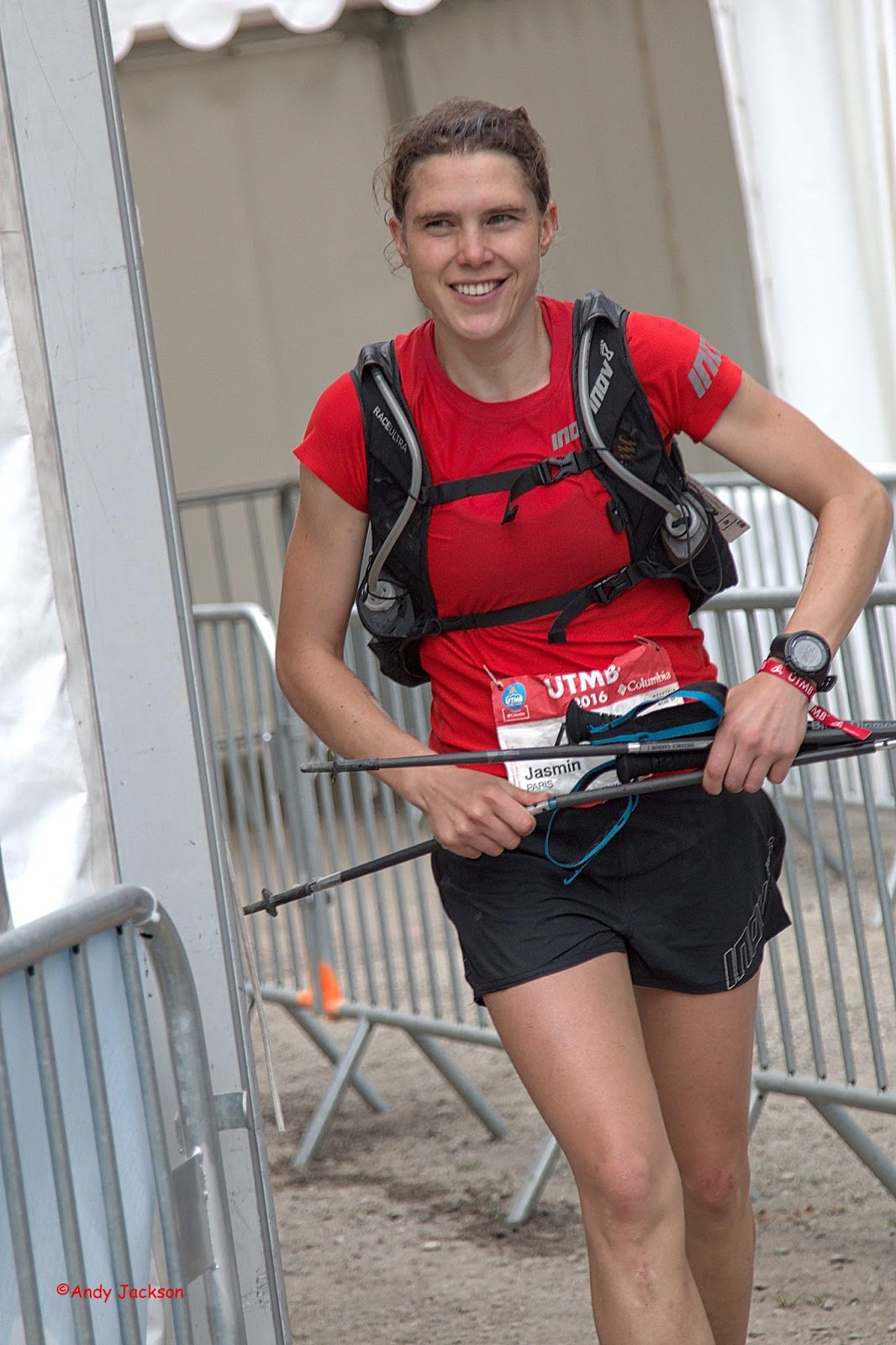
This is the face of someone who has been running across mountains for 24 hours, realising they still have the equivalent of the Wasdale Horseshoe to come. It is the face of a person stupefied by their voluntary participation in such madness. It is my face, on Saturday 27th August, 140 km into the UTMB.
Rewind a day, and I was standing in the main square in Chamonix, on the elite start line of arguably the world’s most prestigious 100 miler, the Ultra Tour de Mont Blanc. I&
This is the face of someone who has been running across mountains for 24 hours, realising they still have the equivalent of the Wasdale Horseshoe to come. It is the face of a person stupefied by their voluntary participation in such madness. It is my face, on Saturday 27th August, 140 km into the UTMB.
Rewind a day, and I was standing in the main square in Chamonix, on the elite start line of arguably the world’s most prestigious 100 miler, the Ultra Tour de Mont Blanc. I’d never known anything like it. People surrounded me on all sides, packed against the barriers, leaning down from balconies, lining the street ahead. The atmosphere was electric with excitement, anticipation and fear. I waited there, amongst 2300 other runners, contemplating the challenge ahead.
For there was no doubt in my mind that it would be a challenge. I was aware that this was unlike any fell race. It was going to be less technical, more runnable, hotter, and longer - 65 km longer in fact, than anything I’d raced before. The unknowns were both intimidating, and exciting.
Since arriving in France two days previously I’d had a drugs test (my first ever, but apparently routine for the top 100 runners), received a ‘how to use poles’ demonstration from Nicky Spinks, and spent a significant amount of time wallowing in the river beside our chalet, trying to cool down. I’d repacked my kit several times (incredibly, I still managed to arrive at the start line lacking a spare battery – luckily my fantastic mum was on-hand to sprint to the car), and had eaten a good number of fresh baguettes under the pretext of carbo-loading. Now all that remained to do was wait...
I counted down the final ten seconds with thousands of others, and then the sea of runners surged forwards, and I was carried along the streets of Chamonix with crowds of people cheering on all sides, ringing bells, shouting ‘Bon Courage!’ and ‘Allez!’. We reached the outskirts of town, and still people lined the path, picnicking, barbecuing, drinking, and even offering free pints as we ran past. I spotted Damian Hall in front, and joined him for the easy first 8km to Les Houches, chatting all the while – so much so in fact, that another runner asked incredulously ‘Are you two going to keep talking all the way around?!’.
Damian pushed on as we reached the first climb, and I settled into what I hoped was a sensible pace, without really having a clue. With Damian gone, I chatted instead to a fellow Czech runner (I’m half Czech), and the climb passed quickly. We ran along a track with fantastic views of sunset and mountains to the left, and I was grinning with the joy of it, and for a moment I spread my arms like a child learning to fly, laughing out loud as I started the descent. I tried to follow the advice of UTMB veterans, and took it steady on the descent, so as to save my quads (n.b. they were trashed by Trient anyway).
The next checkpoint, the town of Saint Gervais, was amazing. One would have thought we were finishing the race, not 21 km into it. It was what I imagine riding the Tour de France must be like. Supporters lined the road either side, 5 person deep, with little children leaning in, reaching out open palms for ‘High 5’s’. I did my best, swerving from side to side to meet them, but eventually gave up, there were just too many.
(photo Andy Jackson)
I stuffed some cheese and crackers into my mouth, followed by a slice of cake, and ran on out of town and into the cool shade of evening. The running was easy, but I was wary of how far there was still to go, and tried to be conservative. Walking one of the up-hills, I heard in the darkness to my left the friendly voice of Jezz Bragg, and we chatted for a bit on the run up to Les Contamines (30.7km). After a short road section we reached Notre Dame de la Gorge (34.6km), where I was amazed and delighted to people dancing around bonfires, singing and partying the night away. Somewhat reluctantly I tore myself away, and started the long climb through the darkness to Col du Bonhomme. The trail was a mixture of slabby rocks, and hard packed sandy trail, all pretty straightforward and runnable, but most people were just walking. Whenever I was overtaken I tried to watch how the person was using their poles, so as to improve my technique. I seemed to be making reasonable progress, and passed a lady on the ascent, although I had no idea where I was lying in the field overall. As we reached the top of the climb I looked behind me, and was taken aback, and rather thrilled by the sight of a seemingly unending trail of head torches, stretching into the distance from where I had come. There was a slight breeze at the top, but I was still amazed when runners around me started stopping to put on extra layers. These were tropical conditions in comparison with Scotland!
A straightforward winding descent took us to Les Chapieux (49.4km), where I enjoyed some excellent salty noodle soup, and passed a brief kit check before heading out again, running slowly along a gradually climbing road. In front of me a zig-zag of torches traced out the route, heading up to Col de la Seigne. I spent some time as I jogged along, trying to work out where the torches stopped, and the stars started. I’d begun to feel a bit tired by this point, and I was glad of the distraction afforded by the somewhat more technical terrain on the next climb, Col des Pyramides Calcaires. I crossed the one (and only) bog of the UTMB route, after which there was an interesting section of boulders before the descent to Lac Combal (65.8km). Feeling pretty worn out already, I was alarmed at the prospect of what was still to come. To my relief, Coca Cola did the trick, and I powered up the next climb, enjoying myself once more. As I moved upwards, I emerged from the thick cold fog of the valley and found myself looking down on a nighttime cloud inversion, snow capped mountains above a sea of silver. It was extremely beautiful.
As I started the descent to Courmayeur (78.8km), my head torch started to flicker, but I pushed on, hoping that its light would last just long enough. It didn’t, and I was suddenly thrown into pitch-black darkness, just 300m from the edge of town. With some fumbling around, whilst losing about 5 places, I found the spare battery, and was back on my way.
(photo James MacKeddie)
My mum was waiting at the checkpoint and I was glad of a change of food (the crackers, cheese and sausage were no longer going down so easily), gulping down a pot of baked beans before heading back out. As I re-joined the route I spotted a lady in front of me, and I tried to stay with her, but she pulled away sometime on the foggy humid climb that followed. It was light by now, but grey, and I focused on moving along steadily, albeit slowly. The incline lessened, and I forced myself into a jog along a small trod through blueberry bushes and low trees. As I plodded along, I suddenly realised that something had changed, and looking to my left I saw that I was emerging above the cloud once more, this time to the orange and pinks of the Mont Blanc massif in early morning. Enthralled and inspired, I started running properly again, on an undulating path, passing another lady (and thus moving into 6th) shortly before Arnouvaz (96.2km).
The climb that followed (Grand Col Ferret) was hot hot hot, and I got the impression that I wasn’t the only one finding it tough. Part way up I stuck the upper half of my body in a cow water bath, further up I as good as rolled in a stream. The descent, which I had been looking forward to, wasn’t much better, and I dropped back from the runners I’d been with. By the time I arrived at La Fouly I was ready to stop. But I stayed only long enough to drench myself with their hose-pipe, and to consume several orange quarters, before setting off again. For a little while I ran with a group that seemed to know one another, and I was somewhat astounded to realise that a) they had done the UTMB several times before b) they seemed to be experiencing suffering similar to mine c) they clearly considered this normal.
In the mid-day sun the sheltered valley was baking hot, and I survived the run to Champex Lac (124.1km) largely thanks to the frequent fountains I encountered at the roadside. Given how I was feeling when I arrived at the checkpoint, I was amazed to see that I was by no means the worst off. In fact, I seemed to be doing pretty well in comparison! The place resembled an army hospital, with runners lying down on benches, or hunched with head down, staring into space. In the 10 minutes or so that I spent there, only one person left the tent, and I set back out with renewed morale. This was further improved by a quick swim in the lake (much to the amusement of the tourists picnicking on its shores), captured on camera by Little Dave (Cummins), who happened to be supporting in that spot.
Mid-race swim (photo Dave Cummins)
I made good progress on the next climb and the traverse through cow fields that followed, but on my screaming quads the descent went on forever, and I arrived into Trient (140.6km) in a rather sorry state (see pictures, top of page!). To make matters worse, the lady behind me (7th) came in as I was still sitting over a can of tinned pears, although this did at least force me out of my stupor and back onto the road. I started the climb prepared for her to catch me, but determined for it to at least take a bit of effort. To my surprise, she never came, and instead I caught the lady in front (Magdalena Boulet, USA), arriving at the final checkpoint, Vallorcine (150.9km), hot on her tail.
Magdalena must have been re-invigorated by my appearance, because she ran straight through the checkpoint and off along the gently sloping trail up the valley. In comparison, I spent a few minutes there, determined to stick to my race plan and look after myself to get around in one piece. Arguably I should have been more competitive, and not let her get away, but I was just glad at this point to be feeling ok again, and looking forward to reaching Chamonix, just 19km away. Alex (one of my support team), who has crewed at equine endurance events in the past described it as follows, ‘If you were horses, you (and almost everyone else) would have failed the vet check at Champex Lac. But at Vallorcine, you would have passed with flying colours.’
As I started up the final climb, Magdalena was already well ahead. Above us, the clouds were gathering, and the air was close with the promise of a big storm. The first drops fell as I reached the summit plateau. A few minutes later lightning flashed across the sky, a brilliant shock of purple white against the darkening sky. More lightning followed - every minute or so now - and I nervously counted the seconds between the thunder and flash of white, conscious of my exposure, and the carbon walking poles in my hands.
(photo Alex Melbon)
By the time I’d arrived at the summit checkpoint, La Tete aux Vents (158.6km), it was dark, and raining hard. The marshal seemed relieved to see me, and turned me in the direction of La Flegere with a slight push, shouting to be heard above the wind, ‘Be brave, and be safe!’. I wasn’t sure I could do much to ensure the latter (feeling somewhat at the mercy of the lightning still flashing across the sky above me), but I certainly wasn’t planning to hang around. In the cool rain, hopping across wet rocks, I was in my element, and I passed several runners, including the Czech I had befriended 150km earlier. I ran straight through La Flegere (162.2km), and into a thick fog, delightfully British. I removed my head torch and carried it in my hand so as not to be blinded by the white, and started the descent. The final kilometres into Chamonix went on forever, on a winding forest trail, in a small pool of light from my head torch, rain still falling hard. I finally arrived at the edge of town, but still had to run a couple of kilometres in a big loop through the streets, presumably usually lined with supporters cheering, except that almost everyone had left to take shelter, and so there was just an occasional waterproof-clad stalwart watching me pass.
I arrived at the final street leading into the town square, and ran across the finish to the cheers of my support team (mum, Alex, Bo and Alvar), and the many friends gathered there to see me finish. I was drenched and tired, and slurring my words like a happy drunkard. I had finished 6th lady, 51st overall, in a time of 28:34:35.
The UTMB was an incredible experience, and I’m already forgetting the pain, and remembering instead the cloud inversions, the sunrise, the trail of torches, and the man playing his harmonica beside a mountain road in the dead of night. Would I do it again? Probably yes, but not for a few years. For now, I’m glad to be running across boggy windswept fells again, planning the next adventure...
On Sunday 2nd October I ran a Paddy Buckley Round in 18:33, and thus completed the classic UK trio of big mountain rounds, having run a Bob Graham Round (15:24) and a Ramsay Round (16:13) earlier in the season. Of the three rounds, the Paddy Buckley proved the biggest challenge, not only physically, but also mentally.
I started at 5am from Llanberis, running clockwise. In contrast to the Bob Graham and Ramsay, I had not been able to recce the Paddy Buckley route, and there were large sections
On Sunday 2nd October I ran a Paddy Buckley Round in 18:33, and thus completed the classic UK trio of big mountain rounds, having run a Bob Graham Round (15:24) and a Ramsay Round (16:13) earlier in the season. Of the three rounds, the Paddy Buckley proved the biggest challenge, not only physically, but also mentally.
I started at 5am from Llanberis, running clockwise. In contrast to the Bob Graham and Ramsay, I had not been able to recce the Paddy Buckley route, and there were large sections (Capel Curig to Rhyd Ddu) which I didn't know at all. Luckily I was supported on the day by a fantastic team, and had people with local knowledge to navigate each leg. The attempt was originally planned for 1st October, but on the basis of a terrible weather forecast, I delayed the start by 24 hours. The decision paid off, and I was rewarded with one of those perfect autumn days - still and sunny, with dazzling views and beautiful colours.
With Konrad’s help, I had cobbled together a 19-hour schedule, which would put me just inside Nicky Spinks’ 2013 record of 19:02. As usual however, I planned to run to feel rather than splits, which was just as well since some of them turned out to be hugely inaccurate.
Leg 1: Llanberis to Llyn Ogwen
Descending Tryfan (photo Chris Near)
(pacers: Tim Higginbottom and Chris Near)
Under any other circumstances meeting two strangers in an empty car park at 4:45am would be regarded as highly suspicious… Tim and Chris had kindly offered to run the first leg with me, which was a huge bonus considering their local knowledge (them being the current and previous record holders for the PBR). After a friendly greeting, and some jokes about their matching gear (unintentional they claimed!), we counted down the seconds to 5am, and set off into the darkness, with Konrad and Moss looking on. We made rapid progress through the complex turns of the quarries and along the steep railroad sleepers beyond. As we neared the first summit, Elidir Fach, we were enveloped in a thick fog, which persisted for much of the leg. Despite discovering that our only compass contained a bubble, Tim and Chris nailed the lines, and we continued to tick off the summits as the blackness around us turned to grey. In their greasy wet state, the rocks of the Glyders were treacherous, and we were forced to slow down, aware that a fall could do significant damage. The clag cleared as we approached Tryfan, and we exclaimed at the beauty of the Llyn Ogwen valley below us, bathed in golden light. We slithered down the descent, and ran into the changeover bang on schedule. With some difficulty, I pulled my wedding ring off my already swelling finger (having forgotten to do so earlier), exchanged it for a cup of cocoa and a cake, and ran on through.
Descending to Ogwen (photo Chris Near)
Leg 2: Llyn Ogwen to Capel Curig
(pacers: Anthony Bethell, Alex McVey, Adam Stirk)
Tryffan and Carnedds (photo Digby Harris)
Descending Carnedd Lewellyn (photo Digby Harris)
Armed with a fresh team, we started the ascent of Pen yr Ole Wen via the east ridge. I was worried to find myself feeling tired already, particularly when we reached the summit a couple of minutes outside the estimated split. Once on top, Alex and Adam pulled ahead and I worked to keep up, aware by now that on this occasion I’d omitted the ‘easy’ first 8 hours of running I’d enjoyed on the Bob Graham and Ramsay Rounds. Approaching Carnedd Lewellyn we were surprised to meet a group of 30 or so walkers coming the other way at a pretty steady pace. They were only carrying small packs, so they can’t have been out all night, goodness knows what time they had set off! We overshot the summit slightly, but Ant called us back, limiting time lost to a couple of minutes. In the growing warmth of the morning sun (Ant already had his shirt off, which shows how lucky we were for the time of year), we descended to the col where Digby and his son Saam were waiting patiently with fresh supplies. Consuming a combination of pickled onion Fish n’ Chips, banana, and milkshake, I scrambled up to the summit of Pen Yr Helgi Ddu, and on to Pen Lithrig. Ant led us off on a direct line through deep heather, and then over the little footbridge and onto the boggy path down to Capel Curig.
Climbing Pen yr Ole Wen (photo Adam Stirk)
Leg 3: Capel Curig to Nantmor
(pacers: Jim Mann, Liz Barker, Tim Budd, Jon Ascroft, John Ryan)
This leg is regarded by many, including myself, as the hardest of the Paddy Buckley Round. Not only is it the longest, but the many indistinct summits also make navigation challenging, and the terrain is rough and frequently wet.
Climbing Moel Siabod (photo Jon Ascroft)
Digging Deep (photo John Ryan)
The first climb, up to the summit of Moel Siabod, was where I really started to struggle, and where I realised what a challenge the rest of the round would be. Still, my pacers were all enthusiasm, and so I battled on, towards the back, head down, getting on with it as best I could. Jim did an awesome job navigating us through the rough heathery terrain (very much a feature of the Paddy Buckley Round, in particular this leg and the following one), and doing his best to avoid the deepest bogs. The heavy rain of the previous day had left the ground waterlogged, and we were frequently forced to deviate from the optimal line, crossing and re-crossing the fence in order to bypass the flooded areas. Jim and John R quickly developed a pattern whereby John avoided the summits, and instead carried Jim’s bag, allowing Jim to save energy for navigation (and supporting again on leg 4). This worked well until Allt-fawr where John suddenly disappeared (it is rumoured that he was sabotaged by suboptimal directions...), prompting cries of ‘Where’s John?!’ as we started the descent. Jon A doubled back to look for him, whilst we pushed on, with Tim now carrying all of my gear and food.
One of the dryer sections (photo Jon Ascroft)
Liz was waiting for us in the quarries, ready to take over navigational duties from Jim. She set off as we approached, so Tim and I chased her up the hill, and onto the course of last year’s British Champs race. How I wished my legs felt as good climbing over the Moelwyns as they had then!
Moelwyns from Cnicht (photo Digby Harris)
Plodding along (photo Jon Ascroft)
At least the weather was good - amazing in fact - and I was still able to appreciate the fantastic views stretching out in all directions. A tussocky descent took us to into the col below Cnicht, where we were greeted by the Jo(h)ns, who had (after some wandering) managed to find themselves and each other. A relieved Tim dropped back, nursing a twisted ankle, and I slogged on up to the summit, where the surprise appearance of Digby and Saam did much to raise my spirits. There followed a very runnable (for some!) descent into the valley, and then a short section along a quiet road in woodland. Running into the changeover I spotted Konrad waiting for me, and for a moment the sight of him prompted me to fall apart… He comforted me with a hug, and the promise that he’d be waiting for me at the end of next leg - and by the time I reached the others I’d pulled myself together.
Although I didn’t know it at the time, the supporters at Nantmor had experienced their fair share of excitement whilst I had been running this leg, as my mum had lost her car keys by the river. Despite much searching they could not be found, forcing a quick trip to the local supermarket for mum (all I noticed was that my beans were in a tin and not a plastic tub!), and a trip to Wales with the spare keys for dad.
Ticking a summit (photo Jon Ascroft)
Leg 4: Nantmore to Rhyd Ddu
(pacers Sarah Ridgeway, Jim Mann, Julien Minshull, Anthony Bethell, Joasia Zakrzewski)
Following Jim (photo)
We had arrived into the changeover about 8 minutes down on my 19 hour schedule, but we made up 6 of this on the first climb, to Bryn Banog. This was somewhat surprising, given the depth of the bracken in the lower sections (if I do a Paddy again, it will be earlier in the year!). I can only assume it was the excellent company that spurred me upwards. Julien amused me with his usual assortment of jokes, whilst Jim and Sarah discussed the many qualities of Kendal Mint cake as a running food, including its natural pain-killing properties…. So enthusiastic was their discussion that I was roused from my slow upwards plod, to ask hopefully ‘Have you got any?’. There was a moment of silence, as we all realised the answer was no, then laughter, and then Sarah (who’d recently offered me a Bounty Bar) started telling me that coconut has very similar properties...
Enjoying it (photo Sarah Ridgeway)
As sunset approached the hills around us turned a splendid array of autumn colours - even in my exhausted state I was stunned at the beauty of it. Ant and Jo joined us before the climb up to Nantlle Ridge, and we chatted about Ant’s Eagle Owl, and how cheap he was to feed compared with a cat, until Jim essentially told me to get a move on (at the time this seemed a bit harsh, but he was totally right, I was slowly ceasing to care). The Nantlle ridge was an exciting distraction, which lifted my spirits as well as my pace. Darkness fell as we dropped towards the forest, and we pulled on head torches to run the final section along forest tracks, arriving into the changeover almost 20 minutes down on schedule.
The gathering dusk (photo Sarah Ridgeway)
Leg 5: Rhydd Ddu to Llanberis
(pacers Konrad Rawlik, Gareth Hughes, Liz Barker)
Feeling oddly detached from the hurried activity around me, I pulled on the arm warmers which Sarah was pushing towards me, pulled a couple of green beans from the cup of soup my mum was offering, and hobbled off into the darkness, leaving Konrad and Gareth to catch me up. I knew there was some slack in the splits on this leg, but it wasn’t clear whether it would be enough… I gulped down a couple of gels, and tried to make maximum use of the poles which I’d picked up at the changeover, pulling my tired legs upwards. In the darkness, things took on a surreal, dream like quality, my world narrowed to the pool of light around my feet. With Konrad beside me, and Gareth doing a brilliant job of the navigation ahead, we started to pull back time. Liz ran with us to the summit of Yr Aran, then peeled off to collect her car from the valley below, whilst we continued up, arriving at the summit of Snowdon 4 minutes ahead of schedule. The summit ridge was windy and eerily empty, and we were glad to reach the sheltered descent of Crib y Ddysgi. As we started the climb of Moel Cynghorion a wave of faintness washed over me, but Konrad didn’t let me indulge it, instead thrusting a bottle of Lucozade and a gel into my hands and saying ‘You’ll be ok, keep going’. We continued to gain fragments of time over the small climbs that followed, and my morale lifted as the end drew closer. The final descent from Moel Eilio was a delight, soft bouncy grass making for a rapid descent under a sky full of stars. I finished the round feeling as good as I had at the start of leg 3, and significantly better than I had for the 12 hours in-between.
Final Thoughts
The Paddy Buckley Round was for many reasons the biggest challenge I've faced this year, and certainly one of the hardest days of my life. I'm proud of myself for sticking it out, but I know I couldn't have done it without the fantastic support team at my side, and my changeover crew; mum, dad, Andrea Minshull, and the Moss/Brae collie duo.
The three big rounds have been an amazing experience. They have given me three of my most memorable mountain days, have cemented old friendships and formed many new ones. I have been touched by the generosity of everyone who has helped me, and moved by the beauty of the mountains I have crossed.
I’m already being asked whether I intend to run them again… The answer is maybe, in part. I’d quite like to run the Paddy Buckley and Ramsay in winter, if conditions are right, and Konrad fancies joining me for a long day in the hills… I’ll probably have another crack at a fast Paddy Buckley at some point too - to enjoy it a little more, and because I think there’s still some room for improvement
Ski Touring
Since my first outings, carried over the local moors on my parents’ backs, to the wild camping trips with my brother in my teens, and the fell-running adventures of recent years, moving fast and light through the mountains has become a joy. This year for the first time, I experienced the feeling in winter, when Konrad and I joined Loic Tregan for a ski touring adventure in the Glarus Alps, Switzerland. Below is a brief summary, and a few photos of our experience - which I h
Since my first outings, carried over the local moors on my parents’ backs, to the wild camping trips with my brother in my teens, and the fell-running adventures of recent years, moving fast and light through the mountains has become a joy. This year for the first time, I experienced the feeling in winter, when Konrad and I joined Loic Tregan for a ski touring adventure in the Glarus Alps, Switzerland. Below is a brief summary, and a few photos of our experience - which I hope will be the first of many in years to come.
Clariden Ridge (photo Loic Tregan)
Fridolins Hut (photo Loic Tregan)
Setting off on skis straight from the car, we started the tour with a 1700m climb, up through the debris of a huge avalanche, to Claridenshütte, where we enjoyed excellent food and a comfortable night. Day 2 turned into rather an epic. After a fantastic morning on Clariden Ridge, our return route transpired to be more challenging than anticipated, and after additional navigation and technical (ski binding) delays, we were forced to re-route, and head for the rather basic Fridolinshütte winter-hut. After a smoke-filled hour, we succeeded in lighting the ancient stove, and having re-fuelled with stock and noodles sourced from the hut cupboard, we curled up together on the mattresses least covered by mouse droppings or snow. Not exactly five star accommodation, but as we all agreed, a great deal better than the outdoor alternative.
Gaining the pass (photo Loic Tregan)
Early morning glacier (photo Loic Tregan)
The next day was spent getting back to where we were supposed to be, and eating copious quantities of bread, cheese, ham and pickles. On day 4 we skied up the Clariden glacier and, aided by Konrad’s mountaineering experience, crossed a steep col before a super 2000m descent cutting fresh tracks into the valley. We climbed up to the fantastically situated Cavardiras Hütte, and left early the next morning (picture below) to cross the Brunnifirn glacier, on our way to Oberalpstock summit (3300m).
Leaving the Cavardiras Hut (photo Loic Tregan)
Sunrise (photo Loic Tregan)
With a spectacular sunrise to start, a 3-summit ridge day from Oberalppass rounded off a brilliant first week of ski touring.
Above Oberalppass (photo Loic Tregan)
Of note, I found the week rather harder than I expected to. In contrast to previous mountain trips, I was pushed to keep up with the others, even after a week of altitude acclimatization. At the time I put it down to my skis, which were relatively heavier, but when I got back I discovered the happy explanation – I’d been carrying an extra passenger 😃
Scottish Islands Peaks Race
Reever (photo Liz Barker)
The advantage of doing SIPR 13-weeks pregnant is that you are used to feeling sick, so you’re already prepped for what’s to come. The disadvantage is that you have the added challenge of wave motion, and are unable to take any anti-sea sickness medication. As it turned out, my worries were unjustified. In the end, only one person on our team vomited, and that was a sailor – on the running section 😃
SIPR is a race for teams of sailors and fell runners, which takes place every year off the West Coast of Scotland. The race starts with a short hill run in Oban, then a sail to Salen on Mull and a run up Ben More, followed by a sail to Craighouse on Jura and a run over the Paps, then a sail to Lamlash on Arran and a run up Goat Fell, and finally a sail to finish in Troon. All in all, it’s a long weekend of non-stop adventure, and a lot of fun.
I’d agreed to run SIPR as part of an all-rounders team, at the start of the year. After I discovered I was pregnant I debated pulling out, but knowing that I would be running with my good friend Liz Barker (who knew the situation well in advance) gave me the confidence to stick with it. Luckily for me, Liz had raced SIPR the previous year for the boat Reever (a lovely class 3 monohull) and knew what it was all about.
The other members of our team were Nigel Holl and Gordon Callander - primarily excellent sailors, but handy runners too – and Jon Gay, a true all-rounder, brilliant at both. As an all-rounder team every member was obliged to run at least one of the three islands (Mull, Jura, Arran), and our overall result would be defined not only by our finishing time, bit also by the total number of man-mountain runs. In reality, this meant that the best plan was for Liz and I to run everything, with Jon along for Mull and Jura, and Gordon and Nigel along for Arran.
The race started at noon on Friday 19th May, from Oban boathouse, with a short (roughly 6km) dash over some small, bluebell covered hills adjacent to the town. The main purpose of this mad sprint seems to be to spread teams out to minimise the chaos that inevitably develops as the boats leave their moorings in Oban and race for a place on the open sea.
On this occasion however, the initial run times paled into insignificance given the complete absence of wind in the harbour. Crews of small and medium vessels pulled out oars, and thus inched their way past the larger boats, although one would still have been hard-pushed to describe it as a ‘race’. A youth team added to the general comedy of the situation when their young crew lowered themselves back into their dinghy with the intention of pulling their boat along, only to get left behind when the wind suddenly picked up.
On Ben More on Mull (photo Liz Barker)
We reached Mull at 5.27pm, roughly two thirds of the way through the field (21/36 overall). The Mull run comprises roughly 10km of small road/track, followed by a loop over Ben More, then a return the same way. It was a glorious summer evening, but I found the out-and-back hard work (for me, pregnancy had cardiorespiratory effects from very early on, most apparent on fast flat terrain), but the mountain was splendid, in particular the technical scrambly sections higher up (where I was in my element, leading the way). Buzzing from the evening light and views, we arrived back at the boat after 4 hours 41 minutes (having made up 6 places), and were soon on our way to Jura.
An interesting aspect of SIPR is that the race fractures into several separate races determined by groups of boats making, or alternatively missing, the tides (critical in the Sounds of Luing & Jura, and around the Mull of Kintyre). On this occasion for example, only the two leading boats made it through the Sound of Luing on the sail to Jura. The majority of the fleet milled around, waiting for the tide to turn, but a few (us included), took a calculated risk, and decided to sail around the West Coast of Jura instead, where the tide is less of a problem. Unfortunately for us, the wind subsequently dropped, and so in racing terms we lost time. However, we did have the pleasure of being joined by a pod of dolphins at one point, which I took as a rather marvellous consolation prize.
Jura, as always, was brilliant, and it was a pleasure to run the now familiar Paps (at least for me and Jon, who have raced the Jura Fell race several times), as a team. Once again, we had beautiful evening light and views, and I was reminded how special the island has become for me, since getting married there last year. We arrived onto Jura on exactly 24 hours after arriving onto Mull, in 29th overall, but made up 5 places during the run (4 hours 27 minutes), and as a result we just sneaked around the Mull of Kintyre with the tide, although I can’t claim any credit for this night-time success, given that I slept through it soundly in my bunk below.
Breaking our 5.27pm island arrival pattern, we sailed into Lamlash at lunchtime on Sunday. We made good progress on the run into Brodick (Nigel’s brightly coloured leggings attracted some attention in the process), and up towards the summit of Goatfell. We were intrigued to pass a great many beagles on the mountain (it subsequently transpired that it was an organised event, rather than a coincidental accumulation), one of which was carrying it’s own GoPro - Nigel and his dazzling leggings did their best to get into the shot.
Arran (photo Liz Barker)
On the way back our early speed and the afternoon heat conspired against Gordon... So much so, that when a shopper in Brodick saw us, she said ‘You’re not going all the way to Lamlash like that are you, do you need a lift?’, at which point Gordon perked up, whereas the rest of us in unison said ‘No!’ and forced him onwards... Getting back to the boat was a team effort in which we all played a part, but the greatest credit has to go to Gordon, who unmistakably earned his ‘All Rounders’ certificate that afternoon.
By the time we reached the boat there was little chance of us catching any team in front, and the remaining boats were several hours behind (courtesy of a tide gap), so we had a pleasant sail over to Troon. The final dinghy drop in the inner harbour was still exciting though, and we had to sail around twice before Liz and I were set free to row into the marina, and officially finish our race.
At the finish (offical photo)
SIPR is a race I’ve wanted to do for a long time, and as so many people predicted, I loved it. I’m already looking forward to it becoming a regular on my racing calendar... although given my circumstances, I’m not sure the experience will ever be quite as unique as this first time!
We finished in 26th position overall, after 42 hours 42 minutes of sailing and 14 hours 32 minutes of running, as 3rd All-Rounders. Although as has been pointed out to me since, since we did actually have an extra team member on every summit, we achieved more man mountains than the eventual winning team (and since they were all men, I am making the assumption they had no secret crew).... 😉
LAMM
Whilst parent-offspring teams are routinely present at mountain marathons, three-generation teams must be exceedingly rare. Not wanting to miss out on the opportunity to be listed as such, and following on from our successful debut partnership at the Highlander in 2016, my mum and myself teamed up once again to run the score class at the LAMM. Set this year in the spectacular location of An Teallach, Fisherfield & Fannichs, with weather that defied the prior ominous forecasts, and almost no midges to be seen, it was a LAMM to be remembered.
LAMM Day 1 (photo Jasmin Paris collection)
To me, these mountains have an old, forgotten, remote feeling quite unlike the summits we typically frequent further south. As a result, we were enjoying ourselves so much on day 1 that we felt compelled to remain on the ridge and bag the Munro (Sgur Mor), rather than taking the racing line, and an extra 10 points, to our next checkpoint. We arrived there at roughly 4 hours of our total allocated 7, at which point I began to doubt we could make it back in time to the camp... It didn’t help that I was unsure exactly how long we had left, having forgotten to start my watch when we set off (this could never have happened if I had been with Konrad!). In the end we made it back only 2 minutes over (collecting 4 penalty points to our total of 150), although the last half hour was a rather frantic dash along the loch-side, and mummy did fall in a chest-deep bog just before we entered the camp, in her commitment to the cause.
The evening was spent eating and socialising with friends from all over (I love mountain marathons for this reason, especially the LAMM), with a brief thunderstorm interlude, during which everyone retired to their tents for a sleep.
LAMM Day 2 (photo Jasmin Paris collection)
On Sunday we did the majority of climbing in the morning, and then headed back towards the finish in the shadow of An Teallach, eager to make it with time to spare. Nevertheless, a tricky encounter with dense rhododendron bushes in the last km cost us several minutes, and we were forced to sprint (well, in my mum’s case, as much as one can following a hip replacement), finishing just inside the allocated time of 6 hours.
We finished in 38th position of 76 overall, 5th Females, and 3rd Female Vets. As my mum pointed out over the 2 days, with a total 13-hour allowance, we raced for 12 hours 59 minutes and 59 seconds. Now that’s what I call getting your money’s worth 😃
Final Thoughts
To some of those reading this blog, these adventures might seem overly ambitious, even foolhardy, in a pregnant state. I just want to stress that I am very aware of the fact that I now have another being to consider besides myself, and that it has definitely changed my approach. All the medical advice is to continue with exercise up to a moderate intensity during pregnancy (providing you did it beforehand). Since I've known I was pregnant, I've consciously made sure not to push myself, always staying well within a comfortable limit. I'm simply taking each week as it comes, with the plan to run for as long as it feels right, and then transition to walking instead.
Scrambling in the Alps (photo Jasmin Paris collection)
After the excitement of the Lowe Alpine Mountain Marathon
(LAMM) described in instalment 1, Bump’s adventures continued with a trip to
Gran Paradiso National Park, in Italy. In theory, this was to be a relaxing
week of ambling across the mountains, with frequent opportunities to sample the
local cuisine. In reality, it started
with a 2000m ascent out of the Aosta valley, carrying all of our gear (in
Konrad’s case thi
Scrambling in the Alps (photo Jasmin Paris collection)
After the excitement of the Lowe Alpine Mountain Marathon
(LAMM) described in instalment 1, Bump’s adventures continued with a trip to
Gran Paradiso National Park, in Italy. In theory, this was to be a relaxing
week of ambling across the mountains, with frequent opportunities to sample the
local cuisine.In reality, it started
with a 2000m ascent out of the Aosta valley, carrying all of our gear (in
Konrad’s case this included all of the group kit, in my case it included a 20
week old foetus), and continued with a fantastic technical scramble,
fortunately aided by a plethora of ladders and chains. On day 2 we descended
into the valley to rendez-vous with my brothers, and assured by them that they
had plenty of food to last us all for the remainder of the trip, we re-ascended
into the high mountains. For the next 3 days we climbed up and down (and up and
down, and up and down...), swimming in icy mountain lakes (except Konrad, who
is a wimp), and sleeping under the stars in the company of Ibex. Rather
predictably, our food supplies dwindled, and in the face of rationing my
threshold for what qualified as a ‘hard cheese’ (many soft cheeses being on the
‘no no’ list for pregnant ladies) became increasingly dubious, justified only
as an effect of the day’s heat 😉 As is always the case, the week ended far
too soon, and we parted from my brothers already making plans for how we’d
manage wild camping with the Bump next year.
Enjoying the Sun at Gran Paradiso (photo Jasmin Paris collection)
Bump reaching 3000m (photo Jasmin Paris collection)
Upon returning home to Scotland we were keen to make the
most of our altitude training, so looked around for a suitable challenge. The
local Caerketton Hill race, a gnarly 3.6km out-and-back, with a testing 300m
climb, seemed just the thing. Competition was fierce, and Bump put up a valiant
fight against Bob, catching him at the summit, only to be overtaken again on
the descent. I’ve promised Bob a re-match next year...
Catching Bob at the summit (photo Steve Fallon)
Unfortunately, this was Bump’s last race for some time,
owing to a sacroiliac injury I sustained whilst scything the most overgrown
area in our ridiculously large garden (I have since come to the conclusion that
we should just get a couple of sheep). Since cycling had already become
impossible (the forward position my bike forces me to adopt is not very
compatible with a Bump), I contented myself with outdoor swimming – at least I
did until about month 6 ½, when I could no longer do my wetsuit up.
At 7 months pregnant, just about able to run again, I took
part in the ROC Mountain Marathon with my trusted partner mum. We opted for the
Short Score Category, theorising that this would give us the option of taking
the most direct route to mid-camp if necessary. As it was, the claggy
conditions probably favoured our slow pace and ample navigation time, because
we managed to collect quite a reasonable score, when one considers that our
team included one baby, and one artificial hip, in addition to the required
kit.Day 2 was splendid, and we enjoyed
seeing the views we’d missed the previous day as we navigated our way back to
the Event Centre.We finished as first
Female Vet team, (48/114 overall), in spite of a 15-minute retrospective time
penalty for having accidentally crossed a boundary line (we were just one of
several teams that did this, and the Race Organiser agreed that the line was
not visible enough on the maps, but understandably a penalty had to be
imposed).
At 36 weeks pregnant I ran my first ever Parkrun (our local
one is Vogrie), inspired by my dad Jeff, who has been participating (his local
one is Glossop) for the last year, with an ever-faster weekly time. Konrad sped
off and won easily, in 17 minutes something, whilst I started steady, and
enjoyed the feeling of running on the flat rather than hauling the Bump up a
hill. We gradually started making up places, and I finished feeling really
good, in 23 minutes 35, which made me 4th lady on the day, and 30/148
overall.
The feeling of easy running didn’t last long though, as the
Bump dropped down a few days later, settling in its new position directly atop
my bladder. As a result, I felt for the first few days as if I was carrying a
bowling ball between my legs, with my ‘running’ resembling a ‘fast-forward
waddle’ rather than anything remotely athletic. My plan of running the Tinto
Hill Race (7km, 460m ascent) two weeks later suddenly seemed like wishful
thinking, but as the day approached I grew accustomed to Bump’s new position,
and decided to give it a go after all. And so, at 38 weeks pregnant exactly, I
lined up for the start of Tinto, along with 243 other runners, waiting for the
starter’s signal. In the event, I didn’t actually hear this (I was so far
back), but I knew from the forward rush of the mass in front that the race was
underway.
Bump racing at Tinto (photo Charlie Ramsay)
The race was great. I started very slowly, and gradually
moved up through the field. I think I must have smiled the whole way - I was
having such fun. I lost a few places on the way down, since I was being very
careful not to slip, but still surprised myself by finishing 148th,
in 49:01 (for reference, our recce, done on a very windy day – but at 4 weeks
less pregnant, had taken us 1 hour 8 minutes). Bump was very well behaved, and
didn’t force a single wee stop 😉
I wont pretend that running during pregnancy has
always been easy. There have been days when I’ve turned around and walked home
thwarted by a stitch, or been plagued by constant stops to empty an
already-empty bladder. And yet, in spite of the challenges, running during
pregnancy has also been fantastic, for so many reasons. It has held my gateway
to the hills open, and thereby kept me sane. It has kept me feeling fit, and
more confident about the challenge of pushing Bump into the world. It has
allowed me to keep in touch with friends, and stay part of the scene that I
love. And maybe the Adventures of Bump and I will even have inspired other ladies
– those who might otherwise have feared to do so - to keep up the sports they
love, when they have Bumps too.
It’s 5 in
the morning, and I’m already climbing out of the valley, my sights on the
sun-tipped summit above me. The record from our Czech cottage to
Boubín (1362m) and back stands at 1:52 (Václav Paris, 2012), a time that seems impossibly fast to me
today. I’m not even taking the fastest route, and there’s a good chance I’ll
need to stop somewhere along the way.
Team Paris-Rawlik(jr.) set the Boubin buggy record
It’s 5 in
the morning, and I’m already climbing out of the valley, my sights on the
sun-tipped summit above me. The record from our Czech cottage to Boubín (1362m) and back stands at 1:52 (Václav Paris, 2012), a time that seems impossibly fast to me
today. I’m not even taking the fastest route, and there’s a good chance I’ll
need to stop somewhere along the way.
Team Paris-Rawlik(jr.) set the Boubin buggy record
There’s a
difference to this summit bid though... it’s a team effort, and only one of the
pair is pulling their weight. The other is asleep, wrapped in a sheepskin to
keep off the morning chill, dreaming of her next feed. She doesn’t even wake up
when I reach the col and transfer her to the carrier, stashing the buggy in the
bushes as I clamber the last 1.5km upwards along the boulder strewn track. I
reach the top, touch the cairn and turn, supporting her head with my hand as I
pick my way down. Back at the buggy I execute a hasty changeover and we’re
running again, flying down the hill through the forest. We arrive back at our
cottage in time for breakfast. My teammate sleepily stretches and smiles, clearly
delighted to have run our target sub-3 hours time (2:53).
My teammate
is our daughter, Rowan, born in November just 10 days after her last fell race
as a ‘bump’. She surprised everyone by entering the world bottom first,
eschewing convention from the word go. Seven months later, I’m preparing to go
back to work (Konrad will be on baby duty for a couple of months now), and it
seems like a good time to write up the next instalment of our running diary.
In spite of
Rowan’s unconventional presentation, I was lucky to have a fairly
straightforward labour and delivery. By the following morning we were out walking
with our dog Moss, and within a couple of weeks I
was venturing into the Pentland Hills with Rowan in a sling on my tummy. At 4
weeks post partum I started a bit of gentle jogging (with Moss, I didn’t run
with Rowan until she was 6 months old), and after my 6 week GP check I slowly
eased back into training. Konrad and I developed a routine in which he would
look after Rowan every day from 6 to 8 am whilst I went running.Other, more innovative ‘maternity leave
training’ strategies included hill reps and intervals, whilst Rowan slept in
her buggy in full sight.
Ready to race at the Mourne Highline
Returning to fitness wasn’t all plain
sailing. I pulled something in my back when lifting Rowan up in the night, and
just as I’d recovered from that I developed mild posterior tibial tendonitis
(an injury I’ve had once before), which grumbled on for about 6 weeks,
stubbornly refusing to settle. With these breaks in training, my first serious race
back - the opening counter for the British Fellrunning Championships (Mourne
Highline, Ireland, in April) - arrived all too quickly, and I lined up on the
start line feeling somewhat unprepared. The weather (pea soup fog) and the
linear course (necessitating that I finish) did little to quell my nerves, and
I purposefully started well down the field. To my great surprise, I not only
made it back to the finish without getting lost and before Rowan started to
cry, but I also finished first lady. The rough terrain helped by slowing
everyone down, as did the fog (I raced Emma Gould for much of the race, but she
went wrong on the final descent), nevertheless it was a great boost for
post-baby running morale. Caitlin Rice, a good friend who also started out with
Glossopdale Harriers, finished second, which I was delighted about. She has
since won the short counter (Tal Y Mignedd), which we didn’t travel to, so the
next two races in the British Championships should be exciting.
My next race, just a week later, was the
Teenager with Altitude in the Lake District (24.7km, 2300m ascent). Rowan had received
her vaccinations the day before, and spent the majority of the night awake, so
my preparation wasn’t exactly ideal, although it did involve a generous amount
of midnight cake eating. The day was also unseasonably hot, more suitable for
swimming than running, but it did make for wonderful views. Sharon Taylor had a
great race, and although I could see her in front of me for much of it, I had
nothing in my legs to mount a credible chase. Nevertheless, it was my longest
run since having Rowan, and I was plenty happy with the result.
On Beinn an Oir (second Pap)
A month later, after another chunk of
training and a couple of 24-hour round supports (a Bob Graham and a Ramsay –
both involving ‘pass-the-baby’ from daddy to mummy between legs), we travelled
to Jura for the annual highlight of my racing calendar, the Jura Fell race. It
felt great to be there, racing, and part of the scene again. Despite a fall
coming off the third Pap, during with I slashed my knee open (fellrunning
legend Wendy Dodds and I had matching injuries at the finish, although she had
4 stitches, whereas I just got glued together) I finished in 3:49 (1st
F, although still 11 minutes off a PB). The following day Liz Barker and I
swim-ran the islands of Small Isles (more on that to follow), and the remainder
of the week was spent taking Rowan onto the Paps for her first race recce,
introducing her to the sea, and trying not to let her eat too much sand.
Team coach, in obligatory LAMM mid-camp attire
On Thursday we headed north to Harris
for the Lowe Alpine Mountain Marathon (LAMM). To those who don’t know, a
mountain marathon is a 2-day orienteering-type race, which is run in teams of
two, carrying everything necessary for an overnight camp. When this year’s
fantastic location (Harris) was first announced last winter, we predicted it
was going to be something special, and set about trying to work out how we’d be
able to compete with Rowan in the mix. We made a plan that involved my mum
carrying Rowan into mid-camp, where she could sleep with me and breastfeed
overnight before travelling to the finish the following morning with my mum.
Luckily for us the organizer Martin Stone was incredibly accommodating, and set
up a private email correspondence with my mum to ensure she would know the
mid-camp location (something we wouldn’t know until our clock started ticking
on day 1 of the event). Konrad and I had originally planned to run the Elite
class, but after some deliberation we switched over to the Score class, on the
premise that the 7-hour daily time limit would be preferable as a fixed end
point for Rowan. I expressed a bottle of milk for day 1, and my mum packed the
breast pump for me to use at mid-camp to do the same on day 2. We were set to
go.
It felt simultaneously ridiculous (most
people wouldn’t even dream of mixing the two), and also completely natural
(fell runners are not most people), to be travelling to a mountain marathon
with a baby. In the end, as I predicted, the support from everyone was
overwhelming, and Rowan was made to feel very welcome. In fact, she was
extremely well behaved and even those camped right beside us hardly heard a
cry. Moss, who also walked in with my mum, actually caused more hassle, as he
went acutely lame overnight and thus secured himself a lift out of mid-camp on
the boat with the injured runners on day 2 (by the evening he’d recovered, so
we think he just wanted a boat ride).
Reviewing our route choices at the end of day 2
Anyway, to get back to the race... We
had a steady first day, neither of us feeling particularly brilliant, not
taking any risks and finishing with 10 minutes to spare. It was a little too
hot for racing, but the views were absolutely spectacular, in particular the
final descent to mid-camp (which was located at Loch Crabhadail, a splendidly remote
stretch of soft green grass beside an incredible white-sand beach). Being
amongst the first teams back, we were sure that others would pass our temporarily
leading score of 300. But we were wrong; by the end of the day we were still in
front, albeit with several teams barking at our heels (with scores of 295, 280
etc.). With this incentive, we went out hard on day 2 and gave it everything to
try and keep the lead. We even took the option (which secured a 50-60-35 point
control trio) of climbing back over An Cliseam (799m), a summit we’d already
bagged on day 1. We cut it fine, a little too fine in fact, and finished 2
minutes over time, both falling at the finish control – me because I tripped
up, Konrad because he was overcome by the heat. Still, we came away with a day
2 score of 379 points (385 minus a 6 point time penalty), which gave us a
comfortable margin over the next team. Martin announced at the prize giving
that this had been the last ever LAMM, and received a thoroughly deserved
standing ovation that refused to finish. In these circumstances, our win felt particularly
special. Although as I’ve come to realise, the greatest prize in any race is now the little person with the beaming smile, waiting for us at the finish
line.
As 2018 turns to 2019, it seems like a good time to reflect
on the running year gone by, in particular the challenge of coming back after
having a baby. Winning the British Championship this year was a real surprise,
and a great honour. But it would be a lie to claim it was easy, so I felt I
should write down a few lines - with other new mums in mind - to say how it
really was.
Firstly, I should point out that I have been incredibly
fortunate, and that I’m well aware that my challeng
As 2018 turns to 2019, it seems like a good time to reflect
on the running year gone by, in particular the challenge of coming back after
having a baby. Winning the British Championship this year was a real surprise,
and a great honour. But it would be a lie to claim it was easy, so I felt I
should write down a few lines - with other new mums in mind - to say how it
really was.
Firstly, I should point out that I have been incredibly
fortunate, and that I’m well aware that my challenges pale in comparison with
those of other new mothers. For a start, I had a straightforward pregnancy and
was able to carry on running until the day my daughter was born. Secondly, I
had no major trauma following childbirth (I’m currently working with a
physiotherapist on closing the separation between my abdominal muscles – diastasis recti – but this is fairly common after pregnancy, and actually hasn’t been
a major barrier for me in terms of exercise). Thirdly I have a very supportive
family, in particular my husband and parents, who make it possible for me to
get out running and racing on a regular basis.
Nevertheless, I still found it hard coming back to running
form (I’m actually not sure I have arrived there yet – I realise now that my
‘pre-baby’ expectations on this subject were somewhat naïve!). When I first
started training again it was a bit of a shock to discover how unfit I’d
become, friends I’d run with comfortably in the past now seemed impossibly
fast. Trying to do too much too soon, I picked up a tendon injury and had to
reconcile myself to the gym for two miserable months. With the return of the
light came a return to the fells, but all too soon also a return to work.
Training became a juggling act with baby time, training frequently taking second place,
or losing out altogether. To reconcile the two, I started to train from
5-6.30am before work, whilst my little family were cosy warm in bed, but it
wasn’t easy, especially after a night of broken sleep (our offspring is not of
the ‘sleep through the night’ variety).
Looking back at the end of the season I was slightly surprised, but extremely happy with what I had achieved (British Champion, and being competitive again at a world level in Skyracing at Glencoe Skyline in September). However, maybe as a consequence of contentment, my motivation to train took a definite nose-dive. I found it harder and harder to leave my bed for the cold
darkness outside, and realised that I needed a new focus. So I did something
crazy, and entered a race I’d vowed I would never ever run, the Spine (a 426km
race non-stop along the Pennine Way in mid-January). Realising I’d need to up
my game and run more than 30 miles a week in preparation, I also started
training in a focused way for the first time in my life. We’ll see whether that’s
worked in a week (eek!!!). The bigger
challenge might be of another kind however... my intention to complete the
weaning process over Christmas suffered a big blow when Rowan got two viral
infections back-to-back and refused to take anything except breast milk for 5
days. Now I’m trying to work out the feasibility of pumping at every checkpoint
to keep myself milked... 😉
Spine training with a pack...
I believe there will be a tracker to follow my progress (or
lack of), excellent procrastination for those dark January workdays in the
office!
We spent the family summer holiday in
Switzerland this year, with the first week based in Grächen, and the second in
St Luc, a village on the Sierre-Zinal race route. Apart from being a super
family-friendly destination (car free, and playparks on every corner), Grächen
also happens to be the start and finish point of the Ultra Tour Monte Rosa
(UTMR), my target long race for 2021.
Thanks to COVID-19, the UTMR didn’t follow
its usual course this year, and stayed in Switzerland throughout, avoiding the
usual high glacier section crossing into Italy. Nevertheless, the course was
still a real challenge, and felt more demanding than the only other 100-miler I’ve
done, the UTMB. The route was more technical, and wilder, with more climb
(reportedly 11,000m ascent, in 175 km) and more exposure. The UTMR is a much
smaller race, which gives it a more intimate friendly feel, like a marked fell
race on a grand scale. Even on the altered route, the scenery was fantastic,
especially the views above Zermatt onto the Matterhorn and Monte Rosa.
We arrived in Grächen 5 days before the race,
and I spent the first night sleeping up high. I hiked up to 2200m after putting
the children to bed, bivvied there for the night, before an easy run at
altitude and returning to the family in time for breakfast the next morning.
Having Konrad and the children around before the race was the perfect antidote
to pre-race nerves, helping me to keep things in perspective. Knowing they
would be waiting for me was also the best possible incentive to get me back to
the finish line once the race was underway!
On race day I woke up at 2:45am, breakfasted
and dressed in silence, making it out of the house without waking the children,
and arriving in the town centre comfortably for the 4am start. I felt great for
the first 60km, and especially enjoyed the section from the start
in Grächen to Zermatt, which includes the incredible Charles
Kuonen Suspension Bridge - the longest pedestrian footbridge in the
Alps. Descending into Zermatt I caught up with Darcy Piceu – famous for her
many finishes and wins at Hardrock 100 – and it was lovely to chat with her for
a while as we climbed back out of the town, onto the massif above. The route
circled around, taking in some incredible airy views of the 4000m peaks, before
dropping back to Zermatt for an uncomfortable 20km of flat running down the hot
valley to St Niklaus. It was a relief to arrive at the checkpoint there, and
lovely to chat with Ruth Croft, who was volunteering on the event.
Running through Zermatt (photo Konrad Rawlik)
Climbing out of the valley, I started to suffer and feel
sick, but thankfully that didn't last long. As dusk approached the route
dropped me to its lowest point (700m) before starting the longest climb of the
race, thankfully broken up by the Visperterminen checkpoint, 110km into
the race. Tom Owens was volunteering there and did an amazing job sorting me
out for the hours of darkness that lay ahead. I ran by myself for most of the
night, although there were often head-torches on the mountain side ahead of me,
drawing me on. I felt overwhelmingly sleepy, and debated a power nap on the
path, but in the end, I just sang out loud to keep myself awake (there were
some decent drop offs to the side of the path), embarrassingly this night-time
concert featured mainly nursery rhymes – the Grand Old Duke of York, amongst
others! The terrain was increasingly rocky, rather like the summit section of
Scafell Pike. I was vaguely aware that I should be loving the technical rock
hopping, but my legs were tired and kept tripping and tangling themselves up,
so I just concentrated on putting one in front of the other.
Descending to the finish (photo Liz Bailey)
With dawn came new energy and the promise of
the finish, and I tried to push on the final section from Saas Fee up to Grächen,
although it was surprisingly technical, with a fair bit of scrambling and
up-down in-outs of rock buttresses, which was hard on tired legs. I finished in
32 hours 26 minutes, in 9th overall, and was delighted to learn there that our
friend Oli Johnson had smashed the overall race to win in 28 hours 23
minutes.
Sharing soup at the finish (photo Konrad Rawlik)
UTMR is a race I would recommend without a
moment’s hesitation. It has miles of stunning scenery and fantastic technical
single-track paths, but what really makes the event is the volunteers at the
checkpoints - it's like having your family waiting to care for you at every one.
I am already looking forward to coming back and racing the full course.
‘I’m looking for a new challenge, an adventure that will push me to the limits of what I can endure, and beyond. I’m ready to feel small and insignificant in the wilderness, and I’m excited to find out what I can achieve, when I believe in the impossible. Thank you for considering my application.’Extract from application essay, 2021.
I can’t recall when I first heard about the Barkley Marathons, but I do remember that at first, I wasn’t at
all convinced
‘I’m looking for a new challenge, an adventure that will push me to the limits of what I can endure, and beyond. I’m ready to feel small and insignificant in the wilderness, and I’m excited to find out what I can achieve, when I believe in the impossible. Thank you for considering my application.’
Extract from application essay, 2021.
I can’t recall when I first heard about the Barkley Marathons, but I do remember that at first, I wasn’t at
all convinced. The event sounded contrived, the course repetitive, and the
emphasis on suffering strange. A few years later, after running the 2019 Spine race,
I was already changing my mind, but I knew I needed
to be 100% committed to Barkley if I was going to do it justice. By summer
2021, that moment had arrived, and I was suddenly excited by the scale of the
challenge. Not for fame or recognition, but for myself, because there is something
strangely addictive about pushing oneself to the edge of what is possible.
Months later, I
arrived in Frozen Head State Park for my virgin attempt at the Barkley
Marathons. I’d spent the winter training specifically for this race, building
up distance to weeks of 80+ miles with a maximum of 35,000 ft (10,700m) ascent.
My training was all done in the early mornings, typically at 5am, and the
longer weekend sessions sometimes started even earlier, as I was keen to spend
as many daytime hours with the children as possible. January and February
seemed to bring one storm after another here in the UK, which probably provided
ideal Barkley training, in terms of mental resilience - it certainly took great
resolve to leave bed and head for the hills with sleet whipping into my face, and
wind knocking me sideways. To maximise ascent and steep gradient whilst
remaining safe from the worst of the wind, I did many sessions of hill repeats,
accumulating 18,000 ft (5,500m) ascent in 22 reps of Castlelaw (a local hill in
the Pentlands) on one occasion. Our dog Moss clearly thought I was mad, and
quickly learnt to hang back as we neared the top or bottom, sensing that we’d
soon be heading back the same way. The rest of my family got involved with the
training efforts too, my brother and mum both organized practice Barkley
Marathon events for everyone, complete with undergrowth to test the hardiest of
bushwhackers, and old magazines to collect pages from. (My brother Vaclav even
went so far as choosing National Geographic titles such as ‘Journey to the
South Pole’, and ‘Disasters.’)
I arrived at Barkley
feeling that I’d done all I could (as a working mum of two small children, aged
4 years and 20 months respectively) to get physically fit, but the many
unknowns ahead of me were intimidating; weather, terrain, navigation, and
sleeplessness all being factors in what should, statistically speaking, almost
certainly be eventual failure. Nevertheless, I was excited to meet Laz, and
hand him my UK car registration plate (a requirement for all race virgins), as
well as the huge wooden ladle my mum had carved out of cherry wood collected
from the Longdendale valley where I grew up - Laz seemed pleased by this,
pronouncing that it would be excellent for ice cream.
Laz hung out the
flags, as is custom on either side of the track from the gate, starting with that of Ukraine, and we marked up maps according to the master
copy and race instructions provided.
A fortunate result of
arriving from Scotland only the day before the race was that my body clock was
still on UK time, and I managed to sleep despite the knowledge that we could be
woken at any moment by the conch, signaling one hour to the race start. In the
event, this happened shortly before 7am, at which point the camp came alive
with last minute preparations. As we lined up by the yellow gate, a stranger
approached me to say my run at the Spine had given his young daughter the
confidence to keep playing football with the boys at primary school, which was
a wonderful thing to contemplate at the start of that next big adventure.
Laz lit his cigarette,
and everyone rushed forwards excitedly, relieved to be running after all the
anticipation. For the first couple of books we moved as a group, and I was
delighted to chat to the inspirational Courtney Dauwalter as we ran along
dodging briars on a rare flatter section. I can’t think of a better place to
have met.
The first descent was
a rapid introduction to Barkley terrain (rocks, slides and undergrowth
included), and I arrived at the bottom to find my compass had disintegrated
somewhere along the way, leaving me with just a plastic rectangle for
navigation. Thankfully I had a spare, which I guarded nervously from that point
onwards.
Enjoying loop 1, credit Simon Franklin
The field started to
spread out, and I settled into my own rhythm, deciding that this would be preferable
to chasing the leaders. Luckily for me, I was joined by veteran and fun-run
finisher Guillaume Calmettes, who gave me a guided tour for several hours
that followed, kindly pointing out landmarks to look out for in the reverse
direction as well. That period was genuinely enjoyable, with company, sunshine
and fresh legs making easy work of the course. On the climb to the fire tower
Guillame dropped back a little, and I briefly joined the group of Paul Giblin,
Aaron Bradner and Tomas Oderud, before taking the lead. I navigated the last
few books of the first loop alone with no issues, arriving back at the gate
after 9 hours 13 minutes.
I rushed through a pan of pasta, changed into long trousers and
top, and added a heavier waterproof jacket, spare gloves and waterproof over-gloves
to the kit I was already carrying (which included waterproof trousers, hat,
gloves, a spare thermal long-sleeved top and a fleece), aware that the forecast
for the night was for heavy rain. Ten minutes later I collected a new number
from Laz (corresponding to the pages I would need to collect from the books)
and set off on loop 2 from the yellow gate, again in a clockwise direction.
Starting loop 2, credit Konrad Rawlik
The light started to fade as I started the first long descent, and
I briefly joined Thomas Dunkerbeck to search for the second book, before he
pulled away on the next ascent. As the darkness deepened, the rain set in.
Hours passed, and the drumming grew louder, until water seemed to be everywhere,
running from the trees, pooling in the hollows, turning the steep descents into
a sliding quagmire. A fog drifted in, dazzling me in the reflected light of the
headtorch, and forcing me to carry it in my hand, where it jostled for space with
the map, compass and poles. The mud clogged the studs of my shoes, and I slid
downwards through fallen leaves, snagging against briars and grabbing out to
tree trunks for traction. At one stage, I looked up and saw two reflected eyes
watching me from an outcrop above, watching my slow progress upwards.
I reached the summit and located the book hidden there, noting how
much harder that was at night. I ran a short way on along the mining bench and
then stopped, studying the blackness ahead, and trying to recollect the route
down along the ridge, searching my memory for the clues Guillame had pointed
out earlier. I made one attempt, recognised it was wrong and climbed back up
again. I stopped to put on layers, grateful for the addition of warm dry gloves
and fleece, before descending once more. Arriving at the edge of a cliff, I
took a guess and headed right, fighting my way through briars as I searched for
a way down. Suddenly a light appeared coming in from the left below me, and I instinctively
started shouting, ‘Hello there! Hello there!’, excited by the sign of human
life. The light turned out to be Thomas again, and he was equally pleased to see
me, having been on the wrong line too far left.
Working as a team, progress improved. On occasion, Thomas would
take off his waterproof over-gloves and empty them of water, a sign of just how
wet it was. The descent from the fire tower was like trying to stand on an
inclined ice rink - in the end we just sat down and slid the steepest sections,
untangling legs and arms from the cable and briars at speed whenever they got
snagged. I remember thinking how impossible it was going to be coming up in the
opposite direction on loop 3, if we made it back in time to tackle that.
By the time we’d reached the final ascent it was starting to get
light, and I encouraged Thomas to push on, as he seemed to be climbing faster.
Just below the summit the flashlight of Grieg Hamilton appeared (already on
loop 3), approaching at pace. He stopped as he passed me, lifted the cap of his
hood and asked, ‘Who’s that?’, before moving on with a quick smile as I gave my
reply. I must have passed Karel Sabbe sometime earlier, whereas I met John
Kelly as I started my descent to camp. He shouted something like, ‘Get back out
for that fun run’, which suddenly seemed doable now that it was light and no
longer raining. I forced myself to speed up, preparing in my mind a list of
things I would need to do at the changeover, to be back out again by 24 hours.
I touched the yellow
gate at 23:38:31, and after a hurried bowl of porridge accompanied by chocolate
milk, a new running pole (the second replacement in fact, having also broken
one on the first loop), dry gloves and re-stocked food provisions, I collected
my next number from Laz at 23:52:24, thus starting loop 3, this time in the
opposite (anti-clockwise) direction. Thomas set off just behind me but quickly
moved ahead again, so I was left alone with my thoughts. I’d been told at the
changeover that most of the field had dropped during the night, and I knew that
I was now the fifth and final runner on the course. At that point I was still
aiming to try and get back within 36 hours, the cut-off to start loop 4,
although I suspected that it would be tight. Realistically, I thought 12-13
hours was more likely, providing I could navigate my way around without mishap…
Taking on water at the fire tower, credit Konrad Rawlik
The first few hours
went well, and I arrived at the fire tower in good time and spirits, buoyed to
see Konrad there in a supporting role (even though he couldn’t say/do anything,
as per race rules). I think I muttered something aloud about the
inappropriately named ‘Fun Run’, before checking a compass bearing and
disappearing into the woods once more. The hours that followed were less
straightforward, and I struggled to find the line on the climb where I’d met
Thomas the night before. Whilst I’d done the loop twice already, the change of
direction made the challenge surprisingly different. The time losses were
small, but continuous, and I was aware that the 36-hour cut-off was slipping
away from me. On the steep descent that followed I fell heavily, and then
again, both times hitting my arms on stones as I did so. The second time I lay
for a moment, waiting for the intensity of pain to pass, before concluding with
relief that there was nothing broken.
I made better progress
on the flat section that followed, and I tried to use the opportunity to take
on calories, nutrition having been neglected somewhat in the focus on
navigation and terrain. I wasn’t enjoying food as much by this stage, but in
contrast to other ultra-race experiences I had no problems getting it down,
possibly because the pace at Barkley is relatively slow. I was keen to make the
most of the remaining daylight and was pleased when I found myself with what I
considered were all ‘straightforward’ books ahead of me as it grew dark. Alas,
my confidence was ill-founded, and I made one navigational error after another.
The 3 hours or so that I’d expected to have in reserve for a 40-hour ‘Fun Run’
rapidly diminished, and I was relieved when I finally reached the last summit,
with an hour to make the descent. Once again however, I relaxed too soon.
Somehow, despite theoretically running on a compass bearing, I gradually
drifted off the ridge onto a diverging slope. At one point I saw a stream and
made my way down to it, then changed my mind and inadvertently overcorrected,
further exacerbating my misdirection. Eager to be home, I convinced myself that
the stream I was following was the one I’d intended to arrive at, despite
increasing evidence to the contrary. It wasn’t until I arrived at a waterfall
and a large pool that the realization struck home, and with it a horrible sinking
feeling inside. I checked my watch and for a moment I lost all hope, with half
an hour remaining I surely couldn’t make it back in time. But then my resolve
returned, and a huge wave of adrenaline kicked in. I was suddenly running back
uphill and across, far faster than I’d moved since loop 1. I found myself
encircled by mountain laurel bushes, and I raged at them, pushing against their
strong arms and shouting out loud ‘Let me through, let me through!’, before
recognizing the futility of my struggle and dropping onto my belly to slither
forwards along the ground, desperately searching for an opening ahead.
Finally able to run
again, I spotted lights to my side, but not the ones I needed. Breathing hard,
I pushed over the next rise where I finally saw what I’d been hoping for. Continuing
to the furthest point across, I re-joined the race route, and finally ran down
the track to touch the yellow gate at 39:49:46. Counting my pages seemed to
take forever, and there was a nervous silence as I scrabbled around amongst the
sweet wrappers in my zip-lock bag for the final one, but finally I had it, and
Laz was shaking my hand enthusiastically, whilst people congratulated me at
either side. My heart was still pounding after the final sprint, and my legs
suddenly felt drained and wobbly, as I struggled to process the fact that I was
done.
Counting the pages, credit Simon Franklin
One week on, I’ve had
time to be proud of myself and of what I achieved. I went to Barkley determined
to give it my all, and I came away knowing I did. Whilst I made many mistakes,
I also found the strength to overcome those disappointments, time and time again.
I am already forgetting how hard my time ‘out there’ was, and in its place is a
sense of nostalgia for the intensity of that effort, and the people I shared it
with. I understand now why Barkley becomes an obsession; in fact I suspect I’m
already firmly in its grip.
At this point I want
to thank Laz and his team for creating and maintaining a challenge that is
genuinely unique and wonderful. A huge thank you also to the fantastic Damian
Hall for his coaching, as well as to Coach Dee for strength training, Shane
Benzie for gait advice, inov-8 for kit and Supernatural Fuel for training food.
Lastly, but most importantly, my husband Konrad for crewing and hugs, and my
parents Alena and Jeff for looking after the children and dog at home whilst we
were gone.
I’m overwhelmed by the
kindness and generosity of the many congratulations messages I’ve received over
the last week, and I hope that I can use a little of that attention for good,
to inspire little girls playing football in primary school, amongst others.
On my windowsill, there lies the little
Ukrainian flag, which we all pinned on at the start of the race. Incredibly and
symbolically, it made it through the briars and through countless falls,
surviving mud slides, river crossings, and that final dash through the mountain
laurels.
It would be
no lie to say I was quietly confident and openly hopeful coming into the UTMB
this year. After a hiatus of 3 years without fast racing (I don’t count Barkley
Marathons, because I think that is a completely different sort of challenge,
and thus not comparable), with COVID and a second child in-between, I’d finally
started to feel fit.
We’d spent
the summer holiday visiting family and friends in Europe (we took the ferry,
car, and dog), including 3 weeks in the Alps
It would be
no lie to say I was quietly confident and openly hopeful coming into the UTMB
this year. After a hiatus of 3 years without fast racing (I don’t count Barkley
Marathons, because I think that is a completely different sort of challenge,
and thus not comparable), with COVID and a second child in-between, I’d finally
started to feel fit.
We’d spent
the summer holiday visiting family and friends in Europe (we took the ferry,
car, and dog), including 3 weeks in the Alps, a genuine training luxury for
someone who works full-time alongside being mum to two small children. As a
result, I arrived in Chamonix, after an 18-hour journey from Edinburgh by train
and bus, excited but also relaxed in the knowledge that I’d done everything
within my powers to prepare.
Training with friends this summer, credit Shane Ohly
In the end,
the race didn’t go to plan. My hamstring started to hurt barely 10km into the
race, which was both confusing and annoying, albeit still entirely sufferable. Much
more worrying was my stomach, which felt off already before the race start, and
had me dodging off into the bushes (I made use of those bags we got, but I
think UTMB could have done with better signposted toilets at checkpoints too!)
for half the night, and which ultimately prevented me eating anywhere near as
much as I usually would. By Courmayeur my body seemed to have cleared itself
out and I was starting to feel better, just empty. The subsequent climb felt
slow and laboured, and I was overtaken by a few people on the easy section to
Arnouvaz. I stayed a while to eat well there, including 2 lots of noodle soup,
bread, cake, melon, and also a gel, but I think the damage had already been
done. As I started the climb of Grand Col Ferret I ground to a halt, quite
literally. Runners began streaming past, offering words of encouragement as
they did so. A concerned pair of hikers kept catching me as I shuffled upwards,
and even offered me some food of their own (I had lots, so declined with
thanks).
My progress
by then was so slow, and I felt so drained, that I debated returning to
Arnouvaz, but the idea of going backwards was too sad. At some point, when I
realized my race was over, I sat down and had a little cry, not only for all
the training, the week spent away from the children, and all the people following
me at home, but also because after 14 hours of pushing myself despite suffering,
I suddenly remembered how mountains make me happy, and I hadn’t had the energy
to even contemplate them until that moment.
In the end
I made it to the Col, and walked from there to La Fouly, although I stopped
several times for a sit down en-route. I planned to drop out there, but
stopping is a hard thing to do, and ultimately, I carried on to Champex Lac,
and then Trient, where I finally called it a day. Failing to finish a race
isn’t really like me (only my second ever DNF I think, not counting Barkley),
and I still feel oddly guilty for doing so, especially as so many people seem
to believe in me. But I think there is strength too in knowing when to stop,
and I hope that I can now turn the disappointment into a positive advantage in
the next running challenge I face.
I’m grateful and happy that my attempt to run UTMB in a climate conscious fashion received a share of the public and media attention this week, and I sincerely hope that it will be a catalyst for action in the running community and beyond, towards a fitter planet for all.
I’d like to finish with a big thank you, to my super coach Damian Hall, Renee McGregor for her very generous advice on nutrition, my friends The Green Runners, my Czech family (Eve, Jiri and Jana) who used their summer holiday to crew me (!), Renee Mand especially my family at home who make it all possible, I can’t wait for hugs when I get back tonight.
‘I understand now why Barkley becomes an
obsession; in fact, I suspect I’m already firmly in its grip’.
My words,
one week after my unsuccessful attempt (‘Fun Run’ completion) at the 2022
Barkley Marathons. By the time I wrote those words, I knew I’d be back, and
imagined myself doing so at the peak of fitness, ready to take on anything. In
the end, my autumn training was dogged by fatigue which forced time to be redirected
from training to sleep, as
‘I understand now why Barkley becomes an
obsession; in fact, I suspect I’m already firmly in its grip’.
My words,
one week after my unsuccessful attempt (‘Fun Run’ completion) at the 2022
Barkley Marathons. By the time I wrote those words, I knew I’d be back, and
imagined myself doing so at the peak of fitness, ready to take on anything. In
the end, my autumn training was dogged by fatigue which forced time to be redirected
from training to sleep, as well as the flare-up of a chronic knee injury, an
MRI of which prompted the orthopaedic specialist to comment, ‘If you want to
carry on running, stick to soft surfaces and avoid anything undulating’. I
didn’t tell him I’d just received a letter of condolences from Laz…
In the end,
thanks to the support of my family and the patience of my coach (Damian Hall),
I managed 6 weeks of solid training in the final run up to Barkley Marathons
2023, and I arrived in Frozen Head excited to see what I could do. This year
there were familiar faces and happy reunions to balance out my nerves, as well
as a fantastic weather forecast for the 3 days ahead. I was convinced the conch
would be blown in the night, so I was surprised to wake up in daylight, having
managed 7-8 hours of sleep. At 8:54 it sounded, and an hour later we were
jogging en-masse away from the yellow gate, into the quiet forest beyond.
Pre-race chat. Credit: Howie Stern
Loop 1
(clockwise in daylight, 8 hours 36 minutes) passed surprisingly quickly. The
running felt easier than the previous year, and it was fun to be with other
runners for much of the loop. My dodgy knee made me cautious downhill, and I
wasn’t surprised to lose sight of Damian and John early on. Rat Jaw had been
mown, removing the challenge of the neck-high briars we’d encountered the
previous year. From the prison to the end of the loop I ran alone, but I
managed to follow a reasonable line and lost no time finding the books. I
entered camp to find the group of Jared, Karel, and Joe still present, so I
made a quick turnaround to get out with them for the nighttime loop.
Credit: Howie Stern
Loop 2
(anticlockwise at night, 12 hours 38 minutes) felt harder, and certainly
colder. I hung on at the back of the group, although I could tell Karel was struggling
a little too (he later posted that he’d been suffering the after-effects of a
stomach bug). Being with others was a real boost, nevertheless we moved more
slowly than we had in daylight and made an error which cost us a little time.
The final two climbs of the loop were rough, and I realized too late that I’d
run out of energy, which resulted in me getting dropped as we started the climb
from book two. I watched the headtorches pull away into the darkness above, as
I slowly clawed my way upwards. A stupid error delayed me at book 1, and I
arrived at camp shortly after Karel and Jared’s departure.
Loop 3
(anticlockwise in daylight, 14 hours 24 minutes). The headtorch I’d started
with was soon unnecessary, and I climbed to Chimney Top in a sky blazing with
pinks. I heard a cheerful shout behind me and turned to see Joe approaching,
refreshed after his brief sleep. We collected our pages, and I wished him good
luck as he pushed on, hoping to catch the two in front. Not long after,
arriving at the next book, I was surprised to find his page still present, and
I wondered fleetingly what adventure he might be having, before turning my
attention back to my own. The climb to the fire-tower felt long and slow, and I
was glad of the cheerful support waiting at the top. I surprised myself by
navigating the next few books with ease, only to get lost on a section of
straightforward trail further on. I was acutely aware of time ticking away, and
I anxiously calculated splits on every summit, hoping to make it back in time
to start loop 4. Between book 2 and book 1, I met Damian and John, then Karel
and Jared, all of whom encouraged me with friendly words, in my quest to reach
camp before the cut-off to start loop 4 (36 hours).
Credit: Alexis Berg
Loop 4
(clockwise in nighttime and then daylight, approximately 16 hours 36 minutes).
I took time at the loop 3 to 4 changeover to prepare myself for what I knew
would be a difficult night, alone in the forests of Frozen Head. Having little
more than 12 hours ahead of me to complete the loop, I knew the chances of
getting back in time were low, but I was determined to get as far as I could. I
ate pasta, Sonic™ potato tots (Damian and John’s
leftovers I think!) and chocolate oat milk, and Konrad stuffed my pack with
food I was still able to eat, including cold pizza, roasted salty potatoes,
gels and sweets. I felt oddly elated heading away from the gate, knowing that I
had already made it so far, largely under my own steam. I was rapidly reminded
how fickle success is at Barkley, when I misjudged the start of the descent to
book 2, ending up in a horrible mess of gulleys, crisscrossed with fallen trees
and vine encased boulders. Unbeknown to me, in the time it took to correct my
mistake, I’d been passed by Tomo, making me the last runner on loop 4. As the
night wore on it became harder and harder to stay awake. The steep climbs were
painfully slow, and the sight of leaves and tree trunks was more soothing than
counting sheep could ever be. Trail with switchbacks was even worse, and I
found myself waking up from microsleeps having missed a turn, debating which
way to go. Reaching the ridge at Garden Spot it was suddenly bitterly cold, and
I stopped to put on a padded jacket, just as I’d done the previous night. I
knew I’d slowed down, and tried to force myself to pick up the pace, but it was
so easy to lose focus, in the sleepy darkness. I was glad when the first light
of morning came, as I reached the summit of Stallion Mountain, colouring the
sky with the promise of a spectacular dawn. Much like the final evening on the
Spine race in 2019, I think the dawn on loop 4 of Barkley 2023 will remain with
me forever, it was that beautiful. The morning that followed was cold, bright, and
clean. The fire-tower was quiet and peaceful as I passed by, as if Barkley was
holding its breath in respect of the morning’s splendor. As I reached the
bottom of the descent towards the prison my watch flicked over from 23:59 to
00:00 again, the 48 hours elapsed. I finished the loop by collecting the
remaining pages (I wasn’t aware, or maybe just didn’t recall because of my
sleep deprived state, that I should go straight back at this point. I don’t
think it would have made a big difference anyway – and I’m glad I didn’t find
myself debating it, since it would have been very hard to give up so close to
the end of the loop). The last two climbs were accompanied by a bizarre mixture
of old friends, family members, exotic animals and modern sculpture displays. I
argued repeatedly with those around me that the climb couldn’t possibly be so
long, and found myself amazed that the ground underneath my feet was the only
thing matching what my eyes were telling me. The descent from Chimney Top was
like a slow motion movie without sound, the forest still and warm from the
midday sun, my shuffle through the leaves a distant noise on the outskirts of
my consciousness. At the top of the last small rise, I saw a body lying across
the path in front, but I knew that wouldn’t be real. Nevertheless it remained there as I got closer, until I was standing above it, at which point I
realized it was Damian, asleep. I stood for a moment, then decided I should
probably ask if he intended to be sleeping here. At which point he opened his
eyes looking a bit confused, and asked me with concern ‘Are you ok?’, which
struck me as somewhat ironic, coming from someone lying asleep across the path
in a forest. We proceeded to discuss the location of the final book, which
Damian had been unable to find in his tired state, and he explained to me that
he’d brought back a leaf, and a small rock, to prove he’d been there. Although
on second thoughts, he said, ‘that probably wouldn’t work would it?’, looking
confused again. He continued to tell me that he’d also left two pieces of
biscuit up there, for Laz to know he’d been there. The image of Laz wandering
around Chimney Top searching for biscuit crumbs was amusing, but not out of
place in my muddled thoughts, and I only pondered it briefly, before suggesting
we return to camp together. It was a pleasure to cover those final moments of
Barkley 2023 with a great friend, who did so well on his first attempt at the
course.
When I
reached the gate Laz looked at me enquiringly and asked whether I still thought
I could do five loops. I looked at him and replied honestly that I thought I
could. He smiled.
It was a
great privilege and huge inspiration to witness Aurélien Sanchez, John Kelly
and Karel Sabbe as they each finished the final loop of the Barkley Marathons
and touched the yellow gate for the fifth time. I hope that one day I will do
the same. Until then, I am grateful to have discovered a little more about
myself, amongst the beautiful wilderness of Frozen Head.
My final
thanks go to my family. To Konrad, for your support and for being my best
friend. To my brother Vaclav, Agnese and Miranda, for welcoming us to New York
and making the trip a true holiday. To my parents Alena and Jeff, for caring
for the children whilst we were gone, and especially to my mum, who potty
trained our youngest in the process! I bet there aren’t many Barkley
competitors who have received inter-loopal potty training success updates!

 Login
Login