❌

Normal view

  • βœ‡Race Ipsa Loquitur
  • Eggs Still on Ice
    I knew what it was before I even opened the envelope. There’s only one thing that comes my way from the Colorado Center for Reproductive Medicine these days, and that’s the yearly storage bill for my frozen eggs.$850 for another year. $850 for one more year of an option. $850 for an option I logically know that I’m not going to take anymore. Yet 10 minutes later I find myself in front my laptop, entering my credit card number, and paying the bill. A slight wave of relief envel
     

Eggs Still on Ice

15 March 2026 at 21:37

I knew what it was before I even opened the envelope. There’s only one thing that comes my way from the Colorado Center for Reproductive Medicine these days, and that’s the yearly storage bill for my frozen eggs.

$850 for another year. $850 for one more year of an option. $850 for an option I logically know that I’m not going to take anymore.

Yet 10 minutes later I find myself in front my laptop, entering my credit card number, and paying the bill. A slight wave of relief envelops me, and I have officially kicked the decision down the road, again.

I publicly grappled with my indecision around having children a few years ago, and in that year, I also did a lot of research. I learned about “childless” vs “child-free”, I read books, I listened to podcasts, I started my own “Women without Kids” group. I learned that I didn’t fall neatly into the dichotomy between childless and child-free, but more in a group of women that I think is larger than we give it credit for, and that’s “childless by circumstance.”

Circumstance. I never faced down the opportunity to have kids with a partner and said no. I never tried to have children and was unable to conceive or give birth. I never suffered miscarriages. I never said no to a partner who asked me if I’d like to have children with them. I, frankly, never had the opportunity.

I recognize some will say that’s not true: I’ve had the option over the past two decades, if I really wanted children, to use a sperm donor and be a single mom by choice. I have the utmost respect for women who choose to do this, but this path never called to me. A lot of complex feelings come with that as well, such as “do I have a right to be sad about not having children if I didn’t pursue the single-mom-by-choice route?”. Am I selfish for feeling that if I was going to have children, I would want to share that experience and joy and responsibility with a partner?

Honestly, I don’t know the answer to that.

What I do know is that these past few years have been a confusing and complicated mix of emotions around children and the growing realization that I will never be a biological mom. And while there is a wonderful movement to expand the definition of “mothering” beyond what we traditionally think of, I still believe women are allowed to grieve not having an experience that is so fundamental to being a woman in our species. With each passing year, I’ve come to acknowledge that yes, I’m sad, and more importantly, that it’s ok to be sad about that. Having children looks extremely hard and exhausting, and also so incredibly fulfilling. And I mourn that I’ll never experience that.1

But these past few years have also been a lesson in learning to hold multiple truths at one time: I can have grief about never being a mother, and I can also be thankful and grateful for the freedom and flexibility that life without children offers me. I can get a pang of jealousy when I see my friends interact with their kiddos, and also be super grateful to give those same kiddos back to their moms after an evening of baby-sitting. I can be angry that I wrote myself off from being a mother because of my eating disorder history,2 and also have compassion for just how many mental health demons I’ve tackled in these years.

For whatever reason, I currently have a lot of friends in their early to mid 30s who are either embarking on their egg freezing journey or wrestling with whether to pursue that option. A lot of times, I send them my old blog post on it, and I think it scares the bejeezus out of them (sorry, all!). I do think it’s a wonderful option and I’m so grateful I had the opportunity, but I also think everyone should go in eyes wide open, knowing that it’s not the iron-clad insurance policy the clinics make it out to be. I also feel some guilt that (1) my employer paid the vast majority of this bill, and there are so many women who would love the option and can’t afford it; and (2) now the eggs are there and I’m not using them. “I am I being selfish?” I find myself asking.

When I started my egg freezing journey, everyone talked about how relieving it was to have that option preserved. But no one warned me about the flip side of that - the definitive choice you will have to make later on at some point. And something that no one talks about, and what I’m facing now, is how egg freezing is just kicking the “do I have children” decision down the road, past the natural biological clock. Every year I pay that storage bill, I delay that decision further. I also delay the grief that comes with it. Instead the grief just sits there undisturbed, lurking in the background. Every so often it breaks through to the forefront, and I break down.

Some year in the next few years, I will have to choose to dispose of my eggs, with my only option being donating to research or straight disposal. I’ll donate to research, but oh how I wish I could donate to someone in need of eggs who may not be able to pay the $20k+ for an egg donor. But because I was over 35 at the time I froze my eggs so could not be FDA screened as a donor, the clinics will not let me donate, even if I make a directed donation to a specific person who would like to use them. I fought this battle once this year and tearfully lost. Clearly as an attorney I’d like to think there is a way around this, but clinics won’t take the liability even with a full release.3 Sigh.

When I get there, I hope that I’ll feel at peace with the decision to stop paying storage fees and to donate/dispose of my eggs. I’m frustrated that I’m not there yet, and that I’m a walking contradiction saying “my time for biological children has passed” while still paying for a very terrible insurance policy. But most likely I’m going to have to accept the fact I will never be fully at peace, and that the day I send in my notice to dispose/donate, will be a day of grief and finality. But perhaps it will also be freeing.

Maybe.
I’m not sure.
I’ll find out when that day comes.

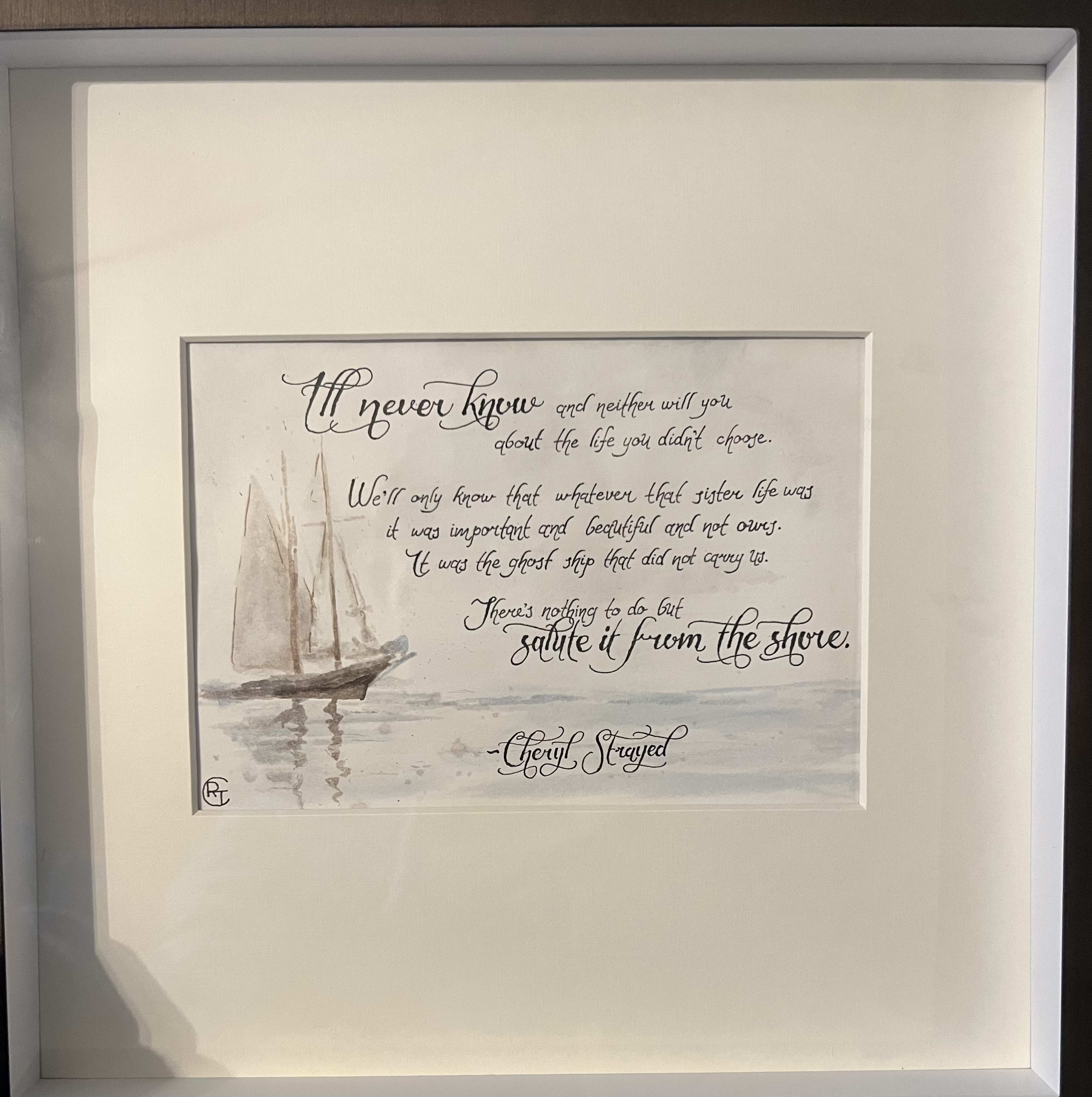
As Cheryl Strayed once wrote (in a piece that I come back to time and time again when I need some comfort): “I’ll never know and neither will you of the life you don’t choose. We’ll only know that whatever that sister life was, it was important and beautiful and not ours. It was the ghost ship that didn’t carry us. There’s nothing to do but salute it from the shore.

This is me saluting.

Wonderful art a dear friend had made for me. It hangs as a daily reminder.

Thanks for reading Race Ipsa Loquitur! Subscribe for free.

1

To preempt many well-intentioned responses I’ll get: yes, I know adoption is always an option. It’s also a very difficult and trying path, and not as simple as the “just adopt!” advice that so many people will offer. I’ve done a lot of research, and while I’m not foreclosing the opportunity, to me it’s similar to when people say “well just freeze your eggs!” or “just have kids on your own!” There’s a lot that goes into these alternative paths, and that deserves respect.

2

This might be a separate post entirely, but I always held the belief that I wanted/needed to be “recoverED” from an eating disorder to have children because the last thing I ever wanted was my impressionable kiddos picking up on remnants of disorder eating habits and mimic those. I don’t know if I’ve ever felt strong enough in my recovery where I could say with certainty I wouldn’t fear this. But I know many others who have started families while in recovery and don’t share the same concerns. So, once again, I don’t know.

3

This isn’t my area of law, so if someone knows a way around this, please reach out and let me know. While it would be a decision fraught with its own complexities, I’m fairly certain I would love for someone else to be able to use them.

  • βœ‡Race Ipsa Loquitur
  • Deoptimizing My Life
    I woke up in the Tahoe AirBnB the morning of the 2017 Spartan Race World Championship and, as usual, checked my Whoop readiness score first thing. 3%. THREE PERCENT - and I had arguably one of the biggest races of my life that day, where I was hoping to secure a second Spartan World Championship title. 3%.The number haunted me during my mobility routine and pre-race breakfast of Pop-Tarts (Cinnamon Roll) and peanut butter. I managed to shake it off and forget about it, but I did go on to have o
     

Deoptimizing My Life

25 March 2026 at 10:47

I woke up in the Tahoe AirBnB the morning of the 2017 Spartan Race World Championship and, as usual, checked my Whoop readiness score first thing.

3%.

THREE PERCENT - and I had arguably one of the biggest races of my life that day, where I was hoping to secure a second Spartan World Championship title.

3%.

The number haunted me during my mobility routine and pre-race breakfast of Pop-Tarts (Cinnamon Roll) and peanut butter. I managed to shake it off and forget about it, but I did go on to have one of my worst races ever - failing obstacles, shattering my pinky finger, and, for the first time in my obstacle racing career, finishing outside the top 10 in 11th place. There were a lot of “what happened out there?” questions I faced while I elbowed my way through the crowd post-race to get to the urgent care for them to take a look at my poor shattered pinky finger.

I took my Whoop strap off that day and never wore it again.

That’s not to say I had a healthy relationship with it beforehand. I never sought out a Whoop - one of my sponsors got it for me in 2016 through a pro athlete deal, so I figured “sure, seemed like a smart thing to do.” Smart…maybe for some people. I had a tendency to use the Whoop strap in a perverse way - to just see how high I could get that “strain” score on a daily basis. Anything less than a 20 was a failure. Any day where I was “recovering” was a failure. Leave it to my eating disorder and OCD to take a recovery tool and make it into a perverse torture device.

My Oura ring that I received as a gift later that year didn’t fare much better.

In 2017, both Whoop and Oura were still in their infancy - niche devices used by the tip of the spear. Over the past decade, they’ve become ubiquitous among athletes, weekend warriors, biohackers, and wellness gurus alike. Beyond Whoop and Oura, we now have the ability to track…everything. Our weight, our exercise, our sleep, our blood sugar, our ketones, our sweat rate, our heart rate, our periods1, and even our bowel movements. We track, and quantify, and analyze and stress about how we can optimize..,everything.

I thought about this as a I watched an ex prick his finger every morning, measuring his ketone levels. A CGM slapped to his arm, giving him warnings that the cauliflower he just ate spiked his blood sugar AND kicked him out of ketosis. But he had the personality where he could laugh it off, then say “fuck it” and proceed to eat an entire mini-bar of gummy bears and chocolate chip cookies and go about his merry way. He could check his sleep score, shrug, and immediately go on with his life.

If that Whoop strap taught me one lesson, it’s that I am not that person. I am the person for whom tracking does more harm than good.

Perhaps this is rooted to my history with eating disorder recovery. Unlike many eating disorder sufferers, I never counted calories and I avoided scales with every ounce of my being. I didn’t want to know, because I knew that knowing would only drive me and my obsessive-compulsive tendencies to a very bad place.

So over the past decade, as the world has focused more and more on tracking and optimization, I’ve opted out. I’ve turned off sleep tracking and heart rate on my watch (bonus - it saves batteries!), I rarely wear a heart rate strap while I run, and I actively avoid trying to see my step count for the day. I went from getting blood work done 4x year to once a year (unless there is something seriously off), and I’ve declined bloodwork panels with tons of extraneous tests that may or may not have significance. I don’t want a full body MRI, I don’t want to know my APOE4 gene status despite there being a strong Alzheimers link my family, and I don’t want a Coronary Artery Calcium (CAC) scoring heart test despite LDL that consistently and stubbornly sits just about that 100mg/dL cutoff regardless of what I do.

I realize this flies in the face of “knowledge is power” and “the more you know, the more prepared you can be.” In a world where we have access to knowing so much about our bodies, I may seem like the outlier for saying “no thank you, not for me.” Perhaps I’m leaving performance on the table. Perhaps I’m burying my head in the sand avoiding a potential catastrophic medical issue.

Perhaps.

But perhaps I’m valuing my mental health and my recovery journey with health anxiety and health-related OCD more right now. I’m coming off a rough fall of an extreme OCD health-related flare where I made decisions in a panic I’m not super proud of. It sucks, but I learned some things, including a reiteration of the fact that for me, optimization and the fear of something going wrong with my body may actually lead to more harmful things (such as the mental and physical stress of potentially unnecessary tests and medical procedures).

Beyond just tracking, I’m re-evaluating my relationship with something in our lives that new research has shown is actually pretty terrible for us. As more and more of my friends choose to completely abstain from alcohol, I actually done the opposite: I’ve started having a drink once or twice a week after a few years of complete abstinence. Long gone are my days of beer bongs and shot skis and flip cup, but sitting around at a dive bar with friends and a beer is something I realize I’ve actually missed. Sure, I imagine if I tracked my recovery and sleep score, I’d see the impact there, but the bonding and social experience that comes with hours of meandering conversations over a few drinks with friends on occasion seems a worthwhile trade-off to me.2

Similarly, strict 8:30pm bedtimes have given way to poetry open mic nights that keep me out until midnight, to the aforementioned bar conversations, and to a late-night movie or conversation with a loved one. You’ll still find me crawling into bed at 8pm some nights when needed, but the stranglehold on my sleep schedule has eased in favor of broader experiences and saying “yes” to what life may have to offer beyond the regimented schedule of a training athlete.

My grandma passed recently at the epic age of 102. And she lived to that age doing so many things that longevity influencers would balk at: buttering her toast with lard, eating potato chips for lunch, having 2 martinis every night for decades. She also lived by herself for 35 years after my grandfather’s death, and didn’t really have an active social life (research has proposed that living with a partner and having lots of friends is a key to longevity). She never took a supplement or pill in her life, and only saw a doctor when my dad forced her to. So if you take her n of 1, none of this longevity and optimization shit makes any sense. (I will say she was an extremely low stress person so maybe that had something to do with it. You know what’s not low-stress? Tracking your freakin’ sleep scores.)

Like so many things in life, perhaps it’s the unsexy “everything in moderation” that wins out. And probably so much of it comes down to an individual’s personality. What I have to trust in this day and age of optimizing and maxx-ing everything is that for me, personally, less is more. Doing less, knowing less, testing less, optimizing less.

Cheers to that.

Thanks for reading Race Ipsa Loquitur! Subscribe for free to read some stuff.

1

Ok, this is one thing that I actually do believe in tracking and wish I had done so earlier!

2

There’s actually an entirely separate post about the interplay of alcohol and my eating disorder that’s been sitting in draft form for awhile now, but the tl;dr is that complete abstinence from alcohol for me can actually be an eating disorder behavior that indicates I’m not doing well in recovery (fear of calories, etc). It’s a tricky subject to broach, but definitely curious if others can relate there.

❌