❌

Normal view

  • βœ‡Mr. Money Mustache
  • Inside Mrs. Money Mustache’s Top-Secret Five-Figure Etsy Shop
    For the past two years or so I’ve been keeping a secret from you, and I think today it is finally time to spill the beans. The secret is that my wife is no longer really retired, and in fact she started a business that is now big enough to fund our entire family’s lifestyle. Making this confession will subject both of us to the full fury of the Internet Retirement Police. But it’s worth it, because there are some valuable lessons in her experience that could be useful to othe
     

Inside Mrs. Money Mustache’s Top-Secret Five-Figure Etsy Shop

6 March 2017 at 18:56

oil-mixFor the past two years or so I’ve been keeping a secret from you, and I think today it is finally time to spill the beans.

The secret is that my wife is no longer really retired, and in fact she started a business that is now big enough to fund our entire family’s lifestyle. Making this confession will subject both of us to the full fury of the Internet Retirement Police. But it’s worth it, because there are some valuable lessons in her experience that could be useful to other people hoping to take control of their own income.

I’m always fascinated and happy to see people making money through self-employment, (especially in fields that don’t require a university degree) because it presents a nice shortcut around most of the problems that the world of work presents to us. Prefer to set your own schedule? Go right ahead. Unhappy with work conditions? Change them. Want a raise? Company profits are under your control. Don’t like your boss? Just find a mirror and have a quick word with yourself.  Sure, there are loads of great jobs out there, but conventional employment is often only a small, boring slice of a life’s work experience.

The Etsy Shop

labeling-soap

You’ve almost certainly heard of  Etsy, a highly popular online marketplace that specializes in handmade, small batch products – most often produced by a single person. Almost everything there is cute, unique, and custom, which makes it a hit in the gift-giving and personal pampering markets. And because the focus is on small entrepreneurial business and relatively natural products, even Mr. Money Mustache can get behind the general theme without too much grumbling about clueless consumers.

My wife was a fan and an occasional customer, but also became curious about just how difficult it would be to make some of the things that were for sale – often at relatively high prices. So she launched an investigation, which has led to two years of fun and learning, and is still growing.

Update: When I first posted this article, we asked people to please avoid trying to track down her Etsy shop, just to keep her experiment realistic. A small percentage of good-hearted but mischievous Mustachians disregarded this request and flooded her shop with orders anyway. Almost her entire current soap inventory (over $1000 worth) was quickly sold out. So if you do find her shop, you’ll only see a few remaining products for now. You’ll have to use your imagination to picture what it usually looks like – an array of 20 different fancy looking soaps and other products.

So to continue this tale, let’s launch into an interview with the lady herself.

An Interview With an Etsy Entrepreneur


Mr. Money Mustache: Hello there wife! Thanks so much for allowing me to do this interview with you – I know you’re normally not a fan of the public eye.

So to start things off, what is it exactly that tempted you to get into the business of being an Etsy seller in the first place?

Mrs. Money Mustache: Hello husband! It is strange and fun to be back on the blog, so thanks for doing this article.

Becoming an Etsy Seller was a gradual process, as it is with many folks, I suspect. I was sitting around being all retired and, frankly, I was bored sometimes. At the time, I didn’t have a real plan for all my free time.

One day, while standing with a group of parents at the after-school pickup, I became enamored with these lovely wrap bracelets with pretty beads all the moms seemed to be wearing. I hadn’t seen them before and became curious, so I started shopping online. I found out they cost a small fortune and, not really being a jewelry person, I quickly dismissed the purchase.

But, upon further review, I saw they were selling on Etsy and this prompted me to think I could make one myself. So, I dove down into a rabbit hole of watching videos and buying supplies and I was hooked. Learning and making really filled a void in my life, so I went a little crazy. I made a bunch of bracelets, gave them to friends, and at a certain point, I had spent more than I felt comfortable on the whole endeavor.

This is when I came back to Etsy and the idea of selling was born. I figured if I could sell enough of these bracelets I had learned to make, I could pay myself back for all the stuff I had bought to make them recreationally.

MMM: Wow, that’s interesting – selling as an atonement for consumer guilt? It sounds negative when you put it that way, but it seems to have become a big positive in your life. So anyway, what date was this?

Mrs. MM: This was in April of 2014. That’s when I started my first shop.

MMM: How long did it take to get your first sale? And how have your sales ramped up since then? What was your busiest month so far?

Mrs. MM:  It definitely took a while to get my first sale. About 2.5 months after first opening my shop. But, I was so busy making items and learning about Etsy that I didn’t really notice the time pass. I remember it was a holiday-specific item (a fourth of July bracelet) and that’s when I realized the importance of holidays in retail (duh!)

My sales increased really slowly over time. I did so much research by lurking around in the Etsy forums and finding out what makes other shops successful. I created a lot of different products (necklaces, bracelets, guitar picks, even crocheted dish cloths!) so I could test them out and see which were successful. A wise man once said: “Work is better when you don’t need the money.” and he was right. :) I was able to do a lot more than a shop that can’t invest much due to money constraints.

My busiest time, by far, was the holiday season of 2015. In November and December of 2015 I was so busy that I couldn’t keep up and had to place my shop on vacation mode (Etsy has an option for that, which basically means: I’m not open for business at the moment.) During just those two months I sold about $10,000 of stuff. I was working constantly and it got in the way of family time and I realized I needed more balance.

blending

Blending various fancy oils in the home workshop, with a stick blender.

MMM: I noticed that even after your first shop became fairly successful, you actually started a second Etsy shop. What was the cause of this? How has the experience been, compared to the first?

Mrs. MM: Yes! I decided to start a second Etsy shop in August 2016. As an Etsy Seller, I really wanted to support other Etsy sellers, so I started buying stuff from them quite a bit. I purchased almost all my shop supplies on Etsy and I also started buying small gifts.

One year, I bought some handmade soaps for family members at Christmas and tried one out myself. I fell in love with it and realized how much better my skin felt. Of course, as a crazy-researcher-type (which is what I realize I am, post retirement), I decided to try making my own soap. This led to a second love and once I felt confident in my products, I opened my second shop, which sells mostly natural bath and body products (soaps, scrubs, lotions, and oils).

This second shop is so much more fun than the first. For one thing, I am making products that I love using myself and really believe in. I also had so much experience at making my first shop successful that the second one was much easier. I had a few customers that shopped at my first shop that immediately bought from my second shop. So, that first sale came much faster.

I also really love the “soaping community”. All the soapers I’ve met through Instagram (which is a platform I used to hate and now love) are so generous with time and information and they make beautiful products too. It’s just a completely different (and more fulfilling) experience this time around.

MMM: How do you decide what to make and what to sell – and which products to discontinue?

Mrs. MM: In both shops, I try a lot of different things. I follow my own feelings of what I’d like to wear or use. I like to make new items and sometimes they do really well and sometimes they don’t. I also find that in the bath & body world, you get repeat customers much more easily. So, they will let me know what they want more of, which has led me to keep products that I wasn’t sure if I should continue and making new ones.

I also follow my values. For example, right now many of my bath and body products are all natural, but I’ve also tried using ingredients that aren’t considered natural. I like to experiment and decide for myself what I like. But, after dabbling in fragrance oils and other “not 100% natural” ingredients, I find myself veering back towards all-natural. I’m trying out a lot of different packaging and am finding that this is a challenge as well, as I want everything to be eco-friendly, but also reasonably priced.

So, I guess I discontinue items that aren’t doing well and that I’m not a huge fan of either. But, I will always make new things (because that’s the fun part), so I will always want to sell new items along with the ones that stay on and sell well.

MMM: What are the factors in your success – Is this something just anybody can do? If not, what skills or personal tendencies do you think would create a good Etsy shop owner?

To take nicer photos like this, she had to figure out lighting, background, and camera - For both Etsy and MMM pruposes, we upgraded to a Sony alpha6300 with separate Sigma prime F/1.4 lens.

To get nicer photos like this, she had to figure out lighting, background, and camera. For both Etsy and MMM purposes, we upgraded to a Sony alpha6300 with separate Sigma prime F/1.4 lens. I love the camera – takes amazing film-quality videos too.

Mrs. MM: My success (or, my definition of success anyway) is probably due to incessant research. I am always researching. I read a lot and look at a lot of other shops and try to figure stuff out. It’s a fun puzzle and I think it is the most interesting part of owning an Etsy shop for me. I would get bored if I wasn’t doing that. The business half of my degree is finally coming in handy!

To be successful on Etsy, you need to understand how SEO (search engine optimization) works. Etsy has their own search engine, so you just need to figure out how to make your listings show up near the top, which is easier said than done!

Once you know that, you need beautiful pictures so that people actually click on your listing. Again, this takes a lot of research and some photography skills. I look at every single picture in a search result and figure out what makes me click on an image. I also look at my listing in that list and see if it stands out.

For example: I recently realized that I was clicking more on photos of soap with packaging than “naked soap”, so I changed one of my listings so that the first photo had packaging – and it did result in more sales.

Doing what it takes to get the shot.

Doing what it takes to get the shot.

SEO and quality photos are the two biggest things. After that, you need to give excellent customer service and ship your packages out in time. It helps if your packages look cute upon arrival too. That leads to good reviews and word of mouth, which leads to more sales.

MMM: What has been the biggest unexpected positive, and negative, in your experience in dealing with customers?

Mrs. MM: The biggest positive has come from my second shop, as I have built up repeat customers in a relatively short amount of time. These are people that leave me incredible reviews, send me a message that brightens my day, post their purchases on Instagram, etc. I am very surprised by this, but it does bring me a lot of joy.

The negatives used to affect me a lot, but I’ve learned that they will always be there. There are people that leave one star reviews without contacting me first. People can be pretty brutal when reviewing a product. I don’t think they realize they are leaving a review to a single person (as opposed to a company). It’s one thing to say “Amazon sucks”, but when someone says “You suck”, that’s totally different. Sometimes they are folks that own a competing shop on Etsy (or have a friend that does), so you know the review isn’t even accurate or relevant, but it still sits there staring you in the face.

MMM: I hear you on that Mean Internet Strangers thing. Sometimes I stumble across multi-page discussions on Reddit or Bogleheads, among people I’ve never met, who are just making the most bizarre and pessimistic speculations about our personal lives, or my motivation for writing the blog, or whatever. There is no practical way to set everyone straight, so you really just have to develop a thicker skin instead.

Mrs. MM: I think it’s a bit easier in the smaller world of an Etsy shop. There are also a lot of difficult customers, but I always answer all their questions and do my best and some of them have actually made large purchases or become repeat customers. One of my best customers in my second shop was someone that was previously difficult.

MMM: What do you think the upper limit on profit would be in an etsy shop? Do any of your role models or competitors seem to be running pretty big operations?

Doing the Math

Doing the Math

Mrs. MM: The sky is the limit! There are many shops on Etsy that started off as one-person endeavors and now they own huge businesses with many employees. Most of them move on from Etsy and start their own web sites, which makes sense as they no longer need the Etsy platform to generate sales.

Etsy also has rules about manufacturing help and the handmade nature of items, so if you get big and want to start selling different things, it makes sense to move on.

That’s not the goal for me, although I might use a helper during the holidays sometimes. (MMM himself has been known to sit on the couch and cut out hundreds of cardboard squares for my packaging material)

My goal is to keep making and to keep learning… not to have a huge money-making operation. My word for 2017 is ‘balance’. :)

I should also add that on the lower end, it’s very easy to make nothing, or even lose money on an Etsy shop. There’s a lot of competition, so it is not easy to get established. Hard work and endless patience are essential to get through that painful first year.

MMM: Hmm, there were no numbers in your answer, but I guess we don’t really know how any of those huge Etsy sellers personally. But based on their photographs of daily production I’d estimate that the upper limit might be in the $200,000 range of annual profit for a single-person shop. $1000 per day in sales, minus about 33% in cost of materials and other overhead.

But as you say, shops can get much bigger than that – they just usually leave Etsy, hire some employees, and expand into a standalone operation.

So let’s talk about your situation instead – what’s the net hourly profit you would say you make at this stage, now that you are established?

Mrs. MM:  Hmmm… that’s tricky because I keep wanting to make new things, so I am spending more than I would be if I were purely profit-driven. My first shop is at a stage where my profits are very good compared to my revenue because I’ve lost a bit of interest in that shop and am not spending much on it. Hourly, I’m guessing around $30 per hour. However, as a result of me losing interest, it has slowed down quite a bit and it is actually “on vacation” on Etsy at the moment.

My second shop is still in the growing stages, so profits are not that great at the moment. I’m also finally at a place where my prices are set where I want them to be. My up front investment was quite big and soap takes 4-6 weeks to cure, so that shop is still up in the air, profit-wise. But, I’m guessing it will become more profitable on an hourly basis than my first shop once I ramp up my operations by making larger batches (less time spent and supplies cost less when bought in bulk).

So yeah, good question. I guess my answer is: “I’m not sure. I should probably calculate that.”
wet_soap

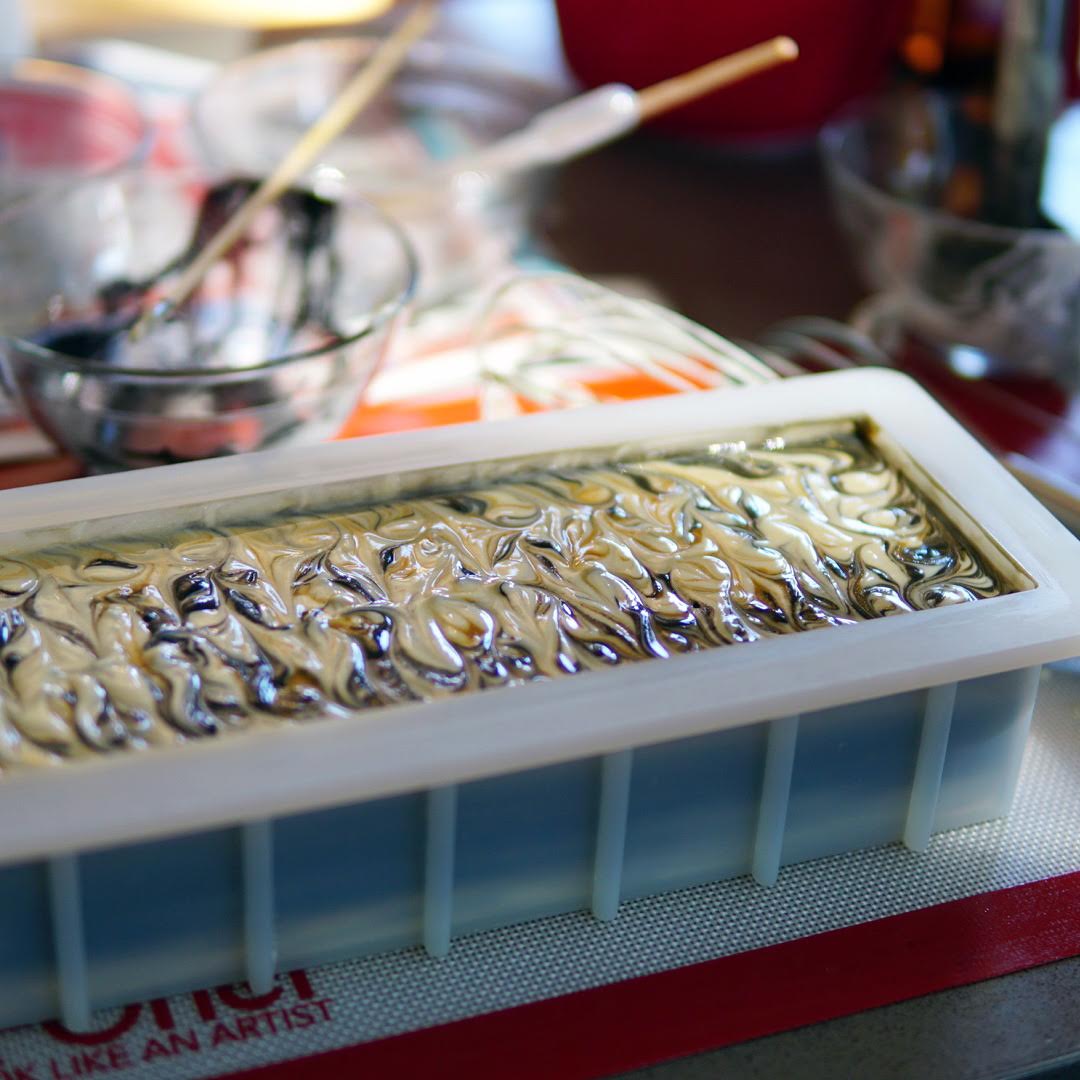
A freshly poured batch of soap. This hardens overnight, and you cut it into 16 bars. 4 weeks later, it is cured and ready to sell.

For example, to make a 5 pound batch of soap (a “loaf”) takes about $20 worth of materials if you are using high-end stuff like coconut and olive oils. This takes roughly 2 hours of labor by the time you make it, clean up, and later cut and package the soap. You end up with 16 bars, which sell on Etsy for $6 each. So, your profit is about $80, for roughly two hours of work. But that work is spread over a month, so you need make a bunch of batches to keep things in stock.

MMM: Where do you see this hobby taking you?

Mrs. MM:  Ultimately, I want to be able to use this hobby for community building. I imagine owning a store somewhere on Main Street that sells my products, but also empowers others to make. I see myself teaching others how to make their own things and how to start their own shops. I see myself making alongside others and having this ongoing conversation about our common problems and our successes. I imagine connecting with other makers in a community space. I see us all teaching kids that you can make instead of buy, create instead of consume. You can own your own business while also doing the things you enjoy.

MMM (update): During the casual yearlong process of working on this article, we ended up stumbling upon an interesting, underpriced old building on Main Street, and are now about to purchase it. It will make for some interesting stories (and parties too), so I’ll keep you posted on that.

Mrs. MM: The maker’s movement is huge and is having a big resurgence in our modern lives. I am the type of person that never considered myself “creative”. I still wouldn’t use that word to describe myself, but I am now a handmade maker. I make stuff with my hands and they are sometimes even useful things! You can do it too!

I would love to go back in time (or forward in time) and live in a world where everyone is a maker of things and we just make and trade with each other. The simplicity and the community of that framework really appeals to me and it gets at the root of what makes us human.

MMM: During these past two years, I have mentioned your growing Etsy hobby, but never told anyone how to find your shop. And even with this article, I still want to encourage readers not to go out and try to find her shop on Etsy. We both felt that doing so would be a form of “cheating”.  Can you explain this philosophy?

Mrs. MM: It was really important for me to create my own success, independently. Success isn’t as fulfilling if you cheat! I’m pretty sure that almost every single person who purchased from me didn’t know my secret identity and that feels good.

I’ve built all of this myself, from scratch. I’ve also learned that many people will pay big bucks to cheat the system (whether it is online selling, blogging, etc). I’ve found that the harder, longer road, is always better in the end.

MMM: That’s really cool. And it’s also more educational for you. As a relatively high achiever with skills in software and technology, and no financial pressure, it can be argued that you are already “cheating” compared to most Etsy sellers.

But if you do it right, financial independence is the good kind of cheating – you preserve the learning and effort, but cut off the stress and any temptation to create shortcuts.

And even without financial independence, entrepreneurship is a huge advantage to add to your collection of life experiences. I have a bunch more stories of entrepreneurial friends I’ve been wanting to share with you, so let’s do it in the months to come.


Somewhat Related Reading:

50 Jobs over $50,000 – Without a Degree
Interview with a CEO – Ridiculous Student Loans vs. the Future of Education
  • βœ‡Mr. Money Mustache
  • Mr. Money Mustache Turns Six Years Old
    Taking down the old sign at the future MMM HQ building last month. Much more has changed since then! In early April of 2011, I started a blog. Although I secretly hoped that lots of people would end up reading it, it was partly just a form of personal therapy – a place where I fight back against a world that had obviously lost its mind, by sharing some financial and living advice that should have already been obvious. This weird hobby ended up being a pretty good idea, as it has blown
     

Mr. Money Mustache Turns Six Years Old

11 April 2017 at 17:55
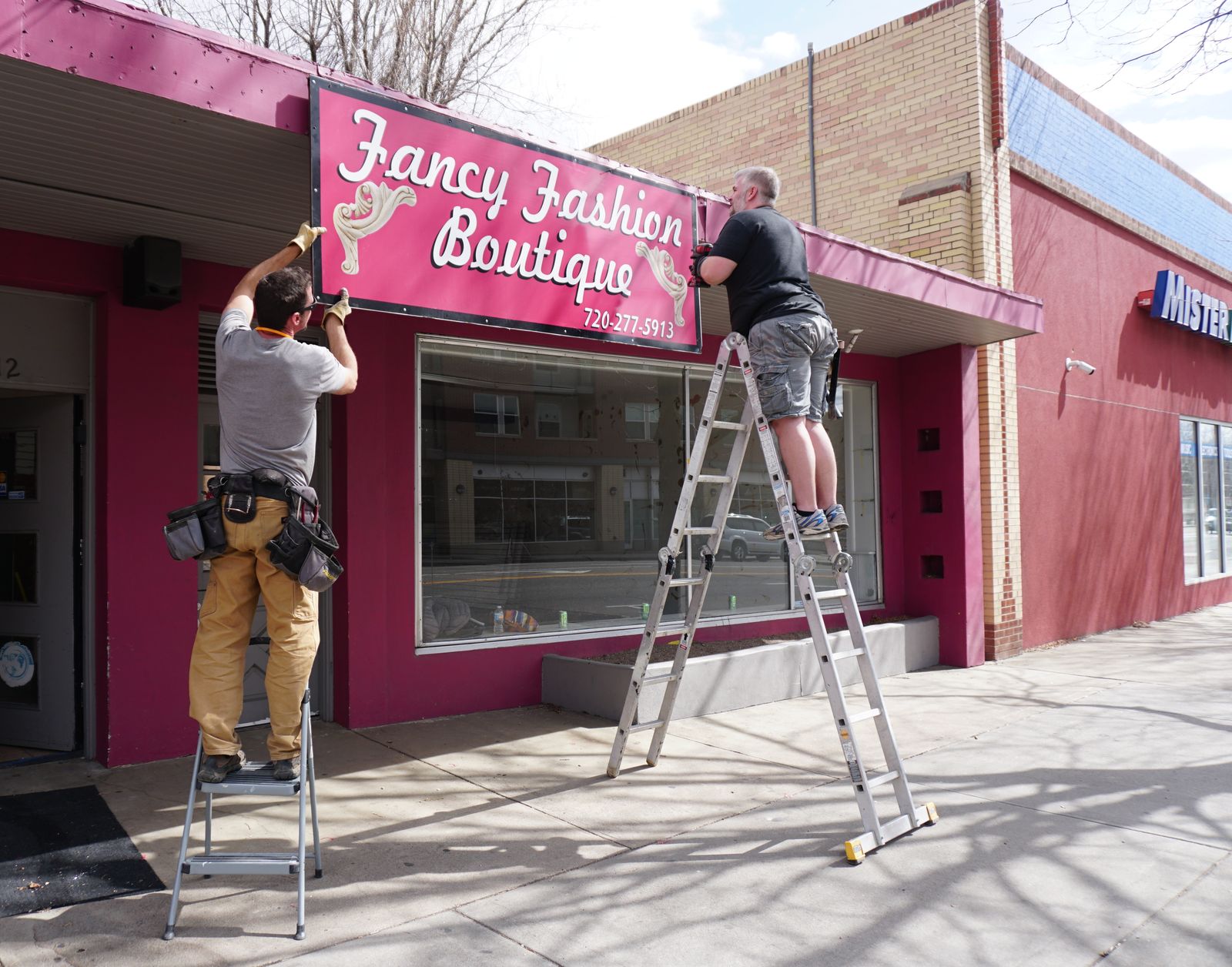
Taking down the old sign at the future MMM HQ building last month. Much more has changed since then!

Taking down the old sign at the future MMM HQ building last month. Much more has changed since then!

In early April of 2011, I started a blog. Although I secretly hoped that lots of people would end up reading it, it was partly just a form of personal therapy – a place where I fight back against a world that had obviously lost its mind, by sharing some financial and living advice that should have already been obvious.

This weird hobby ended up being a pretty good idea, as it has blown up my life in many ways and made it even more satisfying. Early retirement is already a great thing, but enjoying a long, youthful retirement where you get to feel like you’re actually helping other people is far better.  This website has served about 25 million unique visitors, and even the regulars are now in the seven digits. On top of that, I’ve had the honor (and sometimes embarrassment) of showing up in several bigger bits of media (some of them listed on this Media page).

But it’s tough to have such a big opportunity and still maintain a mostly-retired life. When you do the math, even a small bit of extra research and work on my part to make these articles more accurate and less haphazard, would provide much more benefit to these people than any inconvenience it would cause me.

Side note: The most powerful media boosts were not those stories in The New Yorker, TV News shows, or the Wall Street Journal like you’d expect, but rather an unscripted and rambling conversation on the Tim Ferriss Podcast – a sign of how much the world is changing beneath the feet of the old establishment.

Logically, this means that I really should be working on MMM project full-time, and have a big team of dedicated helpers. An even bigger site could create plenty of money to allow this and the work is very rewarding. That extra money could benefit a whole lot of people.

But I really don’t like sitting down and typing indoors all day. So instead I constantly choose to slack off by indulging in low-wage DIY construction work and spending time with family and friends. In the time since my last blog article, we bought an old building downtown and embarked upon a major renovation of it. But this construction project has in turn been interrupted by several visiting guests, a four-day snowboarding trip, and a flurry of local meetings. This week, my son and I spent about 4 hours developing some homemade rifle scopes for Nerf guns. There’s just so much to do in life besides the most “important” work.

The self-imposed pressure to always do more is a nag, but it would be ridiculous for me to ever complain about a life like this. So instead, I will just say “Thanks” for this first amazing six years, and here’s to our next sixty years of changing the world together.

And by “together” I mean, “You doing all the hard work of shifting to a a more badass, efficient, wealthy lifestyle while also converting your friends, while I hang out here in Longmont and occasionally type some shit into the computer to egg you on.”

Useful Stuff and News:

1: How to Find Stuff on Mr. Money Mustache or Anywhere else:

Many people send me emails asking for advice, not knowing I’ve already written about the subject in the past. To find past articles, try typing stuff like the following into your web browser:

site:mrmoneymustache.com 401k
site:mrmoneymustache.com car clowns

and so on. You can do this with any web site and find useful information in their old stuff very easily. For example, let’s search the entire “forum” section of this blog (since it has about 1.4 million different posts from over 32,000 registered members) for conversations about scholarships:

site:forum.mrmoneymustache.com scholarships

Or search every city in the entire US and beyond (via Craigslist) for used Nissan Leafs:

site:craigslist.org nissan leaf

Tangential Pro Tip: you can buy a car from someone you trust in another state, negotiate the deal however you like, then then get it shipped directly to you via companies like Uship – typically for under $1000.  A great trick for casting a wider net!

2: Stuff I’ve been doing besides Writing Blog Posts:

Writing the Foreword to the upcoming “Your Money or Your Life”

Through good fortune and the Magic of the Internet, Vicki Robin, the author of the original book that brought Financial Independence into the consciousness of the modern world, has decided to write a new edition of the book and ended up joining forces with today’s happy circle of FI writers. She invited me to write the foreword to the new edition, which is obviously an amazing honor. I’ll let you know when the new version of Your Money Or Your Life comes out – it will surely become the new standard by which all other books on personal finance are judged. You can listen to Vicki’s moving story of a lifetime of activism in her interview on this podcast from our mutual friend The Mad Fientist.

Reading the Foreword to “The Simple Path to Wealth”

Yet another friend and all-around-good-guy Jim Collins wrote a great book on how simple stock investing is, and it turned out to be a stunning success. So successful that Jim told me he has been forced to massively increase his charitable giving program, which made me very happy. And so successful that the publishing industry came back to him to do an audio book version of The Simple Path, for use on Amazon’s Audible.com library.

Now, this book also happens to include a foreword from old Mr. Money Mustache. Since Jim is doing his own narration, they asked me to narrate my own foreword. I gladly agreed, and this has become yet another small but important task piled upon my Jenga tower of a life.

Pop-Up Business School Comes to America

On the last group Ecuador trip, I met a high-energy entrepreneurial British fellow named Alan Donegan who runs a school that trains people to start their own businesses – with very little money. He gave an impromptu session to the 25 or so of us on that trip, and we were all impressed and entertained.

So far, it has helped thousands of people in England, and he was thinking of trying it on this side of the pond. If we can get our act together quickly enough, we’ll host him here in Longmont this summer, and maybe in other cities as well. If you want to add your town to the list of stops, or support our effort here in Stashtown, you can find Alan through his Pop-up Business School website.

That’s it for the Birthday Edition. I’ll be back with new, better-than-ever articles just as soon as it’s time to take the next break from real life. I hope your Spring is going just as well.

Related Reading: How to Start a Blog

  • βœ‡Mr. Money Mustache
  • There Are No Guarantees
    You know what I have come to realize is almost always ridiculous? Contracts. Contracts, paperwork, and bureaucracy. Guarantees, warranties, and excessive caution in an attempt to ensure a trouble-free future. Not all of it is bullshit, but the older I get, the more I realize that a surprising portion of it is. I mean sure, if I’m Tesla and you are Panasonic, and we’re partnering to build the world’s largest structure and produce the majority of the world’s energy s
     

There Are No Guarantees

25 April 2017 at 18:01

mydoorYou know what I have come to realize is almost always ridiculous? Contracts.

Contracts, paperwork, and bureaucracy. Guarantees, warranties, and excessive caution in an attempt to ensure a trouble-free future. Not all of it is bullshit, but the older I get, the more I realize that a surprising portion of it is.

I mean sure, if I’m Tesla and you are Panasonic, and we’re partnering to build the world’s largest structure and produce the majority of the world’s energy storage products, and we each have thousands of employees involved in the process, we can write up a contract and sign it.

But if I invite you over to my house for one of our customary Sunset Beers in the Park events tonight, how appropriate would it be for me to send along a little PDF contract with five places for you to sign?

I, Jane Mustachian, agree to arrive at the Mustache residence between 5 and 6PM, and consume between 1 and 5 servings of beer and/or wine, over a period not to exceed six (6) hours, to convey myself to and from the event using only muscle-powered transportation… blah blah any food served may or may not contain nuts or gluten… agree to not to hold Mustache family liable for any injuries..  and so on.

You’d think I was crazy, and find another place to have your beer tonight.

We understand this at the social level, and even at the small business level, if we feel a high level of trust. But as soon as we lose our trust and get overly fearful, we start breaking out the lawyers and the contracts and the stifling formality.

It is at this point, I argue, that life starts to suck.

It’s also the point at which a company starts to suck – that moment when it loses its soul and its freewheeling joy, and starts pushing for profits above ethics, and the lower level employees are not empowered to do what they know is right because their boss would have to ask the next level boss and the request would die before it reached someone with enough authority.

This is also the point at which I try to avoid doing business with a company if at all practical, and find a smaller one who could use a new customer.

And therefore I think we can make our lives better if we raise that threshold of fear a little bit, and start running our businesses and our lives as if we were big boys and girls.

Here’s another story which illustrates this point:

On the “contact” section of this website, I have a little note that says people should not email me with requests for marketing partnerships, TV shows, book publishing, etc. Through experience I learned that those activities not nearly as fun as they sound.

But one guy snuck through the gates – “Hey man, I work for a big company but don’t worry, I’m cool – I just have some ideas for a TV show about Mustachian lifestyles and wondered if you want to talk about them.”

So we talked on the phone, and he was indeed cool. It was a nice concept and a respectable company and they had done other successful stuff. So I said I might help out with the project occasionally, as time permitted.

Suddenly, a completely unrelated person from their legal department started emailing me contracts and agreements and such – pages of them! The contracts contained obligations, promises, and bullshit galore.

And here I was just naively thinking I’d have a beer with this creative writer and laugh about some ideas for a TV show. We had already agreed on the phone, that if the project ever ceased to be completely fun – for either of us – then we’d just drop it. Retirement is is too short to engage in non-fun projects, because there is already an enormous queue of extremely fun projects that I haven’t even had time to start yet!

So I told the lawyers thanks, but I wasn’t interested in contracts. But I’d still be happy to help out just as I had originally offered.

And I never heard from anyone at the company, or the creative guy, ever again.

I felt like I had been stood up – the whole thing had been a small waste of time. But I was grateful that I hadn’t actually dug in on a big project with an organization that works this way – for that would have been a much bigger waste of time.

Let’s contrast this with a a few other business arrangements.

Figure 1 - Camp Mustache

Figure 1 – Camp Mustache

I have fixed up plenty of houses with local friends, with many thousands of dollars at stake. Sometimes even lives or limbs, as we scrambled around like monkeys to cut down tall dead trees.  No contracts, just plenty of dirt, scrapes, laughs and good times – and profits, too.

I’ve done several interviews and trips with Jesse Mecham, founder of You Need a Budget. Significant value accrued to both of our businesses from these collaborations as thousands of YNAB customers became Mustachians and vice versa, and yet somehow it never occurred to us to make up a contract.

Next month I’m traveling to Portland – first to visit Treehouse founder Ryan Carson and do some social stuff that might also have promotional value for his business. Maybe record a video and a podcast, and even host a gathering of Mustachians right in the courtyard of their central Portland building. With beer!

No contracts, of course.

Then on to Seattle to attend Camp Mustache – something that is now a popular recurring event. Although there are tens of thousands of dollars involved in putting it on, it’s an informal not-for-profit arrangement and the organizers and I have never signed a contract.

But What if the Other Person Breaks their Promise and I Get Screwed?

You may think I’m painting an unrealistically rosy picture here. Not everything always turns out for the better, right? Business partners sometimes turn evil, tenants stop paying rent, girlfriends or boyfriends dump you, products break,  stock markets crash, bones break, and fatal diseases strike your loved ones.

I agree – life has been known to serve up the odd Platter of Shit from time to time. Every one of those things above has happened to me. And yet in zero of the cases could I have protected myself with a contract or warranty and come out ahead.

I’ve been to court a few times. In some cases, I was the landlord and the tenant wasn’t paying rent even though we had a contract. The judge ordered the tenant to pay. The tenant, who had long since left town, didn’t even know there had been a court case. And yet life went on, and the inconvenience was soon forgotten.

I retired early, invested too much in a house building business, then lost a bunch of money in the ensuing great financial and housing crisis. No contract could have protected me from these market realities, and yet somehow I survived again and life continued to get even better.

I’ve had products malfunction while under warranty, and in most cases the warranty department was so clumsy and incompetent (ahem, Samsung, Nissan) that I just gave up and fixed the product myself.

The point is that in almost all life decisions, the stakes are actually very low. Here in the rich world, the majority of our catastrophes have the following consequences:

  • You might feel “inconvenienced” and experience a frowning face for a short period of time.
  • Some numbers stored in a computer, which represent your wealth, might temporarily decrease.
  • You might have to move your body around – and possibly even experience mild heat, cold, or muscular exertion.
  • You might have to speak some words into a telephone or press some buttons on a computer keyboard to resolve a problem.
  • In more extreme situations, you might even have to speak to one or more humans in person.

Are these consequences really worth worrying about – or potentially even missing out on the chance to do something great?

What does This Have to do with Early Retirement?

Every week, I get at least a few emails from people who have more than put in their time. People in their late 30s and beyond who have worked multi-decade careers, paid off the house, given their kids a good start in life, stashed seven figures into retirement accounts, and long since grown bored of the big-company life.

But they are still working one more year, to add that last bit of safety margin padding, fill up that last college fund for the last kid, max out that health savings account just in case. Some of them have more savings than my family has even now, even though we’ve been retired (and continuing to accumulate wealth) for more than ten years.

And they’re still afraid to retire.

You Become Free Only when you Acknowledge That You Cannot Control Life

You can’t control the random bits of misfortune which may strike you. You can only control your responses.

If you are following the Principles of Mustachianism, you’ve already taken all the preventative work that you need to take: optimizing your habits to maintain a healthy body, mind, and bank account.

These are not a formal insurance policy, because formal insurance is nonsense.

They are a statistical prevention policy, a way of tilting the odds in our favor. And even more important, a response policy – a recipe that ensures that even when shit does hit the fan, you can clean it up, resume your prosperous life, and learn something in the process.

The lesson? Instead of working endlessly to build a glass shield around yourself, start enjoying life right now and just keep a mop handy.


Further Reading: In his joyful short book “Anything you Want” on founding a really successful business, Derek Sivers argues the same thing about contracts – just skip them if you can possibly do so, because people will either keep their word, or they won’t. If you bring it to court, everybody loses, and all a contract does is give you something to show in court.

  • βœ‡Mr. Money Mustache
  • Exposed! The MMM Family’s 2016 Spending!
    Well, I might as well come clean on our spending for last year.  It either went up, or way up, depending on how you want to account for things. Every year, this annual report seems to come out a little bit later – mostly because I’m no longer all that interested in how much money we spend. And Mrs. Money Mustache, my faithful assistant in creating these reports in past years, has disappeared completely from the blog – justifiably more interested in her Etsy Shop tha
     

Exposed! The MMM Family’s 2016 Spending!

19 May 2017 at 18:44

Well, I might as well come clean on our spending for last year.  It either went up, or way up, depending on how you want to account for things.

Every year, this annual report seems to come out a little bit later – mostly because I’m no longer all that interested in how much money we spend. And Mrs. Money Mustache, my faithful assistant in creating these reports in past years, has disappeared completely from the blog – justifiably more interested in her Etsy Shop than family finances. Such is the nature of retirement.

If you are early on in your journey to financial freedom, you should not do what we are doing. Until you have your finances on auto-pilot so that you are saving 50-75% of your income, you should absolutely be reviewing every piece of spending and adding up all the categories.

(Related Article: How Rich are You? How to find your Net Worth and Savings Rate)

But we’re all done saving for retirement. Our cash outflows feel both luxurious and reasonable, and they are well below the retirement income budget, so it seems less and less necessary to measure them.

After all, if you are happy with your body composition, do you still need to keep measuring every calorie you eat? If your breathing is clear and uninterrupted, do you track your annual number of breaths?

But our Supposedly Low Spending has kind of become my brand. And because of that, there are even conspiracy theories that form around this spending:

“There’s no way he’s making that much money and only spending $25k.”

“Oh, looky there.. Mustache bought an electric car as an “experiment”. I wonder if that will show up on their annual spending!”

“How much of his [travel/entertainment/home renovation/marijuana] expenses is he hiding from us as business expenses?”

So I thought I could do things a little differently this year. I can share the normal family expenditures as well what our businesses spent, and everything in between.

The Basic Expenses

Here’s the familiar chart, updated for 2016, complete with last year’s numbers for comparison.

Category 2015 2016 Comments
Mortgage Interest 0 0 If we had a $400,000 loan at 4%, we would have paid $16,000 in interest (!)
Property Taxes 1411 1895 Massive house price increases in my neighborhood come at a cost (prices have doubled in 4 years).
Food and Dining 7,400 6,807
   Groceries    6,232    5,980 A warehouse store opened up in town, within biking distance of home. This reduced grocery costs a little as I shifted more purchases there. See article: Killing your $1000 Grocery Bill
   Wine/Beer    627    321 Fewer large parties this year (boo), plus we cut down our glass-of-wine-or-beer-with-dinner habit (yay!). But many people have been giving me free boxes of beer in exchange for helping them with stuff, which probably makes this cost artificially low.
   Restaurants, Coffee Shop    541    506 Mrs. and Little MM started ordering fancy pizza deliveries every time I'm out on a trip.
Medical 3,733 10,868 Here's where the costs went way up this year.
   Doctor Visits    0    3807 My poor little lad broke his arm on December 30th (fell from a play structure while playing with me!)
   Health Insurance    3,000    6720 A new Kaiser health insurance plan. (A downside of the ACA for those with higher incomes)
   Dentist    256    256
   Pharmacy    42    0 Aspirins, bandages, toothbrushes, and such included under "groceries". Thankfully no prescriptions for any of us this year.
   Physical Therapy    435    0
Auto and Transport 945 490
   Gasoline    332    105 1 snowboarding trip, plus assorted errands in the van.
   Insurance    357    449 Cost increased in September due to newer car (Nissan Leaf).

Still fantastically cheap thanks to Geico
   Registration & Testing    169    75
   Express Tolls and Uber/Lyft    0    70 Still taking Uber/Lyft to the airport instead of driving. Much cheaper than driving/parking, especially if you have some referral credits.
   Service & Parts    88    0 Both vehicles in top shape this year, no scheduled maintenance intervals reached. I'll definitely be buying some windshield wiper blades in 2017 though.
   Public Transportation    0    0 Nothing against the bus, Bikes are just faster
Utilities 1652 1,575 Electricity, Gas (heating, cooking), trash/recycling, city park fees, etc.
Cell Phone 539 600 2 smartphones with data on Google Fi and Republic Wireless
Internet Access 692 540 I negotiated a lower rate for part of the year, then ditched Comcast for Longmont's amazing Gigabit Fiber service ($50/month for 1000 Mbit/S access! - Nerdvana!)
Home 1696
   Home Renovations 120    1696 Finish materials for my house and the homes of some friends/family. Does not include the $30k detached Studio I built.
   Home Insurance 0    0 Still self-insured for the primary house. Please don't complain about this in the comments section ;-)
Gifts/Donations 1,747 2000 Does not include donations made by the business.
Crossfit/Yoga 230 150
School Tuition 0 0 Little MMM was back to 100% public school this year, due to increased confidence/toughness in getting over anxiety. Go little man! But we also do a shitload of learning at home, because it's fun.
Misc 3095 2,564
   Shoes & Clothing    754    622 Lots more fancy stuff for the gang from Gap, Old Navy, etc.

(my clothes are mostly free stuff, thrift shop or included in grocery receipts from Costco)
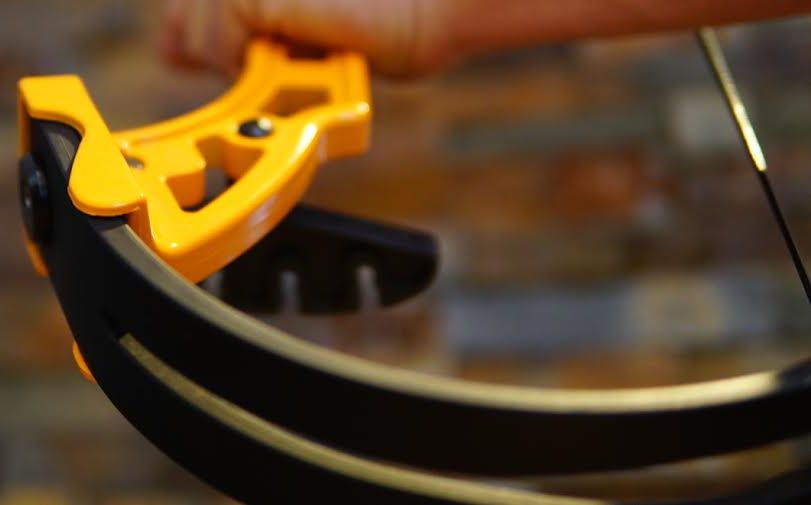
   Sporting Goods    0    98 Sweet Compound Bow and arrows!
   Shopping Misc    1,274    1000 Mostly at Amazon - household/kitchen goods and computer parts
   Books, games, gifts    488    383
   Other    580    422 Stuff I am too lazy to sort out. If something is not listed, assume it is here.
Travel 2,376 2,335 Flights to Florida in January, Canada in July and December,
TOTAL $23,941 $30,193 Adding in our artificially high medical costs is what did this budget in.
   Subtracting Tuition, Donations 22,194    28,196
   Subtracting travel, crossfit 19,588    25,861
   Subtracting organic/luxury food 17,531    23,614 Assuming a 33% increase on groceries due to organic + meat.
   Subtracting home renovation expense 17,411 About $22,000 This is what our "no frills" living cost would be (although you could subtract another $6,000 if we had a lower income and qualified for the health insurance subsidy)

So What is Mr. Money Mustache Hiding From Us?

In a word: Nothing – this is my best guess at what our true expenses would be, if we lived a normal, retired life.

But here are the exceptions and special situations, which you can account for however you like:

  • Higher Income is forcing me to pay full-price for health insurance. Health insurance pricing comes on a sliding scale from “nearly free” below $25,000 in family income, up to full price for incomes over $80,000 (see subsidy calculator)
  • But then again, our family business (of which we are employees) pays these premiums on our behalf, so they are pretty painless
  • I built this nifty studio, spending about $30,000 in the process. Is it spending, or investment? Since it increases the value of the house by much more than that amount, and I will be selling this house and moving somewhere else eventually, I chose to treat it as investment. On the other hand, spending money on repairs, changing paint colors, gardens, or swimming pools would count as spending to me, since these items are more likely to be recurring and/or not recouped at the time of sale.
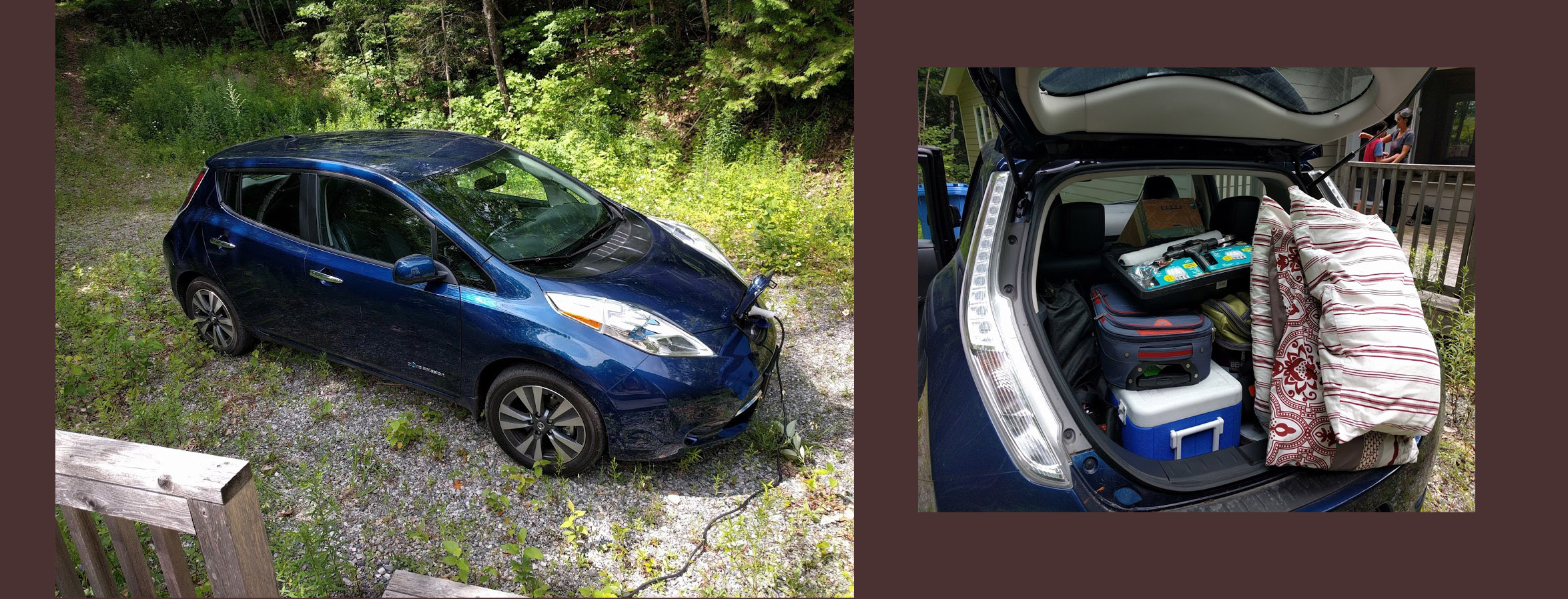
  • I bought a Nissan Leaf for roughly $14,000 after all costs. This was $9,000 more than I got for selling the old Scion xA. Is this spending? Well, I definitely would not have bought it if it weren’t for the blog (it served as a strong form of advocacy) and I think it may have actually made a noticeable difference in US Leaf sales numbers – which was my main purpose. Sure is a nice car, but we barely use cars for personal purposes (I had to become an Uber driver in order to even get enough drive time to properly test the car!)
  • In late 2016, I gave away $100,000 of this blog’s income to various charities, with much more to come. Having a business that makes and gives away money probably reduces the need to give away my real retirement savings.
  • Travel as Mr. Money Mustache (trips to Ecuador, Los Angeles, Portland, Seattle, and a couple of other places) added up to about $4,000 between flights, hotels and food. None of this is stuff I would have done for personal fun, but it may have burned me out enough that I skipped or missed other personal trips (camping, etc) that would have increased my travel spending.
  • Mrs. Money Mustache’s Etsy shop spent more than $20,000 on materials, shipping, tools, etc. Most of this went right back out the door and earned a profit, but you could argue that both of our business expense accounts satisfied our “spending desire”, displacing personal spending in some way. In fact, writing for you consumes so much of my limited free time, that it may prevent me from expanding into other, more expensive hobbies (like upgrading my mountain bike or snowboard gear).

Overall, it looks like another fairly reasonable year. The biggest lesson that I try to emphasize is that spending does not have to scale with income. We spent less than 10% of our taxable income this year, and still cannot see any reason to inflate the lifestyle any further than it is already.

It’s a beautiful life!


Unrelated but Special Thanks to a Reader: Over the last few months, a lot of technical stuff has gone on behind the scenes here. If it weren’t for some serious help from skilled tech people,  this blog’s heavily used forum would no longer be functioning.

 I wanted to thank Kevin Clack – aka Clack Consulting for stepping in to upgrade the forum and continuing to help me with necessary fixes to this day. And if you have a well-established business with technical and web presence needs, you may even be able to become one of his clients as well.

  • βœ‡Mr. Money Mustache
  • Houston Attorney Thrives on Doing The Impossible – Daily
    Some of Houston’s cool and under-appreciated bike infrastructure. In this extremely wealthy country of ours, the chief barrier to wealth is often the information, or misinformation that gets stuck inside our own heads. People with the right knowledge can develop the right habits, and these habits lead them to accumulate wealth very quickly. Meanwhile, the majority of people pick up incorrect financial ideas and bad habits, leading to permanent debt. But they mingle mostly with the
     

Houston Attorney Thrives on Doing The Impossible – Daily

8 June 2017 at 12:53

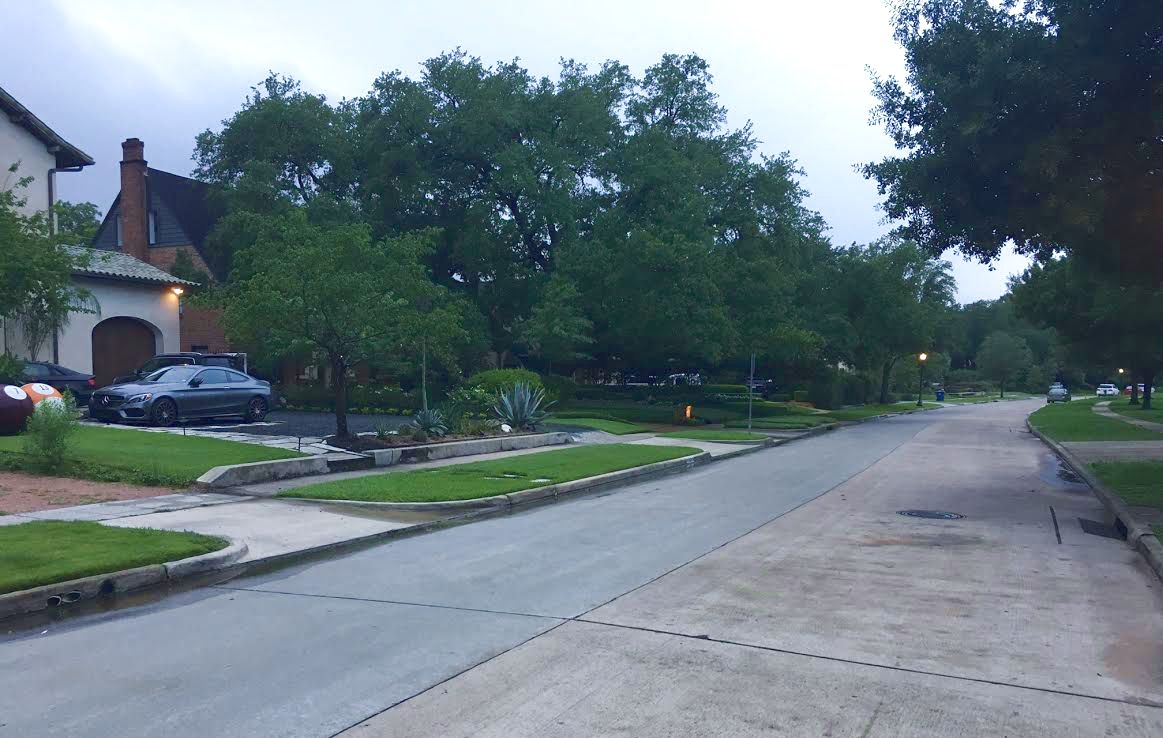
Some of Houston’s cool and under-appreciated bike infrastructure.

In this extremely wealthy country of ours, the chief barrier to wealth is often the information, or misinformation that gets stuck inside our own heads.

People with the right knowledge can develop the right habits, and these habits lead them to accumulate wealth very quickly. Meanwhile, the majority of people pick up incorrect financial ideas and bad habits, leading to permanent debt. But they mingle mostly with their own type, so the failure habits keep spreading.

Sometimes, to break out of the Herd Mediocrity Mindset, you just need to see an example to learn what is possible.

So with that in mind, let’s review an example of yet another allegedly completely impossible thing, that an MMM reader is doing every day.

Jeremy Stone, aka The Rock, engages in a rare – and yet incredibly profitable – activity, in a city that is legendary (in the public mind, anyway) for making this activity completely impossible.

The following tale is drawn from our past year of occasional email conversations.

The Lawyer Who Actually Bikes to Work.
Year-Round. In Houston.

Dear Mr. Money Mustache,

“I’m a lawyer and commute to downtown Houston every day regardless of weather (unless I need to drive somewhere for work), without a handy shower or any special amenities, so it can definitely be done.

I was skeptical too, but my wife pushed me to do it after we got into your blog about 4 years ago, and it’s been one of the best decisions we’ve made.  If anyone complains that they can’t do it because of heat, humidity, needing to dress in a suit, etc, I’m proof that you can do it.”

The Challenge:

Throughout the history of this blog, Houston has become the poster child of Bike Excusitis Disease – the place most often cited as “The Reason I Can’t Bike to Work”.

Houston commuting, as perceived by car drivers (image credit: Politico)

Raised on the slippery black teat of the Almighty Oil Well, Houston was developed for motor vehicles and the metro area now sprawls across ten thousand square miles (6.4 million acres), which means Houston alone is one fifth the size of the country of England. Ironically, the more you optimize a city for cars, the bigger your traffic jams, so Houston has the worst traffic in the US.

And it’s a subtropical steam bath: daily highs exceed 80F / 27C for a full nine months of the year with high humidity year-round.

On top of that, Mr. Stone is a high-ranking official in a law firm, the profession most often cited as one where you can’t bike to work. Lawyers need to wear suits at work, see clients, impress judges, and this calls for the utmost in personal hygeine – scrubbed skin, shaved beards, polished shoes and manicured nails, premium brands and styled haircuts. It’s a hassle, but it is a necessary selling of the soul, in exchange for a six or seven figure income. Right?

With those painful complaints out of the way, we might as well move on to actually solving our problem.

“At first, I thought it was a crazy idea. It wasn’t, and I loved it.

I started commuting on an old but good Trek mountain bike (got stolen), then to a $50 hybrid that was a piece of crap, then upgraded to a fancy Surly Disc Trucker.

Most of this route is nice and easy, because it is mostly on a hike/bike trail. Over the last few years, Houston has been changing old railroad lines into these trails.”

The Route: 

Sunrise in Downtown Houston, as seen from the bike route.

Bike commuting can be superior to driving in every city, but only when you design a route that works for riding your bike. When you drive a car, you will usually end up on the fastest, widest, (and most dangerous) roads, never even realizing that there were parallel bike-friendly options nearby.

“My route takes me through a neighborhood called River Oaks, where the very richest Houstonians have lived for decades.”

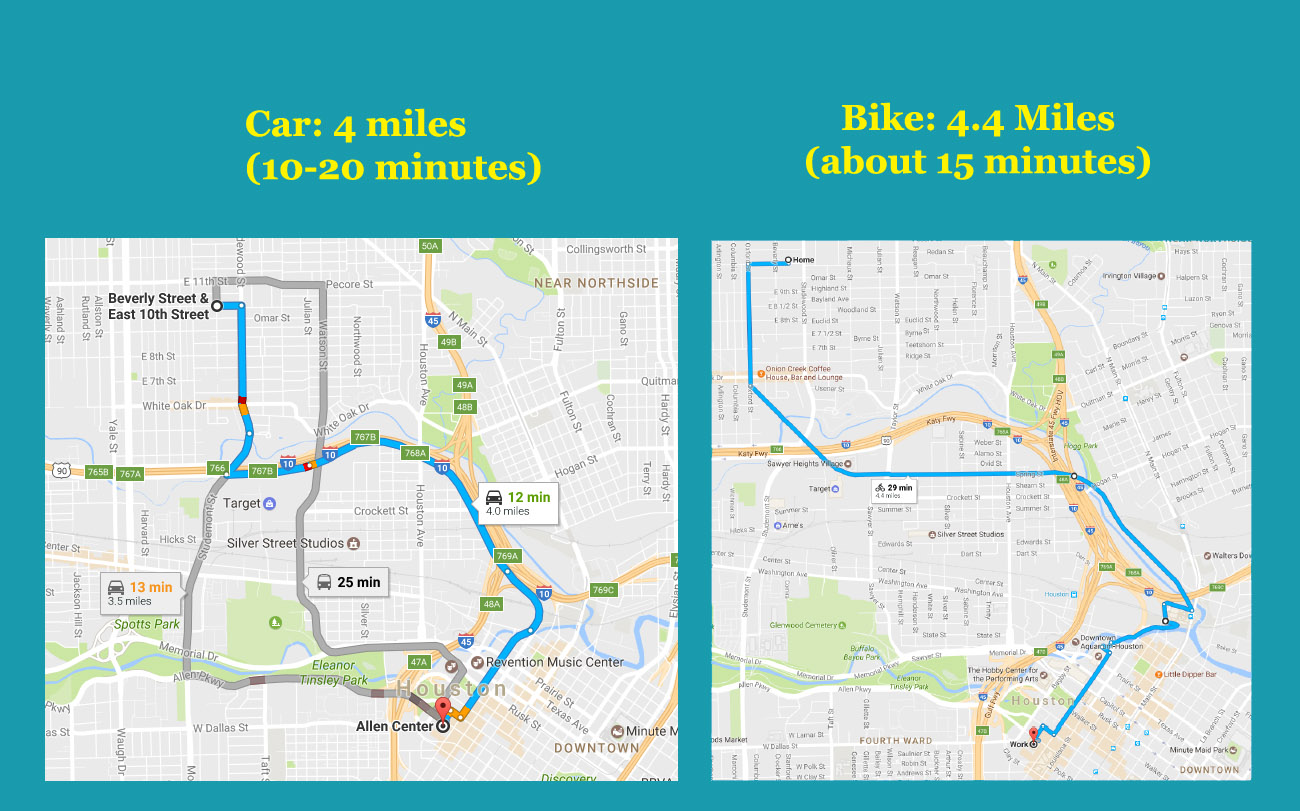
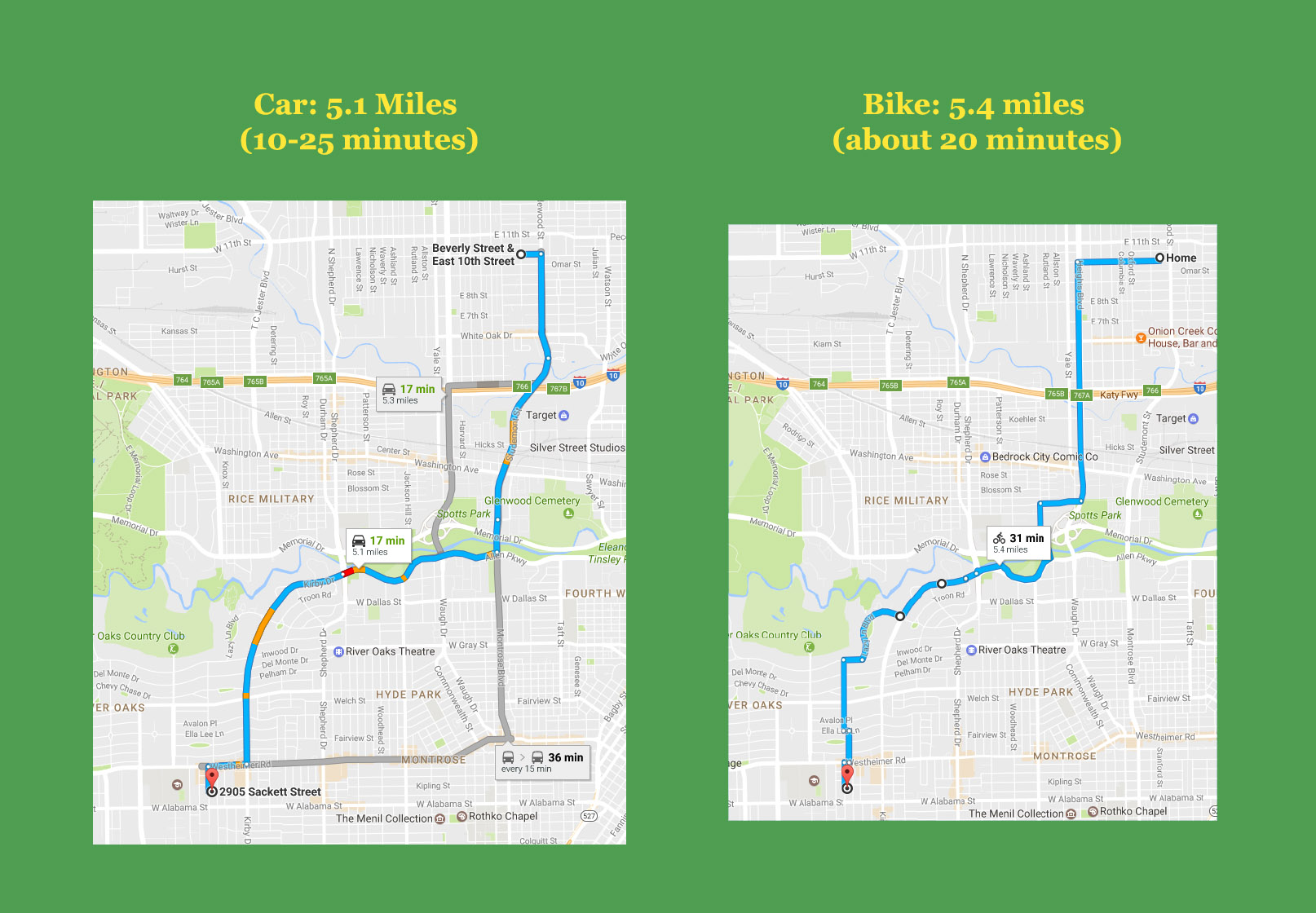
Early in our conversation, Mr. Stone shared a map of his bike route with me, and I compared it to Google’s suggested route for driving a car downtown. The distance is about the same, but in a car you end up on the interstate highway, which makes the commute seem completely un-bikeable.

Fig.1: Google Maps view of car vs. bike routes to work. Bikes are surprisingly fast, plus immune to traffic jams and you get free parking.

Key Strategy Note: this ride was made much easier by the fact that Stone lives within 4 miles of work. This didn’t happen by accident: he chose his home and his work strategically to avoid a car clown commute.

Yet interestingly enough, houses in his neighborhood are still only in the $300,000s. If homes so close in are so affordable, why is anyone commuting into downtown Houston in a car?

There is no answer aside from sheer foolishness – those highways will soon be empty after this article gets out.

“My route takes me along the trail along Silver St. in an old Warehouse district, now an artsy district. Then along White Oak Bayou (Houston is built on bayous, not rivers!) as you near downtown, and under an old 150 year old bridge that has been built over. 

Some of these bridges serve as homes for the thousands and thousands of bats here. You can’t see them, but I took this picture at about 6 or 630 am, and there were bats flying all around. The bridge is so low you get to ride right through them!

Biking beats driving – exercise, fun, no traffic, bats, tombs, turtles, snakes, herons!”

The Speed: 

The deceptive thing about bikes is that within a city, your average speed ends up equal to, or even faster than, a car. In big cities, cars average only about 27 MPH even without traffic, and rush hour can cut this speed in half again. Meanwhile, a slow beach cruiser coasts at about 12MPH (the speed Google uses for biking estimates), a fit cyclist rolls at 20, and an electric bike can easily sustain 28 MPH with almost no effort from your legs at all.

So when I’m in a rush to get somewhere in town, I never reach for the car keys – there’s no time to waste puttering around in a gas-powered wheelchair.

The Cars (and other Financial Effects):

Most people in Mr. Stone’s position have huge houses in the wealthy enclaves of Houston, and drive very high-end cars to work. If there is a spouse and family in the picture, they have multiple cars. And yet somehow, the Stone family survives with just one 2006 Honda CRV (market value about $6000), which remains in great condition because it leads such an easy life.

Driven lightly, the total cost of ownership of a car like this is about $2000 per year. Meanwhile, the typical attorney power couple might keep an up-to-date Mercedes SUV and a BMW 5-series. Driven at the US average level of 13,000 miles per year, this fleet would vaporize about $24,000 per year of personal wealth.

Wow, we need to put that shit into a box so more people will see it:

Average family driving
with two typical lawyer-level cars
destroys about $250,000 of your wealth
every single decade.

Still think biking to work is only for poor people? Do you consider an 11-year-old vehicle beneath your standards?

When you are not dependent on cars, you no longer derive your identity from them, which means you can start thinking about them like the appliances they really are. This makes your car costs drop drastically.

But What if I Move Jobs?

Coincidentally, halfway through our conversation, Stone ended up switching employers and acquiring an even better position.

I imagine that the same sharp mind and optimistic can-do attitude that encouraged him to bike to work, were the things that helped him earn this upgrade. But the new office was in a different part of town, further from home.

Did The Rock head straight to the car dealership to purchase a new Chevrolet Suburban like everyone else in Houston? No, of course, he just busted out the map and the brainpower again.

But What About the Heat?

“Until the new job, my office did not have any shower facilities. But I found it was not really a problem: I just keep my clean dress clothes at work, and change out of my cycling clothes once I get to the office. 

Also, making the trip before sunrise (especially in the summer) gives me much cooler temperatures. The ride home can be hot and sunny, but there is always a cool shower and air conditioning waiting for me when I arrive.”

Rock is right. I too biked to school and work throughout my career, in temperatures ranging from 0F to 105F. Long-time readers already know that bike transportation is probably the biggest factor that accelerated, and continues to fuel, my own family’s early retirement.

Some of my workplaces had showers, and others didn’t – but I never even felt the need to use them. In extreme heat I’d just just put on a clean, dry shirt and maybe a fresh layer of speed stick, and settle in to my office to enjoy the air conditioning. Any trace of perspiration or heat was gone within about five minutes.

This is because physical activity, including riding your bike, is normal, not the exception. It’s not a medical procedure or a competition or something you do in an indoor “spinning” class. It’s not an emergency condition which causes your body to shoot feces from every pore, destroying any nearby pieces of clothing and requiring a long, hot shower every time you move so much as a fingertip.

It’s just what happens every day.  So The Rock and I will see you on the streets tomorrow morning – it’s always Bike to Work Day.

Related Reading on the magic of a Cooperative Spouse:

Is Mr. Money Mustache Ruining Your Marriage – Part 2


Is Mr. Money Mustache Ruining Your Marriage? – Part 1

Epilogue

On the day that I finally got around to publishing this post, Jeremy and his lovely wife happened to be visiting my part of Colorado for a wedding and some hiking. So we invited them over for dinner and we had a great time together. I also gave him one of the secret stash of MMM t-shirts that arrived at my place today:


  • βœ‡Mr. Money Mustache
  • Great News: There’s Another Recession Coming
    If you’ve been keeping an eye on the US economy in recent years, you might notice that things are looking pretty darned rosy. Unemployment is at its lowest level in 40 years, wages are rising, and house prices have not only recovered from their fiery crash of 2009 – they have had several years of record breaking prices in most regions, just like the stock market. A current snapshot of how expensive the stock market is – not in sticker price, but in the more instructive
     

Great News: There’s Another Recession Coming

21 June 2017 at 01:54

If you’ve been keeping an eye on the US economy in recent years, you might notice that things are looking pretty darned rosy. Unemployment is at its lowest level in 40 years, wages are rising, and house prices have not only recovered from their fiery crash of 2009 – they have had several years of record breaking prices in most regions, just like the stock market.

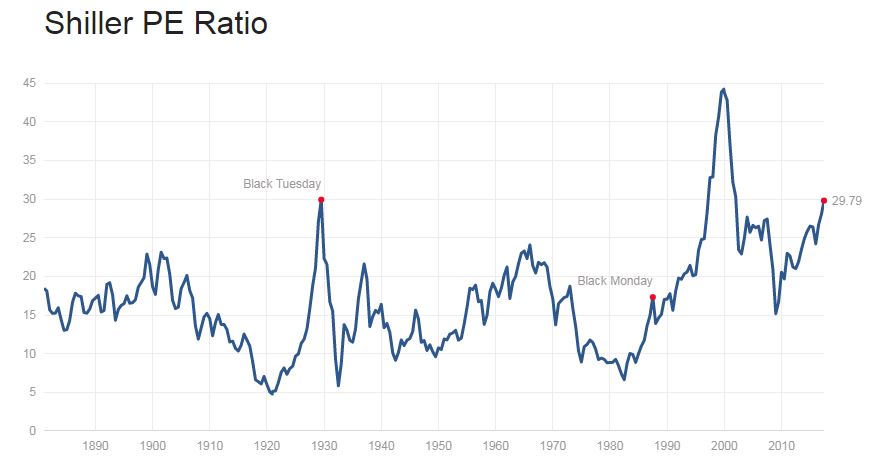
A current snapshot of how expensive the stock market is – not in sticker price, but in the more instructive price-to-earnings (P/E10) ratio. In all of US history, it has only exceeded this expensiveness once – for the late-1990s bubble. Not something that should make you sell your index funds, but probably a clue about an upcoming bubble-based recession. Image source is the very useful site multpl.com www.multpl.com/shiller-pe/

In short, today’s situation is very similar to what Mr. Money Mustache, despite no magical forecasting skill, forecast back in 2013, in an article called “How to Prosper in an Economic Boom“. In that post, I suggested that we were in for some very good years, which made it a good time for getting ahead – make hay while the sun shines!

It’s a lot easier to fix your problems right now, with a stiff economic tailwind at your back, than it will be in just a couple of short years (or less?) when the high seas and lighting bolts and whirlpools are ripping at your pockets. Fair weather preparations include:

  • Rake in your big paycheck while it lasts and don’t blow it on temporary luxuries
  • Keep your living footprint efficient – in expensive cities this is a great time to rent, and not a great time to spring for the sprawling home of your dreams on a big mortgage.
  • Eliminate any last shreds of consumer and student loan debt
  • With the stock market at higher price-to-earnings ratio than usual, there is less harm in paying off your mortgage earlier, keeping six months of living expenses in cash or money market funds, and other non-stock investments like rental properties in low-cost cities (where reliable rent is over 1% of total property price per month).
  • Design your career and your self-employment side gigs so that they are resilient: multiple streams of income from different sources, and an easy answer for “What would I do if my job or industry ceased to exist?”

Of course, becoming less dependent on a steady job is always a good thing – it just happens to be much easier to build that independence if you’re surfing atop a giant economic wave like this one.

So, Here We Go:

With all those preparations in progress, I hope you’re ready, because there’s a recession on the way.

I can say this with confidence because there’s always a recession coming – we just never know exactly when. About the only thing I can guarantee is that we are about four years closer to the next recession than we were when I wrote that optimistic earlier article.

But it is very important to remind yourself of this, because when we get to this rosy point of the business cycle, things have been so good for so long that we  forget that crashes are even possible. If you’re a sagely 27 years old right now, you may have never experienced a recession in your adult life – all you have ever seen is the good times. You’re in for an interesting surprise.

However, on top of that folksy “It always happens” wisdom, there are a few other clues that suggest the time is approaching:

Household debt levels have risen back to their pre-crash peak, and with an even worse composition: more student loans, and a record level of auto loans, the most ridiculous and self-destructive piece of personal finance outside of mortgaging your shins to a loan shark to afford tonight’s cocaine.

Image from the very good Zero Hedge article linked above.

Consumer debt shouldn’t really exist at all – it’s simply a house of cards that allows impatient people to pull their consumption from the future, just a teeeeny bit forward into the present, in exchange for spectacularly bad costs, stress, and wrecking of lives. But because it exists and is profitable, a huge ($1.3 trillion in 2015) financial industry has sprung up to originate, multiply, and churn this debt.

Just like 2007, the financial industry is on top of the world again, with lots of easy money flying around into things like “subprime auto loans”. The Great Recession of that era was caused when the wild packaging and reselling of mortgage debt combined with a false sense of confidence that the party would go on forever.

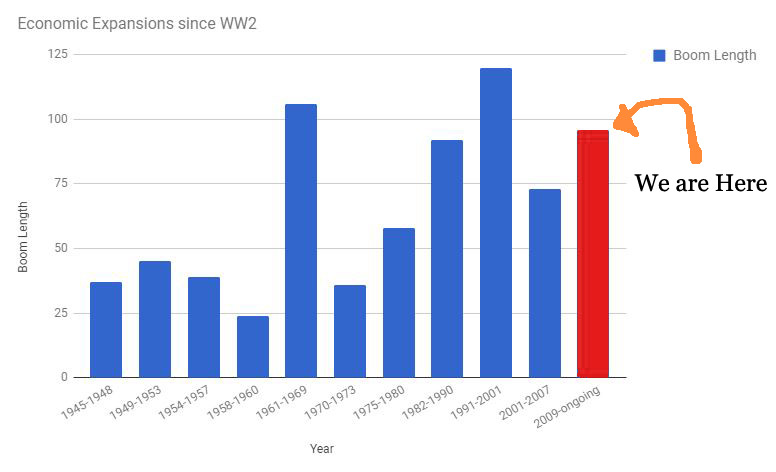
The final piece of evidence comes from just how long the present party has gone on. If you look at the history of economic expansions – how long we have gone since the last recession – we are currently enjoying the third longest one in history:

When we put all Good Times since WW2 into a graph, you can see just how exceptionally long we have been riding high.

So we’ve had a good run. If we go on to tie the Clinton-era record, that still gives us a maximum of two years until the trouble hits. And if you happen to think that economic success correlates with the level of brainpower currently in the White House, then, hmm.. you can make some adjustments based on that as well.

“OK, But What Actually Causes Recessions? And What will Cause the Next One?”

In succinct terms, recessions are caused when a bunch of people lose confidence all at once.

Usually it starts with a mini-crisis: the prices of stocks and houses have been going up for so long that people forget the opposite can happen. A bunch of testosterone-fueled betting and speculation (often by overconfident and under-regulated junior hotshots on Wall Street) ensues. And in general, speculation is a dumb thing.

If you have ever heard of someone buying something, not because they actually want it or because it produces income, but just because they think it will be worth even more in the future, that’s speculation. When people buy apartments in Toronto and leave them vacant (or rent them out at a loss) in hopes of later selling them to an even Greater Fool, that’s speculation. Speculation leads to bubbles, and bubbles always pop, because there was no rational reason for the prices to get that high in the first place. They also happen frequently in the stock market.

When prices hit some random limit or wobble a bit, the bubble often pops. Everyone gets scared and rushes out to sell, so the prices drop rapidly. Suddenly, over-leveraged novices can’t repay their oversized bank loans and they start missing payments.

Banks get scared of losing all that money, so they tighten up lending, which causes businesses to scale back hiring and expansion, leading to layoffs, which cuts down on consumer spending, which cuts down business profits again, leading to even more layoffs, and the problem feeds upon itself.

Eventually, the prices of these valuable assets gets low enough that people with actual money like you and me perk up and start scooping them up at a discount. A pristine apartment building here, some shares of a few thousand established, profitable companies there via an index fund. This puts a floor under the dropping prices.

Meanwhile, the Federal Reserve Bank also steps in, lowering interest rates and flooding the system with cheap money to encourage people to start buying houses again and businesses to start expanding to soak up the pool of unemployed people. Everyone gets back to work, and the recession ends. Usually very quickly – most recessions last less than one year.

So, as long as you aren’t a Consumer Sucka, commuting to work in a bank-financed gas-powered racing sofa and/or borrowing money for furniture and appliances to outfit that last spare room in your suburban mansion, recessions are a great thing. Housing and profitable investments become cheaper, insanity and speculation is reset, and people actually start living more frugally again, getting back to the roots of what living a good life really means.

Most people who are wealthy today, achieved it by building and acquiring profitable investments in the past, when they were on sale.  A recession is just a big sale – on almost everything.

“So, Should I Be Worried?”

No, of course not! This is just money we’re talking about, and you should never be worried about money.

One of the joys of Mustachianism is that it makes you immune to the business cycle. You immediately stop living beyond your means, so you have stepped back from the cliff. Then you start to build a resilient mesh of skills, health, money, friendships, and peaceful personal badassity which further protect you from trouble.

After all:  who cares about the price of gasoline, or affording cholesterol pills, or how to make the next truck payment, when you’re a wiry and muscular Mustachian, riding your swift and sensible bike a few miles to work and banking almost all of your enormous paycheck every two weeks?

Then as you live this joyful existence for however many years it takes, the final stage of complete financial independence arrives automatically, and you are absolutely invincible.

Whether it comes in two weeks or four years, I hope all of us are prepared for next hill on this roller coaster – it’s a lot more fun when you know it’s coming.

—-

In the comments: do you care for a wager on when the next “crisis” will hit and we’ll fall into recession again? What will be the thing that gets us this time?

  • βœ‡Mr. Money Mustache
  • Introducing The MMM World Headquarters Building
    I’ve been using this picture of a similar space at “Shift” coworking in Los Angeles for inspiration in designing my main room because the size and window/door layout are similar. Almost exactly six years ago, I wrote a simple post about a pawn shop opening up in my town. It was during the very early days of this blog, and I figured it was an easy way to take some shots at that financially predatory industry. Also, the shop was called Mister Money, which had an ironic s
     

Introducing The MMM World Headquarters Building

2 August 2017 at 14:04

I’ve been using this picture of a similar space at “Shift” coworking in Los Angeles for inspiration in designing my main room because the size and window/door layout are similar.

Almost exactly six years ago, I wrote a simple post about a pawn shop opening up in my town. It was during the very early days of this blog, and I figured it was an easy way to take some shots at that financially predatory industry. Also, the shop was called Mister Money, which had an ironic similarity to my own name, Mr. Money Mustache.

So anyway, in that post I joked that I was going to buy the building next door, and if anyone walked into my shop trying to borrow money, I’d PUNCH THEM IN THE FACE and tell them to embrace frugality and sensible living, rather than high-interest borrowing, as the solution to their financial problems. For some reason, this idea of the “Face Punch” really stuck with the early readers, and became a bit of a brand for MMM.

As sheer coincidence would have it, in early March 2017 a cryptic ad appeared in the local Craigslist.

Commercial building for sale, $230000

There was an address, but no pictures and no other information.

I recognized the address as being right next door to my pawn shop rival.  And we recognized the price as being about half of what a small single-family house or commercial building goes for around here these days. Mrs. Money Mustache was the one who first found the ad, so she called the number.

To make a long story short, the building was a severely run-down joint, but with extremely good potential. A dozen species of insects and animals called its rotting exterior woodwork their home and three dumpsters worth of demolition, debris and dead trees clogged the property*.

But at the core was a 2400 square foot brick and concrete structure, plus a detached 2-car garage, on an immense 7500 square foot lot, directly across the street from a recently-built $23 million building which happens to host one of the town’s best pubs.

The reason it was so cheap, aside from decades of neglect, is that it was owned by a charming man in his 70s who now lives hundreds of miles away. Once a prominent owner of significant chunks of Longmont, he was unloading this last forgotten scrap of real estate just to get it out of his hair. Perhaps he was unfamiliar with the recent boom in our property prices here, and he was definitely unfamiliar with modern property marketing techniques (he had relied on a friend to even get the ad onto Craigslist). The building had been in constant use by a series of retail tenants, but nobody had had much of an incentive to fix the place up.

I called him later that night with an all-cash offer, and after an hour of telling me amazing stories of his life, he accepted it.  A few weeks later, we closed on the property and then I spent the next few months in a full-bore restoration process – a multi-person vortex of flying sparks, brick, sawdust, diesel, sweat, blood, and beer.

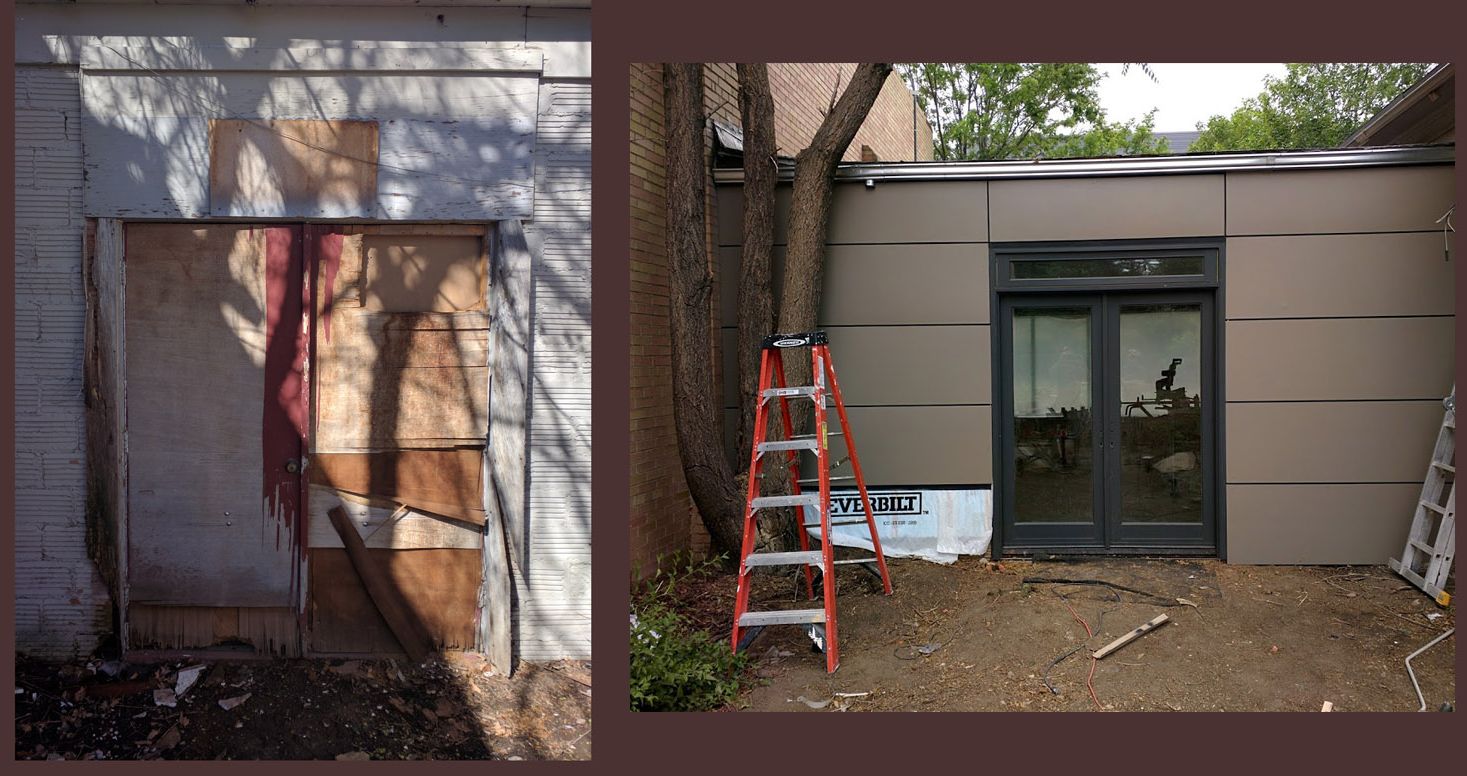
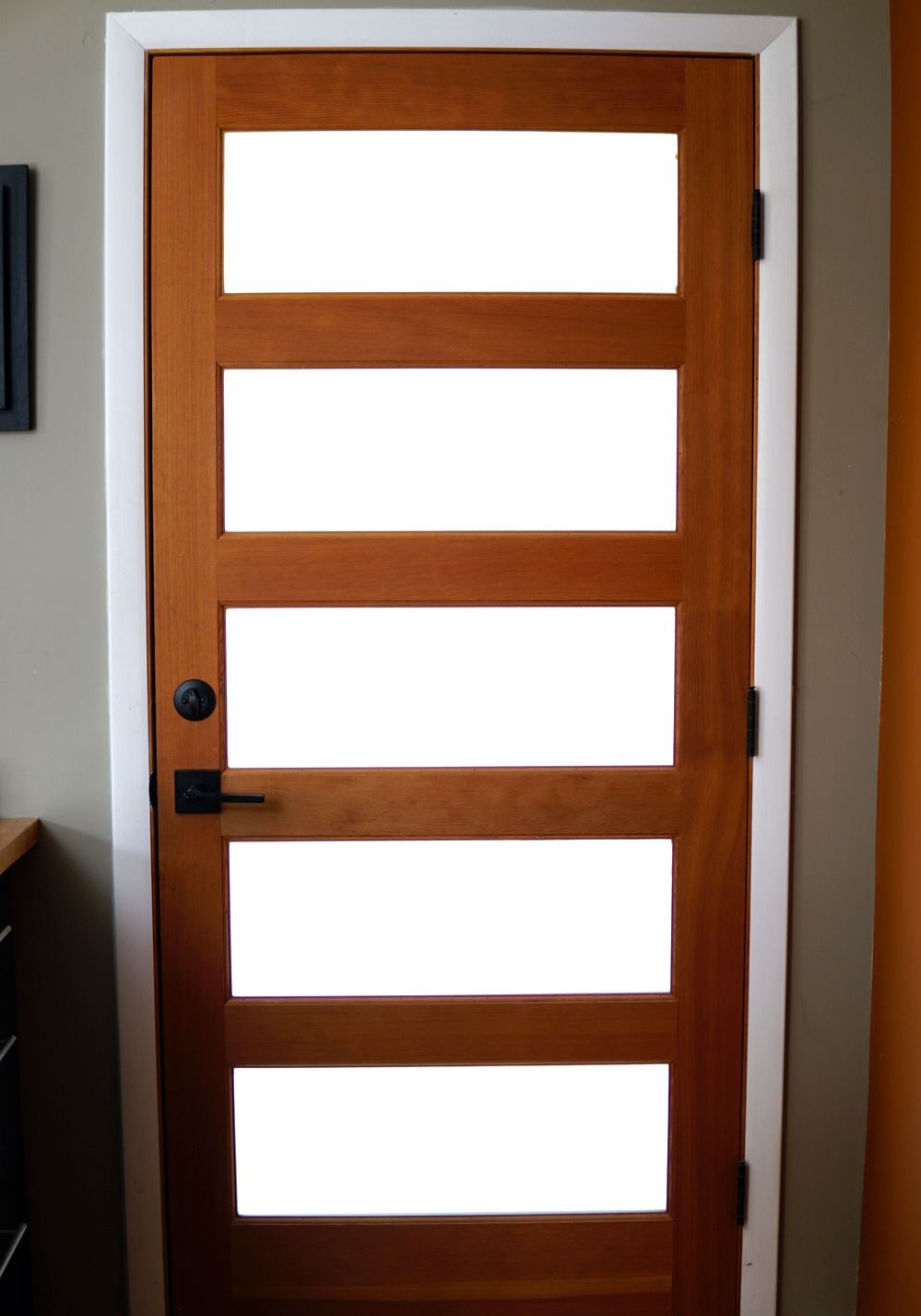
Figure 1: Replacing the Infinitely Shitty “doors” to the back yard and future patio, with a reasonably fancy unit I rescued from another builder via Craigslist. I also added some foam insulation and some repurposed siding – leftover materials and design ideas from last year’s backyard studio project. Just one of about 100 similar-scale improvements this building needed.

So Why Did We Buy a Building?

This somewhat wild scheme is the culmination of a few different values:

  • We wanted to get more involved with the local community, by owning a little piece of the Main Street and helping to make it a more joyful place. There’s nothing wrong with selling stuff and making money, but I’m also interested in teaching classes, hosting events and parties, and donating the space for use for non-profit events which are designed to help people. (See the bottom of this article to learn about the first one)
  • Mrs. MM and a good friend of hers both have booming Etsy shops that are ready to break out into the real world. They enjoy working together so much, that they decided owning a building together was the next logical step. So both women, and both of us husbands, teamed up together and split the building equally.
  • From a financial perspective, it would be hard to go wrong because we got the place for such a low price. The land alone is worth more than the $225k purchase price, and if the town continues its current downtown boom, this could increase drastically again over the next ten years. Since the structure includes 2-3 separately rentable spaces, the property could easily bring in $3000-$4000 per month of income (after renovations) if we chose to rent it out in the future. And there were no banks or borrowing involved, so the stress and closing costs were low, and flexibility is high.

But all those points are just the “pretend responsible adult” justifications. In real life, we bought this thing because it seems like a fun adventure.

As this blog has grown so unexpectedly over the years it has presented all sorts of opportunities. As prestigious as they sound, they really all boil down to either spending more time on airplanes, or more time or sitting at the computer, and always less time being here for my son. I don’t really need more fake lifestyle guru nonsense in my life – I want more great stuff going on right here in our own community.

So, as the headline suggests, I’m outfitting half of this building to become the MMM World Headquarters.

What Happens at MMM WHQ?


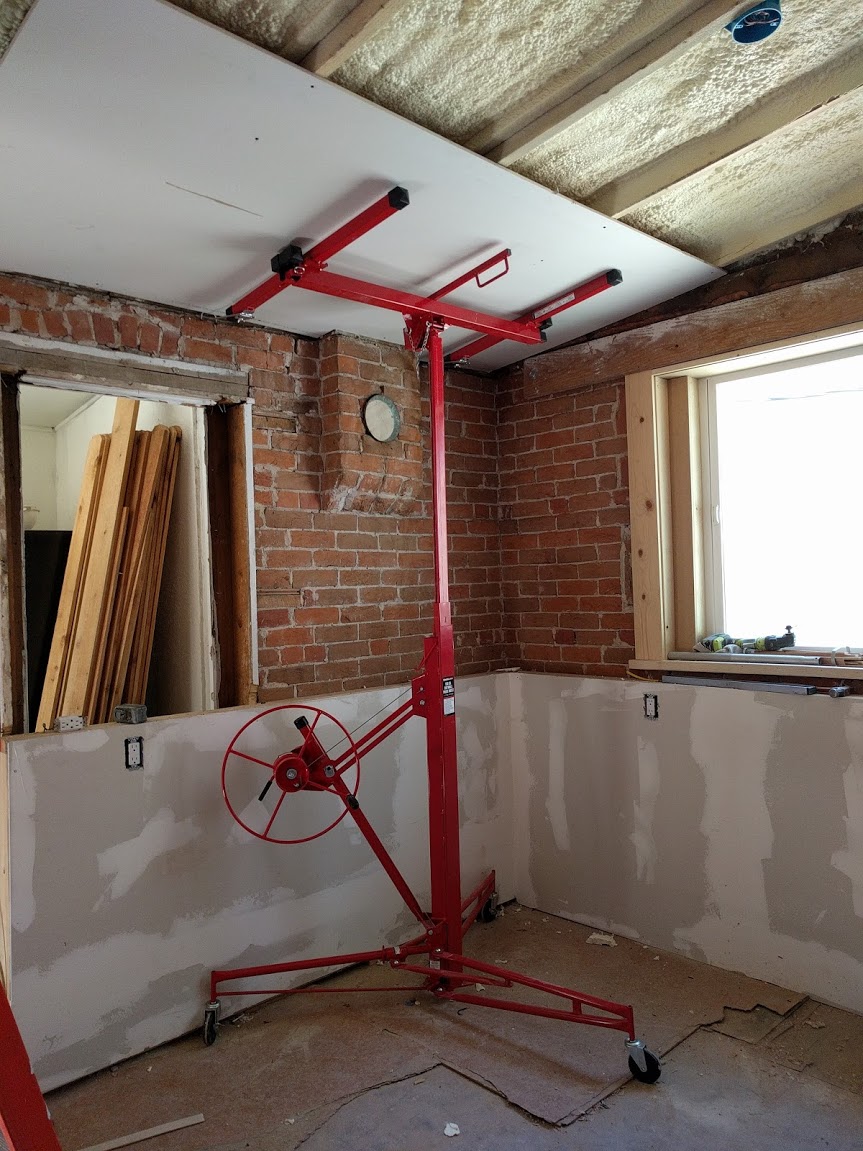
We found lots of cool ancient brick under the other coverings. Here’s a scene from when I was trying out the new drywall hoist to install the kitchen ceiling.

I’ve decided that my side of the building will become a coworking and hangout space for Longmont-area Mustachian Entrepreneurs. It will be membership-based, with about 50 memberships made available at a price of $50 per month. And for the price of membership, locals get:

  • 24/7 keycard access to a big, open room downtown (about 700 square feet) with couches, tables, benches, stylish design, etc. Plus an adjoining small kitchen area for our food.
  • access to 49 other accomplished entrepreneurial local friends, who can all be part of an active Slack Group.
  • WiFi over Gigabit fiber internet access
  • Free or cheap coffee and fitness-friendly snacks
  • Tool sharing library
  • A big outdoor patio courtyard area out back with grill, chairs, speakers, patio lanterns, etc.
  • Outdoor gym with barbells, squat rack, and bodyweight things like pull-up bars, etc.
  • Garage workshop with welding and metalworking equipment
  • Beer brewing setup with permanent kegerator – members with skill in craft brewing can rotate through to produce guest batches. Ideally, this will provide free beer at all times.
  • Bike fixing station, parts inventory and swapping, helping each other improve skills
  • Talks and classes – from members, and from visitors.
  • Group Advocacy for improving the town.
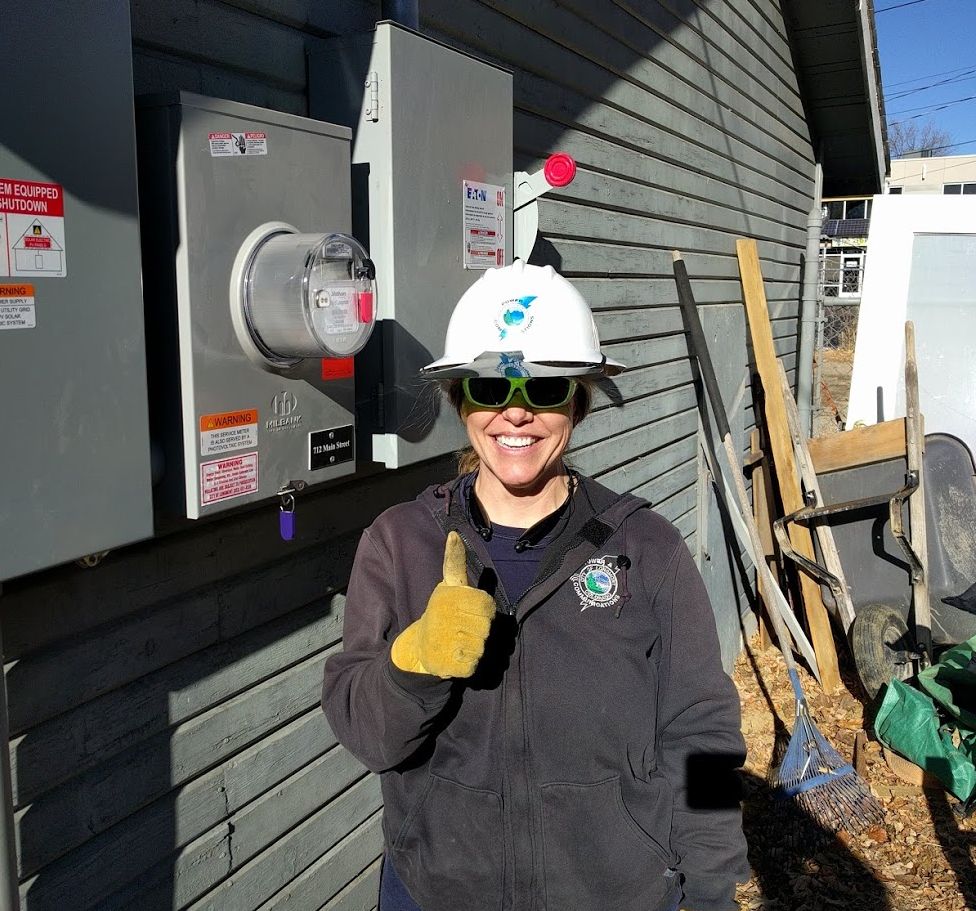
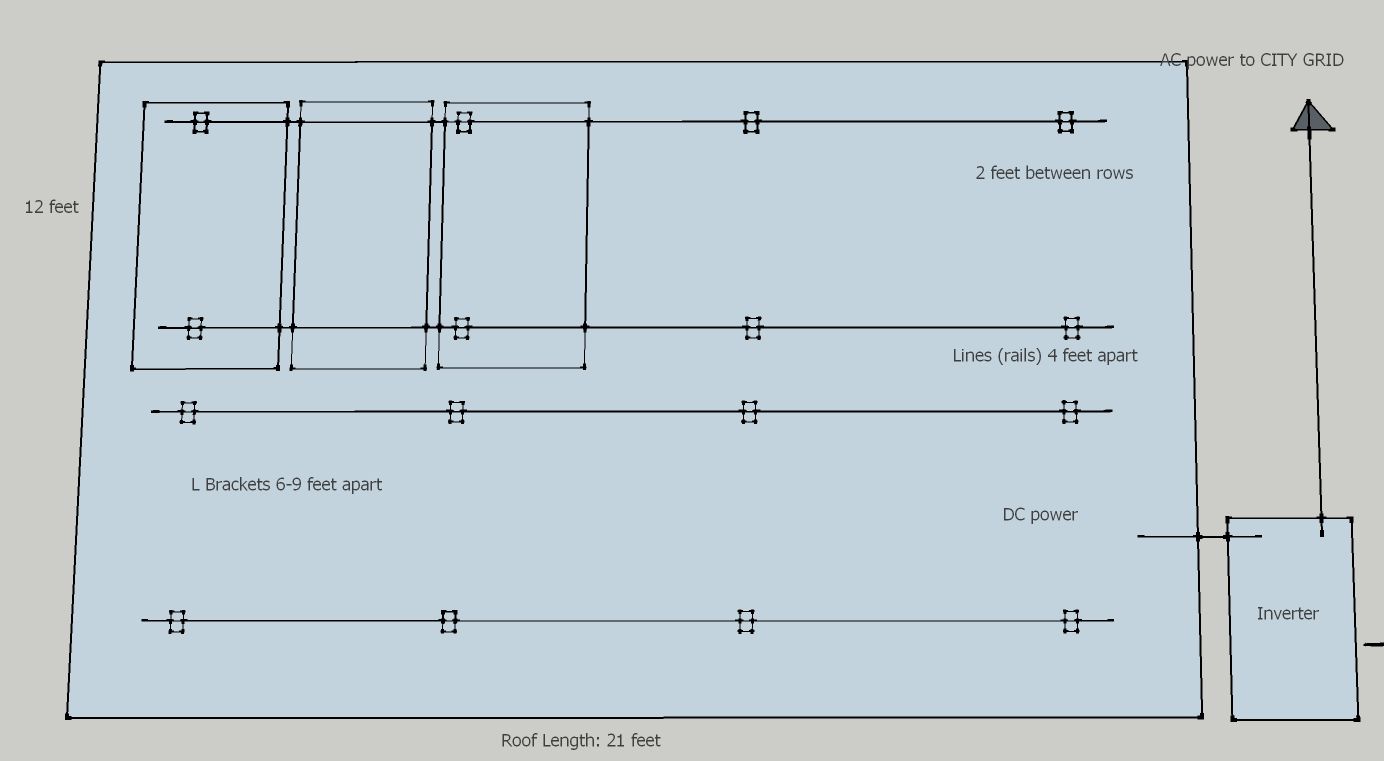
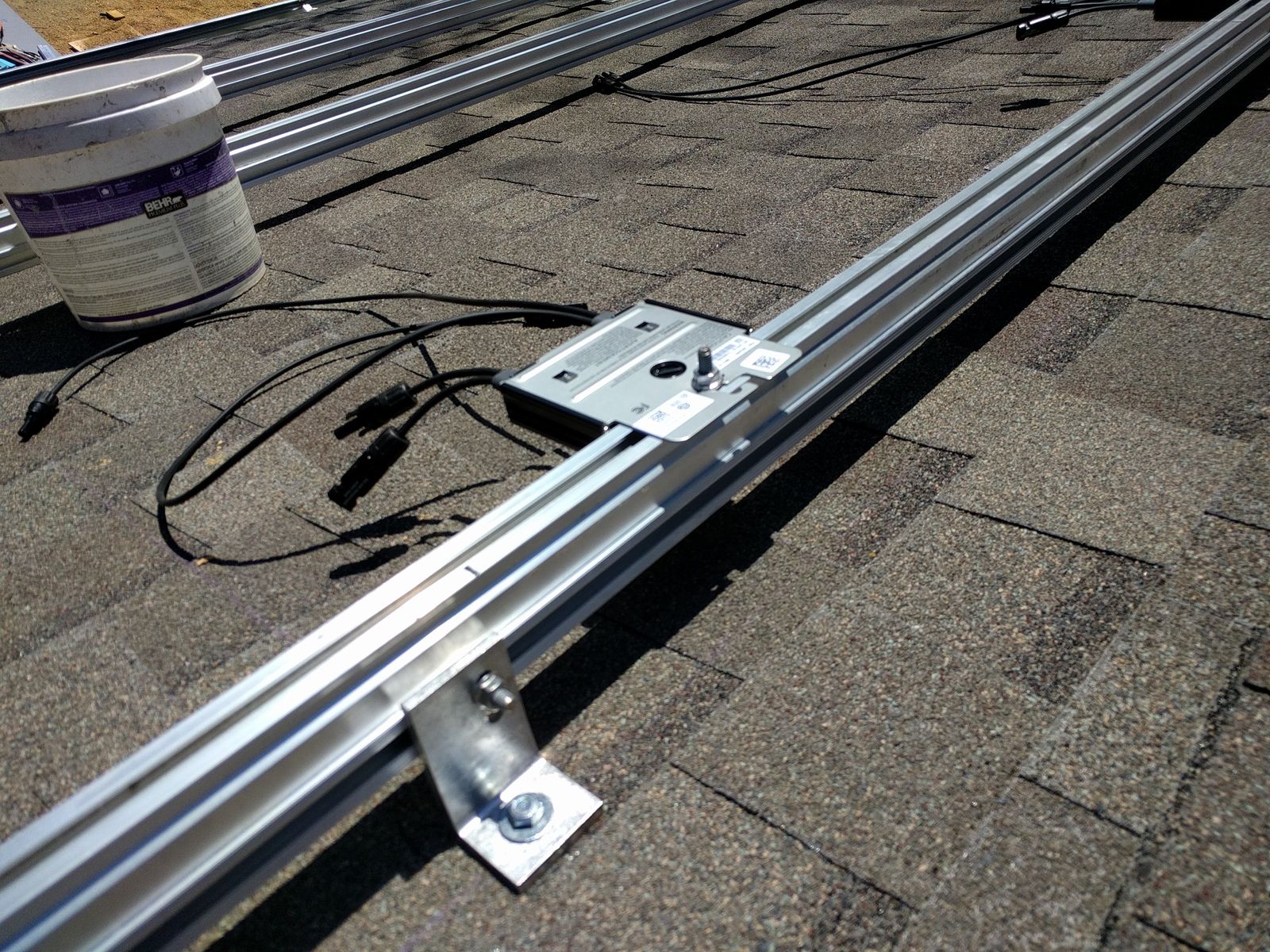
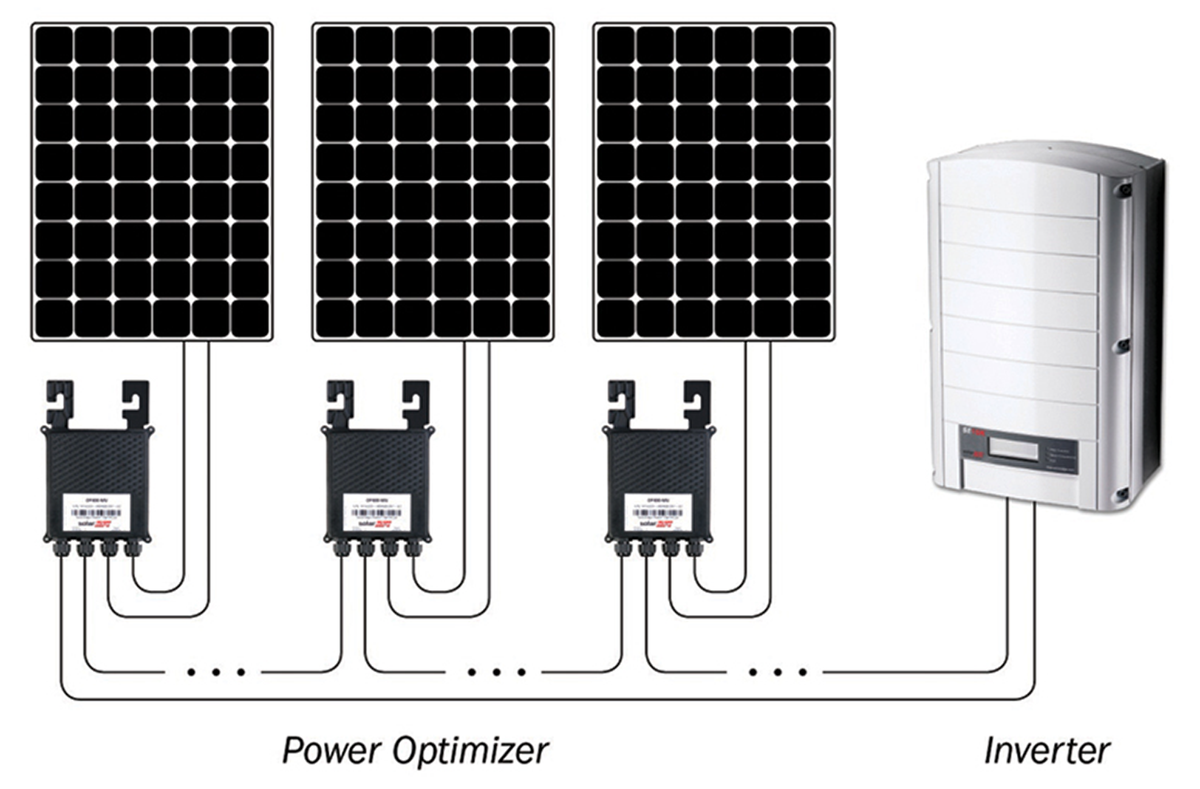
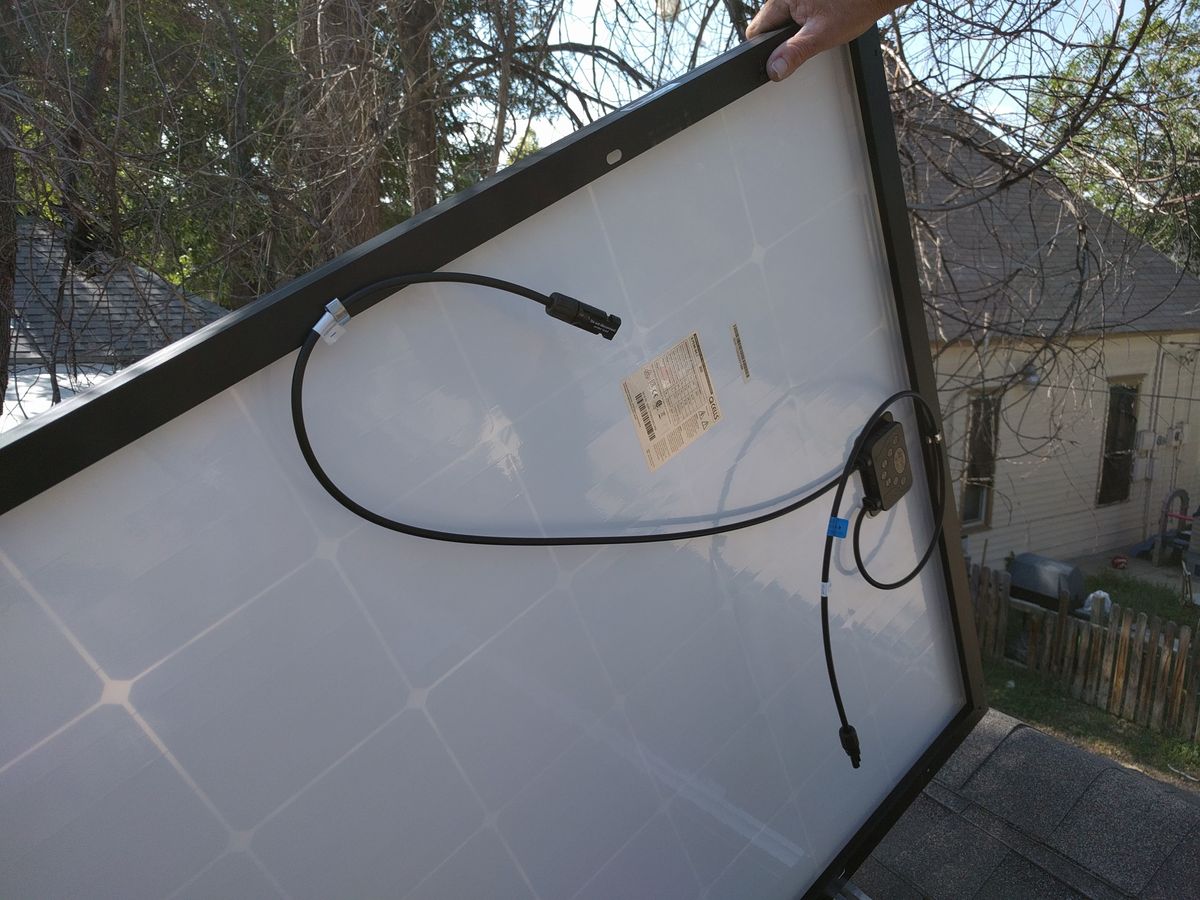
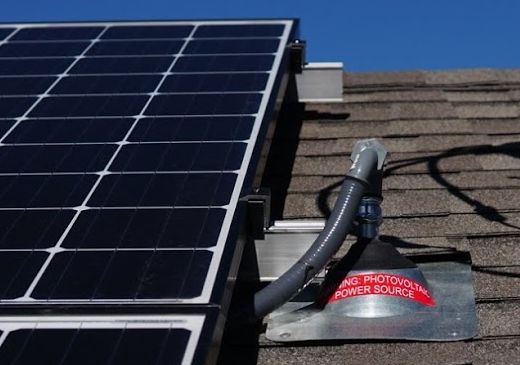
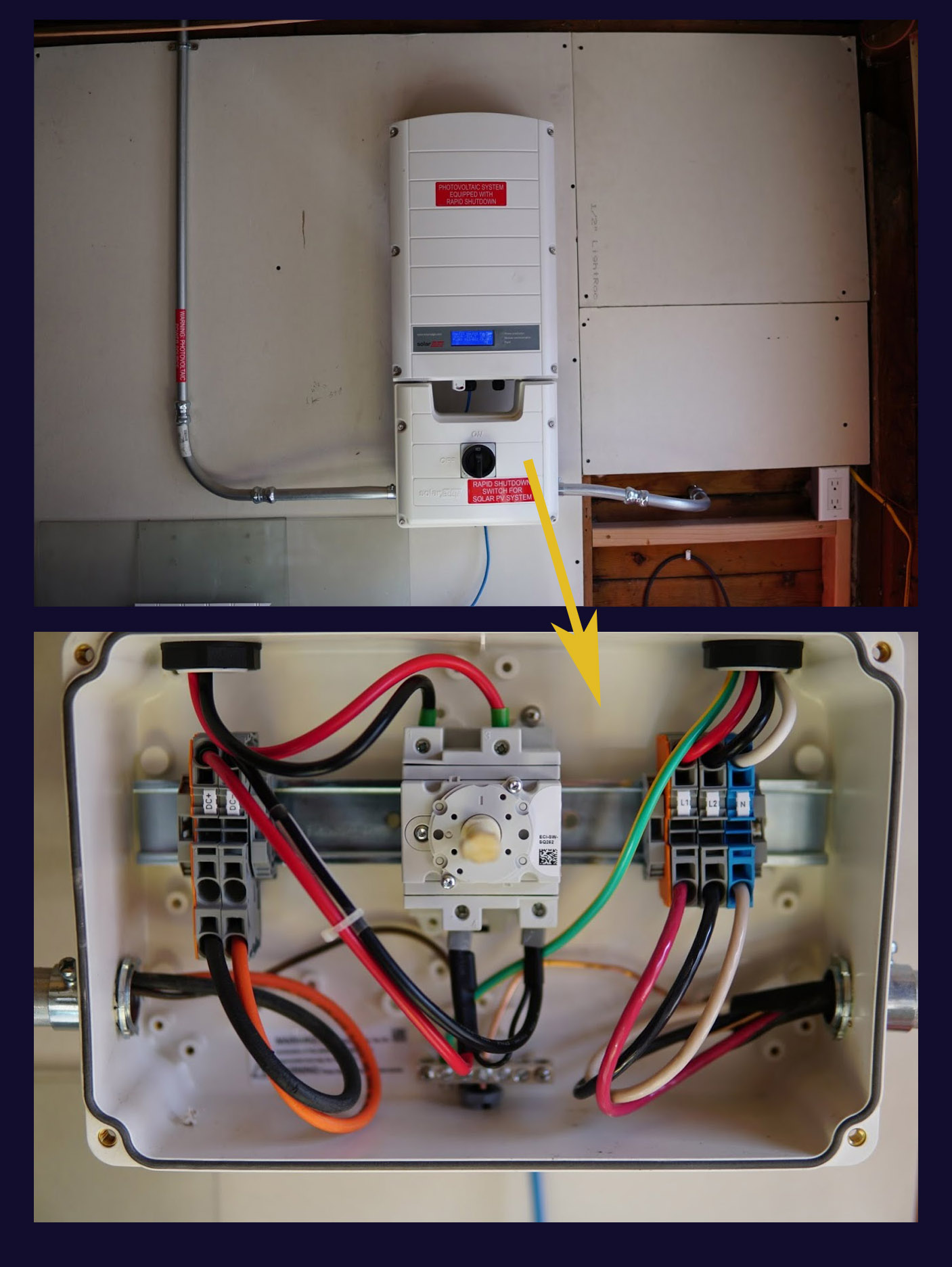
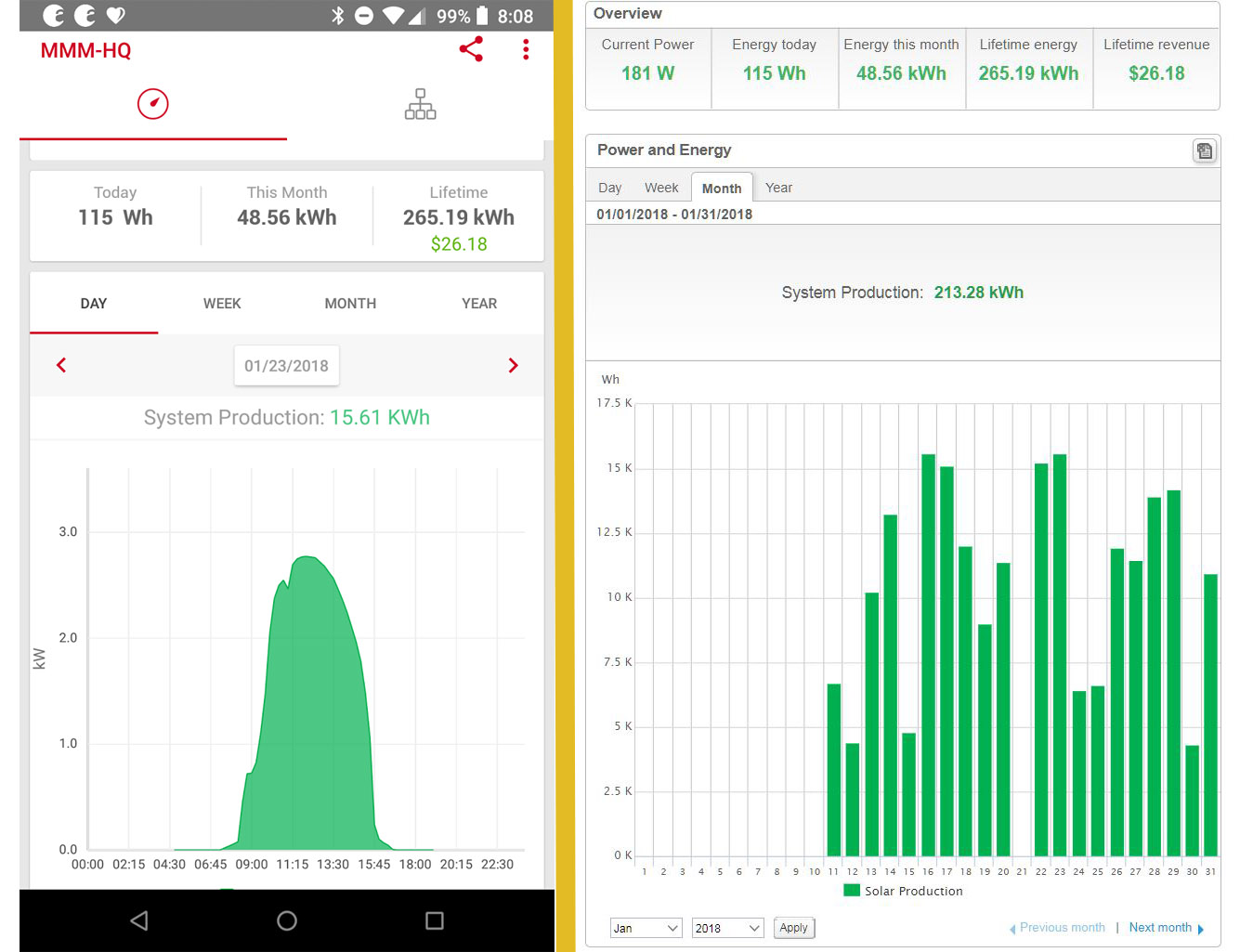
  • The chance to work together on this new building – learning through doing as we build new features. (I’ve already got all the equipment for a 3.6 kW solar energy system ready to install onto the garage roof when we’re ready)
  • And any other perks and cool ideas we can think of with our collective mind power.

Although $50 per month sounds awfully cheap for all of this, it should actually work out great – paying the taxes and utilities and easily pumping out a monthly surplus to use for continued improvements, tools, supplies, etc. I reserve the right to make a profit off of the place eventually, but obviously this is not my main motivation – otherwise I’d charge a more “normal” coworking membership rate or just stay home and crank out blog articles.

If you’re interested in joining, read this rough agreement then send me an email through the contact form with “Coworking” in the title.  (Please include some biographical background to help me determine that you’re a real, friendly person!)

The primary members will generally live within biking distance since I don’t want anyone to sign up for a mandatory car commute. But if you want to become a patron or long distance member – contributing to the cause and working remotely with the core members (perhaps just to gain access to such a cool group, stop in whenever you are in the area and see your money put to use for interesting hactivism here in Longmont), send me a email with “Patron” – we could probably still keep a close-knit group with up to 10 such members.

Important: Although the building now hosts frequent meetups and other events, please do not just show up at random time unannounced as part of your cross-country roadtrip. Instead, just attend an event if the timing happens to align.

 I feel strange adding this note, but travelers have been stopping by almost every day and as much as I love Mustachians, giving tours to unexpected visitors make it difficult to get work done – which is the kind of the point of a coworking space during the day.

Also, the Northern entrance is “Mud and Madder”, the future handcrafted shop owned by Mrs. MM and a friend which is not part of my HQ.

Are you Ready?

Our First Guests

The space is almost ready and the first philanthropic event is already booked: I’m hosting my friend Alan Donegan’s UK-based Pop-Up Business School for their inaugural US event in early September and it’s for everyone – not just members!

You can sign up here:

http://www.popupbusinessschool.co.uk/longmont.html

This is a nine-day class on Mustachian-style entrepreneurship: how to start a business with minimal initial investment and a quick path to cashflow.

Members of the Longmont community** and the coworking space will get first dibs at the tickets, which are are actually worth about $500 each but offered for free due to a unique business model.

(huh?)

Pop-up business school is intended to help anyone – well-established or just scraping by – start a business. Because this is such a powerful way to improve lives and communities, as Pop-Up Business School’s repuation has grown, Alan and company have been able to attract outside funding. City councils, philanthropic foundations, and companies.

So I tried the same thing here for the US debut – inviting a few unusually cool companies that are run by people that understand our mission around here. Almost all of them said yes and chipped in a substantial chunk of money, directly to Pop-up business school. So in thanks I’d like to mention them here:

Betterment Investing – simple, efficient investing platform with behavioral-finance (aka making it fun and easy) at its core. My Betterment Article.

Bluehost Web Hosting – the original and still favorite recommendation for how to get a beautiful website up and running quickly. My related aricle – How to Start a Blog.

Treehouse Learning – a classy and fun way to learn stuff – specializing in software development and other skills – with a meaningful social mission of cutting the cost of higher education.

See you There!

This has been a big and really rewarding project so far. Although it was a big commitment and going out on a limb, the resulting months of hard work and connecting with so many nice people has been exactly what I want out of life – and what I wish for you in your life too.

Here’s hoping that this current project of mine, and your own big efforts in the coming year, continue to crank out lots of opportunities for fun and learning.


*on the positive side, there were a number of functional mannequins and assorted body parts for them in the garage, which I have obviously saved for future fun.

** Out-of-towners looking for frugal accommodation might want to check out the RV campground at Boulder County Fairgrounds, tent camping at Union Reservoir, or even just find a spot for a tent in the nearby National Forest foothills, given the beautiful time of year.


  • βœ‡Mr. Money Mustache
  • From Zero to Wealthy in Two Years – With AirBnb?
    Zeona M. enjoys a recent day at the office. By this point you probably know all you ever wanted to know, and more, about Mr. Money Mustache’s long-ago path to early retirement. But my story is only one of an infinite number of possibilities, which means it is valuable to look around at how other people are doing it. Because of that, I’ve been sharing more reader success stories recently, and I’ve been particularly excited to share this one for quite a while because it comes
     

From Zero to Wealthy in Two Years – With AirBnb?

16 August 2017 at 14:57

Zeona M. enjoys a recent day at the office.

By this point you probably know all you ever wanted to know, and more, about Mr. Money Mustache’s long-ago path to early retirement. But my story is only one of an infinite number of possibilities, which means it is valuable to look around at how other people are doing it.

Because of that, I’ve been sharing more reader success stories recently, and I’ve been particularly excited to share this one for quite a while because it comes from a completely different direction.

I first met Zeona McIntyre just over two years ago, on a warm early summer day in Boulder. Without my knowledge she had created a Facebook group called Boulder Mustachians and already amassed a substantial collection of fun people before I even got word of it. We coordinated to hold a gathering in a beautiful riverside park downtown.

Late that night, after the main party and a smaller afterparty at a pub with a group of diehard survivors, the two of us were walking and talking the two miles across town to get Zeona back to her apartment, and me to the main road so I could bike back to Longmont. And she mentioned something vague and slightly mysterious about how much her life had changed, due to a new rental real estate business. I didn’t understand the details in full, but it sounded significant.

Fast forwarding to the almost-present, I encountered Zeona again. This time she was leading a session on real estate investing at the Camp Mustache Florida event in January*. By this point, she had the relaxed demeanor of an old pro. She owned at least four extremely profitable properties, bought at low prices and bringing in high rent due to the magic of AirBnb. She had more income and opportunities than she had time to think about. By my definition, she was already just about to hit semi-retirement at age 29, which means she had done it both younger and faster than I had.

Note: I have enjoyed AirBnb for years, replacing bland, expensive hotels with more interesting local flavor for both personal and business travel. But I only recently learned from Zeona that they give out substantial travel credits to both traveler and friend via their referral program. So here’s my link for $40 off of your first AirBnb stay.

Since Zeona’s story combines a bunch of hard work, sound business principles, relatively fearless thinking and involved some techniques that had never even occurred to me before, I thought would we could all get some benefit of having a little conversation with her. So let’s see what she has to say:

An Interview With the AirBnb Entrepreneur

MMM: Let’s start with a leading question on the basics first: your Mustachianism story. What was your financial and work life before you encountered this blog, what led you to it, and what changes did you make first?

ZM: My mother got me interested in personal finance right around the time I headed to college. I remember being home on school breaks, watching The Suze Orman show with her and renting books like “Rich Dad, Poor Dad”, from the library. Although I had already begun to amass significant financial aid debt, I already had the concepts of snowball payments and index fund investing, ingrained in me early on.

Sometime around 2012 after stumbling across your blog a few times, I became convinced and converted to hardcore Mustachianism at the ripe ole’ age of 26. I didn’t know how I was going to retire by 30, but I held the vision fiercely.

At the time, I was in massage school, working at a dispensary for $12 per hour, with something like 50K+ of student debt left in a Parent Loan. So I started to bike everywhere, trained my friends to cook meals with me instead of going out to eat, started a massage practice in my living room, lived with my mom for a bit, and put every extra cent towards debt paydown.

MMM: At some point you veered off the standard “work hard, save, invest” path and took a bigger jump into hosting a short-term rental as a source of income. Where did you get that idea?

ZM: My best friend from high school was living the high life in New York City with a stressful career and an expensive apartment, then suddenly found himself laid off. At a friend’s suggestion, he decided to try renting it out on AirBnb while he went off to travel for a while before starting again. His little vacation turned into a year living in Spain and South Africa and by the end of it, he told me that he made $50,000 off renting his apartment!

I decided I had to try something similar for myself.

MMM: What did your own AirBnB financial stuff look like initially? And from that point, how long did you let it ride and what did it feel like?

ZM:
First, a disclaimer: I stumbled into Airbnb during the earlier days of the platform and with no knowledge of the rules. These days, things with AirBnb are much more formal. So some of this stuff (renting out rooms from within a rented apartment) is a gray area.

I began my Airbnb journey in August 2012. My mother decided to move back to Hawaii, so I got a two bedroom apartment and a roommate who could help with rent. I furnished it with all the stuff my mom and I had, knowing that I could sublease it for more to a roommate if it was furnished and because I was curious about trying out Airbnb.

My new roomie was only around part-time, which allowed me to test the Airbnb waters a bit while she was living there (I gave her a cut) and then see if I wanted to get another roommate after she left. I never did.

I started by renting my room, renting hers when she was away, and renting both when she moved out. I would stay in whatever room wasn’t rented, stay with friends, basically whatever I had to do to make it work. I also did all the cleaning myself.

The rooms rented between $45-90/night each including the cleaning fee, and my portion of rent was only $575 so it covered it rather quickly. At the time, I had begun a massage practice by donation, out of my living room, which covered food/gas/bills and Airbnb covered my rent/utilities.

Luckily, I knew how to live frugally; I’m a bit shocked looking back at how little my earnings were to start and proud that I figured out a way to live job-free. I remember feeling so rich with freedom during that time in my life.

In September, after just a month of sampling AirBnb entrepreneurship, I knew I wanted to expand. So I took on a lease on a second apartment, furnished it in a weekend and I was off to the races. That place  was basically training wheels. I made a ton of mistakes and only made a couple hundred a month after expenses. And in December, a neighbor alerted the landlord to what turned out to be a violation of the lease policy, and he asked me to leave.

Although the apartment was relatively painless to dismantle and I got my entire deposit back, I was really shaken up from the experience and thought I might be done with the whole Airbnb experiment. Luckily, my father insisted that I pick myself up and try again, so I did.

My next place was a one bedroom condo that I was renting for $1025/mo, and this experience was much better. I averaged $500-1500/mo. profit from this location, while continuing to rent out rooms in my own home, going to school, doing all the turnover cleans, and doing some massages on the side. Although it sounds busy, it was really fun and flexible. Every day was different, and I only worked a couple of hours a day.

MMM: What was the next step in the expansion? What tricks did you learn and use to make it successful?

ZM: My experiences taught me that there was more profit to be made renting a home as a whole unit, instead of renting single rooms. At the same time, I found myself traveling more often, which forced me to seek out a cleaner that could cover me when I was away.

Looking back, this was a huge and somewhat obvious move towards expansion, and yet it took me awhile to realize. I was very focused on being a “true” mustachian: not hiring out if it was something I could do myself**. Although there is merit to this way of thinking, if you are attempting to scale up, at some point you have to let go and delegate.

I also tested a new vacation rentals software company that responded to guest inquiries/emails/questions if I was out of range for too long. This was the beginning of the automation that presently rules my business, and that same company is the one that I circled back to years later when I pushed to 5+ properties.

Although I mention specific settings that can be used to optimize your Airbnb listing on my blog, I don’t know if there are many “tricks” and I want to be clear in saying that I think it is a very accessible profession for anyone who might have an interest in hosting and hospitality. Thinking of it as a hospitality business rather than a turn-key real estate investment was a significant perspective shift I learned along the way. It is important to consider what sort of experience you are creating for the guest and how you can continually work towards improving that.

MMM: Did you notice any significant change in your life, once you realized how different a semi-passive income like property rentals can be, when compared to a purely active income like a massage practice?

ZM: Yes. In the Fall of 2012, just a few months after I started dabbling with Airbnb, my mother was diagnosed with stage 4 breast cancer. I was pulled away by my mother’s illness and started taking multi-month leaves of absence to support her. Near the end of 2014, I knew I could no longer be away from home so I brought her back to Colorado to live with me.  The grief of losing my mother and one of the closest people in my life forced me into a sort of the “early retirement”. This is when Airbnb saved me, because the rentals were still working for me when I could not work myself.

MMM: That’s a sad story, but I remember feeling the same way when my Dad was on his way out last winter. It would have been much harder to make those international trips on short notice, and to deal with the sad times, if I also had to maintain a chipper and productive face, managing a team of software engineers back at the cube farm.

So anyway, as with any type of success, it takes a certain type of personality and skillset to build a successful business of this type. What general skills, traits, and unusual passions do you think you ended up having, which in retrospect are making this thing succeed.

ZM:
1. Flexibility, I would say is the number one skill that really made this work. For years, any booking took priority over my plans. If someone was willing to pay for my house, I was out. I would either move over to my other apartment (I lived between two condos for 3+years) or stay with a friend. It sounds easy enough but it was ungrounding and quite exhausting.

2. Organization – Scheduling multiple cleans and juggling bookings from multiple sites, gave me a crash course in building systems. My former weirdo obsession with spreadsheets helped me keep track of all my earnings / expenses.

3. Optimization – I was careful not to waste time, resources, supplies, etc.

4. Negotiation skills – Everything is life is negotiable: rent, airbnb rates, cleaner fees, etc. I did my best to maximize earnings.

5. Communication skills – As a manager I really need to listen and keep a cool head. I am frequently responsible for sorting out the needs of guests, property owners, cleaners, you name it. I lean on the side of over-communicating, as I need to check in with everyone to make sure we are on the same page.

6. Believing / Visualizing – I have a uniquely limitless outlook on life. I like to believe that anything I put my mind to is possible and I feel challenged rather than discouraged when someone tries to doubt me or project their limitations on me.

7. Being a Risk-Taker – For as long as I can remember, I have had a large appetite for risk. The way I see it is that I am really thorough in doing my research and after checking out all the possible outcomes, things that look risky from the outside feel like a safe bet.

MMM: What’s the current state of your operation?

ZM: I now own four properties in St. Louis Missouri – single family houses purchased for an average of under $70,000 each. Plus an apartment in Boulder bought long ago for $162,000. On top of this, I manage another 10-20 properties for other property owners for a fee (a practice called co-hosting).

To handle it all, I have hired a team of several people: an assistant, receptionists, management software, cleaning teams, co-hosts working under me, etc. My goal is to take myself completely out of the picture.

After just a year of co-hosting other properties, my business went from $4,000-$6,000/mo. gross, to today, my biggest month to date: a whopping $18,000 (likely $13,000/net). I work about 8-10 hours a week now and I’m excited to ramp down.

Although I have built my business to a place of near automation, I am still called on sometimes and I have a few jobs left to outsource. I am happy to no longer be pulling the 40+ hour work weeks that I did for a few months during the build and I see Early Retirement coaxing me over to her spacious arms again.

MMM: So what’s the future? Have you given up other sources of income? Faced an existential dilemma of what to do with your life if there is no point earning additional income?

I find that as the “earning and spending money” side of life becomes solved, it opens up a whole new can of worms. It can be a very joyful way to live, but you have to be careful because it also gives you the option of sitting around doing nothing, which is not joyful at all. Seen any pitfalls?

ZM: The future is getting myself as close to full retirement as feasible, ASAP. I am still the big boss so I expect an occasional problem to come across my desk, and yet, I feel the key to happiness for myself is having the lowest amount of stress and responsibility on my plate as possible.

Last November, I finally gave up my massage practice in totality. It was strangely difficult to do. I was only making a couple hundred dollars a month and yet, it felt like some sort of safety net. Now, I am experiencing that same fear in letting go of taking on new clients myself (I defer them to my team for a smaller percentage) and running this Airbnb business directly. Although I have hit my “enough” number with my investments, transitions can be scary to make.

At the moment, I am looking forward to more space and time with myself. The two years that I spent essentially retired, gave me great practice at keeping myself entertained. I quickly realized that I had to find another way to derive meaning from my life than working or productivity. I was fortunate enough to find that being there for the people in my life gave me that.

I now travel nearly five months out of the year, have a good social circle and a lot of interests to keep me delighted for years to come. And the worst case scenario? I can always create some new business to tinker with down the road.

Looking forward, I see finding a compatible partner and creating a family as my next challenge to embark on, as well as developing creative pursuits. I really love writing. I would like more time to dedicate to my blog and am toying around with the idea of writing a book at my own leisurely pace. I am also quite terrified of public speaking, so the idea of doing a TEDx talk, sounds like a healthy way to confront that.

(note: you can find Zeona’s personal/business blog at ZeonaMcintyre.com)

MMM: One of the unusual things about you is the number of interesting trips you take. Can you tell us about some of the most interesting ones, and how this plays into the house-sitting and informal sharing economies?

ZM: I just got back from a birthday month away. I dog sat in St. Thomas, Virgin Islands for 2.5 weeks, had a layover in NYC with some friends, sailed for a week in Greece, then caught up with a friend who just moved to Portugal and did a road trip in her Sprinter van from Lisbon to Porto.

I bought the flights with miles, stayed for free everywhere except on the boat, which I got on a half price, last minute tip; all while renting out my homes and car to support my eating out habits.

I guess you could say I am a poster child for the share economy. When I’m out in the world, I rent my car on turo and my homes on airbnb. I travel hack to cover the flights. Promote Airbnb for travel credits. I’m a huge fan of house/pet sitting which still seems to be underground and I use that method to stay in awesome homes for free (and sometimes even get paid) all over the world.

MMM: Thinking about the bigger picture, what is your own definition of a life well lived, and what (if anything) do you think people in your peer group might be overlooking, if they don’t happen to encounter the right teachers early in life?

ZM: I’m all about quality of life. I believe a life well lived is one with lots of love and laughter. People to hug, share delicious food with, and have adventures with. I believe creativity is born out of free time, which Americans especially are deficient in. I think it’s important to spend a lot of time in nature and with the unique opportunity of discovering yourself. The real work is within. I find that people especially my age, are so distracted with things outside of themselves / needing to prove something.

The biggest set back I see around me is limiting beliefs. I see a lot of people telling themselves old stories that keep them stuck in patterns that aren’t serving them. I really enjoy sharing my experiences to show others what is possible. I think the biggest compliment I can ever receive is that I inspired someone, if I’ve done that for even one person, my job is complete. Nothing I’ve done in my career is out of reach to the average person, you’ve just got to believe.

MMM: Thanks for sharing your life with us Zeona!

—–

*Yes, you may be noticing a one-dimensional theme to my social life these days, but hey, it’s hard to beat Mustachians if you’re looking for interesting people to hang out with.

**For the record, Zeona was actually being totally Mustachian here – hiring employees to expand a profitable business. My policy is that you’re not allowed to hire people just to facilitate your own convenience and consumption at home, because you could probably benefit from the extra exercise and learning – along with the extra money.

  • βœ‡Mr. Money Mustache
  • Seek Not to Be Entertained
    I was enjoying a walk downtown with my son recently, when I noticed something wasn’t quite right. A man was emerging from the background of other pedestrians, trying to make eye contact. We kept walking. “Excuse Me! Gentlemen! How much are you paying for your Cable TV right now?” I could now see that he was carrying handful of glossy flyers for one of the monthly television subscription outfits – Dish network or Comcast or whatever. The same stuff that floods my fr
     

Seek Not to Be Entertained

20 September 2017 at 16:38

I was enjoying a walk downtown with my son recently, when I noticed something wasn’t quite right. A man was emerging from the background of other pedestrians, trying to make eye contact. We kept walking.

“Excuse Me! Gentlemen! How much are you paying for your Cable TV right now?”

I could now see that he was carrying handful of glossy flyers for one of the monthly television subscription outfits – Dish network or Comcast or whatever. The same stuff that floods my front mailbox  in far greater quantity than my ability to use it as kindling to start the woodstove on winter evenings.

“Nothing”, we both said almost in unison, “We don’t have TV.”

“No TV? What about Netflix? Hulu? TiVo? Google or Amazon? We can beat ’em – first month is FREE!”

“Nope – none of it. Sorry, we gotta go but good luck with your work today!”

The solicitor was left slightly speechless. To be fair, my last line was a slight lie just for the sake of getting out of the sales pitch. We do rent movies from Google Play occasionally, but this mildly stressful street scene made me realize two things:

  1. Fuck, when are these slimy cable TV companies going to let up on their relentless burying of our world in their misleading “first month free” marketing campaigns? The level of promotion is always inversely proportional to the underlying usefulness of the product.
  2. Man, am I really that much of a weirdo, not subscribing to any of these things that everyone else seems to use? Am I depriving my son of  a normal upbringing?

But this bit of introspection goes along very well with a few other things I’ve noticed over the course of this summer. I think of them as a contrast between Mr. Money Mustache and “normal” people, and I have been pondering them for a while, deciding if I should consider becoming more normal myself.

Should You Strive to be Normal?

Normal people seem to be on a constant quest for action and activity. They’ll plan three lunches with friends for next week, and a weekend of drinking and motorboat riding. Every night they’ll watch TV, and on special occasions they will go out for movies, concerts or dash off to the next state to catch a football game or an eclipse. A really successful normal person is almost never at home.

I can definitely relate to the desire for activity. I’m incapable of spending more than an hour on the couch or sitting at the beach. During vacations, I have to find physical work projects to keep myself happily occupied. I’ve discovered that even one day of zero productivity is bad for me: if I stop doing things, I stop wanting to do things, and pretty soon I’m just lazing around on the couch or taking 11 am naps. For me, inactivity leads to a depressive boredom.

Perhaps this is why normal people strive to keep themselves so busy. If you had a choice between “depressed naps on the couch all day” and “busy day including shopping, a lunch date, front-row Denver Broncos seats and then catching the late show at the movie theater”, you might choose the second option.

And even if you don’t have the time or the cash for a big expensive day like that, you might choose “A few hours of highly engaging strategy video games” or “Game of Thrones binge with my boyfriend” over the depressing alternative of Nothing.

Mr. Money Mustache’s Shocking Abnormality

As part of a great shared day of leisure, a friend and I recently dug out and cleared the sewer line at MMM-HQ. To relax afterwards, we upgraded the front door with a complex wi-fi enabled door lock.

Only after carefully studying normal people have I realized my own abnormality. I haven’t had TV service since 1999, and I only catch the most highly-recommended movies from friends about once a month. I love books, but only get through about one of those per month as well – there always seems to be something more pressing than sitting down on the couch to read.

I never understood the joy of watching other people play sports, can’t stand tourist attractions, don’t sit on the beach unless there’s a really big sand castle that needs to be made, don’t care about what the celebrities and politicians are doing, and while I definitely get into live music, it still only happens about once every few months in practice.

Even wholesome outdoor recreation can be hard for me: I enjoy a good hike, but I’d rather hike around as part of volunteering to build a new trail or put up a yurt on a friend’s mountain property. I tried a day of wakeboarding with friends just recently and while it was a thrill to get up on that wave and swim around in the lake, my brain was calling me back to more productive (and less beer-soaked) pursuits the next day.

Instead of all this, I seem to get satisfaction only from making stuff. Or maybe a better description would be solving problems and making improvements.

If I’m visiting your house, we’ll have a boring day if we play board games, but a great one if we rake the leaves and dig some trenches for an irrigation system. Even emptying out your closets so we can organize your stuff and maybe build in a few new shelves would rank higher than passive pursuits.

If you leave me alone for a day (unfortunately quite rare in my current family life), I’ll have a joyful time rotating between carpentry, weight training, writing, playing around with instruments in the music studio, making lists and executing tasks from them.

Ok – Fine for You, Weirdo, but what does this have to do with Me?

It’s already well-known that Mr. Money Mustache has unusual habits. They wouldn’t work for everyone. But you’ll note a few things that most of them have in common:

  • they don’t cost much to do (and some of them even generate money)
  • most of them tend to increase your physical health
  • they’re also good for your mental health and sense of life satisfaction

So, if you already have plenty of money, you should go right on ahead and continue with the more expensive entertainment options. But if you have any use for more money, it could pay very well to at least consider some of the free or profitable things.

If your health and body are already exactly where you want them, it makes sense that you might continue your convenience-based habits like driving around in a car and hiring people to do the dirty work around your house. Walking that 30 minutes a day is giving you exactly the results you want, right? If not, it would seem logical to re-evaluate that leisure time.

And if you already get plenty of mental work done – your to-do list is always completely checked off, tax return is always early, and you understand all your financial accounts perfectly and where the money is going – it makes sense that you’d take a break and  relax with the TV news, or perhaps the Game of Thrones or the Xbox One.

If not, it would only seem logical to shut off this stream of interruptions and open up space for something else.

But Mr. Money Mustache, I Enjoy These Things! Don’t take them away from me!

This is probably the root of the problem, and the difference between an average life and a life of deep, radiant satisfaction.

It doesn’t matter what you enjoy. It matters what’s good for you. I enjoy pumpkin cheesecake and key lime pie, but I only eat them a few times a year.

I also like salads, but let’s be honest, they are not on the same level as Pumpkin Cheesecake. My heart is beating faster just thinking about it right now. But I eat big salads twice a day.

Yet the salads deliver much, much more happiness, because they allow me to continue to run around and explore the world, climbing trees and jumping off rooftops, while the cheesecake would have me in stretch pants and an extra-wide golf cart seat.

It seems obvious when you put it in terms of food. But the same tradeoff applies with all sources of recreation and entertainment. You don’t have to be as compulsive as me, but you do have to make some changes to your habits, if you expect your life to change.

Now with all this puritan advice properly laid down, we can all relax and realize that there are no absolutes – life is a balance. There is plenty of room in life for both productive and unproductive activities. The problem is that most people have the balance tilted too far towards the latter.

So if your life needs a boost, try giving up something you enjoy, and replacing it with something that improves your life.


  • βœ‡Mr. Money Mustache
  • Electric Car vs. Winter
    Just a few days ago, I got a surprise in the mail. It was a very expensive registration renewal bill* from Boulder County, reminding me that my brand-new 2016 Nissan Leaf was already a whole year old. The car has now been through the full cycle of Colorado’s interesting driving conditions including blazing sunshine, blowing blizzards, rough roads and high mountain passes. More importantly, it has carried large loads of heavy people and one hatchback-busting load of cargo after another a
     

Electric Car vs. Winter

7 October 2017 at 01:27

Just a few days ago, I got a surprise in the mail. It was a very expensive registration renewal bill* from Boulder County, reminding me that my brand-new 2016 Nissan Leaf was already a whole year old.

The car has now been through the full cycle of Colorado’s interesting driving conditions including blazing sunshine, blowing blizzards, rough roads and high mountain passes. More importantly, it has carried large loads of heavy people and one hatchback-busting load of cargo after another as I used it for endless construction projects as well as shuttling around visitors and even a few paying passengers as part of a related Uber-driving experiment.

Since I bought the car primarily so I could tell you about the experience**, this one year anniversary presents the perfect opportunity.

Electric cars have been getting better and cheaper very quickly. Even a year ago, they were competitive with gas cars (especially after applying the various tax credits available here in the US). And as of late 2017, Nissan has just announced a thoroughly updated 2018 Leaf with longer range, new styling, and even semi-autonomous highway cruising, at the same list price.

Halfway through my time writing this article, General Motors announced that it is totally giving up the gasoline engine and switching to a 100% electric fleet in the foreseeable future.

Changes like these will get even more people asking questions, and it will surely trigger even bigger discounts on the 2017 and earlier models of electric cars. In certain areas, you can get a brand-new 2017 Leaf for well under $14,000 and a 2013 from Craigslist for under $8k.

So let’s get into the report. All year, people have been asking what the electric car experience has been like.

  • Is the car reliable? Any unexpected hiccups?
  • How has the range and performance been in various use scenarios?
  • How good does an electric car like the Nissan Leaf handle in the snow?

Life with a Leaf

If you just want the overall summary, the car has been Excellent. Although I did my best to maximize the mileage we accrued on this car over the year, the total still only added up to 3500 miles (5600 km). But what a blissful 3500 miles those were. The car served us generously, requiring nothing in return beyond refilling the windshield washer fluid once.

 It is hard to believe the night and day difference between gasoline cars and electric ones, in terms of sheer driving pleasure and convenience. The difference is so stark, that I now feel utter disbelief that any car company is still making gas-powered cars, and that anyone is buying them for anything other than long roadtrips (and for those, why not just rent a car?) Even the most luxurious gas cars, of which I’ve driven a few, are complete dinosaurs in comparison to an entry-level electric car like Nissan Leaf.

Now, this is definitely my Wussypants Consumer side speaking, displaying signs of Tiny Details Exaggeration Syndrome. Even the cheapest 30-year-old gas car offers incredible speed, comfortable seats and an environmentally controlled seating area. So what’s the point of scaling that ladder of luxury even further?

The short answer is “Car Culture” : the only real purpose of a car is convenience and comfort – people buy them because they can’t or don’t want to do the work of pedaling a bike, and to carry their little kids in safety, and to stay out of the weather. So if you’re going to buy a car, you are presumably looking for those things, which electric cars deliver in exceptional quantity.

The Leaf is Swift. Tight. Precise. It drives like a very sporty car and jumps ahead when you touch the accelerator as if it weighs nothing at all. But it’s also hushed, refined, and serene inside. As you accelerate and leave all the gas cars far behind in your wake of clean swirling air, you hear just a distant whirring turbine sound as the electric motor picks up speed. On the open road even at the vehicle’s RPM-limited top speed of 93 MPH, the ride is quiet and controlled.

The Leaf is also big. It’s relatively long and tall, which makes it roomy inside. I think of it as more of a crossover SUV, with its cabin big enough for five six-foot-tall men, and a hatchback big enough to hold two more of us. If you fold down all the seats, that same area is long enough to close the door on two bikes or numerous ten-foot plumbing pipes. The 17″ wheels are bigger than those on my enormous Honda van, which gives it great rough terrain and snow abilities (a larger wheel diameter improves both traction and obstacle traversal.)

The Stash-inlaws (in Ottawa, Canada) also bought a Leaf after experiencing ours. Their Leaf easily navigates the rough dirt trail to their cottage in Quebec, carrying five people and their gear.

And it’s cheap to operate. Three dollars of electricity fills up my battery, which is good for about 110 miles of mixed driving, or closer to 90 when blazing along at 75MPH on the highway. Charging time (and finding charging stations) is rarely a concern, since  the car is always waiting at 100% if you just plug it in when you go to bed.

As part of my research on charging efficiency, I bought a (used) Chargepoint 240 volt charger and installed it on my house. This made home charging really fast, but the unit doesn’t get much use: as a form of treasure hunt I still find myself using the many free public stations here in Longmont, to the extent that over 50% of my fuel for the year was free.

Charging map for Longmont+Boulder and some of my recent charging activity (mostly free!). Ignore the charge times – in many cases the car reached 100% and just sat there until I picked it up. You get about 25 miles of charge per hour on public “level 2” stations, and peak rate of almost 200MPH on a Level 3.

Since the first member of my local friends bought a Leaf, the trend has spread through the community and there are now at least a dozen of the things in the area immediately around me. A friend calls the neighborhood ‘Leafmont, Colorado’. The inlaws back in Canada also bought one. People are using these cars for long daily commutes to Boulder and beyond, shuttling kids, shopping, and all the other stuff people shouldn’t really be doing with cars, but are going to regardless of what I say. They love their electric cars. The reviews are almost universally raving.

And all of this is aside from the biggest benefit, which is the hidden one that you’re not burning fossil fuels. The US power grid is down to 30% coal and getting cleaner every day, and you can personally improve that number simply by buying renewable power from your local provider as I do here in Longmont.

So, if you do need to use a car on a regular basis for around-town use, there’s really no reason not to use an electric one.

What about Winter Driving?

Luckily, if you turn off Traction Control, you can still do great Reverse Donuts in snowy parking lots.

The Leaf and other electric cars have big advantages over gas burners in this area as well.

  • The electronic traction and stability control systems work much better with an electric motor, because it can be controlled more precisely. In practice this means that while a normal car would dig itself into a rut, the Leaf applies just enough power to get through the snowbank. Or it stops the wheel, giving you a chance to reverse and give it another go.
  • There’s no cold-cranking worries or waiting for a cold engine to warm up. You press the button, the car is on, and cabin heat is instantaneous.
  • The heated seats and steering wheel make the experience even more luxurious (and reduce the need for cabin heat).
  • Remote heating with an in-dash timer or from an app on your phone means your car can be heated and defrosted (or cooled in summer) before you even reach it in your driveway. Without even consuming battery power, if you have the car plugged in.
  • Big wheel diameter, low center of gravity and 50/50 weight balance make for better handling and traction.
  • Front-wheel drive prevents fishtailing, and is every bit as safe as all-wheel drive. Adding snow tires in winter turns the Leaf into a monster snow crusher.

The Bad Stuff

No story (except perhaps one about bike commuting) could possibly be this universally positive, could it? Does Nissan have Mustache secretly on their payroll? Where’s the real meat of this story?

The only bad side of my experience has been finding that Nissan is a Big, Dumb, Old company to work with. To be fair, this is probably true for all car companies except Tesla, but when it comes to new technologies like electric cars, it helps to have someone who is on the ball.

I get the impression that somewhere, deep in the heart of Japan, there are some clever engineers who designed and built this car. Then their work was wrapped up in a thousand layers of bureaucracy and they were never allowed to talk to customers or improve their product again, until the next “product cycle”.

For example, although I spent $14,000 of my own money and a year of my time to promote their car for free, even helping MarketWatch adapt and re-run the story for free multiple times to their huge nationwide audience, possibly boosting the car’s sales quite noticeably, I couldn’t get access to a single Nissan engineer to discuss the details of the car’s battery management with me. While my local salesman is a rock star, very few other people in the company even know what a kilowatt-hour is. Perhaps they’re still riding the gasoline wave of the Nissan Armada and Titan megatrucks, which provide most of their profits.

Because of this, there are a few obvious brain-dead things about the Leaf:

  • There’s no battery temperature management. This means that in cold weather (15F), you get about 20% less range, even though you could heat the battery to room temperature with just 0.5 kWh (under 2%) of its energy. Or simply use wall power when it’s plugged in. A 20% penalty in cold climates to avoid adding a $100 heater. Why!??!
  • The phone app is horrible. I don’t mean this in the snooty way that cell phone review sites compare each year’s identical batch of high-end-phones, it really is bad. On the positive side, you can run a slightly less crappy aftermarket app called “Leaf Manager” which at least makes it usable.
  • Nissan doesn’t seem to care about its past electric car customers: The 30 kWh battery from 2016 will not fit into a 2015 Leaf, and I’m out of luck if I want to upgrade my car to any of these juicy 2018-and beyond batteries which have been improving at a rapid pace. You can upgrade to a fresh replacement of your current battery, although it’ll cost you $5500.The correct way to handle this (as Tesla does) is to make new batteries backwards-compatible whenever possible, and allow old cars to be upgraded with minimal mark-up on the battery. After all, an electric motor can run for over a million miles with zero maintenance. The rest of the car is rock-solid as well. Why not provide a path for these cars to have a healthy 30-year lifespan, getting a longer range every 10 years or so as the batteries need replacement? There’s still a chance for the company (or the aftermarket) to correct this problem, so I remain hopeful.
  • Some readers have expressed concern about the Leaf’s “driver side small overlap front crash” rating (it earns a low rating, while all other safety categories are good). I think it’s a statistically insignificant complaint, but Teslas are surely even safer. Plus, the reader correctly pointed out that if I’m going to nitpick about the phone app, I should also mention crash testing.

The shortcomings of Nissan stir up some real anger in me. But it’s probably because I like the basic car so much. Nissan’s electric car program could capture so many more loving customers, if it were just managed by a charismatic and highly technical leader, rather than a ridiculous pyramid of corporate paper pushers.

If you want a passionate, perfect car and you have unlimited money, there’s only one choice: A Tesla. The Model S right now for $80,000, or a Model 3 next year for $40k.

If you want a really good electric car and don’t want to wait for a Tesla model 3, the Chevrolet Bolt is a great car with 240 miles of range, much better software, similar rockstar acceleration and “only” $30k after the $7500 federal tax credit since they haven’t run out yet.

Chevrolet Bolt

But although it’s a better car than the Leaf, I would have a hard time justifying the extra $10,000 cost of the Bolt. The extra range makes no difference for the typical urban and suburban driving cycle. But it’s still no good for cross-country road trips because it will still only fast-charge at 50 kW, the same as a Leaf. If you can even find a fast charger out in rural Wyoming. Compare this to Teslas, which charge at 120 kW with chargers along every highway in many of the world’s rich countries.

But for non-millionaires, buying a $30,000 car is about as clever as shooting yourself in the wallet. It’s not even a remotely rational option, so flush it from your mind. The Nissan Leaf (and other electric mid-priced cars) are the best affordable option for driving, if you are still stuck in a life that requires a car.

So the Mustache family will probably be keeping the Leaf and continuing to work it hard for the coming year or more. I may add a trailer hitch and some other minor upgrades, but for the vast majority of our possible uses for a car, it’s a pretty amazing deal.


* About $530, just for registration, just for one year. They charge you extra for the first 3 years when you get a new car around here, compared to about $50 per year for my old van and previous car, a Scion xA. The hidden costs of Luxury Racing Wheelchair ownership are really big, and often overlooked.

** Although certain curmudgeons in this website’s forum don’t believe me, it’s hard to explain the shift that happens in your life when you truly don’t need a car to get around. Before the change, a car is a reassuring necessity – just as important to your life as as a bed and clothing.  After the change, you see a car for what it really is: an exorbitantly complex rolling living room. Thousands of pounds of glass and metal, with robotic arms to wipe the windows and a thousand components just for the portion to control the air temperature around you. A car is no more a reasonable form of personal transportation than a cruise ship is a vessel for weekend fishing expeditions on the lake. But, since Mr. Money Mustache represents only a very mild form of frugality, he still gets to use and review these fancy toys!


  • βœ‡Mr. Money Mustache
  • Get Rich With: Conspicuous Consumption
    MMM Note: The following is a lesson from our Canadian friend Mr. Frugal Toque, a long-time reader and contributor to this blog, and soon-to-be early retiree. “This above all: to thine own self be true.” – Commander Data, probably quoting some old English guy. I can’t say for certain that we Mustachians need perfect honesty: I’d be lying to you. But if we’re to proceed with the utmost efficiency, we’re going to have to at least cut the crap out of
     

Get Rich With: Conspicuous Consumption

24 October 2017 at 19:33

MMM Note: The following is a lesson from our Canadian friend Mr. Frugal Toque, a long-time reader and contributor to this blog, and soon-to-be early retiree.

“This above all: to thine own self be true.”

– Commander Data, probably quoting some old English guy.

I can’t say for certain that we Mustachians need perfect honesty: I’d be lying to you. But if we’re to proceed with the utmost efficiency, we’re going to have to at least cut the crap out of our own lives when we look in the mirror and get down to business.

Do you drive a car? I do. Do you lie to yourself about how much the use of that car costs? I used to.

The Toque family makes an annual visit to Grandpa and Grandma Toque every summer, a family reunion of sorts to meet up with the entire Toque clan. Mrs. Toque and I would always record this journey, 600km in each direction, at a reasonable cost of about $100: billing the whole thing to ourselves as if it were simply the cost of gas.

We’ve made this journey for 18 years, every summer we’ve been married and the one before that, and sometimes more than once per year. To add to the issue, before we’d even met, I’d make that 1200 km round trip several times a year in a small sports car with at most one passenger, always billing it in my head as the price of gas.

I would lie to myself, basically. Even while train rides made themselves available, at something like $70 or so round trip, I’d take my own car because, “Hey, it’s the same price, right? Plus, I’ll have my car with me when I get there.”

Never mind that the Toque grandparents live within walking distance to everything and had extra space in their car for events farther away. No, I took my turbo-charged sports car on that long journey, never really accounting for the insurance, maintenance and depreciation it cost me.

Nowadays, having chosen the career Software Engineer over Professional Race Car Driver, I got rid of the sports beast and drive a tidy little Nissan Versa. It only burns through my cash at about 20 cents per km. Despite this savings, this past summer, we took the train on our annual sojourn.

First of all, I have to say, “Holy shit! Trains are awesome.”

If we book our train seats all at once, Mrs. Toque and I and get two comfy seats facing our two children. Then, like a particularly fast cloud, we get to drift lazily past all of the highways we’d normally find ourselves jammed up in. I calculate many tens of dollars of benefits associated with the absence of swearing at stupid drivers and worrying about getting ourselves in another highway collision requiring the procurement of a new car.

In my sports car days, my racing vehicle must have burned through at least 40 cents per km, some $500 per round trip, when a VIA train ride would have cost a tiny fraction of that for a single person. Nowadays, with four seats purchased for the entire Toque family, the cost of the equivalent train ride runs up to $360, exactly the cost of taking an average 30 cents/km car on the same trip.

But here’s the thing: the cost of the train ride is honest. Our consumption stares at us, right there when we hand our credit card information over and click “Proceed with Order”. It doesn’t hide away in the depreciation of our car, maintenance costs and insurance. We can’t lie to ourselves that our trip only costs the price of gas.

Yes, nowadays we drive a cheaper car.  But taking a car because it’s cheaper is still lying to ourselves. Believe it or not, many of the costs of driving a car are hidden away in road maintenance and pollution, line items we find really hard to quantify. I feel confident, mind you, that if we were to find a way to quantify the damage exhaust fumes do and the subsidies that go into highways versus railroads, we would discover that the train ride costs a lot less.

This is what I mean by saying that we can get richer through the use of Conspicuous Consumption. By putting your consumption out there where you can’t hide it, where you have complete honesty, you’ll find yourself getting richer. If, when I’d driven an Eagle Talon TSi, I’d been honest with myself, I’d have saved over a thousand dollars in wear and tear on my car every year.

Moving on, I’d like to give one more example.

A few years back, Mrs. Toque had lamented that many of the children’s Lego constructions had grown dusty. Since the mini Toques wanted to keep many of their toys in the fully assembled state for playing purposes, they would store their toys on dresser tops and inside bookshelves. Layers of dust had accumulated and become unsightly. Now, you might begin to wonder, how many Lego sets are we talking? Figure for a pair of boys, 9 and 11 years of age, receiving a Lego set for each birthday and Christmas since they turned 4 or so. Add in there Mr. Toque’s own building block stash from his own childhood, and we have a lot of the magical clicky-blocks hanging around.

Mrs. Toque wisely proposed the purchasing of a set of simple glass cabinets, which the children could easily operate to retrieve their toys, but would encourage them to “put things away”, and also keep dust from accumulating on them in an unsightly fashion.  As a side note, many of these cabinets can be found cheap, but slightly used, over the Internet.

What does this have to do with Conspicuous Consumption? Behold the image.

The image has enough detail you can recognize the 1980s Transformers.

This is going to hurt my Frugal cred, I know.

We’ve discovered a delightful side effect of these cabinets, and thus I’m writing to you about it.  Whenever the children show interest in acquiring new toys with their allowance, we take a moment and pause in front of the glass cabinets to look at all of the toys currently available.  Are you certain this new toy is significantly different from the toys you have here?  Isn’t such-and-such just a re-paint of so-and-so?  Is the new toy going to increase your happiness enough that it’s worth the allowance money you’ll use up?

Like many other money-related exercises, the goal is to build habits in our children that will serve them for life by preventing them from becoming Clown Consumers looking for happiness at the far end of their credit cards’ limits.

Yes, he made his own U-Wing.

Toque Junior (II)’s custom creations.

It’s not fool proof, mind you. Allowance still flows into toys, but even the younger of the two brothers, at nine years, shows a lot more conscientiousness  about it. He has since built a fleet of his own creations, rather than relying on the official designs, and he spends a bit of time disassembling the formal constructions in order to harvest pieces from them.

There you are: a Hot Tip from the man in the Cold North.  Make your consumption as conspicuous as possible and learn the very finest lessons from it.

  • βœ‡Mr. Money Mustache
  • When Your Shitty Health Insurance Doubles in Price
    Well, despite Mr. Money Mustache’s outrageous optimism, I think we all saw this coming. I opened up my premium renewal email from Kaiser and saw this: Figure 1: My new insane medical insurance premiums for the minimum available “Bronze” program, with a $6500 deductible. My family’s monthly health insurance premium, which had already more than doubled in the last few years to $674 per month, was going up a further 44% for the coming year. For no good reason, other than
     

When Your Shitty Health Insurance Doubles in Price

5 November 2017 at 17:09

Well, despite Mr. Money Mustache’s outrageous optimism, I think we all saw this coming. I opened up my premium renewal email from Kaiser and saw this:

Figure 1: My new insane medical insurance premiums for the minimum available “Bronze” program, with a $6500 deductible.

My family’s monthly health insurance premium, which had already more than doubled in the last few years to $674 per month, was going up a further 44% for the coming year. For no good reason, other than perhaps the the current government’s attempts to kill off the Affordable Care Act. (By cutting various parts of the structure, the insurance market becomes less stable and predictable, and thus more expensive).

Now, before we go any further, I have to note that this is a situation that only affects high income earners. If we were really retired on a $30,000 passive income as we were for some of the decade before this blog started making significant money, our family’s monthly cost would be more like $128, due to tax credits and the Children’s Health Plus plan.:

Figure 2: Net insurance cost for a $30k per year family of three.

But in my email, I just saw the thousand bucks. And if you know how I feel about rules, unnecessary costs, and insurance in general, you can probably guess what my initial gut reaction was:

“Fuck. FUCK THAT! This is absolute bullshit. Fuck you, I quit, I’m not paying it.”

But, since I’m not sixteen years old anymore, I was eventually able to get past this first stage of the analysis and think about an actual course of action.

After all, all the power and freedom in the world is of no use at all, if you choose to wallow in your anger rather than taking steps to create the life you want. So I thought about why I was so angry. It boiled down to this:

The premiums are not an accurate representation of my risk.

The value of medical insurance is pretty easy to estimate: the National Institute of Health calculates that the average person consumes about $449,000* in health care spending over an 80-year lifetime, or $5600 per year.  This is less than my plan’s deductible alone, which eliminates the value of insurance right off the bat. My plan really only covers catastrophically expensive events, which means it is unlikely that I will ever use it.

Plus, most medical spending is loaded towards the last decades of life, where the Medicare program already picks up the bulk of the costs. And, we are healthier than average – aside from one baby delivery about twelve years ago, none of us have ever actually benefited from health insurance in over nineteen years in the country.

When you add up these factors, it is obvious that the insurance is a bad deal. When presented with overpriced insurance, I always just choose not to buy it, which is also called “self-insuring”. But whenever I talk about self-insuring for medical expenses, everyone asks the same question:

“But what if you do get hit by a falling piano and have to spend months in the Intensive Care Unit?”

The answer is that I guess I’d receive some large medical bills!

I’m not denying that an expensive treatment absolutely can never happen to me. I’m just putting an estimate and a limit on how much I am willing to pay for insurance on it.

Remember, health insurance is not really health insurance. It’s just “large medical bill insurance” – a shaky precaution against having to pay for expensive procedures, so you can keep your investments instead of using them to pay the bills, perhaps eventually becoming poor enough that you are covered by public health insurance (Medicaid). A better name for it might be wealth insurance.

We have been trained to think that going without medical bill insurance is very risky. But that’s just because the subject appears frequently in the news. If it weren’t such a hot topic these days, the average person without a chronic illness would rarely think about it.

After all, by comparison, what precautions have you taken against being hit by a meteorite? There could be one streaking towards you right now. It could kill you, or your children, or it could leave you with a lifetime of chronic care costs. Are you telling me you don’t have separate meteor insurance? Why not?

In 2013 a 60-foot chunk of rock came from space and hit Russia with the force of 30 Hiroshimas. The human race escaped with just 1500 injuries, but only because the rock came in at a shallow angle and landed in a very remote area.

If space rocks are too far-fetched, how about motor vehicles? If you choose to drive a car, you are willingly throwing yourself into a far riskier situation than simply self-insuring for medical bills. Even more dangerous, statistically: being inactive and/overweight, a boat in which over 66% of us sail every day.

The point is that while huge, uncovered medical bills are inconvenient, they are rare. Therefore, my willingness to pay for insurance against them must have a limit. I’d definitely pay $50 per month for it, but should I be willing to pay $1000?

What about $2000? $4000? $12,000 or $1 million per month? I think that everyone would hit their “Fuck That” point somewhere in there.

And remember, this problem of expensive medical procedures is unique to the US. You can take your dollars almost anywhere else in the world and pay out-of-pocket to get the same (or better) quality care for a fraction of the cost. At some point, a rational person has to be willing to stop overpaying for this inefficient system.

After doing the math, I decided that my limit is definitely less than $1000, which means I should at least consider other options. So I looked into some of them:

  • Full Self Insurance
  • 2.9 Months per year of Self Insurance (to avoid IRS penalty)
  • Medical Tourism
  • joining a “Healthshare Ministry” like Libertyshare
  • expat insurance like Cigna
  • Artificial poverty (reducing my income to a level where we’d qualify for subsidies)

Self Insuring is the easiest choice: you just don’t renew your insurance and start banking that sweet surplus right away.  There is a tax penalty for that: $695 per adult, $347 per child, or 2.5 percent of your adjusted gross income – whichever is greater. Thus, a family with $100,000 of income would pay a $2500 fee. With my new premium at $11,500 per year, the penalty would still be cheaper all the way up to $461,000 in income. Plus, there are a surprising number of qualifying exemptions, including a death in the family within the last three years, a category which unfortunately includes me.

A 90 Day Insurance Vacation is the lightweight version of self-insurance. The penalty only applies if you were uninsured for three months or more. So if you start your insurance during the enrolment period but then cancel it on, say, October 2nd, you cut your premiums by about 25% in exchange for the reduced risk protection. Just be sure to postpone your Wingsuit Jumping vacation until at least the new year.

Medical Tourism is an important thing that every US resident should be aware of. After all, we live in the country with the most overpriced medical procedures in the world – why should we insist on doing 100% of our shopping here? This would be like insisting you buy only US-produced goods and services: no electronics, no shoes, no Amazon and no blueberries in winter. We should all read a book or two on the subject to understand just how easy it is, to free ourselves from the US-centric assumption that doctors are shockingly expensive.

There’s a lightweight version of medical tourism too: simply comparing insurance pricing from one state and city to another.  From a quick search I see that Colorado is one of the more expensive states for health insurance, with New York being the worst, and the best three being California, Utah and New Mexico. As with everything, it’s good to shop around when choosing where to live, and regularly challenge yourself by asking, “Is this where I’d settle down if starting from scratch?”

Health Sharing Ministries  like Liberty HealthShare looked like the most promising loophole. Due to the strong influence of organized religion in the US, if you can join one of these, you are exempt from the tax penalty. The downside is the same as the upside: these ministries are exempt from ACA rules, which means they can drop you for having a pre-existing condition. And they also want you to affirm their value system, which can range from agreeable stuff like “taking care of your health” to excluding coverage for things that violate religious taboos like abortion or attempted suicide.

Expat Insurance sounded promising when I first heard about it from some fellow Canadian early retirees who write the blog Millennial Revolution. Companies like Cigna will cover you for worldwide medical costs for a fraction of what we pay here in the US. But the hitch is it only applies if you are truly on the road and don’t actually reside here. So it’s not an option for now. But in the long run when I retire to an oceanfront compound (or commune?) in Costa Rica, yes.

Reduced Income is the last and least feasible option on the list for me right now, but it’s genuine and not even artificial in the case of the typical early retiree.

Suppose you are retired with, say, a mortgage-free home and $800,000 in index funds, and living on a plentiful $30,000 per year. Your income tax return will show only about $18,000 in dividends, some of them even tax-exempt. On top of that, you’ll sell just a few shares and pay taxes only on the capital gains. This taxable income in the mid-20s will keep you in a very low tax and health insurance bracket.

 So What Path Did the Mustache Family Take?

I brought all this stuff up to Mrs. MM – the other, less morally-outraged, leader of our household.  Our conversation brought up a few things:

  • Although a $12k insurance bill is insane, we would not even notice a $12,000 difference in income taxes if the brackets were to change. We currently have a high income, but this has not caused us to increase our family spending at all. This is because of the magic of living below your means: once you have enough money, the surplus is just that: a big, fat, awesome bonus. Since I want this enormous surplus to go back to society over my lifetime, why should I be upset about some of it paying for other peoples’ health insurance right now?
  • But, I countered, this doesn’t apply to everyone. The typical MMM reader earns enough money to be hit by these higher premiums, and many are raising families and running small businesses, thus purchasing health insurance on the open market. At the same time, they are trying to save as much money as possible to reach financial independence while they are still young enough to enjoy it. Burning $12,000 per year on mostly-useless insurance can wipe out 25% or more of the amount you could otherwise save for retirement.
  • Given this, the Healthshare ministry was one of the better compromises. However, she felt that pretending to agree with a religion (especially if it’s one that actively oppose some things we value like same-sex couple equality and women’s reproductive rights) wasn’t worth it for us.
  • In my own hypothetical pre-retirement situation (a self-employed couple making $200,000)  I would probably go for full self-insurance, simply paying the tax penalty whenever necessary and using medical tourism for any expensive procedures.
  • But also remember that if you’re a high-income business owner, your business can pay for your health insurance with pre-tax money. This cuts your net cost after taxes by 30-40%, making it a subsidized program after all.

So in the end, we’re just letting the policy auto-renew for now, using that last bullet point as a consolation prize.  And these premiums will probably remain outrageous, unless we fix the underlying problem in the US: it’s not the insurance, it’s how much money we waste on medical care. If the Medical system could grow a Money Mustache**, I am certain we could cut our costs down by at least 75%, just as the average consumer can cut their costs by a similar portion just by learning to life a joyful and efficient life.


Further Research:

After this article came out, a reader told me about the site “Health Care Bluebook“, which allows consumers to look up typical costs of various medical procedures. Many are less expensive than I had assumed.

Footnotes:

* I adjusted the NIH paper’s 2000 numbers to 2017 dollars.

** Ideas for making US healthcare less expensive – please critique and add your own in the comments!

  • Eliminate the 75% of healthcare spending we currently waste on self-imposed lifestyle diseases: eliminate subsidized urban car infrastructure in favor of muscle-powered transportation. Treat soda and products with added sugar in the same way we currently treat liquor. Treat health and fitness (rather than medical treatment) like a human right, instead of a vanity accessory just for rich mountain-dwellers and celebrities.
  • Make health care purchasing look more like Wal-Mart and Amazon, and less like the DMV. Every standard procedure needs to be listed on a menu with a price, and those need to be on the front door so they are subject to competition. By huge national or even international companies and co-ops.
  • Drastically increase the supply of doctors, and make the job more enjoyable: Cut mandatory work hours for residents from 80 to 40 per week. Modernize the medical school curriculum to eliminate pointless memorization, reflect current technology and reduce the cost of the degree.  Open the borders to qualified doctors from other countries. Allow telemedicine – let doctors in other countries certify easily for US diagnostics and prescriptions.
  • Elevate nurses to do all the stuff they already do, but in their own clinics without working for a doctor and paying the money up the chains.
  • Start using search engines and artificial intelligence for diagnosis, rather than flawed and expensive humans.
  • Open state and national boundaries for insurance and hospital services with only the required regulations for safety as we do with other imports.
  • Eliminate the right for anybody to sue for medical malpractice, or indeed for pretty much anybody to sue anybody else for anything. Let’s make our professional reputation and our actions public and then just suck it up like adults, reinvesting the enormous proceeds currently wasted on litigation.
  • Figure out if we can make single-payer health insurance work for us as it already does for most countries. There are many benefits, but the biggest is probably just eliminating all the mental energy we each waste on thinking about this mundane topic. As an analogy, imagine if every citizen had to hire their own police force for personal security – just think of how much energy and fear would be wasted on this topic, which we barely have to think about right now. As it turns out, it works the same way with health insurance.


  • βœ‡Mr. Money Mustache
  • Mr. Money Mustache, UBER Driver
    Unrelated Surprise: Did you know there is now an MMM Android App? It’s really good. Beautiful offline reading. Alerts you to new articles automatically, if you want. Thousands of users already. Free. Many more features (plus an Apple version) to come. It’s on the Google Play Store. —- About two years ago, I switched from taking my personal car to the airport, to hailing Ubers and Lyfts. The math of it was pretty simple: Uber was cheaper than paying for my driving and pa
     

Mr. Money Mustache, UBER Driver

22 November 2017 at 17:43

Unrelated Surprise: Did you know there is now an MMM Android App? It’s really good. Beautiful offline reading. Alerts you to new articles automatically, if you want. Thousands of users already. Free. Many more features (plus an Apple version) to come. It’s on the Google Play Store.

—-

About two years ago, I switched from taking my personal car to the airport, to hailing Ubers and Lyfts. The math of it was pretty simple: Uber was cheaper than paying for my driving and parking*. And that was before the considerable joy and time savings of not having to park in the airport lot and cram in among the huddled masses in the shuttle buses. Nowadays I sit in the back and get some work done like an Executive, leaving the driving to someone else.

Once I arrive at my destination city, these ride sharing services have replaced at least 90% of instances where a car rental would be useful. Between walking, renting a bike, public transit and calling a Lyft, a car rental is only useful for destinations deep in the boondocks such as a ski resort or a distant beach cabin. Which is another great improvement, since renting a car at an airport has never been a fun experience.

But during all these Luxury Executive rides, I’d often get to talking with the driver. We would talk about life, family, money and business. I always inquired about their experience with rideshare driving, and the response was inevitably something like this:

UBER DRIVER: “Oh, it’s pretty good. On a good day I’ll make a hundred bucks, sometimes even two hundred if I really work it and stay up late.”

MMM: “Is that your profit after subtracting the cost of driving?”

UBER DRIVER: “No, that doesn’t include gas. But I’ll only use, like, not even a full tank – maybe thirty bucks”

“Hmm”, I would think to myself.

“If this driver is burning through $30 of gas, (twelve gallons), they’re probably covering over 250 miles. Whether they realize it or not, it’s costing them $125 in direct car costs before even accounting to the damage to their health or the risk of injury. Thus, the net profit might be as low as $50 for a big day on the road, or five bucks an hour.”

There’s no way Uber could be such a successful company if the pay rate were really this low. Is there?

But on the other hand, some of my Uber drives to the airport have included a Dodge Ram pickup truck (V-8 engine, fancy wheels, bought brand new on credit), a BMW X5 and even a Hummer H3 (with over 250,000 miles on the odometer). Maybe people really are that  uninformed about the cost of driving. As my friend Bill said when we talked about this:

“Imagine developing a company specifically to take advantage of people’s ignorance of how expensive it really is to drive their own car. What would this company look like? “

(the answer is of course that it would look like very much like Uber or any other ridesharing company)

To resolve this mystery (and as a way of getting some test miles on my new electric car), Mr. Money Mustache decided to go deep undercover in September 2016, and sign up as a driver for both Uber and Lyft services.

The Initiation

Using another driver’s referral code, I signed up on the Uber system and started to follow the instructions. I needed a background check, medical exam, car safety inspection and a few other daunting things. Luckily, Uber runs facilities called “Greenlight Centers” which put all this stuff in one place. The closest one to me was about 40 miles away in Denver, so I charged up my new Leaf and headed down.

When I arrived, I found an interesting scene that nicely personifies our new sharing economy. It was a mashup of an Apple Store and the DMV. Modern design and furniture, good music and glossy tablets everywhere, combined with an ocean of slightly desperate and bored looking people waiting to start their new driving careers. And Mr. Money Mustache, trying to blend in.

It was a funny feeling, spending those three precious hours of my Tuesday morning, waiting in queues and filling out forms. I was keen to learn about the driver experience and how things work in the New Economy. But I also felt a bit of the nervous “I’m applying for a new job” energy of the other applicants, and like a bit of a fraud for being here when I had absolutely no interest in truly having a job.

There was a trendy little cafe in the corner of the room, so I strolled over and picked up a Clif bar and a coffee. Due to my naive privilege as a former tech worker, I expected it all to be free – after all, don’t all offices offer free coffee and snacks, along with a keg of local beer and another tap for Kombucha? But a man popped out from around the corner and rung me up for $3.85. On top of that, it was a bland coffee in a small cup. This was an interesting reminder that working in a lower-training job is a different world than the one you and I probably both inhabit, here at the top of the economy.

When the process was finally done, my 25-year-old Uber concierge looked up from his iPad and issued me a genuinely warm congratulations and we shook hands.

“So that’s it?”, I asked

“Yeah! That’s it! You could go out and get in your car start making some money RIGHT NOW!”

“Hmmm…”

“Nah”, I thought to myself. “Eighty miles of driving plus three hours in an office building is more than enough wasted indoor time for me for the next little while.” 

The spoiled retiree in me loves hard work, but only the right kind of hard work. The sedentary locked-indoors variety of work always falls to the bottom of the list. As you can tell by the low frequency of these blog posts.

My First Ride

Eventually, I was ready to give it a whirl. I cleaned up my car, stuck the Uber decal on the windshield, put on some nice clothes, mounted my phone on a sturdy dashboard clamp, and fired up the app. Within minutes, I had my first ring.

RIDE REQUESTED! John, 5 minutes away.

The ring was deafeningly loud, because (as I later learned after half an hour of looking unsuccessfully for a way to change it) the Uber app overrides your ring volume setting and sets it to !!MAXIMUM!!  I was so startled that I could hardly slide the “accept” button, but I eventually got safely on the road. I recognized the address as Longmont’s “Pumphouse” brew pub, right downtown.

I headed down the hill and scoped the area, and eventually found John. As he hopped in the car I slid the “start trip” button and his destination was revealed as the local Marijuana shop, just 1.9 miles away.

John and I exchanged pleasant conversation and he was impressed by the quick silence of the electric car. I dropped him off at Native Roots and then parked nearby, expecting another fare to pop up just as quickly.

Ride 1: 5 minutes waiting, 5 minutes driving, 1.2 miles unpaid, 1.9 miles paid. Net fare to me: $3.37

But the second fare wasn’t quite as quick. Fifteen minutes later, the Uber app rang again. It was John, now properly restocked and thrilled that I was still there in the weed shop parking lot. We headed back to the Pumphouse.

Ride 2: 15 minutes waiting, 5 minutes driving, 1.9 miles paid. Net fare to me: $3.37 … plus TIP $5.00!

Hey this wasn’t so bad: that five dollar tip really brought up the average. I was thirty minutes into my career and up about 12 bucks, minus five miles of car costs.

After another five minutes of idle time, the app rang again. This time it was a suburban address listed as 12 minutes (which turned out to be almost four miles) away. I decided to take the ride anyway, in the spirit of experimentation.

I got to the house, but nobody was there. After a minute, I used the Uber app to send the customer a text message. “Oh sorry!”, he said, “My phone GPS isn’t working well because we’re inside so it probably shows us in the wrong place! We’re just on the next street.”

I drove around a bit more and eventually found the young couple, and the app revealed a nice surprise: they were headed all the way to Boulder, which was over 12 miles from this part of Longmont. Surely now I would start earning the big bucks.

After 24 minutes of smooth, expert driving and pleasant conversation, I dropped them off at a restaurant. But I was surprised to see that the total wasn’t that impressive:

Ride 3: 10 minutes waiting, 4 miles unpaid, 12.4 miles paid. Net fare to me: $13.96. No Tip.

Driving in the Happening City

Now I was in Boulder, which has a much bigger scene than Longmont. Everybody is rich, every night is a big night, the University of Colorado is right downtown and it’s all action – there are no real suburbs. Due to high rider demand, the city operates in a perpetual “Surge Mode” which means Uber Fares are 20-30% more lucrative, and there is virtually no wait time for fares. And now, I was right downtown. So the app shrieked its notification tone immediately.

The customer was only a mile away, but due to the incredible slowness of trying to drive a 14-foot-long, 3300 pound Racing Wheelchair in a dense city it took me a lot of slow gliding in traffic and waiting at long traffic lights to get there. It was a couple of younger guys, heading back downtown.

We slogged through the dense traffic yet again at roughly one third of bicycling speed, and I earned my five dollar fare.

The app rang again, and I saw from the map it was yet another non-downtown person, probably looking for another ride downtown.

I decided not to play this game anymore, contributing to car traffic in a city that needs fewer cars. So I let this ride request go to another driver and set my destination to Longmont, hoping to find a customer heading that way so I could get paid for the ride home. There were none.

So I flew the Leaf back along the highway to home, and stopped at the grocery store to pick up some fresh food and a free battery charge for the car.

Total stats for the day:

4 Rides
1:51 hours
18.6 miles unpaid
17.2 miles paid
$32 including tips
~$18 of car costs
roughly $7 per hour net


Ongoing observations

After joining Uber as a driver, it was easy to add on a Lyft license: you can submit scans or photos of the same examination info to both companies. So over the course of 2017, I fired up both Uber and Lyft apps many more times to do some more driving and collect some more observations. I tried night driving, special events, and quite a few different parts of the metro area. I had a lot of fun, but made very little money.

  • One time, I was summoned by a 13-year-old girl coming out of the middle school, effectively turning me into Mr. Schoolbus Dad. After finding her in the school lineup, she directed me to the elementary school, where we picked up her little brother. I dropped them both off safely at home in a rusty suburban area nearby. (note – readers have since informed me that this shouldn’t have even been allowed, as you must be over 18 to summon an Uber. She must have been using her mom’s account, and I was apparently breaking the rules by not knowing them)
  • Another ride was from a college student, deep in the Colorado U campus. It took me forever to navigate the throngs of after school foot and vehicle traffic and find this young lad in the crowd. During the ensuing 3MPH transit of Boulder, I couldn’t help but remark, “Wow! I apologize for how slow this trip is going. I’m usually on my bike when I cross Boulder, which is a lot faster.”
    Our final destination was a strip mall, and he directed me meticulously through the entire parking lot so he could be let off within 20 feet of the front door of the restaurant. End fare for about 35 minutes of work, even with surge pricing, was another six bucks. My resolve to avoid driving cars in Boulder was reinforced.
  • My favorite times to be a driver were Friday nights. It was fun to feel the energy of people going out on the town, and find out what was going on.  I could see Uber driving to be a good escape for single people looking to meet new friends (or romances), because I almost always got along well with the customers, often exchanging business cards or email addresses with people when we found something in common.
    On longer rides with people over 30, the topic almost invariably led to life, business, and money, which led to Mustachianism, which led to me admitting my secret identity. Thus, some of my past Uber customers may even be reading this article today(?)
  • But in the end, it was hard to stay motivated to keep doing this experiment. There is just usually something better to do than driving around in a car, and I wasn’t willing to sacrifice too much of my life to gather more data. And with the financial gain of rideshare driving being negligble, I am surprised that there are so many people who do it.

How to Make the Most of a Low-Profit Situation

Still, as with everything in life, I did my best to optimize Uber driving for both fun and money. From my experience as well as reading online forums, the best way you can do it is:

  • Use the referral and bonus system heavily. Actual driving doesn’t pay well, but I have seen bonuses pop up on my app offering between $100-$500 to refer other drivers. There are also “weekly guarantee” offers that come up occasionally, offering more pay in exchange for meeting a certain threshold.
  • Use the lowest cost and most fuel-efficient car you can find. Uber requires you to have a fairly new (under 10 years) car, so get something on the older side of that spectrum, but with low miles. A 2009 Prius, for example, uses less than half the fuel of most cars of similar size.
  • Focus your driving around on “Surge Pricing”. By watching the app throughout the days and months, you will learn when your area enters periods of higher demand. Special events like Halloween, late weekend nights or major league sports events are popular times.
  • Try to find trips involving highways. Since you get paid mostly by the mile, you earn almost ten times more money at 60 MPH than you make in on a long trip through central city where you might average only 6 MPH. (There is an “hourly” component to your wage as well, but it is incredibly low, somewhere in the single digits per hour.)
  • Experiment with the “set destination” feature to filter for rides going your way. Taking fares with you on your commute to work or to an airport.
  • Make the most of your downtime: there will still be lots of waiting between fares. If you bring a book, podcast, laptop or make business-related calls that help you learn a trade that pays more than driving, you can get yourself into a more lucrative trade.

Suggestions for Uber and Lyft

During the course of this experiment, I happened to receive emails from relatively senior people at both Uber and Lyft for unrelated reasons. So I took the opportunity to make some suggestions to make things friendlier for drivers:

  • Report the total driving time and miles for each ride and each shift, clearly specifying paid and unpaid miles and hours.
  • Provide drivers with an estimate of the car costs incurred, and estimated hourly earnings after these costs.
  • Allow drivers to specify the types of rides they are willing to accept. For example, “only ring me for riders within 1 mile”, or “I would like to be paid for for both pickup mileage and rider mileage.”
  • Provide drivers with the details of where the person is going, or at least how long of a ride it is. Right now, Uber has all this incredibly useful information at the time of booking, but deliberately withholds it from the driver.
  • And here’s the best one:
    Instead of setting a reasonably high price per mile (around $1 in my area) and an almost-zero-dollars-per-hour rate for the driver’s time, let’s do the opposite:
    – 50 cents per mile, which just covers the cost of the car
    – plus 33 cents per minute (driver’s net after Uber fees), which is about $20.00 per hour.
    This has many benefits. It reduces any temptation for drivers to rush or break the speed limit. It makes urban trips (where nobody should be using a car anyway) more expensive. It makes more necessary highway trips cheaper. And it guarantees that if a driver has a customer in their car, they are not losing money.

I was surprised that both companies immediately dismissed all of these suggestions, with a round of vague excuses. This was a disappointment to the Economic Libertarian in me, because it seems obvious that  an open market between buyer and seller is the key to more efficiency.

In fact, early in my driving career I learned how much the unpaid driving was hurting my profitability so I stopped accepting distant fares. The app quickly sent me this note:


Yeah, right. How about you just stop ringing me with fares that are ridiculously far away, or give me the opportunity to GET PAID FOR THE DRIVING, instead?

When these companies deliberately tilt the field, they are being sneaky, which causes them to lose public trust, which causes the public to vote in a bunch of sclerotic regulation to protect the drivers and the public. If you, as a company, just avoid being a dick to people in the first place and treat them with complete openness and good old-fashioned honesty, they are more likely to let you run free.

Since I started this experiment a year ago, Uber has fallen into a world of trouble and bad publicity. Their internal culture of sexual harassment was blown wide open, along with the misdeeds of the wild and temperamental former CEO. From specific programs to evade government regulation to annoying treatment of drivers, Uber triggered a widespread backlash which became the #deleteuber campaign. Saying “Uber” is now a bit like uttering the words “ConAgra” or “Philip Morris” or “Exxon”.

Meanwhile, from the very beginning I noticed a friendlier tone in the way Lyft operates – see this 2016 interview with Lyft more laid-back founder John Zimmer.

In the End..

In general, I really want companies like Uber and Lyft (and Tesla, AirBnb, Google, Amazon and many of the other tech companies that have been stirring things up so much lately) to succeed, because the benefits to all of us greatly outweigh the inconvenience of the disruption.

For example, some people worry about what will happen to driving jobs as self-driving vehicles gradually take over. But I’m excited about the ways this can make our lives safer, quieter, and less expensive as we give up on owning personal cars, ride bikes much more, and use automated cars as a service whenever the bike is impractical. Technology provides a lumpy ride, but it also provides change which is an essential ingredient in every human life to avoid getting into a rut. So, share on.


Further Reading: How Big Oil Will Diean interesting walk through the changes today’s technologies have already set in place – leading us very quickly to a place where nobody in 2010 would have even guessed.


this sentence surely made you ask, “but what about the BUS, Mustache?!?” – good question. Of course I’d always choose biking, then public transit as the first two options, but the airport is 45 miles away (well over 2 hours by bike) and the bus requires a transfer in Denver, which makes it even slower than biking. Also, both Uber and Lyft have referral programs which give you credit for referring friends – I still have a few credits in my Uber account.

If you want to try Uber or Lyft, sign by randomly choosing one of these codes from friends, and you’ll get $10 off of your first ride (and give a small surprise to some of the members of the MMM-HQ coworking space!)

Uber #1

Lyft #1 Lyft #2 Lyft #3

  • βœ‡Mr. Money Mustache
  • How to Give Money (and Get Happiness) More Easily
      If you have more money than you need, you should start giving some of it away.  That’s the lesson I learned about a year ago, when I took a gamble and donated $100,000 to a variety of charities, centered around the Effective Altruism movement. More on Effective Altruism: The Life You Can Save website, and my earlier article on the subject. At the time, I had no experience with giving to anyone other than immediate family and friends, so I didn’t know how I would feel a
     

How to Give Money (and Get Happiness) More Easily

4 December 2017 at 20:27


If you have more money than you need, you should start giving some of it away.  That’s the lesson I learned about a year ago, when I took a gamble and donated $100,000 to a variety of charities, centered around the Effective Altruism movement.

More on Effective Altruism: The Life You Can Save website, and my earlier article on the subject.

At the time, I had no experience with giving to anyone other than immediate family and friends, so I didn’t know how I would feel about it. But over the course of this past year, I have had many late nights to reflect on life and what it means to live one that feels worthwhile. There have been successes and failures, mostly happy times but also plenty of sadness shared with my siblings as our Dad made his departure.

During all this questioning of life, I kept thinking back to the times I’ve been less selfish and less fearful, and more willing to help other people. These were the things that reassured me that my life was indeed a good one, and that I wasn’t squandering the opportunity too badly so far. In short, being a good person was by far the most reliable source of happiness.

So. If hard work and generosity are what bring meaning to life, it makes sense to keep at it, even when it seems difficult. With this in mind, I vowed to make another round of donations of equal or greater size this year.

The Tricky Side of Philanthropy

While most people would assume that giving away money is easier than making it, when surveying wealthy people I have found the opposite is often true. After all, once you build a prosperous business or career, the income becomes almost automatic. You indulge in your natural and joyful tendency to work hard every day, and the money keeps flowing in, often faster with each passing year. There are no decisions to be made, and you know every dollar of net income is going somewhere worthwhile: to you.

But to give money away, you have to overcome a whole new set of challenges:

  • Overcome your fear of having less money.
    After all, more is always better – you can always benefit from more security, right? (this is actually wrong, but it can be hard to recognize)
  • Figure out who is most deserving of your money.
    It took so much time to earn the money and overcome the fear of giving – the last thing you want is to see it go to waste.
  • Figure out how to get that money to the worthwhile recipient.
    You have to find their webpage, mail a check so the credit card company doesn’t steal 3% of your donation, and ask politely that they don’t put you on their mailing list and hound you for the rest of your life.
  • Sort out the tax consequences. In most cases, you can deduct charitable donations on the “itemized” part of your tax return, but until you hit the itemizing threshold of around $10,000 you might not get any benefit. On the other hand, certain charitable expenses are deductible directly from your business income, if you run a business.
  • “Too confusing already. Forget it, I’ll just keep my money.”
    And thus, you end up in the same trap that keeps many people from being generous.

Since I had already pushed through the pain last year, I knew I could handle it and repeat the same thing this year. Just write the same checks and mail them to the same places. Job done.

But then I noticed a few shortcuts that make things even easier:

  1. Betterment Investing just added a spectacular no-cost automatic donation feature. Using their existing tax-optimized system, they allow you to donate your most appreciated shares directly to any of their many connected charities. This gives you the maximum tax deduction right now, while reducing your taxes further when you later withdraw from your account later in life.
  2. Paypal has a similar feature: even from within the minimalist phone app, you can click a “donate” icon and transfer out surplus bits of your balance directly to a large selection of good charities. Paypal does its part by not taking any fee for these donations, no matter how large. You can use up existing paypal balances, or have them draw through your connected checking account  – I found this was a very smooth and easy way to try your hand at giving.

MMM Headquarters Becomes an Automatic Philanthropy Machine

MMM Headquarters shows off its holiday style, just last night.

I noticed that PayPal feature because I happen to have a constant, growing surplus in my account these days, as a result of starting the MMM-HQ Coworking space right here in downtown Longmont.

The money side of this situation is pretty interesting:

  • We bought the property (which now hosts two businesses) for $225,000, which means my half cost me only $112,500.
  • Then I spent about $30,000 in materials and subcontractors to whip it into shape. (Plus about 700 hours of my own labor, which I happily donated)
  • We now have about 60 paying members at $50 per month each, for a total of $3000 per month or $36,000 per year.
  • But the coworking space is still kind of quiet during the days, so we can sign up a few more people and bring this annual number to $50,000.
  • Property taxes ($4k), Utilities and Beer ($1600), and ongoing upgrades ($10,000) only consume 30% of this budget, leaving a huge surplus, as long as I keep running it myself and don’t draw any salary.
  • Many people and companies have started donating supplies to us, in an unprompted show of generosity. Authors send us books, Nimbus Roasters keeps our coffee stocked, Bunch Bikes sent a fancy electric cargo bike, Aerobis sent some cool strength training equipment all the way from Germany, Flatiron Spice Company brought in red and green chili spices, Lefthand gave us a discount on beer kegs, members are donating useful equipment like 3-D printers and weight training equipment from their homes, and the list goes on.So I figured, in the spirit of all this sharing, why don’t we make this building a philanthropy machine? Its ongoing profits can be donated to charities – both local and international – on a regular basis. Along with doing a lot of good, this will probably give all of us members a stronger sense of belonging.

What if I’m Not Ready to Give?

I’m writing this post to encourage people who have plenty, to consider giving it to help people (and parts of our natural environment) truly in need. If I can prompt you, wealthy person, to decide that giving to the world’s most effective charities, is even better than getting a slightly better car or leaving your children an extra-large estate, then this post might be the most effective one on this whole website.

But I do not want to make anyone feel guilty for not giving away money, when they don’t yet have a surplus. If you’re working hard and saving effectively for financial independence, abundance will come. If you’re not there yet, don’t stress out about it. There is no “tithing” in the imaginary religion of Mustachianism.

Details on Easy Giving

Some of the staff of Givewell in San Francisco office perform the “Mustachian Salute”

As part of writing this article, I made part of my $100,000 donation via Betterment’s new system. I have three accounts with the company (my public Betterment Experiment, a rolled-over IRA, plus a personal taxable account with the largest balance of the three). All three accounts have seen rapid appreciation due to the current boiling-hot stock market,  so there are lots of capital gains available to harvest.

Donating appreciated shares expands the power of your giving compared to just giving cash, which is quite a neat trick. This quick table from Betterment’s new Charitable Giving Explainer page lays it out very simply:

In this example, your donation nets about 19% more tax savings than a direct cash donation.

So I tried the same thing in real life. The largest of my donations this year ($70,000) was to GiveWell, through the Betterment system.  As I fired it up, Betterment automatically estimated my tax savings in real time:

This $70,000 donation will cut my 2017 tax bill by $22,841.. AND reduce my eventual capital gains taxes by $4188. This is the true power of donating appreciated shares.

As with last year’s donation, this biggest chunk went to charities based on the Effective Altruism philosophy. What this means in practice is, “Create the best results for humans possible, on a worldwide basis, with each dollar.”

I believe this is both the most humane and the most logical way to donate money, because of the following course of events which has been proven again and again:

Improve developing world health and education

-> these people have better lives immediately
-> but also the more empowered people also choose to have smaller families
-> world population growth slows and eventually reverses -> everybody wins.

So in this round of donations, here is where the money went. You can click each charity name to get to their own website for easier research.

Charity Amount Funding Source
Givewell $70,000.00 Betterment
World Wildlife Fund $10,000.00 Betterment
Doctors without Borders $10,000.00 PayPal (MMM-HQ)
Amazon Conservation Association $5,000.00 Website/C.Card
Natural Resource Defense Council $5,000.00 Website/C.Card
Bicycle Colorado $5,000.00 Website/C.Card
Total $105,000.00


Note on giving through GiveWell: I followed up with a note to donations@givewell.org directing that they use the contribution for “Grants to recommended charities at GiveWell’s discretion”.  This is a necessary step as it’s not yet shown in the Betterment interface.

Note on Donating Appreciated Shares: you don’t need a Betterment account to do this, it just makes it easier. Several other financial institutions make this possible, and Vanguard has a nifty “Donor Advised Fund” feature.

And don’t forget the possibility Donor Advised Fund: you can set aside a larger amount right now (while the tax rules remain favorable to charitable deductions) and give it away over time. See more details at Vanguard and the Physician on Fire’s article about this great strategy.


Got Questions?

Since this is an unusually important topic, I will try to invest extra time into answering questions in the comments section. And if you’re an expert on any of these subjects – philanthropy, investing, tax policy, the developing world, medicine, or the environment, please feel free to do the same.

Thanks, world, for another prosperous year and here’s to the next one!

  • βœ‡Mr. Money Mustache
  • Why Bitcoin is Stupid
    Well, shit. I’ve been watching this situation for a few years, and assuming it would just blow over so we wouldn’t have to talk about it here in this place where we are supposed to be busy improving our lives. But a collective insanity has sprouted around the new field of ‘cryptocurrencies’, causing a totally irrational worldwide gold rush. It has reached the point that a big percentage of stories in the financial news and questions in Mr. Money Mustache’s email i
     

Why Bitcoin is Stupid

3 January 2018 at 00:32

Well, shit. I’ve been watching this situation for a few years, and assuming it would just blow over so we wouldn’t have to talk about it here in this place where we are supposed to be busy improving our lives.

But a collective insanity has sprouted around the new field of ‘cryptocurrencies’, causing a totally irrational worldwide gold rush. It has reached the point that a big percentage of stories in the financial news and questions in Mr. Money Mustache’s email inbox are about whether or not we should all ‘invest’ in BitCoin.

We’ll start with the answer: No, you should not invest in Bitcoin. The reason is that it’s not an investment. Just like gold, tulip bulbs, Beanie Babies, 1999 dotcoms without any hope of a product plan, “pre-construction pricing” Toronto condominiums you have no intent to occupy or rent out, and rare baseball cards are not investments.

Update, 15 months later: The imaginary price of Bitcoin is down over 70% since I wrote this, and a recent study reveals that about 95% of even the trading volume is fraudulent. So I’m feeling pretty good about this article in retrospect, but please read on to learn how to see and avoid future bubbles.

These are all things that people have bought in the past, and driven to completely irrational prices, not because they did anything useful or produced any money and value to society, but solely because they thought they would be able to sell them to someone else for more in the future.

When you make this kind of purchase, which you should never do, you are speculating, which is not a useful activity. You’re playing a psychological, win-lose battle against other humans with money as the only objective. Even if you win some money through dumb luck, you have lost some time and life energy, which means you have lost.

Noticed this ad on the corner of a website recently … because we ALL need daily updates on an obscure piece of niche software technology!

Investing means buying an asset that actually creates products and services and cashflow for an extended period of time. Like a piece of a profitable business or a rentable piece of real estate. An investment is something that has intrinsic value – that is, it would be worth owning from a financial perspective, even if you could never sell it.

Now, with that moral sermon out of the way, we might as well talk about why Bitcoin has become such a big thing, so we can separate the usefulness of the underlying technology called “Blockchain”, from the mania about how people have turned Bitcoin it into a big dumb lottery.

This separation is important because the usefulness of Blockchain is the primary justification people use for the big dumb Bitcoin lottery. 
Once you make this separation in your mind, you can see that Blockchain is a simply a nifty new software invention (which is open-source and free for anyone to use), whereas Bitcoin is just one well-known way to use it.

Blockchain is just a computer protocol, which allows two people (or machines) to do transactions even if they don’t trust each other or the network between them. It can have applications in the monetary system, contracts, and even as a component in higher level protocols like sharing files. But it’s not some spectacular Instant Trillionaire piece of magic.

As a real world comparison, I quote this nifty piece from a reader named The Unassuming Banker:

… imagine that someone had found a cure for cancer and posted the step-by-step instructions on how to make it on-line, freely available for anyone to use.

Now imagine that the same person also created a product called Cancer-Pill using their own instructions, trade marked it, and started selling it to the highest bidders.

I think we can all agree a cure for cancer is immensely valuable to society (blockchain may or may not be, we still have to see), however, how much is a Cancer-Pill worth?


Our Banker friend goes on to explain that the first Cancer-Pill might initially see some great sales. Prices would rise, especially if the supply of these pills was limited (just as an artificial supply limit is built right into the Bitcoin algorithm.)

But since the formula is open and free, other companies would quickly come out with their own cancer pills. Cancer-Away, CancerBgone, CancEthereum, and any other number of competitors would spring up. Anybody can make a pill, and it costs only a few cents per dose.

And yet imagine everybody started bidding up Cancer-Pills, to the point that they cost $17,000 each and fluctuate widely in price, seemingly for no reason. Because of this, newspapers start reporting on prices daily, triggering so many tales of instant riches that you notice even your barber and your massage therapist are offering tips on how to invest in this new “asset class”.

But instead of seeing how ridiculous this is, even more people start piling in and bidding up every new variety of pills (cryptocurrency), over and over and on and on, until they are some of the most “valuable” things on the planet.

NO, right?

And yet this is exactly what’s happening with Bitcoin. And if you haven’t been digging into the cryptocurrency world much, it gets way weirder than this. Take a look at this shot from the website coinmarketcap.com, and observe the preposterous herd behavior in real life:

Fig.1: Various cryptocurrencies, ranked by how many people have been fooled.

“Holy Shit!” is the only reasonable reaction. You’ve got Bitcoin with a market value of $234 Billion Dollars, then Ripple at $92 billion with Ethereum right behind at $85,792,800,592.

These are preposterous numbers. The imaginary value of these valueless bits of computer data represents enough money to change the course of the entire human race, for example eliminating all poverty or replacing the entire world’s 800 gigawatts of coal power plants with solar generation. Why? WHY???
An Aside: Why should we listen to you, Mustache?

I’m only a mediocre computer scientist. But coincidentally, after I got my computer engineering degree I ended up specializing in security and encryption technologies for most of my career. So I did learn a bit about locking and unlocking information, hacking, and ensuring that independent brains (whether they are two adjacent CPUs on a circuit board or two companies negotiating across the Pacific) can trust each other and coordinate their actions in lockstep. I even read about these things for fun, with Simon Singh’s The Code Book and the Neil Stephenson novel Cryptonomicon being particularly fun shortcuts to pick up some of the workings and the context of cryptography.

But that’s just the software side (Blockchain). Bitcoin (aka CancerPills) has become an investment bubble, with the complementary forces of Human herd behavior, greed, fear of missing out, and a lack of understanding of past financial bubbles amplifying it.

Mustachianism – the mental training that gets you to very early financial freedom – requires you to evaluate inefficiencies in our culture and call bullshit upon them. Even if you are the only one in the room willing to do it.

In the field of personal wealth, this means walking your children past the idling lineup of your neighbors’ Mercedes SUVs, over the snowy grass and up to the door of the school – and being confident that you are doing the right thing. Even if you’re the only one doing it.

When evaluating investment bubbles, it means looking at where everyone is throwing their money – no matter how many billions – and being willing to say “Bull. Shit. Guys. Not going to do this with you.”

So I also read a lot about investment bubbles and fundamentals and how to tell those apart. One book that I found very useful in understanding the greed-fear cycle (and Central Banking and the Federal Reserve system to boot) is the 2001 classic Towards Rational Exuberance by Mark Smith. For a shortcut to understanding good investing, you can also simply look up Warren Buffet’s thinking on almost any topic – he’s careful enough about offering opinions that by the time he makes a statement on something, you can be pretty sure it will be among the best answers out there.

And of course, the purpose of this whole aside is that I want to establish credibility with you, so you will give this article some consideration. I believe the current Cryptocurrency “investment” mania is a huge waste of human energy, and our rate of waste has been growing exponentially.

The sooner we debunk the myth and come to our senses, the richer our world will be. So we need more credible people to speak out against it. If you’re one of these credible people, please do so in the comments or in a blog post on Medium that we can all read.

Why was Bitcoin Even Invented?

Understanding the motivation is a big part of understanding Bitcoin. As the legend goes, an anonymous developer published this whitepaper in 2008 under the fake name Satoshi Nakamoto. It’s well written and pretty obviously by a real software and math person. But it also has some ideology built in – the assumption that giving national governments the ability to monitor flows of money in the financial system and use it as a form of law enforcement is wrong.

This financial libertarian streak is at the core of Bitcoin, and you’ll hear echoes of that sentiment in all the pro-crypto blogs and podcasts. The sensible-sounding ones will say, “Sure the G20 nations all have stable financial systems, but Bitcoin is a lifesaver in places like Venezuela where the government can vaporize your wealth when you sleep.”

The harder-core pundits say “Even the US Federal Reserve is a bunch ‘a’ CROOKS, stealing your money via INFLATION, and that nasty Fiat Currency they issue is nothing but TOILET PAPER!!”

It’s all the same stuff that people say about Gold, which is also a totally irrational waste of human investment energy.

Government-issued currencies have value because they represent human trust and cooperation. There is no wealth and no trade without these two things, so you might as well go all-in and trust people. There are no financial instruments that will protect you from a world where we no longer trust each other.

So, Bitcoin is a protocol invented to solve a money problem that simply does not exist in the rich countries, which is where most of the money is. Sure, an anonymous way to exchange money and escape the eyes of a corrupt government is a good thing for human rights. But at least 98% of MMM readers do not live in countries where this is an issue.

So just relax, lean into it, and grow rich with me.

OK, But What if Bitcoin Becomes the World Currency?

The other argument for Bitcoin’s “value” is that there will only ever be 21 million of them, and they will eventually replace all other world currencies, or at least become the “new gold”, so the fundamental value is either the entire world’s GDP or at least the total value of all gold, divided by 21 million.

People then go on to say, “If there’s even a ONE PERCENT CHANCE that this happens, Bitcoins are severely undervalued and they should really be worth, like, at least a quadrillion dollars each!!

This is not going to happen. After all, you could make the same argument about Mr. Money Mustache’s fingernail clippings: they may have no intrinsic value, but at least they are in limited supply so let’s use them as the new world currency! 

Why not somebody else’s fingernail clippings? Why not one of the other 1500 cryptocurrencies? Shut up, just send me $100 via PayPal and I’ll send you a bag of my fingernail clippings.

Let’s get this straight: in order for Bitcoin to be a real currency, it needs several things:

  • easy and frictionless trading between people 
  • to be widely accepted as legal tender for all debts, public and private
  • a stable value that does not fluctuate (otherwise it’s impossible to set prices)

Bitcoin has none of these things, and even safely storing it is difficult (see Mt. Gox, Bitfinex, and the various wallets and exchanges that have been hacked)

The second point is also critical: Bitcoin is only valuable if it truly becomes a critical world currency. In other words, if you truly need it to buy stuff, and thus you need to buy coins from some other person in order to conduct important bits of world commerce that you can’t do any other way. Right now, the only people driving up the price are other speculators. The bitcoin price isn’t rising because people are buying the coins to conduct real business. It’s rising because people are buying it up, hoping someone else will buy it at an even higher price later. It’s only valuable when you cash it out to a real currency again, like the US dollar, and use it to buy something useful like a nice house or a business. When the supply of foolish speculators dries up, the value evaporates – often very quickly.

Also, a currency should not be artificially sparse. It needs to expand with the supply of goods and services in the world, otherwise we end up with deflation and hoarding. It also helps to have wise, centralized humans (the Federal Reserve system and other central banks) guiding the system. In a world of human trust, putting the wisest and most respected people in a position of Adult Supervision is a useful tactic.

Finally, nothing becomes a good investment just because “it’s been going up in price lately.”

If you disagree with me on that point, the price of my fingernails has just increased by 70,000% and they are now $70,000 per bag. Quick, get me that money on PayPal before you miss out on any more of this incredible “performance!”

Figure 2: Random people on Twitter doing some deep, useful Investment Analysis on Bitcoin. (Update from late 2018 – Mike ended up being wayyyy wrong.)

The world’s governments are not going to let everyone start trading money anonymously and evading taxes using Bitcoin. If cryptocurrency does take off, it will be in a government-backed form, like a new “Fedcoin” or “G20coin.” Full anonymity and government evasion will not be one of its features.

And you don’t want it for this purpose anyway – after all, do you currently hide your money in offshore tax havens and transact your business on black markets? Do you practice illegal tax evasion as your primary wealth strategy? Probably not, because life is better and wealthier when you aren’t living a life of crime.

The Cryptocurrency bubble is really a replay of the past: A good percentage of Humans are prone to mass delusions which lead to irrational behavior. This is a known bug in our operating system, and we have designed some parts of our society to protect us against it.

These days, stocks are regulated by the SEC, precisely because in the olden days, there were many, many stocks issued that were much like Bitcoin. Marketed to unsophisticated investors as a get-rich-quick scheme. The very definition of an unsophisticated investor is “Being more willing to buy something, the more its price goes up.”

Don’t be one of these fools.

Further Notes

About the Comments Section: Normally, I try not to publish comments that are just emotional reactions or totally uninformed. For this article, I have set the bar much lower to show you the religious conviction that crypto speculators have.

People are genuinely mad at me for calling out this speculative aspect (note that I did not criticize blockchain at all, just the idea of uninformed people betting on future price increases for the arbitrary “coins”).

The general trend seems to be accusing me of “not doing enough research”, even after I dug into this stuff pretty deeply for a long, long time. I remain open to more information on the uses of Blockchain, but I’ve never seen a valid fundamental reason for betting on future increases in the prices of these things.

And just as a warning, I am always going to tell you that price speculation is a bad way to spend your life. This part of it is ideological to me: You Must Earn Your Money By Creating Value for Everyone.

Here’s a great description of the whole scene by Chain CEO Adam Ludwin. You’ll note that without prejudice and emotion, he describes the actual uses of the technology, without getting into how we should all place uninformed bets on its future value. 

The real test of if you should be a cryptocurrency supporter: would you be exactly as passionate and spend the same amount of time thinking about it, if Bitcoin were still an obscure piece of code, worth less than one cent, and offered no chance of ever earning you any money? Because if you’re going to be an evangelist for anything, it needs to be purely based on the underlying merits, not what you hope it will do for your personal fortune.

This YouTube Video is one of the best shortcuts I found for explaining how Blockchain (and Bitcoin) works.

This Vice article explains yet another ridiculous aspect of Cryptocurrency: running the transaction network (called “Mining”) involves a deliberate computer-intensive crypto challenge syetem called “proof of work”. This inefficient design is now wasting more electricity than many entire countries. Doing one transaction burns 215 kilowatt-hours of electricity, enough to run the entire MMM household for more than a full month, or to power an electric car for more than 800 miles of driving.

Another interesting side-effect of bitcoin mining: big sales of computer graphics cards, and theft of electricity and cloud computer services. One of my coworkers at MMM-HQ works for nVidia, and part of his job is hunting down mining thieves who comandeer virtual servers (cloud computing) to mine coins on their behalf. Some of my conversations with him inspired the research in this article.

I enjoyed this analysis by Aswath Damodaran, a thoughtful investor and Professor at NYU school of business

Another intelligent case by highly experienced crypto business lawyer Preston Byrne. Favorite quote:

“Bitcoin’s growth is not based on its technology alone (which, while powerful, is open-source and therefore easily replicable) but rather on the strength of virality, encouraged by the vested interests who held early and invested in marketing it; with no genuine business underlying it, it acquires its (very substantial) memetic potency only from the evangelism of those who hodl and preach.”

David Webb’s great explanation: Bitcoin: the World’s First Decentralized Ponzi Scheme

Preston Byrne again (brilliant guy!): the Problem with calling Bitcoin a Ponzi Scheme


  • βœ‡Mr. Money Mustache
  • An Interview with Matt Cutts: Can the Government grow a Money Mustache?
    One day last week, the icy grip of a winter storm broke and the skies of Colorado returned to their normal state of deep blue with bright sunshine. So I decided to head out for a hike on the warm red rock trails just outside of Boulder. Taking a break on a big rock at the summit of the mountain, I pulled out a snack and a tiny glass-encased computer from my backpack. I unlocked it with my fingerprint and casually learned a few things, shared a few ideas, and conducted a few thousand dollars of
     

An Interview with Matt Cutts: Can the Government grow a Money Mustache?

22 January 2018 at 17:38

One day last week, the icy grip of a winter storm broke and the skies of Colorado returned to their normal state of deep blue with bright sunshine. So I decided to head out for a hike on the warm red rock trails just outside of Boulder.

Taking a break on a big rock at the summit of the mountain, I pulled out a snack and a tiny glass-encased computer from my backpack. I unlocked it with my fingerprint and casually learned a few things, shared a few ideas, and conducted a few thousand dollars of business before the bag of carrots was done, then snapped a twelve-megapixel image or two before pressing the lock button and tossing the phone back into my pocket.

I took a brief moment to marvel at the efficiency of this whole situation, and how much wealth it brings to people like you and me who are privileged and clever enough to get set it up in our lives.

Efficiency reduces waste and multiplies your productivity, and even a small helping of it is enough to tilt you into a lifetime of financial surplus. Yet it is so rare that most people in the richest countries spend most of their lives in debt.

This contrast was illustrated dramatically as I descended from that Millionaire’s Rock and returned to reality. I needed to renew my driver’s license, so I stopped at the Department of Motor Vehicles only to find a two-hour lineup of people, waiting to speak to an understaffed roster of tired employees, manually entering information that was already duplicated on countless other government servers, into their own antique computers. And this was obviously not a new problem: I could see signs that a construction project was underway – the waiting room was being doubled in size to allow more people to sit and wait.

THIS”, I thought, “is why so many people hate the government. Here we are spending taxpayer money on more drywall and willingly wasting my time, instead of figuring out the root of the problem, which is that I should have been able to renew my driver’s license with a smartphone app, at least any time after the year 2010.”

And I have similar stories about paying my city utility bills, applying for building permits, handling payroll taxes, and legally immigrating to this country in the first place. We need these public services, but we’d all be much wealthier if they worked more efficiently.

Why does this happen? Why is almost everything from Silicon Valley shiny and efficient, and almost everything from Washington DC (or the local government office) crusty and outdated?

In a word: Humans. When we work in big groups, we grow less efficient. When our groups have been around too long, we get even worse. When the management structure is too messed up, nobody is willing to take risks.
And most importantly of all, the most effective workers know all of this, so they avoid seeking jobs where they’ll be stuck in a crusty work environment.

In other words, truly talented tech workers rarely apply for government work, reinforcing a circle of inefficient services for citizens, and a low public opinion of government efficiency. Is there a way to fix this?

Enter Matt Cutts and the US Digital Service

Matt Cutts arrives in central DC, after a midwinter morning’s bike commute to work.

Luckily, this self-reinforcing problem was not lost on the world, and some people have been trying to crack it.

Imagine, for example, if we could take one of the core developers of the Google search engine (one of the most efficient pieces of software in the world’s history), and get him to leave the lucrative tech industry to help the ailing public sector?

Matt Cutts is famous enough in the software world that he has his own family of followers known as ‘cutlets’. The Wall Street Journal stated in 2009 that ‘Cutts is to search results as Alan Greenspan is to interest rates’. And some of his efforts leading the Webspam and SafeSearch teams are the reason you can get useful Google search results instead of the monetized junk that is always trying to game the system and collect your clicks.

Then, imagine you could pull in a bunch of other top-tier developers and designers, empower them in Washington, and put them to work solving some of the nastiest efficiency problems?

It would be a tough job, but it would also be some of the biggest bang for the buck you could ever achieve, because all the fruit is juicy and hanging very low from the trees.

In Silicon Valley, you might compete to shave a dollar off the cost of app-powered flower delivery for a few thousand high-income families. In the federal government, you can change the lives of hundreds of millions of people whose lives are affected by government services.

Veterans applying for medical help, people applying for visas, businesses trying to win contracts or comply with regulations. Doctors trying to finish Medicare paperwork so they can spend more time with patients. And the Department of Defense gaining better security, to avoid having their information (or their nuclear launch codes) pickpocketed by hackers from more nimble organizations.

So, this has actually started happening.

In 2014, a critical mass of tech-savvy people in the White House were able to form something called the US Digital Service and begin looking for talent. They began to form a nimble start-up company within the government, with more autonomy and less bureaucracy holding it back.

In 2016, they found a willing recruit in Matt Cutts, which is around the same time I met him*

After kicking around the idea for a few years as I watched some of the progress via his Twitter account, we finally decided to do this interview. So let’s get into it!

Matt Cutts and the US Digital Service

MMM: How did the idea of the US Digital Service get started? Was it directly from Obama’s staff contacting you, or someone from the tech industry looking East?

MC: The US Digital Service got its start from a pretty big disaster: when the healthcare.gov website failed back in 2013. Regardless of whether you’re conservative or liberal, it’s pretty wild to see a signature presidential initiative at risk because the enrollment website didn’t work well. Todd Park, who was the CTO of America — how cool of a job title is that — recruited a small cadre of tech folks to help the website hobble over the finish line. Within a few months after that success, the government stood up the Digital Service to help on other technology projects throughout the government.

MMM: When I hear the word “Digital Service”, it has some echoes of both Secret Service and the military, like you sign up to be one of The Troops. Do you see parallels (and major differences) between enlisting for military?

MC: Absolutely. One parallel is the Digital Service asks people for a limited tour of duty. Most people end up staying for over a year but less than two years. We also try to set the expectation that like all jobs, some days are harder than others and can be really challenging. The idea is that we promise to find high-impact projects that will benefit others when you bring your expertise to government.

That can mean working in stressful situations where things aren’t going well. Your readers know how important it is to stretch ourselves to learn in new situations though, and how meaningful it can be to align our mission in life with our beliefs**. And of course, one huge difference is that no one in the Digital Service is put in harm’s way like the military or Secret Service.

So the work is demanding, but it’s nowhere near as hard as the military. We’re still sitting indoors while talking to people or tapping on keyboards.

MMM: How do the pay, benefits and work environment compare between USDS and private industry? What about living expenses in the area. Any perks or career advantages you perceive to working there?

MC: It’s a misconception that you have to take a huge pay cut. USDS can pay up to the maximum government “General Schedule” salary, depending on previous experience and salary. That can mean around $160,000/year. We ask people to move to Washington, DC, which is an expensive place to live, but it also has great public transit. You really don’t need a car in DC and it’s possible to live close to where you work.

I usually ride my bike to work and get a free workout each day. I will note that when working for government, you don’t always get to use all the latest cloud-based productivity tools that you can access in a startup, but that depends on which agency you’re working with.

MMM: What major things has the Digital Service accomplished so far? Do you have an estimate for how many people are affected and how many dollars (and hours) have been saved, versus the amount spent on the program?

MC: Oh man, I could talk about the work we’ve done for a long time. Sometimes it’s bringing time-tested industry best practices into the government. Take bug bounties, for example. The idea of offering money to researchers who find security holes has been used since 1995 on Netscape. But the Federal government had never done a bug bounty before. Our team at the Pentagon has run 7-8 bug bounties with great results: the government is more protected, and bug bounties can be cheaper than other ways of finding security holes.

Here are a few additional accomplishments:

These are just a few projects we’ve done. If you want more nitty gritty details, check out our multiple reports to Congress. Or if anyone wants to apply to the US Digital Service, we’d be more than happy to talk about projects in more depth.

With a modest budget, we’ve helped tens of millions of people across the US. A pretty conservative estimate is hundreds of millions of dollars saved. Plenty of labor hours have been saved, too. When a computer can check that all the documents for an application are attached and complete, for example, that saves manual checking, not to mention time (and postage) mailing paper back and forth.

MMM: When working on complex software projects in a big company, I found the hardest part was often the beginning – after you have a foundation you can work off the same pattern, your reputation grows and your progress grows exponentially. Do you see this happening in your work so far?

MC: It really varies based on the situation. When there’s a crisis, we can move quickly. Other times, an agency does need to see that you’re committed over time. Lots of people in the government show up promising to help and then don’t deliver. So we start off small, building trust and credibility.

One example was veterans’ disability claims. The people judging those claims had to download dozens of documents one at a time. So we built a “download all” button for them. It wasn’t hard technologically, but it solved an actual problem. It showed that we were listening to their issues and were serious about helping. From there, we were able to build up a relationship with partners and stakeholders. In fact, we just passed 100,000 Veterans whose appeals happened a little better or faster because of tools that we built.

MMM: From the outside, I have imagined that many of the government’s priorities turned over after the 2016 election – Have you noticed a change from the inside, or do you feel your work remains prioritized and valued?

MC: Practically everybody agrees that we need government services to be more modern. Did you know that the government runs some technology systems that are over 50 years old? This still amazes me. Improving technology is one of the few ways where a service can get better and still cost less. Our work is nonpartisan, and we still get to work on important projects that matter to the public.

Earlier this week I got to have breakfast with members of Congress from both sides of the aisle, and it’s remarkable how much common ground there is on improving technology so the government works better for people.

MMM: There’s another group called Code for America that has a similar-sounding mission to the layperson. Could you explain the difference between CfA and USDS?

MC: Code for America is a great group of folks! They’re a non-profit that works primarily with state and local governments to improve their technology. The US Digital Service is a part of the Federal government, so we tackle programs at a national level. It turns out that the civic tech space is pretty small in some ways, so it’s still possible to get to know a lot of people who have an outsized impact on technology in government. Code for America is one of the organizations that got me interested in civic technology in the first place.

MMM: Has financial independence played a role in your willingness to do this job?

MC: No one needs to be financial independent to work for the USDS–we pay solid salaries–but my previous career as a software engineer did give me the freedom to work on what I want. But you’ve made the point over and over that financial independence doesn’t automatically mean that you stop working–it means that you work on what you want to work on. At the US Digital Service, I get to work with amazing people who are tackling projects that really matter.

MMM: Should readers of this interview apply to the USDS? If we wanted to filter to exactly the right candidates, how would we do it?

MC: Yes, they should apply! We’re always looking for mid-career software engineers, site reliability engineers, product managers, and designers–people who have accumulated some real-world experience and maybe a few scars. If you can stand up a major web service, for example, that’s a plus. We also look for folks with emotional intelligence and the ability to tell the truth in hard situations. You may need to sit down with a cabinet secretary and break the news that their new product isn’t ready to launch yet.

MMM: How else can they support you?

MC: If your readers are not ready to apply themselves, maybe they know a good software engineer and will encourage them to apply? Also feel free to share this interview with them or elsewhere on social media. :) It’s important to know that there’s a third path open to technologists now besides academia and industry. And it’s possible to find jobs that are meaningful even if they can also be hard. Keep looking until you find one that’s right for you. Lastly, you can follow USDS on Twitter and on Medium.

MMM: Thanks for your time Matt, and thanks for taking the time to help out in the world. This article is part of an ongoing series of “Interviews with Interesting Mustachians”, and there are quite a few in the queue for this year. To a prosperous 2018!

And if you have questions for Matt and the USDS team, feel free to write them up in the comments. I’ll invite them to participate in the discussion.


* I first heard about Matt when he sent me a random PayPal donation in 2015. It was a shock:in a long-ago article in the very early days of this blog, I had put a donation box in an article with a comment like “Hey, you can keep reading for free, but if you insist on sending me money, here’s the way to do it.” He shocked me by sending $100.00, so I looked up his biography and sent him a thank-you email. Later, he enticed me into attending an underground conference called “Foo Camp,” which involved spending a weekend camping out with 200 young Silicon Valley tech titans and giving impromptu talks to each other. I gave a talk on Mustachianism, and answered questions from a guy at dinner about index fund investing. Later, someone pointed out that it was sci-fi legend Hugh Howey, and both my son and I have since gone on to read most of his books.

** Matt and I did this interview by collaborating in a Google(of course) Doc, which means he was able to add his own links. So, all the links within are by him. I noticed that some of them, like this one, link to old MMM articles. I was impressed by his deep and historic knowledge of Mustachianism. ;-)

  • βœ‡Mr. Money Mustache
  • My DIY Solar Power Setup – Free Energy for Life
    It is pretty well known at this point that Mr. Money Mustache is enamored with solar power. Besides the obvious Sci-Fi coolness of it (Electricity, Satellites, Futuristic Robots!) and the eco-friendliness of it (energy with zero noise or pollution), in the last five years the money side of things has finally matured, so that solar power is now the cheapest way to make electricity – even before you account for the added bonus of any available subsidies and the benefits of pollut
     

My DIY Solar Power Setup – Free Energy for Life

8 February 2018 at 00:56

It is pretty well known at this point that Mr. Money Mustache is enamored with solar power. Besides the obvious Sci-Fi coolness of it (Electricity, Satellites, Futuristic Robots!) and the eco-friendliness of it (energy with zero noise or pollution), in the last five years the money side of things has finally matured, so that solar power is now the cheapest way to make electricity – even before you account for the added bonus of any available subsidies and the benefits of pollution-free living.

A Watt of Solar Panels: From $100+ to under fifty cents (2017) in less than my lifetime (image source cleantechnica). And the 2017 number for the blue side of the graph hit over 95,000 MW.

It works for individuals: In many cases, if you can get a good rack of solar panels on your roof, your monthly savings will be equivalent to making an investment that performs better than the stock market. But the numbers look even better as your solar setup becomes larger, like if you’re running a solar energy utility or a community solar farm.

Related: In recent Colorado Energy Bids, Solar energy is the cheapest option, even when backed by battery storage (Vox).

The fun part of this for me has always been the physics. Ever since I learned how much energy the Sun shines onto our planet’s surface (about 16,000 times more energy than all of humanity consumes, even with our current bloated habits), I have been certain that a mostly-solar-electric world was inevitable. The only obstructions were human inertia and politics, which are temporary. Physics is forever.

For example, consider the following map showing the tiny amount of our deserts we would need to cover with solar panels to replace all energy consumption (electricity, oil, gas, nuclear, hydro, wind, etc)

Fig. 1: Tiny land area required to power all of humanity. (image source)

And it’s actually even better than that: the image above assumes an old-school solar panel efficiency of 8%, whereas 18% is now a standard rate. So you can cut the black dots in half again, and then chop a few more times to account for the other existing clean energy sources.

And of course, you don’t have to concentrate the panels and run giant power lines everywhere as implied by the map. You can stick solar panels virtually anywhere and they will start working like little employees for you, tirelessly cranking out energy (which is equivalent to money) and automatically.

Which is of course the real subject of this article.

My DIY Solar Project

The new solar array at the MMM HQ workshop generates more than enough power to run the whole property year-round, plus charge the electric cars of the various members.

So naturally, I have always wanted to have my own solar power farm. Until now, various excuses kept me from getting it done: no great places to put panels on the roof of my main house, slightly unfavorable local regulations, but mainly a lack of knowledge of exactly what to buy and how to install it.

I vowed that whenever I finally got this project done, I’d write up a report to you, to spare you some of the research and time consumption that I had to go through.

So let’s get into it!

Part One: Show me the Money

As you can see from the picture above, I’ve started by building a relatively small solar array. There are twelve panels, each about 40 x 60 inches. Each one generates 300 watts of electricity when the sun shines, and when you run the numbers for my climate, the whole setup will crank out about 6100 kWh/year of electricity, a chunk which is worth about $732 per year at average US power prices.

Pretty amazing – enough energy to run my coworking space and Mrs. MM’s adjacent retail store… from a chunk of pretty black glass that is about the same size as a single car parking space!

Meanwhile, the wholesale cost of this equipment broke down roughly like this:

  • 12 solar panels at $130 each: $1656 (a total of 3600 watts at 46 cents per watt)
  • 12 Optimizer modules (which increase power output during partial shade): $650
  • One SolarEdge 6 kW Inverter (converts the DC from the panels to AC for the grid): $1102
  • Various brackets, mounting racks, bolts, and wiring stuff: $460

So my total cost, due to the very good luck of having a friend who is both a dedicated Mustachian and the owner of a booming solar company, was $3900.

That’s the best case, but even after you add normal profit margins plus a 30% tariff that The Donald recently levied on solar panels (and remember the panels are thankfully only half the cost of the system), you can still buy a similar Complete kit for $5000 or so.

When you’re measuring the annual return on your investment (or “payback period”), there’s only one thing that matters on the cost side: price per watt. I ended up building this system at about $1.08 per watt, which is low by today’s standards but will soon sound high.

And remember, there are usually tax incentives to cut this cost further  – you can take 30% off the top of this cost due to the US Federal “Investment Tax Credit (ITC)“, and possibly more from your state and local government or utility.

The Great Solar Journey to Durango

Last year, I met a badass Mustachian entrepreneur named John. He was in Longmont to visit some family here, but his real home base is in Durango, Colorado where he runs a successful solar installation company called Shaw Solar. There are a million stories that need to be told about this man, but for now we’ll start with this one.

Knowing how long I had been interested in a do-it-yourself solar project, John decided to step up and help me get it done at last. We went over technical details, calculations, strategies, and costs. All of this culminated in me taking a spectacular roadtrip to Durango along with another local friend, in May of 2017.

It was quite a trip, for much more than the acquisition of solar panels and advice. Durango is a stunning little town, and it turned out that John lives in a community of equally impressive siblings and friends – for example his brother Charles who DIY-renovated a 50,000 square foot school over a 20-year period, which has now become the jewel of Durango’s downtown.

Time For the Build

I drove back from this trip full of confidence and energy… only to end up storing the solar panels for months in my studio building as I worked to finish higher-priority parts of the Headquarters building, then waited for the time and motivation to plow through the building permit application.

It took another visit from John to really kickstart the project, and once we worked through it I realized my worry was completely unfounded – if you know what you’re doing, a simple solar array can be completely installed by two people in a less than a day’s work. Here’s what we ended up doing.

Step Zero: Research and Permit

Begin with the end in mind. The amazing Kari Spotts (LPC’s lead of renewable power metering) helps me swap in a new dual-flow electric meter at the successful completion of this project.

This is the part that stops most people before they even begin. The quickest shortcut is that if you’re not interested in these details, find someone who is, to catapult you through it. But if you have enough curiosity to learn the details, here they are:

How big a system should I build? In general, the bigger, the better. The cost per watt goes down as your system grows, making it a higher annual yield on the investment.

“I don’t live in Colorado. How much juice will I get out of it where I live?” This part is fun: The National Renewable Energy Lab runs a great, free calculator called PVWatts that does it all for you: factoring in average weather and solar angles in your area, even allowing you to specify solar panels placed at any crazy angle you like. (In other words, your house doesn’t have to have a perfect South-facing roof).

“Do I need some of those Tesla Powerwall Batteries too?” No. Unless you’re building an off-the-grid cabin, in almost all cases you will want to “grid-tie” your solar array, so you can effectively sell your surplus electricity back to the power company (and thus, other nearby customers), cleaning up your whole town and saving the huge cost of batteries. The Powerwall works great if you want protection from power outages, however, and can even pay for itself if you live somewhere with a smart grid that allows day/night price arbitrage.

“How do I get a permit to build this thing?” Your city’s building department probably has a page describing how to apply. For example, here’s the one for Longmont. The trickiest part is generating a “one-line diagram”, but I cheated by just photoshopping my own details into the example provided with my city, leading to this result, which they approved without question.

Step One: Layout

I had a nice, simple roof that was already facing South, tilted up at a 30 degree angle, which is just about perfect for solar panels. But you can also put them on other slopes or flat roofs, and they still work surprisingly well.

I needed two rails for each row of panels, and the rails get supported by “L”-shaped brackets bolted into the roof. So I ended up with this configuration:

Laying out support brackets, rails, panels, and power inverter.

Important consideration: Because I was putting this on a garage roof (technically “unoccupied space”), I was able to squeeze them all the way to the roof edge. If you are installing on a house, your city’s fire code may require that you leave a 3 foot walking access around the edges. Sometimes it’s wise to think outside the box: a garage roof, a standalone ground-mounted rack if you have lots of unused land, or creating the new workshop/carport/garden shed you’ve always wanted in the sunniest part of your yard.

2: Install your Brackets and Rails

Once you figure out where to put the long “lines” shown above, you measure them out and snap chalk lines right over top of your existing roof material. Then, use some sturdy 2.5″ lag bolts and washers to hold down the L-shaped brackets that come with the solar racking kit. Pre-drill each hole, and inject in some “Through the Roof” sealant with a normal caulk gun before driving in those bolts – this creates a permanent watertight seal. (There are also special brackets to accommodate different roof styles like tile and metal).

Once the brackets are in, you simply use the supplied slide-in bolts and nuts to attach the long rails, straighten them up nicely, and lock it down. Doing all of this with a cordless impact driver makes it quick and clean.

3: Bolt down and connect the Optimizers if you’ve Got ‘Em

These are just little flat boxes that you connect to the top of each pair of rails, about 6″ from the eventual right edge of each solar panel. There’s one optimizer for each panel, and it acts like a babysitter – monitoring output from the panel, compensating for voltage changes when necessary (such as when shade hits that panel). You’ll notice that each optimizer has four wires protruding from it, and there’s one optimizer for each panel. This will make sense in the next step.

Optimizer mounting (face down), plus a good shot of the connections between roof, brackets, and rails. Note – a solar installer saw this and said he suggests you use flashings like this for extra protection on those L-feet.


Once all the optimizers are in place, you connect each pair of longer wires together with the incredibly convenient fast-click connectors. The positive and negative wires have differently shaped connectors so you can’t accidentally reverse them.

You end up connecting optimizers to each other, and each panel only to its host optimizer, like this:

Inverter to panel connections

If you have two lines of panels as I do, connect the far end of one line to the far end of the next line, so you end up with a long series of optimizers where both ends terminate with a loose wire on the end closest to your inverter.

Grounding is Important: Using the supplied grounding screw terminals, connect all the rails together with bare 10AWG copper wire. From that last terminal, you’ll be running a length of the same size wire down to the inverter.

4: Install the Solar Panels!

The bottom of each panel has two long output wires. Use clips and/or zip ties to keep the cables tidy so they don’t dangle onto the roof too much.

This step is better with two people, especially on a steep roof. Starting at the furthest corner from the location of your inverter, connect each the panel’s wires to the matching ones on its host inverter. Set the panels down straight, and use the click-in clamps that come with the racking system to clamp down the panel using your cordless drill/driver.

By the end of this step, you’ll have one or more tidy lines of panels with just two powerful-looking DC wires poking out the end, with connectors ready to go.

You’re now ready to build the final run of wire, which will enter a metal conduit and travel through your roof, down the side of your house, and into the inverter.

5: The Home Run:

Drill a 1″ hole in your roof and put a roof boot over top of it, tucked under the upper course of shingles. From there, your goal is to provide a protected path to get the high voltage DC wires from the panels, down to the inverter.

My city required 3/4″ metal conduit, which gave me the opportunity to learn about the various fittings and connectors that are part of working with conduit. I also bought a conduit bending tool, since there are many more outdoor electrical projects still on the docket for the MMM HQ building.

I ran a length of metal conduit up from the inverter and just beyond the roof boot, then transitioned to a downward-facing connector to some flexible conduit, just to keep the wires covered until they get under the panels. All three conductors including the ground are running through this tube. If doing it again, I’d suggest using a different conduit box for that transition. Also, you can switch from a bare ground wire to a stranded, insulated ground at that point – much easier to pull through!

6: Mounting The Inverter and Connecting it all to the Grid:

The part that sounds the most mysterious is actually one of the most simple:

  • Hang the inverter on the wall using the supplied bracket and a few screws
  • Connect the conduit and pull in the DC wires from the solar panels into the inverter’s connection box. On this Solaredge unit, there are nice spring clip terminals.
  • Do the same on the other side of the connection box, running a length of 8/3 household wiring (for outputs up to 40 amps) right into the breaker box, as if you were hooking up any other 240 volt circuit.

Inverter mounting, including the conduit going up through the roof (left), out to the main breaker box (right), required warning stickers (red), and how it’s hooked up inside (bottom)

7: Get it all Inspected and Power it Up!

The inspector will probably have a nitpick or two with your work. Stay strong and make any required corrections, and pass that inspection. Then you flip on the AC breaker, the DC power switch, the inverter’s main power switch, and poke through the menu systems to make sure everything is set to run the way you like it.

For this Solaredge system, I had to run a “Pairing” step with the power optimizers (see manual), and add a TP-Link Wireless Repeater/Bridge to allow the inverter’s wired Ethernet connection to join my existing property-wide Wi-Fi network. Which happens to be the the spectacularly good Google Mesh Wi-fi system.

So What’s Next?

From this point on, it’s all on automatic pilot. The system generates electricity every day, which reduces the Headquarters power bill down to zero. In winter, the days are shorter so we might consume more than we produce. But in summer, a large surplus will more than make up for it.

My inverter from Solaredge comes with a really nice monitoring features, available from both a phone app and any browser. Plus, you can share a public version of your page with anyone. Here’s one I made for the MMM-HQ array.

At the time of writing, I’ve had the system online for 27 mostly-January days, including a couple of writeoffs where the panels were covered in snow. It has still averaged about 10 kWh of electricity production per day, which is more than the average consumption of the whole facility. Put another way, the 265 kWh of electricity is enough to power an electric car for roughly 1000 miles of driving.

The monitoring tool also estimates about 410 lbs of CO2 emissions prevented, which is 0.2 tons or about $4.00 worth at current carbon cleanup rates. If you happen to care about running a carbon-neutral life (or business) as I do, this means the carbon offset makes your solar electricity about 15% more valuable in your mental accounting.

I can also double or triple the number of panels on this particular system (once I decide on a good place to put them) without changing the inverter or any of the grid-tie connections, which will greatly improve my annual return on investment. It’s just a LEGO-like plug and play to connect more panels to an existing rack of them, plus the inverter has a second set of inputs if you are running in some wires from a string of panels you have placed somewhere else.

My power company pays out a check for any overall surplus at the end of each year, purchasing the power at a wholesale rate. But many regions are more solar-friendly than this, giving you a full retail or even higher rate for solar-generated electricity as an incentive to go green.

The Final Word:

Solar energy is strangely fun to produce – most people report satisfaction far beyond just the monetary benefits. It gets you out there rooting for the Sun, and for your fellow humankind to follow suit and start harvesting it alongside you. So if you’ve been considering getting it done, the time is good.

Thanks again to John Shaw (shawsolar.com) for all the help with this project. If you have questions about the details or the industry in general, please put them in the comments and both John and I should be able to weigh in.

And if you happen to own a home or business around Durango, CO, contact Shaw Solar directly and tell ’em who sent you!

I also recruited some highly valuable help from an excellent more local electrician : Derek Miller who runs Omni Electric – highly recommended for projects in the Longmont/Boulder/Evans areas.

Rough Edges Alert: I’ve started by publishing this article in an unpolished form, so if you see incorrect details, please let me know and I’ll clean it up over time after publication.

  • βœ‡Mr. Money Mustache
  • Money and Confidence are Interchangeable
    So, I’m assuming you are here reading this because you want to get yourself some more money. And since this is Mr. Money Mustache and not a standard financial publication, you’re willing to think about the bigger picture: Not necessarily “Maximum money at all costs so I can have a nice, spendy retirement!” More like “A good, fun amount of money so I can walk outa this cubicle with confidence and never look back.” Making that mental leap is a huge one. I
     

Money and Confidence are Interchangeable

9 March 2018 at 19:06

So, I’m assuming you are here reading this because you want to get yourself some more money.

And since this is Mr. Money Mustache and not a standard financial publication, you’re willing to think about the bigger picture:

Not necessarily “Maximum money at all costs so I can have a nice, spendy retirement!”

More like “A good, fun amount of money so I can walk outa this cubicle with confidence and never look back.”

Making that mental leap is a huge one. It takes you from a life of permanent pursuit of the unattainable, to one where you get to the “Enough” stage pretty quickly. This alone will change the course of your life for the better.

But what if there were an even bigger mental leap that we were leaving out? One that starts with the hard-nosed math of living off of your investments, but then puts it on a more flexible scale that allows you take shortcuts and attain the freedom you want, much sooner?

Well, there is such a shortcut of course, and there is even a story right from my own life that illustrates it.

The Unnecessary Fears of Teenager MMM

Since I was a kid, I’ve always had confidence issues. I was afraid to attend the birthday parties of other kids, if there were too many strangers around. I was afraid to try new foods or join any teams. It took me a long time to become outgoing enough to start meeting girls in high school.

I compensated for these things by trying to be really good at everything, in an attempt to alleviate feelings of worry. Insisting on A+ grades even on the most pointless of assignments, just because I felt that “winning” was a safe defense against bullshit workloads.

I engaged in slightly compulsive weight training and with some of my fellow status-seeking schoolmates until we were all well-dressed two hundred pound muscleheads, safe from the risk of bullying and gleefully (but needily) soaking up the status rewards of having more prestigious outer appearances. We would have all claimed it was for fun reasons or health reasons, but there was plenty of teenage insecurity driving up those barbell plates at 5:30am as well.

Even as a young adult, my desire to build up a massive financial surplus was probably at least partly driven by a desire to protect myself from things that could go wrong – like unemployment or being stuck in a job that I no longer enjoyed.

I’m not ashamed to admit all of this, because you need to see your opponent clearly in order to beat it. I went through this journey of insecurity and came out on top – in the safety of a well-designed life with lots of advantages. But since then, as I have spent the subsequent thirteen years learning more about that life, and meeting new people with entirely different successful lives, I have come to realize something I wish I could have known earlier:

I had nothing to worry about in the first place.

It turns out I didn’t need all that money, because my needs and wants will never be more than I earn from my natural desire to do useful work. You don’t need to be a musclehead in order to have friends or meet attractive people or deter bullies – normal fitness is just fine and being friendly and open is much more attractive – whether your goal is finding love or running a powerful enterprise.

You don’t have to OVERACHIEVE at everything you do – you can be strategically great at things you truly enjoy, carve the rest of the unnecessary crap out of your life, and spend your days in a much healthier balance of work and play.

Many of us are focusing our energy on building up the wall of protective money and insurance policies around us to ever-greater heights, working one last year and funding one last insurance policy against an obscure risk, when really our deficit is not in money. It’s in confidence.

And thus, it turns out that Money and Confidence are Interchangeable.

Figure 1: With no confidence, you need a shit-ton of money to feel comfortable. Find a smarter balance.


Think about it: It took me seventeen years of school and ten years of work to become an expert software engineer, making a growing six-figure salary and with a million dollars* of investments by about age thirty.

But then, years after retirement I started a carpentry business just for fun, and within just a few weeks of spreading the word, I had enough business to easily pay the bills with very part time work. It was a lot of fun. So, would a sufficiently confident carpenter really need to do the engineering career and save that million, in order to live a satisfying life?

In 2011, I started this website to write about money. Even without the lottery-like success it has lucked into, I would have still ended up with a writing career in a popular subject that was loads of fun and could again have easily paid the bills through things like consulting, advising, speaking, or connecting with new friends for business opportunities. And I’ve enjoyed writing since I was ten years old – with enough confidence, I could have started writing about money decades earlier.

In 2017, I bought a small commercial building alongside some friends and converted half of it into a coworking space, and it easily filled up with members. Despite charging only a third of standard rates, the income from this business would also be plenty to fund a happy family’s lifestyle. If I had the confidence earlier in life, I could have shortcut the intervening work and achieved almost exactly my current lifestyle decades ago: no war chest of investments required.

More important than these examples from my life, are examples from yours.

Every day, I get emails from people describing their plentiful savings and unpleasant jobs, and then a description of the golden handcuffs or fearful assumptions that keep them working in their jobs.

They wonder when, if ever, they’ll be able to quit. When really, the problem is not the money, it’s the confidence. With confidence, they could quit right now.

Confidence allows you to change your current life entirely and instantly, without the need to change anything – because you’re just rearranging the feelings in your mind.

Imagine for a moment that you’re Jill CTO or Joe Attorney, locked into a prestigious firm and a two point six million dollar Washington DC dream townhouse. You’ve got an entire department reporting to you, your ex-spouse to manage, two kids in private schools, a standardized and rigorous vacation plan to address both sets of inlaws,  and a comfortable, safe 2016 Lexus Hybrid SUV that you use several times per day because although you agree with Mr. Money Mustache that more people should be riding bikes, it just doesn’t work with your lifestyle right now.

You’re a high achiever, no doubt about it. But what is all this achievement buying you in life happiness today? Are you selling off your current years of youth to The Firm, and putting off your happiness because in just another decade or so, once the kids are grown and things settle out, then you’ll give yourself permission to be happy?

If so, you may have confidence issues, just like the rest of us.

What if we could take all that complexity and ass-covering and self-protection in your current life, set it aside, and consider the following ideas.

In fact, let’s repeat all of this together in the first person so it sinks in for real:

A Recipe For Badass Confidence

  • I will always be able to get a job if I need one.
  • Billions of people are living far less expensive lives than mine, and yet many millions of these people are surely happier than me. What is their secret?
  • While I don’t control the entire world, I am in control of my response to everything I experience. And my response is the part that determines my happiness.
  • I am in control of my cost of living. Everything I do is a decision, and it’s made by me, not the world around me.
  • I can always learn new things. With proper dedication, I can gain any skill that I want or need. This means when I depend on other people, it’s just a positive choice we are both making. When others depend on me, they are acknowledging my strength and I will choose to pass some of it on to them.
  • My kids will be just fine. Just by giving them my love and support and being honest with them. They don’t need prestige and they don’t need the support of multimillionaire parents to prosper in life. Nobody does.
  • Exotic Travel (just like any other luxury) is not a necessity for a happy life. At a moment’s notice, I could choose to spend the rest of my life within driving distance of this spot, and still lead a completely blissful existence forever.
  • But on the other side of that same coin, I can always move. My current location is a mixture of chance and choice, but people move all the time and their lives are usually better for it.
  • I can always make friends. No matter where you drop me in the world, I could build up a loving support network of warm and caring relationships. Because people are the same everywhere – we all just want to be valued and given some warm attention.
  • I know that my real goal in life is happiness, and I will always have the right tools available to me to maximize my happiness. They’re everywhere, and they are free.
  • Millions of others have achieved this before me, with fewer advantages and in harder times. I have more than enough personal power to get this shit done, in spades.


That collection of points above, is my personal version of what Confidence means. But you’re welcome to use it, adapt it, even turn it into a t-shirt or tattoo for yourself. Confidence is the opposite of fear, and fear is the enemy that stands between most people and greater happiness.

And because it’s interchangeable with the need for money, that dozen or so bullet points can easily be worth millions of dollars.

The biggest bonus about this multimillion dollar recipe? If you haven’t followed it before, your initial results will come strikingly fast and fuel your desire to get yourself even more of it. Confidence is addictive, joyful, and self-reinforcing.

What To Do With This Amazing Power

You now have two complementary tools in your belt: Money, and Confidence. Both of them are useful. But it would be foolish to develop one exclusively, while completely ignoring the other.

Most people work too much on the money and use it to compensate for a lack of confidence. To get to the next stage in life, you will need to stop doing that.

The Freedom to live happily is your goal. Confidence is part of the price of admission.


*based on 2005 retirement date inflation adjusted to 2018 dollars


  • βœ‡Mr. Money Mustache
  • Hacking Hedonic Adaptation to Get Way More For Your Money
    After three years, wall-mounted toilet paper has become the latest thrill. When I built our current house, I decided to do as much of the work as practical myself, because I learned years ago that this is the most satisfying way I can possibly live. I love sitting back late at night, especially during cold winter nights or intense summer rainstorms, and looking up at the high ceilings and the ornately framed windows and thinking about all that structure holding itself together and protecting
     

Hacking Hedonic Adaptation to Get Way More For Your Money

10 April 2018 at 18:31

After three years, wall-mounted toilet paper has become the latest thrill.

When I built our current house, I decided to do as much of the work as practical myself, because I learned years ago that this is the most satisfying way I can possibly live.

I love sitting back late at night, especially during cold winter nights or intense summer rainstorms, and looking up at the high ceilings and the ornately framed windows and thinking about all that structure holding itself together and protecting us so nicely inside. Satisfaction.

Sure, practicality also required some compromises – I hired out the big, repetitive task of drywall, and hired friends to work with me on the heavy parts like framing the roof.

But as soon as the house was even remotely habitable, with plywood kitchen countertops and no bathroom sink, we moved in. This allowed me to keep working on the place without being away from the family, and also to move out and stage the previous house nicely so we could put it on the market.

That was in early 2014, and true to my nature I’ve never really stopped working on the house since then. The first things were urgent, like quality countertops and sinks and faucets, appliances and light fixtures and functioning closets, so I did these things quickly. Then I installed a really nice woodstove before that first winter came, then built the second bathroom, and moved on to renovate our son’s room in the old wing of the house that had not been part of the fully rebuilt section. Then more closets, trims, cabinetry, little features here and there as the need arose, and even the rather major feature of the detached Rock’n’roll Studio.

There have been a hundred little upgrades, always arriving with random timing, as time permitted.  And the interesting thing about them has been this:

Each little upgrade – whether big or small – has brought a similar amount of short-lived but genuine happiness.

When I upgraded the countertops from plywood to stone, we were all thrilled at the new, smooth and easily cleanable nature of the kitchen. Then after a week or two, this thrill became the new normal, and it was gone.

But then, I added shelves to a closet, and fighting with piles of clothes in laundry baskets became a joyful flip through a row of hanging shirts and nicely folded pants on smooth wooden shelves. Another thrill! For another couple of weeks.

On and on these small upgrades went, each one accomplished by my own two hands, so that I got the satisfaction of a job well done, and also lived in a house that was constantly getting just a bit better every week.

Looking back, this has been so much better than just moving into a pre-made, perfect, fancy house that somebody else built for me, and doing it this way has also saved me hundreds of thousands of dollars at the same time. And even if you’re not a carpenter yourself, you can get the same benefits by understanding the human psychology at work here.

Hacking Hedonic Adaptation.

You may recall me cautioning you in this long-ago MMM Classic, to avoid buying yourself fancy shit, because the thrill of every new life upgrade – whether it is a nicer dishwasher or a faster Mercedes – always wears off, and your overall life happiness returns to exactly where it was. It’s quite an un-intuitive result, but if you watch yourself over time, you will notice it is uncannily accurate.

For example, I started this blog seven years ago in 2011, and distinctly remember being very happy with life, even way back then. Sure, I had problems just like everyone else, but on balance it was still a great life, because I was already pressing most or all of the actual buttons for human happiness

Some of the recipe for happiness (a slide from my WDS talk)

Since then, I have stumbled into a few upgrades:

  • A nicer house
  • A nicer bike (several, actually)
  • A nicer car
  • A nicer dishwasher
  • Internet fame
  • Several times more money than I had before
  • A really fun new business (the MMM-HQ coworking space)
  • And many, many other nicer things (clothes, electronic gadgets, interesting trips, and so on)

And yet, I’m still not really any happier than before, sitting here right at this moment. My life looks more prestigious and luxurious on paper, but since I was already extremely fucking happy with life before, there was not much to improve.

This brings up a strange paradox. Because I also remember feeling quite giddy and thrilled with each of these upgrades as I made them. Those happy feelings were genuine. What Gives?

The Happiness Bump

The phenomenon at work was the temporary thrill of a new life upgrade. If we were to sketch it out on paper, it would look like this:

The Short-term Happiness Bump from lifestyle upgrades

As you can see, you make the upgrade, and you do get some genuine thrills for a short time.

The key thing to know about your happiness is that you have a ‘baseline’ level. Some of it is genetically inherited, but you can also have a strong effect on it yourself, by pressing the genuine happiness buttons in the diagram above.

Most lifestyle upgrades (cars, dishwashers, or even my new toilet paper holder) do not press these buttons, unless they truly address a shortfall in your previous life.

In the best possible outcome, you might make a life change that helps you gain new skills, increase your health, or improve your life’s core relationships. This could stretch out the shaded “Actual Benefit” part of the graph to be much longer, in the extreme cases for your whole life.

But in the typical outcome, most of us make changes that produce only a short bump, and then may even come back to haunt us with a payback time (which I labeled the “debt hangover” in the picture. Anything that puts you into debt, makes you less healthy or otherwise compromises your ability to live a happy life fits into this category.

Putting it into Practice

Your job as a wise, badass Human is to understand your strengths and weaknesses, and then arrange your life to make the best of things. The temptation to pursue  shiny but useless upgrades is one of our biggest weaknesses.  So try the following hacks:

  • Consider each potential change (whether it is a purchase, a trip, or a lunch out at a restaurant) from the perspective of one year in the future. How much better will your life be in one year, if you make this decision right now?
  • Delay everything and space it out as much as possible. The anticipation of a treat often provides at least as much joy as the consummation. Simply doubling your waiting period will cut your spending on this stuff in half. 
  • By cutting your upgrades into smaller pieces (as I did with the piecemeal home construction), you get to experience the thrill more often.
  • Put your priority on upgrades that remove a strong daily negative or a barrier to happiness. For example, upgrading from a 2009 to a 2018 BMW will very likely not make you happier, but upgrading a barely-functional bike or shitty kitchen faucet to a to a good one you use daily can make a real difference.
  • Find ways to modify each potential upgrade so that it presses more of your happiness buttons. Make it more challenging, do things that require you to learn or accomplish something first, choose things that allow you to create or strengthen friendships, and choose the healthier options out of any alternatives you are given.
  • Use your temptation to buy or consume new things as a habit trigger: catch yourself in the moment of weakness (because this happens automatically and frequently), and use this to do something good for you instead. For example, every time I walk by my fridge and gaze longingly at the handle, thinking of pulling out a cold beer, I am reminded to go out to my back patio and do 100 push-ups instead. In really disciplined times (like the last few months for me), I back this up by also not keeping any beer in the house. But even if the end result is a bubbly reward, I have improved the reward bump by packaging in a permanent benefit (fitness) with the otherwise very short term reward of a drink.
  • And finally, keep a list of your top life priorities on your fridge door, or your work computer monitor, or somewhere else that you see it many times per day.  Stuff like better friendships, better parenting, health, financial independence, happiness, personal growth. Looking at this list before you decide to do anything – whether it’s planning a lunch or moving to a new house, can serve as a surprisingly powerful anchor to help you fine tune your happiness bumps – stretching out the good parts and eliminating the hangovers.

Happy Hacking!

In the comments: which life upgrades have you made that ended up producing neutral results or even regret, and which ones have provided more lasting happiness?


Received β€” 15 May 2018 ⏭ Mr. Money Mustache
  • βœ‡Mr. Money Mustache
  • A Day In The Life of my Supposedly Frugal Stomach
    Kicking Ass with Money is much like healthy eating and joyful living. It’s a series of daily habits that get you ahead, rather than a one-time heroic effort that fixes all your problems so you can go back to whatever you were doing before. Because of this parallel, the subject of food is one of the nicest examples of Mustachian living, and one of the most powerful and efficient things to master. Your eating choices will drastically affect your budget (especially if you are raising a
     

A Day In The Life of my Supposedly Frugal Stomach

15 May 2018 at 18:06

Kicking Ass with Money is much like healthy eating and joyful living. It’s a series of daily habits that get you ahead, rather than a one-time heroic effort that fixes all your problems so you can go back to whatever you were doing before.

Because of this parallel, the subject of food is one of the nicest examples of Mustachian living, and one of the most powerful and efficient things to master.

Your eating choices will drastically affect your budget (especially if you are raising a family), but they also affect your health, energy levels, productivity, and happiness. The path to a great life goes directly across your dinner plate, so it is important to take this shit seriously and not mess around with your nutrition.

I’ve written about food several times before, sometimes with a focus on recipes or costs or general principles. But people often don’t believe me – they think I am either lying about my family’s grocery spending, eating a diet that is poor in nutritional value, or at least spending an inordinate amount of time on meal planning and preparation.

The truth is none of these things, although the actual story may still surprise you. So I thought that instead of issuing vague commandments like the preacher I am, I could share my functional and (somewhat) affordable eating style, even though it’s unusual and surely not for everyone.

So I’ll lay out a single day’s nutrition strategy, and why I think it is a good one. And then you can choose whether to ridicule it on Reddit, or adopt any tricks from it that you like for your own family. Are you ready? Then let’s take a trip into the MMM kitchen!

Alongside the Table Saw, the Cutting Board is also a favorite tool.

The first bit of crazy is that when I’m home, I eat almost the same thing every day. My son eats exactly the same thing every day* for now, and Mrs. MM runs her own show, perhaps with a bit more variety than either of us. This is a unique situation in our family that is different from most, and it adds extra complexity but fortunately not extra cost. You play with the cards you are dealt.

Most Important is your Eating Philosophy

For most people, food is just an automatic routine. They eat whatever seems tasty whenever they are hungry. People with stronger passions (sometimes known as Foodies), spend a large part of their day and mental energy seeking out perfect ingredients and flavors and meals. And for many, eating is an addiction – food calls to them (especially desserts and snacks), and they fight this addiction with varying degrees of success. People with a busy urban social life like New Yorkers get most of their food from restaurants, which throws both the nutrition content and the monthly cost into a randomizing hat.

The problem with all of these philosophies is that each is a huge gamble, with your life as the stakes. Because depending on your body chemistry and the foods you choose, you can end up anywhere on the health scale – I have met sweating car bound 25 year-old office workers who could barely stroll from the parking lot to the building, and also know a ripped 65 year-old carpenter who can still frame a three-story house by himself. The difference in the diets of these two men is as stark as the contrast in their physiques.

So my eating philosophy has always been that of the Engineer/Robot. Design each meal and each day’s food intake, according to my body’s current needs. Since my activity level changes drastically (yesterday’s mountain hike requires several times more calories than today’s work on this blog article), the food intake has to change accordingly. And since I don’t always get things exactly right, the mirror tells me when it’s time to make adjustments.

And finally, I’m a big fan of high standards and not fooling yourself. Stay lean and keep your body in condition to work hard. Learn to use the mirror, the measuring tape, and the scale as allies rather than generators of guilt and fear. If you’re not there yet, keep yourself moving in the right direction rather than being complacent. For example, if my abs get paved over with fat, I’ll adjust the variables below to go into fat loss mode until the problem is corrected. On the other hand, if I’m getting too skinny and trying to put on strength and weight, I’ll add the extra meals back in.

The Weird MMM Meal Plan

Breakfast

I have come to think of Breakfast as the time of Breaking the Fast.. but by now we all know that fasting is good for you, right?  So the design of your breakfast presents an interesting life-boosting opportunity: When you wake up, you’re already in a nice low-blood-sugar state, which means your body is beginning to think about burning fats as a source of energy (ketosis). This means that you can just prolong the fast by skipping breakfast and just enjoying some coffee or water, or take a softer approach and at least have a breakfast that is very low in sugar. So I do this:

  • Espresso Coffee with Whole milk and Coconut oil
  • A handful of mixed nuts
  • A few squares of dark chocolate (85%)

Subjectively, I find this breakfast is satisfying and delicious, but also keeps my body in low-sugar mode so I can begin a day of physical labor without hunger – and potentially work as long as I want, even skipping lunch and running on stored bodyfat if desired. (Note, I make the espresso with this cheap but good espresso machine and heat/fluff the milk and coconut oil together to get the result in that picture).

The end result is this nutrition profile:

note: all nutrient weights are in grams

At this point, you may be asking, “Wait, does Mustache really weigh and analyze his food?” – and the answer is “sorta.” While I endeavor to lead a relaxed, hippy lifestyle, the Engineer/Robot side is always in the background running the numbers. If you have at least a rough idea of the nutrition content of what you are eating, you will have a far easier time getting the results you want.

Mid Morning Snack

After breakfast, I usually bike downtown to a mixture of construction and weight training in the back “prisonyard” of the MMM-HQ Coworking space. After a few hours of this, I am ready for a bit more nutrition:

  • A giant salad
  • Plenty of water, or even the indulgence of a second cup of coffee

These big salads are a big part of my daily food expenditure and effort, but probably an even bigger part of my health. So they are definitely worth it. I make it easier by making salad in bulk every few days, and starting with a base of a pre-made $2.28 Kale Salad Kit from Sam’s/Costco. This provides a bunch of greens and saves much chopping. But I discard the crappy sugary dressing that comes with the kit and use my own olive oil-based dressing, also made in bulk from high quality ingredients also bought in bulk, (like 3 Liter Jugs of olive oil!)

I may throw in a protein bar (30g protein, $1.00) to this snack, depending on the intensity of the work.

Lunch

After the midmorning snack, I am back out for quality time with the saws and ladders for a few more hours, which feels great on a relatively light load of food because the body is burning clean and lean. The low carbohydrate nature of everything I have eaten so far keeps the hunger level so low that I could even work right through and skip lunch if needed, or if I were trying to lose fat. But since I’m currently at roughly right fat level and not wanting to be any lighter than I am, I break at around 2PM for something like this:

I have been on a bit of a Tilapia binge in recent months, because they are almost too convenient and tasty and easy to prepare. So much so, that I jokingly refer to them as “marriage savers” – there is no need to fret over whose turn it is to prepare dinner, if something with such a good nutrition profile is always in the freezer and just 15 toaster oven minutes away from your tongue.

While the nutrition profile is good, they are still a bit of an expensive source of protein. $2.00 sounds like chump change, but the same protein can be had for under fifty cents from other sources like bean and rice combinations, eggs, or even whey protein supplements.

A cost difference of just $1.50 per person per meal, multiplied over a four-person family’s 372 meals per month makes a difference of $558 per month, or about $96,000 per decade after compounding.

Yes, that is a hundred grand, and this is just the difference between a semi-frugal $2.00 meal component and a fifty cent equivalent from, say, your crock pot.

Imagine, then, the effect that impulse grocery purchases like those little $7.49 packs of sushi would make, if you casually toss them in the cart on a regular basis? A decade of a family’s innocent-seeming Whole Foods indulgence could pay for a house outright, while leaving them no better nourished than wiser meal planning with bulk ingredients.

Put a crock pot and a Costco membership to good use, and just watch what happens to your bank account.

Now, I took that sushi picture on my own kitchen table, so we too are guilty of this indulgence. But we are long past financial independence, and even then it is a rare purchase. The overall lesson is just, again, to take this shit seriously – make sure you appreciate every food purchase above beans-and-rice level as a conscious luxury rather than just a habit. And if you are in debt, no sushi for you!

Dinner

Another typical dinner – main dish is based on potatoes/veggies plus fancy sausages baked into a cheese-laden casserole.

Around 3:30pm in the afternoon, I’ll walk or bike home from “work”, so I can be there when my son returns home from school – one of the biggest rewards of early retirement. One of us parents will cook him a homemade pizza at this point (I pre-make the personal size shells and keep them in stacks in the freezer), so he can recharge with about 480 calories from a delicious meal that costs only about 50 cents to make.

Then us Adults will usually collaborate to make something like pulled-pork tacos:


On the side, we might add chopped fresh vegetables, more salad, or something more substantial as the appetites require. Like the filets, it’s not the cheapest possible way to get a meal, but at least it is reasonable. Also, we are omnivores, which is a more expensive and polluting way to get protein – but if you’re not badass enough to eat vegetarian you can at least make a substantial dent in your eco footprint by making beef your last choice of meats.

Adding it All Up

Although it took me quite a few hours to collect all this data on what I eat and add it up in a spreadsheet, the results have been quite interesting because I had never done it before. With just the stuff described above, I arrived at this point:


And the numbers were a bit surprising to me, in the following ways:

  • I am spending a lot more on food than I thought. If all three of us ate the way I do, our annual grocery bill would be $8600, not counting additional indulgences or food for parties. Since our real bill is closer to $6000, you can see that I am doing more than my share of the spending. Then again, I do weigh more than both Little MM and his mother combined , so perhaps this is fair.
  • My base calorie level is about right for my age and height for a moderately active person, but on active days I need closer to 4000 calories (if you look up a 185 pound male “athlete” for the baseline)
  • My base protein level is also about right for moderate activity, but on highly physical or weight training days I like to boost that to one gram per pound of bodyweight.
  • So while everything in this article is detailed and accurate so far, I tend to eat a variable amount of additional food to meet hunger needs, scaling it all up and down depending on what the mirror says. I use one or more of the following boosts.

Boosts

  • Handfuls of Nuts (1 ounce worth, 160 calories)
  • Protein Smoothie (banana, peanut butter, plain yogurt, tiny bit of milk, ice, water, and vanilla protein mix – about 1000 calories and 40 grams protein)
  • 2-3 simple eggs cooked in olive oil with a bit of cheese: 500 calories, 20 grams of protein, 50 cents or so.
  • Avocado toast: 3 eggs, some shredded cheese, avocado, all on a piece of whole wheat toast with butter. A truly decadent weight gainer of a snack, although quite cheap. Leave out toast if you are not trying to maintain or gain weight. 1000 calories, plenty of nutrients about a buck.


*and while I won’t explain this in detail here, parents of children with his personality type will understand without question. It is something people do tend to grow out of as they get older and gain confidence with new experiences.


❌