❌

Normal view

  • βœ‡Mr. Money Mustache
  • My $3500 Tiny House, Explained
    Meet “Timothy”, the new tinyhouse-style conference room at MMM HQ. One of the nicest new trends of recent years is really the revival and rebranding of something very old: the smaller dwelling. Over the last few months, I have built just such a structure, and it has turned out to be a rather cool experience. In fact, I’m typing this article for you from within its productive new confines. Technically, it’s just a fancy shed. But it is functioning as a freestanding off
     

My $3500 Tiny House, Explained

30 June 2018 at 15:36


Meet “Timothy”, the new tinyhouse-style conference room at MMM HQ.

One of the nicest new trends of recent years is really the revival and rebranding of something very old: the smaller dwelling.

Over the last few months, I have built just such a structure, and it has turned out to be a rather cool experience. In fact, I’m typing this article for you from within its productive new confines.

Technically, it’s just a fancy shed. But it is functioning as a freestanding office building, a sanctuary, and would even make a pretty fine little dwelling for one person, if you were to squeeze in the necessary plumbing. It’s a joyful place to spend time, and yet it only took a moderate amount of work and less than $3500 of cash to create it.

The experience has been so satisfying and empowering, that it has  reminded me how much we rich folk are overdoing the whole housing thing.

The latest and most distant Las Vegas Suburbs – still expanding (actual screenshot from Google Maps)

For decades, we have been cranking up household size and amenities in response to increasing productivity and wealth. In the 1940s, the typical US household had four people sharing 1000 square feet, or the equivalent of one large garage bay of space per person. Nowadays, new homes average around 2600 square feet and house only three people, which means each person floats around in almost triple the space. We have also started placing these dwellings in bigger expanses of blank grass and/or asphalt, which separate us further from the people and places we like to visit.

The funny part of all this is that we prioritize size over quality. Houses are sold by the square foot and the bedroom and the bathroom, rather than the more important things like how much daylight the windows let in or how well the spaces all fit together. And we settle for the shittiest of locations, buying houses so far from amenities that we depend on a 4000 pound motorized wheelchair just to go pick up a few salad ingredients.

Meanwhile, smaller houses and mobile and manufactured homes have continued to exist, but they have sprouted an undesireable stigma: those things are only for poor people, so if you can afford it you should get yourself a large, detached house.

My Tinyhouse Dreaming

Ever since my teenage years, I have dreamed of casual, communal living. 1992 still ranks as possibly the Best Summer Of My Life, because my brother and I lived a leisurely existence in the utopian garden-and-forest expanse of our Mom’s half acre backyard complete with swimming pool, fire pit, and pop-up tent trailer.

We lived at the center of small, historic town, with very little for teenagers to do in the summer besides find a way to get beer, and find somewhere to drink it so we could play cards and make jokes and if we were really lucky, find romance. And in these conditions, Mum’s backyard came to the rescue of our whole social group.

People would show up in the morning and just linger and come and go all day, swimming in the pool, grilling up lunches and dinners, playing cards at night or watching movies in the impromptu movie theater I had set up in the old detached garage. There were last-minute multi-person sleepovers every weekend. Leftover spicy bratwurst for breakfast cooked over an open fire in the morning. The fond memories from this early-nineties teen utopia live on in all of us*. So naturally, I have wanted to find ways to recreate that carefree feeling ever since.

According to people who actually study this stuff, the key to a really happy community and warmer friendships seems to be unplanned social interactions: you need to run into people unexpectedly every day, and then do fun stuff with them. To facilitate this, you need to live close enough together that you encounter one another when out for your morning stroll. Smaller, cheaper housing is the key to this, as well as a key to spending a lot less money on isolating yourself from potential new friends.

Weecasa resort (image credit Weecasa)

Need a few real-life examples? Right next to me in Lyons, Colorado, someone (I wish it were me!) thought up the idea of creating a resort out of tinyhouses called WeeCasa. Consuming less space than just the parking lot of a normal hotel, they have a beautiful and now highly popular enclave where the rooms rent for $150-$200+ per night.

Two friends of mine just bought a pair of adjoining renovated cabooses (cabeese?) in a Wisconsin beach town, with plans to create the same thing: a combination of a pleasant and walkable lifestyle with fewer material strings attached, and a stream of rental income when they’re not there.

Another friend built her own tiny house on a flat trailer platform, and has since gone on to live in a beautiful downtown neighborhood, both car-free and mortgage-free except for a small parking fee paid for stationing it in her friend’s back driveway. The monetary impact of making such a bold housing move for even a few years of your youth, is big enough to put you ahead for a lifetime.

Even my neighbourhood of “old-town Longmont” has recently inflated to the point of tiny starter home selling for $500k, for the same reason: people really want walkable, sociable places to live and house size is less important than location. While I’m in favor of this philosophy, I’m not in favor of anyone having to spend $500,000 for a shitty, uninsulated, unrenovated house. So we need a greater supply of smaller, closer dwellings to meet this higher demand.

But that’s all big picture stuff. The real story of this article is a small one – a single 120 square foot structure in the back of one of my own properties right here in downtown Longmont, CO. So let’s get down to it.

The Tinyhouse Conference Room

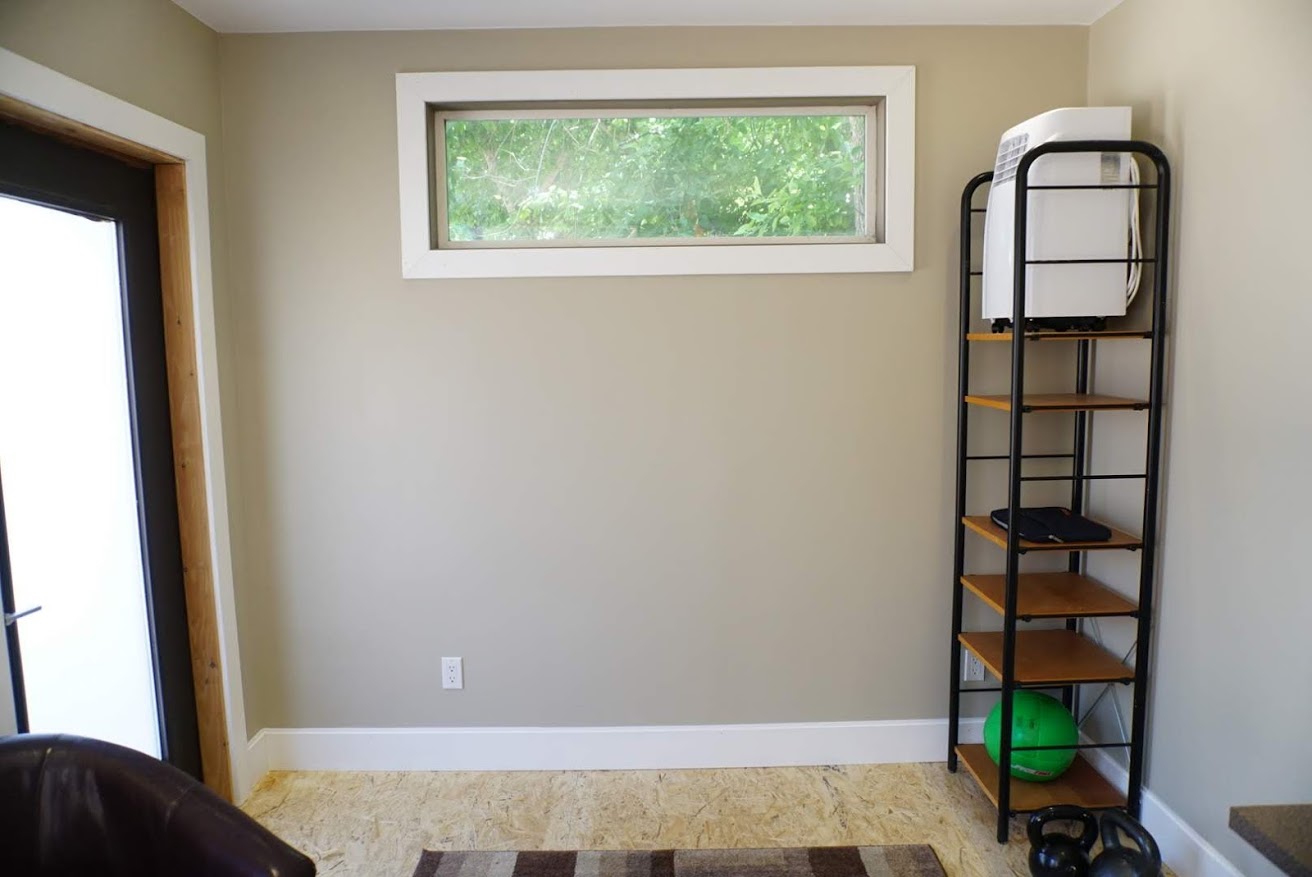
An interior view of our new workspace.

Nearing its one year anniversary, the “MMM-HQ” coworking space has been a lot of fun to run so far. It has been a mixture of quiet workdays, heavy workouts, evening events, and occasional classes and markets. (We have about 55 members and are looking for a few more, so if you happen to live in Longmont click the link above.)

But with only one big room as our indoor space, some members have felt the pinch of needing a quiet place to do longer conference calls or client meetings.  So the plan has always been to build a couple of new spaces, and at last I have one of them mostly finished. And I made a point of documenting the whole process so I could share any ideas and lessons learned with you.

What goes into a Tinyhouse?

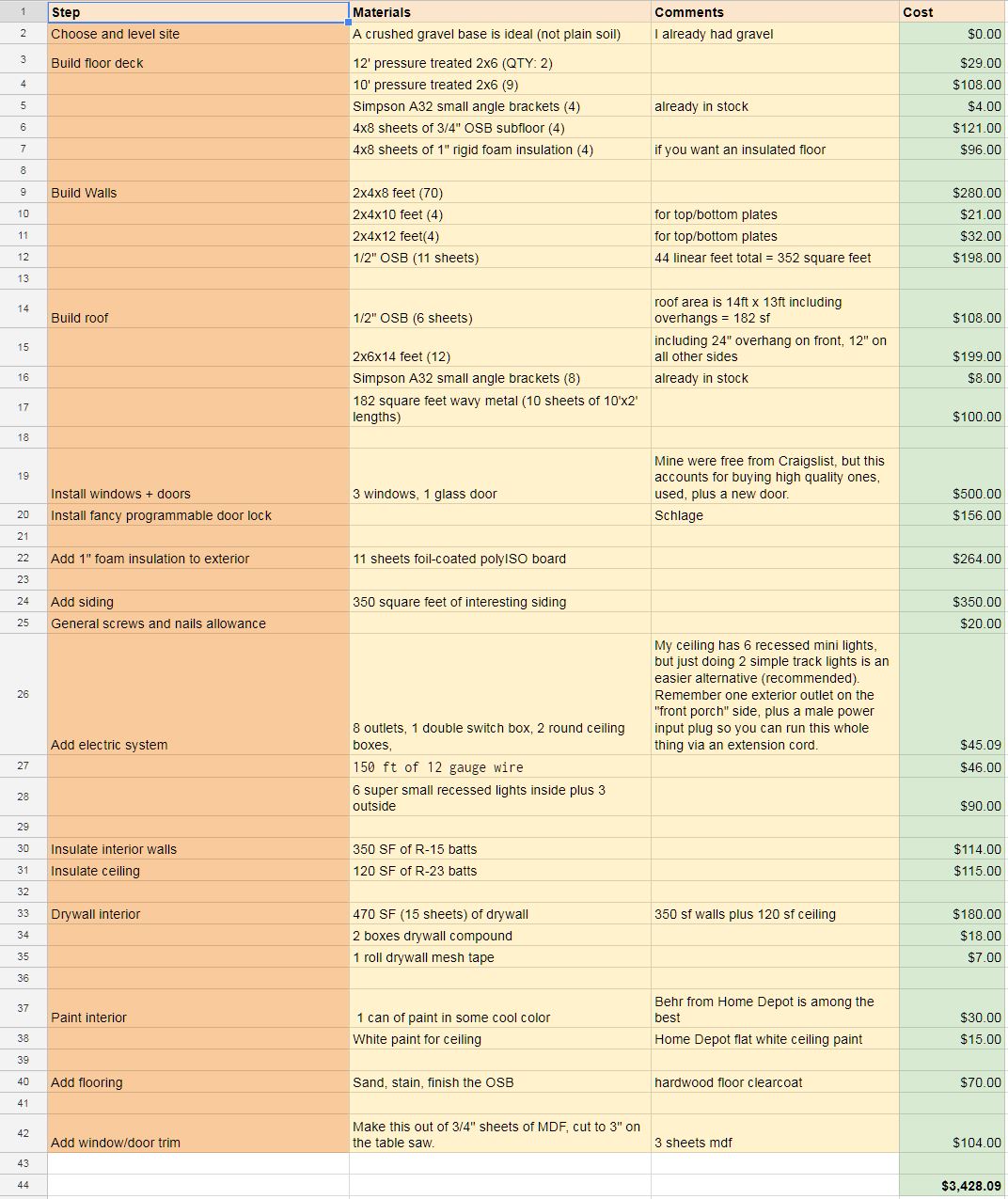
As with any big construction project, I started with a spreadsheet of steps and materials.

Here’s the complete list of steps and materials. You can click for viewing or download an .ods version for tweaking.

To save time, I tried to think ahead and get everything in one order **- most lumber shops will do free or cheap delivery on large orders like this.  Of course, I ended up only partially successful and had to go back for missed objects, but I added those to my spreadsheet so your order can be more complete than mine.

At this point, it was just a matter of putting it all together, an effort which took me about 120 hours (three standard weeks) of work, spread out very casually over the past three months. Most of the work is standard house framing stuff, but just for fun we can step through it in rapidfire style right here.

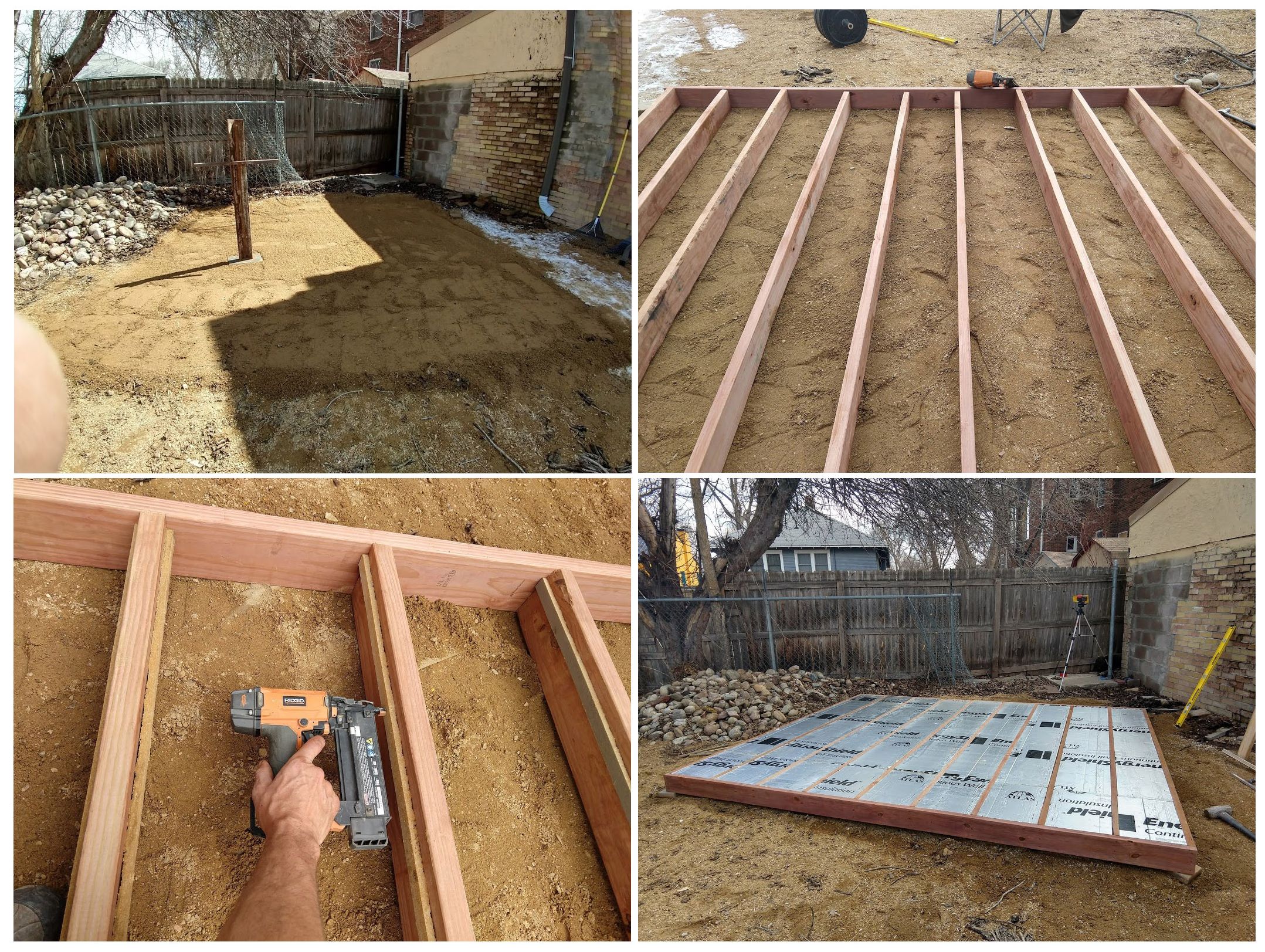
The Super Simple Insulated Floor

Normally when building a small house, you’d dig a hole and pour a reinforced slab of concrete, as I did for the larger and fancier studio building at my main house. But in this case, the goal was fast, cheap and simple. So I just raked out a level patch of crushed gravel, compacted it with my rusty homemade welded compactor tool (“La Cruz”), and then started laying out pressure treated 2×6 lumber.

Here’s the 12×10 floor platform. Note the little support rails which allowed me to tightly fit in the foil-coated foam insulation between the joists. Most joints are done with simple 3.25″ galvanized framing nails, but I added Simpson corner brackets on the insides of the outermost joists for more strength.

Framing

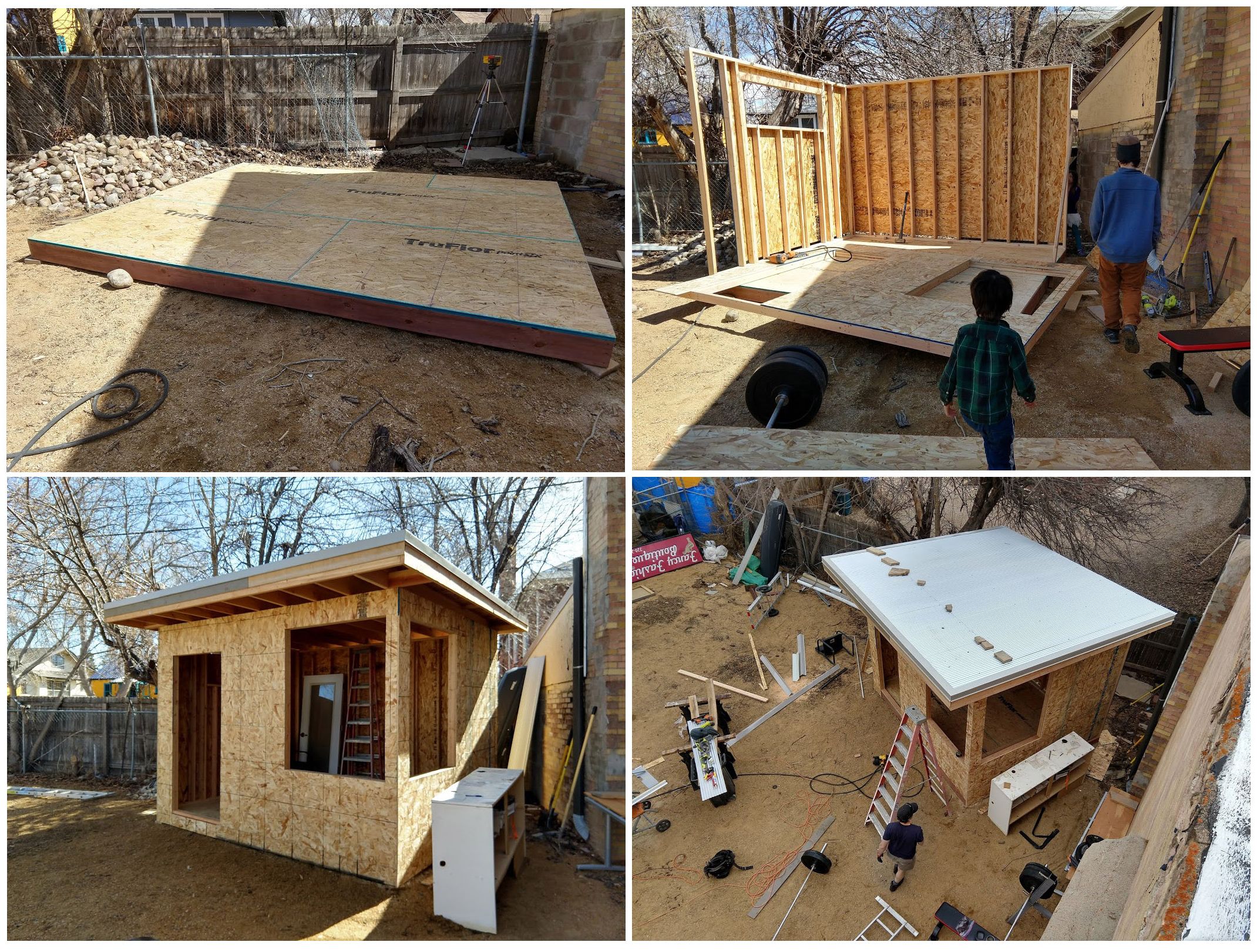
Once I had those floor joists super square and level (hammering in stone shims under corners and joists as needed), I added a layer of standard 3/4″ OSB subfloor and nailed it down judiciously with the framing nailer to ensure a very rigid base. Then started to make the walls.

I used the floor as a convenient work platform for building the four walls. I built them flat and even added the 1/2″ exterior sheathing in advance, then tilted them up with the help of a friend or two. This method makes for heavier lifting but higher quality, because you get a perfectly straight and square wall almost guaranteed. Plus, it saves time because sheathing is a fussier job to do on an already-installed wall.

Once all four walls were set up and locked in place, I created the roof frame, which is really just a rather large wall. I did this on the ground, but had to compromise and skip the pre-sheathing step even though it would yield better quality, because we needed to keep it light enough to lift. If I had really strong friends or a telescoping forklift like real framing companies have, doing it all on the ground would have been a big win.

Framing and roofing.

A Metal Roof (of course)

I wanted a relatively flat-looking roof, so I cut wedge-shaped 2x4s and nailed them to the tops of the roof rafters before adding sheathing. This results in a slope of only 2%, but with a careful underlayment job and the seamless nature of metal roof sheets when compared to shingles, I have found it is nicely watertight. If in doubt, you can add more slope or use a rubber EPDM roof. The other advantages of metal: longer lifespan, lighter weight, and better protection from summer heat.

Insulation and Siding

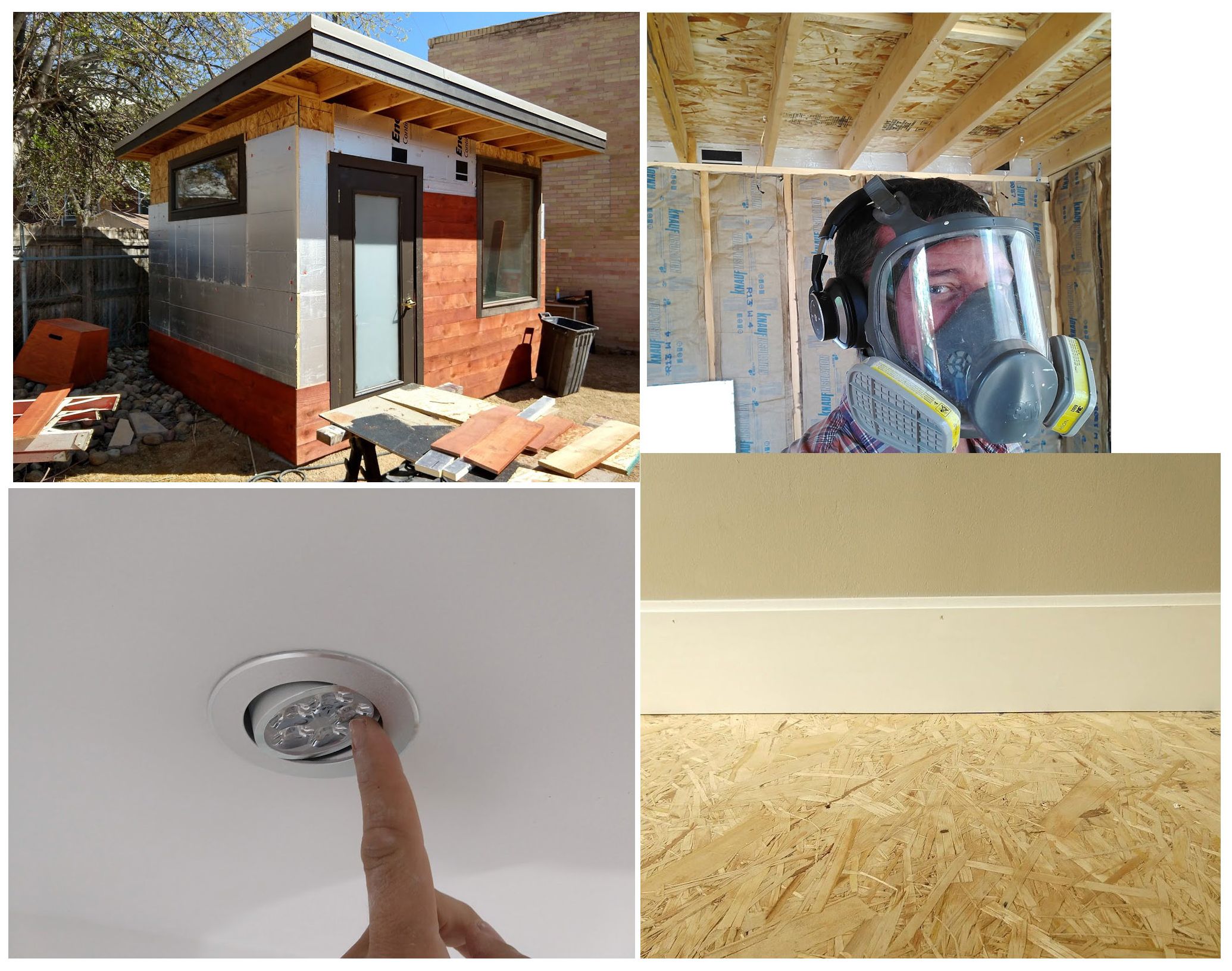
Various wall layers revealed, insulation, lights, super frugal wood floor!

On top of those handy pre-sheathed walls,  I added 1″ foil-covered foamboard, then some stained cedar fenceboards to create the reddish exterior you see in these pictures. Although the cedar gets quite a few compliments, it was an experiment I wouldn’t repeat: the boards expand and contract in changing weather and leave visible gaps at times. Next time, I’ll use more wavy metal siding, or something prefinished with an interlocking tongue and groove profile.

Electrical was done exactly the same way you’d wire up a normal house, with outlets and switches in AC Romex-style wiring. But on a tinyhouse like this, you might choose to have it all terminate at a male outdoor receptacle on an exterior wall like an RV or camp trailer, so you can run the whole thing from a good extension cord.

Insulation was just basic batts in this case, but you can use spray foam for even better performance.  I drywalled everything using standard 1/2″ “lightrock” wallboard, hoping to keep the structure weight down in general, in case this thing ever needs to be moved with a forklift.

For lighting, I used these LED lights I found at Amazon at $4.20 per fixture.

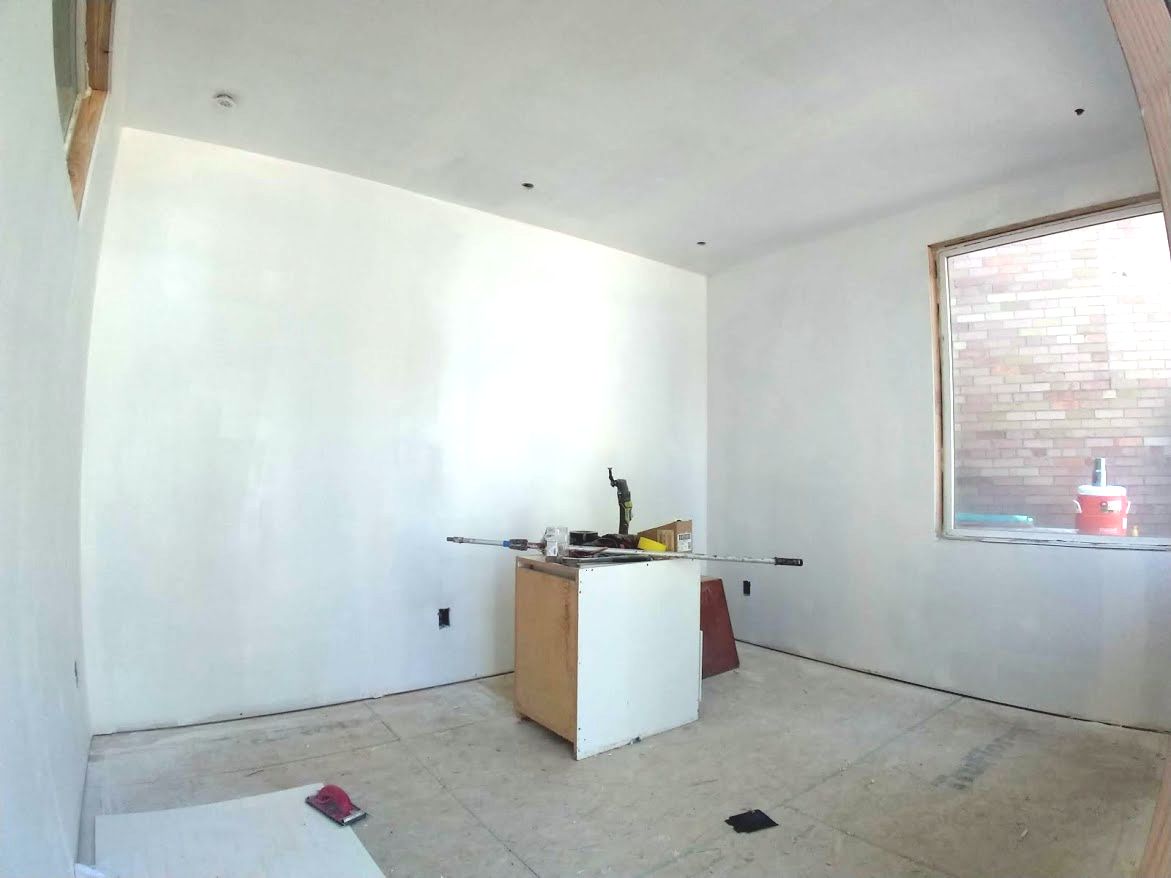
The bare drywall stage – one of so much promise.

The Final Touches – Interior Trim, Furniture and Climate Control

At this stage in the construction story, I had something that looked like any other ready-to-finish example of modern house construction, and it was such a happy and familiar feeling. It’s a blank canvas but also a very solid one upon which you can create anything – an office, a bedroom, music studio, living room. Or if you’ve got the pipes for it, a kitchen or even a bathroom with a fancy shower.

Normally by this stage in building a house, you’ve spent at least $100 per square foot, so you can imagine the pleasantly Mustachian feeling I got when I arrived here at about $22.

So to keep the frugal trend going with the floor, I decided to try just smooth sanding the raw OSB with a good belt sander and clearcoating it with this really tough floor urethane. It came out looking pleasant, and is very durable and mud/gravel resistant. But I found the sanding was a slow process – throwing in a basic but attractive engineered wood floor at under $2 per square foot is probably a better idea next time at only slightly higher cost, unless you are building a big enough space to justify renting a real floor sander.

I made my own trim and window jambs by buying three 4×8 sheets of 3/4″ MDF and slicing them up on the table saw. Like the floor, this adds a bit of labor, but the benefit is you can get nice beefy trim in whatever dimensions you like (and even throw in some matching custom shelving and built-in cabinetry!) and save a couple hundred dollars per room.

The portable air conditioner occupies only one shelf.

For furniture, I picked out a mixture of stuff I already had, an Ikea desk frame from Craigslist, and a nifty chairside table from a local big box store.

Finally, I added some simple but effective climate control by just throwing a low cost portable AC from amazon up on the shelf (it vents through a 6″ hole I cut to the exterior). In the winter, I’ll just stash that little air conditioner somewhere and replace it with a silent oil-filled electric radiator for heat.

By plugging either of these machines into a wifi-controlled electrical outlet, I can even control the heating and cooling from anywhere using an app on my phone, as I already do for the various patio lights and ventilation fans I have in my life.

So do YOU want a Tiny House?

The real point of this article is just to share the idea that small structures can be very useful for many things. They are quicker and cheaper than creating a traditional house or building an addition onto one. They may allow you to have a guest house or home office or even an AirBnb rental in space that was formerly just a water-sucking part of your back lawn. Many cities allow you to place small things like this in your yard without requiring a building permit. And if you have the skills to build these things, you can even create an instantly profitable business cranking them out to satisfy the strong demand.

As for me, I’m hooked – later this year I’ll build a second one of these things here at MMM-HQ. And perhaps I’ll even get a chance to help someone build yet another in a tropical seaside location this winter, as part of my ongoing “Carpentourism” habit.

Happy downsizing!

*except my Mum, who still regrets letting so many teenagers run free and attract the ire of the older neighbors and occasionally the police department. Sorry Mom..  but also, thank you so much!

** I also took advantage of the large chunk of spending for a tiny bit of “travel hacking“, picking up an Amex Platinum card that gives me about $1000 of cash/travel credits only if I can spend $5000 within the first three months. For travel hackers, timing the acquisition of a new rewards card to coincide with a chunk of planned spending can be a useful way to squeeze the travel budget into an existing renovation budget.


  • βœ‡Mr. Money Mustache
  • The Twenty Dollar Swim
    Gratuitous mid-lake selfie from yet another day of nearly-zero-dollar “motor”boating, earlier this week. It was mid July, and I had just finished a sweaty run on the trails which criscross my older sister’s farm in Canada. I was overheated and heading straight for their swimming pool when she saw me walking across the lawn. “Oh yeah, please do use the pool! You’ll help get my cost per use down because it’s still way up there in crazy territory”,
     

The Twenty Dollar Swim

25 July 2018 at 16:58


Gratuitous mid-lake selfie from yet another day of nearly-zero-dollar “motor”boating, earlier this week.

It was mid July, and I had just finished a sweaty run on the trails which criscross my older sister’s farm in Canada. I was overheated and heading straight for their swimming pool when she saw me walking across the lawn.

“Oh yeah, please do use the pool! You’ll help get my cost per use down because it’s still way up there in crazy territory”, she joked.

Moments like these are why I love being part of this family. The self-deprecating Spock-like humour where we can make fun of our own flaws and indulgences, while simultaneously enjoying them just as much.

But it also sparked an interesting conversation, because I knew they had been running this pool since the early 2000s, raised their two now-adult water loving boys in the house, and hosted gatherings for family and friends throughout every summer. And it wasn’t an exorbitant pool. Surely this was one of the more affordable indulgences, right?

“Has the cost per swim really been that high?”, I asked.

“Every jump into that pool has cost almost twenty bucks, if you average it out.” she replied.

“Wow, how could that be true?!” I mused.

So I did some rough calculations like those you see in the box below, which you can totally skip right over* if you just want the final answer.

The pool originally cost $30,000

But that money could have been invested instead, which would have compounded at 7% for these 18 years.

$30k compounded at 7% (30×1.07^18) is an amazing $101,300!

Electricity at 10 kwh/day x $0.20 at for 100 days per season is $200 per season or $3600 total
Chlorine and other chemicals: $600 per season add to $10,800
Maintenance like vacuums, nets, a new liner: $800 per season $14,400

We’re already at $130,000

Not even counting the hundreds of hours that went into scooping out bugs, spiders, mice, and even raccoons, and potentially higher home insurance premiums and water bills (in my region a 25,000 gallon pool costs $125 in water to fill – once!)

And how many swims were enjoyed in the pool? If every family member swam every day for every season, you’d still only end up at 18 years x 100 days x 4 people = 7200 swims.

$130 grand divided by 7200 is $18.oo


.

So the final number is about 18 bucks per person per swim, just as my sister claimed.

Looking forward to a refreshing dip with Mom and Dad and the kids? That’s $72 bucks that you ended up burning, by the time all the chips fell.

I know this is a strange way to think about a swimming pool. But this is a Mr. Money Mustache article, and this site is all about different ways to think about your life decisions.

Most people just say something like, “Well, we’ve already got it so we might as well enjoy it, right?”

The problem is that they also apply this to other purchases, even those they haven’t made yet. The richer our tastes become, the more likely we are to buy ourselves little upgrades “just because it would be nice”, or “just in case”,  or because Joe Jones next door or a magazine article mentioned the idea.

“Okay Mr. Money Mustache, What Are You Taking Away From Me This Time?”

Don’t worry, I’m not necessarily going to strip you of your dreams of that swimming pool, or anything else. But I do want you to start thinking about these costs in a much more visceral and explicit way, so you can really make sure you are not fooling yourself. For example, let’s step through a few more common blunders:

  • “We had a great time visiting the Smiths in their ski house last weekend – LET’S GET ONE OURSELVES!” – sure, as long as you are ready to devote your financial life to the activity and the activity is worth $890.00 per night you actually spend there. But if this number sounds like anything other than chump change, you and your friends might want to just share an Airbnb for your ski weekends, or even better, take up local mountain biking instead of far-away skiing.
  • “I like these two houses equally, but one of them has a much bigger yard which is better for Junior to play in. They’re the same price and the bigger yard is just ten miles down the road!” – okay, but make sure that Junior’s time in the extra yard space is worth $150 per hour.
  • “I’m thinking of springing for the $9000 long-range battery in my upcoming Tesla Model 3 order” – this one strikes straight at my own heart, because I crave a long range Model 3 myself. But even for a serious roadtripper, this works out to $125 per hour of charging time that you manage to avoid. Aren’t you willing to take a few minutes occasionally to walk around and admire your beautiful car if you get paid $125 per hour after tax for it? If you are, standard range will do.
  • “I live in an area with snowy winters, so I need all-wheel-drive” since we already learned that all-wheel-drive does not make you safer, the only time it actually helps you is when it prevents you from being stuck. But this could work out to between $50 and $500 per time the AWD actually gets you out of a bind. Aren’t you willing to shovel your driveway a bit more thoroughly (or work from home on the worst days) for $500 a pop?
  • “We’d love to have an extra bedroom as a way of accommodating Grandma’s Annual Visit” Sure, but if you spend $30,000 extra on a slightly larger house and use that guest room 20 nights per year, it’s about $70 per night that you use it. 
  • “I live in Chicago and we just love to spend weekends on the Boat.” Even if you go all-in and give up all your weekend activities on the land to maximize your time down at the marina, those nights in that little wedge-shaped cabin bed will average out to about $500 per night. Or more if you opt for a bigger boat or more time with the motor on.
  • “We love to explore and be free for a few months each year, so we’re getting an RV and towing the car…” But a three month, 15,000 mile RV trip works out to about $200 per night that you sleep in that vehicle – why not pick up a fairly new Prius and a good tent and hit the road, and treat yourself to beautiful rental accommodation whenever you want it along the way?

We could go on and on with these examples, but the real thing to understand is that making commitments usually comes with a bigger cost than you expect. There are a shitload of dollars at stake, but also a substantial portion of your focus and mental energy which will go into furnishing, maintaining, insuring, and cleaning these pleasant weekend distractions.

“But How Can I do It Better While Keeping My Life Fun?”

As a Mustachian, you have way more options open to you than you realize. But to take advantage of them, you need to stop doing what other people are doing, and live differently.

At the most frugal level, you can just cut yourself off cold turkey. From now on, just start doing all leisure within biking distance of home, and preparing all of your own food – no exceptions. You can still organize and host parties, however.

If you’re in a stressful debt situation right now and want to be out of it, you should just do this right now as a mental reset and watch the incredible results on your wealth. Most people who hit this reset button end up between $20,000 and $100,000 further ahead within just the first year, with many happy stories to share about it, so if you’re in need of a quick life boost, do this instead of dilly-dallying around with my rich person suggestions below.

But if you’re a debt free person with higher income and just want to accelerate your path to financial freedom, you can still dabble in the spendier life and keep up with your peers, by simply shuffling the luxury deck a little bit differently. A few principles that can still cut your budget by 75%:

  • Prioritize the healthy stuff first: It’s the weekend and you are ready to celebrate. But first, what’s on your to-do list? Are you fully caught up on your workouts, grocery shopping, and various nonsense with the incoming mail? If not, budget a full day for that rather than packing up the car for a road trip. How’s your yard looking? Have you fixed that door that doesn’t latch correctly? Well, look at that, your whole weekend is booked after all and you’ll feel better for it.
  • Muscle over Motor: If you like being on the slopes, learn to mountain bike. If you like being on the water, try a big, cushy sea kayak complete with cupholders for your sunrise coffee or sunset beer. Invite your fit and funloving friends and start exploring waterways everywhere. Or if you want a night out on the town, choose somewhere close and grab your bike rather than somewhere far and looking for your car keys or your Uber app.
  • Rent Instead of Buying: With Airbnb or even plain old hotels, you can still have weekend getaways when you truly deserve and can afford them, and yet the cost per use is much lower. The numbers will still look big, and that’s a good thing because you will be reminded that it is always expensive to leave your already-perfectly-good-home and go out to do even fancier things. When you’re living large, it’s best to joyfully acknowledge it rather than pretending it’s normal.
  • Make Special Arrangements: If you like cottages, make yourself useful to a friend who owns a cottage, by always being the one to bring the food or the wine, or donating your time to help with the maintenance or renovations. I helped build a cottage for my inlaws in Canada a few years back, and have enjoyed the fruits of our combined labor ever since – at no cost to the MMM family. Similarly, if you like boats, volunteer as part of the crew on a real yacht. If you like houses, specialize in building or renovating them, or hosting paying guests in the unused portions. If you like cars, become a car expert rather than just a car consumer.

The Final Word:

If you’re already eating and sleeping well, chances are that you already have all the basic ingredients for a happy life.  So as you go on to start adding some spices to the dish as all of us do, just be sure you look at the price tag. The advantage you’ll gain will last a lifetime.


Epilogue: Just this year, after her boys had grown up and flown from the nest and all the fun had been had, they filled in the pool and are in the process of replacing it with trees and other natural landscaping instead. A bold move that few people would be rational enough to take – live long and prosper, Sister.

Extra Credit: Here are a few of the cost-per-use calculations I made for this article. Share some of your own in the comments!

Mountain house: $24,000 per year mortgage and/or capital cost, furnishings, utilities and maintenance divided by 30 nights per year. Plus $90 in car costs per roundtrip drive for a weekend.

Bigger yard: 1 hour per week of activities that really could not have been done in a smaller yard or an outdoor park, compared to 100 miles of extra driving ($50) and 3.5 hours of your time ($100) spent doing that driving.

Tesla Battery Upgrade: The only time you use the longer range is on roadtrips over 230 miles. If you do a 600-mile trip once every month, you have to make two extra 30-minute charging stops per month. Figure the $9000 battery costs you about $1500 in extra capital cost and depreciation per year, or $125 per month. However, if you are a Tesla fan like me and you want the company to make more profit to continue their mission, you may still opt for the extra options since you have nothing better to do with that money anyway.

All wheel drive car: if the car costs $5000 more up-front plus an extra $200 per year in fuel and maintenance, you could estimate it as about $500 per year more expensive to own. Then, how many times do you truly get stuck in a front-wheel drive car with really good dedicated snow tires on winter rims? (because snow tires always come before buying AWD!)

Grandma’s bedroom: a $30k more expensive house might consume about 2% of that extra cost in maintenance and taxes annually ($300), plus 5% annually in financing/capital costs ($1800), for a total of $2100 per year. Strangely enough, this extra bedroom works out to be one of the cheaper indulgences in this list, especially if you can use that room as an office too, or rent it out occasionally.

Boat: It costs about $15,000 per year to own, dock, store, transport, maintain, depreciate, and fuel a 26-foot motorboat with a little sleeper cabin in the front. If you spend each of the sixteen weekends of Chicago’s warm seasons exclusively in the boat, you’ve still done only about 32 days there, which yields the surprisingly high cost of almost $500 per night.

RV: Even a relatively small $50,000 RV depreciates about $0.50 per mile and burns fuel and oil and tires at another fifty cents. And that’s before you even pay for supplies, maintenance and nightly parking fees! Large RV travel is even dumber, financially speaking – note that the fanciest tour-bus-sized RVs you see cost about $500,000! The physics are simply against you if you are trying to travel in your own personal rolling building. Although stationary living in a not-too-expensive RV or trailer can be a highly Mustachian choice.

* I let you skip that one just so you would keep reading and see my point. But now that you see it, hopefully you also see that you do need to look at the numbers in life and figure this stuff for yourself, because it’s a way bigger deal than you might think!


  • βœ‡Mr. Money Mustache
  • What Really Goes on at MMM Headquarters
    I’d love to retire early, but then what?  … Although I retired about thirteen years ago, and continue to be retired, about one year ago I opened up a little business on Main Street here in Longmont, Colorado. It is a multi-purpose gathering space, under the guise of a coworking space, with the typical-for-me grandiose name of “Mr. Money Mustache Headquarters”. Or, MMM-HQ for short. At the time, I wrote a blog post about it, and promised to keep you updated on ho
     

What Really Goes on at MMM Headquarters

5 September 2018 at 15:19


I’d love to retire early, but then what? 

Although I retired about thirteen years ago, and continue to be retired, about one year ago I opened up a little business on Main Street here in Longmont, Colorado. It is a multi-purpose gathering space, under the guise of a coworking space, with the typical-for-me grandiose name of “Mr. Money Mustache Headquarters”. Or, MMM-HQ for short.

At the time, I wrote a blog post about it, and promised to keep you updated on how it was going. Since then, many people have been asking for updates. Approximately one group of random roadtripping Mustachian tourists has stopped by each day to peer in the windows*. And several people are considering opening their own coworking spaces in other cities, if the case for it looks good.

Although this HQ is a small scale thing (we are hovering at about 50 members and I’d love to get to 80), it has provided me with some great lessons in both life and business, which are long overdue for sharing.

Plus, I can now fully vouch for the idea as a good one for other people to pursue, given the right situation. Owning a coworking or other community-oriented space can be both a good business and a great life choice, for people before or after the early retirement stage.

So, here’s what I’ve learned after launching into the most unexpected business of my life so far:

1: Owning a business can be like a having mental health therapist that pays YOU:

As I always say, early retirement is great, but it doesn’t mean you’re allowed to stop working. You need to accomplish something meaningful with almost every one of your days, whatever “accomplish” and “meaningful” mean to you. You also need to get out of your house, strain your muscles, have positive interactions with other humans, and experience at least a bit of hardship. These are simply parts of the recipe for Human happiness, like a series of buttons you can press to get more of it.

A therapeutic January morning in the Prisonyard Gym with special guest Jesse Mecham

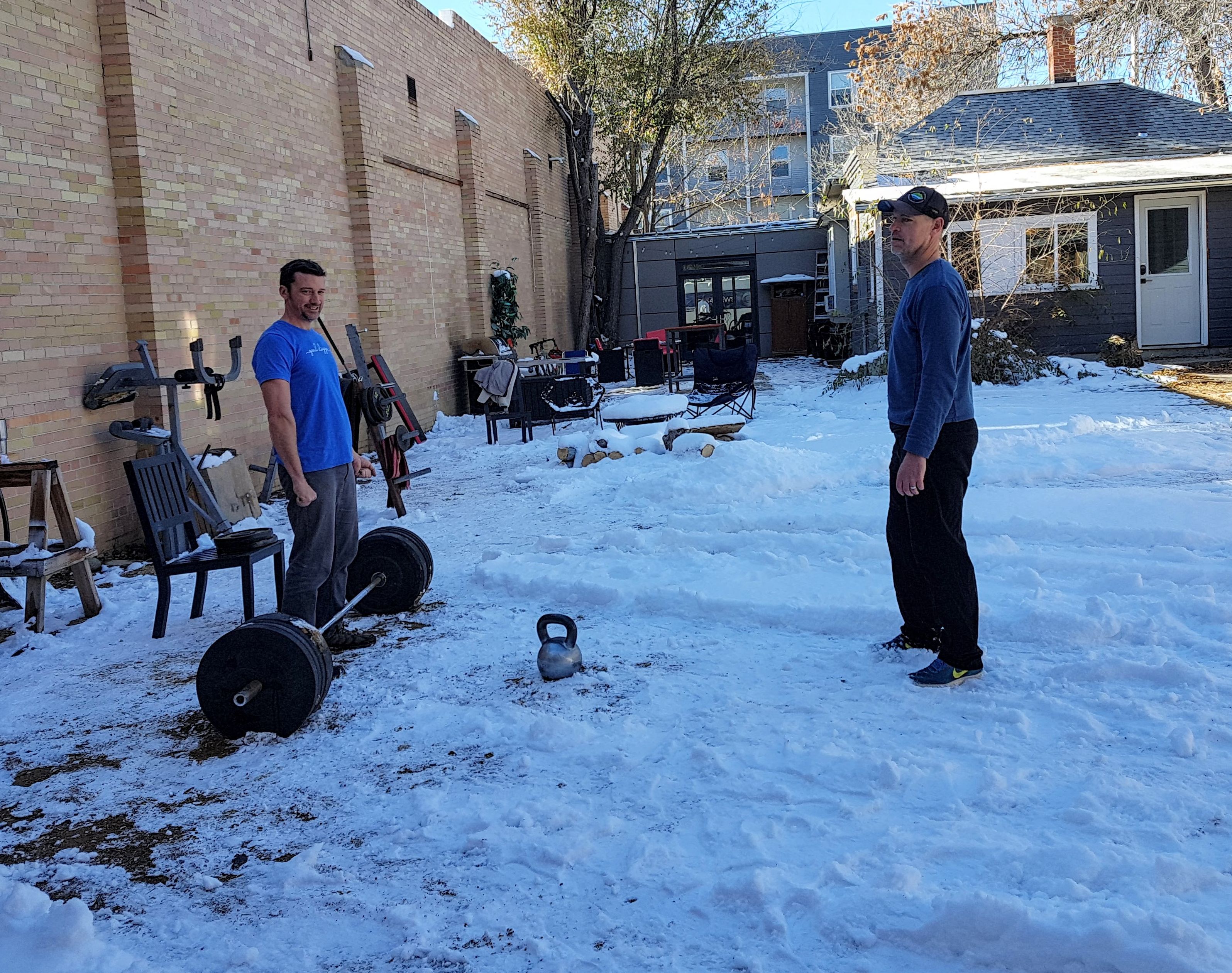
So in my case, adding HQ to my life has been a very nice way to press more of those buttons. Almost every morning, I walk or bike or jog the 1.2 miles down to the building bright and early, open up all the doors for some fresh air, put on some music, and sweep the floors or make coffee or set things straight in preparation for the day. Then I head out to the patio and the “Prisonyard” outdoor gym beyond to do some basic weight training before I get sucked too deeply into computer work or any to-do lists.

As the day goes on, there will be a random stream of members and conversations and tasks and meetings and errands around town, which is just unpredictable enough to keep each day fun.

And the best part of it all is that it’s completely optional work. I can choose not to visit, and the members take up the slack and care for the place themselves. I can go on vacation and nothing blows up while I’m gone.

Owning a coworking space has all the benefits of having a really good office job where you like all of your coworkers, except without the accompanying obligations or politics. I refer to it as my therapist because a visit never fails to put me in a good mood, no matter how I felt before deciding to head down there. And a healthy and reliable way to make yourself feel great is an important part of any life.

2: It’s easy to arrange big events, but slower to create a consistently buzzing daily scene.

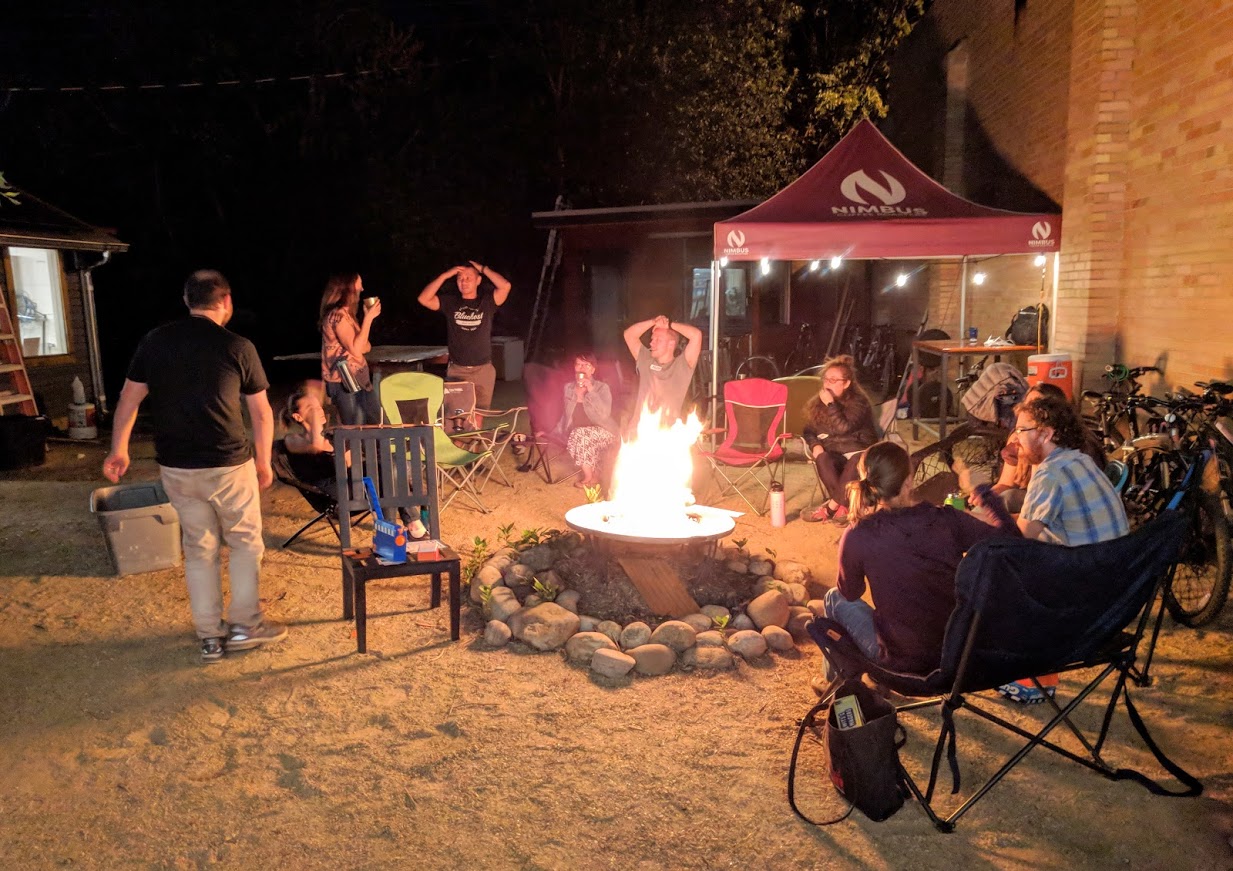
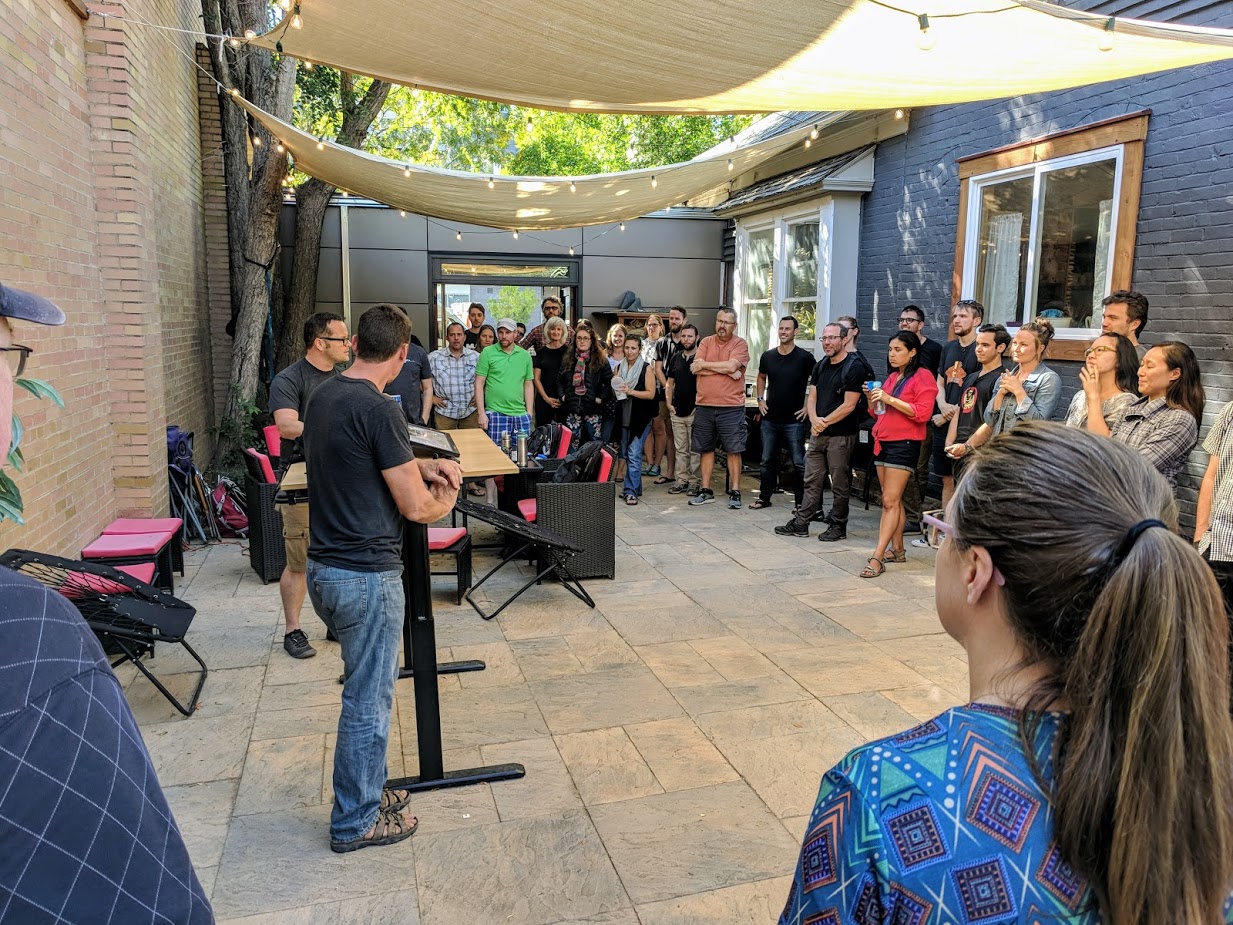
The year started big, with about 90 people crammed in for the first pop-up business school. Then, the vibe flipped around completely as we moved on to just a few people hanging around during normal days, working on laptops or perhaps the squat rack. But there have also been a pretty good series of after-hours events including barbecues, potlucks, regular meetups of the Northern Colorado Mustachians Group, a visit and Q/A session with YNAB founder Jesse Mecham, a Virtual Reality demo night, a music jam or two, and various charity and learning events and markets.

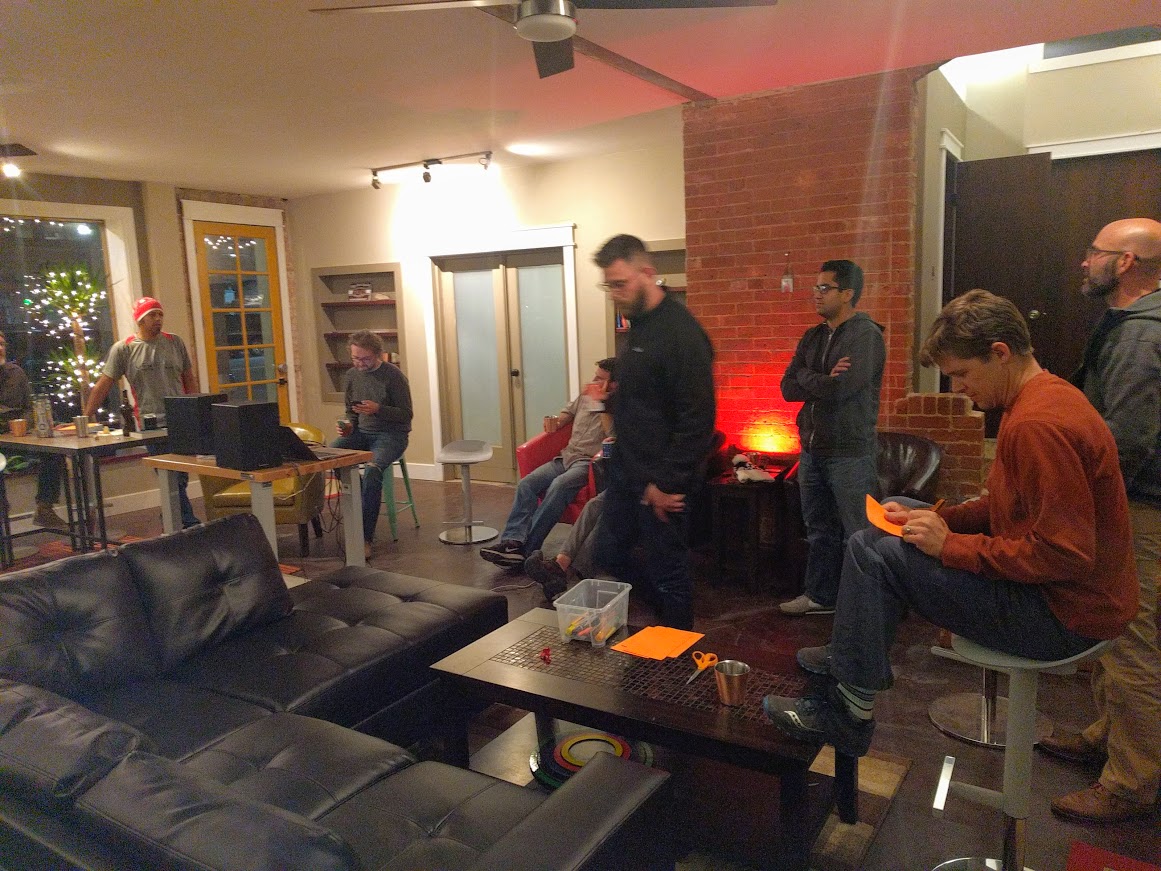
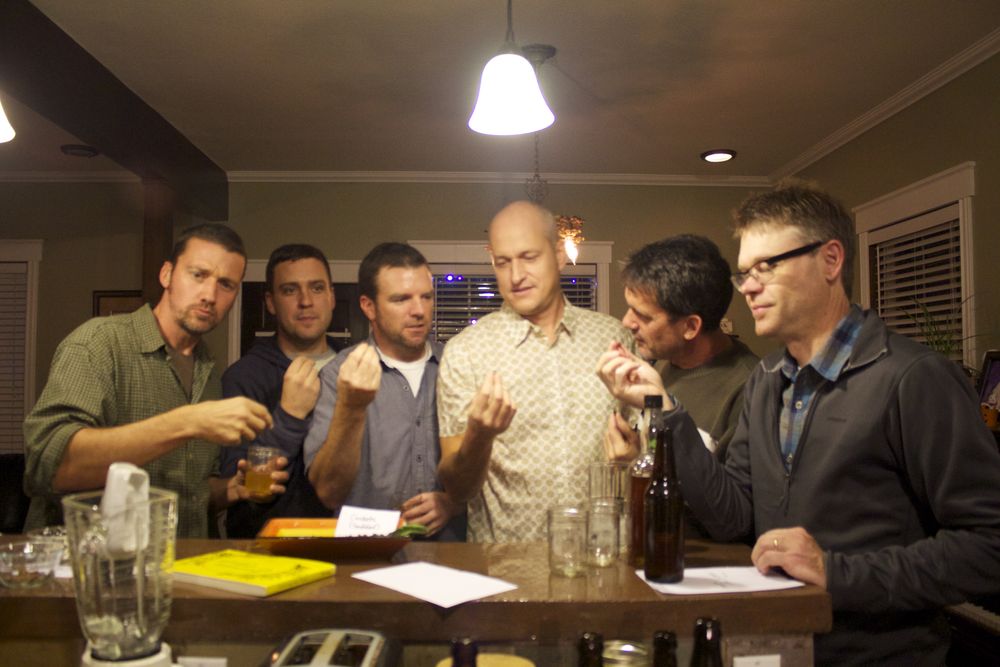
The annual Beer Club charitable meeting, comprised mostly of my neighborhood Dad friends.

On the down side, it takes more work to meet and sign up each new member than I expected, and we tend to lose more than expected, as people who signed up early but realized they don’t really need a coworking space have dropped out. And in the classic Blogger’s Dilemma where the demographic of the audience often reflects that of the writer, we end up with quite a high percentage of well-to-do white males in our 30s and 40s, which could lead to the term “Broworking Space”. But I’m trying to break this trend!

On the upside, the community side has been just as good as I had hoped. Thanks to the magic of our private Slack group, Members of HQ have been helping each other with both business and leisure pursuits on a daily basis and the connection has helped all of us including me. I often joke that my primary purpose for this coworking space is as a “Friend Harvesting Machine”, and it is living up to that promise.

3: The Money Side of Things

In principle, coworking is a good business model because it works a bit like a gym: you can have a large number of members sharing a common space because not everyone is there every day. This is why there are so many companies expanding into the business like WeWork, Regus, Proximity, Galvanize, and a zillion more.

But like any business, your income and spending need to be balanced.  I’ve deliberately gone low on both sides, by starting with an affordable building and subsidizing it with my own mostly-unpaid labor. Because of this, the $2500 per month income (50 members at $50 each) is enough to sustain the place including property taxes, utilities, maintenance, beer (and artisinal coffee from one of our own members!) The downside of this approach is that our space is smaller and less fancy than other coworking spots. It was really just one big room until I opened the Tinyhouse conference room in June.  Since the space is still way underused on any given workday, we could easily double this to 100 members, which would bring the business up to $60,000 of gross annual income – more than enough to sustain any reasonable lifestyle with very part-time hours.

Normal coworking spaces will tend to have a much larger building, with hundreds of members paying between $150 and $300+ per month for semi-private working spaces, or more for fully dedicated offices. This leads to higher rent and utility costs, plus the need for at least one full-time administrator and even a receptionist (although both can be the same person, which could be you if you are motivated.) The end result is a good income stream, at the expense of a business that requires real work on a fixed schedule.

So you can see why MMM-HQ is taking the slower paced road, for now.

4: So, should I start my own? (or join one?)

If you’ve got the time and energy, hell yes!

If you are thinking of opening a space in roughly the MMM-HQ model (or already have one), feel free to give me the details by dropping me an email via my about->contact form. Before doing so, I’d suggest you

  • start by putting up a good website with your proposed building/location, amenities, monthly cost and your contact info.
  • Then share it around with anyone you know who may be interested and get feedback.
  • Then email me with that you have so far.

At this point, I will link to it from my own HQ page, which will then become a directory for a network of community-oriented Mustachian coworking spaces. You can gather interested parties first before taking the plunge, although I would suggest that you only do this if you are financially well established and not overly dependent on the whims of bank financing.

Although I would (of course) charge no franchise fees, we could still set up an informal sharing arrangement where members of any Mustachian Headquarters affiliate location would be free to visit any other one.

And if you are wondering if joining a club like this is a worthwhile use of your own fifty bucks a month, I have to say it’s hard to see the downside as long as you use the amenities and like socializing with other people. If free coffee, beer, work space, an outdoor gym, tool library/workshop and access to fifty local entrepreneurs is not worth it to you, then I’m not sure what is!

In The Comments: Do you have any questions or comments about this or any other lifestyle or post-retirement business ideas? I’d be happy to answer them, and hopefully many other entrepreneur-readers will be willing to share their own knowledge and experience as well. 

*Out of respect to the members who are in there trying to get real work done, please don’t show up unannounced – instead, join one of our public meetups if you happen to be in the area, which I always announce on Twitter and usually Facebook too.

  • βœ‡Mr. Money Mustache
  • What Everybody Is Getting Wrong About FIRE
    Fig 1: Suze Orman’s opinion of our lifestyle, as captured in a crazy interview on Paula Pant’s Afford Anything podcast. In case you hadn’t already noticed it in the news, it seems we are hitting a  turning point in how the rest of the world perceives this lifestyle that you and I have been enjoying. First, we were ignored. Then, there were a few stories that just focused on the strange lives of  Mr. Money Mustache a few other freaky magicians, cataloging our feats
     

What Everybody Is Getting Wrong About FIRE

5 October 2018 at 17:31


Fig 1: Suze Orman’s opinion of our lifestyle, as captured in a crazy interview on Paula Pant’s Afford Anything podcast.

In case you hadn’t already noticed it in the news, it seems we are hitting a  turning point in how the rest of the world perceives this lifestyle that you and I have been enjoying.

First, we were ignored. Then, there were a few stories that just focused on the strange lives of  Mr. Money Mustache a few other freaky magicians, cataloging our feats of extreme frugality like “spending less than 100% of your money on a car” or “occasionally eating food from one’s own kitchen.”

But time went by, and our numbers kept growing. And we weren’t just thirtysomething white male tech workers anymore, we were women and men of all ages and professions in all different countries, absorbing blogs and podcasts from a thousand different sources.

Vicki Robin, author of Your Money Or Your Life came out of retirement to write a new edition of her foundational book on the subject of financial independence* and some prominent filmmakers have spent the past year making a documentary called Playing with FIRE about all of this too.

And suddenly, instead of just a blogger or a few millennials here and there, the media is starting to call it the Financial Independence Movement. And this is a big deal, because when it comes to cultural traditions, perception pretty much defines reality.

But when you look it up by Googling the FIRE Movement, you still get a pretty mixed bag of arguments.

The New York Times article looks very positive. But there’s another one in there called “Why I Hate the FIRE Movement”, another that complains our ideas are a “Massive fallacy of composition”, and any number of others saying that we have got one aspect or another wrong.

There’s a tricky paradox going on here: the more people you reach, the bigger the range of misconceptions that will come up, potentially cockblocking your movement before it really takes off.

So, with that in mind, let’s clean up the biggest bits of WRONG that are preventing the latest round of several million new arrivals from fully enjoying the fruits of their own labor.

Because as soon as you stop making excuses for why these ideas can’t possibly work for you, you can start actually doing them and seeing the benefits – today.

1: This is ALL WINNING and there are NO DOWNSIDES.

If you think there is even the slightest flaw with the ideas behind FIRE, you’re probably just not understanding it correctly. Because the whole reason for doing any of this is to lead the happiest, most satisfying life you can possibly lead.

Sure, there are a few tricks behind the curtain – I’m going to make you occasionally tackle some moderately difficult stuff instead of the lazy, easy things you are accustomed to doing. But this too is a win, because a lazy life is a sad, depressed, unsatisfying life. We are going to lift you up OUT of that bullshit. So from now, you can assume that any objections can be solved. Zero complaints allowed.

2: It Doesn’t Matter How Much Money you Make

Sure, many of the people most passionate about FIRE tend to be tech workers and doctors who happen to make a lot of money. When people with lower salaries notice this fact, they tune out and assume the ideas won’t work for them. When in fact, they work even better, the further down the income scale you go.

When I tell a Google employee earning $200,000 per year that she should not burn through too many $10.00-plus-tip glassses of wine at happy hour, she can rightfully respond that each one represents only about ten minutes of her after-tax pay. But what about the guy getting by on $20k? A ten-dollar expenditure is ten times more of a blow to his finances, and an even bigger portion of his monthly surplus income, if he has any surplus at all.

I’m not telling low-income people that they can retire in five years. I am telling them that they can make their lives better, RIGHT NOW, by spending less money on certain things that don’t improve any of our lives. Ten dollar drinks are one easy example, but there are dozens of other ones that I’m suggesting.

And dozens of ten-dollar bills start to add up to real money pretty quickly, which is something most people don’t realize. The vast majority of wealthy people are the ones who have figured out that a millionaire is made ten bucks at a time.

At the opposite end of the scale, earning more income will rarely solve your financial problems: most high-income people are still within just a few paychecks of insolvency, because it is possible to blow almost any paycheck, simply by adding or upgrading more cars, houses, and vacations.

A fundamental truth in society is that most people are pretty bad at math. At the core, these FIRE ideas are simply about taking some solid math, combining it with principles of human happiness, and then distilling it down into a list of simple tactics that will get you way ahead in all areas of life. The benefits go way beyond money.

3: FIRE Is Not Really About Early Retirement

Everybody uses the FIRE acronym because it is catchy and “Early Retirement” sounds desirable. But for most people who get there, Financial Independence does not mean the end of your working career.

Instead it means, “Complete freedom to be the best, most powerful, energetic, happiest and most generous version of You that you can possibly be.”

Does this mean you will quit commuting through traffic into a lame corporate office to sit in meetings about products you don’t really care about? Yes.

But does it mean you won’t work hard at things that are important to you, for the rest of your life? NO!

The people who lob this “retirement is bad” complaint against us are often the lucky ones – a professor who loves researching and teaching, or an established doctor who loves saving lives and happens to enjoy the work environment she has created for herself. But in real life, over half of people are in jobs they genuinely do not enjoy, and which they would immediately quit if they didn’t need the money.

Early retirement means quitting any job that you wouldn’t do for free – but then continuing right ahead with work in something that works for you, even when you don’t need the money.

If you’re lucky enough to find a job this good early on in your career, then congratulations, you can have the benefits of early retirement even before you have the huge nest egg. But don’t fool yourself  – having the financial independence side of things is very powerful as well.

And because of this tendency of early retirees to go on through life and keep earning more money – at least occasionally – the issue of running out of money is even more remote. Most of us end up with a higher net worth every single year, even decades after turning in the keys to the cubicle.

4: You Can Be Happy on ANY Level of Spending

As a society, we’ve been trained to assume that having a bigger budget is always better, and cutting back always means some sort of compromise. The Suze Orman interview above is just dripping with that assumption. The amazing news in this department, which will save you millions of dollars, is that this is complete bullshit!

Happiness is your goal in life, and it comes from meeting certain core Human needs. The thing is, that there are many ways to meet each of these needs – some of them free and some of them shockingly expensive.

For example, improving your physical health is one proven way to be happier. But you can accomplish this with a $2500 per month personal trainer or a $100 set of barbells from Craigslist. Same happiness, vastly different cost.

And as it turns out, there is a similar hack for every single one of life’s major expenses. You can meet all your needs at little or zero cost – it just takes a bit of skill. At this level, you would be able to save almost all of your income.

Or, you can substitute a bit more money and a bit less skill to meet those needs in an (only slightly) more efficient lifestyle, like the one I try to lead. This might allow you to save half or two thirds of your income.

Or, you can spray money in every direction randomly, trying to meet an unfiltered list of wants and needs, and end up with a random but very expensive life, while remaining almost broke throughout the entire thing. This is what most people do, and it leads to saving almost none of your income.

All three choices are possible to do with great happiness. But in a bit of a paradox, the last and most expensive choice is the most difficult one in which to find happiness, because you end up with so many distractions and so little free time.

5: It Doesn’t Depend on A Booming Stock Market

I started this blog soon after the crash of 2009. Now we’re in the boom of 2018. Another market crash of epic proportions is coming sometime, probably pretty soon.

Our uninformed opponents think that FIRE-style early retirees are extra vulnerable to this. But in reality, it’s just the opposite: we are on a safe island, far above the choppy seas of the everyday economy. Because here’s how it really works:

  • We have low and easily controlled expenses – remember, we got here precisely by being good at controlling our spending.
  • The stock market always fluctuates, and crashes are an expected and healthy part of the system. Then Human ingenuity continues its magic, we keep on striving and inventing great things, and the market goes back up. Stock market volatility is already built into the math we used to design this plan. Relax.
  • Even in the event of a permanent collapse (for example the end of the US or world economy), the FIRE practitioner would still come out ahead: instead of focusing your energy on leasing BMWs or dressing yourself up fancy, you have learned to live happily and work on your skills, health, and friendships. It’s a package that will make you wealthier in good times and bad.

6: Education, Health Care, or High Cost of Living areas are Comically Tiny Obstacles

FIRE is simply about making smart decisions with your spending so that you waste less money.  This means that you have way more money available to work with.

The potentially costly monsters mentioned above are simply things that cost money. So if you get better at managing your money, do you think these problems will loom larger, or smaller, in your life?

For example, my son will be reaching University age in just five more years. I haven’t bothered to set aside any money for this part of his education, because we already had way more than enough before he was born!

On top of that, financial independence gives us many more options to handle any unexpected expense, whether it’s education, health, or anything else. For example, as a team my son and we parents could easily:

  • shop around to find the most cost-effective way to get any given degree (start with community college for the first two years, compare different schools, etc.)
  • earn more merit scholarships to get through even an ivy league school for free.
  • earn more money to pay for any cost shortage
  • bypass university entirely and simply start a business
  • move to another state or even country in order to qualify for local tuition rates or more reasonable medical rates
  • use personal relationships to get cheaper or free education or medical care in exchange for helping teachers and doctors with something they need from us.

These are just a few ideas. The point is, every problem can be solved, and financial independence simply gives you more mental and money power to solve these problems.

7: The Only Thing To Fear, is Fear Itself

In the interview, Suze Orman goes on and on about what might go wrong, and how you need an incredible amount of money saved to protect you, just in case. But this thinking is completely backwards – money will not cure your fear, as megamillionaire Suze proves so clearly.

If you are afraid of what might happen in the future, you have a mental problem rather than a financial problem. So you should work on that first, by training your mind and body:

  • Start each day with at least a one mile brisk outdoor walk – before you even attempt to work.  This drastically improves your hormonal balance and reduces stress and fear.
  • Read books about managing stress and learn about meditation using something like Headspace, Camp Calm  or the free Insight Timer.
  • Completely avoid the daily news cycle, especially on TV or radio. If you insist on being a world events junkie, just read the Economist once per week. Focus on optimistic sources of information – like this blog!
  •  Seek out and hang out with more optimistic friends. Remove negative or gossipy friends from your daily life.

8: Place Your Bets Where The Odds Are In Your Favor

Because my brain has a math side I can’t turn off, I tend to see the world in terms of numbers rather than just emotions. And this is incredibly helpful, because by understanding probability, it helps me set up my life to ensure a much more joyful stream of those happy emotions.

For example: many people avoid cycling because they have heard from friends that it is very dangerous. But by doing so, they replace bike trips with sedentary car or bus trips, which clog their arteries and compound into fat gain and other medical issues which really are dangerous.

A lifetime of bicycling in average conditions might give you a 0.2% chance of untimely death due to accident – which can be slightly higher or lower than car driving depending on where you live. But a lifetime of drinking soda and skipping your cycling and barbell workouts gives you at least 50% higher chance of dying ten years earlier due to medical complications, while cycling reduces those health risks (and costs) considerably. So which activity is really the dangerous one?

With this in mind, which of these activities is more risky?

  • working ten extra years in a job you don’t love so you can have an extra million saved up in case you encounter heath problems later.
  • quitting that job right now and investing those ten years into living a healthier and less stressed life with more exercise, better relationships, and a more diverse range of skills. Focusing on you instead of your bank account.

We’ll skip the spreadsheets for now and just boil this into a list of habits that really do give you the best chance at a good life: more happiness, better health and less negative stress.

  • Physical health FIRST: your brain is a system of meat and tubes, just like the rest of your body. The whole system will only perform well if you place its wellbeing first, before anything else. Salads and barbells every day, no goddamned excuses.
  • Mental health NEXT: feed your mind with happy input and learn to practice mindfulness, educational reading, and meditation daily, which is simply a workout for the brain.
  • Daily hardship and Learning: if you are not sweating and learning and doing something difficult and solving problems, you are not living fully. Find a way to scale back the pampering and achieve more with your own body and mind.
  • Indulge, but only with Moderation and Self-Mockery: this country is rich enough that you can become wealthy even without perfect self-discipline – even on minimum wage. But the moment you think you deserve or need whatever indulgence you are currently treating yourself to, you have lost the game. Luxuries and treats are just short-term pleasurable distractions, like any other drugs. Indulge if you can afford them, but you’re not missing one ounce of happiness if you choose to go without at any given moment.

So that’s the FIRE movement.

It’s a system of living your best life in all ways rather than just the financial, based on our best understanding of human nature, with a bit of math and science behind it. Like science itself, it’s not a dogma or a religion, but more of a self-aware system that invites questions and experiments. It’s always open for modification or improvement, but like science itself, there’s nothing for a rational person to hate. Who hates learning?

The reason it has spread to millions of people is that it works. People try it, they like the results, and so they share it with their friends, and the cycle repeats. There’s no stopping an idea or a movement like that.


*and guess who had the honor of writing the foreword for the new edition?

Note that I use Amazon affiliate links to point to any Amazon products mentioned, which allows this blog to earn money – so many thanks if you use them.


  • βœ‡Mr. Money Mustache
  • An Interview With The Man Who Never Needed a Real Job
    “Dear Mr. Money Mustache… I’d like to retire soon. I’ve had a good career and the numbers say I’m just over the threshold, but I’m still afraid. It would help if I had a solid plan for what to do after retirement – perhaps even make some money eventually. Because I think it would help boost my confidence to pull the plug at the old law office. But as an attorney, I’m trained to see the pitfalls of everything and frankly I’m afraid. How do
     

An Interview With The Man Who Never Needed a Real Job

8 November 2018 at 15:29


Dear Mr. Money Mustache…

I’d like to retire soon. I’ve had a good career and the numbers say I’m just over the threshold, but I’m still afraid.

It would help if I had a solid plan for what to do after retirement – perhaps even make some money eventually. Because I think it would help boost my confidence to pull the plug at the old law office. But as an attorney, I’m trained to see the pitfalls of everything and frankly I’m afraid.

How do all of you fearless Mustachians just go out and start businesses and make money, when it is so hard to get started – so many details and contingencies to account for?

– the Skittish Scottsdale Solicitor

Dear SSS,

To answer a question like yours, it sometimes helps to look at a role model who has some of the traits you would like to cultivate in yourself. So this seems like the perfect time to share a story I have been wanting to tell here on MMM for at least five years. And the funny part about this tale is that it keeps getting more interesting, the longer I wait to share it.

It is the story of my long-time friend Luc, who has earned a reputation in our own community as the honey badger of entrepreneurship.

The Honey Badger

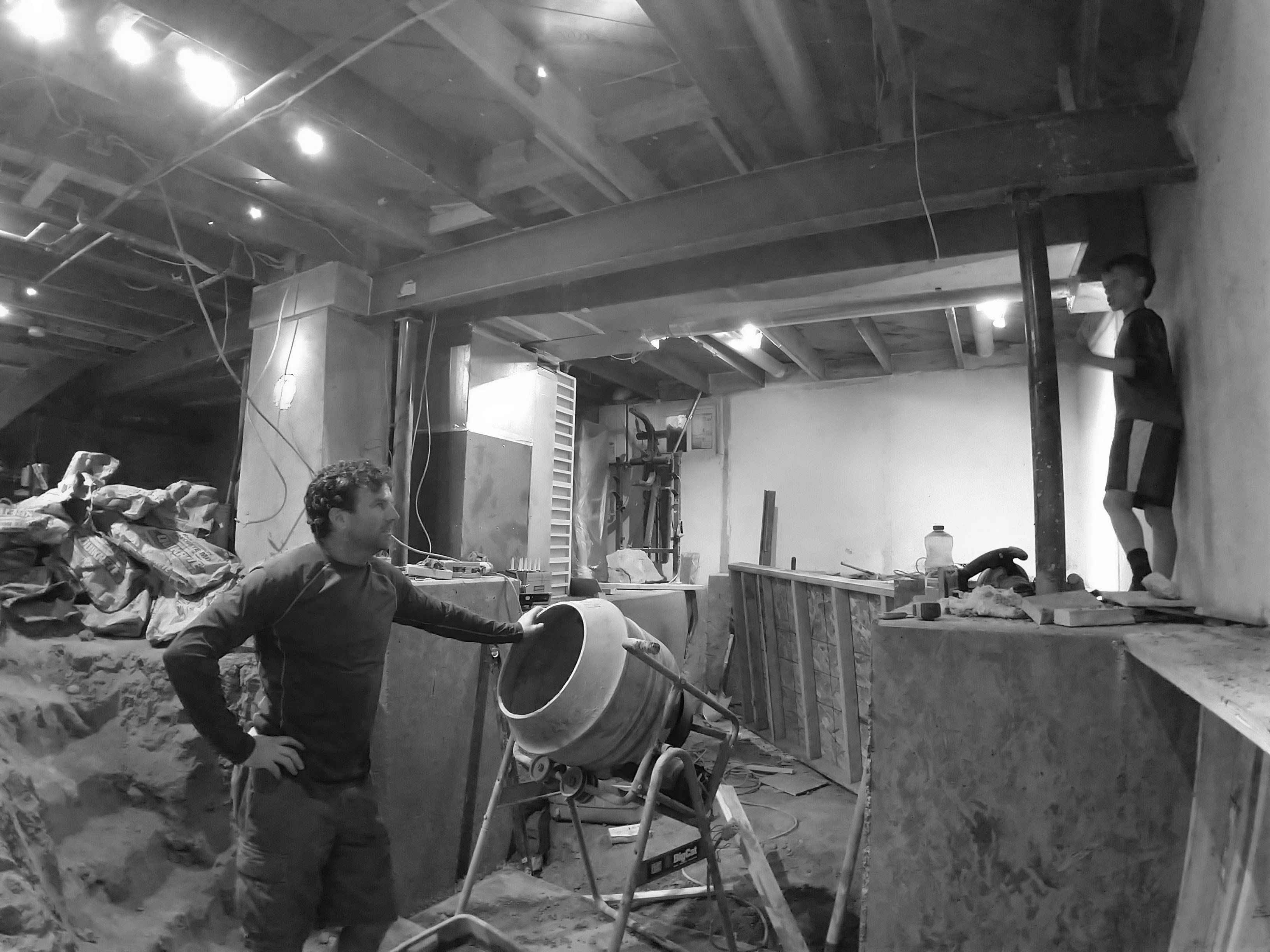
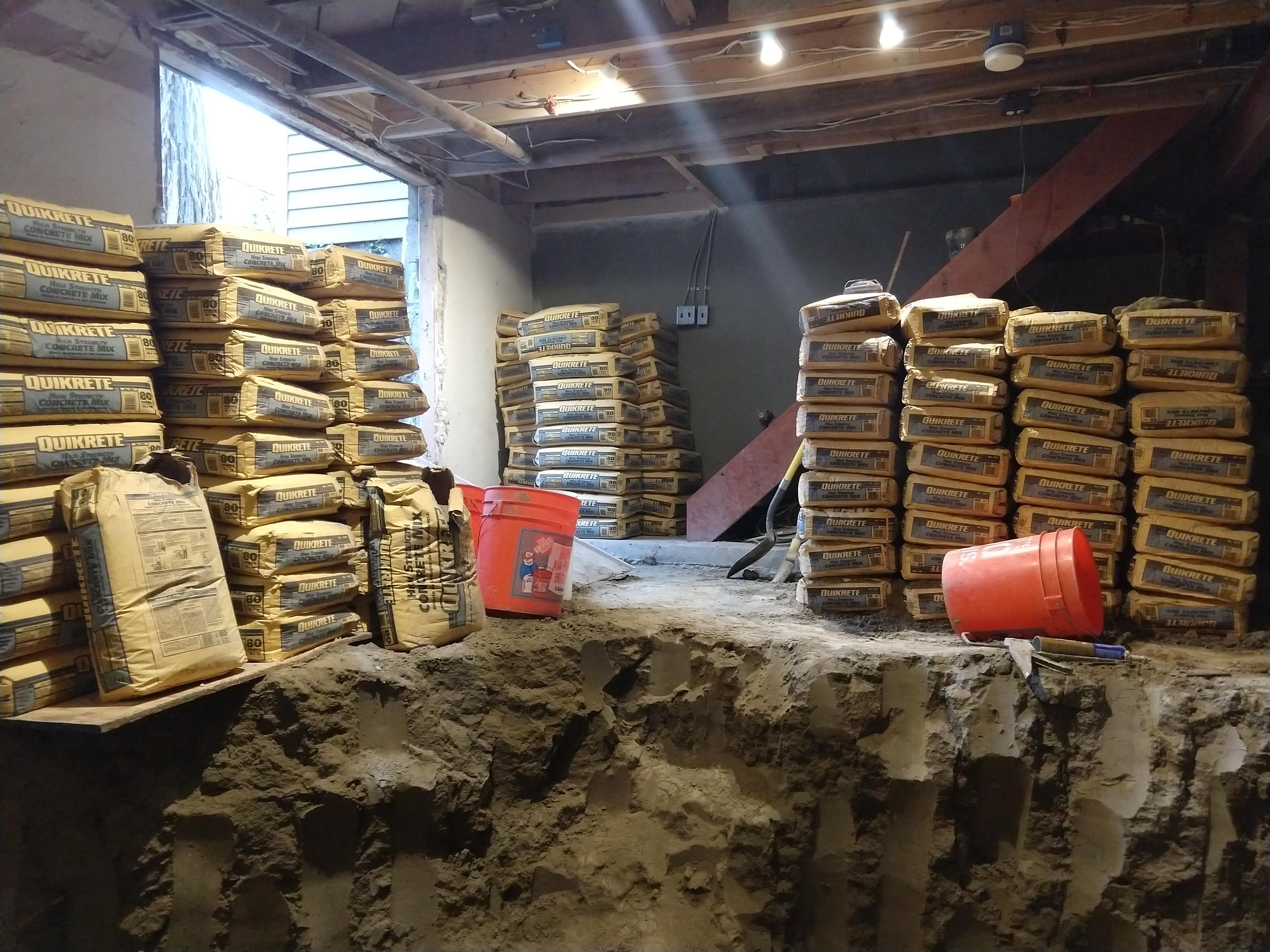
Luc takes a brief rest from digging out 30 tons of dirt from his own basement and hand-pouring a new foundation while his son supervises.

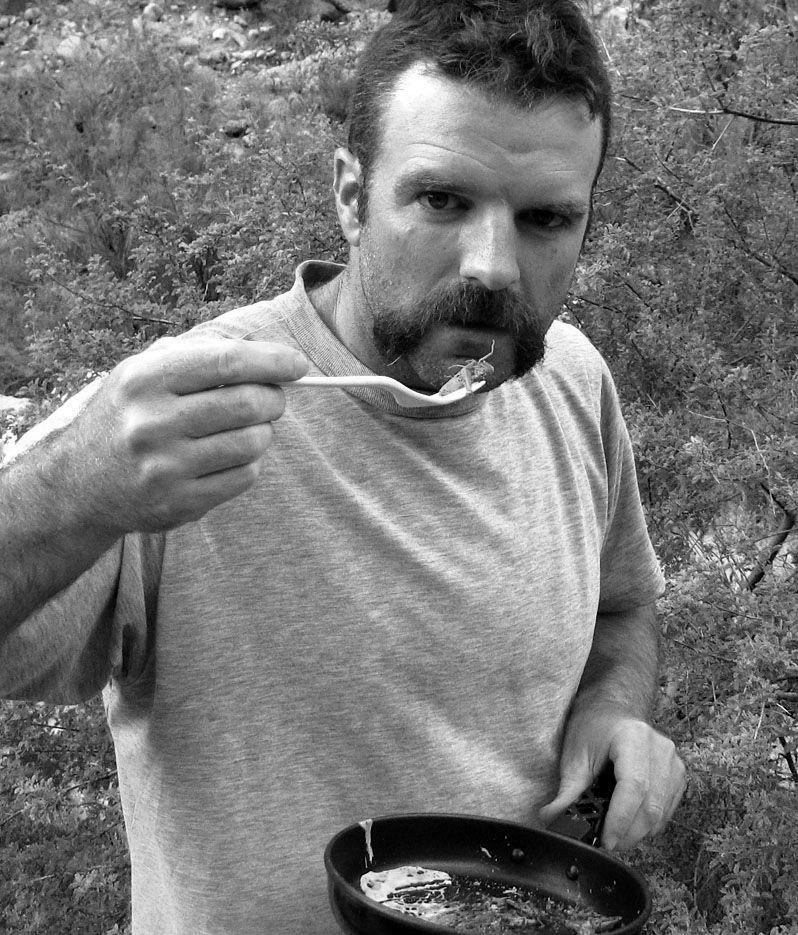
From painting houses to raising edible insects, selling handmade pine coffins to writing  and shooting his own feature length film in Scotland, all while never becoming too proud to take a literal Shit Shower while cleaning the sewer lines in his own rental properties, Luc’s story never fails to amaze. And it can be especially useful for those of us on the other end of the spectrum – wannabe entrepreneurs who are still hesitating to open our first small business checking account.

This story is a great financial lesson as well. Luc’s family* has gone from zero to financial independence without the benefit of the easy tech salaries that got my own household there back in the mid 2000s. Like most of us, they have seen windfalls and setbacks over the years, but the biggest factor in getting them to a better financial place has been continuing to get the work done, while choosing not to squander all of the proceeds on an ever bigger lifestyle.

So from this interview I’m hoping you will pick up both some inspiration for continued down-to-earth hard work, and a perspective to just go out and try new things, especially in the area of entrepreneurship.

If you do it right, there is upside waiting around every corner. So let’s get into the questions!

The Man Who Never Got a Real Job

MMM: The first moment we met was in July 2005, when I had just retired and we bought our first house in old-town Longmont, with a baby on the way. Walking through my new backyard, I immediately noticed two thirtysomething dudes in dirty clothes, working up on the roof of the old garage on your side of the fence. And I thought to myself, “These are my type of people!”, and walked over to meet you.

What was going on in your life at that moment, in both life and business?

Luc: Well, considering our daughter was born nine months later, it was near the end of one phase and the beginning of the next. At the time, my primary business was a house painting company that I had started in the late ‘90s, after my biology degree wasn’t enough to get me a job at a pet store (in Boulder you need advanced degrees for that sort of thing).

I had worked pretty hard to get that painting company up and running, starting as a one-man show, then employing as many as 18 people at one point. It was a good gig in that I had a lot of free time to work on other projects in the winters, and even went back and got my Master’s degree along the way.

By 2005, though, I had severely downsized the company and I was back to a small crew. I was beginning to think about what I wanted to be when I grew up.

One project we started that year was buying and quickly fixing up a house a few blocks from our place on a street called Carolina Avenue. This was primarily achieved by leveraging the equity we had built up in our first house. I still own and rent out that place (which you subsequently helped me do a more extensive renovation on).

MMM: So then we both had these children born at almost the same time, and all six people in our two families became friends. We both started helping each other with construction projects, but when Longmont denied my building permit application to expand our tiny 600 square foot house, I decided to move out and turn that one into a rental, and move into a bigger place a few blocks away. What was the catalyst that made you leave the little leafy paradise of that street? (and yes I realize this is a leading question :-))

Luc: The first thing is that old Happy Street is a pretty busy street, and with a young daughter, we thought it might be nice to live on a quieter stretch. One day my wife and I went for a walk and picked our favorite blocks in the neighborhood. There happened to be a “beautiful” old fixer upper for sale on one of those blocks, and within a few days we were under contract.

That we were willing to take the plunge so quickly was largely because of you and your construction company. At the time, I hadn’t done any extensive remodels, but because you were willing to help me out, I figured we could make it work.

At the time, my wife was certain that it would be a fix-and-flip and there was no way she would actually live in the house. Because it started out in such bad shape, it was hard to imagine it ever becoming a nice family home, but it really did in the end. So we we moved in at the beginning of 2008 and here I sit, typing away in the office.

The Rental Real Estate Projects

MMM: So, our biggest collaborations over the years have been in fixing up houses, often rental houses that one of us owned (okay most of them were yours.) We started with The Foreclosure Project  in 2011, then went back and did a major upgrade to one of your other places here in town. Most recently we did The Atwood Project, which was the inspiration for my post on Installing your own furnace.

How has your experience been in owning single family rental houses, while doing your own management and maintenance? Is it a reasonable return on your investment and labor?

Luc: There are a lot of real estate/rental experts in the Mustachian fold – I am not one of them, but real estate is the main reason we’re now financially independent.

We bought our first house in 1999 with $5000 from my dad and a $3000 courtesy check from Chase. We chose the house because it had a mother-in-law basement, with its own entry and kitchen – we went from paying over $900/mo in rent to having a tenant and paying around $300/mo toward our own house. We were fortunate enough that soon thereafter Longmont housing prices had a nice little bounce.

In 2003 I took out a home equity line of credit and we bought a condo in Fort Collins. A realtor soccer friend had given me a handy little spreadsheet that detailed all the ways to make money from real estate, and at the time it was hard to find cash flow properties in Longmont.

In hindsight, that first condo was a mistake. It was an hour commute to deal with any issues, it wasn’t a place I had much emotional attachment to, and it didn’t attract tenants who cared about it – it was a soulless investment. Nonetheless, we held it for over ten years, and finally saw some significant appreciation in the last few years (and it gave me my first taste of YouTube success with a video on How To Finish a Subfloor.)

I sold the condominium on Craigslist in 2015 and did a 1031 exchange for the Atwood Project – probably the most soulful investment I’ve made.

The lesson I learned from that first condo was that I wanted properties that were in my neighborhood, that I cared about, and that, when fixed up, made our community nicer. And of course they had to make money, too. Again, I was lucky enough that all those things were achievable here in Old Town Longmont, even through the recession.

Over the years, we leveraged our way into four rental properties in Old Town (moving into our current place along the way and turning that original home into a two-unit rental). The cash flow alone allowed me to spend less time painting and more on other pursuits. And my wife was able to move her teaching career down to half-time.

In 2016, I spent an average of under 10 hours per property – over the whole year – on maintenance and administration. Yes, there are occasional shit showers when cleaning out an old lead P trap, but most of it is more pleasant than that.

After finishing up the remodel work on the fourth and final property, we had 100% occupancy in all places and pulled in about $92,000 in rent; $36,000 after expenses.

Meanwhile, our longer term gamble on the livability of Old Town has paid off, as home prices have more than doubled here in the last several years, leaving us with equity close to $1.5 million (including the home we live in). The best example is the Foreclosure Project, which we bought for $113,500 in 2011, put about $25K into it, and is now worth over $300K.

To take some of that appreciation money off of the table, I chose to sell the most expensive of these houses last year, and re-invest the cash into standard stock market investments.

This is where MMM will probably caution you that not all real estate investment will go so well.

Building DIY Electric Cars

Although it’s no Tesla, this little homemade contraption was my first peek at the world of electric cars.

MMM: One of the most technically impressive things to me, was the time you read a book on converting an old gas-powered GEO Metro econobox car into an electric vehicle (EV), using basically a trunkload of golf cart batteries. And then decided to team up with a friend and try the same thing yourselves.

Not being auto mechanics yourselves, what possessed you to do this? And did it turn out to be a good business idea in the end?

Luc: Ha, this was a terrible business idea. I can remember sitting in the office of the City of Longmont fleet manager, trying to convince him to let us convert some of their gas pickups to electric; Fox News was blaring in the background and he was staring daggers at me. Needless to say, we didn’t get that gig, and that was probably a good thing, considering we didn’t have the expertise or capital to pull off truly decent EV conversions.

We did do a couple GEO conversions and an old Ford pickup, which was a lot of fun, but they were novelties more than anything. That was 2009, and it was an exciting time in the electric vehicle world. Lithium batteries were becoming more reliable and less expensive, the movie Who Killed The Electric Car? had come out a few years prior, Tesla was starting to make some waves, and of course addressing climate change was becoming more urgent. I wanted to do something meaningful, and I thought electric cars were the future of transportation. The cash flow I was getting from rentals had given me more free time. And I’m slightly crazy, so why not start an EV business?

At the time, Colorado had an amazing incentive for people to buy EVs. One of my favorite parts was arguing with the clueless administrator of the law for months, and then lobbying for sensible changes and clarification when they wrote the new law.

We spun off a new company, Boulder Hybrid Conversions, with two other guys (with more EV expertise), in which we converted Priuses to plug-in hybrids by upgrading them to a larger battery.

Meanwhile, largely thanks to my partner, our original business morphed from being a handcrafted car conversion hobby, to a reseller of electric car batteries and other components. It became one of the larger businesses of this type in the country, grossing over $1 million a year. I had a lot of other ideas for how we could expand the business, but my partner didn’t see it, so he ended up buying me out for about $125,000 (which, for all the time I put into the biz, turned out to be decent but not extravagant hourly compensation).

Boulder Hybrid Conversions became Boulder Hybrids, specializing in hybrid and EV maintenance and repair. One partner bought the rest of us out, and he continues to grow that business. I now own a 2013 Nissan Leaf and a 2015 Prius wagon (my off-road vehicle) and one share of Tesla, and I look forward to the day when I can buy an autonomous mini-van that will safely transport my family and me to Wisconsin overnight while we sleep.

Dead Pine Trees for Dead Bodies

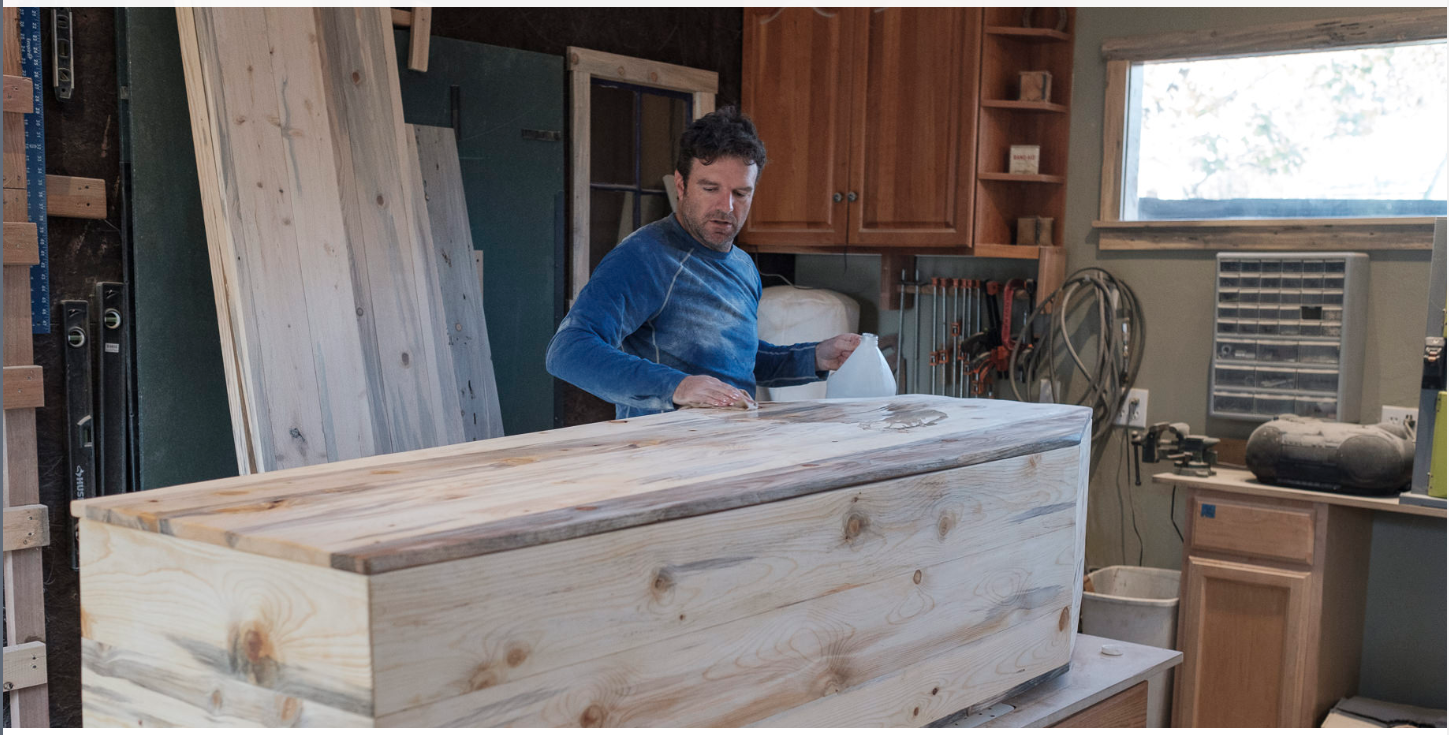
A handcrafted biodegradeable coffin takes shape in the handcrafted workshop. (image credit: Mat Bobby / Longmont Colony)

MMM:

One day, I got an email from you that said, “Well, I’ve done it again – decided to start yet another business. Building coffins from reclaimed beetle-killed pine planks”

So we both reviewed the simple plans from a book you had found in the library, built a prototype of this Dracula-style “toe pincher” coffin, and then you photographed it and put up a website. I gladly worked alongside you because I like hanging out and building things, but I remember thinking, “Luc’s really gone off the deep end here  – who is going to buy our DIY coffins??”

What was the motivation and the eventual fate of that coffin venture?

Luc: I started Nature’s Casket in 2009 for the same reasons I started the EV business: to do something meaningful for the environment. And because it was different and exciting. And because I wanted to help my brother with more hours when we had downtime from painting. All the remodel work we had done meant I had most of the woodworking equipment I needed to build coffins. And it was nice to have some technical, logistical, and, hell, labor support from old MMM to get it going.

The green burial movement, already well-established in the U.K., had been growing in the U.S., largely as a result of the Ramsey Creek Preserve,   a conservation burial ground that conserves the land in a natural state. Green burial is traditional burial: simple and environmentally friendly (none of the swimming pools full of formaldehyde that are pumped into cadavers, no unsustainably harvested wood, stamped metal caskets, toxic paints, concrete vaults, or pesticides and copious water for manicured cemeteries).

Here in Colorado, the pine beetle epidemic was devastating our lodgepole pine forests, but leaving a lot of dead trees with beautiful blue grain (from a fungus that feeds on the beetle’s waste).

With some support from Karen Van Vuuren, who runs a nonprofit helping families direct their own funerals (and has now started The Natural Funeral), I was able to start getting the word out and selling a few caskets here and there. And it turns out that the media is really interested in things like death and beetlekill wood.

The Denver Post ran a front page article on my business in 2010 – many people saved that article, and when they’re ready, I get a call for a casket (to this day I’m still getting calls from that article). The New York Times mentioned Nature’s Casket (they never contacted me, so my mom was the first one to tell me about that). The Wall Street Journal sent a guy out to do a piece on beetle kill (I wasn’t mentioned in the article, but had a lot of time in the accompanying video). National Geographic sent one of their photographers out to take photos of the caskets at a funeral, but we didn’t make the magazine. There was also a nice story in Longmont’s Times Call newspaper.

Soon I was shipping coffins around the country. One of the most interesting gigs was when we built and reinforced eleven oversized caskets (with MMM on welding and metalworking support) that could hold up to a ton; these were for the reinterment of a 19th Century family cemetery in Virginia that was being moved to make room for a high school football stadium (most of the remains were biodegraded, so they included all the dirt from each plot).

This is where I should mention that I’m kind of success-averse. Nature’s Casket could have been a large business with an industrial shop and a storage warehouse if I had pursued that path. Instead I stopped shipping (too onerous and stressful) and ceased most advertising. Now it’s just a local business, and I average less than one casket a month – it’s still quite rewarding, but there are other projects to focus on.

Miscellaneous Mini Businesses and Pursuits

MMM:

Scattered in among these years were a few smaller things. The time you started designing your own greeting cards and printing them on fancy textured recycled paper. Then there was Simple Brew Kits, which was just assembling the required components for converting good grocery store cider into booze. A photography pursuit that started with just taking your daughter to over twenty of Longmont beautiful parks and ended up culminating in a show at the city’s museum.

Oh! And then of course the time you went to Scotland with two friends and some quickly researched photo equipment and shot a feature length film that ended up in the Front Range Film Festival – despite the fact that none of you had any experience or training in filmmaking. What was that all about?

Luc: Recycled Greeting Cards was actually born in the late ‘90s, around the time I started the painting biz. At one point I had pretty high hopes for RGC, even attending the National Stationery Exhibit in New York. That business was mostly a failure, although I have one loyal business customer who still buys a thousand or so cards a year.

Simple Brew Kits was a business I started for a blog post that I never published titled “How To Start A Business In One Day.” And that’s essentially what I did, filling out all the paperwork and putting up the website in a day. I didn’t sell many, though, until your post about the business, after which I was suddenly inundated with hundreds of orders. That slowly tapered off, and recently I decided to shut it down for good. Again my success aversion won the day. But we made a lot of fun (and some disgusting) drinks out of that whole deal, and I’ll still occasionally bust out some fermented cider or grape juice.

The photography gig was a byproduct of becoming a parent. My daughter was born in the spring of 2006. After my wife’s maternity leave, I became a stay-at-home dad off and on for a couple years. I wanted a project that would get us outside, but that would also provide me with something exciting. I decided we would visit each one of Longmont’s city parks and take pictures. I just had a little point-and-click dealio, but it took decent pictures.

A few years and thousands of pictures later, I chose one photo from each park and submitted the project to the Longmont Museum. To my surprise, they accepted the show, and even helped me publish a book of the photos. It was a gratifying experience and has led to more photography projects – something I’ll continue to pursue.

The Scotland film, Carve The Runes, came from an idea I had many years ago to get a group of friends together, rent a castle in Scotland, and produce a music album (despite having no musical talent). Over time, the idea morphed into making a film instead. I was able to convince my brother Isaac and a good friend, Ian, that this was in fact a realistic and good idea.

And so, in 2015, we spent ten days traveling around Scotland, filming and, well, just filming – we didn’t have time for anything else. I had envisioned some time for fly fishing and golfing in between shoots, but damn, making a movie is hard.

The film is about two brothers, one of whom has a terminal illness and goes to visit his brother in Scotland, where he’s doing climate change-related research. The basic idea for the film was laid out beforehand, but most of the script was written on the fly (I didn’t think we would use a script). Ian was cinematographer/sound guy/key grip/best boy, and maybe more important, moral support. We didn’t sleep much, and we drank a lot of scotch. It took us a couple years, but we finally finished post-production at the beginning of 2018.

We submitted it to a number of film festivals, and were happy to be accepted into our local Front Range Film Festival, where we won Best Feature (out of a limited selection). The acting and cinematography are suspect, but the soundtrack (friends and acquaintances) and screenplay, if I may say so, are legit; I’d love it if we could remake this with some real producers and actors (Francos, Afflecks, are you reading this? Or maybe the leads should be sisters).

A Quixotic Urban Oasis and the Big Dig

A few thousand pounds of concrete? all in a morning’s work.

MMM:

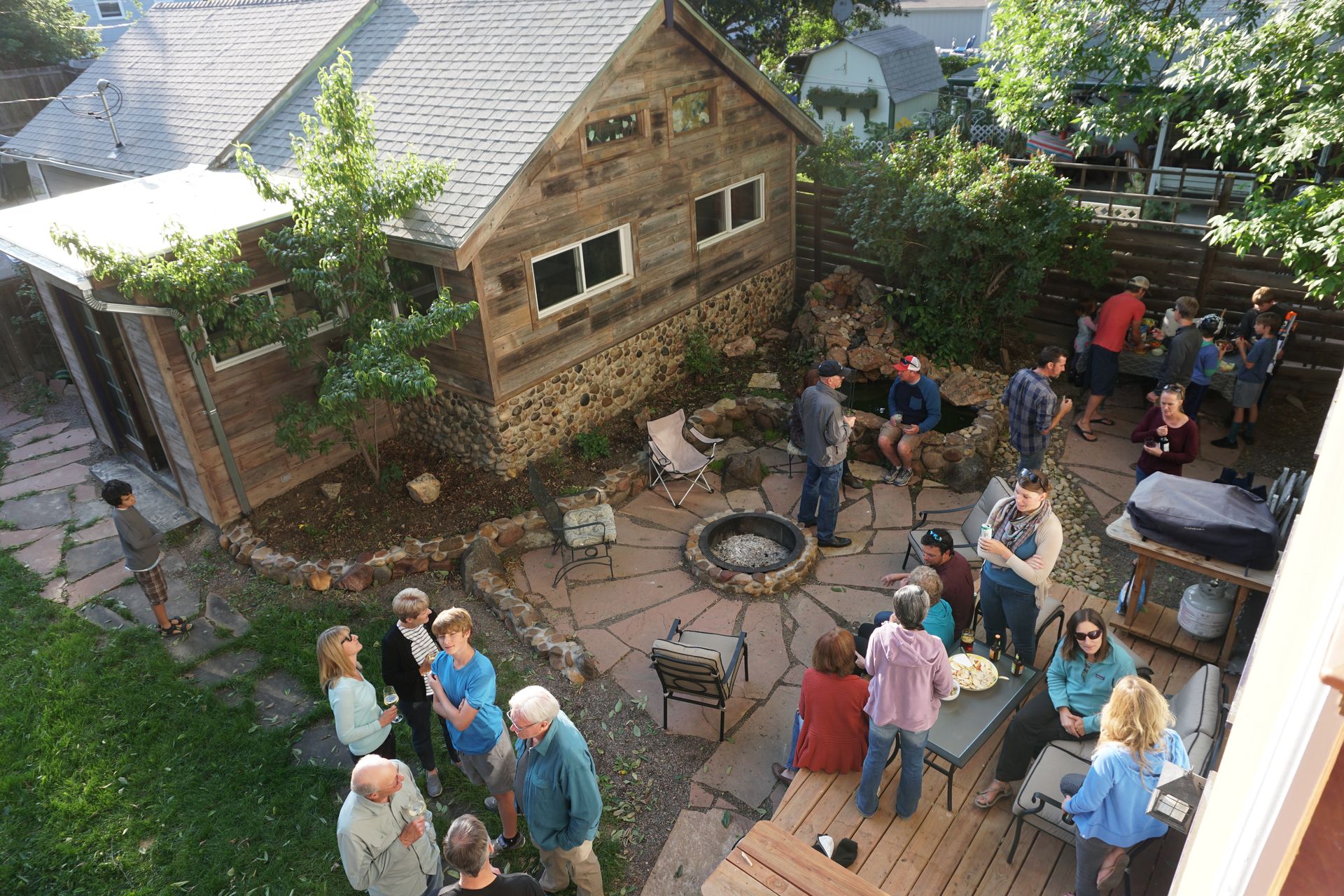
Surely the most concentrated demonstrations of your varied efforts and interests is in your own house. Because we restored it together from its original tippy skeleton into a solid and classy residence. But then a few years later went on to add a two story addition all the way up from the hand-dug structural piers. And then to build the garage workshop which has turned into an enviable hobbit-like enclave of living and productivity, both inside and out.

But all of this pales in comparison to the most recent upgrade, the Big Dig where you hand-dug about 60,000 pounds of concrete and soil out of your own basement (with occasional help from a beer-fueled team of other local Dads) to upgrade it from the typical Victorian house storage cellar into a very functional Man Cave complete with golf simulator and workout room.

What has driven you to go so far, when some people won’t even change a furnace filter? Any downsides and pitfalls?

Luc’s Hobbit-esque backyard oasis and workshop/garage, carved from an area that was originally just weeds and concrete.

Luc: I have labeled myself an eclectic: someone who loves to continually explore new ideas and embark on new adventures. The peril is getting so wrapped up in the novelty component that one never finishes anything – what I call dilettantism. This is part of my success aversion: I love to get a project or a business up and running, but it’s hard to continue to find it rewarding once it becomes quotidian. Routine is anathema to eclectics. Most of my projects reach a level of fruition that’s satisfactory to me, but I still think I can strike a balance that leaves things more complete.

To use my house as a metaphor, I’ve completed a number of satisfying projects (with a lot of help from people like you (mostly you, in fact)), but in the meantime many of the details have been overlooked: we need a new kitchen faucet, a toilet needs to be re-seated, I could organize the cookware situation better (and oh, by the way, I should probably spend a little more time with the family).

In the mid-aughts, I was working on figuring out what I wanted to be when I grew up – I decided to embrace my eclectic nature. Now in the late teens, I’m realizing I need to fine tune that to incorporate more focus, responsibility, meticulousness and perseverance.

Physical Fitness and Doing Experiments On Yourself

MMM: Another unusual trait I’ve noticed is that you seem to operate in extremes. You can eat a plate of cookies or drink a bottle of wine in one sitting, but then also go for three days straight with zero food during a fast. You’ve tried a variety of 30-day experiments in different eating styles, following them up with weigh-ins and blood tests to see how they affect your good and bad cholesterol counts. You adopted weight training and have stuck with it for many years now.

This is different from my own approach, where I eat roughly the same thing year after year, making only small tweaks – like I lift heavier barbells and eat more carbs if I want to gain weight, and cut out beer and go to bed hungry when I need to lose fat.

Have you noticed anything about the Human body and what makes it function best? Any advice for people who are prone to binging, on getting control of their eating and drinking habits?

Luc: Oscar Wilde, perhaps after bingeing on absinthe, said “Everything in moderation, including moderation.” That was kind of my motto for much of my youth, and it fits well with the eclectic personality. But if you only practice moderation in moderation, I discovered, you tend to feel like shit a lot and you weigh about 20 pounds more than you should. I’ve modified the motto to Everything in moderation, including gluttony.

I think everybody’s different in terms of what works best for them to stay in shape and feel healthy, but there are some common threads. In our simple carb-y society, one of the easiest ways to eat better is to cut out most simple carbs (but, if you’re like me, allow yourself an occasional plate of cookies).

After all my fasting and intermittent fasting and super low fat and super low carb and alcohol temperance experimenting (and reading the research), I’ve come to a few fairly simple conclusions. First, a low glycemic diet (like the Mediterranean diet) seems to be the best. And eating within a fairly small window each day, say from noon to 6, is healthy. Of course, less alcohol on a daily basis is good.

With the new gym, I plan to have a regular but varied workout that includes weightlifting and short bursts of intense cardio on the bike. And, for eclectics like me, mixing it up and allowing myself to occasionally break the rules is key to continued success.

The YouTube Channel and Online Pursuits

At some point, I remember you started documenting your projects on YouTube. This has grown into a bit of a “channel” where at least one of your videos has over 100,000 views.

I have always hesitated to put up videos myself, because so much of YouTube is slickly produced and well-edited today and I am shy to put up my amateur work – much like the fearful theme that started us off on this whole article today. But you didn’t seem to care, and you just did it, and now the channel is out there.

How has your YouTubing experience been and do you have advice for anyone else? How hard would it be for a YT channel to become a successful business?

Luc: Ha ha, yes, the YouTube project has been quite an adventure. Currently there are three videos with over 100,000 views, including the Atwood remodel video, with over 750,000 views (you’re in that video – how does it feel to be a rock star?). What’s funny is the Atwood video was really poorly produced, yet it still somehow went semi-viral in the spring of 2017, spiking from an average of about 400 views a day to a peak of 21,000 views. That tapered off over the next year and a half, but I’ve made almost $1500 on that video. I’ve been trying to push the traffic from that vid to an updated and better produced version of the video, with limited success.

Like a lot of my other projects, the YouTube project has been a gung ho endeavor, jumping in with both feet in spite of limited skill and experience. A more well-thought out plan, executed with better focus, may have lead to more success. Then again, it might not have gotten off the ground if I had been too cautious.

In my newly grown up and focused life-phase, I hope to grow the channel into one that attracts more subscribers and maybe even provides enough income to buy more than a meal out on the town every month. Still, I have to keep that eclectic feel – I mean who doesn’t want to see everything from remodel work to creative pumpkin carving to insect eating to casket building to Trump parody to crazy body hair shaving? I have about 30 projects in the can as we speak, just waiting to be edited and uploaded.

(MMM note: did you catch that? Thirty projects we haven’t even mentioned in this article, including the time he tried to earn a Guinness world record by carving a 27 foot “Mustache” into his own body hair?)

The best advice I can give to aspiring YouTubers is don’t have a shaky camera – man does that drive people nuts, as I’ve been told again and again by people who watch the original Atwood video (there’s a lot of anger out there, as you well know, MMM). There’s something to be said for the amateur folksiness of YouTube, but there’s a balance between unwatchability and being too slickly produced (I’m still working on finding it). I’m probably the wrong guy to ask about what people want to see, but I imagine it’s pretty much anything you have an interest in, as long as the video is useful or entertaining.

Financial Independence and What’s Next?

Neighbourhood friends sampling Luc’s Sauteed Crickets at a party

MMM: As the years have gone on, you’ve remained a self-employed person and never stopped working hard on things. But I have noticed your work progressing from hardcore grinding out of professional painting jobs near the beginning, to more eclectic stuff now that is less income oriented. For example, the time you raised edible insects in your basement and researched and wrote an academic paper on how good it would be for the world if we switched some of the rich world’s meat consumption over to nutritionally superior stuff like cricket flour or bee brood. Not a lot of money in that type of thing, at least not to pay this month’s grocery bills.

What has been your secret to this decreased pressure on income making, and would you say you have a better work-life balance now than you had back in 2005?

Luc: Primarily because of my real estate investments, I’m fortunate enough to be in a position where most of my projects don’t need to make money. To me, the end goal in life is fulfillment, and the only way to achieve fulfillment is by making the world a better place, whether through service to the community, producing beautiful works of art, fighting for peace and justice in the world, writing a blog that denounces materialism and promotes sustainable living (wink wink), or just by being a good person to those around you.

A lot of my projects still focus on things that improve my own life, but more and more I hope to work on projects that help others, from the hyperlocal (being a better father and husband and friend) to the local (being more involved in our community) to the global. On the local front, one project you and I have worked on a little together is trying to get more solar power in Longmont. On the global level, I’ve been working with my father, E.G., on The Cooperative Society Project, a decades-long project that looks at the potential for humans to make the transition to a new stage of human interaction: one driven by cooperation rather than conflict.

The way I see it, the beauty of financial independence isn’t freedom from work, it’s the freedom to work on a fulfilling life.

An Afterword from MMM:

So this is a long article. What does it have to do with YOU and your own financial independence?

I have wanted to share these tales because they’re a great example of the idea of living with less fear. The neat thing about Luc’s entrepreneurial ventures is that he is willing to do things, even if he’s not skilled or experienced at them.  They often don’t pan out, and that’s okay, because it’s okay to fail. In most cases, failure is just a lesson that leaves you further ahead than when you started, with some great stories to show for it too.

But to minimize the damage of failure and maximize the chance of success in entrepreneurship, Luc and I have both noticed a pattern over these thirteen years:

  • Start Small and Just Sell Something – most failed businesses start with borrowing and risk. Instead, you should find a customer first and get them interested in buying your stuff. Only after the sales come, should you reinvest some of this money into a bigger business.
  • Hard Work Can Save You from your Mistakes – when you’re getting started in anything, you will make expensive mistakes. But you can dig in harder and correct them and learn from them.  You need to be willing to launch the business out of your spare room, be your own janitor, and make late night runs to the supply store or the post office to get those shipments out. Plenty of time for kicking back and gathering passive income later on, once the business is profitable
  • Keep Life Simple, Frugal and Stay Focused – a business takes time to build and it takes a while for it to start producing money. But if you enjoy it as your source of entertainment, it will naturally get the time it needs: Spend your weekends in the workshop instead of the golf course or the ski hill. And if you let go of material desires, you won’t be nearly as hungry for money. So while a $20,000 per year hobby business won’t even cover the lease payments on your neighbour’s pickup trucks, it may be more than enough to keep you well fed and happy, for life.

If you’ve got a lifestyle business that you love, feel free to share it in the comments below and inspire the other people reading alongside you.

* In this article I profile Luc, but he is of course part of a hardworking and resilient family of four. His wife is also a friend of mine and an equally wonderful person, but I have kept this story just focused on Luc in the interest of the privacy of the rest of the family. 

Further Reading:

Poppa’s Cottage YouTube Channel

Poppa’s Cottage Blog

Updated Atwood Remodel Video

Carve The Runes Trailer

How To Build A Coffin Video

Portraits of Longmont Parks

The Potential For Entomophagy To Address Undernutrition

 

  • βœ‡Mr. Money Mustache
  • How to Retire Forever on a Fixed Chunk of Money
    These last two articles have focused on how common it is for early retirees to continue making money after they say goodbye to the cubicle. I share stories like that because I’ve seen it happen in so many lives, including my own. Plus, if you do it right, work is fun. But the downside of all this “side hustle” talk is that you can take it too far, and people start to think that early retirement is possible only if you keep making money afterwards. To the point that I&rsqu
     

How to Retire Forever on a Fixed Chunk of Money

29 November 2018 at 21:01


These last two articles have focused on how common it is for early retirees to continue making money after they say goodbye to the cubicle. I share stories like that because I’ve seen it happen in so many lives, including my own. Plus, if you do it right, work is fun.

But the downside of all this “side hustle” talk is that you can take it too far, and people start to think that early retirement is possible only if you keep making money afterwards. To the point that I’ve now been hearing many thirtysomething millionaires saying things like,

“Sure, the numbers say I’ve easily reached financial independence, but I’m not even going to touch my nest egg until I’m 60.

So these days, I just do a bit of unpleasant consulting work here and there to cover my expenses and to get the employer subsidized health insurance. “

On top of that, it is hard to get mainstream financial advisers to admit that there is such thing as a finite chunk of money that you can live safely on, forever. They say stuff like, “Financial independence is great, but truly retiring from making money? Forget it.

Related: your spending can be more efficient if you channel it through a good rewards credit card.

This is where Mr. Money Mustache puts a stake in the ground.

Because it IS absolutely possible and in fact very easy, to make a chunk of money last through your lifetime. There is no magic or unusual risk or hope involved, it’s just plain math.

Even with all the complexities of the modern financial world with its booms and busts, OPECs and Brexits and the churning sea of changing politicians and dictators, it still all boils down to a really simple number. And we can illustrate it with this really simple example:

Let’s say you want to be able to spend $40,000 per year, for life, and have that spending allowance continue to grow with inflation. And you never want to make another dollar from work in your lifetime.

In this situation, the following three sentences represent the entire universe of probability for you:

  • If you retire with $800,000 in investments, you will probably make it through your whole life without running out of money (a 5% withdrawal rate)
  • If you start with a $1 million nest egg (a 4% withdrawal rate), you will very likely never run out of money
  • If you start with a $1.33 million chunk (a 3% withdrawal rate), it is overwhelmingly certain that you’ll have a growing surplus for life.

Now, these statements do all depend on the continued existence of a productive human race which continues to innovate and trade and not destroy its own productive capacity.

But you know what?

  • In the event of a global apocalypse, you won’t be thanking yourself for spending those last few years in the office accumulating a few last shares of index funds anyway.
  • The strategies described in this blog are designed to shift us all to a more sustainable, healthy, productive economy. So when you live a Mustachian lifestyle, you’re boosting the likelihood of an apocalypse-free future for all of us. Thus, because of you, We are all going to do just fine.

So. A fixed chunk of money is about as safe a retirement strategy as you’ll ever find.

It’s safer than relying on any job, because keeping a steady job depends on the overall economy remaining healthy enough to feed your company, your company remaining solvent, and you remaining productive and useful to that company.

Meanwhile, a good investment portfolio just depends on the world economy in general continuing to exist.

But once you’ve got that chunk, how do actually convert it into a safe stream of lifetime income?

In other words, most of us get to the door of financial independence with something like this:

A complex financial picture with lots of dollar signs – but can you retire on it?

But what we really want is something like this:

This is how money flow really works in early retirement..

So What Is The Problem?

Most people get stuck on the same three questions:

  • What investments do I use to provide a lifetime of income?
  • A big chunk of my savings are in 401k or pension, locked up until I’m 59. How do I retire at 35?
  • How can I pay for (US) health insurance on a $3300 per month budget, when I’ve heard monthly premiums can exceed $1200 per month for a family of four?

The great news is that there are easy answers for all three. They are just not widely known because true early retirement (with no backup income) is such a rare field that very few people write about it. So let’s bang out those answers right here:

Investments:

The Simple Path to Wealth is a short book on investing that convinces you that the simplest strategy is also the best.

As always, I suggest that you only need one thing: a generous bucketload of low-fee index funds. It can even be a single index fund if you want to keep it even simpler: Vanguard’s VTI “Total Stock Market Exchange Traded Fund”

Whether you own these funds through your company’s 401(k) plan, or the brokerage account of your choice, or a Vanguard account, or through an automatic management service like Betterment* as I do, doesn’t matter. What matters is that you are buying pieces of real, profitable companies, which pay dividends and appreciate over time.

Okay, got the funds, Now What?

Okay, you’re 35 years old, you have saved exactly one million dollars, and handed in your resignation.

At this point, you will probably have at least two chunks of money: a normal chunk (also known as a taxable account), and a retirement chunk (perhaps a 401k, IRA, or pension).

Let’s suppose it is divvied up like this:

When you retire early, you Use up your taxable accounts first.

On your first day of freedom, you log into your account, find the option for what to do with dividends, and set those to get automatically deposited into your checking account.

Right now, the VTI fund happens to pay a 1.89% annual dividend, which means that the $500,000  account in that green box above will pay $9000 in annual dividends straight to you.

Then, if you’re shooting for $40,000 of annual spending, simply set up an automatic monthly withdrawal of an additional $31,000 per year ($2583 per month) to be sent to your checking account, which is set to automatically pay off your credit card, which you use to buy your groceries.

But Won’t I Run Out of Money If I Do This!?

That’s the magic of early retirement math – the answer is NOPE! Because check out how this plays out:

  • Because of those withdrawals, your account will lose a few shares every year.
  • But because of natural stock market growth, your account will be fighting back and each share will be worth a bit more.
  • Thus, your money lasts much longer than it would if you were just keeping it all in a checking account or stuffed in your mattress.
  • So a quick spreadsheet simulation of this drawdown reveals that your account survives almost 23 years. At which point you are 58 years old – almost eligible for penalty-free withdrawal of your true retirement money.
  • BUT, during this whole time, that other $500,000 in your retirement account grew untouched (and untaxed), and it’s now worth about $1.2 million dollars even after accounting for future inflation**. In other words, you have WAY more than enough to live on forever at that point.

Here’s a quick spreadsheet with simple assumptions and 4% after-inflation stock market returns. In this situation the first 500 grand lasts about 23 years.

And here’s the same thing, except I did it in Betterment’s fun retirement income simulator, using a 95% stock portfolio. This version is slightly less optimistic, but still gets us out to almost 20 years in the most probable scenario.

If you have a really large locked-up retirement balance and a small taxable account, you might want to tap into the retirement account sooner. There are ways to do that penalty-free too, see this earlier MMM article for a few ideas.

The overall lesson: It doesn’t matter how you have your investments split up between normal investments and retirement accounts. It just matters how much you have in total.

Heck, even if you are stuck with a $1 million house occupying a huge part of your net worth, you can convert that into livable money: sell the house, put the cash into index funds, and use the resulting cash stream to rent a spiffy but reasonably priced house or apartment in the lovely walkable area of your choice.

Okay, What About Health Insurance?

If you are stuck in the world’s most expensive medical care market like I am, the most profitable investment of all may be salads, bikes, and barbells because these virtually eliminate the “lifestyle diseases” that trigger about 75% of US healthcare spending.

But even so, most people choose to insure against surprise medical bills, and people with existing medical needs depend on help with those costs.

The good news is, the politically controversial Affordable Care Act actually handles this much better than most people assume. If I go to healthcare.gov right now (or in my case the Colorado-specific equivalent) and put in a hypothetical 4-person family with a $40,000 annual income in my zip code right now, I see this:

This represents a cost reduction of $830 per month relative to what a high-income person would pay for the same coverage. So in other words, the United States just has a progressive tax bracket system like other rich countries, chopped up a little differently. It’s not great and to be clear, this is shitty health insurance because it has a high deductible. But at least it’s not a retirement-buster.

Other Things You Probably Don’t Need To Worry About But Everybody Does

What if Stocks fall or My Cost of Living Goes Up?

Stock market crashes are never permanent. In the long run, the market always goes up. So all that happens during a crash is that those few shares that you do sell during those brief times when the market is down, will hurt your account balance just a bit more. Within a year or two, the market is back up and your remaining stocks are more valuable than ever. If you want even further reassurance, you could just choose to spend a bit less money during this time.

As for your cost of living going up faster than inflation – it rarely happens. And if it does, you can adjust by spending less in other areas. Most things are in your control, especially if you take a big-picture view. You can shop around, move, and alter your lifestyle in a million different ways, and in fact this is really good for you.

Standard retirement advice is based on protecting people from any form of hardship or change, which is completely counterproductive. In the right quantity, these are the backbone of a good life and the fuel for personal growth. Without them, you will melt into a whining puddle in front of a television that endlessly blares Fox News.

Every Financial Advisor (even Betterment!) Seems to Suggest Lots Of Bonds, – Why Does MMM Only Hold Stocks?

The quick answer is that stocks earn more money on average, especially right now in 2018 with bond yields so low. Sure, stocks are more volatile, but volatility only bothers fearful people who look at the stock market every day and fret when it jumps around. As a Mustachian, you don’t do this. Lower stock prices are simply a temporary sale on stocks.

What About All Sorts of Other Stuff Not Covered in this Article?

The absolute key to success in early retirement, and indeed most areas of life, is to get the big picture approximately right and not sweat the small stuff. And design the big picture with a generous Safety Marginwhich allow lots of slop and mistakes in your original forecasts and allows you to still come out with a surplus.

For example, in the story above I assumed a $40,000 annual spending rate, which is way more than almost anyone really needs to live well here in the US, especially once your kids are grown. I completely ignored Social Security, which will benefit most people at a level between $1000 and $2500 per month for a big portion of their older years.  I ignored any incidental income or inheritances or profits you might make on selling your house someday, and the list goes on.

So that’s the line in the sand.

Although I personally think working hard almost every day after your retirement is good for you, it is also completely optional, and you do not have to earn any money at it if you don’t want to.

A chunk of money is a perfectly good retirement plan, and the math doesn’t care if you are retiring at 5 years old or 85. If you get the numbers right, you’re set for life.

—–

*Betterment, Wealthfront, and Personal Capital are investment management systems known as “Robo-Advisors”, which typically buy shares on your behalf and then add on features like rebalancing, tax loss harvesting and personalized advice. I happen to use Betterment because I like the interface and benefit from their tax loss harvesting more than pays for their service fees in my own tax situation.

Betterment purchases a flat rate advertising banner elsewhere on this site, although I don’t get paid for mentioning them or for any new customers they might get. And blog affiliates/advertisers have no say in what I choose to write.

** For this calculation, I assumed the stock market delivers a 4% rate of return including dividends, after inflation. (or roughly a 6-7% total annual return)


  • βœ‡Mr. Money Mustache
  • The Economics of Divorce
    Even in the most carefully run and financially independent of lives, there will be some wrenching twists and turns. Friendships and businesses will fail. You or your loved ones will get sick and some of them will die. Kids will have plenty of trouble on their long road to adulthood – if they even make it. And all around you, there will be a sea of fighting and breakups and divorces and mismatched relationships that you wish would end, for your sake or that of your best friends. With all o
     

The Economics of Divorce

31 December 2018 at 23:51


Image result for heart break emojiEven in the most carefully run and financially independent of lives, there will be some wrenching twists and turns.

Friendships and businesses will fail. You or your loved ones will get sick and some of them will die. Kids will have plenty of trouble on their long road to adulthood – if they even make it. And all around you, there will be a sea of fighting and breakups and divorces and mismatched relationships that you wish would end, for your sake or that of your best friends.

With all of this happening, it’s a wonder that we can remain happy and productive and even thrive as humans. But we can. And we do. Because sometimes life just serves up a shit salad and we don’t have a choice in the matter, but we always have a choice of how to respond to it.

So if you haven’t already heard through the rumor mill, the former Mrs. Money Mustache and I are no longer married. Although we had been drifting this way for a while, the formal change of our status is still less than a year old, so it’s still a topic that deserves some quiet respect*.

The downfalls of our own relationship are personal and not something we choose to make public, but you’ve heard it all before anyway. Sometimes people just grow apart over the decades and no matter how much they work at the relationship, find that they want different things from life. And when this happens, not even the greatest advantages of a lifetime money surplus or a supportive network of great friends and family or living in a beautiful place can save you.

Update: Some of the negative speculators have assumed “your wife dumped you because you were too frugal.” This part may be necessary to address because of the money theme of this blog.

The answer is NO. I was the one who asked for the separation so you can blame me for it. And no, there were no frugality issues because earning and accumulating money was always extremely easy for us. We spent whatever we wanted, we just happened to have finite desires. Plus I was not the “boss” of the house. Mrs. MM has always been an independent-minded person who is good with money and decides on her own spending.

So that’s the bad news. The good news is that we have had about the most amicable separation that one could hope for, we all still spend plenty of time together and our son is still in the same loving environment he has always had. And I would venture to say that both of us parents are going to come out of the experience much better off than we were before.

See, even the harshest moments come with a little golden key taped secretly onto their side, which you can use to unlock personal growth and greater future happiness. But only if you choose to accept that key and put it to use.

I’m not going to sit here and pretend that there weren’t plenty of harsh moments for both of us, both before and during this experience, with plenty more still to come. Because divorce, especially with children and family and traditions involved, is really fucking hard. 

But guess what? There are a lot of things in life that are hard. Being born and going through childhood is hard. Having babies of your own is even harder. School and jobs are hard, and money is really hard for most people. Relationships and friendships and dealing with bossy or dysfunctional friends or family or parents, personal habits and addictions, and everything else. Life is full of hardships.

But throughout all of it, we always have a choice about how to deal with them.

We can choose to focus on how unfair the situation is, how we were right and we tried our best and the world still mistreated us. And we can fight back, chasing the unfair person or company or situation and get revenge. We can make sure they know exactly why they were wrong and every way in which they were flawed.

And we can collect bathtubs full of sympathetic tears from our friends. And burn years on reliving the past, with a mixture of regret and vengeful self-righteousness and self-pity.

– OR – 

We can get right back to work on positive things to rebuild our lives. Improving ourselves through better habits and health. Building new relationships and nurturing old ones, and making sure we put out only positive energy to every person in our lives, including our ex-spouse. Building everyone up and never, ever tearing anyone down. Because they already do that plenty to themselves.

Like almost everything else in life, human nature draws us to the easier but more destructive of these paths, and only self-knowledge and self-discipline can lift us out of that rut and place us onto the more productive one. And even then, our human nature will keep pulling us back and we’ll make mistakes. And then we’ll have to drag ourselves back out of that rut again. And put the happy face back on, and start behaving like an adult again.

As one friend puts it, “Being a divorced coparent is like being the co-owner of a business. Except it’s the most important company in the world and having it fail is not an option. So you have to treat your business partner accordingly.”

It has been a hard year. But at the same time, I feel we have both already learned so much, that it seems almost impossible that the experience won’t help both of us live better lives in the future. We are both doing well in forming new relationships and supportive of the other’s success in that important aspect of moving on.

But this is usually a personal finance blog. What does my romantic life have to do with your financial life? Not too much in the specifics, but quite a bit in general, because about half of all marriages end in divorce, and I have found it can be quite a tricky minefield to navigate.

First of all, there is the effect on your child raising, which is a parent’s most important job in life. In the best scenario, the end of a marriage is just a change to your love life, and you can continue to collaborate with your former spouse in a wonderful and open way. But the more conflict you have with that ex, the harder it is to cooperate, which leads to a worse experience for everyone – especially your children.

Then there is the social shame attached to divorce in our culture. While it could be looked at as the natural and peaceful end of an arrangement that has just run its course, other people will see it as a failure or a betrayal or a sin. In fact, when rumour of our separation got out, multiple gossipy and negative and downright distasteful discussions formed around the Internet – on Reddit, other bloggers’ websites, even right here on my own forum. People who don’t even know you, will speculate on your character and your motives. It adds pain to an already difficult situation. The only way to survive this is to ignore it and focus on your own internal compass.

And finally there is the famed financial cost of divorce. It is legendary for destroying lives and fortunes, and indeed this is sometimes accurate. This is because conflict is a form of war, and war is the most expensive thing humans have ever invented. And if you hire lawyers and other specialists to fight on your behalf, you just multiply the damage and the cost and stretch out the timeline.

But fortunately, like everything else, going to war is almost always a choice.

And if you don’t choose to fight, a divorce doesn’t have to cost much at all. Two people can peacefully collect up their financial and physical belongings and go their separate ways, and the only cost is in any duplication of possessions you choose to do, to replace things you formerly shared.

So the former Mrs. MM and I (mostly under her guidance!) worked through the do-it-yourself paperwork and paid a $265 fee to the county court for the divorce. I bought the lowest-cost house in the neighborhood, just a 2.5 minute bike ride down the hill from the family house, and I’ve already fixed it up and started hosting Airbnb rentals to help make it carry its own weight. I left the Nissan Leaf behind and chose not to buy a car of my own because I already have bikes.

We share plenty of time with our son and he is doing amazingly well – because we are choosing to make this new life about growth rather than conflict.

And most notably from the perspective of early retirement and financial independence, having enough money in advance has made this part of the split much less painful. Both of us can remain retired and continue to live in mortgage-free houses with investments easily covering our living expenses, while sharing child raising expenses. Although I chose to buy a house, nobody had to compromise on quality of life or sell the expensive family house.

Because I enjoy moderate living for its own sake, my own cost of living will go way down. And because I continue to enjoy writing and working, my income may continue to stay high through this next stage of my life. I’ll continue to use the surplus for projects and philanthropy just as before, but the point here is that one’s relationship status does not have to affect their financial status.

As a long-time reader said to me in a recent email as we discussed our shared fate, having a solid financial cushion and low expenses and lifestyle flexibility, has made the best of an otherwise difficult situation – especially in not having to disrupt the lives of our kids.

Still, having been through it, I would not recommend divorce as a decision to be taken lightly. If you’re still married and there is even a chance that you want it to last, you might consider the following steps.

How to Stay Married

Read about how to stay married – early and often. Peruse the bountiful relationship advice section at Amazon and definitely check out the 5 Love Languages book that resonates strongly with so many people.

Most of us (myself included) drift through the years, assuming we are doing a perfectly good job at being married, while unintentionally making all the same mistakes that everyone else makes.

Bad idea.

You need to proactively nurture a close, loving relationship before things get too dire, and never take it for granted. Because many bits of damage you do to a relationship are permanent. You cannot nag or criticize your partner for years and expect them to forgive you when you eventually see the light. And for those being nagged: you cannot ignore the requests of your partner for years, and expect them to forgive you for that either.

There are so many things, like being on each other’s team in times of hardship, and being genuinely excited and greeting your partner warmly at the door if they’ve been away, that fall to the side in marriages as they get stale. Every time you let this slide, you do a bit of permanent damage. The effects are cumulative like erosion, not temporary like moods or weather.

So the bad news is that there is definitely such thing as “too late.” At some point, the idea of “working on” a marriage sounds like hell because you have been waiting for so long to be able to escape it.

But the good news is that it might not be too late for you, if you do want to stay married. And the benefits begin immediately – if both people are working at it, every positive gesture from one side will be met with a positive one from the other, and they can reinforce each other into a beautiful upward spiral.

But if You’d Rather Not Stay Married

The flipside of all this is that many, many people are currently married, who should not be and don’t want to be.

You may be two perfectly great people with irreconcilable differences, or there might be one great person stuck with an abusive user or loser, or any other combination in the grand spectrum of possible humans. And it is important for these people to hear that although divorce is always difficult, sometimes it really is the best choice and there should not be shame or blame associated with this choice.

Every human needs and deserves to be accepted and loved – even the people who drive us crazy and even those who treat us poorly. They are who they are and while you can’t change them, you can’t make the world any better by spitting venom back at them. So your best strategy is to carve them out of your life, while keeping your words as kind and respectful as you possibly can.

And heed the wise words of my own relationship and coparenting counselor, who noted that the first months after any divorce are the times of greatest conflict. And then it gets easier. And easier. And mellower and friendlier. And after a few years, many former divorcees have moved on so happily that can’t even believe that they were ever angry at each other. That’s entirely possible, and it should be your goal.

So lean on friends, talk to a relationship counselor even if it is just by yourself (yes, it’s really worth it!), read books, laugh, cry, learn mindfulness and meditation, eat salads, get outside and exercise, write more new things and build new things and new businesses and new relationships, and you will come through it better than ever.

That’s what I’ll be up to in 2019.  I hope your new year is even better!


In the Comments: I have found it so helpful over this past year to share with others and realize that I am not alone in this. Feel free to share your own experiences and hopes and fears anonymously.

My comment form allows you to use a pseudonym so you can be anonymous while you let out the truth. And read the other comments, to see what other people around you are feeling.

And for those who have been through this and gotten through the other side and found happiness, go ahead and share your message of hope.


* A bit of social approrpriateness that seems to be lost on certain forum participants and even other bloggers, who we won’t call out here. Please don’t be like them – using the Internet to publicly gossip about strangers helps nobody.


  • βœ‡Mr. Money Mustache
  • How To Slow Down Time and Live Longer
    “They sure grow up fast, don’t they?” “The older you get, the faster time flies.” “You can’t slow down time, so treasure your days because they’ll be gone before you know it.” We’ve all heard these thoughts, often from the parents of grown children. If you’re part of the older and wiser population, you may have even spoken similar words yourself. And if you’re younger, you may have felt fear well up in your heart as your el
     

How To Slow Down Time and Live Longer

29 January 2019 at 03:17


“They sure grow up fast, don’t they?”

“The older you get, the faster time flies.”

“You can’t slow down time, so treasure your days because they’ll be gone before you know it.”

We’ve all heard these thoughts, often from the parents of grown children. If you’re part of the older and wiser population, you may have even spoken similar words yourself. And if you’re younger, you may have felt fear well up in your heart as your elders dropped this bit of Bummer Wisdom upon you. The Inevitability of Life Racing By.

But your fear is unfounded.

Related imageBecause somehow, I seem to have stumbled upon a workaround to the problem of life being too short, and instead I find myself existing in a different universe of Vampire-like perpetual renewal and the feeling of youth. While other parents of almost-thirteen-year-olds claim the time has gone by in a flash, I feel I’ve had my own son for at least 30 years.

And those same thirteen years since I retired from real work have also been packed with an almost inconceivable variety of experience. Adventures in business, travel, relationships, weddings, funerals, adventures, injuries, growth, definitely at least the recommended minimum dose of pain, but a much bigger amount of joy.

Reflecting back on it all always leaves me shaking my head in a smiling disbelief and muttering at least one involuntary “Holy Shit.” I feel like I have lived an entire human lifetime, or maybe even more than one, in just the years since I hung up the keyboard and walked out of that cubicle.

I look at this strange development with great gratitude. After all, if we are going to assign any purpose to our lives, it’s probably something like “Make the most of the time you are here, and try to do some good while you’re at it.”

So if I feel like I’ve already had a spectacular amount of time and Made the Most of It, you can imagine how lucky I feel to still have so many more decades worth of it potentially still in the tank!

What do you think could be going on here?

As it turns out, I am not the first one to wonder this. And there is some real science that connects a Mustachian Early Retirement to a life that feels much longer and more full, even before we get into the reasons you will probably literally live quite a bit longer as well. The key to this is in the way we perceive the passage of time.

Figure 1: Some of Eagleman’s Intriguing Books I’ve read (click for more.)

A few years ago, I stumbled upon the work of the modern-day Indiana Jones neuroscientist/author/adventurer David Eagleman, immediately developed a Man Crush and started working my way through his books and interviews. It was exactly what I was looking for at the time: a bigger picture on why our brains behave the way they do in many different realms of being alive: emotions, decision making, happiness, and of course our perception of time.

Like many people who were born with an engineering side to their brains, I sometimes feel like I’m standing with half my body outside of the human species, observing with Vulcan-like amusement how crazy we all are, and the other half firmly inside it, being whipped around by all the same joyful and tumultuous and passionate and irrational emotions as everyone else. So it can be very satisfying to try to put it all together, by embracing all that humanity but also understanding it from a bigger perspective.  Books like Eagleman’s are a lot of fun and useful in that regard.

So by reading books like Incognito and The Brain (along with this interesting profile on him in the New Yorker), I was able to learn a lot more about the nuts and bolts of my own existence as a creature, which I find is a very useful antidote to prevent me from taking myself and my moods too seriously as a person. And it also helps me get the most of the gigantic arc of a human lifespan with all of its details, without getting too hung up on whether I’m “doing it right” or fussing about our inevitable mortality.

Image result for brain

This is your brain on MMM

That compact but powerful brain of yours is more than just your thinking appliance. It’s your entire world, because it controls every bit of your interaction with the world, plus the way you feel about it. And one of its trickiest roles is in sucking up and storing every experience you ever have, and filing those experiences away so that you can recall the most important ones, all while leaving you able to focus on immediate tasks without becoming completely batty from this ever-growing pool of past experiences.

So the brain uses a few tricks in order to keep you sane. And the best way to sum up its approach to things is this:

To focus on the novel and important-seeming things, and mostly ignore everything else.

We’ve already covered the remarkable subject of human habits, where we learned that our brains tend to click us into little autopilot routines whenever possible to avoid the strain of puzzling consciously through every single moment, of every single day.

So an average person might go through routines like …

  • “get out of bed” 
  • “make some coffee and breakfast” 
  • “get dressed up and drive to work”

… in an almost unconscious fashion.

Habits like these are convenient, but they can also compromise your full enjoyment of life. Because when you are running on autopilot, you are not forming nearly as many meaningful memories. And if you do it long enough, your brain will also start clumping entire phases of your life into individual thoughts:

  • “my childhood”
  • “high school”
  • “the college years”
  • “those years I worked in Des Moines as a fertilizer salesman”
  • “the baby-raising years”
  • “my 25 year career as a Middle Manager in Megacorp”
  • “my golf-and-TV retirement to a Florida condo”

If you look back at your own phases so far, which ones do you remember being the longest and most vibrant?

For most of us, it ends up being the ages from about 6 through 21, because these were the times of greatest change, learning, and new firsts in life. Then as we get older, we lock ourselves into family and work routines, including the most time-compressing of all: a multi-decade period of having the same house and the same career. The years go by, but significant new experiences become more and more rare.

Mustachianism (even if you are a long way from early retirement) is thus the perfect antidote to this, because I am always encouraging you to try new things and maintain an eye towards constant optimization.

With practice, you will let go of your natural fear of failure, and start thinking of everything as an opportunity for an experiment. Or as the great Bob Ross would put it, “There are no mistakes in life, just happy accidents.”

Although you will be fighting the very core of your Human nature with this activity, it’s a fight worth picking, because you are immediately rewarded with a life that is wealthier, more satisfying, more interesting, and one that feels much longer.

To put this philosophy into practice immediately, all you need to do is start throwing some changes into your daily routine. A few ideas ranging from beginner to expert:

  • Take a different route to work than you usually do, and a different route home. Pay attention to the new experiences you have on this journey.
  • Shop at a different grocery store and get ingredients that you don’t usually get, in order to eat different meals than usual.
  • Try breaking your usual morning routine by going out for a short walk before you have your breakfast and sit down for work. (I happened to do this today, and it led to me feeling great, and my walk turned into a run, and the added energy from that led me to sit down with inspiration to write this very article for you.)
  • Find a way to meet a new person every week, or at least every month. People are the most powerful gateway to new memories and a longer, richer life.
  • Switch roles in your company, or switch to a new job.
  • Remove TV, news and social media from your daily routine or limit them each to five minutes per day. Then when you feel the inevitable pull to check in, use this as a “keystone habit” to grab your paper to-do list and start working on something from the list – even if it’s just ten push-ups, or picking up an old-fashioned paper book you are working through.
  • Move to a new apartment or house that is closer to work and to worthwhile amenities like public parks and waterfronts.
  • Start your own small business and begin building it up, embracing change and setbacks until you find something that is truly rewarding.

All of these things will shake up your life for the better, and they will restart the flow of new memories, waking your brain back up and extending your time of really being alive.

For my part, life keeps getting more varied with each passing year, and time keeps getting slower and slower. Here’s to you and I clinking our glasses together in the distant future, after several more centuries of the joyful Vampire-style youth that is early retirement.


In the Comments: what have your experiences been, with periods of your life where time has flown by, and others where your memories are particularly rich and detailed? And if you’re an early retiree, what has your experience been with the flow of time since you pulled the plug?


Selected quotes from the NY article that I liked: 

“Clocks offer at best a convenient fiction, he says. They imply that time ticks steadily, predictably forward, when our experience shows that it often does the opposite: it stretches and compresses, skips a beat and doubles back.”

“When something is new or more emotional, the amygdala seems to kick into overdrive, recording every last detail of the experience. The more detailed the memory, the longer the moment seems to last. “This explains why we think that time speeds up when we grow older,” Eagleman said—why childhood summers seem to go on forever, while old age slips by while we’re dozing. The more familiar the world becomes, the less information your brain writes down, and the more quickly time seems to pass.”

  • βœ‡Mr. Money Mustache
  • Four Ways We Can Hang Out
    A recent campfire at in the back yard of MMM-HQ coworking space. Hi there. Don’t get too excited, this isn’t a real blog post. But there were enough things worth sharing that I thought it would be worth sending a little mid-month Hello. Life has been busy around here, drunkenly walking that fine line between the zones of “Exciting and stimulating and action packed!” and “Way too much overflowing action, how do we turn off this firehose?!” It’s one of
     

Four Ways We Can Hang Out

11 February 2019 at 18:42


A recent campfire at in the back yard of MMM-HQ coworking space.

Hi there.

Don’t get too excited, this isn’t a real blog post. But there were enough things worth sharing that I thought it would be worth sending a little mid-month Hello.

Life has been busy around here, drunkenly walking that fine line between the zones of

“Exciting and stimulating and action packed!”

and

“Way too much overflowing action, how do we turn off this firehose?!”

It’s one of the core Tenets of Mustachianism that too much of a good thing can become a not-so-good thing, so I have been working on stepping back and focusing on the smaller and more personal things with the people who are close to me, even if it means turning down bigger, “important” sounding things out there in the world.

If you are an overdriven and success-oriented career person, you can take the same lesson: your PERFORMANCE out there on the business stage is a lot less important to the world than you imagine it is, so now is a great time to lean back and take a few breaths and turn down that extra work assignment so you can spend Saturday just digging in the sand at the playground with your kids.

Okay, so with that take-it-easy warning aside, here are a few things that have been keeping my local gang and I busy recently:

1: We have expanded the MMM HQ

MMM watches as Alan Donegan’s Charisma steals the show at September’s Pop up Business School

Some adventurous friends decided to dive in with me and team up to buy out the other side* of the building that houses my little coworking space in downtown Longmont. As a result, we have now quadrupled our interior space and are looking for new members!

In the spirit of adventure and growing the community from the current 50-ish to a new goal of two hundred, we are no longer limiting it to people who live right in Longmont – you can be the judge if it’s worth $52 per month to be part of our growing entrepreneurial gang.

You can join here immediately if you are super confident,

or read more about it at mrmoneymustache.com/hq/ or even stalk us by following the new MMM-HQ Twitter and Instagram feeds.

2: I started a YouTube channel with my son!

Over the long holiday season, my 12-year-old son and I were spending a lot of time together. He has become a prolific music composer and video editor and posts something to his own channel almost every day. So he often ribs me about my own neglected MMM YouTube channel, with just a few halfhearted construction videos I had thrown up to illustrate certain things as part of blog posts.

Long story short, we just turned on the camera and started recording some Question and Answer shit and putting it up there, learning as we go. So far, it’s a “He’s the DJ, I’m the Rapper” situation, but I hope to get him to come out from behind the camera one of these days too, at least for a cameo.

The result, our first six figuring-it-out-episodes, is here and we definitely plan to do more:

The MMM Channel on YouTube

It has been a lot of fun so far, and an incredible bonding experience for the two of us, to be working on something difficult together. I’m even paying him for his work and we will also split any resulting revenue from YouTube (currently a not-too-bad thirty bucks in the first month!), as I think this is a great way for a kid to learn more about money.

3: I’m part of The FI Summit

One of the members of my coworking space is an enterprising dude named Sean Merron, who also runs a podcast called 2 Frugal Dudes. Over the past year I’ve come to respect his work, so when he invited me along with some other very genuine financial independence writers to join a little online course they are running in March, I was happy to accept. I am going in as a newcomer to such an experience, so it’s an experiment.

The event takes place live on March 5-7, with course material and replays available afterwards.

You can join us (and read all about it) at https://fisummit.2frugaldudes.com/ and get 10% off with their coupon code MMM.

4: Mustachians are Uniting

This isn’t just a website or even a ‘movement’ anymore. There are real-life friends, and potlucks, hikes, local and international trips, and even romances going on out there and I have had great fun watching them all develop over the past few years. A few ways you can get involved in real life:

Camp Mustache was the original meetup – About sixty people in a beautiful rented lodge in the rainforest outsid of Seattle. Five years running now, it is small and well established, so it always sells out much quicker than any resonable person could be expected to buy tickets. It is the only event I’ve attended every year. But it set the stage for its international cousin …

Camp Mustache Toronto is a similar but more Maple-flavored event, also in a lakeside natural area far enough from the concrete jungle that it feels like a genuine camp. This year’s event is in September. But Camp Mustaches are just the start of it all.

Camp Fi is a more ambitious string of events, spawned by an unstoppably friendly and optimistic guy named Stephen who liked Camp Mustache so much that he decided to adopt the principles and take it from coast to coast. They have run something like a dozen already, and there are more coming up on the calendar.

The NoCo Mustachians Meetup Group is a 400-strong club of fun and FI seekers in my own area. There is a nice, sociable overlap between members of MMM-HQ and this larger group, so they often use our building to host their larger events.

The ChooseFI Meetups: if my hobby of “Financial Independence Guru” were an actual business, I would never tell you about this, because these guys would be my toughest competition. Growing from nothing to hundreds of thousands of followers in just the last few years, I have heard about more Choose FI meetups than Mustachian ones in recent times, and some existing MMM groups have even been so bold as to rename themselves from my silly (but more fun) terminology to adopt some version of the more bland and sensible “FI” branding.

Fine, have it your way, FI people – your ability to get together and have fun in the real world is way more important than appeasing Mr. Money Mustache’s ego, so I encourage you to get out there and enjoy it all.

And with that batch of suggestions, the clouds have suddenly cleared up outside my own window, so I am going to fold up this laptop and head out on the town myself.

Have a great week!


*People familiar with the project may be asking “What about the Mud and Madder soap and handcrafted shop that was there before this?”

The answer is that the ladies who owned that side decided to close up their retail experiment and return to the more efficient model of online Etsy-style sales. They offered to sell me their side, so I gladly brought in three new friends to become partners in the newly expanded coworking venture.

  • βœ‡Mr. Money Mustache
  • How to Create Reality
    So a funny thing happened on Twitter this week, which almost changed the world a little bit. Someone sent me a beautiful 3-D mockup of a fictional, car-free city of 50,000 people, set in the scenic nook of land* between Boulder, Colorado and Longmont, where I live. It came complete with street plans, detailed descriptions and dozens of cool photos, both real and computer-generated, showing how it would feel to live there. They called it Cyclocroft, in honor of the generally pro-bike stance of M
     

How to Create Reality

27 February 2019 at 20:48


So a funny thing happened on Twitter this week, which almost changed the world a little bit.

Someone sent me a beautiful 3-D mockup of a fictional, car-free city of 50,000 people, set in the scenic nook of land* between Boulder, Colorado and Longmont, where I live. It came complete with street plans, detailed descriptions and dozens of cool photos, both real and computer-generated, showing how it would feel to live there. They called it Cyclocroft, in honor of the generally pro-bike stance of Mustachian culture.

This was not out of the blue: these plans came from some long-time readers, who have heard me muse about better cities in the past. Over the last few years, I have come to realize that the fastest way to get my fellow Americans into healthier, wealthier lives is probably just to change the way we lay out our living spaces. Instead of wasting trillions of dollars on separating and isolating ourselves just to accommodate giant racetracks for our gas-powered wheelchairs, we could make everything about 75% less expensive (and many times more fun) by making cities that work without cars.

So anyway, these architects sent me the plans, and I put them up on Twitter with a comment about how they’re fictional but boy wouldn’t this be a nice way to use a single square mile compared to what we do right now.

One square mile of suburban Detroit. Note the amount of space wasted on accommodating cars. Without the cars, you could house AND employ about 50,000 people with this much land.

I thought that would complete my social media indulgence for the day, but NO, things were just about to get interesting.

That night, an MMM reader who also happens to write for Forbes, wrote to me asking if he could do a story about Cyclocroft. He also pulled in the designers Tara and John from B4Place. And the next day, this rather racy article showed up in the news:

Whoa there, Forbes!

While the story was technically accurate, calling me a “Wealth Guru” instead of an “Early Retirement Blogger” definitely amped the intensity. And words like “Plans” and “has teamed up with” made it sound like things were very imminent and real, rather the just a set of pretty pictures I was happy to share.

But the world started to react as if Cyclocroft really were real. Twitter responses and emails started coming in from people who would buy properties and move there, if we really built it.

Even more notably, my email inbox and even the voice mail of my supposedly private mobile phone, started filling up with notes from news agencies and big players in finance and real estate, asking if they could do news stories and/or help get involved in building Cyclocroft.

Forbes – Wealth Guru Plans Dutch-Style Car-Free Bicycle-Friendly City Near Boulder, Colorado

Curbed – Could a car-free, Dutch-style city work in Colorado?

The Real Deal – Imagine a city with no cars, free bikes — and 50,000 people in one square mile

Boulder Daily Camera – Mr. Money Mustache has no formal plans to build dense, ‘car-lite’ city between Boulder, Longmont

The Chief Marketing Officer of the nation’s largest mortgage providers (who I was surprised to learn is also a longtime Mustachian) came to my coworking space and we talked for two hours about whether we could make it a reality. Because, aside from the potential to improve world through better design, residential housing is the world’s largest market, worth trillions of dollars.

Now, just in case you have any illusions about Mr. Money Mustache’s superpowers, it is important to remember the real story. I am a retired, stay-at-home Dad who occasionally types shit into the computer, and that’s the end of it. On the average week my biggest “business” meeting is a Tuesday morning workout in the back yard of the HQ for some squats or deadlifts with a friend or two.

Actual day of work. Does this look like a City Developing Wealth Guru to you?

Now, this Cyclocroft bonanza is still cause for celebration – all this attention and energy will definitely not go to waste. I really do plan to nudge this country towards its rightful status as a Badass Utopia – it’s a lifelong project for me, and we are only about eight years in. It’s just that Starting a City right now does not play well with my other project of Raising a Boy, a contract which still has about five years left on it. I’m not a great multitasker so anything outside of that job has to be low-stakes and with complete flexibility.

But there’s still is a heck of a life lesson in this story, that can help all of us change our lives. It’s on par with the lessons of the Optimism Gun, and the Circle of Control.

The lesson is to Begin with the End in Mind – and Start by Painting a Beautiful Picture of that end  destination.

It’s the technique at the core of the world’s best marketing and negotiation strategies, and it works so well because it short circuits the human brain into making everyone – including you – see things in the desired way.

I’ve known this for a long time, and applying it is the reason for most of the successes I’ve had in life so far. Yet I still sometimes get sloppy and fail to use it, and sure enough many of my failures can be tracked back to that sloppiness. Let’s check out a few examples of Painting the Picture in real life so you can see exactly how this works and how powerful it is.

When I started this blog in April of 2011, I didn’t just start rambling about interest rates or student loan debt. And I definitely didn’t mention carbon footprints or get into environmental guilt-tripping. The first sentence of the first post is “What do you mean you retired at 30?”

Retired. At. 30.

It was a simple picture of a very clear end destination that automatically got people’s imagination running and filling in their own details.

Everyone knows that a 30-year-old is a fairly young adult with lots of promising life ahead of them. And everyone knows that “Retired” must mean some unusual financial accomplishment was involved, which makes them imagine what their life would be like with that sort of money.

In retrospect, that marketing decision was the main thing that has made the MMM blog catch the attention of newspapers, which in turn brought in the readers, which in turn kept me motivated to keep writing it. So painting that initial picture was an amazingly big leverage point.

And Cyclocroft worked in exactly the same way. You’ve heard me harping almost daily about “live close to work and ride a bike”, but this produces only small changes in the world. You are still fighting the car-based design of your city, your car-loving spouse, and all of the excuses that pop up from looking at the small day-to-day picture.

But Tara and John bypassed all of those arguments by sharing a simple, beautiful picture of the end lifestyle, with just enough detail to provide a framework that got everyone’s imagination running.

Car-free city. Next to Boulder. 50,000 people.

People read these key points and see the pictures, and in their minds they are already nestled into this bucolic town in the Sunny Western US at the base of the Rocky Mountains. For most people, the sale is already made and now they are ready to hear the details – most importantly “How can I get you my money?!”

Once you go looking for this pattern, you see it everywhere, especially in the most successful bits of persuasion in the world.

Tesla almost completely took over the coveted luxury car market with no paid advertising, even while its competitors fought tooth and nail with their old ads, by painting a clean-slate picture: clean, beautiful, prestigious cars that are the fastest in the world. They were introduced to the world as if they were movie stars, rather than squeezed out through the crusty sphincter of an old corporate marketing department as most cars are. They can even make a commercial hauling appliance into a rockstar that has everyone waiting breathlessly for its world-changing arrival.

So How Can You Use This Amazing Power on Your Own Life?

We can see how this works by painting a few pictures of our own:

You want less money stress in your life:

Describe the picture of your ideal financial life. Your house is paid off, the kids are well cared-for, and you think about money no more than you think about tap water. It’s just there, so instead you spend your time figuring out how to get more fulfillment out of each day.

Then to get there, you suddenly feel the motivation to streamline your spending (and perhaps optimize your earning) today. It’s no sacrifice to skip over a car upgrade, if it rockets you towards this clear picture of your future life, right? And conversely, making the car upgrade is suddenly less appealing if it means you will be extending your time on Cubicle Lockdown by three more years and pushing off the beautiful picture you have painted for yourself.

You wish your spouse was on board with more frugal living:

You won’t get anywhere by nagging your partner that she needs to take shorter showers or telling him to give up his Porsche convertible. The only hope of teamwork is to agree on the end goal: do you want financial freedom more than you want the Porsche, or not?

Well then, what does financial freedom look like? Perhaps it includes being able to stay home to raise children, or to have more time to travel together, or to pursue part-time meaningful work instead of full-time-just-because-I-need-the-money careers. Or something else you can both agree on. This article on Selling the Dream describes a case study where this method worked beautifully for a couple.

Once the dream is there, the daily steps that move you towards it become easy and obvious.

You want to earn your dream job 

Rather than sucking up to the company or stepping through your individual qualifications and acronyms of all the programming languages you know, begin your campaign as though you’ve already won.

Describe (with beautiful pictures of your past work and future proposals if appropriate), the way that things will work, once you are working with the company. The ways you are excited to build the culture of the group you will be joining and managing, and why that is destined to influence the entire company over time. This vision of you excelling in this job needs to become a crystal clear anchor in the company manager’s mind, that lodges itself in as the way things are going to be. From there, it becomes difficult to dislodge.

These same principles work in both large and small situations, for persuading any range of people from just you up to the entire Human population. From getting into better physical shape to winning an election.

My own Failures to Paint the Picture

When I look at my own areas of less-than-satisfactory performance in recent years, they all carry the hallmark of scraping along from one daily hardship to the next, while neglecting the big picture.

My former wife and I did not keep our own marriage alive, and it may be partly because we didn’t think of what we wanted a good marriage to look like. We just reacted to the ongoing realities of daily life, doing more damage as time went on.

My son copes with some anxiety and can tend to be an extreme homebody, avoiding all new situations if not challenged to do otherwise. But if you work at it, you can get him out for adventures, and he always has a great time. And his Mom has shown much greater skill than me in making these things happen.

But far too often during our days together, I will make a few offers to go out and do things together, then give up and feel deflated when he rejects them. And I come back the next day and try the same thing, and I usually get the same result.

But if I paint the bigger picture well in advance – for example of a two-night camping trip with his favorite friends and their dads and kayaks and sand dunes – the chance of a breakthrough greatly increases.

The recipe for change is right here in front of all of our faces. It’s up to us if we are bold enough to paint the picture, and then do the work that will become obvious once that picture is hanging on the wall in front of us.

Okay, but When Do We Get To Move to Cyclocroft?

I am happy that this big, beautiful picture of the future of North American city planning is now out there, creating an anchor in the public mind that is bound to stick. That alone is an amazing accomplishment.

For my part, I’d love to help out in many ways. But at the same time, the picture I have painted for my own life does not involve being a property developer. I’ve done that on a small scale in the past and learned there are other people that thrive on the phone calls and meetings and contractor cat-herding much more than I do. So as much as I’d love the results, I’m not willing to do the workAnd this is a great thing to know about myself, because chasing accomplishment and prestige and things that seem “important” is not necessarily the path to a happy life, if you don’t enjoy the work along the way.

But with the right group of people working together on the aspects they truly enjoy, it really could happen. Tara and John like designing spaces. I like describing things to the world, but also solving physical and engineering problems. You might like running a restaurant or a bike shop, or playing in a jazz trio. It takes all sorts of people to build a new city and change a culture, but as long as we are all working on the same end goal in mind, we will definitely get there.

——


* Never mind that this particular chunk of beautiful land is currently a NOAA facility! The real point is that when you only need one square mile, you can fit a world-changing city almost anywhere, including into the corner of an existing large family farm.

  • βœ‡Mr. Money Mustache
  • How I Sold This Website for $9 Million
    Dearest Readers, I’ve been waiting to tell you this with considerable excitement for a whole year, but the sales contract prevented me from doing so until this moment. And as of April 1st, 2019, I’m officially free to reveal that: Mr. Money Mustache has been sold! Yep. I’m not sure if it’s the age-old truism that “Everybody has their price”, or the fact that I got bored after eight years of writing it and just ran out of things to say, but over time I have co
     

How I Sold This Website for $9 Million

1 April 2019 at 16:38


Dearest Readers,

I’ve been waiting to tell you this with considerable excitement for a whole year, but the sales contract prevented me from doing so until this moment. And as of April 1st, 2019, I’m officially free to reveal that:

Mr. Money Mustache has been sold!

Yep. I’m not sure if it’s the age-old truism that “Everybody has their price”, or the fact that I got bored after eight years of writing it and just ran out of things to say, but over time I have come to realize that it was time to pass this golden opportunity on to someone else.

The highest bidder in this case was Shamrock Financial Trust*, a financial products company in the Isle of Man, UK that specializes in special premium investments that beat the market while dodging the taxman.

I was unsure of exactly why Shamrock would be willing to pay so much for my collection of five hundred articles mostly about spending less money and investing in index funds. But when you put six zeroes after a number on a check, it is amazing how quickly uncertainty and questions can vanish!

From my understanding, a site like MMM has a certain value just from its ranking in the search engines, and ongoing traffic of several million page views per month and about 33 million unique visitors over its lifetime. But still, those are just numbers on the page and don’t seem real because I haven’t been taking full advantage of the opportunity.

But, the Shamrock leadership team has assured me that the site will take on a vibrant new life, with a team of professional writers churning out fresh content on the daily, and an SEO-optimized stream of monetized offers that deliver maximum value-added solutions to all stakeholders.

And I just thought I’d reach out to see if we could jump on a call to catch up on the bleeding edge of some big data, to see if there’s any Corporate Synergy in our Core Competencies.

Fuck! Don’t you hate corporate bullshit and business buzzwords? Me too.

(thanks to reader Ron Cameron in the comments below for mentioning this incredibly appropriate Weird Al / Crosby Stills and Nash song. It is SO good!)

It was both fun and sickening for me to type that cheerful little story, but hopefully you realized from the title alone that it is April Fool’s Day, and I thought I should play along with a preposterous headline of my own.

In reality, of course I have no desire to sell this website, because doing so would violate some of the core math of early retirement happiness:

  • It would subtract something from my life that brings me true happiness (the ability to be in touch with you, which in turn brings more friends and lots of challenge and a sense of meaning into my life)
  • while adding more money, which would make absolutely no improvement to my life because I am not feeling any pain due to a shortage of money.

And that’s the real reason I figured this lame April Fool’s prank also contained a life lesson that was worth sharing as a blog article. Because I am still hearing from people every day who are selling out their own lives for their careers.

So many people are using a successful working career and earning loads of money as an excuse for not facing the realities of life.

Although this is certainly not a gender-specific problem, as a 44-year-old man living in a wealthy area I am surrounded by peers who are afflicted by this disease of Success-itis.

People who are rockstars in the corporate sphere and at the peak of their careers, who have become so addicted to the activity that they can’t see they are just chiseled Kuhl-clad rodents jogging in the latest trail runners on a gilded hamster wheel.

Career success is a very sneaky thing, much like a layered salad of Superfood Greens that gradually devolves into a dessert of Creme Brulee enhanced with crystals of Crack Cocaine as you dig deeper. It starts out with all sorts of self-actualization and personal growth, but as you begin dining you are also hooked up to intravenous feeds of ego stoking and copious income. So even as the worthwhile parts fade, you grow more and more addicted to the superficial rewards.

Of course, the standard American tradition is to spend all of this money as soon as you get it, locking in a lifestyle that is so bloated and inefficient that you “need” to keep earning the enormous bucks to “support your family.”

It becomes very easy to justify career-itis as a noble and selfless thing, rather than the lame indulgence it really is, when you are simultaneously addicted to corporate accomplishment, and bad at managing the veritable shitload of money it generates. If you are making a multiple six figure salary in your 40s and still not even financially independent, please grow up and learn a bit about money beyond just buying yourself nice stuff. It should be embarrassing to be still dependent on a paycheck while sitting in such a privileged position.

But even for those of us who get the money part solved, with investments large enough to see us through several prosperous lifetimes, the career addiction still remains strong. The fact that people still end up on redeye flights, missing their kids’ school performances and barking out buzzwords at underlings during endless conference calls even with tens of millions in the bank, should serve as a real warning of how addictive this disease can really be.

So for this April First, I would like to issue a little reminder, for overly successful men and women of my overly rich country:

A successful career is a fine way to learn some life skills and earn some money. But if you’re still doing it at 40 years old, you are probably sucking at something else.

And if you’re still in the office at 50, you’d better be changing the world and not just a cog in a machine that is doing something you don’t believe in.

Since career-itis is an addiction to success, the easiest way to break free is to give yourself permission to suck for a while.

If you are a Successful Career Man and you want to start a family, there is going to be a 20-year period where you are either a half-assed worker, or a half-assed Dad, or both. But you can’t be amazing at both. And that is totally okay.

Because a good life is one that is well-rounded and nuanced. It’s not about PERFORMANCE at all costs. It’s about being okay with trying new things and making mistakes, and growing as a human in exchange for that.

Your kids don’t care if you make $75,000 or $75 million per year, because either of those numbers is more than enough to have all possible doors to happiness open to them.

So my challenge to you is not to work the longest and most fruitful career possible, but rather to move on to new and bigger challenges as soon as you are strong enough to do so. 

Complacency and doubling down on your existing half-satisfying job is a form of weakness. Moving on and trying new things is a sign and source of flexibility and strength. And mental flexibility and strength are the biggest allies you’ll ever find in the long journey through life.

Thus, of course I did not sell this website, and of course I’m going to keep occasionally writing things for it, on my own schedule and nobody else’s, while struggling and fighting and learning in all the other areas of life.

It won’t be perfect, but it will be interesting and fulfilling and awesome. I wish you the same in your badass and ever-changing life!


* This is a fictional name that I picked because it contained the word Sham, plus a real financial company from the Isle of Man sent around some bogus legal threats to a few bloggers several years ago so I thought it would be nice to combine the ideas. 

Received β€” 2 May 2019 ⏭ Mr. Money Mustache
  • βœ‡Mr. Money Mustache
  • The Real Benefit of Being Rich
    There have been a lot of big bills coming across my kitchen table recently. Property taxes, car registrations, income taxes, things for the school orchestra in which little MM plays the standup bass. Plus the usual credit card bills for all my spending on groceries and not-all-that-rare luxury indulgences. There’s nothing bad or unexpected in this pile of bills, but I still see it adding up to a tidy sum. But this morning as I was looking at the latest one – a bill from the City of
     

The Real Benefit of Being Rich

11 April 2019 at 17:40


There have been a lot of big bills coming across my kitchen table recently. Property taxes, car registrations, income taxes, things for the school orchestra in which little MM plays the standup bass. Plus the usual credit card bills for all my spending on groceries and not-all-that-rare luxury indulgences. There’s nothing bad or unexpected in this pile of bills, but I still see it adding up to a tidy sum.

But this morning as I was looking at the latest one – a bill from the City of Longmont for all the various utilities, I noticed that the same familiar feeling crept across my chest that I had felt for all of these other expenses: a feeling of warmth and reassurance.

The utility bill had a little note on it that said “DON’T PAY – account is being paid by credit card.”

So I can be reassured that whenever the due date comes up, the right amount of money will be sucked out of my credit card account to pay for the electricity and gas and water and trash service. And then whenever that credit card bill is due, another automatic payment will suck the right amount of money out of my checking account, and I’ll remain debt free.

Isn’t this remarkable? I get to frolic around in this super comfortable house of mine, keeping it warm in winter and flipping on lights and stereos and pulling cold beers out of the fridge and hopping into a hot shower whenever I like. Hosting guests and sharing the fresh food and hot showers and cold beers with them too.

Music and movies stream in over the fiber optic internet connection, and my fleet of crisp and well maintained bikes flow in and out of the garage doors in the back without a second thought about how the bills will be paid. In fact, I don’t even know when a single one of my due dates hits during the month, and I also don’t keep track of when my dividends or payments come in from stock investments or my little one-owner business.

Everything is worry free, because I know there’s enough, and the very feeling of knowing that I have enough warms my heart and soul every single day. It is a feeling of liberation and freedom and a glider that keeps me soaring high above the bullshit of worry or having to sell out my free time for activities that aren’t really helping anyone. To me, this feeling is the very core of being a Rich Person.

But now that I’ve got you imagining a glossy and pampered douchebag, barking orders at my live-in assistant and personal stylists before I climb into a white-leather Lexus to roll down to the marina, I should mention a few additional details.

All this incredible luxury occurs within my small house on the train tracks, tucked into a less-than-gentrified neighborhood at the corner of a less-than-world-class city. When I sit at that kitchen table, I gaze out at a shitty pergola structure that really needs the first available appointment with my fire pit, which covers a sadly undersized side patio, which is currently the only outdoor living space on my postage stamp sized lot.

When I ride those wonderful bikes out of that tidy garage, I pedal past my 21-year-old Honda Odyssey, and I’m usually en route to Sam’s Club to pick up another backpack load of discount groceries, or to perform another few hours of dirty manual labor at my always-under-construction coworking space downtown. My flannel shirt may have holes in its sleeves from welding sparks and my jeans may have a ripped seam or two from performing squats without proper workout gear.

The two stories above are two different takes on the exact same life. As a high income professional, you might have shuddered at the second one. Riding a bike during Colorado’s unpredictable snowstorms or searing desert heat, eating at restaurants less than once a month, cutting your own hair, or standing atop a 32 foot ladder to reach the last patch of your house with a paintbrush are surely just the desperate acts of an extremely frugal man, who does them to save money because he needed to escape the corporate world, right?

But unfortunately for my uneasy high income critics, this is just not true. Because of my advancing age, natural growth of the stock market, and ongoing love for work including writing this blog, I can afford to not do any of these things. In fact, depending on how you measure it, last year I spent only about 5% of my income on myself. I could spend twenty times more and still not even have to go back and get a real job!

At the same time, I have a few acquaintances – perfectly wonderful and thoughtful people – who do spend twenty times more and are still struggling to pay the bills and work one last year to get ahead of the treadmill. And they compare themselves to their other CEO peers, noting with relief that at least they spend far less than those crazy spenders and thus are living sensible lives.

Who is the reasonable one here, and who is off with their heads in the clouds? Mr. Money Mustache, or Corporate Chief Christine?

The answer of course is that we are both floating in space. My lifestyle is less expensive, but it’s still way more than almost anyone gets to experience, even in the richest country in the world. A single man in a three bedroom house worth over $350,000, with a seven passenger racing sofa parked out back that can tow 1.5 tons of construction materials in his cargo trailer, both of which he only needs once or twice per month. Plane tickets and parties, nice clothes and Amazon deliveries. It is all stuff that my teenaged self could have never even imagined.

So I could spend more, but I could also spend less, and I could be just as happy at any of those levels. My spending level today is just the result of my own imperfect efforts to build the happiest life I can manage while wasting as little as I can without being overly inconvenienced. And hopefully so is yours.

The trick is in realizing you can always go further while also ending up happier in the process. In not being afraid to add challenge to your life, because the right kind of challenge is a win/win rather than a tradeoff. And to not worry about what experiences you might be missing, but being mindful of the beauty of whatever you are doing right now.

At almost every moment in time, there is always something you could be doing that costs absolutely nothing, but which also makes you absolutely happy.

Your lifetime wealth surplus depends on how often you choose to find these joyful moments.

And only when you go far enough so that your spending is only a small portion of your income, do you become rich. It is at this point that your incoming bills feel like a joy rather than a burden, and your children’s future educations feel like a playground rather than a minefield. Even lurking medical expenses or aging parents who may need your help or the inevitable blow-ups in the economy just become things you are prepared for, but not worried about.

Right now, if you have any sort of income at all, it is probably enough to make you feel rich. The only question is, what changes do you need to make to your life over the next few months to unlock this joyful feeling?

Received β€” 8 May 2019 ⏭ Mr. Money Mustache
  • βœ‡Mr. Money Mustache
  • Our Shared Ongoing Battle To Not Buy A Tesla
    Like you, I am pretty much resigned to the fact that I’m going to have to buy a Tesla at some point. I can tell because I have read every last scrap of Tesla news and inadvertently memorized every last technical detail about the company and their cars and energy storage systems that has ever been printed or YouTubed. Since about 2012. When this happens to me for any product, whether it’s a new laptop or a different vehicle  or a house in a certain neighborhood, I usua
     

Our Shared Ongoing Battle To Not Buy A Tesla

8 May 2019 at 21:14


Like you, I am pretty much resigned to the fact that I’m going to have to buy a Tesla at some point.

I can tell because I have read every last scrap of Tesla news and inadvertently memorized every last technical detail about the company and their cars and energy storage systems that has ever been printed or YouTubed. Since about 2012. When this happens to me for any product, whether it’s a new laptop or a different vehicle  or a house in a certain neighborhood, I usually end up buying it.

The purchase tends to happen when the list of justifications builds up to a tipping point where it starts to seem sensible. For the Tesla, these justifications are things like:

  • “I strongly support the company and its mission. Unlike almost any other big company on Earth, Tesla exists primarily to help out the human race. Surely worth a few of my spare bucks, right?”
  • “I can afford to buy it in cash without having to go back to work or anything extreme like that.”
  • “It’s the best car AND the best piece of technology in the world, and at least ten years ahead of the next best. Shouldn’t a lifelong tech expert like myself be taking a peek at the future?”
  • “It would be a lower-pollution way to replace some of my air travel, as the only car that can drive itself most of the time on long highway trips. PLUS, imagine the road trips I could take with my son! Mammoth Caves National Park! Lifetime Memories just like I have with my own Dad!”
  • “They are reasonably priced these days at “only” about $39k for a new Model 3 and even lower for a used Model S.”

In the past, my mind has made up similar justifications for other purchases like, “this lovely camera will help you create more engaging pictures for the blog.”, “this drywall hoist will save you a lot of time”, “you will make a profit by owning this high-end new laptop because it will encourage you to write more.”

And it’s not just me. As I’ve talked to more and more people about this, I find that most of us have some sort of Purchase Justification Machine running in the background of our minds. The PJM’s effects can range from very useful, like a carpenter buying a nailgun which will be used every day to make money, to completely disastrous, like the office worker who buys a $40,000 8-passenger Honda Pilot for his 12,000 annual miles of mostly empty driving on smooth roads, because “I need to make sure I can get to work in the winter, too.”

I like to fancy my own PJM as being at least a bit better than average, after all I have always maintained a slightly-less-ridiculous level of spending than the average middle class worker. Most of the things it has talked me into buying have indeed been things like nailguns or reasonably good quality clothing that just happens to be from Costco or the thrift shop.

Yes, there was once a brand-new $13,000* Honda VFR800 sport motorbike which destroys a lot of my credibility, but that was in 2001 long before Mr. Money Mustache was born.

But I can TELL that it is really grasping at straws when it tries to justify that Tesla. And that’s why I thankfully still don’t have a Tesla.

The PJM has done its work well, but I try to stay ahead of it by tossing in my own list of objections, like throwing gnarly stumps into a wood chipping machine to slow it down.

  • “You don’t even have anywhere to drive that Tesla, dude! If you had a mandatory 20-mile commute and absolutely could not move closer to your six-figure job, that would be one thing. But you’re retired and you bike everywhere, so a car is only for camping and hiking trips. Wait until you are further along in the child-raising project and have more free time to take off for month-long road trips.”
  • “You can’t just leave a $40,000 car out in the searing Colorado sun to bake and fade and collect birdshit, but you also don’t want to sacrifice an entire bay of your tidy workshop garage for a car. So you need to at least wait until you build that master bedroom deck which doubles as a carport, right? So you’d better get out the post-hole digger before you sign into the Tesla Design Studio.”
  • “No matter how much you use that car, it will always cost more per mile than cross country air travel even with full carbon offsets. So don’t get lured in by the nearly-free nature of electric car charging.”
  • “Make sure you try it before you buy it. Rent a Tesla from Turo or from a friend and try your first road trip. If you still crave one after that first thrill wears off, then we can talk.”

See what’s happening here? In order to keep ahead of the relentless efficiency of my Purchase Justification Machine, I just need to throw up nice, rational roadblocks to slow it down.

But the reason this is so effective is that I’m not just flat-out denying myself that Tesla. It’s pretty hard to tell yourself that NO, you can never have what you want. Instead, I’m just telling myself what things need to happen first, before clicking “buy” on the Tesla website.

And if these things are healthy, happy things (raising my son, getting other labor-intensive projects done with my own hands, and planning a great future series of camping and roadtrips), I divert my attention into living a good life right now, instead of doing the easy thing which is just buying myself another treat.

And the further I can delay this or any purchase, the longer my money can remain productively invested in stocks, and the more it prevents my PJM from locking its greedy crosshairs onto the next little lifestyle “upgrade” that it will find.

But this trick is not just for jaw-dropping electric sports cars. You can use it almost anywhere in your own life.

Kicking the Kitchen Down the Road

A friend of mine loves to cook, and has been pining for a kitchen upgrade for many years to make this activity more enjoyable. And I can’t blame him – his kitchen is indeed dated, as is the rest of the house. But he’s also in debt and not climbing out very quickly. And too busy to do the kitchen upgrade work himself, because work and kids suck up all his time. Should he allow himself to upgrade this kitchen?

Yes!

BUT only after meeting a carefully considered list of conditions:

  • Quit Cable TV, Netflix, Hulu, Facebook, Twitter, video games, and other time drains. Because getting three hours of life back each day will give you more time to address other shortages in life.
  • Make sure you’re getting in at least an hour of outdoor walking and/or cycling every day. Plus, regular weight training. The joy of a new kitchen is nothing compared to the benefits of getting your heart, muscles and mind in better shape.
  • Use another hour of each day for cleaning, organizing and optimizing the house you already have. Is every drawer in the kitchen well-organized? Could you get more space by hanging up the pots and pans? Adding one of those large but simple heavy duty rolling islands with butcherblock top from Costco? What about just a super nice faucet for 80 bucks and a couple of nice track lights?**
  • How about the rest of the house? Are  the closets well-organized with optimal shelving? Is the garage spotless? Carpets DIY steam cleaned and rooms patched and painted nicely? Gardens and lawn tidy and peaceful?
  • How about the finances? Have you checked around for lower mortgage rates, home and car insurance, mobile phone plans, and canceled any unused subscriptions? Ask your friends what rates they are paying for all these things, switch to the best option, and you cut your bills by $500 per month, which will add up to pay for a kitchen pretty quickly.

See, instead of being constantly depressed because it will be years until you can afford that kitchen, you use it as a trigger to get busy and improve your entire life right now. Which gives you the feelings of happiness and control that were making you crave that kitchen in the first place. Or that Tesla.

And on that note, I am going to get out there and start measuring the post locations for my new deck.

Epilogue!

The very day after I published this, I went down to visit a friend in Broomfield to chat and borrow some of his spare video gear (to help me delay purchasing my own, of course!)

But what should I find in his driveway, but a BRAND NEW Tesla model 3, long range all wheel drive in the same glowing red color shown above, which he had just picked up the day before.

I gave him the whole interview on why he bought it, because I know he doesn’t commute to work and has no need for a fancy car either.

They were the same reasons that I had listed above – he’s mostly curious about the future of technology, wanted to support it, and knows that Tesla is it. If it weren’t for Tesla’s existence, he would be perfectly content with a 15-year-old Honda. This company is really pulling out a unique set of buyers that no other car company could ever entice.

So we took it for a test drive. My diagnosis: very similar to the Nissan Leaf in interior size and tight, silent driving feel for standard urban driving – except much more artistic inside and out, and so fast that you literally start to lose consciousness and get dizzy under full acceleration. Kinda silly, but the very existence of cars is silly so you might as well embrace it.

Oh! And unlike the Leaf, when you fold down the rear seats and climb inside, it is plenty big and flat to sleep two people, which makes it a passable road trip mini-camper, even without a proper hatchback.


In the Comments: what is YOUR Purchase Justification Machine trying to make you buy? Have you already bought the Model 3 or are you still milking the 2010 Prius for all it’s worth? How long are you going to push your current smartphone until you allow yourself to replace it? Sharing your battles will give others the strength to keep their own procrastination game strong.


* I forked over $10,000 of my hard-earned cash as a 26-year-old kid in the year 2001, which is about $14,000 if you adjust it for inflation to 2019. But motor vehicles prices have risen slower than general inflation over recent decades, so I split the difference a bit here. But any way you slice it, this was a foolish purchase on my part!

** I linked to those because I have been using that particular track light everywhere in recent years – headquarters, home, and other projects. Way nicer quality/style than the options at Home Depot despite lower price. These LED bulbs are great for it as well.

  • βœ‡Mr. Money Mustache
  • Should We Employ Our Own Kids? (and How Much to Pay Them)
    My Brother Wax Mannequin, training the next generation of workforce last summer. Way back in 2015, I had a nine year old boy. Even back then, I could see him showing some early flashes of adulthood and maturity, and it got me wondering about his future as it relates to money and freedom. So I wrote a post called What I’m Teaching My Son About Money, which shared some ideas about how we can raise our next generation of kids to be happy masters of money rather than the stressed-ou
     

Should We Employ Our Own Kids? (and How Much to Pay Them)

20 July 2019 at 16:49


My Brother Wax Mannequin, training the next generation of workforce last summer.

Way back in 2015, I had a nine year old boy. Even back then, I could see him showing some early flashes of adulthood and maturity, and it got me wondering about his future as it relates to money and freedom.

So I wrote a post called What I’m Teaching My Son About Money, which shared some ideas about how we can raise our next generation of kids to be happy masters of money rather than the stressed-out slaves that most people (even those with high incomes) are today. And now, four years later, some of my predictions and questions from that article are starting to come true, and I’m wondering what to do about it.

To me, the biggest question is this:

Where is the balance between giving your kids a helpful boost, and “helping” them so much that you distort their view of the world and create a generation of Whining Complainypants Adults?

Opinions on this subject can vary widely, and in fact even you and I might have rather different views. But hopefully we can at least agree that the whole thing sits on a spectrum, and that even that spectrum itself is slippery because every child and every upbringing is unique.

So let’s get onto the same page with an attractive and scientific-looking diagram.

Almost any parent would agree that the left side of the spectrum is a bad place for kids to be born. Because it affects not just their childhoods, but their entire lives. So we strive to provide a life that is further to the right, keeping our kids fueled with food, love, and opportunities.

But as with all human pursuits, we have a tendency to go too far and get into the “Too Easy” end of the spectrum. We may be smothering our kids with too much “help”, or perhaps compensating for being so busy with our fancypants careers that we don’t have much time to spend with them.

While this all feels like common sense, there’s also some biology behind it. Babies and young kids who experience a harsh environment during this critical part of development will tend to grow up more optimized for survival and street smarts, with lower levels of trust and a harder time blending in with a peaceful society*.

And on the more fortunate side of the divide, children raised in peace and security will optimize more for “book smarts” intelligence as well as being more trusting and less prone to violence. The entire apparatus of our brain will end up wired differently, based on the experiences we have in early childhood.

The problem for wealthy people is that the human brain is not wired to stop at “enough”, because enough has not been a big part of our shared history.

So we tend to overdo it when creating a comfortable life for our own kids, often justifying it with this exact sentence:

“We work hard, so we can give our kids some of the opportunities and the nice things that we didn’t have in our own childhood.”

It sounds noble and honorable on the surface, but be careful, because we can ratchet that same justification up far beyond any reasonable lifestyles without realizing we are just stoking our own egos or compensating for our own fears (and perhaps battling our peers/competitors in the Who’s-the-Best-Parent Competition on Facebook).

And then these kids respond by developing in a different way that can have its own downsides. Not understanding what it means to be poor. A lack of life’s most valuable skill – the skill of efficiency, optimization and reducing waste. And even a lack of life satisfaction and balance in later adulthood, because of a focus on easy consumption rather than the joy of creation.

So with such a slippery slope and those two pointy arrowheads to navigate, what’s the ideal strategy for us parents?

I don’t have all the answers, but one idea I have been interested in for years seems to have a lot of advantages: Hiring your children to work in your own small business.

Just think about it. You get to do all of these things and more:

  • help your kids earn their own money
  • teach them the value of hard work
  • have more excuses to spend time together solving problems – maybe even as they grow into adults
  • potentially cut the family’s total tax bill by transferring income from the high tax bracket of the parents, to the low (or zero) bracket of the kids.

Of course, there are also a few traps to watch out for in running a family business:

  • the job you give them might be better (or worse) than what they could get elsewhere, leading to a distorted view of what it really means to work for a living
  • if you don’t get along particularly well, tying your fates together even closer in a company will magnify any problems in your relationship
  • your kids might miss out on other, broader life experiences they could have had out there in the real world (like my own formative jobs in the gas stations and convenience stores of my small town, which are still the source of stories and laughs to this day.)

Still, the potential benefits clearly outweigh the risks to me, so the idea remains an exciting one in my mind.

Little MM and the Budding YouTube Project

I have been dabbling with this with my own son for several years – he helped me with the arduous task of mailing out over 1200 MMM T-shirts a few years ago and occasionally helps his mother in her soap production enterprises. His earnings have typically been on a per-shirt or per-soap basis

But things really took a step up this past January when he talked me into dusting off the neglected MMM YouTube Channel and actually starting to produce some shows together. Because we started with the good luck of a partially established audience and we have put some real effort into it (13 episodes over these first six months), it has taken off a little bit and we now have over 27,000 subscribers and the channel has earned about $1600 in YouTube ad revenue so far.

As a fun incentive, I offered at the beginning to pay him a flat (low) fee for editing and producing each episode, then split the income from this venture equally beyond that. So now, the little dude has made $800 on top of his base fees for the work.

If this continues, it could grow into a real income, which is quite exciting but also brings up some interesting tax questions. After all, right now he is a dependent for tax purposes, which means at least one of his parents get a tax deduction for raising him. But if he earns his own money, he might rise out of this dependence and even start owing taxes on his own. So is it worth it?

Hey, Let’s Ask my Accountant!

Outsourcing my taxes to someone younger and more enthusiastic about it than me has worked wonders.

To get better advice, I decided to run this by my own business and personal tax accountant, Chris Care who runs his own firm called Care CPA. We talked over the ideas of family businesses and employing a child in greater detail.

In summary, the results are better than I expected, which explains why people are so keen to hire their children.

Here’s my brief Q&A with him. Thanks for your help Chris!

MMM – So the first question is, what are the basic rules about employing one’s own child in a family business. My first instinct is that it sounds smart, because you are shifting income from parents in a potentially high tax bracket, to kids in a low tax bracket. So overall as a family, your tax bill falls.

But Is it a good idea? How old do they have to be? Any things to watch out for?

Chris Care: The biggest thing to watch out for is making sure the children are old enough to actually work. A lot of business owners want to pay their 1-year-old $15,000 a year for “modeling” by putting their picture on the company website. To me, this is a stretch.

You also want to make sure you’re paying them in accordance with the tasks they’re doing. If they are 12 years old and filing paperwork for you, or cleaning your office, or other administrative tasks, you probably can’t justify paying them $50 an hour. You should make sure there is a clear job description, and keep an accurate record of the number of hours worked and the tasks performed, just like any other employee does at their job

MMM –  What is the current child tax credit amount, and how would it phase out if he started making his own money? And does this scale up and down with the parents income as well?

Chris Care – Currently, the child tax credit is up to $2,000 per child, with up to $1,400 being refundable if the credit exceeds your tax amount.

In general, as long as you can claim the child as a dependent, and your income is below $400k if married filing jointly ($200k otherwise), you can claim the child tax credit no matter how much money your child makes. Above this income, the child tax credit phases out, but it is still not related to the child’s own income.

MMM –  Oh wow, I didn’t realize that. And at what level would he need to start incurring his own income taxes? And as an employer, would I be on the hook for stuff like quarterly tax payments, unemployment insurance, worker compensation, and so on? Could he be more like a contractor and avoid these complexities?

Chris Care – It’s unlikely you could classify your own son as a contractor. The IRS used to have a 20-factor test, but recently they have been narrowing and cracking down on this issue – more details here: Behavior, Financial, and Type of Relationship

Aside from that, you’d have to handle things in the standard employee way:

  •  tax withholding from every paycheck, submitted to the government as part of a standard payroll process. (MMM Note – even I have to do this as an employee of my own LLC, I use a provider called ADP and am evaluating a newer one called Gusto).
  • quarterly payroll taxes for social security and medicare
  • State unemployment insurance if applicable in your state
  • FUTA (A form of Federal Unemployment Tax)

Just like any other taxpayer, the child will need to file a federal tax return if their earned income is above the standard deduction ($12,000 for 2018, and $12,200 for 2019). Note that state filing thresholds are often much lower than federal thresholds – check with your own accountant!

MMM –  If a kid is living at home with no expenses, he might be wise to put as much of this into retirement accounts and otherwise defer taxes. If my company offered an employee 401k plan, could he put away the full $19,000 per year, or is there an even better option? Maybe his own tax-deferred college savings plan?

Chris Care – As with any other employee, the child can participate in the company’s retirement plan, as long as the plan is written to allow minors to participate. The contribution limits will depend on the type of retirement plan. In your example of a 401k, the child could defer the full employee amount ($19,000 in 2019) as long as wages were at least that amount. He would also get the employer match if your company established one.

College savings plans are an option, though whether or not he can open his own would be a question for your specific provider. Financial service firms tend to get a little hesitant opening accounts for minors. You could always open one, and he could contribute to it.

MMM Summary: Wow, this is much better than I had even hoped. In rough terms terms, it sounds like if I can pay my son $30k from my company’s income, I might save about $10k in marginal income taxes, while his resulting tax bill would be quite minimal.

Thus, it makes sense for me to start paying him as a real employee, rather than just paying all the taxes at my own marginal rate and keeping it in our own family spreadsheet, as I do now. 

Chris Care – Yes, there are some good opportunities for tax optimization by hiring kids.

In general, if you can justifiably pay your child a wage from the family business, it is an excellent way to lower the family’s tax burden, and give them a massive boost in retirement savings (since 401k contributions add up way faster than IRA contributions).

Also, by owning the business, you can administer your own 401k plan – which means you don’t have to wonder if your employer’s plan will allow for a mega backdoor Roth, since you can design it that way! Just keep in mind, that 401k plan is for all employees, so any attributes you establish for family members would also be there for non-family members that you may hire.

Another optimization: if you were a sole proprietorship, or a partnership where both partners are parents of the child being employed, the child’s wages would not even be subject to SS/Medicare taxes.

This means you could pay them the $12,000 standard deduction plus $19,000 401k deferral, with zero income tax, zero SS/Medicare taxes, and zero Federal Unemployment tax. They may still be subject to state income tax and state unemployment tax, but those would be relatively minor.

You can essentially shove $31k into a zero tax situation, from potentially a ~35% situation.
This means it may be worth operating the youtube channel as a separate company, and employing your son as a real employee…

MMM – hmmm, lots to consider! For now, YouTube is still only a few hundred bucks per month so we are not there yet. But it sounds like little MM’s future is bright, as long as he remains motivated to work hard and be creative and keep producing.

Which is a good general philosophy for any of us: keep some good hard work as part of every day, whether you’re ten or one hundred years old. Doing good work and producing good things tends to lead to a good life.


A Few More Thoughts and Disclaimers from Mr. Care:

  • In all of these answers, I have assumed the child is a true employee, where he receives a regular paycheck and a W-2 at the end of the year, and the company is a C Corp or S Corp.
  • As with all tax planning, tax credits, and personal situations, there are exceptions and limitations. So we’ve made some broad assumptions to answer these questions. For me to post an exhaustive list of these would take an entire blog post of its own. Always check with your tax professional, or make sure you understand the IRS guidance.
  • generational wealth / inequality / dynasties / buffett
  • effective altruism

A Final Thought from MMM:

If all this sounds like wishful thinking to you because you don’t own your own business yet, I strongly encourage to start one! For the great majority of early retirees, having a small entrepreneurial pursuit is both a reassuring security blanket and a fascinating and fun way to explore life after the cubicles and commuting stage is over. The Joy Of Self Employment.


* This one of many interesting and sometimes untintuitive insights I got into Human nature when reading the rather excellent book Sapiens.


  • βœ‡Mr. Money Mustache
  • How to Make a Thousand Bucks an Hour
    Another summer evening skate-n-scoot outing with Mini Me It’s Back to School time here in Colorado, which means both my son and I will be hanging up the swim shorts and kayak paddles and getting back to more serious business for a while. It has been a slow and endlessly sunny and leisurely summer, and a nice break for both of us, which has been very relaxing and a great time for bonding. But relaxation has its limits. At some point all that Chilling Out fades its way into Complacency, and
     

How to Make a Thousand Bucks an Hour

22 August 2019 at 18:14


Another summer evening skate-n-scoot outing with Mini Me

It’s Back to School time here in Colorado, which means both my son and I will be hanging up the swim shorts and kayak paddles and getting back to more serious business for a while.

It has been a slow and endlessly sunny and leisurely summer, and a nice break for both of us, which has been very relaxing and a great time for bonding.

But relaxation has its limits. At some point all that Chilling Out fades its way into Complacency, and our natural Human nature starts to work against us, telling us to conserve energy and not really do much of anything. And laziness begets more laziness, and life actually becomes less fun.

You can see this effect in our activities. I’ve only completed two blog posts over the entire summer holidays, and together we have put out only two YouTube videos. Spending more time at home and less at the MMM Headquarters squat rack has caused me to lose at least five pounds of leg muscle that I had wanted to keep. Little MM has spent a lot less time practicing on the upright bass and putting out songs, and a lot more time playing video games and getting sucked into the “dank memes” and “Trove” channels on Reddit.

It has been a fun break, but as the freshly polished school buses awaken with the sunrise, it will be even more fun to get our own lives cranking into a higher gear as well. And if you’re reading this, it means I am off to a great start!

Complacency Is Expensive

This laziness was affecting my financial life, and your financial life too. I had let thousands of dollars of uninvested cash build up in my checking account, where it was sitting around earning nothing. My credit card bills had come in, been automatically paid, and filed themselves away without me even reviewing them for fraudulent transactions or wussypants spending on my part. And I had a growing mini-mountain of things I need to do regarding insurance, accounting, and legal stuff in both my personal and business domains.

And yet once I got my act together last week, I cleaned up the whole mess and set things straight in less than an hour.

It’s not Just Me, it’s You

When I talk to friends and family, I notice a common theme: they tend to set up certain “hassle” things once, and then ignore them as long as possible unless some absolute crisis comes along and forces them to make a change.

“Oh, I just do all my insurance stuff with Jim Schmidt’s Insurance office downtown, because my parents referred me to him when I first moved out for college.

Even better, his wife Jane runs a loan brokerage, so she handles all our family’s mortgage needs!”

On this surface, this sounds fun and folksy and like a nice way to do business. And that is exactly the way I like to live: keeping my business relationships as casual and fun as I can. But when it comes to money, complacency can come at a price, so at the bare minimum we should find out exactly what price we are paying.

For example, just recently a coworking member came to me and asked for some financial help. And as always, I suggested we start by looking at big recurring expenses. So we dug into the details of her insurance and other major bills streaming in from ol’ Jim and Jane, and found an interesting breakdown:

  • Required liability coverage on a 2010 Subaru Forester: $580 per year
  • Optional collision and comprehensive coverage ($500 deductible): $360 per year
  • Home insurance on a 2000 square foot house ($500 deductible): $1450 per year
  • Mortgage interest on a $300,000 loan at 4.85%:  $14,550 per year
  • Student Loan interest on an old $35,000 student loan at 5.5%: $1925 per year

Total: $18,865 per year.


It’s no wonder my friend was having financial stress – she had interest and insurance costs that were soaking up half of a reasonable annual budget before she could even buy her first bit of groceries or clothing.

So, right there we did a quick round of phone calls and online quotes, and streamlined a bit of the insurance coverage by increasing the deductibles. Within 90 minutes (she did most of the work while I had a beer and swept the floors of the HQ), we had the following new set of options:

  • Subaru liability coverage: $380 per year ($200 savings) through Geico
  • Removal of collision and comprehensive (in the unlikely event of a crash, they could afford to replace the car with less than two months of income) ($360 savings)
  • Home insurance on a 2000 square foot house ($5000 deductible): $650 per year ($800 savings) through Safeco
  • Refinanced mortgage to 3.375% through Credible.com*: $10,125 per year ($4,425 savings)
  • Refinanced Student Loan (also Credible) to 3.85%: $1347 per year ($578 savings)

New total expenses: $12,502 ($6363 per year in savings!!)


It is hard to even express the importance of what just happened here.  My friend just did two hours of work in total while drinking a glass of wine,  and dropped her annual expenses by over $500 per month, or six thousand dollars per year. And she will of course invest these savings, which will then compound to about to about $86,000 every ten years. 

Even if she has to do this annual round of phone calls and websites once per year to maintain the best rates on everything, she will be earning about $3150 per hour for this work. Hence the bold title of this article, which you can now see is very conservative.

The Optimization Council

The first Optimization Council meeting at MMM HQ

So you’re convinced. $3150 is enough to get you to pick up the phone, but how do know who to call? Who is going to be your coach if you don’t live near Longmont and thus can’t just join the HQ and have Mr. Money Mustache tell you what to do?

The great news is that all of this knowledge already exists, right in your own circle of friends. To extract it, you just need to gather them together and get them to talk about it.

Earlier this month, I floated exactly this idea with the members of my coworking space, proposing that we form a group with the witty name “The Optimization Council.”

The Council would meet every now and then to talk through life’s biggest expenses and opportunities, and harvest the wisdom of the group so we can all benefit from the best ideas in each category.

The response to this idea was overwhelmingly positive. So we called a first “test” meeting earlier this month and a small group of us talked through the first few categories, sharing not just names like “I use Schmidt Insurance”, but details like, “We have $250,000 coverage with a $1,000 deductible and our premium is $589 per year.”

The meeting was so lively that we quickly ran out of time, but resolved to meet again soon to figure out more things together. I served as the scribe using a shared google doc – here’s a snapshot of that to give you an idea of our topics:

So Yes. There is some thinking and work involved. But there’s also an opportunity to drastically improve your short term cashflow and long-term wealth, and break your friends out of their cautious shell to help them get the same benefits.

As we learned long ago in Protecting your Money Mustache from Spendy Friends, most people tend towards complacency, and following along with the group. Which leaves a big gaping void at the top of the pyramid where the leadership role waits unfilled.

If you are bold enough to climb into this spot (which really means just sending a few emails and Facebook messages, procuring a box or two of wine, and making a large tray of high-end nachos for your guests), you can all reap the rewards for decades to come.

And instead of avoiding this little chore like a hassle, dive into it like a gigantic shower of fun and wealth. After all, this is pretty much the core attitude of Mustachianism Itself.


In the comments: we can start our own Optimization Council right here. If you have found a good deal on any of the categories of life, feel free to share a quick summary of your location (state), and details of the company and product/service/price that you found is the best. To avoid spam filtering, please use names but not direct links.


A Note about Credible:

Watchful readers may have noticed I also mentioned this company on Twitter recently. After a few months of skepticism that the world needed yet another financial company, I was convinced by some conversations with the people running it and a Zoom video of the customer experience from a senior employee, with some very candid commentary on their design choices.

I like it because they import the lending models from their large supply of hooked-up finance companies, then run the rate comparisons on their own server rather than farming out your personal information to each separate lender. It saves you from filling out multiple applications when collecting rates, and also saves you from getting on everyone’s spam list (they don’t sell your contact information, which is a rare thing among loan search engines).

It was a hard model for them to get going, because the banks naturally want to have your information so they can spam you.  But now that they have a growing presence in the market, lenders are forced to come through Credible to get access to this pool of qualified people. After enough testing with people I knew, I found the experience is worth recommending.

So I also signed this blog up with their referral program  – please see my Affiliates philosophy if you are curious or skeptical about how any of that works!

With all that said, if you want to try it out, here are the links:

Mortgages and Refis

Student Loan Refis – $300 bonus with this link

  • βœ‡Mr. Money Mustache
  • Michael Burry Trashes Index Funds – Are We Screwed?
    As a general rule, Mr. Money Mustache avoids reading the daily news and ignores the fluctuations of the stock market. And he advises you to do the same thing. The negative factors of wasting your time, diluting your precious brainpower, and creating undue stress by worrying about things outside of your circle of control far outweigh any slight advantages you might get from the tiny slice of news stories that are actually useful and relevant to your daily life. But on very rare occasion
     

Michael Burry Trashes Index Funds – Are We Screwed?

12 September 2019 at 14:36

As a general rule, Mr. Money Mustache avoids reading the daily news and ignores the fluctuations of the stock market. And he advises you to do the same thing.

The negative factors of wasting your time, diluting your precious brainpower, and creating undue stress by worrying about things outside of your circle of control far outweigh any slight advantages you might get from the tiny slice of news stories that are actually useful and relevant to your daily life.

But on very rare occasions, something will squeeze its way through the News Sphincter that is worth addressing, and last week I learned of one of them. The basic idea was this:

Image source: Bloomberg
If you’re not a finance nerd, the phrase “Like Subprime CDOs”, just means “really bad”.

Michael Burry, who in my opinion is a relatively brilliant and well-known financial figure, voiced his concerns that we may be inflating a big bubble by concentrating too much of our money in passively managed index funds.

And because I have been telling you since the beginning that index funds are the best way to invest, my email inbox and Twitter feeds started filling with concerned questions and links to his interview on Bloomberg, asking if we should be taking this seriously.

So is it a big deal? Should we be worried?

The quick answer is No. And we’ll get into the full explanation below, but first let’s do a quick review of Index Funds in general.

Why Index Funds are Great

Index fund investing is both the simplest and the highest performing way to invest your money. It’s as simple as getting any brokerage account and buying the Vanguard Exchange traded fund called VTI, or getting a Betterment account and setting your allocation to at least 90% stocks.

It’s the ultimate win/win because you just set it and forget it. Both the math behind it, and the historical performance for the past 40 years (since the invention of index funds) has proven this out.

Yes, a small percentage of actively managed funds have beaten the market, and a larger percentage have trailed the market. But this over and underperformance itself tends to be random, and today’s winners often become tomorrow’s losers.

A bowl of actively managed funds. Can you pick the winner?

And here’s the real problem: you can’t predict in advance which of these horses you are betting on. So your best bet is to ride directly in the middle of the pack, while minimizing the fees you pay for the privilege.

But suddenly, Michael Burry says we are reaching the point where this model may soon stop working. So who is right? Mr. Money Mustache or Michael Burry? Have I been naively misleading you?

And what about the reassuring words of Jim Collins in his book The Simple Path to Wealth or rather amusing Guided Stock Market Meditation he put up on YouTube? Is Jim full of it too, in light of these new comments from a financial expert?

Now, we are already treading onto thin ice here, because similar stuff is in the news every day, and most of it is junk. Financial ‘experts’ are a dime a dozen, and just because somebody got something right once (in this case predicting the 2008 financial meltdown), doesn’t mean they will be right in the future.

Because the financial news industry is powered by profits which come from clicks and traffic, their job is to shock and worry and distract you as much as possible so you will click your way through more of their bait. Within the context of that single Burry interview, for example, I saw the following bits of “Breaking News”:

Big gain! (never mind that aside from meaningless fluctuations, the market has gone exactly nowhere in the past nineteen months since January 2018)
Down Six Percent! (Oops it was back up to those highs by the time I checked)
Triple digits! (oh, wait, that is less than a third of one percent because the index is about 27,000)
Volatility! Impact! (oh wait, that is all just the random fluctuation it always does and it means absolutely NOTHING to you as an investor)

NONE of these things are the least bit newsworthy, and they shouldn’t even be mentioned in a footnote, let alone labeled “Breaking News.”

So, stock market reporting is silly, and predictions of doom should be viewed even more skeptically. Because the nature of our economic system assures that virtually 100% of predictions of financial doom will always be wrong, because we are not really all doomed – the future is very bright.

However, I’ve read a lot of Mr. Burry’s writing and have more respect for his analysis than that of permanent fearmongers like Peter Schiff or Dmitri Orlov. So I pay attention to his opinions, even when they differ from my favorite permanent realist-optimists Warren Buffett and Bill Gates.

So the summary of his argument is this:

  1. Passive investing tends to distort the prices of individual stocks, because we buy everything in a fixed ratio without considering the value of each company.
  2. The “exit door” is small – there is a lot of money invested in fairly small companies whose shares are not frequently traded. So if we all tried to sell at once, we’d have way too many sellers and very few buyers. This would cause a massive price crash in the stock prices of these small companies.
  3. There are some complex bits under the hood of index funds – things like options and derivatives that can break under stress and cause money losses or more volatility.

Now at this point, the stock traders and active fund managers are probably cheering and jeering at us:

“YAY! Told you all along – come back to us where you belong.

We are well worth our much higher fees because we are gonna beat the market! Just look at this cherry-picked data from the current ten year bull market!”

But instead of picking a fight, let’s just address these points one by one:

  1. Yeah, but active traders have been making this argument against passive investing forever. The theory is correct, but in practice it would only be a problem if too many of us became passive and there were no active traders left. Thus the real question is: Are we close to this tipping point? And the easy answer is “Not even close”. Index funds own about 18 percent of global shares, and 45 percent here in the US. And active trading still outweighs index fund trades by 22-to-1.
  2. A small exit door only matters if everyone is running for the exits at once. And even then, as index fund investors (as opposed to active stock traders), we don’t do that. And even in the event of liquidity problems in a big sell-off, the only downside would be some bigger temporary price swings. We don’t care about those either.
  3. To better answer this question, I interviewed some of the people deep inside the machine – Betterment’s investing team and their director Dan Egan. A summary of their thoughts – This is actually more of a problem for “Synthetic” or leveraged index funds, not the true funds we invest in. For the most part, in the index funds you and I use, our money simply purchases real shares of businesses.

Point #1 above deserves a bit more of an answer. Because the real question here is “how many active investors does it take to balance out a market?” And like everything in life, this is not a black-and-white question. Instead we can look at this as being on spectrum. For reference, this is where we are now:

The great increase in Index fund investment after MMM and Jim Collins started advocating for it :-)
Image source – Morningstar / CNBC

A Purely Active Market

If everybody was an active investor or speculator, you would just have a sea of squabbling bullshit. Even today, people are trading back and forth for no reason just based on what they think the price will be later this afternoon. Even worse, you have “technical” traders, who place bets on the immediate future of a stock based not on fundamentals, but on obscure (and proven to be useless) mathematical patterns of what the stock price has done in the recent past. I may be unfairly lumping thoughtful value-based investors in here with day traders, but stock price prediction is a slippery slope and most of the trading volume on today’s exchanges is very slippery. And don’t even get me started on the nonsense of “high frequency trading” and the “flash crash” of 2010. No shortage of overly active trading.

If Everybody Was Passive

At the other extreme of this would be an “All Index Fund” world, where giant zombie-like index funds would just buy all the companies in proportion to their current market value, even when those companies have stopped making money or are on the verge of bankruptcy.

Nobody would be even looking at the earnings, so stock prices would never drop, even when the underlying companies go extinct. And on the flip side of that, companies who became vastly more profitable would never be rewarded with higher share prices.

In this case, a gigantic market opportunity would open up. Apple shares would still be at their 1980 IPO price of 39 cents per share (after accounting for splits), and each share would pay an annual dividend of $3.08, which is like getting a 792% annual interest rate on your investment. Individual investors (even me!) would come back to the market and they would flood in and buy Apple shares, until the share price rose up to a level where supply and demand balanced out. And today, that price happens to be about $216 per share.

There are plenty of people out there, finding and exploiting these little opportunities. People like outspoken tech investor and futurist Catherine Wood speak authoritatively about them – but only time will tell if her $2.3 billion ARK capital fund proves to outperform the market over the long run.

And that is the real answer to question #1: If Actively managed funds start consistently outperforming index funds on average across the entire industry, then we have reached the point of “Peak Indexing”, and you should switch to a good low-fee active fund.

This is far from happening, but I’ll let you know if it ever does.

And for every successful niche-finder, there are a hundred wannabe players, spouting buzzwords and predictions, getting ever-louder when they are right but going mysteriously off the radar when proven wrong. This survivorship bias ensures that if we read the news, we get the mistaken impression that most stock predictors know what they are talking about. They don’t.

So really, that’s all there really should be to stock investing. A small group of dedicated experts seek out the best values, and in a big enough market a larger amount of index fund money can tag along.

Never Forget What Stock Investing Really IS

The value of one share of a company is equal to the “net present value” of all of its future lifetime dividends payable to you the shareholder. Higher expected profits mean higher eventual dividends and thus higher stock prices. Lower profits mean lower prices. And a company that never makes a profit over its lifetime should not even be listed on the stock exchange.

Lower expected interest rates also mean those future dividend payments are worth more of in today’s dollars, which means today’s stocks are worth more. Which is why drops in the interest rate often trigger simultaneous boosts in all share prices.

Some companies don’t currently pay dividends, but that is only because we the shareholders have given the management permission to temporarily reinvest profits into growth – in hopes of larger future dividends.

If we knew (theoretically) in advance that a company would never pay any of its future earnings to shareholders, those shares should be worth zero. A company which never produces and returns value to shareholders is worthless from a financial perspective – unless you could get someone to buy your proven-worthless slips of paper purely on pure speculation, in hopes of selling it to someone at a higher price in the future – like gold and bitcoin. Speculation of this type is a less-than-zero-sum game, a tax on overall human prosperity, which is why you shouldn’t waste your time on it.

So the stock market really is built upon the fundamentals of earnings and dividends. Not on news snippets and soundbites and rapid trading. And since publicly traded companies are big, slow entities with hundreds of employees and thousands of customers, their fates simply don’t change very quickly. “Analysts” who try to predict these future earnings with any certainty rarely outperform a coin toss.

So We Can All Just Stay the Course and Relax

Just as with other bits of news in the financial media, you do not need to take any action. Keep investing and stay the course. If you are so inclined, study up on profitable real estate investments as a side hustle, and if you want a bit of a safety margin in exchange for slightly lower returns in the long run, consider paying off your mortgage as you approach early retirement.

Once you arrive, you will probably find that money and investments are the last thing on your mind. After all, that’s what Financial Independence is all about – becoming free from the need to worry about money.

It’s a nice place to be, and I’ll see you when you get here!

  • βœ‡Mr. Money Mustache
  • Pizza Delivery is for Millionaires
    My son and I are having a beautiful Saturday night here at home. The sun is setting over the mountains outside my bedroom window and I’ve just finished baking a pizza which I am about to serve up for his dinner. Although our day has been very simple, there has been an underlying magic within it that triggered an epiphany that I just had to write to you about. Because within this simple moment seems to be the secret to pretty much everything. We woke up to a cloudless blue s
     

Pizza Delivery is for Millionaires

19 November 2019 at 03:23

My son and I are having a beautiful Saturday night here at home. The sun is setting over the mountains outside my bedroom window and I’ve just finished baking a pizza which I am about to serve up for his dinner.

Although our day has been very simple, there has been an underlying magic within it that triggered an epiphany that I just had to write to you about. Because within this simple moment seems to be the secret to pretty much everything.

We woke up to a cloudless blue sky and were treated to summer-like warmth even though it’s November. I served up a French toast breakfast and then we ate together as we made plans for our day. We decided the first stage would be some computer work for him, while I went out to do some yard work and a bit of maintenance and cleanup on my construction van, to get it ready to lend to a friend.

Stage Two was our big walk downtown. Little MM wanted to get some shots of old buildings as part of an assignment for photography class, and I wanted to fix a minor leak in the roof of the MMM HQ Coworking building, so we decided to combine the errands. The walk was long and adventurous and we even stopped for some exorbitant ice cream cones on the way, courtesy of a gift card I received for helping someone last month.

We got it all done – Little MM got his 24 required shots, I fixed the roof and also ran into my co-owners Mr. and Mrs. 1500 who were setting up the building for a group breakfast tomorrow. So my boy and I strolled the 1.5 miles home through the sunny leafy autumn streets of Longmont and settled in for the night.

I popped one of my homemade pizzas into the oven. Because it was a big one, it was going to take at least 25 minutes to cook so I figured I’d use that time to shower off the day’s dust and sunscreen. But then I noticed my hair was starting to get a bit out of control so I gave myself a quick haircut before the shower.

And as I stepped out of my room, dressed in clean clothes and feeling sharp and healthy and arriving in the fancy kitchen I built last month just as the oven beeped to indicate the pizza was finished, I realized that this is the secret to wealth. Days like today. Monetary wealth for sure, but also every other kind of wealth.

We had just enjoyed an almost perfect day almost effortlessly, just by having the right habits in place.

We had a shitload of fun, socialized and exercised and advanced the projects that are important to us. But simultaneously, we spent very close to zero dollars, and left the world mostly unscathed as we finished our day.

The beeping of that oven full of homemade pizza was what really set off the epiphany in my head.

“Damn”, I realized, “even with all this excess money building up over the years, it didn’t even occur to me to order a pizza. It’s just automatic, and thus faster and cheaper and healthier, to make my own.”

Plus by avoiding the delivery I am saving my neighbors from one gas-powered car bringing an unnecessary extra serving of danger and pollution onto our street. It’s a three-way win with no losing involved.

Ordering a decent extra-large pizza including tax, tip and delivery: $20
Dad’s Homemade pizza: about $4
Difference: 500%

Sure, the difference here is only sixteen bucks, but I wanted to highlight the percentage difference instead. Because if you apply this philosophy of efficient, automatic habits all through your life, it really does tend to cut your costs so that your life becomes 2, 3, 4, or even 5 times less expensive.

So I thought to myself “WHY does anyone who is not even a millionaire yet, or even worse who has a mortgage or credit card debt, still do something as frivolous and easily avoided as ordering a pizza?*”

With that example drawn out in detail, let’s look at some of the other details of this day:

New kitchen in my latest frugal fixer-upper house in progress. Even the toaster is fancy!

My new kitchen which made that pizza cooking so enjoyable was built on a total budget of about $6000 including changing the floorplan, electrical, plumbing, cabinets, countertops and all the appliances.

This is less than half of what custom-ordered cabinets alone would have cost, and a full kitchen remodel of this type usually tops $25,000. But by getting assemble-it-myself cabinets from Ikea and my appliances from Craigslist and doing all of the work myself, I cut the cost by about 75%, while earning plenty of great physical exertion and satisfaction at the same time. Savings: about $20,000 or 80%

My son is in the public middle school rather than in the private school across town, which is where some of the other multimillionaire parents send their kids. If the private school were better for his needs, of course we could afford to send him there too. But we gave the local option a chance and it has turned out to be an incredible place for him. Savings: about $20,000 per year or roughly 100%

We chose walking as our means of transportation, and if we were in a rush we would have ridden our bikes. This habit of not driving doesn’t just save me gas and maintenance money, it also allows me to keep an older vehicle. I have a 1999 Honda van that is still in sparkling new condition.

She just reached drinking age, all cleaned up for her first can of Coors Light!

It stays new because I barely use it, because I have designed my life to be within an entirely muscle-powered radius. But this brand-new van is worth less than two grand and insurance is about twenty bucks a month. Maintenance is less than $10, registration is $5. Savings versus owning an “average” $35,000 American car and driving an average amount: about $600 per month or 90%.

We didn’t go “shopping” (100% savings), watched a movie at home instead of the theatre (100%), I cut my own hair for the something-hundredth time (100%), we advanced our health rather than chipping away at it (100%), and built this warm caring relationship with each other as well as with our friends (priceless).

And there were all sorts of other less tangible things working in the background too. I bought a commercial building and started this coworking space as a way to pass the time and spend time with old and new friends – the same reasons that someone might buy a vacation home in the mountains or at the beach.

But instead of costing me a few thousand dollars per month and requiring 100 miles of driving every time I visit, this building is just a pleasant walk from home and it generates thousands per month in cashflow and appreciation. It is great for the mental and physical health of all of our 75 members and growing, and we all save money by being a part of this community.

Mr. 1500 and I hosting a party at MMM-HQ for the first screening of the Playing with FIRE documentary, April 2019

The funny part of all this is that today was a completely normal day for us – most of my days are very similar to this one. The only unusual part was that I happened to take a step back and actually notice it. And that is really the point of this whole article:

We get used to our daily routine, and think of it as “normal”, even if it is completely ridiculous.

In recent months, I have just had my eyes re-opened as I have had more contact with people who are living more typical American lives than me. Their normal is different than mine, so when I visit I happen to notice the differences – more car trips and impulse purchases and pizza deliveries.

These people are not living lifestyles that appear exorbitant at all, and their houses aren’t packed with expensive things. But these little 5-to-1 differences just silently happen, quietly and consistently and add up to perhaps $100 per day, when compared with a more streamlined lifestyle.

And $100 every day becomes $36,500 every year, and if you invest that conservatively it will compound into about $520,000 every decade.

$520,000 per decade.
Just from the tiny mindset switch between
“hey lets order a pizza”
versus
“Hey, let’s throw a pizza into the oven.”

I really think this is important, and as this whole “FIRE Movement” thing grows, some people are getting soft and complaining that Mr. Money Mustache is “too extreme”, and so we should take a gentler and easy path and let our spending get sloppy if that is what’s right for us.

The thing is, this is usually just wrong. It’s laziness rather than practicality. Because Mr. Money Mustache is already plenty spendy, and plenty sloppy – well beyond the level required to live a happy life.

I can afford to live this way, because I’m old and wealthy now. If you are still young and poor, you should be spending less than me, not more.

So, pizza delivery is for millionaires, and it’s also time to put away those car-clown keys and get back on your bike. We’ve still got work to do.


* Of course, this is a perfect-world generalization. Real life has room for joyful exceptions and imperfections. But you have to know the reality of what you should be doing, before you can safely start making exceptions like ordering your pampered ass a pizza.

  • βœ‡Mr. Money Mustache
  • Let the Roaring 2020s Begin
    — First some great news: because of your support in reading and sharing this blog, it has been able to earn quite a lot of income and give away over $300,000 so far. The latest $100k of that happens at the end of this article. Please check it out if you want to feel good, learn more, and even join me in helping out the world a bit. — As I type this, there are only a few days left in the 2010s, and holy shit what a decade it has been. Ten years ago, a 35 year old M
     

Let the Roaring 2020s Begin

29 December 2019 at 00:30

First some great news: because of your support in reading and sharing this blog, it has been able to earn quite a lot of income and give away over $300,000 so far.

The latest $100k of that happens at the end of this article. Please check it out if you want to feel good, learn more, and even join me in helping out the world a bit.

As I type this, there are only a few days left in the 2010s, and holy shit what a decade it has been.

Ten years ago, a 35 year old MMM and the former Mrs. MM were four years into retirement, but not feeling very retired yet. We stumbled out of 2009 with a precious but very high strung three-year-old, a house building business that was way more stressful than it should have been, and a much more rudimentary set of life skills. It was a time of great promise, but a lot of this promise was yet to be claimed.

Ten years later, despite the fact that I have one less marriage, one less surviving parent, and ten years less remaining youth, I am in an even better place in life right now, and would never want to trade places with the 2009 version of me. And on that measure alone, I can tell it has been a successful decade.

This is a great sign and it bodes well for early retirees everywhere. Compared to the start of the decade, I am healthier and stronger physically, wealthier financially, and (hopefully) at least a bit wiser emotionally. I’ve been through so much, learned so much in so many new interesting fields, and packed so much living into these 3653 days. A big part of that just flowed from the act of retiring from my career in 2005, which freed me up to do so many other things, including starting this blog.

It has not always been easy, in fact the hard times of this decade have been some of the hardest of my life. But by coming through it all I have learned that super difficult experiences only serve to enrich your life even more, by widening your range of feelings and allowing you to savor the normal moments and the great ones even more.

Ten Years of Learning in Three Points

I think the real meaning of “Wisdom” is just “I’ve seen a lot of shit go down in my lifetime and over time you start to notice everything just boils down to a few principles.

The books all say it, and the wise older people in real life all say it too. And for me, it’s probably the following few things that stand out the most:

1) This Too Shall Pass: nothing is as big a deal as you think it is at the time. Angry or sad emotions from life traumas will fade remarkably quickly, but so will the positive surprises from one-time life upgrades through the sometimes-bummer magic of Hedonic Adaptation. What’s left is just you – no matter where you go, there you are.

2) But You Are Really Just a Bundle of Habits: most of your day (and therefore your life) is comprised of repeating the same set of behaviors over and over. The way you get up, the things you focus your mind on. Your job. The way you interact with other people. The way you eat and exercise. Unless you give all of this a lot of mindful attention and work to tweak it, it stays the same, which means your life barely changes, which means your level of happiness barely changes.

3) Change Your Habits, Change your Life: Because of all this, the easiest and best way to have a happier and more satisfying life is to figure out what ingredients go into a good day, and start adding those things while subtracting the things that create bad days. For me (and quite possibly you, whether you realize it or not), the good things include positive social interactions, helping people, outdoor physical activity, creative expression and problem solving, and just good old-fashioned hard work. The bad things mostly revolve around stress due to over-scheduling one’s life, emotional negativity and interpersonal conflict – all things I am especially sensitive to.

So while I can’t control everything, I have found that the more I work to design those happiness creators into my life and step away from things that consistently cause bad days, the happier and richer life can become.

Speaking of Richer:

I recently read two very different books, which still ended up pointing me in the same direction:

This Could Be Our Future, by former Kickstarter cofounder and CEO Yancey Strickler, is a concise manifesto that makes a great case for running our lives, businesses, and even giant corporations, according to a much more generous and person-centric set of rules.

Instead of the narrow minded perspective of “Profit Maximization” that drives so many of the world’s shittier companies and gives capitalism a bad reputation, he points out that even small changes in the attitude of company (and world) leaders, can lead to huge changes in the way our economy runs.

The end result is more total wealth and happier lives for all of us – like Mustachianism itself, it really is a win/win proposition rather than any form of compromise or tradeoff. In fact, Strickler specifically mentions you and me in this book, using the FIRE movement as an example of a group of people who have adopted different values in order to lead better lives.

Die with Zero*, by former hedge fund manager and thrill seeking poker champion Bill Perkins sounds like a completely different book on the surface: Perkins’ point is that many people work too long and defer too much gratification for far too long in their lives.

Instead, he encourages you to map out your life decade by decade and make sure that you maximize your experiences in each stage, while you are still young enough to enjoy each phase. For example, do your time in the skate park and the black diamond ski slopes in your 20s and 30s, rather than saving every dollar in the hopes that you can do more snowboarding after you retire in your 60s.

Obviously, as Mr. Money Mustache I disagree on a few of the finer points: Life is not an experiences contest, you can get just as much joy from simpler local experiences as from exotic ones in foreign lands, and spending more money on yourself does not create more happiness, so if you die with millions in the bank you have not necessarily left anything on the table. But it does take skill to put these truths into practice, and for an untrained consumer with no imagination, buying experiences can still be an upgrade over sitting at home watching TV.

However, he does make one great point: one thing you can spend money on is helping other people – whether they are your own children, family, friends, or people with much more serious needs like famine and preventable disease.

And if you are going to give away this money, it’s better to do it now, while you are alive, rather than just leaving it behind in your estate, when your beneficiaries may be too old to benefit from your gift anyway.

So with this in mind, I made a point of making another round of donations to effective causes this year – a further $100,000 which was made possible by some unexpected successes with this blog this year, combined with finding that my own lifestyle continues to cost less than $20k to sustain, even in “luxury bachelor” mode.

And here’s where it all went!

$80,000 to GiveWell, who will automatically deliver it to their top recommended charities. This is always my top donation, because it is the most serious and research-backed choice. This means you are very likely doing the most good with each dollar, if your goal is the wellbeing of fellow human beings. GiveWell does constant research on effective charities and keeps an updated list on their results – which makes it a great shortcut for me. Further info in my The Life You Can Save post.

Strategic Note: I made this donation from my Betterment account where I keep a pretty big portion of my investments. This is because of tax advantages which multiply my giving/saving power – details here at Betterment and in my own article about the first time I used this trick.

$5000 to the Choose FI Foundation – this was an unexpected donation for me, based on my respect for the major work the ChooseFI gang are doing with their blog and podcast and meetups, and their hard-charging ally Edmund Tee who I met on a recent trip. They are creating a curriculum and teaching kids and young adults how to manage their money with valuable but free courses.

$2000 to the True Potential Scholarship Fund, set up by my inspiring and badass Omaha lawyer friend Ross Pesek. Ross first inspired me years ago by going through law school using an extremely frugal combination of community and state colleges, then rising to the top of the pack and starting his own firm anyway. Then he immediately turned around and started using some of the profits to help often-exploited immigrant workers in his own community with both legal needs and education.

$1000 to plant one thousand trees, via the #teamtrees effort via the National Arbor Day Foundation. I credit some prominent YouTubers and Elon Musk for promoting this effort – so far it has resulted in over 20 million trees being funded, which is a lot (roughly equal to creating a dense forest as big as New York City)

$5000 to Bicycle Colorado – a force for change (and sometimes leading the entire United States) in encouraging Colorado leaders and lawmakers to shift our spending and our laws just slightly away from “all cars all the time” and towards the vastly more effective direction of accommodating bikes and feet as transportation options. Partly because of their work, I have seen incredible changes in Denver, which is rapidly becoming a bike utopia. Boulder is not far behind, and while Longmont is still partially stuck in the 1980s as we widen car roads and build even more empty parking lots, these changes slowly trickle down from leaders to followers, so I want to fund the leaders.

$5000 (tripled to $15,000 due to a matching program that runs until Dec. 31) to Planned Parenthood. Although US-centric, this is an incredibly useful medical resource for our people in the greatest need. Due to emotional manipulation by politicians who use religion as a wedge to divide public opinion, this general healthcare organization is under constant attack because they also support women’s reproductive rights. But if you have a loved one or family member who has ever been helped during a difficult time by Planned Parenthood, you know exactly why they are such an incredible force for good – affecting millions of lives for the better.

And finally, just for reasons of personal and local appreciation, $1000 to the orchestra program of little MM’s public middle school. I have been amazed at the transformation in my own son and the hundreds of other kids who have benefited from this program. They operate a world-class program on a shoestring (violin-string?) budget which they try to boost by painstakingly fundraising with poinsettia plants and chocolate bars. So I could see that even a little boost like this could make a difference. (He plays the upright bass.)

You could definitely argue that there are places that need money more than a successful school in a wealthy and peaceful area like Colorado, and I would agree with you. Because of this, I always encourage people not to do the bulk of their giving to local organizations. Sure, it may feel more gratifying and you may see the results personally, but you can make a much bigger difference by sending your dollars to where they are needed the most. So as a compromise, I try to split things up and send the lion’s share of my donations to GiveWell where they will make the biggest difference, and do a few smaller local things here as a reward mostly for myself.

So those are the donations that are complete – $99,000 of my own cash plus an additional $10,000 in matching funds for Planned Parenthood. But because environment and energy are such big things to me, I wanted to do one more fun thing:

$5000 to build or expand a local solar farm.

This one is more of an investment than a donation, but it still does a lot of good. Because if you recall, last year I built a solar array for the MMM Headquarters coworking space, which has been pumping out free energy ever since. My initial setup only cost me $3800 and it has already delivered about $1000 in free energy, more than the total amount used to run the HQ and charge a bunch of electric cars on the side.

So, I plan to invest another $5000, to expand the array at HQ if possible, or to build a similar one on the roof of my own house, possibly with the help of Tesla Energy, which is surprisingly one of the most cost-effective ways to get solar panels installed these days. These will generate decades of clean energy, displacing fossil fuels in my local area while paying me dividends the whole time, which I can reinvest into even more philanthropy in the future.

What a great way to begin the decade. Let’s get on it!

* Die With Zero is not yet released, but I read a pre-release copy that his publisher sent me. The real book comes out on May 5th

** Also, if you find the scientific pursuit of helping the world as fascinating as I do, you should definitely watch the new Bill Gates documentary called Inside Bill’s Brain, which is available on Netflix.

  • βœ‡Mr. Money Mustache
  • Exposed! Mr. Money Mustache’s 2019 Bachelor Spending!
    Purchases like this really blow my budget. These days, I do a fair amount of informal financial coaching for both old friends and newer acquaintances.  It’s a pretty amazing experience, almost as if I were a real doctor – people let down their guard and talk about the details of their financial lives, without the usual hangups and secrecy that tend to plague our society when it comes to the subject of money.   Often, even taking this first step is a huge le
     

Exposed! Mr. Money Mustache’s 2019 Bachelor Spending!

27 January 2020 at 18:54
Mr Money Mustache Car
Purchases like this really blow my budget.

These days, I do a fair amount of informal financial coaching for both old friends and newer acquaintances. 

It’s a pretty amazing experience, almost as if I were a real doctor – people let down their guard and talk about the details of their financial lives, without the usual hangups and secrecy that tend to plague our society when it comes to the subject of money.  

Often, even taking this first step is a huge leap towards creating a more wealthy and prosperous life. Money conversations are not something we should reserve only for our paid professional advisers. We should speak about it openly with our friends and family, and support each other in a lifelong quest to make the most of our lives.

Through these hundreds of little sessions, I have started seeing a pretty consistent pattern:

  1. People who struggle with money see the whole subject as a swirling, confusing mess. Income and spending, debt and retirement accounts are everywhere. They describe the situation in a long, meandering paragraph. 
  2. People who are good with money have this stuff more mentally sorted. They can quickly list their income, their assets and debts, and most importantly they know how much money they spend each year.
  3. People who have been good with money for a long time have moved even further. They might not track it very closely, but they still maintain a growing surplus – because living well within their means is just a natural habit, which means there is no conceivable way they can run out of money in their lifetimes. People in this category sometimes need to be coached away from the habit of being too “cheap”, and towards making the most of the opportunity of a lifetime.

As an MMM reader, you are headed straight for Option #3 above.

But you may have to move through #1 and #2 to get there, which means sorting things out and tracking your spending. 

Tracking Your Spending is Fun, Useful, and Easy (Yes, really!)

I can already hear your collective groan as I give you this prescription, but adding up your past year’s spending is one of the most useful things you can do with a Saturday morning, and here’s why:

  • You can see where your money is going to waste and where you can make really easy improvements that completely change the course of your life
  • You will get the courage to switch jobs, houses, cars, and other life decisions as your fuzzy swirling financial paralysis transforms to a crystal clear understanding of money – one of life’s most useful and fun tools.
  • You can immediately see how much money you will need to retire. (just take your annual spending and multiply it by 25 as recommended by the 4% rule)

I’ll show you my spending if you show me yours.

Road Trippin’ in a Tesla. I keep this cost low by bartering carpentry or business help with Tesla-owning friends, or renting them on Turo.

Now for the fun part. I like to think that I live in “Category 3” of that list above – most of my major life expenses (housing, cars, health, food, clothing) are lower than average, because I have simple tastes and I love optimizing things.

Meanwhile, I have several sources of income which add up to many times more than my living expenses (stock index funds, real estate investments, this website, and side hustles like carpentry and operating the MMM HQ coworking space.) 

So I haven’t been tracking my spending for a while. But a couple of years ago I went through a major life change – the former Mrs. MM and I split up and moved to separate households in the same neighborhood.

With the old routines shaken up, and new things like hosting more parties, outfitting a new home and increased friend/family/long-distance-relationship travel, how has my bachelor spending been transformed?

It’s time to find out.

How Do You Track Your Spending?

My expenses are really easy to track: I funnel all my spending through a rewards credit card, which saves me about $2000 each year. (in 2019 I used the two highest-paying cards from Capital One which you can find here.)

Meanwhile, I hook up a third party financial app to automatically monitor these transactions, alert me to any unusual activity, and – the best part – automatically categorize and add everything up for me. I’ve been using one called Truebill for a couple of years*, and it has the simplest interface of anything I’ve tried – you get results like this:

Recent screenshots from my own Truebill account. (Sorry about all that cash sitting around earning nothing, I will put those little green employees to work ASAP!)

Truebill is great for tracking and improving spending, and you can also track with Personal Capital, which I have used for the last five years or so mostly for keeping tabs on all my net worth (see my 2013 article on that).

BUT you can also all this quite easily with no apps at all, just by downloading the full list of your 2019 transactions from your bank and opening it up as a spreadsheet. In Capital One (which I also use for my checking account), I just clicked on each account and there is a link for “Download Transactions” right at the top of my transactions list.

For me, it was extra easy because I used the same bank for both checking and credit cards, so everything shows up on a single login screen like this – kudos for Capital One for doing this so well since most banks have pretty bad websites:
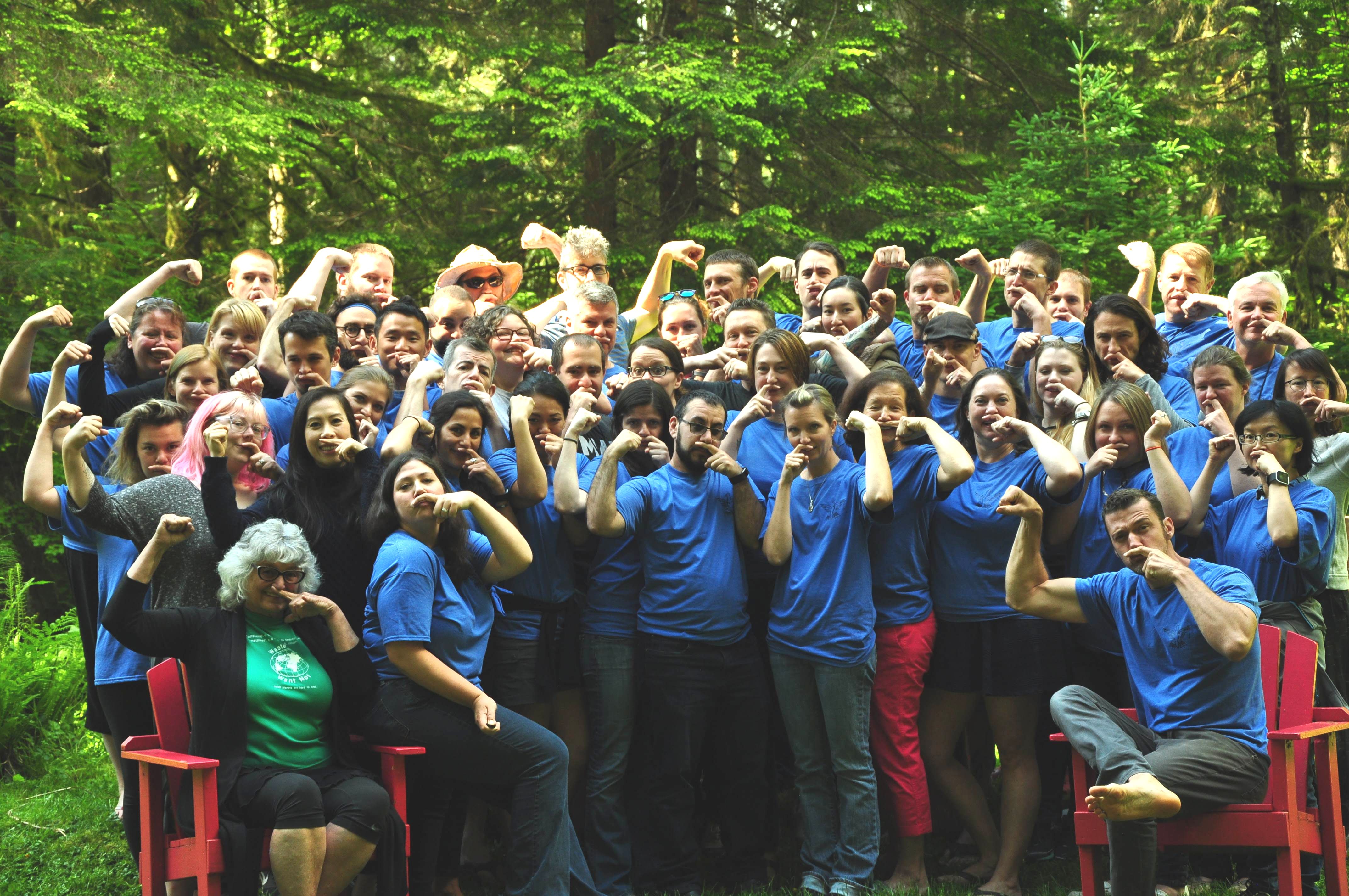
Lots of useful stuff on my capital one home screen (don’t worry, balances and account numbers, etc. have been modified for public sharing)

So whether you use an app or a conventional spreadsheet, tracking your spending is quite useful, to know where you are now.

But the biggest message to take home from the results is this:

These are not your “living expenses.” This is your current level of spending, something that is entirely under your control.

There is always a trick for everything, and you get to decide how many of these tricks to apply.

For my part, I try to use only the tricks that save me money and make my life better in some way. For example, I do my own carpentry and I use my own legs for transportation, because these are a win/win for me. But I do pay an accountant to do my taxes for me. Your own choices may be completely different, but it’s important and empowering to use that word – choices.

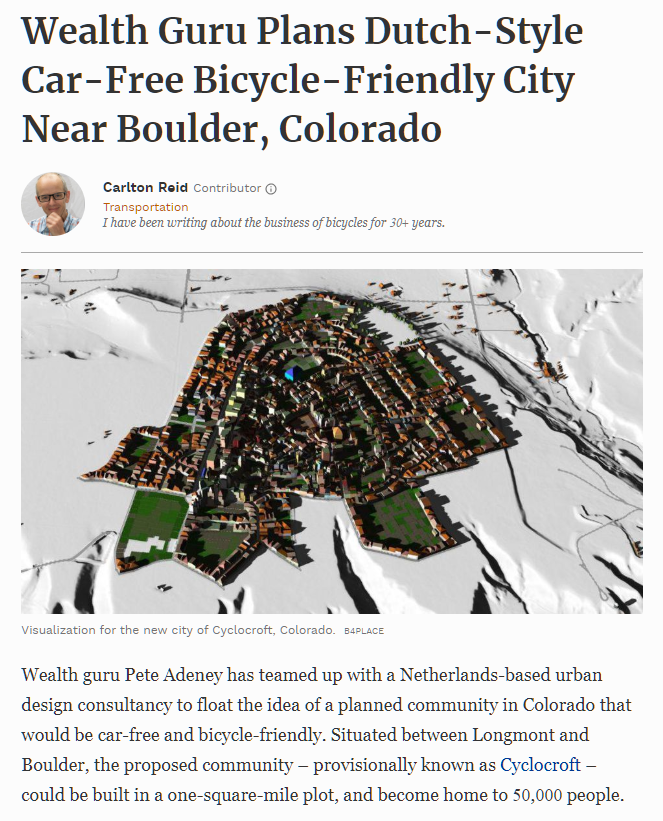
Special Notes Before I Share This

Many fun and even “fancy” things in life don’t have to show up as expenses – like parties at the MMM HQ, which is actually a business rather than an expense.

The table below will shock some, offend others, and hopefully inspire you to at least consider a few new things. But because of my unique life situation, I have made a few unusual choices. I’ll explain them in advance so the table will make more sense.

Do I really have zero medical expenses?

Yes, and I have for my whole life – this is a probably combination of dumb luck (genetics) and hopefully-smart luck (I made a guess that 1-8 hours of outdoor physical work, bikes, barbells and salads every day would be good for my health and so far it seems to be working.) But I know this is not a lifelong guarantee, because there are no guarantees.

What about kid related expenses?

My little 13-year-old is pretty low-maintenance these days: he develops stuff on the computer, plays the bass and rides scooters with friends. When we are together, we do these same things along with hikes and bike rides and the odd road trip. Other kids are into more expensive activities and that is wonderful if they enjoy it and you can afford it. This table includes the half of his food and necessities that I pay for, but does not include any money that changes hands between Former Mrs. MM and myself over these final four years of our co-parenting project. However, I am infinitely grateful for how happy and cooperative our arrangement has become, and suffice it to say that nobody needs to feel sorry for either of us in the financial sense either.

How can you even sleep, with no house insurance and no health insurance?

This really depends on your personality type – and mine may be unusual in this regard. I simply don’t worry much about things like theft, accidents, fires, disasters or anything else. I certainly know they are possible, but my mind thinks in statistics and probabilities rather than emotions or fears. In other words, I’m a bit of a robot. And the robot in me says, “On average you will make a profit and you can afford any worst-case consequences, so why buy insurance?”

For people in situations where losing a material possession would be a big deal, insurance may be appropriate. But I also still like the old-school advice of “don’t buy stuff that you can’t afford to lose, and take really good care of the stuff that you do have.”

But this will all be covered in more detail in an upcoming article about health insurance, including an interesting new option I am just about to try this year.

What Else Are You Hiding From Us?

My businesses pay for some stuff (blog-related trips, this computer, tools, etc.) that happens to be fun for me too – this may prevent me from spending personal money on other fun stuff.

Charitable donations, which now total over $300,000 (see previous article), are also not part of what I consider spending. To me, these are a reallocation of a good part of this website’s income to causes that need it more than me. But I probably wouldn’t be brave or badass enough to give away much money, if I were only earning the bare minimum needed to cover my lifestyle spending in the chart below.

And I don’t include income taxes in my spending, because if someone really lived on a level of retirement income to cover even twice this level of spending they would pay no tax. In my situation, I do earn more than I spend, and pay plenty of tax on it. But much like the charitable donations described in the last article, I think of income tax as just another way of contributing a small portion of this super-lucky surplus back to society.

It’s really not a big deal – and I find that statement to be true in all areas of life: as you get older and your material desires drop away, fewer and fewer things seem like a big deal.

Okay, let’s get into it!

MMM’s 2019 Bachelor Life Spending
(all figures are for the full year)

CategorySpendingComments
Housing
Mortgage + Insurance0Bought the current house ($315k) with cash, and I have been self-insured on houses for the last 5 years or so. Not for everyone but it feels right for me.
Property Taxes$1735My current place is a 3Br/2Ba home in an “up and coming” (i.e. working class) central area. Downside: pickup trucks everywhere. Upside: cheap to buy, and located on creek and bike path. Walk/ride everywhere!
Maintenance and Renovation$4699Renovated my kitchen (IKEA), plus assorted painting + lights
Utilities – City$1227Electric + Water + Trash service. Average electric = $24/month including electric car charging.
Utilities – Heat$353Natural Gas service (incl. hot water)
Household Items $294Things like lamps, picture frames, vegetable peelers, wine glasses at places like Target.
Total Housing$8308
Food
Groceries$4615Mostly fresh, organic higher-end stuff. For one active man and 1/2 time of a growing teen boy. Costco/Sam’s whenever possible, plus Whole Foods for more specialized items, and because it’s within walking distance.
Restaurants$910Many more nights out in this new life – expensive but fun.
Beer/Wine/etc$203
Total “Food$5728
Medical Care
Health Insurance$0I decided to self-insure for 2019 as an experiment (because the US coverage mandate was removed), to see if I found it stressful/scary. Article on this to come!
Medical Bills$0Had a truly fortunate year again – capping 45 years with just about zero medical costs so far. Will not take this for granted!
Dentist$0Confession: I have only been ONCE in the last 25 years. Complacent because I’ve never had a cavity. Teeth are fine and clean. Am I pushing my luck?
Automotive
Gasoline$22.621999 Honda Odyssey – used mainly for construction hauling. I do lend it frequently to friends, but they return it full of gas. But I walk and bike for all of my in-town transportation.
Maintenance$0She had a perfect year (although with low mileage, car breakages are rare)
Car Registration$545For van, cargo trailer, and Nissan Leaf shared with former Mrs. MM
Insurance$397Mainly for the Leaf because it includes comprehensive (long story) – this is my half of the shared policy cost. Still using Geico and it’s great.
Automotive Total$965
Travel Total$3702Plane tickets, car rentals, airport transport. Interestingly, most accommodation was “free” due to staying with friends, credit card points and AirBnb Referrals.
Entertainment$400Plays, Books, Netflix, Google Play movie rentals, even a couple Oculus VR video games.
Mobile Phone$300I’m still on Google Fi. It’s $20 per month+data, a solid value for lower data users – I like the free international coverage.
Internet$600This is expensive because we buy Longmont’s gigabit fiber internet, but well worth it for a household of blogger/video gamer/youtubers.
Total$21,470Hey, not bad!
Total “Barebones” $13,068My real (still luxurious) living expenses without the travel and $5000 kitchen renovation. Still includes restaurants, booze, cars, gadgets from Amazon, and living in a 3 bedroom detached house!
……………………….……………

So, What Now?

Well, this was a pleasant surprise. I had felt like I was living a total billionaire’s life in 2019, because it has been so packed with interesting people and places and experiences. I always buy whatever I want – after considering whether it will really make me happier – and this leads to a feeling of almost dizzy abundance. But I guess abundance just isn’t that expensive.

2020 is shaping up to be an even bigger year of personal growth and better friendships and hard work. I’m drawing up the plans for an exorbitant second-story deck off of my bedroom. The Tesla Model Y comes out in just a few months, and I am in love with it.

It could get expensive.

Stay tuned and I will let you know how it goes!

In the Comments: do you track your own annual spending? If so, how did you do last year? If not, what is your reason?

*About Truebill: I heard from Haroon Mokharzada as he was just founding the company, and was impressed with his background of seeming to be on the “good guys” team. So I have been a casual user ever since, just to follow their progress. The Truebill service/app is now good enough that I can see it being useful for many people – not just for tracking spending. And they have a sizable development team and a large and growing base of happy users. Nice job y’all!

Affiliate notice: While I have no financial relationship with Truebill, this blog may get a commission for other recommendations within this page, including Personal Capital, Airbnb and the credit card recommendations. And many thanks if you do use them!

  • βœ‡Mr. Money Mustache
  • Lessons in Fear and Wealth from the Coronavirus
    As I write this, the biggest story in the entire world is a virus that is making its way around the planet, leaving a trail of sickness and death in its wake, while sending a much bigger shockwave of fear and uncertainty out front. Last week, the US stock market dropped 15% in just a few days, the most shocking correction since the 2008-2009 financial crisis (and the most interesting drop since the founding of this blog in 2011). I am sure you’ve been hearing, reading or watchi
     

Lessons in Fear and Wealth from the Coronavirus

3 March 2020 at 20:52

As I write this, the biggest story in the entire world is a virus that is making its way around the planet, leaving a trail of sickness and death in its wake, while sending a much bigger shockwave of fear and uncertainty out front. Last week, the US stock market dropped 15% in just a few days, the most shocking correction since the 2008-2009 financial crisis (and the most interesting drop since the founding of this blog in 2011).

I am sure you’ve been hearing, reading or watching plenty about it already, but the real question is, what should we do about it?

The Scary Side

Is this a screenshot from the fear-mongering TV news? Nope, just a moment from a classic zombie movie, although sometimes it is hard to tell the difference.

The fear and doubt seems to be what the news stories have been emphasizing. The disease is highly contagious, and very sneaky. Each carrier seems to infect 2-3 additional people, which means exponential growth. And with an observed death rate of about 1% so far (on a limited data set of older people on a cruise ship) it may be several times times more deadly than the common flu.

On the news, we see rows of hastily installed hospital beds, people wearing paper face masks even here in our own country, empty supermarket shelves and shuttered factories and public venues.

And we are reminded that we ain’t seen nothing yet, because with mild symptoms that can hide for days, most cases are going unreported and the disease is pumping its toxic tentacles through the arteries of our economy, plotting its attack while we are left POWERLESS UNTIL THE RIOTS IN THE STREET START AND PEOPLE ARE SMASHING THROUGH OUR WINDOWS TO TAKE OUR LAST FEW CANS OF BEANS AFTER WE RUN OUT OF AMMO IN OUR SHOTGUNS.

Some people are just prone to this type of thinking, and I even have a few in my own life. They have warned me to gather “at least a few months worth” of nonperishable food in my pantry and make sure I have a generator and plenty of fuel, at the very least. And to reconsider my stance of not keeping any guns in the house.

The Not-So-Scary Side

I went out on the town early on in the scare. The reality was different from the news headlines, although restaurants did close a few weeks after this post was first published.

As I write this on March 2nd, there have been about 90,000 confirmed cases of COVID-19. And while the number is still growing rapidly, at the moment it is still a tiny number, about one thousandth of a percent of the world’s population. So even if it multiplies 100-fold, it would be a tenth of one percent. And out of these 90,000 people, about half are already recovered and have moved on with their lives. And the vast majority of the remaining ill, and all those who are so far undetected, and those who are yet to get infected, will also recover.

Past and current status of the outbreak.

But do we have any idea how bad it will get, before it gets better? As it turns out, we do. But first, some perspective.

Here are this year’s numbers for the tried-and-true traditional flu for the 2019 flu season in the US alone (and remember the USA is only four percent of the world population):

Wow, 32-45 million cases of the flu already, and tens of thousands of deaths. Even I had no idea it was that serious, and yet the flu is something I don’t even worry about – ever!

Even scarier: every year, about 2.8 million people die in the US alone, and a full 70% of these deaths (over two million people per year) are caused by “lifestyle factors”, which to put it plainly means ignoring Mr. Money Mustache’s advice about bikes, barbells and salads every day.

So if we start with the common flu, which is surprisingly scary, choosing car-based transportation and TV-based entertainment and consuming processed high-carbohydrate food and soft drinks should feel at least an additional hundred times scarier than that.

But do you feel the appropriate ratios of fear in these two situations? And a much smaller amount of fear about the Coronavirus? Probably not, because we humans generally suck at putting numbers, statistics and probabilities into perspective.

We Have Been Here Before

In my lifetime alone, we have seen the rise and decline of quite a list of worldwide health scares, each of which was covered in the news with similar intensity to what we see today. AIDS, Ebola, SARS, Bird Flu, and the 2009 Swine Flu pandemic, also known as H1N1. That one was particularly serious in retrospect, having infected between 11-21% of the world’s population and taking the lives of about 500,000.

Yet here we are, with that fearful event gone from the rearview mirror and a global economy that is far richer than it has ever been. Which is exactly what we will eventually be saying about the present moment in time, from our vantage point in the even more prosperous future.

And Math Can Help Create Perspective

Contagious diseases don’t just grow forever until everybody is dead. They follow an S-curve, like this recent prediction for Covid-19’s spread. It currently estimates that we may see things flatten out fairly soon, but more importantly it continually updates to new information and makes an educated guess – a great strategy for dealing with unknowns in life in general.

One mathematical model that a researcher is updating each day – image source.

On the other hand, some estimates are more pessimistic. Disease modelers at Northeastern University used different assumptions in mid-February to predict between 550,000 and 4 million cases in China*, before we reach the flat top of our “S”. That because of extreme quarantines, that turned out to be pessimistic as well and China flattened out well below 100k.

So let’s imagine that a 4-million outbreak happened in the rest of the world. That’s still only a twentieth of one percent of the world’s population who would even get the disease, and then a further 99% of those would recover. Again, it’s too early to guess the world numbers, and I’m not qualified to do so. But it’s always important to put things into context of the almost eight billion people on Earth – that’s a deceptively large number.

As a final source of information, when it comes to world health issues I always like to see what Bill Gates has to say. And sure enough, he written this great opinion piece in a medical journal and an even better Ask Me Anything on Reddit. His main point? The damage done by a virus really depends on how well our governments respond to it. Lots of caution and a quick response leads to much better results.

So there’s still a lot of uncertainty. But when faced with a lack of information, we can choose one of two options on where to learn more:

  • Good looking news anchors with fake tans and no scientific background, who make more money if they generate more viewership hours and advertising revenue, which is proven to multiply if they can cause their viewers to experience fear, or
  • Scientists and mathematicians who study this stuff for a living, and use incoming data to make a series of continually refined predictions.

As Mustachians, we get our information from scientists rather than news anchors and politicians, and then we choose a course of action based on what is in our circle of control. In the case of the Coronavirus, I would say that means taking the following steps:

  • Continue the usual program of living a healthy life. Just the incredibly simple steps of cutting cars, sugar and television out of your life as much as possible will virtually eliminate the 70% fatality risk factor of being inactive and unfit – and yet only a tiny percentage of people – even those lucky enough to still have fully able bodies – actually follow this advice. On top of that, this strategy will also greatly boost your immunity to Covid-19, and decrease your chance of serious illness or death if you do catch it.
  • Don’t try to out-guess the stock market. Just celebrate the fact that we have a temporary sale on stocks. While the endless stream of meaningless market commentary every day means absolutely nothing, one fact remains indisputable: stocks you buy today at a 15% discount from their peak, will be 15% more profitable for you over your lifetime.
  • And finally, still important but statistically less urgent is taking actual steps related to dodging this and other viral illnesses. Wash your hands a few times a day and avoid unnecessary large gatherings of people in close quarters, until the health organizations tell us we are in the clear.

Guns and ammo and a bunker full of canned beans not required.


* a really interesting quote from that same article about the size of the uncertainty around diseases:

” In the autumn of 2014, modelers at CDC projected that the Ebola outbreak in West Africa could reach 550,000 to 1.4 million cases in Liberia and Sierra Leone by late January if nothing changed. As it happened, heroic efforts to isolate patients, trace contacts, and stop unsafe burial practices kept the number of cases to 28,600 (and 11,325 deaths). “


Advertisement – An MMM-Recommended Bonus as of March 22, 2020:

The last couple of week’s unprecedented 1.5% drop in US interest rates is a once-in-a-lifetime opportunity to cut down interest costs on any remaining mortgages or student loans you still have. Check out Credible.com (NMLS No. 1681276) for a fast check on whether or not it is worthwhile in your own situation. (See their mortgage disclosure here)

Student loans click here ($300 bonus for MMM readers!)

Mortgages click here

note – Credible has now joined the short list of approved MMM affiliates, see more info here if you are curious how I handle them.

❌