
❌

Normal view

  • βœ‡eliot peper
  • Brad Feld on Nietzsche for creators
    “One man had great works, but his comrade had great faith in these works. They were inseparable, but obviously the former was dependent upon the latter.” -Nietzsche I didn’t write my first novel to fulfill a lifelong dream of becoming a writer. I wrote my first novel because I was a voracious reader, and there was a book I wanted to read but couldn’t find, so I opened up Microsoft Word and started typing. At the time, I was working at a venture capital firm as a drop-in
     

Brad Feld on Nietzsche for creators

15 June 2021 at 05:58
“One man had great works, but his comrade had great faith in these works. They were inseparable, but obviously the former was dependent upon the latter.” -Nietzsche

I didn’t write my first novel to fulfill a lifelong dream of becoming a writer. I wrote my first novel because I was a voracious reader, and there was a book I wanted to read but couldn’t find, so I opened up Microsoft Word and started typing.

At the time, I was working at a venture capital firm as a drop-in operator for their portfolio companies. Startups were thick with human drama—enormously ambitious projects, fortunes won and lost, cofounder disputes, friendships forged, dreams shattered, success, betrayal, etc.—but many business books seemed to gloss over the depth of the human experience of entrepreneurship in favor of sterile lessons learned. Startups seemed a perfect canvas for fiction that could pry open that interior world, so my embryonic manuscript followed a pair of friends who drop out of college to start a company and get sucked into an international conspiracy along the way.

As I set to work on the opening chapters, Brad Feld’s blog proved to be an invaluable resource. Brad is a VC at Foundry Group, and over the many years he’s been publishing his blog, it has helped render a previously opaque industry transparent. The candid glimpses he provided were grist for my literary mill, and the genuine vulnerability evident in his writing was a welcome respite from an internet rife with self-congratulation and performative failure. Also, he loved science fiction.

So I bit my lip, crossed my fingers, and cold emailed Brad the first few chapters of my novel. I didn’t expect a reply, but he responded four hours later saying that he loved the story and wanted more.

Fast forward to last month when I put the finishing touches on my tenth novel. Along the way, Brad has gone on to support my writing as a publisher, patron, fan, and friend. My books wouldn’t exist without him. Life’s fulcrums are only visible in retrospect. That unreasonably fast and unreasonably generous reply to a tentative email from a stranger was the crux.

By believing in me, he gave me the faith to believe in myself.

Every artist, entrepreneur, and creator knows the power of a helping hand from a fellow traveler. Setting out to explore unknown territory is scary, and the least we can do to aid each other in our respective quests is share notes. Philosophers distill such notes into language that ignites the mind and endures in the heart.

So I was delighted to receive an email from Brad saying that he and Dave Jilk had written a book that collates their best notes—and notes from many of their friends—into a compendium of practical wisdom for people determined to contribute to shaping a better future. And I was doubly delighted to discover that, like this blog post, each chapter opens with a line from Nietzsche memorably capturing a timeless truth.

The Entrepreneur’s Weekly Nietzsche provides an invaluable philosophical toolkit for anyone building a business or forging a new path beyond the beyond. In the following conversation, Brad and I discuss the creative process behind the book and what he learned studying and applying Nietzsche’s ideas.

*

As you explored his body of work, what surprised you most about Nietzsche?

I was fascinated by the number of different thoughts his philosophy stimulates. It is said that “Nietzsche philosophizes with a hammer.” He is provocative. He is blunt. He is clever. His aphorisms have incredible depth. As we dug deeper, so much of what he said was relevant to entrepreneurship. He wasn’t giving answers but providing context for intense contemplation.

In what important ways is he misunderstood?

Some people think Nietzsche is a Nazi. More recently, the alt-right has tried to co-opt some of what he’s said. Dave and I explored this deeply, and we included an Appendix that is written like a journal article (e.g., lots of footnotes) titled “Don’t Believe Everything You Hear About Nietzsche.” The section headings cover the primary misunderstood topics: Anti-semitism, German Nationalism, White Nationalism, and Misogyny. The irony of all of this is that he’s extremely disdainful of anti-semitism, gave up his citizenship, was stateless for much of his adult life, and was generally apolitical.

As with much history, there are fascinating stories behind the story. For example, Nietzsche’s sister was a Nazi and, when Nietzsche died in 1900, she took over his literary estate. She cobbled together notes from some of his writing into a book titled Will To Power. She promoted this as his magnum opus, but in the 1960s, the philologists Mazzino Montinari and Giorgio Colli read the entirety of Nietzsche’s original documents and, after completing their comprehensive translation, called The Will to Power a "historic forgery" artificially assembled by Nietzsche's sister and Köselitz/Gast. Imagine if you had an agenda, took my entire collection of emails, cut and paste sentences that fit your agenda, and then published this after I died? That’s essentially what Nietzsche’s sister did. The Nazi’s then embraced this, and Nietzsche didn’t have a posthumous version of Twitter to call his sister out as a fraud.

This is a philosophy book written for practical, determined people intent on making things better by making better things. How did you go about linking theory to practice?

We started with 52 Nietzsche quotes that we thought refer to entrepreneurship. After pondering them, we translated them into modern English and then wrote a two to four-page essay about the thoughts stimulated by the quote. We weren’t prescriptive, but rather provocative, the way we envision Nietzsche would have been. Our goal wasn’t to say “do this, do that,” but to cause the reader to think, reflect, and relate the quote and our essay to their own entrepreneurial experience. About two-thirds of these are followed by narratives from entrepreneurs that were simply prompted by the Nietzsche quote. These narratives are lightly edited by us, so the voice of the entrepreneur writing them really comes through.

I love how every chapter opens with a quote and then brings the idea to life in a concrete example. You’ve mentioned how Ryan Holiday’s The Daily Stoic was an inspiration, and there are also parallels to Seth Godin’s The Practice. Why this format? Why did this particular book take this particular shape?

Soon after Dave and I started seriously working on this book, Ryan Holiday came out with his book The Daily Stoic. I’m an enormous Ryan Holiday fan and love how he has made Stoicism accessible to modern life and entrepreneurship. Dave and I couldn’t get our mind around 365 Nietzsche quotes (like Ryan did with Stoicism), so we decided to use a weekly format—hence 52 quotes and chapters.

What was it like to co-author the book with Dave? How was it informed (or not) by the business you built together? What did the process teach you about creative collaboration?

Dave and I have worked together on many projects going back to our first company (Feld Technologies) in 1987. We met in college in 1983 and have been best friends ever since. Given our extensive experience working together, we knew how to collaborate. We are very tolerant of each other’s quirks, annoyances, and style. Dave is exceptionally patient with me as I’ve never met a deadline that I took seriously, even though I get plenty of things done on time.

What lessons did you learn from Nietzsche that you applied in writing and publishing this book? How might artists or other creators benefit from reading a philosophy book for entrepreneurs?

To think. To reflect. To be uncomfortable. To go deeper than the surface on an idea. To allow contradictory notions to co-evolve into something with more clarity. To love beautiful wordplay.

Which philosophers have changed how you see the world and live your life? What should fans of The Entrepreneur’s Weekly Nietzsche read next?

Read all of Ryan Holiday’s stuff. If you find our book interesting and want to learn more about Nietzsche, read Nietzsche by Lou Salome and translated by Siegfried Mandel. Try some Nietzsche in the original. And, when you get a little tired from the effort, gobble down Andy Weir’s The Hail Mary Project.

*

Complement with Kevin Kelly on the technology trends that will shape the next thirty years, Brad on riding the entrepreneurial rollercoaster, and why business leaders need to read more science fiction.
Get new posts via email:


Eliot Peper is the author of nine novels, including Cumulus, Bandwidth, and, most recently, Veil. He sends a monthly newsletter, tweets more than he probably should, and lives in Oakland, CA.
  • βœ‡eliot peper
  • Loosen the straps
    When water leaks into your SCUBA mask, beginners tighten the straps.But this warps the seal, letting in more water.Experienced divers loosen the straps because they know that the ocean provides all the pressure you need and the straps are just there to keep the mask in place.The same principle applies to creative work. When you get stuck trying to make something, don't force it. If you tighten the psychological straps, stress floods in, drowning your ideas.Instead, go for a hike, read a no
     

Loosen the straps

8 July 2021 at 22:03

When water leaks into your SCUBA mask, beginners tighten the straps.

But this warps the seal, letting in more water.

Experienced divers loosen the straps because they know that the ocean provides all the pressure you need and the straps are just there to keep the mask in place.

The same principle applies to creative work. 

When you get stuck trying to make something, don't force it. If you tighten the psychological straps, stress floods in, drowning your ideas.

Instead, go for a hike, read a novel, play a game, call your mom, let your mind roam free—a solution will reveal itself when you least expect it.

*

Complement with Quantity is a route to quality, not its opposite, Be bold, and Creativity is a choice.

Get new posts via email:


Eliot Peper is the author of nine novels, including Cumulus, Bandwidth, and, most recently, Veil. He sends a monthly newsletter, tweets more than he probably should, and lives in Oakland, CA.

This blog exists thanks to the generous support of loyal readers.
  • βœ‡eliot peper
  • Ten popular Bandwidth highlights, annotated
    A while back, Goodreads asked me to annotate ten of the most popular Kindle highlights in Bandwidth. I love snatching glimpses into other people's creative processes, and these notes give you a sneak peek into mine.Let's dive right in. The highlights from the novel are indented and my notes follow.There was a deeper silence behind the music. A quiet no mere noise could fill. It took a moment to register. His feed. His feed was gone. Not dimmed, not marginalized. Gone. Dag swayed on his feet. Hi
     

Ten popular Bandwidth highlights, annotated

6 August 2021 at 06:04

A while back, Goodreads asked me to annotate ten of the most popular Kindle highlights in Bandwidth. I love snatching glimpses into other people's creative processes, and these notes give you a sneak peek into mine.

Let's dive right in. The highlights from the novel are indented and my notes follow.

There was a deeper silence behind the music. A quiet no mere noise could fill. It took a moment to register. His feed. His feed was gone. Not dimmed, not marginalized. Gone. Dag swayed on his feet. His window into the digital infinite, that whirling vortex of endless global conversation, had been slammed shut. It was always there in the periphery, the low murmur of the entirety of human culture, as present and comforting as the sound of waves from inside a beach house. A vast, pulsing constellation of voices, information, art, commentary, and dramas, distilled through the algorithmic sieve to the intimately relevant personal feed. So second nature that it was obvious only now, in its absence. It was as if he had gone suddenly, inexplicably deaf.

Years ago, a designer friend explained to me how white space—the empty areas surrounding design elements—is just as powerful and important as the designs themselves.

The seed he planted grew into Analog—the off-grid social club that hosts so many of Bandwidth's crucial scenes. I realized that a powerful way to demonstrate the methods by which a ubiquitous digital feed shaped the lives of people living in this particular future was to cut them off from that feed.

Dag's shock at having the feed stripped away illuminates the depth of its influence.

It was a painful lesson, but eventually I realized that building something meaningful requires you to let go of the obsession with perfection. It requires empowering others and trusting them to do their part, even if they do it differently than you might have. But trust is a two-way street. Autonomy means you’re held accountable.

In some ways, every novel is really about the act of writing a novel. This is one of those places where that truth gleams out through the interstices of its tightly woven nest of story.

Great lobbyists are like novelists, they use lies to tell a deeper truth.

Although the idea for Bandwidth had been gestating for a while, I had a number of false starts. Who among the cast would be the protagonist? Was this a contemporary tale, or would it take place decades hence? What might that future look like?

At one point, I thought that the hero might be a stand-up comedian. I am so glad I didn’t go down that route. I’m not nearly funny enough to do justice to a comedian’s inner life. But the jump from comedian to lobbyist was shorter than you might think. Both professions require a finely tuned sense of observation and an intuition for the invisible systems that shape our world and lives. As a novelist, I'm keenly aware of the parallels with writing fiction.

It was from that milieu that Dag began to emerge. A striver with a keen eye for the dynamics and incentives that guide and warp society. A survivor who was willing to do what it took to win. A seeker who couldn’t deny his own failings once he finally achieved true introspection.

Characters rarely stride onto the page fully formed, like a stage actor entering from the wings. Instead, they start as a blurred sketch, and only become more solid, more real, as the story progresses. Like all of us, they define themselves through their actions, and I always know that a character is becoming a human being when they start doing things that surprise me. By the end of the rough draft, Dag and the rest of the cast had become dear friends.

Like memory, history was synthetic. Humans thought of both as factual records, but study after study confirmed that they were more like dreams, narratives constructed and reconstructed by the mind to fit the demands of the present, not the reality of the past.

I've always felt that writing history and science fiction are related endeavors. Both involve living life with an eye toward gleaning theories of how the world became what it is and the forces shaping what it might become. Both involve not only putting yourself into someone else's shoes, but doing so for people who inhabit a context totally foreign to your own. Both involve combining analysis and imagination. That is not to say that science fiction and history are equivalent, only that they are distant cousins to each other, as dreams are to memory.

Shankar Vedantam wrote that those who travel with the current will always feel they are good swimmers, while those who swim against the current may never realize they are better swimmers than they imagine.

Vedantam's beautiful metaphor powerfully highlights the ways in which we so often draw false conclusions about individual successes and failures—forever discounting the major role that hidden variables like bias and luck play in determining outcomes.

If there’s one thing I believe, it’s that optimism compounds better than cynicism. You can either complain about how some French noble predetermined your desire for a lawn, or laugh at how ridiculous life is and build yourself a rock garden. It all depends on your point of view. And at the end of the day, your point of view makes all the difference in the world.

It's a facile misconception to believe that any problem has an ultimate and final resolution—be it personal, social, political, moral, or technical. Problems can be solved, and yet every solution begets new problems. Problems are inevitable and soluble. That's what keeps life interesting.

The real question is how to summon necessary courage, curiosity, and compassion as we face and solve the problems life brings our way. Believing that a better future is possible is the first step towards contributing to it.

Acting on a whim, he ducked into what turned out to be a bookstore. Every book faced cover-out from the dense forest of shelves, and Dag was immediately absorbed in scanning the thousands of titles on offer. Most of the books were in Mandarin or English, with some Spanish and Arabic thrown in for good measure. As he grazed, Dag occasionally picked up a book and flipped through it, only to replace it on the shelf. Books are sharks, he remembered reading somewhere once. There were sharks before there were dinosaurs, and the reason sharks are still in the ocean is that nothing is better at being a shark than a shark. As antique media went, books were still far more popular even than vinyl, surprising analysts who predicted time and again that the feed would render them obsolete. Perhaps being outside the feed was in fact part of the appeal, offering readers something similar to what Analog patrons sought. Of course, that line about sharks must have been from a twentieth-century source, for the metaphor broke down now that the marine predators were all but extinct. With luck, today’s vote would shift civilization’s direction onto a path that might allow for such species to return in a distant, happier future.

The wonderful line about books being sharks is from the brilliant Terry Pratchett, whose richly imagined Discworld series of fantasy novels does a better job distilling the social, political, psychological, and technological forces shaping our culture and extrapolating their consequences than any explicit analysis I've ever read.

Discovery consisted not in exploring new lands but in looking at the world through fresh eyes.

I've always loved the feeling of getting off a plane and entering a new country where I don't speak the language. It's thrilling and challenging and sometimes overwhelming to throw yourself into the unknown like that—wandering foreign streets, tasting strange foods, miming your way to a bathroom.

But my favorite part about traveling to distant lands is the experience of returning home to discover that things you took for granted reveal themselves for what they are, that basic truths are unveiled as cultural assumptions, and that there is so much beauty and wonder right in front of us all the time every day if we take the time to really look.

We are the stories we tell ourselves. The world existed at the cusp of history just as Dag lived at the cusp of his feed. Collective and individual identities might be shaped by circumstance, but only acquiescence guaranteed them to be determined by it.

If we are the stories we tell ourselves, what happens when someone else controls the narrative? What does it take for a cynic to rediscover authenticity? How is technology changing the structure and exercise of power?

These were some of the recurring questions that surfaced again and again as I worked my way through Bandwidth chapter by chapter, scene by scene, word by word. They are questions I am forced to consider every day when I succumb to the distraction of social media, find myself ignoring injustice because it all just seems to be too much, or contemplate just how out of touch our social institutions are from a world of accelerating innovation.

These are dark thoughts, and there is a dark vein running through Bandwidth. But whenever I struggle, I try to channel Dag’s passion for history. I’d rather live in 2021 than in 1921. Or 1821. Or 1721. Or any other time. Dag would never trade his future for our present.

By historical standards, most people alive today enjoy miracles that the emperors of old could only dream of (and likely didn’t). We are a lucky and privileged few, and whatever corruption and injustice we seek to overcome isn’t new or unique. And that leads us to a challenging conclusion.

The world is what we make it.

If we throw up our hands when the going gets tough, we get what we deserve. So take a deep breath, do some gentle stretching, and make the world a better place. Do a favor for a stranger. Be kind when instinct calls for harshness. Question your assumptions. Make good art. Tell your loved ones how grateful you are to have them in your life. Lend a hand to those in need. Take real risks to do the right thing.

Oh, and remember that in an age of acceleration, contemplation is power. The feed can only define you if you let it.

Schemes begat schemes begat schemes. Outside the false constraints of sport, there was no such thing as decisive victory. There was only the blind fumbling of the fallible, of which history was its record.

One key difference between narrative and reality is that while fiction often builds toward a crux upon which the future depends, in the real world there is no endgame.

Instead, the world keeps turning, actions beget reactions, yesterday's heroes become tomorrow's villains, ideas wax and wane, and we live through it all straining to hear the signal in the noise.

It is this strange cascade of successive, interdependent new beginnings that simultaneously brim with meaning and are destined to fade that my novels explore.

*

Complement with Cory Doctorow on Bandwidth, the East Bay Express on Borderless, and this podcast interview about writing the Analog trilogy.

Get new posts via email:


Eliot Peper is the author of nine novels, including Cumulus, Bandwidth, and, most recently, Veil. He sends a monthly newsletter, tweets more than he probably should, and lives in Oakland, CA.

This blog exists thanks to the generous support of loyal readers.
  • βœ‡eliot peper
  • Amal El-Mohtar and Max Gladstone on writing This Is How You Lose the Time War
    This Is How You Lose the Time War by Amal El-Mohtar and Max Gladstone is a mind-expanding, heart-wrenching tale of dastardly intrigue and burgeoning romance that follows two supremely competent secret agents traveling through time to bend the arc of history toward their respective masters' incompatible political ends. The story is a shining example of the authors' lovely definition of literature in the acknowledgements: "Books are letters in bottles, cast into the waves of time, from one person
     

Amal El-Mohtar and Max Gladstone on writing This Is How You Lose the Time War

19 August 2021 at 18:32

This Is How You Lose the Time War by Amal El-Mohtar and Max Gladstone is a mind-expanding, heart-wrenching tale of dastardly intrigue and burgeoning romance that follows two supremely competent secret agents traveling through time to bend the arc of history toward their respective masters' incompatible political ends. The story is a shining example of the authors' lovely definition of literature in the acknowledgements: "Books are letters in bottles, cast into the waves of time, from one person trying to save the world to another."

Among other wonderful things, Max is the bestselling author of the Craft Sequence, and Amal is the New York Times Book Review's science fiction and fantasy columnist. Both are Hugo and Nebula Award-winners and are as generous as they are brilliant. In the following conversation, we explore their creative process, the power of speculative fiction, and how letters warp time and kindle intimacy.

*

What is This Is How You Lose the Time War's origin story? How did you decide to write this particular book together?

Max: We knew we wanted to write a book together long before we knew we wanted to write this book. I came off a book tour one summer feeling a powerful need for solitude, and at the same time for deep connection, as one does after a week or two of the constant light chat that characterizes that sort of thing. I was feeling the miles. I found myself at an Italian restaurant near the Flatiron with a glass of wine and a folder of short stories Amal had sent me. We’d been corresponding—writing each other letters—for about a year by this point, but I hadn’t been able to receive any letters on the road, of course. The stories stood in for letters. Reading them I thought: these are great, they’re really really great, and there’s so much here that I’d love to learn from, and to work with, to work against. I started texting her as I left the restaurant. We need to write a book! It’ll bring the universe into harmony! And let dolphins sing!

How did writing the book change your understanding of time, love, and war? How do you read history differently having written about secret agents dueling to shape it?

Amal: I think we were both coming to the book with a sense of wonder around the expression of time in hand-written letters—that sense of folding up a singular moment of yourself and sending it into the future to be read by a person who doesn’t yet exist, and who’ll be reading a letter from a person who no longer exists, but was preserved in the amber of ink on paper. Wonder, too, around time’s stoppages: that a letter can include someone having stopped, perhaps even mid-sentence, walked away, and returned to the letter three days later, while the person receiving the letter reads it smoothly in a sitting. Or vice versa! These all seemed to touch on conceptions of time travel and intimacy—the vulnerability of committing a truth of yourself to your invention of a person—that we were already talking about, already developing, but getting to explore and articulate and develop them in the book, together, was just tremendous.

If This Is How You Lose the Time War is a conversation between the two of you, how does Red and Blue's correspondence reflect your joint creative process? What do you hope readers glean from your message in a bottle?

Amal: That sense of striving together, “against and for,” as we say in the book—of wanting to impress each other while pushing against our limits, our comfort zones, our areas of familiarity—was very much part of our writing process! You might find, too, as you read the book, that their insights and styles are blending a little—purpling, you might say—as they share themselves with each other, and this was very much our experience in crafting it. At the beginning of the process, Max wrote about four times as quickly as me, and had to wait for me to finish my sections; by Act Two, he slowed down and I sped up to the point where we were finishing at exactly the same time. There was definitely a feeling of… Synchronizing with each other, reaching towards each other, admiring and encouraging each other.

What did you learn about craft from cowriting the book? What did you learn about each other? What did the experience teach you? What advice can you offer other writers looking to develop and grow?

Max: It was so great to have someone specific in mind—as a reader, as audience, but also as a sort of good-natured competitor. Amal would write a line that totally slayed me, just laid me out on the mat, and I’d think, shit, I have to give her something back that’s at least that good. You get that sense of two rabbits racing one another. And then there’s the joy of swapping laptops, each seeing what the other one has written—cackling, because it’s better than you ever could have guessed. I think it’s important to write for an audience that impresses you.

What role does science fiction play in our culture? What does literature mean to you?

Max: Right now we’re in a culture of science fiction. Marketers spin science fictions to sell apps and technologies and political philosophies. I think science fiction, correctly practiced, can help see the water we’re swimming in, understand its weaknesses and failure modes. The rhetorical tools of science fiction (and fantasy) can tease out the implicit metaphors in our lives. If you’ve never had a headache before, you might need one described to you before you realize that’s why you’re miserable this afternoon, and take corrective action.

What books have changed each of your lives, influenced who you are becoming? What other books would fans of This Is How You Lose the Time War enjoy?

Amal: One of mine is in This Is How You Lose the Time War—I have Blue mention Naomi Mitchison’s Travel Light, about which I’ve written elsewhere (in fact, the first thing of mine that Max read, if I’m not mistaken—before we’d met or exchanged words!). A more recent one is Susanna Clarke’s Piranesi, which feels like the kind of book that arrives once a generation to just illuminate all the neglected corners of your soul and befriend the spiders making homes there. In terms of things fans of our book might enjoy—Arkady Martine’s Teixcalaan books (A Memory Called Empire and A Desolation Called Peace), Fonda Lee’s Green Bone Saga (Jade City, Jade War, Jade Legacy), Ann Leckie’s The Raven Tower, and Sofia Samatar’s Olondria books (A Stranger in Olondria, The Winged Histories) are the tip of the iceberg of things I’d like to recommend.

Max: In case anyone who’s read This Is How You Lose the Time War hasn’t read Madeline Miller’s books, I think Song of Achilles and Circe are brilliant, must-reads. Beyond that—these aren’t necessarily anything like Time War but they are books that found me like a rope finds someone at the bottom of a deep dark pit: Kay Ryan’s poetry collection The Best of It, Sarah Caudwell’s brilliant, witty, sly Hillary Tamar mysteries beginning with Thus Was Adonis Murdered, and Karin Tidbeck’s short story collection Jagganath.

*

Complement with Alix E. Harrow on writing The Ten Thousand Doors of January, Meg Howrey on writing The Wanderers, and my recent TechCrunch interview about how speculative fiction empowers readers to challenge the status quo.

Get new posts via email:


Eliot Peper is the author of nine novels, including Cumulus, Bandwidth, and, most recently, Veil. He sends a monthly newsletter, tweets more than he probably should, and lives in Oakland, CA.

This blog exists thanks to the generous support of loyal readers.
  • βœ‡eliot peper
  • Rugby
    I played rugby in high school. I was never particularly good, or even particularly passionate about it, but playing rugby taught me an important lesson that has stuck with me ever since.Growing up, I wasn’t a traditional geek or a traditional jock or really a traditional anything. I was curious, bookish, a little aloof, and abhorred conflict. I was on the math team and the basketball team. Because I was tall and athletic, I was lucky to never be a victim of bullying. To this day, I’
     

Rugby

8 October 2021 at 17:22

I played rugby in high school. I was never particularly good, or even particularly passionate about it, but playing rugby taught me an important lesson that has stuck with me ever since.

Growing up, I wasn’t a traditional geek or a traditional jock or really a traditional anything. I was curious, bookish, a little aloof, and abhorred conflict. I was on the math team and the basketball team. Because I was tall and athletic, I was lucky to never be a victim of bullying. To this day, I’ve only been in a single physical fight in my entire life: an awkward grappling match with another third grader on the front steps of my elementary school. I can’t remember what it was about, or who won.

Needless to say, the physicality of rugby came as a shock to me. We ran endless drills where you either tackled or were tackled. Imagine someone bigger, stronger, and faster than you running straight at you and your entire job is to throw your body at theirs at full speed and bring them to the ground where other players will pile on top, rucking for the ball. Now imagine that it’s not a drill, but a tournament, and that the guy sprinting toward you is an opponent, not a teammate, and that victory depends on you taking him down.

Frankly, it was harrowing.

No, I do not play rugby anymore.

But rugby taught me that if you really care about something, you have to be willing to take hits for it. In fact, really caring about something means being willing to take hits for it. Courage is a skill. You can practice it. You can develop it. Every time you feel afraid is an opportunity to summon it, whether in business, activism, art, marriage, sport, or any other arena. If you seek out your fears and face them, new worlds will open to you, worlds full of new fears for you to overcome. And then one day you’ll realize that wisdom is just what courage looks like in the rearview mirror.

*

Complement with Be Bold, The Path, and How to Kill a Dragon.

Subscribe to my newsletter for monthly book recommendations and writing updates:


Eliot Peper is the author of nine novels, including Cumulus, Bandwidth, and, most recently, Veil. He publishes a blog, sends a newsletter, and tweets more than he probably should.
  • βœ‡eliot peper
  • A Swing, a Miss, and a Burrito
    To whomever needs to hear this: I just took a big swing, gave it my all, and missed.I'm not gonna lie, it sucks.The details don’t matter, but this does: If I had known it would work at the outset, it wouldn't have been worth doing. Making art requires taking real risks. Courage isn’t the absence of fear, but its answer. You can’t get somewhere new without venturing into the unknown.Now, please excuse me while I go eat a burrito... and get back to work.*Complement with Creativi
     

A Swing, a Miss, and a Burrito

14 October 2021 at 23:33

To whomever needs to hear this: I just took a big swing, gave it my all, and missed.

I'm not gonna lie, it sucks.

The details don’t matter, but this does: If I had known it would work at the outset, it wouldn't have been worth doing. Making art requires taking real risks. Courage isn’t the absence of fear, but its answer. You can’t get somewhere new without venturing into the unknown.

Now, please excuse me while I go eat a burrito... and get back to work.

*

Complement with Creativity is a Choice, Lasting Value, and Reassurance.

Get new posts via email:


Eliot Peper is the author of nine novels, including Cumulus, Bandwidth, and, most recently, Veil. He sends a monthly newsletter, tweets more than he probably should, and lives in Oakland, CA.

This blog exists thanks to the generous support of loyal readers.
  • βœ‡eliot peper
  • Heroes Are Whoever's Left When Everyone Else Runs Away
    I interviewed Andy Weir about writing Project Hail Mary.Project Hail Mary follows an unlikely astronaut on a desperate mission to save the solar system from a spacefaring bacteria that eats sunlight. It’s an immensely entertaining adventure that will teach you more real science than you learned in high school. Never has a novel so deserved the moniker science fiction.A software engineer turned novelist who's been obsessed with space since childhood, Andy is the author of Artemis,&nbs
     

Heroes Are Whoever's Left When Everyone Else Runs Away

22 October 2021 at 22:31

I interviewed Andy Weir about writing Project Hail Mary.

Project Hail Mary follows an unlikely astronaut on a desperate mission to save the solar system from a spacefaring bacteria that eats sunlight. It’s an immensely entertaining adventure that will teach you more real science than you learned in high school. Never has a novel so deserved the moniker science fiction.

A software engineer turned novelist who's been obsessed with space since childhood, Andy is the author of Artemis, Chesire Crossing, and The Martian, which Ridley Scott adapted into a blockbuster film starring Matt Damon.

In the following conversation, we discuss Andy’s creative process and the story behind Project Hail Mary.

*

What is Project Hail Mary’s origin story? How did it grow from the first glimmer of an idea into the book I’m holding in my hands right now?

It was actually a collection of unrelated story ideas I had been brewing. I was working on an idea where a guy wakes up aboard a spaceship with amnesia, another idea about a maximum efficiency rocket fuel, an idea where a single person has more authority than any human being has ever had in history, and a few other concepts I don't want to say because it would spoil the book. But basically, I was working each one as a potential book and none of them were enough meat to be a story. But when I put them all together, it worked out great!

What does it mean to become a hero? What did you discover about living your own life by inventing the journey at the heart of this novel?

I think the best quote about heroism is, "Heroes are whoever's left when everyone else runs away." Sometimes it's just what you have to do because the alternative is unthinkable.

So much of Project Hail Mary is about solving problems, many of which appear intractable. How do you approach solving problems, and what did you learn from the protagonists about problem-solving?

I like to break them up into small, bite-sized pieces. Fix all these little problems and you'll be able to fix the big problem.

In researching Project Hail Mary, what surprised you most about advances in space technologies? What do the headlines miss? What key implications are under-appreciated?

There's been a lot of advances in zero-g 3D printing. They haven't been talked about much in the news, but it's an exciting field of study. Imagine putting all the mass for a space station up as a liquid slurry—taking the minimum possible volume, then having a 3D printer in space slowly make your station out of it. No more having to fit chunks into a rocket. Just send more 3D juice.

What are the most interesting aspects of the relationship between science and engineering? Why are they—and the feedback loop between them—so important?

Well, science is speculative and engineering is hands-on. You need both to accomplish anything.

What did choosing to make the protagonist a science teacher teach you about science education? How can science education and communication be improved?

Well I didn't go at it with the idea of focusing on teachers. I just wanted some explanation for his personality and that seemed to suit well.

What does science fiction mean to you? What role does it play in the culture?

To me, sci-fi is a setting, not a genre. It's more like saying "Chicago" than saying "Comedy.” Because you can have a sci-fi comedy. Or a sci-fi drama. Or sci-fi action. Romance. You name it. It's a background for your story.

As for culture—I don't think much along those lines. I just write to entertain. I don't delude myself into thinking I'm doing any great service for culture.

What did writing Project Hail Mary teach you about craft? What creative challenges did you grapple with that were different than your previous books?

My biggest challenge was figuring out how to exposition all the stuff that lead to the ship being built and launched. The flashback approach worked well.

How has your relationship with your readers evolved since The Martian?

I don't think it's changed much. I still answer all fan mail and reply to all Facebook DMs.

What books have changed your life? What should fans of Project Hail Mary read next?

I don't know if a book has ever changed my life. Though if you like hard science fiction, I recommend The Expanse series. Book one is Leviathan Wakes.

 *

Complement with Cory Doctorow on writing Attack Surface, Daniel Suarez on writing Change Agent, and five lessons I learned writing Veil.

Get new posts via email:


Eliot Peper is the author of nine novels, including Cumulus, Bandwidth, and, most recently, Veil. He sends a monthly newsletter, tweets more than he probably should, and lives in Oakland, CA.

This blog exists thanks to the generous support of loyal readers.
  • βœ‡eliot peper
  • A Recipe for Adventure
    Welcome to my life/world which is stable until……something disrupts it, launching me on……a journey into the unknown where I’m beset by……progressive complications that ultimately threaten what I care about most until……all is lost and I must……transform my life/world……welcome to my new life/world.*Complement with A Brief Anatomy of Story, The Path, and Advice for Authors.Get new posts via email: El
     

A Recipe for Adventure

1 November 2021 at 21:42
  1. Welcome to my life/world which is stable until…
  2. …something disrupts it, launching me on…
  3. …a journey into the unknown where I’m beset by…
  4. …progressive complications that ultimately threaten what I care about most until…
  5. …all is lost and I must…
  6. …transform my life/world…
  7. …welcome to my new life/world.
*

Complement with A Brief Anatomy of StoryThe Path, and Advice for Authors.

Get new posts via email:


Eliot Peper is the author of nine novels, including Cumulus, Bandwidth, and, most recently, Veil. He sends a monthly newsletter, tweets more than he probably should, and lives in Oakland, CA.

This blog exists thanks to the generous support of loyal readers.
  • βœ‡eliot peper
  • Scholars of Causation
    I interviewed Stewart Brand about writing The Maintenance Race. The Maintenance Race tells the thrilling story of a 1968 solo sailing race around the world, a feat that had never before been attempted. It follows three competitors—the man who won, the man who chose not to win, and the man who cheated—illuminating what their respective journeys reveal about the art of maintenance. Yes, that’s right, maintenance: the critical but rarely celebrated work of keeping systems running
     

Scholars of Causation

11 November 2021 at 21:04

I interviewed Stewart Brand about writing The Maintenance Race.

The Maintenance Race tells the thrilling story of a 1968 solo sailing race around the world, a feat that had never before been attempted. It follows three competitors—the man who won, the man who chose not to win, and the man who cheated—illuminating what their respective journeys reveal about the art of maintenance.

Yes, that’s right, maintenance: the critical but rarely celebrated work of keeping systems running smoothly. We all know we should maintain what we care about: our possessions, our relationships, ourselves—but it’s always tempting to skip to the hot new thing that captures our attention, letting our lives fall into disrepair in the process. The Maintenance Race will show you why maintenance matters and how bringing the full scope of your care and attention to bear on it can be transformative—the story sucked me in from the first sentence and inspired me to apply its ideas to my own projects.

Stewart has led a long and fascinating life that I can’t even begin to summarize here, but that I highly recommend you investigate further—this film and this podcast interview are great places to start. He is the president of the Long Now Foundation (I’m a proud member), the founder of Whole Earth Catalog and the WELL, and the author of many books, including How Buildings Learn.

In the following conversation, we discuss why maintenance matters and the creative process behind The Maintenance Race, which is the standalone opening chapter of Stewart's forthcoming book.

*

What is the origin story of The Maintenance Race and the book it may ultimately grow to become? What made you realize this is a story you need to tell? How has the project evolved since you first conceived it?

A friend named Garrett Gruener said “Why don’t you do a book about maintenance?” I replied politely “Yeah, I wish someone would do that, but it’s not me.  I have a book I’m working on.” By next morning the book I wanted to write had a title, Maintenance. That was two and a half years ago. The research keeps surprising me. I have to continue it until it doesn’t—until it begins to close on itself, and I know what my news can be.

My discovery of the Golden Globe race came from briefly knowing one the legendary competitors, Bernard Moitessier. Years ago I read his book The Long Way, so I knew about his exemplary maintenance stye. Hugh Howey suggested I compare him to Donald Crowhurst. I had read the book about him too. Rereading them I discovered Robin Knox-Johnston. I had characters. I had saga. The rest was just research and writing.

You released the first chapter, The Maintenance Race, as a standalone Audible Original and asked listeners to share feedback to help inform whether and how you write subsequent chapters. What’s the most surprising thing you’ve learned from listeners so far?

I used to buy Buckminster Fuller’s admonition, “NEVER show half-finished work.” For some writers that means: "Don’t even tell anyone what you’re working on.” I’m now persuaded that the opposite works best, at least for me.

I think it’s worth knowing as soon as possible if the thing you want to build is going to take on a life of its own—if it’s going to “make circuit” with the world (in Gregory Bateson’s terminology). Software developers hasten to build an MVP—Minimum Viable Product—to connect with early users and get a sense of how to shape the product around real use. (Amazon developers prefer test launching of a “Minimum Loveable Product”—a more demanding exercise.)

I saw that the first chapter for my barely-started book Maintenance: Of Everything was working out surprisingly well and looked like it could stand alone. So I polished it up enough to send to some magazines; they weren’t interested. For fact checking I had sent an early draft to a friend, writer Hugh Howey, who was long a professional sailboat skipper. He loved it, critiqued it (overnight!), and sent it to his friend Don Katz, founder and executive chairman of Audible Inc.

Don liked it and sent it to David Blum, editor-in-chief of Audible Originals, who liked it and assigned it to pruducer Rachel Hamburg, who deftly guided me through the process of improving the story’s listenability. When I asked my friend Peter Coyote if he would consider narrating the story, he recommended his beloved acting teacher Richard Seyd (who was born with a British accent appropriate to a mostly-British story).

I specify all this to honor the extensive handing-around by supportive people that is involved in getting any piece of writing into the world. 

The most surprising feedback? Many wondered how I could possibly make the rest of the book as gripping as the first chapter. Now I wonder too.

The Maintenance Race is a thriller: it makes you want to find out what happens next even as it makes you think. How do you think about the relationship between stories and ideas? How are you going about weaving them together to create this book?

The start is where you lose or win the reader. My title might as well have been Maintenance: The World’s Most Boring Subject. For most of us, maintenance is only interesting when it is life-critical, like with airplanes. Sailing alone for half a year in the murderous Southern Ocean qualifies. Add competition. Add true-life legends at their mythic best. With luck you might boil the reader’s blood a bit.

My medium is journalistic essays—lots of news, with enough argument to hold it together and maybe give it direction. I try to give the reader sufficient information—all of it hopefully “new, true, important, and well written”—for them to find their own argument in it and disagree with mine if they choose.

Narrative is what our mind craves, but there is a problem. David Krakauer voiced it this month in Parallax—the newsletter of Santa Fe Institute, which studies complexity. He wrote that narrative is "a sequence of limited and dominant cause/effect relations required to explain the present in terms of a contingent past."

To make a story work, the past is adjusted to explain the present in a satisfying way. The punchline shapes how the joke develops. The moral determines the fable. Narrative is always a simplistic lie, compared with the boundlessly multi-causal-at-multiple-scales real world.

My Chapter 1 is a morality tale where the several outcomes in the infamous 1968 Golden Globe Sailboat Race are explained in terms of differing modes of boat maintenance. Dramatic! Persuasive!  True too!—to the facts that are reported. The moral determined the fable. I can’t do that with the rest of the book.

In his Parallax essay, Krakauer goes on to write, "One way to apprehend this complexity is through methods or frameworks that can deal with irreducible complexity, either with coarse-graining observations and understanding how much information is being lost, or by working within methods that eschew easy explanations in terms of patterns and schemes that provide a means of classifying varieties of historical sequence.”

But don't we ultimately need to derive explanations that are sufficiently straightforward to inform action, and wouldn't any such explanation fall right back into the clockwork trap (and make for a great story)? If complexity is indeed irreducible, then what we can we learn from it beyond humility?

It’s good to regard narratives with suspicion always. Each is just one path through reality, not reality itself. For those interested in becoming liberated from the narrow-mindedness of stories, explorers of non-narrative understanding include Krakauer's Santa Fe Institute (where I was a board member for 14 years), Philip Tetlock (trainer of “superforecasters”), and Judea Pearl (author of The Book of Why).

Maintainers are massive scholars of causation. They routinely have to figure out why something stopped working, and it can be maddening. Each success is a compelling detective story. Once they understand the problem (or have a guess they’re willing to work with), they have to figure out what to do about it. Each of those successes is a caper story. In The Maintenance Race an example is Bernard Moitessier figuring out how to fix his disastrously bent bowsprit, at sea, by himself.

Why is it so easy to underinvest in maintenance, whether it’s of physical infrastructure, personal relationships, software, public institutions, or anything else? What can we learn about ourselves and our blindspots from observing maintenance failures?

The short answer is mismanaged priority lists. We tend to let our lists be dominated by things that are urgent, that require immediate action. Things that are profoundly important but don’t require immediate action—like maintenance—go so far down the list they seldom get dealt with, or they get only half-hearted, feeble attention.

What differentiates masters of maintenance?  How do maintenance and long-term thinking relate to each other? How is your work at the Long Now Foundation influencing the book, and vice versa?

Maintainers are habitual long-term thinkers. At The Long Now Foundation we’re treating my research on maintenance as an informal Long Now project. A related formal project, led by our executive director Alexander Rose, is the Organizational Continuity Project examining how really long-lived and long-valuable institutions manage to keep themselves useful for centuries. Institutional maintenance.

What’s the most unexpected thing you’ve discovered researching the book? What’s taken you by surprise, and how has it changed what maintenance means to you?

The most news for me keeps coming from software engineers. Yeah, software eats the world, and maintenance eats software developers. The fixing and adjusting never stops. It is so complex and tedious the developers are always trying out better designs to minimize it. When stuck with it they try to automate around it. And still it eats them. The clever results of their inventiveness can help any other maintenance domain that chooses to pay attention.

How are you planning to maintain a book about maintenance? What strategies are you employing in researching, writing, and publishing this book to help it survive and thrive for the long run?

The book will be similar to my How Buildings Learn in some ways. I expect it to be richly illustrated throughout. I was once a photojournalist and still prefer to communicate that way. But a major difference is that this book can’t attemp to be comprehensive the way my buildings book was. (A measure of success with that is that How Buildings Learn continues to sell well 18 years later without revisions, and no other book has tried to replace it. Of course that success may also be a measure of how static the building trades are. Nobody is growing bio-buildings yet.)

Like my buildings-in-time book, this one is introducing a broad topic—maintenance-in-general. But it can only be introductory. Each of its chapter (on vehicles, aerospace, cities, Japan, civilization, planet, etc.) could be, with vast research, an entire book. And to stay relevant each such “book” would have to live online and be updated continuously by a large team. So, forget that. All I can do is introduce. That will make it a short-lived book.

What might last, if I’m successful, is interest in the subject as a general one. I’ve scanned and read hundreds of books so far in my research. In very few of them is “maintenance” even an item in the index. An indication of success for my book would be if “maintenance” starts showing up as an index item in a wide variety of books, the way “infrastructure” now does, for example.

So. The range of my chapters is so wide, I need all the help I can find to fact-check, correct, improve, and comment on what I write. I plan to pre-publish chapter drafts online and sometimes elsewhere—as I did with The Maintenance Race—and invite assistance. Will that help or hurt eventual book sales?  Who cares? I just want text and imagery that has been de-bugged by a lot of eyeballs.

What should fans of The Maintenance Race read while they wait for the next chapter? What books have shaped your thinking on this subject in unexpected ways?

The four wonderful Golden Globe books are: 

Some books that have surprised me and shaped where I might go with the book are: 

Can you share anything about the next chapter?

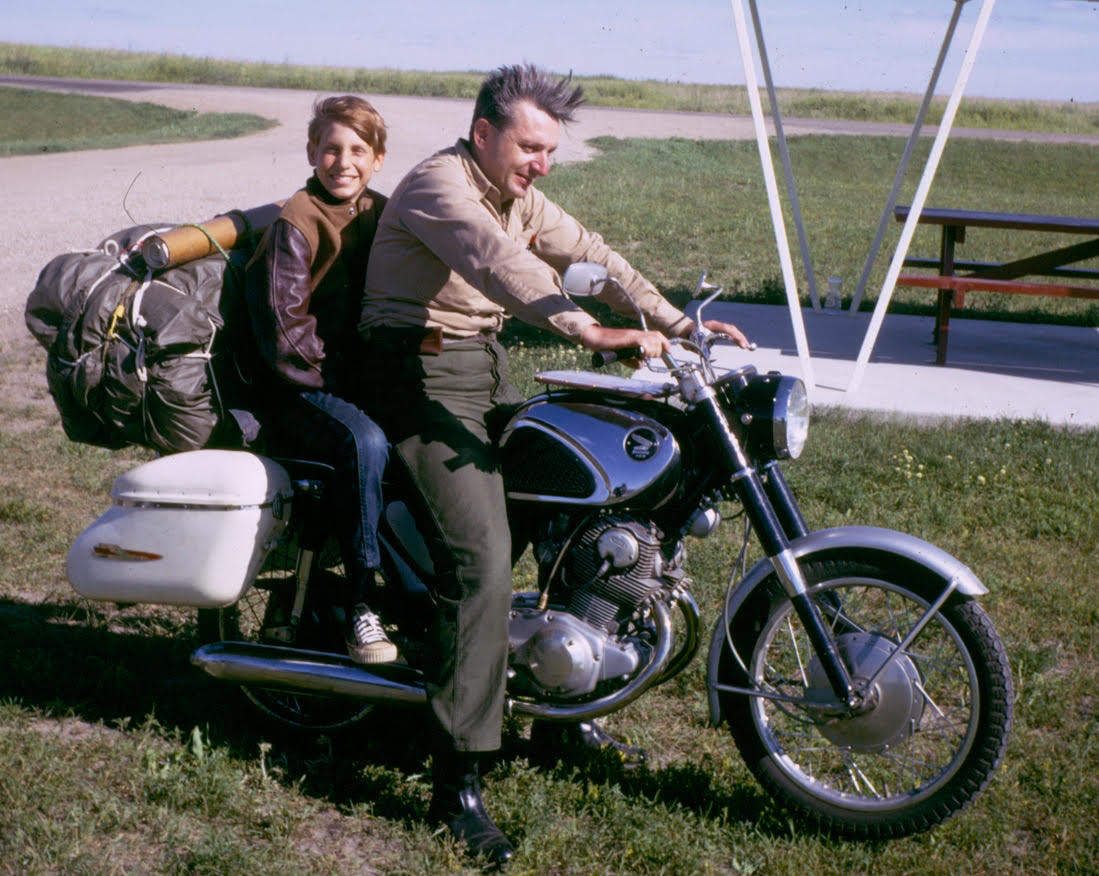
My second chapter is titled “Vehicle,” starting of course with motorcycles. And of course I draw on Robert Persig’s celebrated Zen and the Art of Motorcycle Maintenance. Since my book will be illustrated in color, I looked for imagery.

Most people know that Persig's brilliant philosophy book is based on a real motorcycle road trip that he and his son took, across the American west. What most don’t know is that their trip companions took a few photos. This is one:


In the summer of 1968 Robert Persig was photographed at a roadside stop (I think in South Dakota) by Sylvia Sutherland. His troubled 11-year-old son Chris is on the back with the camp gear and motorcycle tools. Maintenance of the motorcycle was described in detail throughout the book, but its make and model were never mentioned. It was a 1966 Honda CB77F “Super Hawk”—Honda’s first sport bike. Persig kept it the rest of his life. It is now in the Smithsonian.

*

Complement with Kevin Kelly on the Technology Trends that Will Shape the Next 30 Years, How Richard Feynman Made Sense of Complex Ideas, and Kim Stanley Robinson on Inventing Plausible Utopias.

Get new posts via email:


Eliot Peper is the author of nine novels, including Cumulus, Bandwidth, and, most recently, Veil. He sends a monthly newsletter, tweets more than he probably should, and lives in Oakland, CA.

This blog exists thanks to the generous support of loyal readers.
  • βœ‡eliot peper
  • How I Write Books
    I want to read a book.That particular book doesn’t exist.I write it.Thankfully, most of the time I want to read a book, it already exists, so I read it.*Complement with A Recipe for Adventure, the story behind Borderless, and Five Lessons I Learned Writing Veil.Get new posts via email: Eliot Peper is the author of nine novels, including Cumulus, Bandwidth, and, most recently, Veil. He sends a monthly newsletter, tweets more than he probably should, and lives in Oakland, CA.This blo
     

How I Write Books

17 November 2021 at 17:45

  1. I want to read a book.
  2. That particular book doesn’t exist.
  3. I write it.

Thankfully, most of the time I want to read a book, it already exists, so I read it.

*

Complement with A Recipe for Adventure, the story behind Borderless, and Five Lessons I Learned Writing Veil.

Get new posts via email:


Eliot Peper is the author of nine novels, including Cumulus, Bandwidth, and, most recently, Veil. He sends a monthly newsletter, tweets more than he probably should, and lives in Oakland, CA.

This blog exists thanks to the generous support of loyal readers.
  • βœ‡eliot peper
  • Pull a Single Thread, and the Universe Unravels
    When writing, the narrower your focus, the farther you can venture in its pursuit.In “Authority and American Usage,” David Foster Wallace’s book review of a dictionary deconstructs the complex feedback loop between language and culture. In “watermelons,” Andrea Castillo uses the eponymous fruit to cross disciplines and millennia exploring humanity’s relationship with water. In Levels of the Game, John McPhee describes a single tennis match that implies the en
     

Pull a Single Thread, and the Universe Unravels

2 December 2021 at 01:05

When writing, the narrower your focus, the farther you can venture in its pursuit.

In “Authority and American Usage,” David Foster Wallace’s book review of a dictionary deconstructs the complex feedback loop between language and culture. In “watermelons,” Andrea Castillo uses the eponymous fruit to cross disciplines and millennia exploring humanity’s relationship with water. In Levels of the Game, John McPhee describes a single tennis match that implies the entire American experiment.

Any individual feature of the world is an aperture to its entirety. Derive generalities from specifics. Use the particular to reveal the universal.

*

Complement with Stories Are Trojan Horses for Ideas, Reassurance, and Loosen the Straps.


Get new posts via email:


Eliot Peper is the author of nine novels, including Cumulus, Bandwidth, and, most recently, Veil. He sends a monthly newsletter, tweets more than he probably should, and lives in Oakland, CA.

This blog exists thanks to the generous support of loyal readers.

  • βœ‡eliot peper
  • Please fix it!
    Emails like this are why I love my editor:The sunrise/moonset early scene near Santa Barbara. I checked and had actually noted it in my Spring comments; since it was not repaired, I assume that maybe I was ambiguous or at least not forceful enough. So let me be clear: you will lose the confidence of some readers if you leave this impossible situation in. Please fix it!And in case it’s not clear what I mean: when the sun is rising in the East, if the moon is setting in the west, it will be
     

Please fix it!

7 December 2021 at 01:13

Emails like this are why I love my editor:

The sunrise/moonset early scene near Santa Barbara. I checked and had actually noted it in my Spring comments; since it was not repaired, I assume that maybe I was ambiguous or at least not forceful enough. So let me be clear: you will lose the confidence of some readers if you leave this impossible situation in. Please fix it!

And in case it’s not clear what I mean: when the sun is rising in the East, if the moon is setting in the west, it will be fully illuminated by the sun. That is, if the moon is setting at sunrise, it’s a full moon. It can’t be a crescent. 

So you can make it a full moon. 

Or, if you want the crescent, since the scene starts before sunrise, you can have the sliver of the moon in the EAST. In that case, the “horns” will point up and to the right, the bow pointing at the sun, fading as the dawn progresses. (Then, since the moon travels eastward relative to the sun, we’re seeing a “waning crescent.” It will be thinner, and closer to the sun, the next day. Eventually, it will pass the sun (“new moon”), after which point it will be visible as a crescent just after sunset, and it becomes a “waxing crescent.”)

There was another one more thing, but I now forget what it was! Not as vital, at any rate.

*

Complement with Quantity Is a Route to Quality, Not Its Opposite, Cultivating a Sense of Presence, and How I Write Books.


Get new posts via email:


Eliot Peper is the author of nine novels, including Cumulus, Bandwidth, and, most recently, Veil. He sends a monthly newsletter, tweets more than he probably should, and lives in Oakland, CA.

This blog exists thanks to the generous support of loyal readers.
  • βœ‡eliot peper
  • Narrative as Crowbar
     Over in Future, I wrote about unlocking expertise through storytelling:People have wandered the intellectual garden of forking paths for thousands of generations, but the internet is a profound accelerant for such cultural exploration. It is a shadow city with billions of residents. Everyone has a voice, even if nobody listens. Yes, there are assholes and authoritarians. But there are also good samaritans, beautiful nerds, brilliant poets, and every other kind of human you could possibly
     

Narrative as Crowbar

3 January 2022 at 23:11

 Over in Future, I wrote about unlocking expertise through storytelling:

People have wandered the intellectual garden of forking paths for thousands of generations, but the internet is a profound accelerant for such cultural exploration. It is a shadow city with billions of residents. Everyone has a voice, even if nobody listens. Yes, there are assholes and authoritarians. But there are also good samaritans, beautiful nerds, brilliant poets, and every other kind of human you could possibly imagine. The more long-tail blog posts, niche newsletters, and scientific papers I read, the more I realize how desperately we need more stories that bridge important ideas into the larger culture. Humanity has so much profound understanding locked inside expert silos, and narrative is a crowbar that can pry them open for the rest of us.

Read the full story.

*

Complement with Literary Leverage, What My Secret Agent Grandmother Taught Me, and Stories Are Trojan Horses for Ideas.


Get new posts via email:


Eliot Peper is the author of nine novels, including Cumulus, Bandwidth, and, most recently, Veil. He sends a monthly newsletter, tweets more than he probably should, and lives in Oakland, CA.

This blog exists thanks to the generous support of loyal readers.
  • βœ‡eliot peper
  • Refracting Reality Into Rainbows of Possibility
    I interviewed Monica Byrne about writing The Actual Star, an epic tale of self-discovery that spans millennia and questions the very meaning of civilization. Born of extensive research into Maya history and culture, this wildly ambitious speculative adventure will challenge you to reframe the past, present, and future. Monica is also the author of The Girl in the Road, as well as a prolific playwright and screenwriter—an artistic career supported by her patrons on Patreon. In the followi
     

Refracting Reality Into Rainbows of Possibility

12 January 2022 at 02:13

I interviewed Monica Byrne about writing The Actual Star, an epic tale of self-discovery that spans millennia and questions the very meaning of civilization. Born of extensive research into Maya history and culture, this wildly ambitious speculative adventure will challenge you to reframe the past, present, and future.

Monica is also the author of The Girl in the Road, as well as a prolific playwright and screenwriter—an artistic career supported by her patrons on Patreon. In the following conversation, we discuss her creative process, what she learned writing The Actual Star, some of the big ideas the story explores, and the power of speculative fiction.

Photo credit: Tiffany Anderson.

What is The Actual Star’s origin story? How did it grow from the first glimmer of an idea into the book I’m holding in my hands right now?

I visited Belize in 2012 to see the places my mother had taught in 1963 as a Papal Volunteer. I signed up for a day trip to the sacred cave Actun Tunichil Muknal, which… changed everything.

If you've read the chapter of Leah's first excursion into the cave, that was pretty much my experience. I felt all that euphoria. I came out and my first thought was "I have to go back," and my second thought was "I have to write a play about this!" I was revising my play What Every Girl Should Know just then, so I had playwriting on the brain. I called the new play The Cake or the Onion. I wanted to write something happening on three different levels of a stage, in three different time periods, that intersected like a symphony. But the more I thought about it, the less a play seemed to "fit" the enormity of the ideas that were coming up, and so I switched to it being a novel instead.

What surprised you most in your research on Maya history and culture? What are the most important ways in which many of us misunderstand the Maya? How did Maya thought influence how you approached telling this story?

What surprised me most was appreciating the logic of human sacrifice. It's a universal technology, not all that different from what we do today; it's just that today, the altar is capitalism, and the human bodies are on the other side of the world. At least the ancient Maya were upfront about it.

The most common misconception in the U.S., at least, is that the ancient Maya "disappeared." They didn't disappear at all—only some elite state apparatuses of the Maya fell, because they no longer served Maya people. Maya communities re-formed and thrived, and continue to, to this day. But the persistence of the "disappearance" story serves a convenient, racist narrative, that the American continents were somehow empty when Spanish invaders arrived; or even if there were people here, they were ignorable. That narrative has daily, disastrous consequences for modern Maya communities all over Central America, as in the Guatemalan genocide of the early 80s.

How did depicting past, present, and future civilizations change your personal definitions of “civilization” and “progress”?

What most folks see as “civilization” in the archaeological sense is actually a very narrow definition of it: those which leave behind stone monuments and/or written records. If you define “civilization” as a group of people living together, which I do, the vast majority of civilizations didn't do this. Does that make them any less civilizations? No—but it does make them less knowable via the Western toolbox and Western criteria we prioritize, which is frustrating. But what if we put far more emphasis on, for example, tracing oral histories than digging up stone? There are so many ways to illuminate the past that don't necessarily get equal funding or attention.

And yeah, progress is a myth. The ancient Maya knew that! They saw time as cyclical, not linear. They built collapse into their understanding of the universe, whereas we still labor under the delusion that time is a straight march into laser guns and starships.

What creative challenges did you encounter weaving so many disparate threads into a single story? How did you overcome them?

I can just say that it was very, very difficult; and that I used many, many colored index cards.

Photo credit: Monica Byrne.

What did writing The Actual Star teach you about craft? What advice can you offer other writers looking to develop and grow?

I would say to pay attention to whatever gives you butterflies in your stomach. This book took eight years—not just the research journey, but the publishing journey. It was a nightmare. It still is, in some ways. But do I regret writing and publishing the book? Not for a second. Because that feeling I got in the cave, that gave me butterflies in my stomach, is real and pure and good, and I'm honored to be its vessel. So my advice to writers is: find whatever is trying to find its expression in you, and become its loving servant.

What did writing The Actual Star teach you about life? How are you different for having written it?

That it's okay if things fall apart. That that, in fact, is the nature of the universe.

What does speculative fiction mean to you? What role does imaginative literature play in the culture?

It's a prism. Imaginative fiction—mythic, speculative, genre, fantastical, or science fiction, whatever you want to call it—is the prism through which we aim the white light of our current "reality" and see the full array of colorful possibilities projected on the wall, that are all contained within the original light. For me, this is a far, far more exciting endeavor than just writing the white light itself.

How has your relationship with your readers shifted since starting your Patreon? How is the feedback loop between authors and audience evolving, and how does that impact book publishing?

My patrons and my readers are my rock. They really are. They support me both financially and emotionally, especially when the publishing industry does not. Like all relationships, it takes work, but I base mine on transparency, accountability, care, and joy; and it's worked out really well so far. I just wish all writers were able to be directly supported like this—because for the most part, the publishing industry sets up all but the most wildly privileged writers to fail.

In the acknowledgements, you mention that Kim Stanley Robinson is a foundational writer for you. What do you love about Stan’s work, what have you learned from it, and how did it influence The Actual Star?

Oh, where to begin! I read Red Mars when I was sixteen, and have been reading him ever since. The most important thing is: I felt he treated science fiction as being as real as everyday life. I was raised on Star Wars, so I needed to see that science fiction could also be this—that technology wasn't just shiny metal parts, it was also the intimate work of human bodies. There's a LOT of Stan's influence in The Actual Star. Some of it is explicit and borrowed (for which I asked permission)—like the naming convention for reincarnated characters, and the concept of documented anarchy. But then there's just the messiness of human self-governance. I thought of the Mars trilogy symposiums when writing the tzoyna scene in Teakettle—just, around and around and around, and feeling like you're getting nowhere. We think everything will be sterile and efficient in the future? That's a masculine fantasy. It won't be.

What books have changed your life? What should fans of The Actual Star read next?

Go read Pleasure Activism by adrienne marie brown. Her writing and organizing are acts of science fiction, because she's imagining new paths into the future—even if her books are not shelved as such. And she (along with Walidah Imarisha) are the ones who taught me that.

*

Complement with Kim Stanley Robinson's lunar revolution, Annalee Newitz on who owns the future, and the best books I read in 2021.

Subscribe to my newsletter for monthly book recommendations and writing updates:


Eliot Peper is the author of nine novels, including Cumulus, Bandwidth, and, most recently, Veil. He publishes a blog, sends a newsletter, and tweets more than he probably should.
  • βœ‡eliot peper
  • What Writers Do
    Imagine you’re holding a laser pointer.You can point it at anything you want: a potted cactus, the Diophantine Equation scrawled across a whiteboard, the steaming cross section of a fresh baked croissant, a malfunctioning karaoke machine, a whorled knob of lichen encrusted bark, a lopsided smile, the green flash of a Pacific sunset, a signed first edition copy of Dune, a rusty scalpel.But this is a special laser pointer. You can point it through time as well as space: your first kiss, the
     

What Writers Do

18 January 2022 at 03:03

Imagine you’re holding a laser pointer.

You can point it at anything you want: a potted cactus, the Diophantine Equation scrawled across a whiteboard, the steaming cross section of a fresh baked croissant, a malfunctioning karaoke machine, a whorled knob of lichen encrusted bark, a lopsided smile, the green flash of a Pacific sunset, a signed first edition copy of Dune, a rusty scalpel.

But this is a special laser pointer. You can point it through time as well as space: your first kiss, the pre-fame Beatles playing covers in dingy Hamburg nightclubs, knives piercing Caesar’s body at the Curia of Pompey, the sky raining fire in the way of Chicxulub’s impact, the formation of the first black hole.

You needn’t stop at what has happened, you can point at what might or might never happen: human civilization spreading out across the galaxy, a lone figure leaping off the roof of a skyscraper, performing slam poetry at the DMV, a world that has conquered death, no more push notifications, slaughtering a unicorn for its precious horn, the Golden State Warriors winning ten consecutive NBA championships.

In addition to the external world, you can aim your laser pointer at the internal world: the emotional hangover of a half-remembered nightmare, the loss of a loved one, the blank ecstasy of orgasm, the comfortable kinship of old friends, dreams of who you might become, the smell of home, a newfound sense of freedom, your longtime crush on that cute coworker, shame at never having been able to shake your childhood fear of spiders, burgeoning hope, the fading memory of your grandmother’s face, the shock of a well-laid plan shattering on first contact with reality, an irrational but unshakeable faith in humanity.

This is what writers do: They point laser pointers.

This is what writing is: Calling attention to something at the expense of everything else. Then calling attention to the next thing, and the next, and the next, and the next—a bead of light zipping across space and time and thought and feeling to draw a line called story.

*

Complement with How I Write Books, Stories Are Trojan Horses for Ideas, and How to Kill a Dragon.

Subscribe to my newsletter for monthly book recommendations and writing updates:


Eliot Peper is the author of nine novels, including Cumulus, Bandwidth, and, most recently, Veil. He publishes a blog, sends a newsletter, and tweets more than he probably should.
❌