A year ago, I had just returned from a trip to New York. It was a great trip, stacked with board meetings and breakfasts and lunches and drinks and dinners. Normally, too many meetings exhaust my brain quickly, but each of these were invigorating. Not one, but two deals actually came from this trip. And as I landed back in San Francisco, I remember thinking that was a great use of travel.That was also the last time I traveled. A few weeks later, our office shut down and it has been work from ho
A year ago, I had just returned from a trip to New York. It was a great trip, stacked with board meetings and breakfasts and lunches and drinks and dinners. Normally, too many meetings exhaust my brain quickly, but each of these were invigorating. Not one, but two deals actually came from this trip. And as I landed back in San Francisco, I remember thinking that was a great use of travel.
That was also the last time I traveled. A few weeks later, our office shut down and it has been work from home ever since.1
It’s wild both how fast and how slow this past year has gone. If you pause just for a moment and think about the reality: that we’ve been in a state of lockdown for a year now, it’s surreal.2 I mean that: it does not seem real. My brain has collapsed the past year into a mere moment in time.
But we’re also still in that moment and I find myself getting more impatient with each passing day. Oddly, good news about cases going down and vaccines going up only seems to exacerbate such feelings. “Let’s get to the finish line already!” That kind of thing. So I’m somewhat sympathetic when I see news suggesting air travel is quickly ramping back. That seems like good news, but I’m terrified that it’s a bunch of people even more impatient than myself who are just prolonging the return to normalcy for all of us.
It’s incredibly frustrating.
I want to travel again too — believe me — but I also don’t want that travel to lead directly or indirectly to people getting sick, or worse. And I don’t want it to delay the world where we can all feel invigorated again.
Aside
After some reflection, I think I’m just about ready to start this here newsletter up again at a regular cadence. Here’s the current modus operandi I’m thinking about (subject to change, as always):
A short-ish bit of personal writing at the top.
A handful (5-ish) of links below to external things which I believe are worth the click.
Essentially, this will be an easy, in-your-inbox way to keep up with my various readings and writings throughout a given week. Pretty short. Very digestible.
Links
What killed Volkswagen’s electric car? Well, a lot of things. But mainly hubris. 🔋
Susan Orlean has some good tips for how to improve as a writer. The major one: as vain as it sounds, read your own work. ✍️
Amazon is apparently planning a wall-mounted Echo/Alexa device, which means we’re just one step away from a full-on Amazon TV, ahead of the mythical Apple Television. Though it makes perfect sense for Amazon’s model and strategy. 📺
The NYT obit of Hank Aaron is just fantastic in that it’s so data and story rich. What a career. What a life. ⚾️
Basically all of Ezra Klein’s column on the insanely conservative realities in progressive California is worthy of an excerpt. So instead I’ll just share the whole thing. 🌞
For all the (warranted) hype Clubhouse is getting right now, I found myself also agreeing with a lot of the points Mark Sternberg lays out here. As a pretty intense introvert, I struggle with a lot of these issues. 🗣
We have taken a couple trips down south and a few up north, but never more than 90 minutes by car. Staying in Airbnbs to break up the monotony of living in a city with nothing open. In fact, I’m on one right now.
I often say that my goal in life is to get to a place where I no longer need to check email. It’s a funny thing to say. It sounds like a pretty low bar. And just a weird thing to aspire towards. And yet, it’s true.I’ve ranted about email for years and years at this point. I even quit using it for awhile when I was a reporter years ago as sort of a stunt — it was glooooorious. I want to get back to that world, but it’s next to impossible now in our current world, of
I often say that my goal in life is to get to a place where I no longer need to check email. It’s a funny thing to say. It sounds like a pretty low bar. And just a weird thing to aspire towards. And yet, it’s true.
I’ve ranted about email for years and years at this point. I even quit using it for awhile when I was a reporter years ago as sort of a stunt — it was glooooorious. I want to get back to that world, but it’s next to impossible now in our current world, of course.
Anyway, people are sick of hearing me complain about email at this point — my wife, most especially — but it was top of mind this week reading two pieces by Cal Newport. He actually has a new book on the topic, which these posts are excerpted from (I have not yet read the book, nor do I know Cal — this isn’t SponCon).
To study the effects of e-mail, a team led by researchers from the University of California, Irvine, hooked up forty office workers to wireless heart-rate monitors for around twelve days. They recorded the subjects’ heart-rate variability, a common technique for measuring mental stress. They also monitored the employees’ computer use, which allowed them to correlate e-mail checks with stress levels. What they found would not surprise the French. “The longer one spends on email in [a given] hour the higher is one’s stress for that hour,” the authors noted.
And:
Much in the same way that our attraction to food is coupled with the gnawing sensation of hunger in its absence, our instinct to connect is accompanied by an anxious unease when we neglect these interactions. This matters in the office, because an unfortunate side effect of overwhelming e-mail communication is that it constantly exposes you to exactly this form of social distress.
And:
A frenetic approach to professional collaboration generates messages faster than you can keep up—you finish one response only to find that three more have arrived in the interim, and, while you are at home at night, or over the weekend, or when you are on vacation, you cannot escape the awareness that the missives in your in-box are piling up ever thicker in your absence.
And finally:
To return to our motivating question, there are many reasons why e-mail makes us miserable. It creates, for example, a tortuous cycle that increases the amount of work on our plate while simultaneously thwarting, through constant distraction, our ability to accomplish it effectively.
All of the above pretty accurately conveys my feeling about email. It’s not that the format is evil, nor is any individual sending it, it’s that it wasn’t designed with the notion of what would happen with these messages sent and received in aggregate, at scale.
But at the same time, we feel increasingly overwhelmed and frustrated by the sheer number of hours we now spend engaging in this streamlined back-and-forth messaging. Once we removed the cost and friction from office interactions, the quantity of this chatter skyrocketed. According to various studies I gathered during my research, in 2005, we were sending and receiving 50 emails a day. In 2006 this jumped to 69. By 2011 it was 90. Today we send and receive an estimated 126 messages, checking our inboxes once every 6 minutes on average.
Utterly insanity. And still going up. That was something I used to get a lot: push back along the lines of “boo hoo, you’re too popular”, but that wasn’t it at all, I was just ahead of a curve that was and is coming for everyone.
The technologist’s response to email overload is to make these tools even faster. Gmail now autocompletes our sentences, saving typing time, while AI filters try to categorize and prioritize messages arriving too quickly for us to keep up with them on our own. But as the history of technology teaches us, making tasks faster does not by itself guarantee that we become more productive. It’s never been easier to send a report to a colleague, but at the same time, it’s never been harder to find the uninterrupted hours necessary to do a good job writing the report in the first place.
This is like the famous example of how when you expand the number of lanes on freeways to ease traffic, the traffic just expands to fill the new bandwidth. If you make email clients faster, we’ll just get more email even faster as more of it will be sent even faster. And so I wait.
A Smattering of Links
Weather Line, my favorite iOS weather app, was sold and will shut down. Kudos to creator Ryan Jones on the exit, and for making sure we’ll get it for another year. I’m really going to miss those widgets…
Here’s a lot of insight and wisdom and nuance from Noam Bardin, a co-founder of Waze, upon his exit from Google.
I finally got around to watching the “Intel Unleashed” presentation from March. While I’m far from an expert on Intel, like a lot of folks in tech, I’m fascinated by the potential for a comeback story here — both because I think it will make for a compelling narrative, but also an important one given where Intel sits (figuratively and historically: at the center of the computing industry, and quite literally: in the US). It has also seemed to be a bit of a shitshow
I finally got around to watching the “Intel Unleashed” presentation from March. While I’m far from an expert on Intel, like a lot of folks in tech, I’m fascinated by the potential for a comeback story here — both because I think it will make for a compelling narrative, but also an important one given where Intel sits (figuratively and historically: at the center of the computing industry, and quite literally: in the US). It has also seemed to be a bit of a shitshow in recent years. While still a massive business obviously, it feels a bit like an anagnorisis situation. That is, Wile E. Coyote has run over the cliff and is about to drop but doesn’t realize it yet…
The good news seems to be that new CEO Pat Gelsinger clearly gets this. And perhaps just as importantly, he clearly cares about this, as someone who worked at Intel for 30 years and has now returned to right the ship. And most important still, he seems to have a plan. And to be in command of the situation.
That’s the key takeaway in watching his comments here. I’m reminded of a post I wrote five years ago, revisiting a Q&A session Steve Jobs did with Apple employees back in 1997, as he had yes, returned to the company to right the ship. This comparison is undoubtedly unfair — Gelsinger, for one thing, wasn’t a founder of Intel; then again, neither was Andy Grove, Gelsinger’s mentor whom he must channel here in this task — but it feels like the apt one to make. My takeaway from the Jobs video was just how in command he was. Of the issues, of the technology, of the company, of the moment.1
Gelsinger’s presentation here is entirely different. For one thing, it’s an actual presentation and not a Q&A. Still, the same thing is conveyed: just how in command he is. And perhaps even more so than Jobs, just how enthusiastic he is about the opportunity here. It’s perhaps more a political stump speech in its vibe — meant as much for Intel employees as anyone else — but it’s nonetheless infectious.
The parallels here also feel even stronger since it’s Apple first and foremost who has been at the forefront of embarrassing Intel on the consumer-facing front. Not only is the company in the process of abandoning the x86 chips, but they’re doing so with their own in-house-designed ARM-based chips. And they smoke you-know-who.
Dopey ads are not the way to respond to such pwning. This is.
Great Stuff
Some good stuff I’ve read of late that’s worth your time. To follow along with these recs in real time, might I suggest Matter (a new service still in closed beta, but you can use this link to sign up)...
Speaking of the Intel shitshow, here’s a deep-dive Ian King and Tom Giles did for Bloomberg into what exactly went wrong, starting with saying ‘no’ to the iPhone, but more so the entire Brian Krzanich era, it would seem…
Anton Troianovski explores a science experiment happening in Russia’s Lake Baikal:
The Baikal telescope looks down, through the entire planet, out the other side, toward the center of our galaxy and beyond, essentially using Earth as a giant sieve. For the most part, larger particles hitting the opposite side of the planet eventually collide with atoms. But almost all neutrinos — 100 billion of which pass through your fingertip every second — continue, essentially, on a straight line.
Derek Thompson explores the jackassery of Alex Berenson…
Fun Stuff
Remember Flappy Bird? How about playing it as an interactive notification widget in macOS? 🐦
If you’re like me, you think of Tyrannosaurus Rex as one, giant terrifying dinosaur. But how about the idea that there may have been 2.5 billion of them over their reign? (Not to worry, probably only 20k alive at any given time…) 🦖
Baggy jeans may be making a comeback. Which means my closet may be making a comeback. Next, I just need cargo shorts — so useful! — back. 👖
You can now have the book cover of a book you’re reading as the cover photo of your Kindle. I cannot believe this was not an option until 2021. 📚
Just in as we’re hopefully all ready to fully return to movie theaters, Downton Abbey 2 — 2 Downton 2 Abbey? — will be there to ring the bell. 🍽
My Stuff
Blogs
I’ve been regularly blogging again here. A selection of those below...
I’m also reminded of an interview Satya Nadella did at the Code Conference back in 2014, shortly after taking over at CEO of Microsoft. It was pretty clear he was also in command and ready to right the ship. And he has.
Watching the Apple v. Epic courtroom battle from afar has been fascinating. On one hand, it seems pretty clear that Apple is going to win this case on various legal grounds and precedents. On the other, they clearly have so much more to lose than this case.That’s why I was surprised that Apple allowed it to go this far. Which is to say, to court. Where again, ruling aside, both public opinion and more importantly, discovery come into play. Look, I get it. Apple feels duped. And they were!
Watching the Apple v. Epic courtroom battle from afar has been fascinating. On one hand, it seems pretty clear that Apple is going to win this case on various legal grounds and precedents. On the other, they clearly have so much more to lose than this case.
That’s why I was surprised that Apple allowed it to go this far. Which is to say, to court. Where again, ruling aside, both public opinion and more importantly, discovery come into play. Look, I get it. Apple feels duped. And they were! And they feel wronged. And, I mean maybe? But regardless, come on, Apple, you’re a $2 trillion company. The world’s only $2T company, in fact.
You’re no longer the resistance battling Big Brother IBM. You’re no longer the David fighting the Microsoft Goliath. In terms of market cap, you’re now bigger than both of those old foes, combined. Granted, Epic is no pipsqueak, but your revenue last year alone was 10x what Epic is worth as a private company. You’re not just fighting down, you’re now Big Brother Goliath fighting down. Even if you win, you lose.
Obviously, Apple is hoping a win in court will both make a statement and set a new precedent for the way they are operating and wish to continue operating the App Store. But no matter what the courts decide here, the public, and by extension, the regulators are just gearing up for a new, much larger battle. And as a direct result of all the various things unearthed in discovery for this trial, you’re going to lose that battle. And that matters because it’s the actual fight on which the war will be decided.
And that’s why I have to believe that Epic’s maneuver here wasn’t a calculation for today, but for tomorrow. And while they’ve been saying this is about more than Epic, such cliches often ring hollow — here, I’m not so sure. What started as a savvy PR move to poke the bear,1 actually may have ensnared the bear in a trap. And the bear viewed the trap as a giant den of honey.2 And ate the whole thing. He just couldn’t help himself. And now he actually can’t help himself.
The die is cast. Apple is now in a war they cannot win, after they win this battle.
If you’re dumbfounded as to why people who can won’t get the vaccines — why they wouldn’t help themselves, if nothing else?! — this piece by Derek Thompson feels like a great primer.
After 15 months away, I’ve started going into the office again. Not everyday, but most days. It’s both great but also is going to take some real getting used to in ways that perhaps I wasn’t expecting. This isn’t at all about COVID protocols, but rather time.Most of us have spent the past year-plus working from home, where “going to work” means rolling out of bed and moving maybe 100 feet. Perhaps even not getting out of bed at all, at times. Our modern world
After 15 months away, I’ve started going into the office again. Not everyday, but most days. It’s both great but also is going to take some real getting used to in ways that perhaps I wasn’t expecting. This isn’t at all about COVID protocols, but rather time.
Most of us have spent the past year-plus working from home, where “going to work” means rolling out of bed and moving maybe 100 feet. Perhaps even not getting out of bed at all, at times. Our modern world made working this way feasible, we have the technology to miss few, if any, beats. And maybe even gain a couple working this way. That’s largely because of the time compression happening when you remove not only a commute, but also the inner-office intangibles.
We all knew and understood that commute times add up, but it is different to live this reality again. A 30-minute commute in the morning and a 30-minute commute at night is an hour of your day you had previously “unlocked” (to work or do something else). I’ve been largely taking Ubers again, so I can actually work — including, by the way, writing this, if you want to consider that “work” — but if I were to drive, I obviously wouldn’t be able to do that. I could fill my time with a podcast or something else to listen to, but it would be a wholly different use of the time than it has been this year.
And again, it adds up. When traffic is fully back to normal, I suspect my 30 minutes each way will be more like 45 minutes. And that means it’s an hour and a half of time spent commuting a day. For some, it will be far more, of course. And I suspect that alone may be the biggest bit of pushback in the return to office work. Because that time adds up so quickly and is so obvious.
The inner-office stuff is more interesting. You’d probably never think that folks popping by your desk or saying ‘hello’ as you walk to the restroom as units of time. But they are. And as great as they are — and they are great, even for an introvert like myself after the past year — they also add up. And it leads to this strange feeling at the end of a work day back in the office where you feel like you’ve had less time to get stuff done than you did previously.1 Because you have!
Again, I’m not saying these are bad things, they’re just changes from the past year.2 And while perhaps obvious ones, they were at least less obvious to me until I started living them again. It’s not even like there’s some tally of time to know how much is shifting, it’s just a feel. The feeling that you have less time. And it’s going to take a while to get used to that again. If we ever do.
Editor’s Note
I’m on the verge of switching things up again in my newsletter routine. I know. I KNOW. I’m a huge pain in the ass. But I just enjoy experimenting and shaking things up, partially as inspiration to keep going, to keep writing. So don’t be surprised if the next time you hear from me it’s in another format, perhaps from another email address, perhaps on another platform. Anyone who wishes to unsubscribe can always do so; no offense taken. As always, I do aspire to do something a bit more unique but also more streamlined, especially in a world of pure newsletter inundation, some five years after I started writing one. Thanks, as always, for reading and sticking with me.
If you believe we’re moving to a world of self-driving cars — one day — devoting so much space to the parking of cars makes absolutely no sense. Even if you don’t believe in such a world, the realities of ride share make parking seem prehistoric. And in many ways, almost barbaric, given what it has done to cities.
While this is a highly controversial topic, to say the least, I found this tick tock by The Wall Street Journal to be a fascinating read that would seem to point to an Occam’s Razor explanation…
On the topic of controversial topics, the drama surrounding Bill Gates is nothing if not depressing, and potentially pretty disappointing. This Bloomberg piece is a good summary of what has played out to date.
On the other end of the spectrum, Guy Fieri is coming out the pandemic looking like a goddamn saint, albeit a weird-looking with tips dipped in frost and donkey sauce. And a well paid one, with a new contract from The Food Network to prove it.
Have you ever wondered why Bruce Willis and company — formerly huge, exclusive movie stars — are making a ton of generic, low-budget movies? I certainly have. And well, this is the story for us.
After the past week, month, and six months, the internet doesn’t need another take on Elon Musk and Twitter published. So instead I’ll email it to about 10,000 of you. This is a train wreck we’re all watching aboard the train being wrecked. Not only can we not turn away, we’re in the middle of it! Elon believes he had to derail the train in order to fix it, but it’s traveling at bullet speed and he just threw half the crew off the train. Pop quiz, hot shot: what do
After the past week, month, and six months, the internet doesn’t need another take on Elon Musk and Twitter published.
So instead I’ll email it to about 10,000 of you.
This is a train wreck we’re all watching aboard the train being wrecked. Not only can we not turn away, we’re in the middle of it! Elon believes he had to derail the train in order to fix it, but it’s traveling at bullet speed and he just threw half the crew off the train. Pop quiz, hot shot: what do you do?
That answer, is also seemingly being calculated and re-calibrated in real-time. It’s not that every day has something new, it’s that every tweet has something new. It’s both exhilarating and exhausting. And excruciating — especially for those who have worked at Twitter, or have loved ones who do, or who just have loved the service over the years. It feels perilously close to the brink. A train off the tracks heading for the ravine if only it can get through that active minefield first. Look up, an asteroid!
And yet. There’s a flip side to the shitshow which you can’t help but feel as well, if you’re being honest with yourself. What if Elon is right? Even by accident? Now, his tactics are awful — in some cases, truly awful — and this all has entirely too much of a “fuck it, we’ll do it live” feel. But the reality is also that Twitter wasn’t working on a number of fronts, and most importantly as a business that was going to last in perpetuity.
I’m not sure you’ll find anyone who would say that Twitter wasn’t a bloated company. Yes, basically all companies become bloated with time, but Twitter didn’t have the financials to back up the bloat. So Elon Musk is doing what he felt needed to be done to rightsize the company and going from there. Again, there are probably a hundred ways to do it better — like this, for example — but this is the business world’s equivalent of ripping off the band-aid… and finding the wound is not healed. Oh shit.
Still, somehow Twitter seeminglybeat the wild request to ship a few new things in a matter of days (or be fired). Sure, the features are perhaps half-baked, but it’s… something? What else might get out the door or thrown out the window in the next few weeks? It’s wild to watch what was a large company operate at startup speed again in just a few days. And if you can look past the personnel fiasco — “but other than that, what did you think of the play, Mrs. Lincoln?” — it’s sort of incredible? Not in a good or bad way, but in a very literal sense. Almost impossible to believe.
As an aside, hello! I'm back here on 5ish because... Twitter is (seemingly) closing the platform, Revue, on which I had been (infrequently) publishing my newsletter for the past year and a half. I actually guessed this would happen six months ago in my last newsletter, so there's that. Fun times.
Just a stunning account by Rod Buntzen, who was a young Naval scientist in 1958 when the US tested a 8.9-megaton thermonuclear weapon on Eniwetok Atoll. “I thought that the hair on the back of my head might catch on fire.”
A lot of really compelling thoughts and historical anecdotes on the concept of “taste” by Brie Wolfson. Here’s one:
Another framing for this is “turpentine.” It comes from Picasso remarking that “when art critics get together they talk about Form and Structure and Meaning. When artists get together they talk about where you can buy cheap turpentine.” Taste rests on turpentine.
A pretty sad but also pretty great dive into how Bruce Willis went from hugely promising up-and-coming actor to one of the biggest movie stars in the world to someone taking in seemingly endless paychecks to do cameo appearances in B-movies. I’ve long been interested in this turn, and now we know why he was doing it. And why he will no longer be doing it, sadly.
Speaking of new CEO’s coming in to try to re-make companies, Dana Mattioli dives into Jassy’s first year in his role atop Amazon. Which has been rocky, to say the least. But a lot of that sure feels like poor timing.
As you might expect, there’s a lot in the FT’s lunch chat with Musk: Twitter, Mexican food, Ukraine, aging, population, Mars, money, Tesla, parenting, Starlink, China, Apple, Taiwan, Russia. You will be entertained.
“So much of the world is creatively constipated, and we’re going to make it so that they can poop rainbows.”
The Megalodon was probably even bigger — and faster than we previously thought. And hungrier too. 🦈
Every single SNES manual is now online. I repeat: every single SNES manual is now online. This is one of the most nostalgic things I’ve ever experienced, truly. 🕹
Slate’s dive into the history of the word “motherfucker” is nearly a decade old but perhaps even more relevant in our current times. 🤬
What’s the deal with all those seemingly personal spammy text messagesby Max Read, not Jerry Seinfeld. 💬
Robert Vlasic loved pickle jokes and distributed a pamphlet with them, because of course he did. Also, we finally get an explanation for Vlasic’s stork logo. RIP at 96. (Also, #GoBlue 〽️) (Also no pickle emoji?!) 🥒
My only regret is that there’s work to do. Like actual work. Like meetings to be in. People to see. Life to live. I sincerely wish this whole Twitter fiasco had happened over a long holiday break so I could just follow it in real time. Because it’s the most entertaining the internet has been in some time. It’s like a goldmine of content that got dropped on a clown car.Yes, a large part of it remains depressing. A lot of people lost their jobs. But come on, none of those people
My only regret is that there’s work to do. Like actual work. Like meetings to be in. People to see. Life to live. I sincerely wish this whole Twitter fiasco had happened over a long holiday break so I could just follow it in real time. Because it’s the most entertaining the internet has been in some time. It’s like a goldmine of content that got dropped on a clown car.
Yes, a large part of it remains depressing. A lot of people lost their jobs. But come on, none of those people could possibly be wanting to work through this. Would you? Would these people?! Everyone will find other jobs. The only downside is that those jobs will not have the eventual stories to tell that this one will, from just this week alone.
To me, this all would still seem to follow “Elon’s Razor” — that is, the most entertaining scenario is the most likely. But my other, more dire, thought is currently this: what if Elon Musk, in realizing that he, in fact, would be forced to buy Twitter one way or another just resigned himself to cut costs as quickly as possible while trying to grow the user base as quickly as possible so as to flip it back to the public market with minimal loss of capital? I mean, there’s going to be a large loss of capital regardless, because the market conditions are just different from when the original offer came about. Still, it’s better to lose, say, $20B rather than $45B?
But in trying to execute the above plan, everything is going wrong. It’s just a legitimate comedy of errors. The clown car is back, baby.
Apple continues to play their dangerous game with regard to their in-app payments cut. And it’s pretty clear that it’s going to backfire — likely sooner rather than later. They should be trying to get ahead of it, and engendering goodwill, but instead they’re digging in. Good luck.
Steven Levy asks us to take a step back to note that while always difficult, a downturn is a natural market occurrence and actually, all the companies we now know and love arose from the ashes of past downturns. This time will be no different, as hard as that is to see, in the moment.
A fun history of the IPA — the pale ale which, yes, gets its name from India, but had little to do with the continent beyond the British soldiers drinking it en route to the country. The US, of course, has subsequently taken over the market in ways both good and bad.
I like this framework from economist George Gilder:
“Wealth is most essentially knowledge,” Mr. Gilder says. “Let’s face it, the caveman had access to all the materials we have today. Therefore, economic growth is learning, manifested in ‘learning curves’ of collapsing costs driven by markets.” Yet these learning curves get waved away by economists. Mr. Gilder says information, not materials, drives growth: “Crash a car and all its value disappears, though every molecule remains.”
This is from almost a year ago, but seems perhaps even more important today: the pandemic highlighted many things about our lives and work before and it also charted a path for what should matter and what we should focus on. One of those things should be the written word.
“Silver is an ethereal white. It almost has no colour – or every colour – while titanium or nickel are so very warm, and stainless steel is so very cold and blue.”
A year late, but a rather fascinating Q&A with Kenneth Branagh. 🎭
This $400 Lego set is for adults, not kids. And I’m all about it. 🧱
I know that basically all musical artists are selling their catalogs right now in a red hot market, but doesn’t it seem a little early for Justin Timberlaketo be doing it?! 💿
Did you know the massive wine brand Cakebread exists because an auto mechanic with a side passion for photography agreed to a photoshoot assignment in Napa Valley one day? After he took classes from and eventually befriended Ansel Adams, no less? I did not. 🍷
The new Zelda game is coming in May of 2023 and the Nintendo Switch, the console on which it will play exclusively, will be over six years old. And no one will care about that, which is sort of wild. The value of IP. 🕹️
Speaking of, the first Super Nintendo World — the theme park — in the US looks like it will be opening slightly before that Zelda launch… 🍄
Why is Venice not underwater right now? This is why. 🌊
The author Michael Lewisrecently spentsix months with FTX chief Sam Bankman-Fried. To which I say: Sweet Jesus, what timing! 🕙
Hello from Tennessee where it’s — checks weather app… checks weather app again — 61 degrees and sunny? Where tomorrow, it will be 65 degrees and sunny. On Thanksgiving Day. That sounds great because it is great. But it’s also weird. I just came from Northeast Ohio where it was about 15 degrees and we barely missed a snowstorm which dumped several feet of snow on Buffalo. So much snow that they had to relocate an NFL game. Here, just a few hundred miles south, it&r
Hello from Tennessee where it’s — checks weather app… checks weather app again — 61 degrees and sunny? Where tomorrow, it will be 65 degrees and sunny. On Thanksgiving Day. That sounds great because it is great. But it’s also weird. I just came from Northeast Ohio where it was about 15 degrees and we barely missed a snowstorm which dumped several feet of snow on Buffalo. So much snow that they had to relocate an NFL game. Here, just a few hundred miles south, it’s warmer than it is in San Francisco.
Hope everyone (in the U.S. at least) has a good Turkey Day. I’m planning to settle in for some great sporting events — watching, not playing, of course. Beyond the NFL games on Thanksgiving, the U.S. is playing England in the World Cup on Friday. And then, of course, Michigan is playing Ohio State on Saturday. With #3 vs. #2 with both teams 11-0…1
Normally, I’d be watching these by a fire. Not this year. #GoBlue 〽️🏈⚽️🦃
Fun to look back at the June 2018 HBO internal townhall conversation between AT&T’s John Stankey and HBO’s Richard Plepler. I wrote a few posts about it at the time, as it was clearly more indicative of a looming storm of shit than anyone was letting on. But there’s also nuance to how it ultimately played out. While Plepler unsurprisingly left, HBO was able to regain its footing — seemingly thanks to a combination of Plepler lieutenant Casey Bloys stepping up and AT&T stepping away (selling all of Warner to Discovery).
With everyone scrambling to figure out the next shoe to drop after the FTX implosion, seems like people are overlooking the situation with Tether. I’m not quite versed enough in the world to know something one way or another, but I’ll leave you with this tidbit from an article last June:
Even by crypto’s often-surreal standards, Tether has a peculiar history. The company was founded in 2014 by Brock Pierce, a cryptocurrency evangelist who, as a child actor, starred in the “Mighty Ducks” movies. He and his partner, Reeve Collins, later handed control of the firm to a former plastic surgeon named Giancarlo Devasini, who has stored some of Tether’s assets in a bank in the Bahamas run by one of the creators of the “Inspector Gadget” cartoon.
Speaking of FTX, this is a fascinating read — albeit one with more leaps than standard reporting — on what might have been happening behind the scenes at Alameda Research, the firm whose close — to say the least — ties to SBF and FTX ultimately doomed the exchange itself.
There’s a lot of good stuff in here about the current state of the business of newsletters by Byrne Hobart. A couple things that stood out to me is his correlation between the economy and subscription growth — not too surprising, but fascinating that it plays out on such a micro level. And also the call out for how many funds started out as newsletters — which makes sense in that you’re directly giving people an entry point into how you think about various topics, including investments. Some of those people may wish to give you money if they agree with those thoughts and assessments…
With the stunning — well, not so stunning to some of us — return of Bob Iger to lead Disney after retiring and putting in place his handpicked successor, Bob Chapek, to run the show, there are no shortage of behind the scenes tick-tocks of what happened. From the reporting thus far, clearly bad quarterly results played a role while key executives losing faith played perhaps a larger one. But it’s wild that Chapek was just a few months ago given a new contract by the board. You might say they had to in order to stop the swirling speculation about his contract and tenure, but it was a very costly mistake, clearly. Sports teams do this all the time — “he’s our coach” — but this is such a wild self-own for corporate America. Iger is now seemingly acting fast to reverse a lot of the Chapek changes. And then it’s on to find who is next — again. (Also, the title refers to maybe my favorite meme — perfect here.)
“Getting some of those longer-term positions, pivots, big bets, people in the roles, breaking ties—those are the things to me that are a lot more productive than the fact that I sent 50 or 100 emails in a day.”
— Google CEO Sundar Pichai, talking about productivity in our new world work environments. (Disclosure: he’s also the CEO of the LP in the fund where I’m a partner. I also link to almost anything which takes a shot at email.)
The Quick Stuff
The leap second is set to die (in 2035), it’s fascinating why it exists and what it takes to make it go away. 🕰️
Artemis, the new space program which will eventually take us back to the moon, is now officially underway. While this first stage is unmanned, the next phase, likely in 2024, will take people around the moon. And then the plan is to land people back on the moon in 2025. Finally. 🌝
40 Awesomely Weird 1980s Horror Movie Trailers? Sure, allow yourself to be sucked down this YouTube rabbit hole. (Thx Hunter) 🎬
After a three year shutdown for repairs, the Large Hadron Collider is up and running again. What will it be looking for post Higgs boson? Maybe the Muon g-2 anomaly, leptoquarks, the W boson mass… Standard stuff — or actually, stuff that might break the Standard stuff. ⚛️
Trent Reznor is quitting Twitter, but just as interesting is how he’s now constantly framed as the famous film score composer rather than the Nine Inch Nails frontman. Quite the reinvention — and undoubtedly a smart one given how hard it is to hold on to music in changing times. 💅
Anyone want to hear me talk about the 2000 Christopher Nolan film Memento for 90 minutes or so? Now is your chance. 🗣️
E. Bryant Crutchfield passed away a few months ago at 85. He invented the Trapper Keeper, but also immediately recognized the importance of the external design element of the contraption. Neon unicorns, dancing dolphins, puppies holding flower baskets in their mouths, etc. It’s wild the percentage of kids that had them in the 1980s and 90s. Just full of fun anecdotes, such as:
He found the name during a martini-fueled lunch with Jon Wyant, his research and development director. They had already decided to call the folders trappers. “What are we going to call the notebook?” Mr. Crutchfield recalled saying. “The Trapper Keeper,” Mr. Wyant replied. “Bang!” Mr. Crutchfield recalled. “It made sense!” 🍸
With the holidays fast approaching, I thought I’d use this opportunity to clear out a bunch of links I had saved over the past year-ish. I’ll be heading off on an adventure next week — somewhere far, far away (more on that in the links below). And I look forward to catching up on a lot of reading.1 Sort of like what I used to do with Pocket (though these days on Matter, a GV portfolio company). To reset, as it were, for 2023. Speaking of, I clearly made the right call about a
With the holidays fast approaching, I thought I’d use this opportunity to clear out a bunch of links I had saved over the past year-ish. I’ll be heading off on an adventure next week — somewhere far, far away (more on that in the links below). And I look forward to catching up on a lot of reading.1 Sort of like what I used to do with Pocket (though these days on Matter, a GV portfolio company). To reset, as it were, for 2023.
Speaking of, I clearly made the right call about a month ago to bring this newsletter back around these parts as sure enough, Revue was formally killed off today by Twitter. RIP, old friend. At least Twitter itself is still alive and kicking… us all in the head (or worse) on a seemingly daily basis. I’m honestly very, very excited for this news cycle to end. But it doesn’t seem like it will anytime soon, sadly.
Meanwhile, what did end was the second season of White Lotus. Still wrapping my head around it to distill thoughts. But mainly I’m impressed by how short the season was — just seven episodes. And I remain firmly in the camp that Netflix is shooting themselves in the foot with certain shows (not all of them) by sticking with the binge strategy. Part of the power of White Lotus is being able to talk about it for a week afterwards. The watercooler.
We’re currently watching the new season of The Crown on Netflix and there’s absolutely none of that — at least within my social graph. While they’re reconsidering almost everything, Netflix should consider at the very least a hybrid approach, where they release maybe the first season of a show in full binge mode to get people hooked and then if the show is a success, move to a more traditional weekly model to let natural buzz do its thing. Then again, I’ve been saying this nonstop for six and a half years at this point.
Just in case this is my last dispatch of the year (quite likely), Happy Holidays and New Year, all. 🎉🥳🍾
This is from back in August, but worth the read if you missed it because it feels like all of this is going to come to some kind of head in 2023. The reporting doesn’t put either Facebook or Apple in a particularly good light, but it’s more damning of Apple because it suggests just how far the company is pushing to not only keep their 30% cut from the App Store, but to milk companies, even and maybe especially the largest to get more, more, more.
A comprehensive dive into what the history of other wars may point to for the end of this conflict, eventually. The range is from the literal bang to the whimper, but the most likely outcome is somewhere in between, and that will take a long time, even from now. Also, this quote by Hein Goemans is just fantastic: “Sometimes war generates its own causes of war.”
A completely dispiriting look into why we can’t have nice things here in California — and really, likely the entire US, at least when it comes to infrastructure of this scale. Unsurprisingly, dreams are quickly crushed by political bullshit. “Then came the decision to start building a train between Los Angeles and San Francisco that reached neither city.” The current estimates for when this project will actually be done range from: will “not be completed in this century” to “it will never be operable.”
Speaking of, here’s a great Ezra Klein op-ed on why we suck so much at building things like high speed rail in the US. And, provocatively, why Democrats are worse still. One thought: too many of the leaders in the party are or were lawyers.
A fun interview with Dril, talking about the past and present of Twitter, as well as the other networks that are attempting to take the crown. “Dril is a community member, he was born of the internet, Elon merely adopted it.”
With the latest Fed rate hike today, it seemed like a good time to share this piece by Matthew Yglesias. A good overview on the hikes, but I also appreciated his take on the VC vs. Journalist debate, which continues to rage.
On the flip side, here’s Paul Krugman with some historical context for the 2 percent inflation target. Which, of course, seems to be largely based on bullshit political dynamics forgotten to time and now are just taken as gospel. (Yes, I just used both “political bullshit” and “bullshit political” in one section.)
“Nobody’s going to sign up to take cold showers. Nobody’s going to sign up for not using their washing machine.”
When I was a kid, I loved the movie Mr. Baseball, in which an aging American slugger (Tom Selleck) gets sent to Japan to play the game. Turns out, 30 years later, I wasn’t alone. ⚾️
Steven Levy dives into Tony Faddell’s attempt to make the “iPod of crypto” — a digital, secure wallet — in France. 🪪
When Julian Robertson, the founder of Tiger Management, passed away in August, there were a number of great obits written. Here are two filled with fun backstories on his life. One such tidbit: the name of his hedge fund sprung out of his habit of calling people “Tiger” if he couldn’t remember their name. “I didn’t want my obituary to be, ‘He died getting a quote on the yen,’” Robertson said in 2013… Indeed. 🐅
One likely casualty of the move to electric cars? AM radio. And interestingly, largely for technical interference issues. Though they may need to be worked around as some 47 million Americans still listen… 📻
If anyone needs me on February 17, I’ll be at Universal Studios Hollywood — the first US outpost of Super Nintendo World opens that day. It won’t be as cool as the Japanese variety — it will have one ride to start, Mario Kart — but they got it up and running pretty quickly. 🍄
Speaking of nerd fantasies, apparently there was a tiny window in which you could booka hobbit hole to spend the night in Hobbiton — it was yesterday, as a promotion through Airbnb, and it undoubtedly sold out immediately. It would have if the stay was $6,500 a night, but it was $6.50 a night. That’s not a joke. The good news is that I’ll be there in a few weeks regardless on a trip to New Zealand. 💍
Though, as anyone with toddlers will know well, “vacations” are now very much in quotes. And often far more work than just staying at home. Still, it’s aspirational.
Welcome to 2023. Just back from vacation chasing a small child around Australia and New Zealand for a few weeks. Not too much downtime but I was able to get quite a bit of reading done in the small slivers of time that would open during naps and bed. And actually, some writing too. Mainly, I was reminded just how fantastic it truly is not to check email all the time. I’ll pay for it over the next week or so, but it’s something that eases my anxiety to a point that it probably should
Welcome to 2023. Just back from vacation chasing a small child around Australia and New Zealand for a few weeks. Not too much downtime but I was able to get quite a bit of reading done in the small slivers of time that would open during naps and bed. And actually, some writing too.
Mainly, I was reminded just how fantastic it truly is not to check email all the time. I’ll pay for it over the next week or so, but it’s something that eases my anxiety to a point that it probably shouldn’t. Clearly, I’m doing something wrong. But I’ve been complaining about this topic on the internet going on 20 years now and still, here we are.
New years are nothing if not good markers in time from which to reassess the way you operate. So it was hardly surprising to see a flurry of news around companies trying to re-imagine or trying to entirely get rid of meetings in the workplace as we all try to adapt to the way of things post-COVID. Even and maybe especially Facebook/Meta is having such challenges of how best to operate now, as Alex Heath notes in his new Command Line newsletter (subscription only). And the whole “quiet quitting” thing, which may not be all that novel, actually, as Cal Newport points out:
This is why so many older people are confused by quiet quitting: it’s not meant for us. It’s instead the first step of a younger generation taking their turn in developing a more nuanced understanding of the role of work in their lives. Before we heap disdain on their travails, we should remember that we were all once in this same position.
I’m trying a slightly different format below with images and excerpts for the top reads. Thoughts, as always, are most welcome. (I’m already seeing alerts that this email may be too long, so I’m cutting out at least one segment.)
This detailed report on the trials and tribulations of making the latest Mission: Impossible installments is from last March, but worth surfacing again as we near the release of the first of these films (see: below) — Dead Reckoning Part One. Say what you will about Tom Cruise, but his commitment to filmmaking (again, see: below) and the theatrical element of it in particular is impressive. He’s the last true, true movie star in that he won’t be seen on a streaming service (at least not before his films run in theaters for an extended time) and he’s probably the only person left to demand such things. And this was written before the success of Top Gun: Maverick. Now Cruise can truly do whatever he wants here.
Sure enough, Cruise was having none of it. Seeing himself rightly as Paramount’s most important, not to mention longest-term, partner, he was said to be furious. He had no intention that any of his movies would play for a day less than his standard three-month run. “For him, 45 days is like going day-and-date,” says a Paramount source. He also felt that setting a date when the movie could be seen on the service would discourage people from going to the theater. Cruise is one of the last dollar-one gross players in the business, so box office receipts are key to his compensation. (He makes much more from the films than the studio does.) A source says Gianopulos had relied on the advice of Paramount Pictures COO Andrew Gumpert that the studio had the power to shrink M:I 7‘s theatrical window. (Paramount declined to comment.) But language in Cruise’s contract said the movie had to be handled in a manner consistent with the previous film. Cruise called his lawyers.
Also, just wild how many times M:I production had to be shut down during COVID restrictions. It matches the number in sequence of this next Mission: Impossible film. (The Hollywood Reporter)
Just incredible reporting by Olivia Nuzzi, matched by equally great writing about the absolute insanity that continues to surround Trump, the candidate. She’s great at the keep-a-sentence-going-until-you-twist-it-into-a-punchline. My favorite part:
What he means when he says “Miami” is that his SUV rolls down the driveway, past the pristine lawn set for croquet and through the Secret Service checkpoint at the gate, for the two-hour trip to another piece of Trump real estate, the Trump National in Doral, about eight miles from the airport in Miami-Dade County. There, he meets regularly with an impressive, ideologically diverse range of policy wonks, diplomats, and political theorists for conversations about the global economy and military conflicts and constitutional law and I’m kidding. He goes there to play golf.
Fine, one more:
On the day he announced his candidacy this past November, the air was heavy with oleander and snipped greenery and sea mist colliding with mold and wood polish and hotel soap and the metallic vapor of Diet Coke and the alcoholic ferment of generations of cougars in Chanel No. 5. The floor was staged for something between a rally and a cocktail party.
It’s wild that Trump agreed to participate in this. But then again, of course he did. He’s Norma Desmond in Sunset Boulevard. (New York Magazine)
The entire time I’m reading this Economist report on the struggle for car manufacturers to adapt in a world where software is increasingly the focal point I’m thinking one thing: Apple. Yes, the company has infamously struggled with their still never formally announced car project, with several trips back to the drawing board. But the reason why they’d seem to be going after the space — beyond the obvious massive revenue potential — is that they can do what they did for personal computers and smartphones: meld hardware and software into on cohesive product. All of the other projects right now are clearly more piecemeal, save perhaps Tesla.
Moreover, making the mechanical engineers who still dominate the car industry work with software engineers, who will increasingly take a lead, will not be easy. One side is trained to achieve the perfect Spaltmaß, a German word for the gap between a car’s body panels. The other has no problem putting out half-baked “beta” products and collecting feedback from users.
As Tesla has proven, and Apple’s stumbles behind-the-scenes seem to make clear: it’s incredibly hard to produce a car. When you add in the self-driving elements, it’s seemingly next-to-impossible. Especially if you believe in Spaltmaß — something which Apple clearly will as well, but Tesla has seemingly been more okay with doing things on-the-fly, in beta.
Still, Apple has to enter this market eventually. And probably not just with software or some half-baked solution. They can unify the problems here. Even if it takes years. (The Economist)
A good post by Doug Shapiro on the current state of television (and film) production and where it’s likely headed
One notable thing about all this angst: it has been caused primarily by disruption of the way TV and films are distributed and, to a lesser extent, changes in how they are consumed. The way they are created, however, has not changed much.
In fact, while the Internet caused the costs to distribute content to plummet over the last decade or so, the cost to produce TV series and films has risen dramatically. It’s expensive and risky and consequently is still dominated by only a handful of big companies.
But, he asserts, AI may be on the verge of changing this, while at the same time, consumer quality expectations are changing/morphing thanks to Netflix, but also YouTube and TikTok.
For that matter, will is be possible to train an AI on the footage of every Angelina Jolie movie ever, including her voice and facial expressions, license her likeness, and then create a new film starring a 28-year Angelina Jolie, starring opposite a 32-year old Paul Newman, all in the Unreal Engine? The way things are headed, it probably will.
Yes, it will — I wrote this six years ago (wild). Such technology for this will probably be ready sooner than we imagine, but the societal and ethical questions around this will slow things down. But newsflash: in the end, money will win. (Medium)
Throughout his career, Mr. Chapek has used and praised a management framework that emphasizes accountability and a structure for corporate responsibility. The method, called ARCI, is often taught in business schools. Under the philosophy, there should be no ambiguity about who is responsible for the success or failure of an effort. Under the ARCI framework, each time a company makes a big change, it must identify personnel who are accountable for the decision, responsible for its success or failure, consulted for feedback and informed of its impact. “Who’s got the ‘A’ on this project?” Mr. Chapek would often ask in meetings, according to people familiar with the matter—meaning, who is accountable for it? Some executives found the approach irritating because they felt it invited other managers to get involved with decisions that ordinarily would be made by a single segment head, people familiar with the matter said.
You can imagine how inspiring this all must have been for one of the all-time creative companies. We all get why companies bring in consultants, at least in theory — outside perspective, fresh ideas, etc. But does it ever actually work?
You just can’t force such frameworks on a company whose lifeblood has been creativity since its inception. Obviously. Which is why the most shocking element of all of this is that Iger thought Chapek was the right person for the job. I’m still not sure we have a great answer on that and why Iger left so quickly the last time around. Seeing the pandemic writing on the wall? Something else? (WSJ)
You probably heard that there was no beer for sale during the World Cup in Qatar, but did you know that Budweiser had already shipped all the beer to the country when the last-minute decision was made to ban it? Ouch. (NYT) 🍺
In a more sober, somber, and serious note, read the post from Céline Gounder, the wife of Grant Wahl, the famed journalist who tragically died while covering the World Cup from an aneurysm. (Substack) 😢
For something more uplifting, please read Isaac Chotiner absolutely eviscerating Alan Dershowitz in interview form. (New Yorker) 🤭
Of all the scores he’s worked on over the decades, Hans ZimmerthinksInterstellar is his best (so far). Hard to disagree. (The Playlist) 🎼
Why did Harrison Ford agree to do 1923, the Yellowstone prequel — again, a true movie star jumping to television? Because he views the current prestige television projects as films. Just really long ones. Again, hard to disagree (for the best of them). (NYT) 📺
Here’s a list of predictions about 2023 made in 1923. (Twitter) 📆
Matter, a GV portfolio company in the reading space — basically how I readall of these links shared — is going to start charging customers later this month for premium features — something which many users have actually been asking for, fearful the service may go away otherwise. Here’s some of their thoughts on the topic. (Matter) 📚
Several countries in Europe are going to start using the heat from data centers to help provide warmth in the winter. Clever. Wild. (WSJ) 🔥
Now that it’s finally out of your head, feel free to read this backstory about Wham!’s seminal “Last Christmas” — George Michael played every instrument himself, despite not really knowing how to. (The Guardian) 🎄
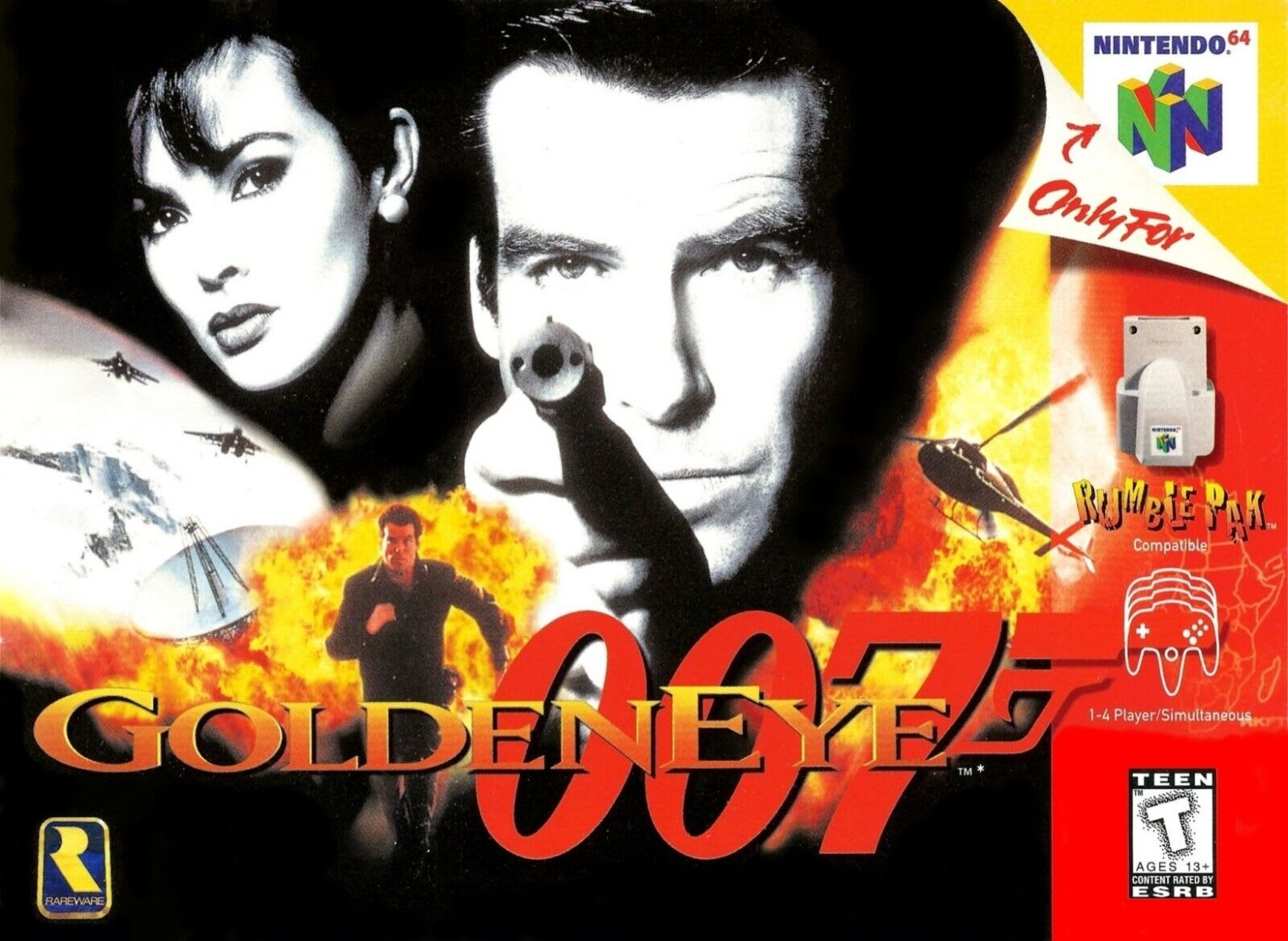
My first video game console was a Nintendo Entertainment System. My most-used video game console was probably the Super Nintendo. But the actual game I played the most in my childhood was on neither of these. It was on the Nintendo 64. GoldenEye 007. And it’s back. (Re)launching today on both the Xbox and Nintendo Switch, it’s a port of the classic. The Xbox version brings visual upgrades while the Switch version brings online multiplayer. The amount of hours lost this weekend for a
My first video game console was a Nintendo Entertainment System. My most-used video game console was probably the Super Nintendo. But the actual game I played the most in my childhood was on neither of these. It was on the Nintendo 64. GoldenEye 007. And it’s back.
(Re)launching today on both the Xbox and Nintendo Switch, it’s a port of the classic. The Xbox version brings visual upgrades while the Switch version brings online multiplayer. The amount of hours lost this weekend for a certain cohort of children born in the 1980s and 1990s will be endless.
It’s a funny thing. Most adaptations of movies into games were bad (and vice versa used to be the case too, though both have changed in recent years). And while GoldenEye is a decent enough James Bond movie, I believe Pierce Brosnan’s best, it’s not one of the most iconic ones. And the game came out nearly two years after the film. Hell, it was released just a few months before the next Bond film, Tomorrow Never Dies.
But the game was just in the right place, right time to work, with the right team making it. Rare, a British firm (later acquired by Microsoft), had had huge success with Donkey Kong Country on Super Nintendo, and was able to take advantage of the 3D graphics and crucially, four controller ports, on the Nintendo 64 to make GoldenEye 007 a phenomenon. The third highest-selling game on the console behind just Super Mario 64 and Mario Kart 64.
My friend Brad who lived up the street from me had what was at the time, a truly massive 60”+ TV in his basement. And four controllers. The amount of hours lost playing that game in that basement now baffles the mind.
This essay is not new. It is from 1944. It wasn’t even an essay at first, but a speech, given by C.S. Lewis at his Memorial Lecture at King’s College in London. But it’s fantastic. It rings just as true today, on so many levels. Scoundrels abound.
On the topics of great essays of yesteryear, here’s Joan Didion writing on the notion of self-respect in 1961. It’s just outstanding writing. And she wrote it at the last-minute after another author failed to file their own essay on the topic. And she wrote it to an exact character count.
Staying on the topic of essays, but switching to something more contemporary, here’s Paul Graham on the power of writing to clarify your own thoughts. This is more or less how I live my life and have for decades now. And this doesn’t just mean publishing your words. Sadly, a lot of this practice for me in recent years has been in the form of emails.
A good interview with economist Tyler Cowen. You’ll note that he credits blogging for his success and, per above, that while reading (and conversation) are great for gathering information, it’s only through writing that you’re forced to decide what you actually think about something. He also wants an AI chatbot to come along that will help him effectively live forever.
Switching things up, Craig Hockenberry gives his raw, painful assessment of the current state of Twitter — and more specifically, the Twitter ecosystem. His Iconfactory birthed not just Twitterrific, but also the notion of a Twitter bird and the word “tweet”. They also, of course, make several other apps. I personally love Tot (a simple note-taking app — on my homescreen!) and Wallaroo (a wallpaper app). RIP Twitterrific.
“Everyone who retires from surfing just goes surfing more."
Attention: after years of saying they wouldn’t do it, In-N-Out is headed east. Eat your heart out, Shake Shack. 🍔
Hugh Jackman would like you to know that he didn’t take steroids to get into form as Wolverine — and also that he didn’t know that the wolverine was an animal and not a wolf man hybrid. Go Blue? 🐺
Did you know that Rolls-Roycesells well over half of the world’s cars priced over €250k? Ferrari sells one-third of such cars. and Lamborghini sells basically all the rest. Where’s that Apple Car? 🏎️
There’s apparently science behind why kids love those huge planet/stars comparison videos on YouTube. And presumably why I like them too. 🪐
Elise Stefaniksure seems to be a new, more viral variant of opportunistic political climber. Or, as we less politely call them: phonies. 🗳️
Still, could be worse. You could be Kevin McCarthy. His embarrassment led to a truly great headline: Leopards Eat Kevin McCarthy’s Face 🐆
The parallels of cricket and baseball go way back. And they may be about to collide in the U.S. And baseball could probably learn a thing or two. 🏏
Not sure I would have imagined that one of George W. Bush’s daughters — now Jenna Bush Hager — would control arguably the most powerful book club since Oprah, but here we are. 📚
Hello from 35k feet. The last time I was in the sky, just over a week ago, SVB was in the midst of collapsing. It feels like two months ago. What a surreal time to be alive. Which I suppose every generation says because it truly is all relative. Which just makes me worry about what our children will have to deal with... But at least maybe they won’t have to put up with Twitter in times like these? Anyway. At least the WiFi is working!The Good Stuff✈️ The 747 RetirementSince I
Hello from 35k feet. The last time I was in the sky, just over a week ago, SVB was in the midst of collapsing. It feels like two months ago. What a surreal time to be alive. Which I suppose every generation says because it truly is all relative. Which just makes me worry about what our children will have to deal with... But at least maybe they won’t have to put up with Twitter in times like these? Anyway. At least the WiFi is working!
Since I’m flying… here’s a nice farewell to Boeing’s 747 aircraft and a look into what’s next by Adam Clark Estes. Not the far-flung or pie-in-the-sky stuff. But just where the aviation industry is likely headed in the next several years. Increments, but hopefully they add up. The 747 will be in the skies for a while still, of course. They’re just not making new ones. Goodnight, sweet prince.
With the opening of Super Nintendo World in LA, Andrew Webster sits down with Mario, Zelda, etc creator Shigeru Miyamoto on translating his digital creations in to the real world. Pretty much all feelings of wonder I can recall having these days tie directly back to the stuff I loved as a child. This, I suspect will qualify. I mean, you enter the park through a goddamn warp pipe. See Webster’s follow-up on the park as well.
A fantastic pre-eulogy of Twitter by Paul Ford. Several LOL parts. But I also like (and increasingly believe myself) his high-level notion that look, maybe we weren’t meant to be connected to everyone on the planet. It’s one of those ideas that sounds perfect on paper and is rancid in reality. We were promised flying cars, and what we got was basically all seven sins at scale in real time, all the time.
I like the way Casey Newton frames his thoughts on who might win in the AI arms race. Basically everyone agrees that yes, AI is awesome and fascinating and the future in many ways. But no one yet knows what exactly that looks like — quite literally. What’s the UI that makes all of this really sing? Is it really a text box? Something tacked on to a search engine? That seems unlikely. So there’s a race on the product side to nail this. Also, don’t sleep on voice coming back around again with this far better technology?
Nothing too outlandish in what Jason Kilar lays out as to what he imagines Hollywood looks like in the near future. But it all feels right — and, selfishly, is in line with a lot of whatI’vewrittendatingbackyears. Kilar, of course, has seemingly been one-step-ahead of much of this (and, sadly, perhaps one click too early for his own good) so his is a good perspective as we exit the all-out arms race of streaming and enter a more nuanced era of consolidation and, hopefully, a focus on quality and presentation.
“This isn’t theater snacks — this is really food. This is dine-in 2.0, because the industry has to compete with people being on the couch. How we execute the concept creates an entertainment experience that’s communal.”
— Brian Schultz, who, in line with the Kilar piece above, is trying to open a theater in NYC which aims to re-center the cinema experience as a night out and not just a more expensive version of what you get at home.
The Quick Stuff
Apparently, the only growth demographic for wine is those over 60, which is sad. And teetotaling trends aside, seems to also be a massive branding/perception issue. Where are the wine ads? 🍷
The flip side is soft drink makersgoing “hard” — both in spirit(s) and advertising to court the youths. With truly awful-sounding drinks. But it’s rather fascinating how they’re doing it, getting around rules from 100 years ago… 🥤
You know what can beat a machine at Go? A human aided by another machine to exploit a weakness in said machine. It doesn’t have to be us versus them, folks! ♟️
You know Toblerone chocolate? Maybe not, but I’m sure you’ve seen the packaging. But it’s about to change because it turns out you can’t use images of the Swiss Alps if you’re not fully made in Switzerland. 🗻
AI + Radio? It’s being tested where I grew up. (And am coincidentally flying over right now!) Hello Cleveland! 📻
How much thought when into the game Oregon Trail? A lot. 🐂
I didn’t always agreed with NYT film critic A.O. Scott, but I always read his thoughts on films. And as he steps away after doing the job for 24 (!) years, it’s hard not to appreciate his accomplishment. 📽️
If we’re ever to do any truly long space travel, we’re likely going to need to figure out how to put our bodies into a state of hibernation for long periods of time. It’s being studied. 😴
Maybe folks from Medieval timescan help? (Probably not.) 🥱
Jony Ivedesigned the new red nose for Britain’s Red Nose Day. And, of course, it’s great. Clever design — in how it works. 🔴
But it’s not quite as good as his emblem design for the upcoming coronation of King Charles — similar to his Terra Carta work with the then-Prince. Just fantastic. 👑
I sent my first newsletter almost exactly seven years ago. The world, and my life, were very different then. It was August of 2016. Barack Obama was still President, nearing the end of his second term as we all barreled towards the 2016 election. We all remember what happened next... I was just wrapping up a vacation in Europe with my wife. Over two years away from our first child being born. Now I’m here living in Europe, waiting on our second.Anyway, I was thinking about this first news
I sent my first newsletter almost exactly seven years ago. The world, and my life, were very different then. It was August of 2016. Barack Obama was still President, nearing the end of his second term as we all barreled towards the 2016 election. We all remember what happened next... I was just wrapping up a vacation in Europe with my wife. Over two years away from our first child being born. Now I’m here living in Europe, waiting on our second.
Anyway, I was thinking about this first newsletter today as our youngest just watched Willy Wonka & the Chocolate Factory (after my wife read her Roald Dahl’s book, Charlie and the Chocolate Factory — power swap by Hollywood there, ampersand and all). That first newsletter — which, sadly, no longer resides online because The Artist Formerly Known as Twitter killed off the Revue newsletter platform on which it was sent, so it now just resides in my inbox vault — was entitled “In a World of Pure Imagination”, because Gene Wilder, the star of said movie, had just passed away.
In the quiet moments before the wonderful chaos, I’m finding myself thinking, as I often do, about content. And I think I have a plan. A giant, unified plan. Finally. But it will take some time as I take some time. Stay tuned, in a few months. ✍️🍻
Caity Weaver humorously tries to track down where Cruise actually lives — likely somewhere in England — as he’s become something of an enigma in modern life. Unlike seemingly every other actor on social media, Cruise only seems to exist in the real world when he’s promoting his movies (which he does relentlessly). I appreciate this reclusiveness, it is a bit odd for a celebrity in our modern world, but it also adds to his mystique as the last “true” movie star. One where we don’t know (and track) his every Starbucks order.
If, like me, you were shocked by the news that Anchor Brewing, the 152-year-old iconic San Francisco brewery, was going out of business, this backstory as to why will probably just make you angry. Let’s hope someone —the employees?! — steps in to save them.
Speaking of SF, the title and certainly the images (!) are a bit much here, but overall, this feels like a fair look at the city — where I lived and watched degrade over the past 15 years — by Tabby Kinder and George Hammond. Still, there’s some hope…
Mark Gurman, as always, seemingly has all the key details about the iPhone 15 ahead of its launch. The key upgrade this year will clearly be the first chip built with the 3nm process — which should both lead to a nice speed jump and, more importantly, better battery life. But the real hardware upgrade (beyond the switch to USB-C) will likely be the mute toggle becoming an “Action” button, just like the Apple Watch Ultra has. Say goodbye to the constant swiping left to open the camera app. (Also, StandBy is great.)
Scott Galloway on the Gulf States attempt to pivot from oil. The “Neom” project is the most forward-facing effort, but there are hundreds of other elements to the pivot, both large (tech investing, buying sports teams) and small (marketing luxury and trying to lure the world’s wealthiest people).
This post by Ellis Hamburger, who previously worked at Snap, from April still very much resonates. Even if they growing to a massive scale, all social media services eventually die by their own hands due to cheap engagement tactics to ramp monetization. From Facebook on down, it’s inevitable.
“What gives you opportunities is other people doing dumb things. In the 58 years we’ve been running Berkshire, I’d say there has been a great increase in the number of people doing dumb things.”
— Warren Buffett at Berkshire Hathaway’s annual meeting this past May
The Quick Stuff
It’s morbid, but if you really want to know what happens to the human body when a submarine implodes while heading down to the Titanic, this is the piece for you. 🚢
What will happen to Christopher Nolan’s 11 miles of IMAX film for Oppenheimer once it’s out of theaters? 🎞️
While he’s back to chess, this is a fun read about Magnus Carlsen’s detour into poker while he was seemingly bored with the game he has dominated for so long. ♟️
Keita Takahashi created Katamari Damacy 20 years ago and now gets nothing from its continued success. He did have an (indirect) hand in helping to create Slack though! 🕹️

 Login
Login