❌

Reading view

Snowbound in 1970

A few weeks ago, a news item from England caught our eye: a blizzard in Yorkshire had stranded sixty-one people at a remote pub for three days. Among the stuck were members of an Oasis tribute band that had been booked to perform and whose gig was … extended. On Twitter, there were many joking responses to the affair, along with some stories of similar snowbound experiences, including this one from a Twitter user named Tim Oliver

Snowed in two nights in Northern NM in 1970. Also, a bunch of Cajun pickers and a Nashville semistar. Add dogs, ten cases of Lone Star, four of Annie Greensprings, 6 jugs of Jack Daniels & a couple lbs refer. We perfected Neil Young’s The Losing End.

Obviously, we needed to know more, so the Statesider’s Doug Mack called Tim Oliver for all the details. Spoiler: it’s an even better yarn than you’d expect from that tweet. This interview has been lightly edited for length and clarity. 


Let’s start with some background. What were you doing in this place and how did you get snowed in? 

Okay. I have to paint the setting for you a little bit. And if you have a map handy, try to find Las Vegas, New Mexico. It’s in Northern New Mexico, about 50 miles east of Santa Fe. They’re separated by the Sangre de Cristo mountains and it’s quite a juxtaposition. I even bought a map in Costco, of all places, that called Las Vegas the wildest of the Wild West. 

Las Vegas was on the railroad and it was divided into two parts. West Las Vegas was almost entirely Hispanic and East Las Vegas was all Anglo when I went there as a student in 1969. I had just graduated from high school and I was 17 years old. And I show up at New Mexico Highlands University. I picked that because I had to go to college somewhere — it was either that or get drafted to go to Vietnam. The school was a compromise with my father. It was cheap enough for him and it was far enough away from home for me. 

It was a blast. This place had no law. I mean, it was wide open — the amount of drug use and just crazy partying. And the rents were extraordinarily low. You could get an apartment for $15, $20 a month, so there was no point in living in the dorm. In fact, I had a dorm room, but then I went into an apartment, too. As soon as I got my lottery number for the draft, which was a pretty high number, I knew the draft was not hanging over my head anymore, so I kind of quit going to college and was just hanging out and partying and having fun. And in this crazy place, one of the things that seemed to collect there were fugitives “on the lam,” if you will. This one particular group we called the Louisiana people. We don’t know what they were wanted for. I’d heard different things, mostly drug charges and draft dodging. They were all friends from someplace deep in the bayou and they all had weird names — one guy was named Box and another guy was named Frog. 

There was another guy that hung with them named Bobby Charles. He was a noted songwriter — he wrote “See You Later, Alligator” and “Walking to New Orleans,” which was a big hit for Fats Domino. We were friends at the time. I mean, we didn’t keep in touch after I had moved away and stuff, but we used to hang out. We’d go get some drinks and some dope and smoke some dope together, try to find some chicks, whatever you do, you know, out in the middle of nowhere. NPR had a little story about Bobby Charles, and it didn’t say a thing about him going to New Mexico. According to that story, he got busted in Tennessee and moved to Woodstock, New York and eventually went there, I’m sure, but before he got there, he was out west. 

There was another guy — I won’t mention his name because he’s still around him and he’s back in legitimate business — but he was a pot dealer and he had money and he had this little house. It was an adobe hut, three rooms. The bedroom was his and then he just let his friends stay in the rest of it. The house was in this little town — get out your map again — called Montezuma, New Mexico. They had a Fred Harvey Hotel there. 

Have you heard of Fred Harvey?

I haven’t!

You better look up Fred Harvey! [I later looked it up and it is indeed a fascinating story!] 

Fred Harvey felt built very nice hotels along the Santa Fe Railroad, including the Grand Canyon and Albuquerque. There was one in Las Vegas. There was a movie back, I think in the 1930s, called “The Harvey Girls.” [Looks like it was released in 1946 and starred Judy Garland and Angela Lansbury.] It’s all about how, in these remote hotels, they would have housing for their help, and the girls all had little dorms and they would all live together and work for Fred Harvey for, like, a summer. The Harvey place up there in Montezuma was a castle. And the reason it was up there is there’s a pretty big pond that was always in a shadow. You’re getting up about 8,500 feet in elevation, so there’s always ice in this pond and they could load it onto the train for whatever kinds of perishables there might be; that’s how they had the refrigerated cars back then, ice packed in sawdust. So there’s this huge castle as a backdrop to this little adobe hut where we were staying. 
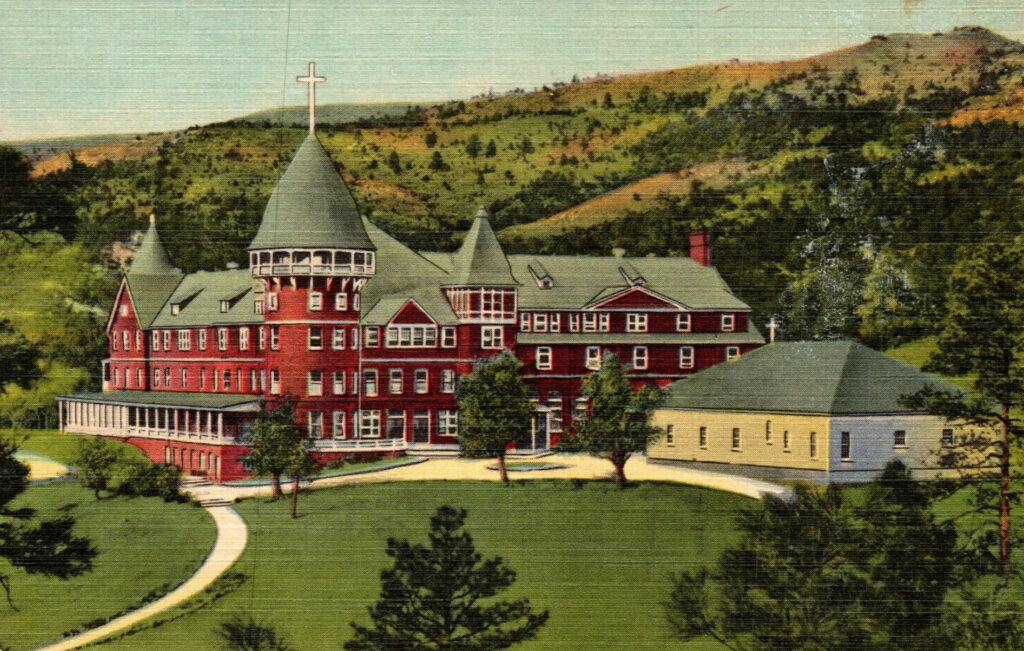
The Montezuma Castle as seen in a postcard from 1940.

The Louisiana people, Bobby Charles, and some other miscellaneous folks, including me, were there on a winter’s night, and I’m pretty sure it was 1970. We were just doing our normal thing, but we were pretty well supplied. We had Boone’s Farm apple wine I think it was that and not Annie Greensprings [as listed in the tweet] but we also had something like five pounds of pancake batter, six or more dozen eggs, several rashers of bacon, and some other stuff to eat. So we were just in the house, partying it up, and it started to snow and snow and snow, and you couldn’t get anywhere. 

Whatever car we might’ve had was parked outside was a heap. And it was, you know, up in the mountains and there wasn’t a lot of reason to go anywhere and we just loved it. We would make up a bunch of food and you’d get your bacon and eggs and pancakes, drink a bunch of beer, and everybody would get kind of woozy about the same time and just kind of fall asleep. And then pretty soon one of these Louisiana people would wake up, roll a joint, start strumming his guitar. We’d rub our eyes and go into the other room and have a beer, you know, maybe a glass of wine or even orange juice a little morning pick-me-up, although this might be in the middle of the afternoon. We did that for two and a half days. Just go to sleep for a while, wake up, party, go to sleep all the while, singing and laughing and telling stories. 

The Louisiana people were outstanding musicians. They just grew up that way, it’s in their blood. They had a bunch of guitars and I had a harmonica and Bobby Charles was there. One of our favorite records was Neil Young’s “Everybody Knows This Is Nowhere,” which was pretty new at the time. The song that stands out to me, because I still remember every word, is “The Losing End,” which is still one of my favorite songs today because of that memory associated with it. We got really good at it, but we never performed it for anyone else, just for each other and our own enjoyment. We would, you know, do harmony and these guys were great on guitar. I put a few harmonica licks in there and it was just a blast. 

It sounds like there was no sense of peril. It was just, “We’re stuck. Let’s just make the most of it.”

Yeah, it wasn’t a whole lot different than what we do ordinarily, except it had an extra frisson about it because we were snowed in. It was beautiful outside. We were stuck together. I mean, otherwise, in Las Vegas, it would be people coming and going. But we were all kind of just stuck together. I think anybody that was there remembers it as just a unique two days where we were kind of forced to do what we love to do anyway, but nobody had to leave to go to jobs and stuff like that. So no, there was no peril. Just fun. 

So then you just kind of waited it out? How did you get out eventually? 

In New Mexico, the snow does not last a long time. The sun is so potent when it comes out and it doesn’t get that cold there. So you get these big dumps, snow storms, but the ground wasn’t frozen when the snow fell and then the sun came out and it warmed up. 

I did look up those pictures of the Fred Harvey hotels, by the way. These are really spectacular buildings. 

Yeah. Now at the time, maybe half a mile away was a hot spring. The Harvey people had built it into a series of baths. They were just kind of concrete squares that would fill up with water and then one would fill up and it would overflow into the next, and then that would overflow into the next. If you wanted to do it, you’d have to go find Brother Carmona and he’d be kind of patrolling around, and you’d have to pay him a half-dollar each. I call him brother because at the time, the Catholic Church owned the Harvey Castle. They were training Mexican priests there. And, you know, nobody wears a bathing suit in the hot springs, of course. So it would be us and girls and we’d be running around naked in there, and you’d look at the windows and there would be these priests looking in with hands cupped around their faces. 

Do you still keep in touch with anyone who was snowed in with you?

Yes, we all keep in touch. I was just on the phone for 45 minutes yesterday with an old friend from Vegas, and we all realized that it was an experience that we just fell into out of the blue. I mean, I’m just a white, suburban, middle-class kid that ended up at this college in the same town. And just because I am who I am, I gravitated towards the most fun happening. We just had a blast. We were pretty pretty taken with one another.

Do you have any advice for people who are snowed in at a party house or a bar or anywhere? 

I would say, pee outside, because if the pipes break, you’re not going to have a toilet anyway, so you don’t want to overburden it. Or if there’s a lot of people stuck, often the septic tank will fill up. 

Find somebody that you like and cuddle up next to them and just forget it. You’re not getting out of there. You have an opportunity for 10 hours to just relax, feed your head and make an event that you’ll remember. Now, this one in England, they had that Oasis cover band. That was probably a blast. If you can find some good music, that’s always going to make it good. 

Dogs are always necessary. Let ‘em in. If you’re snowed in, let the damn dogs in. Your house is going to be a mess anyway — and forget about that, you clean the house. Don’t worry about it. Get the fragile stuff out of the way, because people are gonna get drunk. 

We didn’t have any board games, we just told stories. I would suggest against board games. Tell stories. Get somebody started — there’s always some, a storyteller in every crowd, who will draw other people out. So that’s what I’d suggest. 

We end every interview with the same question. It’s a tough one: Cake or pie?

Pie. Especially if you have some ice cream. That cannot be beat — that’s not even a question if there’s ice cream.

The post Snowbound in 1970 appeared first on The Statesider.
  •  

On the Road with Thomas Jefferson

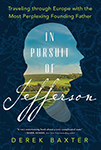
Thomas Jefferson is famous for many things, but writing a travel guidebook to Europe doesn’t usually make the list. In 1788, though, he did just that, in the form of a 5,000-word letter to two young acquaintances who wanted his recommendations. Jefferson’s Hints to Americans Travelling in Europe drew on the future president’s experiences on the continent. More than 200 years later, it also helped inspire a new travelogue, In Pursuit of Jefferson: Traveling Through Europe with the Most Perplexing Founding Father, which is just out from Sourcebooks. The Statesider‘s Doug Mack talked to the author, Derek Baxter, about the book and his journeys in the footsteps of one of the nation’s most famous historical figures. This interview has been lightly edited for length and clarity.


I know every interviewer asks this of every author, but I think it’s a useful starting point, so … Where did your interest in Thomas Jefferson begin, and how did it lead to this book?

Thomas Jefferson is very present here in Virginia. I played him in the fourth-grade class play. I went to the school he founded, the University of Virginia. I saw him as my favorite founder because he seemed like he could do everything. He could write brilliantly in the Declaration of Independence and invent things and play the violin. He just seemed like the kind of person I wanted to be.

When I reached my late thirties, I felt that maybe my life was, in a way, getting a little quiet. It wasn’t quite what I had envisioned it or, you know, maybe I was missing out on some things that I had really enjoyed, especially travel—I had previously done some backpacking through Europe, but now I was set in a career that didn’t really involve travel and it like part of me was missing and, and maybe some of the creative side of me was missing. I was kind of looking for a challenge when I came across this guide that Thomas Jefferson had written. And it just seems to speak to me like, well, here is something I could do. And so, over a few years, mostly with my family but occasionally solo, I took these trips and actually followed this guy just to see what would happen.

It sounds like you had a lot of fun. I mean, especially at the beginning of the book, you’re running in costume through vineyards or you’re talking about Jefferson smuggling rice back into the USA.

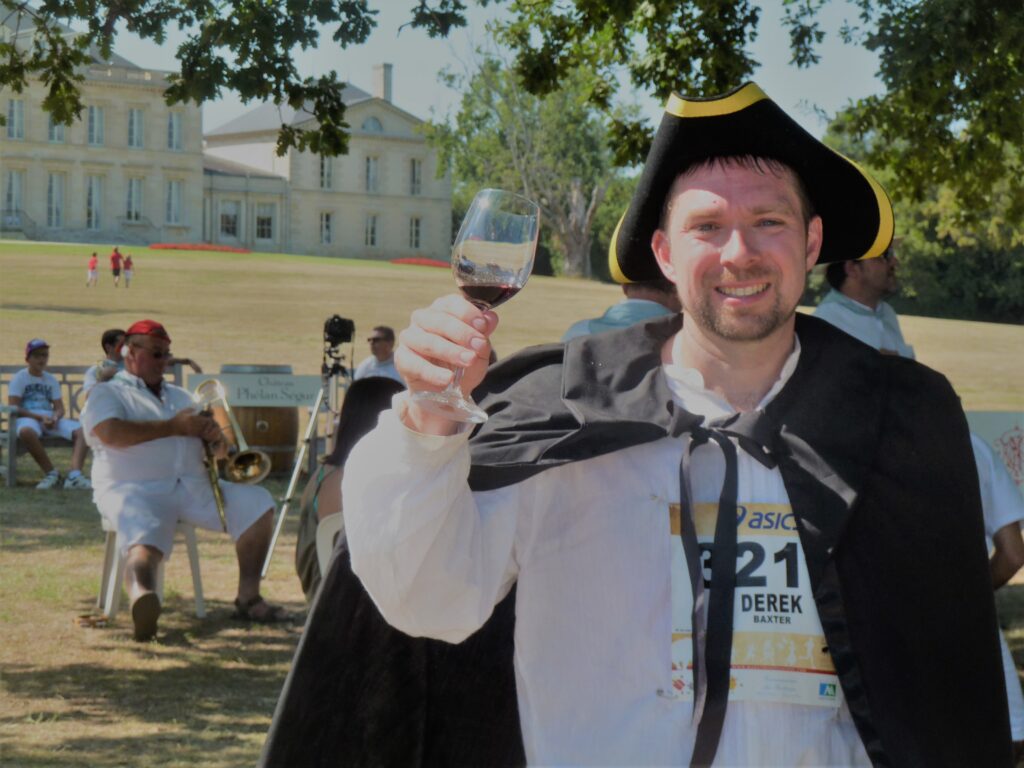
Right. It was mostly fun throughout. The first trip that you mentioned was, was maybe the craziest one. It was this marathon that they run in Bordeaux, where people run in costume and you actually get to drink wine along the way. That was one of the things in Jefferson’s guide: go to Bordeaux and try the wine there. It seemed like this was kind of like a great way to get in there and see it. This was 2012 and the theme that year was history, which also seemed to me like a bit of a sign in a way because I think that’s the only time they’ve had that particular theme. So I thought, okay, they’re not going to give me any side-eye if I’m dressed as Jefferson. My wife and I went and we ran and it was amazing — it was a fun time, but it also gave me the sense, like, okay, this is a good idea. I think we should, we should continue.

Yeah, it’s a great scene of you lining up with some Romans and Napoleon. It just gets you right into the mood. At that point, were you thinking book or were you just thinking this would be a fun activity to do?

Not necessarily a book. I did take notes and I was trying to record my impressions and I wanted this to be a transformative experience, but I wasn’t thinking about it as a big, elaborate book—but that grew on me as I did more trips. I was learning things and I wanted to share them.

The book is fairly light at the beginning, but it does get into some more serious themes later. There’s a poignant line about being at Monticello and seeing “a brick with a handprint left in it: the marker of an enslaved artisan’s humanity, fingers splayed in the read clay, frozen in time.” This chapter is clearly a tonal shift in the book, and you handled it beautifully. Can you talk a little bit about how you were experiencing that shift in perspective yourself sort of in that moment or in this accumulation of moments?

Jefferson’s guide talks about many subjects — you know, architecture, agriculture, food and wine, gardens, all these interesting themes that I was learning about and experiencing. But the one thing it doesn’t talk about that was massively important to Jefferson was slavery. Obviously, everybody knows Jefferson was a slave owner and I knew some about that as I started off; I kind of thought at the beginning, well, this is the unfortunate part of Jefferson. But at that point, I didn’t think, “This is going to be a real focus of my journey and of this book,” because this was about his travels and the wine and the architecture. But as I went on, I really did come to understand that slavery was intertwined with everything he did. I mean, this is how he’s paying for his travels and for just about everything — it came mostly came from his tobacco, which was grown and picked and packed by enslaved workers on his plantations.

Jefferson had a government salary as well, but it was really tobacco that paid the bills. And he sold 31 enslaved people while he was in France, because he was in debt. When I learned that, it just really bothered me. When I was traveling in Europe, I kind of spaced these trips out roughly once a year, and the rest of the time I was here in Virginia, and I would take some trips to Monticello, and I would learn more about how he put his ideas into practice. And when you’re there and you learn about architecture and landscaping and all the rest, it was always enslaved people, obviously, who did the work. He was completely reliant on enslaved people for everything.

I started to start to kind of veer off. I start to, first of all, wonder whether this whole project was worth doing and whether it was really worth adding more attention to Jefferson. I had put him on this pedestal, but should he be there? It led to some introspection and eventually I wound up spending a lot more time kind of off the regular itinerary and looking more into the lives of some of the enslaved people who lived at Monticello.

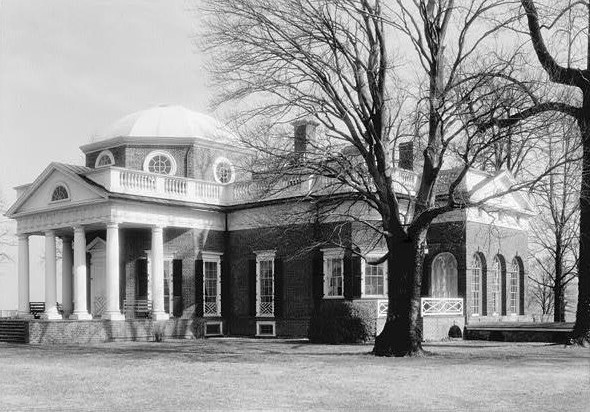
Monticello

I really appreciate books that balance the serious and the fun. I think the lighter parts help show the depth of humanity, but then they make the really awful things all the clearer and more stark.

Right. There is such a deeper story about how enslaved people weren’t going on the trips with him in Europe, back at the plantations, wondering if Jefferson was ever going to come back from France. If he hadn’t — if he died in some accident over there or something like that — they might have been sold, with mothers separated from children. That happened quite a bit. So, yes, there are lots of moments of joy, but it’s always tempered by this deeper story. And it’s the story that’s kind of been… not hidden, but not fully emphasized in the past.

Throughout the book in these chapters in USA, but also in Europe, you try to capture the sense of place and get into the small details. Can you talk a little bit about how Jefferson brought the ideas of landscape and architecture that he saw in Europe back to the USA and how those travels affected the built environment around him?

Jefferson had read books about landscape garden and about architecture back home, but I think it was very different when he actually got on the road and saw things with his own eyes. So for landscaping, he went to England. Obviously, wasn’t a big fan of the king, but the one thing he loved about England was the gardens, which are very different from the more formal gardens they had at Versailles and other places in France. And that was absolutely what he wanted to do. He visited 19 of these gardens and took very practical notes because he was already thinking about how he could landscape back home.

And at Monticello, he developed this series of roundabout roads, which kind of encircle his mountain through the woods. So there was actually a road that could go just very directly through the farms, straight up to the house, but instead he would prefer to take visitors who were going there for the first time on these, on these roads that would kind of spiral up the mountain through these, these very wild woods. You would emerge and you’d see Monticello at the top of the hill, which is beautiful, of course. And you’d see all these pastures. It was kind of this bucolic vision. And I think he was trying to tell the story about, you know, how he had mastered the mountain and you could look out to the west and see this American land landscape that was out there.

As for the architecture, that was even more influential. The house was half built by both enslaved and free workers. Before Jefferson went to France, Monticello looked totally different than the current Monticello. It didn’t have a dome for one thing, and the design was copied from books, kind of like a paint-by-numbers thing. But then he traveled to Europe and he came back with these French neoclassical ideals. He saw a building in Paris, which you can still see, and he got the idea for the dome. He loved the trend in Paris to make mansions look like they were only one story, even though they were really, say, three stories. So there were little tricks he picked up.

Are there places or things that you wanted to include in the book, but you weren’t able to?

Yeah, I could keep writing this book forever. We had one final trip planned for, it was for the summer of 2020, so you can kind of guess what happened to that one. I traveled to a lot of places that Jefferson went to here in the US, just for background and context for the book.

There were some less obvious ones like the Peaks of Otter, which are these mountain peaks in central Virginia, which Jefferson visited, I think when he was 71. He surveyed the peaks, which kind of just showed that he never gave up on traveling. There are so many other places as well that my family and I went to — Williamsburg, Philadelphia. You can see some historical traces of Jefferson in New York City and throughout new England.

What are the traces in New York City?

So in New York City, he lived on Maiden Lane, which is down in the Wall Street area. And there’s Fraunces Tavern, which is still open as a tavern. I also just like walking around lower Manhattan and seeing Trinity Church and some of the other historic places as you go further uptown.

There’s always one question that we end with at The Statesider: Cake or pie? For you and also for Thomas Jefferson.

I would definitely answer pie for myself. I think Jefferson would’ve gone pie, too. There were a lot of desserts at Monticello. I think they did serve something like an apple custard pie. He loved apples. I think he’d go for some kind of fruit pie.


In Pursuit of Jefferson: Traveling Through Europe with the Most Perplexing Founding Father, by Derek Baxter is available now from Sourcebooks. Pick up a copy now through the Statesider bookshop, which supports local independent booksellers.

The post On the Road with Thomas Jefferson appeared first on The Statesider.

  •  
❌