❌

Reading view

My Social Graph is Broken So I Have No Idea Who My Friends Are
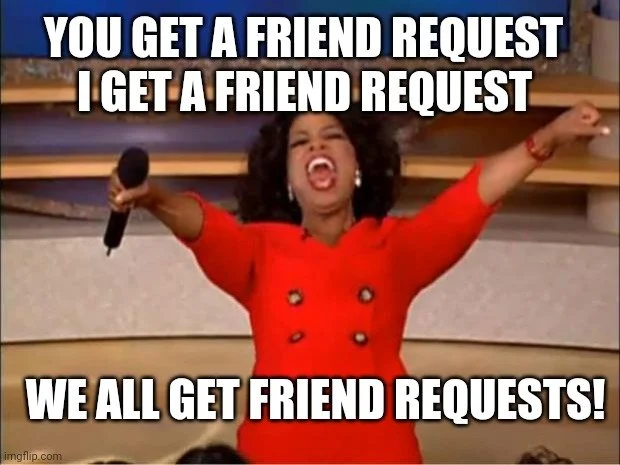
In 2010, Facebook launched Places. It was their answer to Foursquare.

It failed almost immediately—not because the feature was bad.

The graph was wrong.

When people built their Foursquare networks, they did it knowing exactly what the app was for. A Foursquare friend request meant something very specific: You’d be ok running into this person IRL. Facebook's graph was built for something else entirely—reconnecting with classmates, staying in touch with family, documenting life milestones. By the time Facebook tried to bolt location sharing onto that, nobody wanted to tell their grandmother where they were having drinks on a Tuesday.

The graph had no context. It failed.

I've been thinking about this a lot lately, partly because I've been poking around Goodword’s relationship management platform and a handful of other "network management" apps. Also, I was talking to Vic Singh, who is building Originalis—an operating system for venture capital.

He said something that crystallized the whole problem.

Vic was explaining how Originalis uses network intelligence to help VCs figure out who they should pull in for diligence on a deal, who they should be warming relationships with before a fundraise, and who the right follow-on investors are when a portfolio company goes out for a Series B. What he kept coming back to was: you can't do any of that if the underlying graph doesn't know what the relationships actually mean. You might have a connection to someone on LinkedIn, but does Originalis know that you met them once at a conference versus that they were your co-founder for three years? Those are not the same relationship. The strength, the recency, the context—all of it matters.

Without that, you're not working with a network. You're working with a contact list.

That's the problem every consumer network management app has failed to solve, and most of them haven't even tried. There are lots of other apps that have asked for my network as well—to help me figure out who to share the app with.

Here's what typically happens: you download one of these apps and you start alone. You need connections to make it worthwhile, but you don’t know who you know that’s already on. In the early days, you might be the first one through the door.

It asks you to connect your LinkedIn, Facebook, etc., or upload your contacts. You're then handed a decontextualized blob of everyone you've ever emailed or connected with—your college roommate, the person you met at a conference in 2017, your kid's pediatrician, a founder you passed on, your high school friend who sells insurance now. They're all in there.

There's no single player mode. There's no foundation. And there's no way to act intelligently on a graph without understanding what each relationship actually is.

What makes this harder is that "network management" isn't even one problem. For me, right now, it's at least five distinct ones: making more time for individual friends when I'm a time-poor parent of a toddler; building a lightweight professional CRM for non-sales relationship work like VC coaching, finding activity partners (local cyclists, softball players who can rake), trying to find more couple friends in Brooklyn with similarly aged kids who also have a Wednesday date night. These all involve discovery, scheduling, and accountability at different times.

Those are not the same problem. An app that tries to solve all at once will likely solve none of them well.

What would it actually take to do this right? If you’re really going to be the next LinkedIn or the world’s best personal CRM, what’s the first hurdle?

I’d start by helping people understand who they actually know before you try to do anything with that information. Run a structured interview. Superhuman scaled plenty while still requiring a 1:1 chat to walk you through their app, so we’ve seen it work before when someone considers the problem important enough and the system promising.

Walk a user through their circles. Where did you grow up, and do you still talk to anyone from then? Walk me through your resume—what communities did each chapter create? Where does your kid go to school, and how do those parents communicate? What WhatsApp groups are you in? Layer in cross-platform data—calendar, email, some entity resolution to figure out that OldMetsFan1986 on Instagram is actually my friend Bob.

Then, critically, ask what success looks like in each circle. Not "do you want deal flow?"—that's a LinkedIn question. Ask: what does being a good friend look like to you? What do you regret not doing better?

That messy, friction-heavy onboarding is the product. The features everyone's building on top of it are only valuable if that foundation is there. Vic had to fight for this at Originalis. In his first board meeting, one of his investors told him nobody had ever cracked the network intelligence problem and he should skip it.

He didn't, because he knew the whole thing falls apart without it.

Most consumer apps skip it because it doesn't scale the way investors want things to scale. So we keep getting apps that ask for your whole contact list, build features on top of a broken graph, and then wonder why nobody sticks around or finds value.

Facebook Places was sixteen years ago and we still haven't learned this lesson.
  •  

Probable Versus Possible: Managing Expectations as a Startup CFO

You’re sitting in a board meeting watching your CEO paint a picture of the next 18 months, and everything they’re saying is…

not impossible, but...

But you know the assumptions underneath it. And you’re about to have to present the model that’s supposed to back all of it up.

That tension — between what’s possible and what’s probable — is the part of the job you feel your reputation is tied to. Not the spreadsheet. Not the close. The job is being the source of truth in a room that has strong structural incentives to prefer the optimistic read is what causes you the most anxiety.

CEOs raise money by being ambitious. VCs invest by underwriting ambition. And the CFO sits in the middle of that, responsible for keeping things grounded in a culture that was explicitly built around believing the improbable.

I had lunch today with a group of startup CFOs and some of nextNYC’s supporters from Stifel Bank and KPMG, and this was the topic that kept surfacing.

Two approaches came up that I thought were genuinely useful:

The first was the audit committee. This is a standard governance mechanism that plenty of startups skip because they think it’s too formal for their stage. It’s not. The audit committee gives the CFO a dedicated forum — a smaller group of board members with finance or operational backgrounds — to walk through the numbers and assumptions without the CEO in the room. That last part matters more than it sounds. There’s a specific dynamic that happens when you try to have a grounded conversation about probability and a founder who raised a Series A on vision and conviction is sitting across the table from you. The audit committee lets the CFO actually do the job of informing the board, rather than managing a real-time negotiation between what the numbers say and what the CEO wants the room to believe.

The second approach was about shifting towards clarity on how the inputs all roll up and who owns them. One CFO described her role as essentially educating the board on how all the levers work — not just presenting the model, but making sure every board member understood which driver produced which outcome, and who in the organization was accountable for each one.

Instead of “we’ll hit 50% quarter-over-quarter growth,” the conversation becomes: “we can hit 50% QoQ growth if marketing delivers X leads and sales closes at Y efficiency — and here’s who owns each of those. They’ll go into more detail on how their teams will try to get to those levels.”

That’s not only more honest, but it’s also strategically smart. It distributes accountability where it actually lives. The CFO stops being the person who either sandbagged the plan or failed to deliver it. The model becomes a collective assertion rather than a personal prediction.

Both of these are really about the same underlying move: creating structural conditions for honesty in a context that otherwise makes honesty very hard.

Startups don’t fail because CFOs ran out of ideas for keeping things grounded. They fail because the incentives, the dynamics, the whole culture around fundraising makes it easy for everyone to agree on a number — and very hard for one person to say the number isn’t real.

You can’t opt out of the ambition. That’s not how these companies work, and you wouldn’t want it to be. But you can build the forums and the frameworks that give the truth somewhere to go.

That’s the job. The spreadsheet is just the vehicle.

For more insight into how your board and cap table can affect your plans, check out our upcoming webinar: Your Cap Table is Your Strategy.

  •  

Investors: What Have You Built for Me Lately?

Every emerging manager gets asked the same question eventually, usually by an LP who has seen too many pitch decks: “Why do you exist, and what are you genuinely better at than everyone else?”

A thesis and a network are table stakes. Everyone has those. And in a world where founders can get further on less capital than ever before, and where the number of funds multiplied wildly a few years ago, table stakes aren't going to hold up much longer.

The funds that are going to matter are the ones that have built something irreplaceable beyond the checkbook.

This isn't a new idea. First Round Capital didn't rest on having a great platform — they looked around, saw that other funds were doing content, and decided to build one of the most important repositories of startup knowledge that exists. The First Round Review raised the bar for what "being helpful" even means—and a huge percentage of the founders that they back, as they’ve discovered, have been subscribed well in advance of ever pitching the firm. Similary Jason Lemkin didn't just throw a SaaS happy hour — he built SaaStr—the preeminent conference and community in the space, which is even its own business.

These aren't investors who did the minimum viable version of differentiation and called it a day. They went all the way.

The next generation is doing the same thing, and the pattern I keep noticing is that none of them started by asking how to differentiate their fund. They started by asking what problem founders in their space actually had — and then built the thing that solved it.

Sophie Purdom, who I interviewed about this last summer, noticed that nobody was rigorously tracking every transaction in the climate tech space. Not as a fund strategy, just as a genuine gap in how the industry understood itself. So she and her co-founder started doing it, newsletter by newsletter, for six years. That data became Sightline Climate, now a thirty plus-person company selling market intelligence to corporates, banks, and governments. The investing came later, almost as a natural consequence — founders sought her out because she understood their space better than almost anyone. She calls it "earned deal flow." The differentiation wasn't the plan. Solving the problem was the plan.

Vic Singh, a GP at RRE Ventures, is co-founder and CEO of Originalis, building what he describes as the operating system for venture capital. He started from the observation that venture is a craft business that somehow runs on file cabinets — unstructured data, non-repeatable processes, institutional knowledge that lives in people's heads and degrades every time someone leaves. The problem he's solving isn't abstract. It's the one he lives every day: how do you move fast enough to win a deal without cutting corners on the work that tells you whether you should? His board pushed back on tackling network intelligence specifically. He did it anyway, because he knew from experience that the signal you actually need — relationship strength, domain expertise, recency — has never lived in any database.

I went in depth around the problem in this interview here:

What's interesting is that you're seeing this problem get solved from both sides simultaneously — vendors like Vic who are also practitioners building for the industry, and firms building internally for themselves. Melody Koh at NextView recently stepped back from full-time deal flow to focus on building the firm's own AI and data infrastructure internally. When I asked her why it had to be her and not an outside hire, she was direct about it: workflow problems belong to the people actually in the workflow. Someone who has never decided whether to spend a partner's time on a company can't build tools that make that decision better. You can buy scaffolding. You can't buy the judgment about which problems are worth solving.

USV took a different path to the same destination. Spencer Yen and the USV team spent three months building a team of internal agents — Arthur for deal analysis, Ellie monitoring investment emails, Sally for meeting transcripts, Connor tracking the calendar. What started as a simple meeting recap email became, incrementally, the foundation for how the firm organizes everything it knows. The problem they were solving wasn't "how do we become an AI-native firm." It was simpler: how do we make sure the context from our conversations doesn't get lost?

Everything else followed from that.

Mike MacCombie has built 146 communities across cities, stages, sectors, and functions. Not because community is a good differentiator on a pitch deck, but because he understands from a behavioral science background that the highest-trust networks are the ones that compound — and that founders in his verticals need access to each other as much as they need access to capital.

The thing worth noticing is that none of these people are building to impress LPs. They're building because they identified something founders or the industry genuinely needed, and they had a specific ability to provide it. The fund differentiation is real, but it's a byproduct.

Which brings me to the question I'd ask any investor who's reading this: what problem are you solving for founders that nobody else is solving? Not what makes your fund unique on paper. What do founders in your space actually need that they can't get anywhere else — and are you the person to build it?

It’s something I try to help my coaching clients—VCs and those trying to break in—think about.

If you don't have a clear answer to that, that's where to start.

  •  

Don’t Just Link Me, Bro: A Guide for Students and Early Career Professionals to Network Up the Ladder

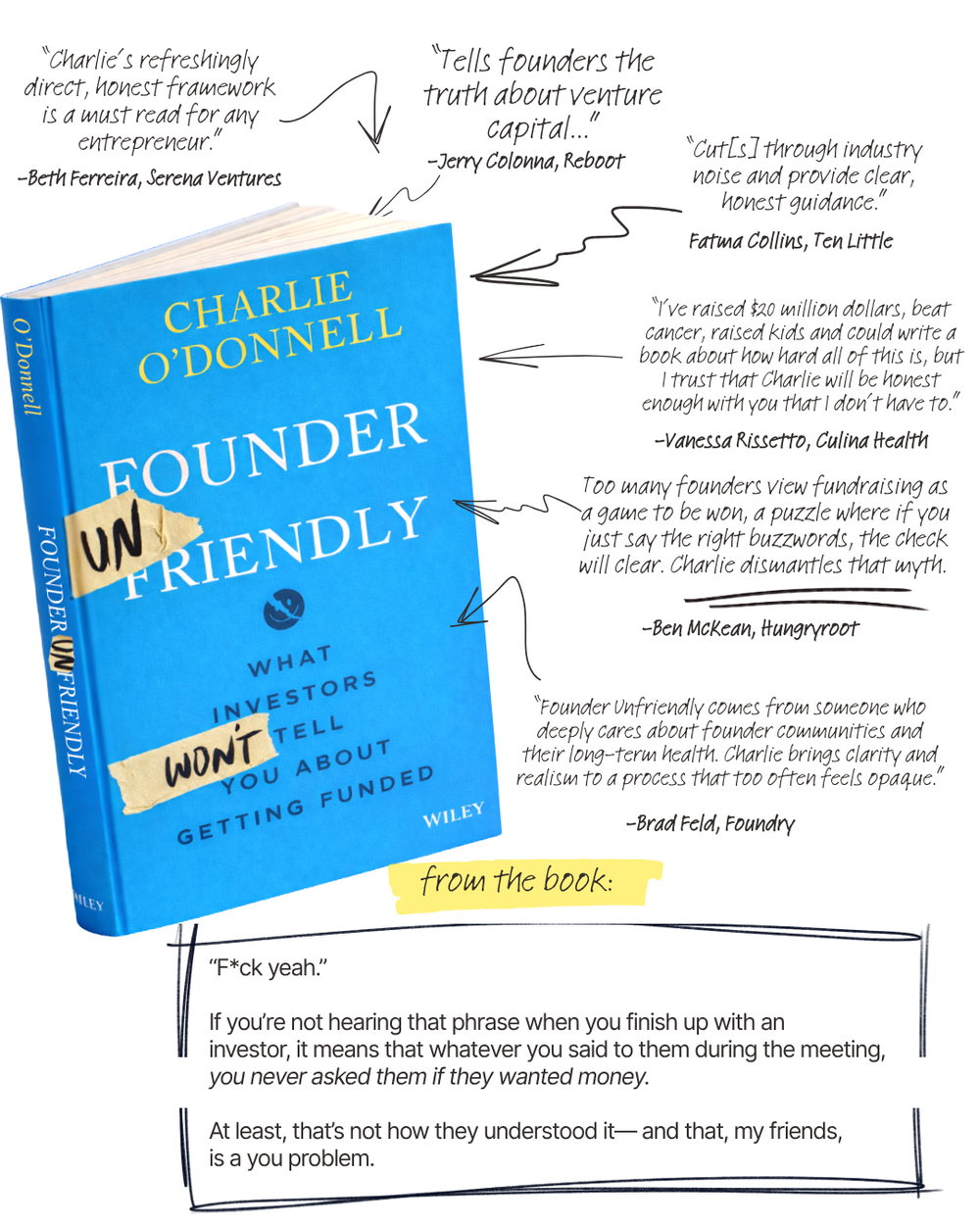
I've been doing a lot of talks with students and founders related to my new book, Founder Unfriendly: What Investors Won't Tell You About Getting Funded which is now available for pre-order. (If you enjoy my writing here, please consider buying it now. If you e-mail the receipt to founderunfriendly@next.nyc, I’ll invite you to this amazing AMA series we have with founders from Datadog, Brigit, Zerohash and more…)

Here's how the post-talk networking usually goes: a minority of the people follow up with a LinkedIn invitation, and that's pretty much going to be it. They'll never follow up again. Ten years from now, either one of us will notice the other as a potentially important connection that seems valuable, but we have no idea how we're connected.

That's not a relationship. That's network lint that just gets in the way of a search to find a useful bridge to someone.

There’s a better way to establish yourself as a three-dimensional, memorable professional that adds value and offers a connection from a position of strength, no matter how down the ladder you feel.

I Will Follow

First, LinkedIn has a Follow button. It's one-directional. Use it. Follow me and set a notification to get my posts as they come in. You don't need my permission and you don't need me to accept anything.

Then, engage. How about a generous repost of my book announcement on LinkedIn?

“I just had the chance to hear Charlie speak to my class and given how much I learned in just an hour, I’m excited to dive into his book for founders.”

(Or, you know, your own version of that…)

That's your baseline. It costs you nothing but a little time and attention and it keeps the door open. No one is going to find it annoying.

Message in a Bottle

Soon after the talk, email me. Not a LinkedIn DM — email. You can get my e-mail. That’s probably one of the easier things you’ll figure out in your career.

Tell me what specifically you took away from what I said. Not "great talk," but this specific thing you said changed how I think about X. Tell me something about you, briefly. And then — this is the part almost nobody does — offer something.

But what? What’s a student or young professional have to offer? That’s where people get stuck.

The trick: have something ready before you even know who you're going to meet.

The best version of this isn't scrambling to find something useful after the fact. It's walking into any talk, any panel, any networking event with an offer already in your pocket. Something you can deploy for almost anyone—or at least a way of figuring it out quickly.

If you run a student podcast or a newsletter that goes to your marketing club, that's an asset. You can offer almost any founder or investor a platform, however small. If you're involved in a student org that could serve as a test group, you can offer user research — put an app or product in front of 20 people in your demo and send back what you heard. Those are standing offers. You bring them everywhere.

I Would Walk 500 Miles

But even if you have none of that, you have time and a willingness to do legwork that busy people won't do themselves. That's more valuable than you think. Say you meet someone building a proptech company that sells to real estate management firms. You probably don't know any property managers. But you could spend a week emailing 20 of them, introducing yourself as a student researching what technology they use in their operations. Some ignore you. One or two respond. And now you've done something the founder couldn't easily do — gotten a cold inbound from a potential customer — and you have something real to hand them.

Whoever you meet or listen to on a panel or podcast, if you can't figure out who the type of person is that they would accept a connection to any time from anyone, then you haven't understood exactly what this person does for a living and how they earn or what motivates them. You have to ask enough questions or do enough research (PS - AI can be a great partner for this) to understand the type of lead they find indispensable.

This kind of thing is a skill, and the best networkers I know started developing it early.

Ali Hamed, one of the best fundraisers I've come across, was doing this kind of legwork as a student — figuring out what connection someone needed and working hard to make it happen before anyone asked. He asked me for an introduction to one of First Round Capital's portfolio companies. Later on, he forwarded me a note from that founder thanking him for the valuable introduction to a potential customer he had made.

Mitchell Green, founder of Lead Edge Capital, used to blind-email people to each other at the beginning of his career when he was long on chutzpah (look it up), short on connections. I don't necessarily recommend it, but he was uncannily good at it. He once connected the founder of a direct-sales jewelry company to the COO of Avon.

When the founder asked how she knew Mitch, the COO said she didn't — but that he'd sworn she absolutely had to meet this person.

It was, in fact, a fantastic connection.

You don't have to go full Mitch, but I'll tell you one thing: most emerging VCs will take a warm intro to a real family office that's interested in venture. Almost any founder will take a meeting with a potential customer. The threshold for a useful connection is lower than you think, and the willingness to make one — cold, unbidden, with no guarantee it lands — is rarer than it should be.

Here's why this matters beyond the immediate relationship you're trying to build: if you can't figure out how to create value for someone when you're just starting out, with no title and no track record, you're going to have a hard time moving up. Every job you want assumes you have this skill. The people hiring you are banking on it. The question is whether you wait until you're hired to prove it, or whether you show it now — before anyone's taken a chance on you.

There's one more move before the LinkedIn request.

The heartbeat email.

This is exactly what it sounds like: a short, periodic update on what you're working on, thinking about, and learning. Once a quarter is plenty. The pitch to someone you've been orbiting is simple — I send this to a small group of people whose feedback I value. No pressure to respond, just wanted to keep you in the loop as I figure things out. That's it. No ask. No agenda. Just you, showing up consistently, as a real person with a point of view and a trajectory.

If they don’t like it, they can unsubscribe. That’s pretty much the worst that can happen, because if you never reach out, you wouldn’t have had a relationship anyway, so you’re not losing anything.

There are lots of simple tools out there link Mail Merge from Digital Inspiration that allow you to send this out. Claude Cowork can queue this up as individual notes for you as well, even tailoring them to the person.

If someone glances at it and something catches their eye, great. If it sits in their inbox unread, fine. The point is that over time, you stop being the person they vaguely remember from that talk once. You become someone they've heard from. Someone they've seen engage. Someone who's been quietly building in their peripheral vision.

Then you send the LinkedIn invite. By that point, you're not a stranger asking to be let in. You're a memorable, helpful, three-dimensional human being — exactly the kind of person worth having in a network.

You can tailor this in a way that feels authentic to you, as long you don’t end up in the worst case scenario—rediscovering this person ten years from now when you try to fundraise for your startup, realizing that you could have been slowing building up a connection with this person over time in a non-transactional way, but instead you have to go in cold.

You can find more advice like this in my book! Get it now!

  •  

Venture Capital Has a Starting Line Problem

What most people don’t know is that the game engine for Nintendo’s Excitebike (1984) was used to power Super Mario Bros. a year later.

I backed a micro-mobility company about six or seven years ago. The company was run by a Hispanic founder. He was gritty, insightful, and every bit as hardworking as anyone I've ever funded. Yet, he struggled to raise. Ultimately, the company went under. Not having enough capital to push product innovation was the biggest issue.

I saw that Joseph Cohen had raised $14.2 million in total for Infinite Machine, with investors including a16z's American Dynamism fund. They’re building what can reasonably be described as Tesla for ebikes. They literally look like a pregnant Cybertruck gave birth to an ebike. I’m told it’s really fun to ride and as a big fan of the Revel scooters, I believe it.

If you’re looking at the two companies, the easy read is: bias. Hispanic immigrant founder couldn't raise, connected white guy from Penn clears double digit millions.

Case closed, right?

I thought it was an interesting example by which to dig deeper into the nature of how bias and capital access works.

It also make me think about a phrase that someone brought up to me recently:

“Comparable companies.”

She was sharing that Black founders, for example, “…have been shown to raise roughly one-third as much venture capital as comparable startups formed in the same year, industry, and state” versus their white male counterparts.

What should we count as a comparable startup? I see founders looking to who else raised capital all the time wondering, “Why that company and not them?”

Two NYC micromobility companies getting two wheeled vehicles in the hands of customers. We can put aside that they were different looking products and one was a rental model vs the other is a sale.

Those things change and VCs know it. These companies look pretty comparable.

Yet, I’ve taken a pitch from both of those founders and I know they aren’t.

I first met Joseph Cohen about 16 years ago when I was working for First Round Capital. Josh Koppelman had suggested I meet this founder he had met at Upenn. Josh called him a “rocket ship” if I recall.

He was building a product called CourseKit to replace what everyone agrees is god-awful software made by Blackboard. Blackboard is installed in nearly every major college and university, and one of the many things it does is run the Classroom software where homework is uploaded and the syllabus is posted. It's been there for 20 years. Nobody likes it, so his premise wasn't a bad one.

I thought he was pretty dismissive of the way software actually gets purchased by university IT departments. He believed that once everybody was using his software, administrations would have to concede, and they would tear out the system they had been using for a long time and replace it with a product built by a startup. I was pretty sure he had never even spoken to anyone within the university IT stack.

That didn’t hinder his confidence.

I didn’t see his pitch for Infinite Machine, but I’m 100% sure it was wildly different from the company I backed because of what each founder believed he was allowed to say.

Find out what VCs really mean when they say your idea is interesting.

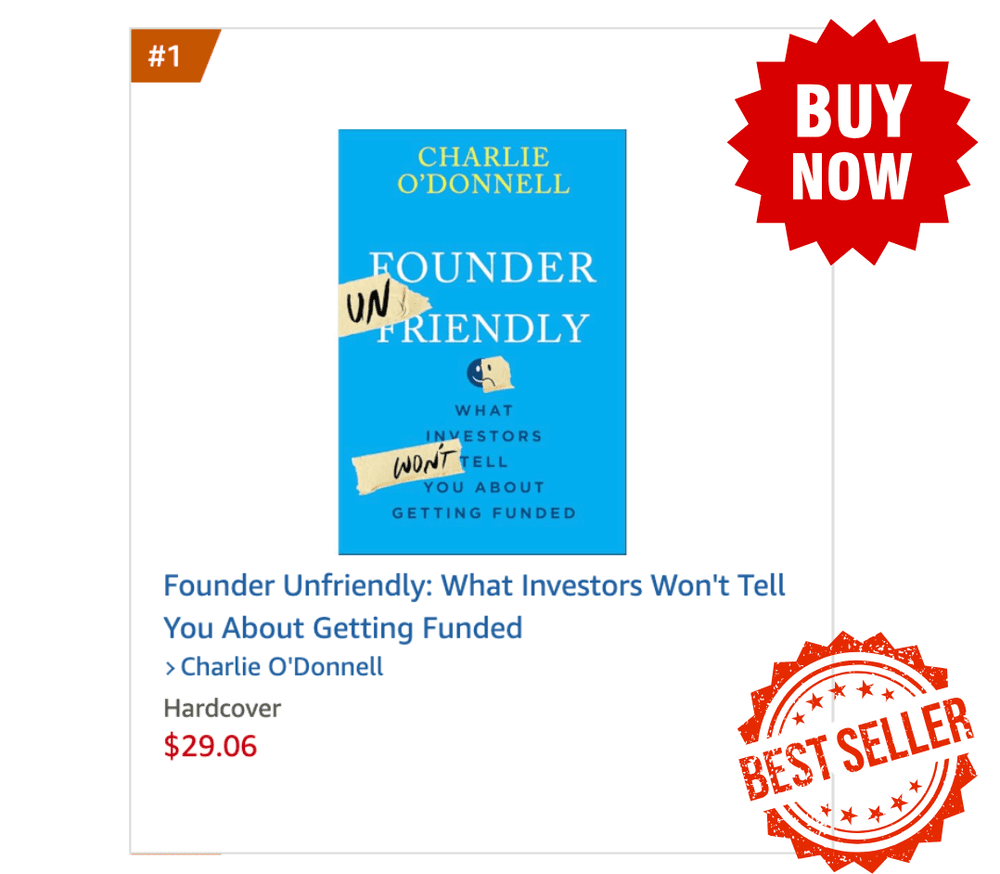
Founder Unfriendly is the #1 Business Entrepreneurship book on Amazon right now.

preorders will get access to a private series of talks with founders from Datadog, Zerohash, Moveable Ink and more by e-mailing their receipt to founderunfriendly@next.nyc

My founder's pitch was always stuck between two modes: the big vision he wanted to build and the off-the-shelf scooters he was actually renting to show near-term revenue. He never fully committed to the "we're going to burn cash for 18 months and change urban mobility forever" pitch so it got muddled. Investors kept asking about the state of the company now, the nature of the progress he had made up to that point, and the downside economic risk of the current model—all questions he was probably more likely to get as a minority founder, but he couldn’t see his way out of them.

A “better fundraiser” could have judo moved these questions into a conversation about growth, but this wasn’t a failure of pitch skill or imagination. I think it's a completely rational response to growing up in a household where money was real, risk was real, and "we might go to zero" was not an abstract investor concept but an actual lived experience. He was pitching the way someone pitches when they've been taught that financial responsibility matters, but he was pitching in front of people who don't care about financial responsibility at all — they care about whether, if the risk was ramped up high enough, this could return a fund.

I'd be willing to bet Joe, on the other hand, walked in with a swing-for-the-fences pitch, blessed by a UPenn network of founders and operators to pressure-test it before he ever walked in the door.

That's the starting line. Not the room. Not the partner across the table.

When people talk about bias in venture, it feels like they're usually pointing at the decision-maker. Or, at least it felt like that to me as a straight white male decision maker.

You hear stories about the partner who asked the wrong questions and the room that looked like a fraternity reunion.

Did you get mistaken for a courier at the office of a VC firm?

That stuff is real and so are the numbers of who gets funded, but I still think we're focused on the wrong barriers.

Venture pitches come down to trust and fit. Do I trust that you can do what you say you’ll do and is what you’re saying you’ll do something really big?

Because we only get a small sample of a founder relative to the decade we’re going to spend with them going forward, VCs are bound to use proxies to assess trust. I didn’t work with you, but I know people who did. I don’t know how much work you put into diligencing this idea but other people tell me you’re really smart.

That’s a perfectly logical approach to a difficult problem. Why wouldn’t you rely on your network to help you make a trust decision?

Think about how you'd hire a babysitter. If your closest friend's sitter of five years suddenly became available, you'd jump at the chance to hire that person if you needed one. That's not bias — that's sensible risk management. You're not discriminating against strangers. You're prioritizing known quantities.

Investors do the same thing—and it’s a hard argument to make that they shouldn’t.

If you were early to a successful company, I can trust that you know what great looks like and the bigness of big.

If you’re in networks already adjacent to venture, I can trust you’ll source capital and talent faster and more easily.

As someone who built a fair diverse portfolio of female founders and founders of color, I saw first hand the extra miles that some of these founders had to go, because they didn’t begin on the same starting line.

They might have run faster and harder, but some people start out so far ahead, it’s difficult to suggest they don’t have a better chance of winning.

If you're a founder who came up without venture-backed friends, without the network of people who've already been selected by this system, without the nine months of cash runway to get to meaningful traction before you even start a conversation — you walk into that first pitch meeting already behind.

It’s not because the investor is prejudiced—obviously everyone has their biases, but those aren’t nearly as impactful as the fact that every rational signal they use to assess credibility is a signal underrepresented founders had a harder time acquiring than someone else.

If resilience was a driver of startup success, that experience would be an advantage.

I just don’t think it is.

The number one thing a founder is looking for is speed—and it’s hard to go faster when your better networked counterpart is running in a lane with one Mario Kart boost pad after another.

I backed a lot of underrepresented founders at Brooklyn Bridge Ventures. What I watched — and was slow to fully admit — wasn't that investors were treating them differently in rooms. It was that by the time they got to the room, they were starting from a fundamentally different position. One group of founders, on average, had enough cash to bootstrap for close to a year. The other was closer to zero net worth. One group had a text thread full of people who'd been through a raise before. The other was figuring it out first in their networks.

Same grit. Same intellectual capacity. Completely different starting lines.

I’ve heard some people identify this as a “pipeline problem” but that makes it sound like there aren’t enough capable founders from underrepresented communities. That’s B.S.

I think the issue is that these high potential founders aren’t getting networked in the same way—and where that begins for VCs is in the hiring practices of your companies. When you’ve got founders who keep referring to their AE’s as “salesguys” and who aren’t checking the counts of who even got interviewed for positions, you’re compounding a gap between who the industry sees as insiders versus outsiders.

If we' were to ever truly measure “comparable”, it would account for who had the warm intro network, who had already worked inside a funded company, who had the financial cushion to spend another six months iterating before going out to raise.

Strip all that away and you're not measuring bias anymore — you're measuring a gap that bias built long before the meeting happened.

Here's the uncomfortable part, and I'm going to say it anyway: if you're an underrepresented founder, you have to accept that the way credibility is measured isn't going away. You can argue it should be measured differently and maybe you'd be right. But in the room, today, the investor is still going to weight proximity, track record and network density, and they're going to do it largely without realizing it.

Fighting that in the meeting is a losing play.

What you can fight — and what actually moves the needle — is getting onto the treadmill earlier. Find your way into the networks where funded founders live. Do the work that gets you known inside ecosystems, not just adjacent to them. Understand that your job, unfairly, is to accumulate the credibility signals that other founders got handed by forcing your way in—and risk getting seen as pushy or overly ambitious, because we’re not trying to climb a highly political corporate ladder.

We’re trying to jump the buildings in the Matrix. It’s overly ambitious by design.

That's an ask that shouldn't fall on you. The fact that it does is an injustice.

Should the system work towards making itself more fair? 100%.

Can you afford to wait for that?

  •  
❌