
❌

Reading view

REVIEW: Nothing to Be Frightened Of (Julian Barnes)

What you can’t find out, and where that leaves you, is one of the places where the novelist starts. Julian Barnes ‘Nothing to Be Frightened Of’

Julian Barnes’s Nothing to Be Frightened Of confounded my expectations of autobiography. I had naively‑imagined a cradle‑to‑career narrative, where it begins with or before birth and proceeds from there. Instead, Barnes assembles something more fragmentary and different. It is a book that has all the usual autobiographical ingredients, discussion of his grandparents, parents, brother, and childhood incidents, but this is all constantly rearranged around a single gravitational force: death.

Throughout, Barnes provides a narrative with multiple threads weaved together like a tapestry that at a distance creates a coherent picture, but at its core is full of contradictions. For example, a childhood story about his grandparents’ duelling diaries comes up again and again, with his grandfather’s record of “Worked in garden. Planted potatoes” counted by his grandmother’s “Rained all day. Too wet to work in garden”. Elsewhere he contrasts his own “colouring in” of memories with his philosopher brother’s suspicion of memory altogether:

My brother distrusts the essential truth of memories; I distrust the way we colour them in.

Source: Nothing to Be Frightened Of by Julian Barnes

The focus on death also extends to discussion of free will, evolution, the brain, and religion. Barnes makes those extensions explicit. At one point he asks whether his “death‑awareness” is bound up with being a writer, and imagines a doctor offering him a brain operation that would remove his fear of death at the cost of removing his desire to write:

We have devised a new brain operation which takes away the fear of death … you’ll find that the operation will also take away your desire to write.

Source: Nothing to Be Frightened Of by Julian Barnes

Late in the book he reflects on genetic inheritance and free will when he notes, almost dryly, that aspects of his and his brother’s mannerisms—“the angle I sit at a table, the hang of my jaw … a particular kind of polite laugh”—are “definitely not expressions of free will” but “genetic replicas” of their father. Here I am reminded in some ways of Christos Tsiolkas’ lecture on doubt, fence-sitting and the importance of questioning:

I’m not proposing we always sit on the fence. However, I am suggesting that as writers, playwrights, intellectuals, we are required to doubt and we are required to question.

Source: 2025 Ray Mathew Lecture: Christos Tsiolkas by library.gov.au

Stylistically, the book feels as much like fiction as his novels feel like non‑fiction. Barnes argues that the novelist is someone who lives in the blur between memory and invention:

A novelist is someone who remembers nothing yet records and manipulates different versions of what he doesn’t remember.

Source: Nothing to Be Frightened Of by Julian Barnes

Throughout, he keeps crossing the line between essay and story, memory and scene. It reads like an autobiographical novel that is honest about its own constructedness and place in time.

I may be dead by the time you are reading this sentence.

Source: Nothing to Be Frightened Of by Julian Barnes

These authorial asides reminded me of Paul Auster’s games in The New York Trilogy. They make the memoir feel self‑consciously written, as if the subject is not just death, but the sheer artificed nature of any story we tell about it.

Perhaps I am putting together quotes to which I am giving false coherence. And the fact that my mother did not die of grief, but was left for five years in her own canoe when least equipped to paddle it, does not signify either.

Source: Nothing to Be Frightened Of by Julian Barnes

Along with Barnes’ self-conscious style, chronology is repeatedly sacrificed throughout to theme. Interestingly, stories are actually often repeated, with a slight tweak each time. Early on Barnes warns that “there are going to be a lot of writers in this book. Most of them dead, and quite a few of them French,” and quotes Jules Renard’s line that “It is when faced with death that we turn most bookish”. That warning is also a kind of method statement: the book lurches from family anecdote to Renard, Montaigne, Flaubert, Koestler, Zola, Stravinsky, and others, not as digressions but as parallel case studies in how human beings have tried to live with the knowledge of extinction. However, there is also something ironic about using anecdotes from fictional authors in that it we are never quite sure what is truth and what is narrative.

With this, we are told a story that could be true, but could also be something that we somehow will to be true. Barnes is repeatedly explicit about this risk of “willing” coherence. In a key late chapter he pushes back against his GP’s idea that dying is the “conclusion” to a life‑narrative. For him, life is “one damn thing after another” rather than a musical score with “theme … development, variation, recapitulation, coda”. He argues that although he respects our desire for narrative, it is often “little more than confabulating.”

So if, as we approach death and look back on our lives, “we understand our narrative” and stamp a final meaning upon it, I suspect we are doing little more than confabulating: processing strange, incomprehensible, contradictory input into some kind, any kind, of believable story—but believable mainly to ourselves. I do not object to this atavistic need for narrative—not least since it is how I make my living—but I am suspicious of it. I would expect a dying person to be an unreliable narrator, because what is useful to us generally conflicts with what is true, and what is useful at that time is a sense of having lived to some purpose, and according to some comprehensible plot.

Source: Nothing to Be Frightened Of by Julian Barnes

Alongside narrative and coherence, misremembering is something that comes up again and again, he even quips “misremember me correctly, we should instruct”.


Having recently read Departure(s), a novel that too includes autobiographical threads, I came to this book wondering how it might be different. Clearly, it is different in that it does not purport to be fiction. But then maybe it is not really that different at all as both are forms of artifice and expression. Barnes makes the case that all art (I assume that autobiography and fiction is ‘art’?) is our feeble attempt to say “I was here.”

Even the greatest art’s triumph over death is risibly temporary. A novelist might hope for another generation of readers—two or three if lucky—which may feel like a scorning of death; but it’s really just scratching on the wall of the condemned cell. We do it to say: I was here too.

Source: Nothing to Be Frightened Of by Julian Barnes

Ironically, I am not sure where that leaves me, reading a book and writing a review. I am left wondering.

The post REVIEW: Nothing to Be Frightened Of (Julian Barnes) appeared first on Read Write Respond.

  •  

OpenAI Has New Focus (on the IPO)

The Wall Street Journal recently reported that leadership wants OpenAI, the company, to focus. Seems like a plain old business strategy story. Nope!

First, in more prosaic terms, the all-hands and what was said was indicative of need for focus and urgency. I read it as mild panic stations. Second, step back enough and a clear and complete image should emerge. It reveals the real game being played. It is the grand hand at the big AI poker table. The IPO. Who gets there first, who sets the rules. And who really wins.

The IPO is not about one company. Instead it is about three American AI companies — Anthropic, OpenAI, and SpaceX, which owns xAI. It is about the scale of money to be raised from the market. It is also the urgency to do so. The Economist notes that if all three offer 15 percent of their shares, the combined sum would roughly equal every dollar raised across all American IPOs over the past decade.

It is against the backdrop of a global crisis, and this being a battle for winner take all. And most importantly, with the Middle East busy with bigger problems, the money spigot for American AI might be as tight as the Strait of Hormuz right now. The Gulf sovereign wealth funds that have been backstopping this AI frenzy have other fish to fry, at present.

Public market investors in New York and London will now have to carry the weight. Which means the IPO window is real, it is short, it is now, and it will not stay open forever. In short, this is a three horse race to the IPO market. And OpenAI isn’t the leading pony.


OpenAI was all over the map. Sora. A web browser called Atlas. A hardware device. TikTok-for-AI. All announced with the same breathless urgency, same press release energy, different product each time. Cashing in on the announcement economy.

Simo told staff last week they had to stop being distracted by “side quests.” That is a remarkable word for what was, in practice, an $840 billion company running several unrelated experiments inside itself while its most focused rival ate its lunch.

All startups, big and small, are messy. Some have more disorder than others. The admission of chaos is a way to show recognition, and eventual correction of the problems. The question to me, is why this admission of chaos? And that’s why you need to bring out the popcorn.

Let’s break down the WSJ news report itself. The fact that the Journal “reviewed” the transcript is a giveaway. The Journal didn’t say they had the transcript, or that it was leaked to them. “Reviewed by” is a tell. This is a controlled leak. Nothing wrong with it.

Companies do it often. Big publications like the Wall Street Journal get the scoops and exclusives. This is a game that has been played for the longest time. Every word attributed to Simo, from “side quests,” to “code red,” to the Anthropic “wake-up call,” was chosen for outside consumption, to shape the story.

Don’t get me wrong. While the actual new content of the story is thin, it is still real. The organizational dysfunction is real. The Sora team was housed under research while launching a consumer product — a good sign of that dysfunction. However, the Anthropic “wake-up call” framing is a classic Jedi mind trick. Admit competitive weakness to look clear-eyed to investors and customers, while simultaneously using a rival’s success as the proverbial carrot and the stick.

However, one has to read the story in a larger context. The WSJ report has to be read against other news this week. Reuters reports OpenAI is in advanced talks with TPG, Advent International, Bain Capital, and Brookfield to create a new joint venture valued at around $10 billion that would push its enterprise products through PE-backed portfolio companies across industries. It is forming “Frontier Alliances” with McKinsey, BCG, Accenture, and Capgemini, announced last month. This is a great narrative being put together for a company on a deadline, for a specific audience. OpenAI is great at building narratives. It might back its way into a long-term strategy, but for now, you have to see every piece of news coming out of OpenAI right now as part of a jigsaw puzzle.

There is one audience for this final picture. The bankers and institutional investors who will price the offering. OpenAI needs them to believe three simple things. It has its house in order. It has a real swing at corporate dollars. And that it is ahead in the AI race, both for consumers and corporations.

One thing odd, maybe just to me, is why OpenAI has been stuffing its ranks with former Facebookers who are known to juice growth, find edges, and keep people addicted. They have little background in getting enterprises to buy into a product. Simo herself ran the Facebook app. That organization’s genius is consumer engagement: behavioral hooks, dopamine loops, the relentless optimization of the feed. You can see that in the recent iterations of ChatGPT. It has become such a sycophant, and creates answers and options, that you end up engaging with it. That’s juicing growth. Facebook style.

The next shoe to drop would be news that OpenAI poached some big name executives from say, Salesforce or one of the big boy SaaS companies to take charge of the enterprise push. Right now, OpenAI’s own numbers show that its enterprise business generates $10 billion out of a total annualized revenue of $25 billion. In comparison, Anthropic, the smaller company, is widely regarded as ahead in enterprise adoption.


Why is all this important? Again, as I said, money. I know I am repeating myself. The public market money. That is the only real story. There are three AI companies heading toward public markets. Two have friends in Washington. One has a great satellite launch and Internet business. One has focus. One is perceived as an “all over the map” business.

Zoomed in, there is a reason why Grok and OpenAI are looking to go after the “code” business. Anthropic’s success is good enough proof that AI, despite all the talk of impending singularity and AGI, is all about software — the critical choke point in a digital-first world. That is the business. For now! Not orbital data centers. Not a social video app. Not a hardware device. All these may (or may not) be real money spinners in the future, but for now, you gotta focus on juicing your revenues to go public. Focus is the answer.

Anthropic’s revenue run rate has surged past $19 billion, up from $9 billion at the end of 2025 and roughly $14 billion just weeks before that. Amodei confirmed at Morgan Stanley that $6 billion was added in February alone, driven almost entirely by Claude Code. Revenue doubling in two months. That is the curve that makes a prospectus compelling without a PR campaign to explain it.

The US government has tried to change that calculus. Defense Secretary Hegseth declared Anthropic a supply-chain risk after it refused to give the Pentagon unrestricted access to its models. Altman positioned OpenAI as a bridge-builder while quietly moving to take Anthropic’s vacated government contracts.

Anthropic has no friends in Washington. What it has, in the immortal words of former Microsoft CEO Steve Ballmer, is “Developers, Developers, Developers.” Right now, developers are the ones who actually matter. Despite its somewhat unclear messaging and occasionally awkward public identity, Anthropic’s Claude Code is a product they want to use. Wallet always speaks the loudest.

I won’t be crying over OpenAI. They are doing $25 billion in annualized revenue, with 900 million weekly users, and a CEO who has proven he can bend a narrative to his will.

As I said before. When a grand hand is being played, focus is not such a bad thing. Especially when the billions you desperately need are on the line.

March 17, 2026. San Francisco.

  •  

Meta’s Moment of Reckoning

Pop some popcorn. Put some butter. Add some salt. Because opportunists (politicians) are pointing their muskets at villains (tech bros), using children’s welfare as the ammunition. In case you were wondering, I am talking about the battle between New Mexico AG and Silicon Valley’s villain in chief.

The next bout is on May 4. So mark your calendars. Why?


This week two verdicts came in quick succession. First, a New Mexico jury ordered Meta to pay $375 million for knowingly enabling child predators on Instagram and Facebook. Then, a Los Angeles jury found Meta and YouTube negligent for designing platforms that addicted a young woman who first used YouTube at age six and Instagram at nine.

On the surface this is big win for ambulance chasers. However it could be much bigger if politicians actually have the best intentions that go beyond winning the next elections. History tells me, they are what I said they are, opportunists.

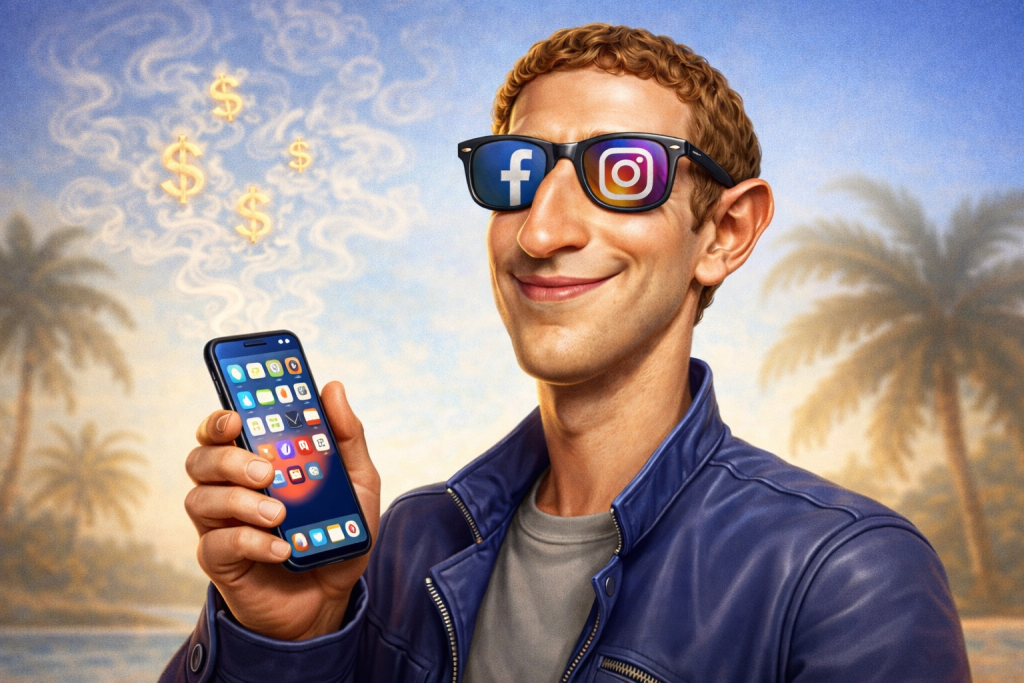
Let’s be honest about what New Mexico AG is. He is an elected official who identified the most despised man in American technology, a category that has never been more unpopular, and filed suit. Zuckerberg is the perfect patsy. Ian Fleming couldn’t have created a more perfect caricature of a villain for our post social age. Weird. Awkwardly dressed to appear cool. Black AR glasses.

Rich, arrogant, visibly indifferent to the damage his products caused, and now on record in two courtrooms defending decisions his own safety teams told him were harming children. The internal documents that came out in both trials showed the same pattern: engineers and safety researchers raising alarms for years, recommendations made and ignored, Zuckerberg choosing growth. None of this is new. I wrote about Facebook’s growth-at-any-cost DNA back in 2018. The pattern has not changed. Only the courtroom has.

New Mexico AG smelled blood. A politician at the end of the day, doing what politicians do. Scoring points against the current villain in chief, building a reputation on the wreckage of someone else’s failure, and calling it justice. The “independent monitor” he is asking for is the tell. And that is not how change happens. That is a patronage job dressed as accountability. That said, underneath the political theater, the structural demands are real. And if a judge grants even a portion of them, they could change daily life for two billion people.


Think about what your daily experience on Instagram or Facebook or TikTok or YouTube actually is. You think you made some choices. Pat yourself on the back. You have been fooled into thinking that you were the one making the choices. Now, let’s get real.

You open the app and a feed appears. Like I did. This morning. I went to Instagram to see what my “pen friends” were doing. I didn’t see a damn thing. What I saw, I didn’t choose. Neither do you. You see what they want you to see.

An algorithm shows you what it wants to show you, trained on everything you have ever paused on, liked, or watched past the halfway point. It is the ultimate illusion, where perception is conflated for reality. It has one job: keep you there. The most reliable way to do that, as the internal research showed and as the companies knew, is to surface content that provokes anxiety, outrage, desire, or envy. Those are the emotions that generate engagement. Engagement brings in the moolah. The loop is the product. I called this trap back in 2018. The feeds have only gotten more sophisticated since.

Layer in the design features built around that loop. Infinite scroll, so there is never a natural stopping point. Autoplay, so the next thing starts before you have decided you want it. Notifications calibrated to pull you back at the moment your attention drifts elsewhere. Variable reward, the unpredictable appearance of a like, a comment, a new follower, built like a slot machine. None of this happened by accident. All of it was tested, measured, and optimized.

This is what the courts are now calling a design defect. And to understand why that matters, you need to understand the wall that has protected these companies for thirty years.

Section 230 of the Communications Decency Act, passed in 1996, is the founding legal pillar of the modern internet. It says platforms cannot be held liable for content posted by their users. It is why Facebook is not responsible for a defamatory post, why YouTube is not liable for a radicalization video, why the whole architecture of user-generated content was able to exist at scale. Every time someone tried to sue a social platform for harms caused by what users posted, Section 230 was the wall. Case dismissed.

The Los Angeles plaintiffs found a door in that wall. The jurors were specifically instructed not to consider the content Kaley saw on the platforms. Not because it was irrelevant to her harm, but because content is where Section 230 lives. As NPR reported, the lawyers pursued a case of defective design precisely to get around the high bar set by Section 230.

The entire case was built around the design. Infinite scroll, autoplay, algorithmic feeds, notification systems. Those are not user posts. Those are the company’s own engineering decisions, made in their labs, tested on their servers, optimized by their employees. CBS News put it plainly: this case centered around how the apps are designed, not the content itself. Section 230 does not protect you from your own product choices.

The jury answered yes to seven specific questions per defendant. Were they negligent in the design or operation of their platforms? Was that negligence a substantial factor in causing harm? Did they fail to adequately warn users? And did they act with malice, oppression, or fraud? That last finding triggered punitive damages.

The pipe (aka the Social Media platform), not what flows through it. That argument won and opened new legal ground that can change everything that comes next.


If the design is the defect, the remedy is redesign. Not a warning label. Not a terms of service update. The product itself has to change.

Not surprisingly, I have some suggestions. Actually pretty simple ones that even politicians can grok.

Start with defaults. Right now every addictive feature ships on by default. Flip that. Ship the product in its least addictive form. Chronological feed. No autoplay. Scroll that ends. Notifications off until you choose otherwise. Every addictive feature requires an explicit, informed choice to activate.

That is consent architecture. And it is exactly what these courts have been asking. Did you warn users? Did you get meaningful consent? The answer, established now by two juries, is no.

Real age verification is the other demand with teeth. But it is also a hairball that will unwind a lot of the internet, security and privacy. That is for experts with more gravitas and knowledge than me.

Instagram’s Adam Mosseri knows what is coming. His year-end memo was full of language about authenticity, credibility signals, and platform responsibility. The same language is now showing up in court filings. At trial, he testified that there is always a tradeoff between “safety and speech.” That is a telling formulation. Safety as a constraint on the product, not a foundation of it. When I pushed on what Instagram is really positioning itself to become, he pushed back. But the architecture he described, who posts rather than what is posted, is exactly the consent architecture these courts are now demanding.

The practical problem for the platforms is simple. You cannot run two different algorithmic systems in one product without everyone noticing. Once you build the less addictive version for minors, the question becomes impossible to avoid. Why is that version not the default for everyone? Why is the more addictive version what adults get, when they never consented to it either?

The legal fight is about children. The logic does not stop at eighteen.


The tobacco parallel is everywhere in the coverage this week. It is the right one, but people are using it loosely. The important part of the tobacco story was not the $206 billion settlement. What changed behavior was what came alongside the money: mandatory disclosure of internal research, advertising restrictions, forced redesign. Joe Camel did not die because of a fine. Joe Camel died because a court said you cannot market this product to children, and you cannot keep making it more addictive than it already is.

The companies held out for decades. Denied the science. Attacked the researchers. Then they did not.

But here is where the parallel gets uncomfortable. Tobacco did not go away. It became Juul. I wrote about Juul back in 2018, when Silicon Valley was celebrating a $15 billion e-cigarette company as a tech startup. I called it Camel 2.0 then. Same addiction, new delivery mechanism, new investors, new PR. As a former smoker who nearly lost his life to cigarettes, I was livid. Tobacco companies figured out how to sell the same addiction in a cuter package, and Silicon Valley helped them do it.

Zuckerberg will do the same. He is too good at survival not to. The feeds may change form. The addiction machine will find a new name. Addiction is a lucrative business. It always finds a way.

Meta and YouTube have already announced appeals. They have the money and the lawyers to fight this for years. And they will. But discovery in each new case keeps producing documents. The internal research keeps surfacing. The bill keeps growing. Eventually it is cheaper to change than to fight.

Zuckerberg’s doctrine is simple: two steps forward, one step back, and make it appear as if he is changing. His superintelligence memo last July was the latest example. Talk about the future, avoid the present, and let the lawyers handle the rest.

That is the logic of the crowbar.

All eyes on Santa Fe on May 4. There just might be enough structural change. And if consent architecture is put in place, then we can all feel the glow, for a moment. Billions of people deserve a different default. Till the battle starts again. Like Juul.

March 25, 2026, San Francisco

PS: I want to apologize for sending two long emails in a single day. I had no intention of doing so. I was definitely not going to write about Meta or social media. I was thrilled to just nerd out about broadband today. However, I can’t help myself when it comes to Facebook and Zuckerberg and their shenanigans. I have been covering them since they were a tiny startup.

  •  

REVIEW: This Is What It Sounds Like (Rogers and Ogas)

Listeners are an essential part of the endless cycle of music because all music makers start out as listeners. Out of that listening are birthed singers, dancers, performers, composers, DJs, record executives, technical innovators, sound designers, and record makers, all eager to show the next generation, This is what it sounds like . . . to me. Susan Rogers and Ogi Ogas ‘This Is What It Sounds Like’

In This Is What It Sounds Like: What the Music You Love Says About You, Susan Rogers (along with co-author Ogi Ogas) provide a scientific scaffolding for experience of falling in love with a song. At the heart of the book is the Listener Profile, a methodical framework that categorises our musical “sweet spots.” Rogers breaks down the listening experience into seven primary dimensions:

  • The “What”: Melody, Lyrics, Rhythm, and Timbre.
  • The “How”: Authenticity, Novelty, and Realism.

While Rogers’ background as a cognitive neuroscientist shines through, she balances this with various “behind the desk” anecdotes from her time engineering for Prince during the Purple Rain era and her work with Geggy Tah and Barenaked Ladies. These snippets provide a necessary human pulse to the clinical approach.


One of the interesting aspects was Rogers’ discussion of novelty and our appetite for musical risk. This is captured by a novelty–popularity curve: simplest, most familiar music on the left; boundary‑pushing, complex music on the right; sales/popularity on the vertical axis. This curve is ever evolving and what might be considered complex today, can easily become more familiar in the future.

Though its shape remains the same from generation to generation, the curve itself slides steadily to the right along the axis of novelty as different musical innovations become commonplace. The peak of the curve - along with the most popular style of music -retains a balance of familiar and novel elements, but what those elements sound like changes as audiences get accustomed to musical advances.

Source: This Is What It Sounds Like: What the Music You Love Says About You by Susan Rogers and Ogi Ogas

I could not help but draw parallels to Raymond Williams’ theory on cultural evolution:

  • Dominant: The music that defines the current “mainstream.”
  • Residual: The sounds of the past that still shape our present.
  • Emergent: The new, “novel” expressions that push boundaries.

Rogers argues that our “Record Producer Brain” is constantly scanning for these elements. However, taste is rarely static. You might find that your profile shifts as you age or changes depending on your social environment. This fluidity suggests that the Listener Profile is not a fixed DNA sequence, but a living document that evolves with our life stages.

The identities we construct for ourselves are reflected in the things we collect and like, so much so that when we unveil a drastic change in the food we eat, the hobbies we enjoy, or the genres of music we’re into, people who know us understand that something important about our identity has changed. Empirical research has shown that our conception of personal identity is linked to our musical choices.

Source: This Is What It Sounds Like: What the Music You Love Says About You by Susan Rogers and Ogi Ogas

Another thing that stood out was tension between Rogers’ profile and the concept of guilty pleasure. When we align Rogers’ science with Donald Winnicott’s concept of the True Self and False Self, a “guilty pleasure” is often just a conflict between our True Self (the raw, emotional response to a melody) and the False Self (the persona we present to fit social expectations). Rogers’ intent with the framework is to provide the structures required to strip away the “False Self” and understand why a specific timbre or rhythm resonates with us, regardless of its perceived “coolness.” It was interesting thinking about this alongside Chilly Gonzales’ Enya: A Treatise on Unguilty Pleasures and how it comes to grips with personal taste.

During quiet moments in the studio, I enjoyed asking record makers to name a guilty pleasure—a record you would be embarrassed to admit you liked. Such confessions can be deeply revealing. The records we treasure covertly reflect facets of our musical self that we’d just as soon not have others know about.

Source: This Is What It Sounds Like: What the Music You Love Says About You by Susan Rogers and Ogi Ogas

I was once told that “no one likes your music.” Of course, the comment was said in spite, but ironically it is true for when it comes to the Listener Profile, we are all unique, there is no average. As a combination of neurological wiring, personal history, and emotional associations, our relationship with a song is unique.


If Michel Faber’s Listen - On Music, Sound and Us is a soulful, visceral exploration of the act of hearing, Rogers’ work feels like its intellectual counterpart - an exploration written “from the head up.”

The post REVIEW: This Is What It Sounds Like (Rogers and Ogas) appeared first on Read Write Respond.

  •  
❌