Hues of red and lavender blended together in the clear evening sky. I don’t think I have seen the sky like this before. I write with my laptop propped up on one lap as I gaze out the window, trying to find the words to describe the sky. As the minutes pass, the sky changes. The sun sets further over the hills; pink rises and the lavender turns to grey. The street lights illuminate.
I sometimes think about how sunsets are never the same. I know what colours to expect and in what direction I need to look to see them, but there is always a surprise: the arrangement of the clouds, or the lack of them, the position of the sun and how it relates to the hills or the trees, or something else. This evening, it was the hues of red and lavender. I felt like I was seeing a sunset I had never seen before. No two sunsets are the same.
Before the sun set over the hills earlier this evening, the sun peeked over and below clouds, creating bands of yellow through the greys and the whites in the sky. I smiled as I admired the details of the sky – the clouds, the colours, the width of the horizon.
Looking back, I realise that this is now the time of year where I can watch more of the setting sun. The clouds of winter have receded; the spring breeze blew them away. The sun sets later.
From my window I no longer see the pink in the sky; the sky is now a deep blue. Things change with time. But the colour is forever in my words: the way that the red and lavender blended in a way I have never seen before, now here, in words.
This was the sunset of March 19th, 2025, seen from here, the place I call home.
When I woke up this morning, I knew I wanted to open the blinds early – to let the spring light in. The previous night, I had made sure the book I wanted to read was sitting by my bedside, ready for me in the morning. I enjoyed the soft yellow light shining through the room as I read, my book temporarily taking me into the world of motorcycles and maintenance and care.
I love how books let you be in two places at once: where you are, and another world crafted by the author. Maybe that is part of why I love writing, too: I can craft a little world for you to be in for a few moments.
After spending my time immersed in another world, I got up and looked out the window. There was a light blanket of frost on the grass that, just yesterday, was more green than I have ever seen it, illuminated by the light of spring. Seasons and times blend together: the cold of winter and night lingers in the morning, the sun bringing new perspective to the frost.
I love frosty mornings: the chill wakes me up. I went for a walk to get some bread; I had half an avocado in the fridge that I didn't want to let go to waste.
Outside, the world was quiet. I myself was still waking up; the fresh air helped. I paid attention to my breath with every step I took. I have a bit of a cold; being in Nature was exactly what I needed. On one part of the walk, with nobody else around, I closed my eyes and recalled memories of other mornings where the air was just like this. I felt connected both to the world around me and other moments in time.
The frost outside has melted. After my walk – and my delicious breakfast – now sit in my armchair, gazing out the window with a sense of peace. I just finished my cup of tea. I always like to hold my tea cup for as long as I can so that I can feel all the warmth it has. Since I am writing, the tea cup is next to my left knee. I can still feel its warmth.
When Ryan Coogler’s Sinners introduces a klansman and a vampire in the same frame, the audience is left with a choice: cower in terror or snicker at the absurdity. I chose the latter. Click for my take from a writer's POV!
This week I joined a session at school on the topic of career planning. I had an hour of time to work through a series of questions designed to help me make progress on a goal. The goal I chose for the session was to think about my career goals. What do I want to do in my career? What is my dream?
I love technical writing and communication, which I did professionally before starting my degree, but I wanted to think beyond areas where I have already worked. In the careers session, I made progress but I was still on similar tracks to my previous thinking. But tonight I had a new idea.
When I was a kid, I briefly dreamed of being an inventor. I loved making things It is perhaps then little surprise that computers, followed by programming, eventually caught my attention. I could make new things and share them with people!
This evening, I thought about how I could keep that dream alive, if only in the form of an idea in the back of my mind. I came up with a way to connect the dots: what if I worked in a place where I was designing new technologies?
Over the last year I have been thinking a lot about the intersection of technology, design, and how we use technology. Learning about the history of art has helped give me a new toolkit through which to look at the world, too. I think I would love to work in a place that lets me ask big-picture questions about the future of technology, and to help design new technologies.
I would love to be able to make prototypes of new tools with a team of people, all looking to solve the same problem. I want to work on technology that helps people. I want to cover new ground, using prior art as inspiration but not necessarily as a direction. We have problems to solve that need novel solutions. I want to build technology where ethics is a central part of the discussion.
I would also love to use my technical writing skills to take notes of what I was helping to build. I’d love a prototype made in this hypothetical lab to eventually become something that people can use. I love making things people can use.
Whether or not this is a dream I end up pursuing, I am not sure. But I did want to write it down. Until this evening, I had not yet made the connection between my childhood interest in becoming an inventor and the fact that there are people out there who design technology.
If anyone can help me connect the dots further between the aspiration to prototype new technologies and what this looks like in the real world, please feel free to send me an email!
It’s almost like I’d love to work at a modern-day Bell Labs :)
One thinks of Thomson Reuters as a source of good information on issues (Thomson) and news (Reuters). That's the brand. Alas, it's also a source of information about you and me to ICE, Palantir, and others. That's what The Minnesota Star-Tribune reported back on March 3rd, and 404 Mediadoes again today.
Sam Altman just went on record saying intelligence **_will soon be sold on a meter, “like electricity or water.” _**If you don’t understand what he just said, let me tell you. He is not building a chat interface. He is building the grid for human cognition. And he intends to charge you for your own relevance. They stole all this data from us, the people. Our life’s work, our creativity, our art. They devoured the open internet and blew through every copyright law on Earth. And now they want to “sell it back to us” in the form of a utility?!
Only in America
Cory Doctorow explains how ICE in airports "hanging around like a bad smell and being totally useless" is a warm-up for their armed and masked presence at every polling place in November. He has concrete suggestions for stopping that, which he addresses to Democrats. Wise Republicans should be on board, too.
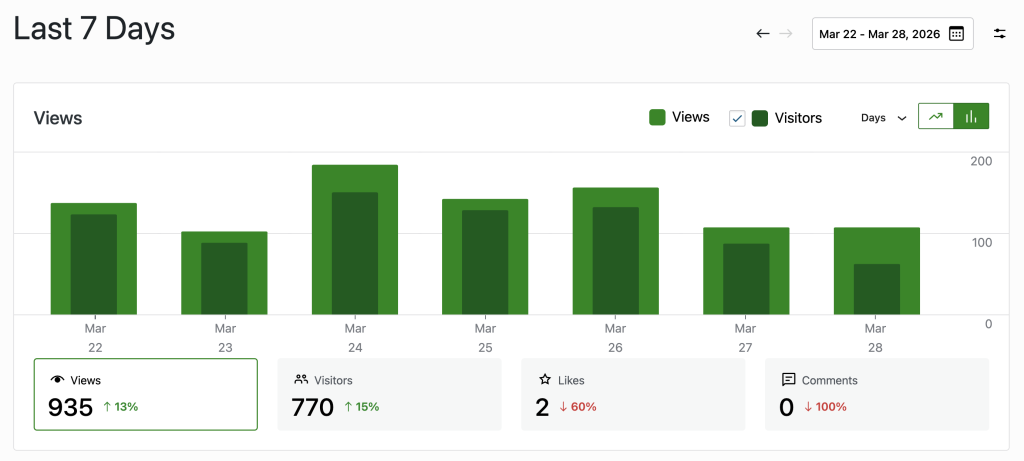
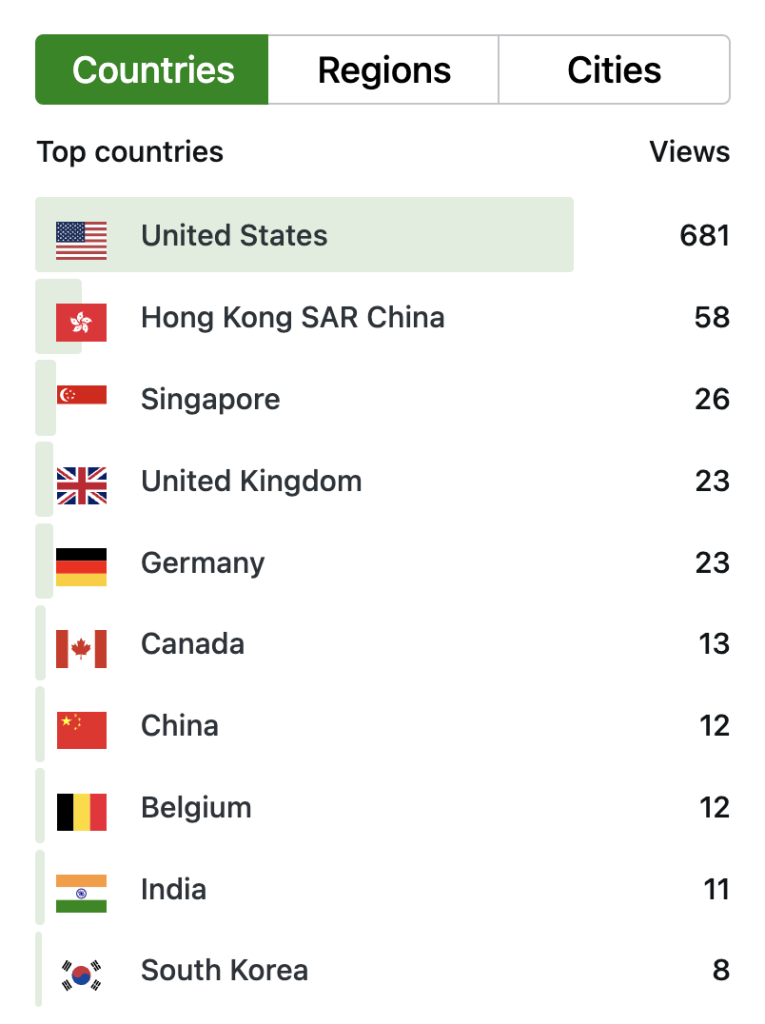
David Weinberger once said, “In the future, everyone will be famous for fifteen people.” It’s the future now, and he was right, or close enough. Because today we live in a world where the power to publish and distribute no longer belongs just to institutions, but to everybody. Me included. Here are some stats for this very blog:
At its peak, this blog had dozens of thousands of visitors daily. But that was in the ’00s, when blogging was a small pond, and I was a large fish in it. That was also when big newspapers and broadcast networks were still mountain ranges on the media landscape. Now those mountains have worn down to hills amidst fresh volcanoes: stars new and old, gushing out “content” on podcasts, social media, YouTube, and the rest. They’re the ones with readers, viewers, followers, and subscribers in the dozens of millions.
While that’s interesting, the media landscape has widened exponentially as millions of consumers have also become producers. In sum, their flow is immense: far larger than what we get from the old hills and the new volcanoes. Let’s call it the allstream.
It’s not “the media” anymore. It’s too different. Let’s explore how.
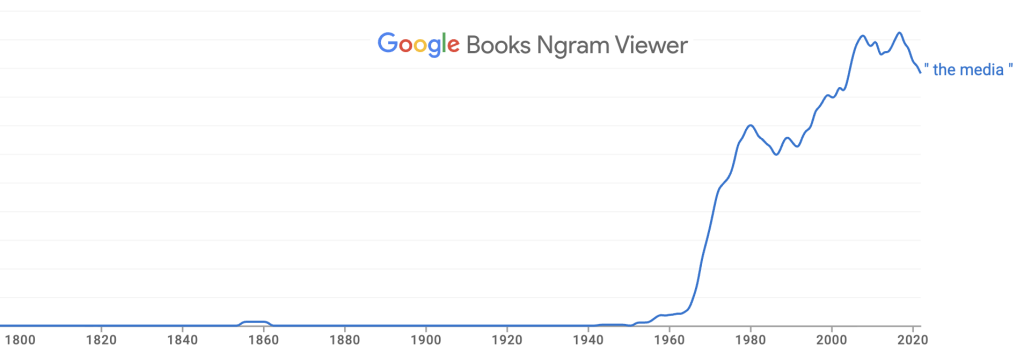
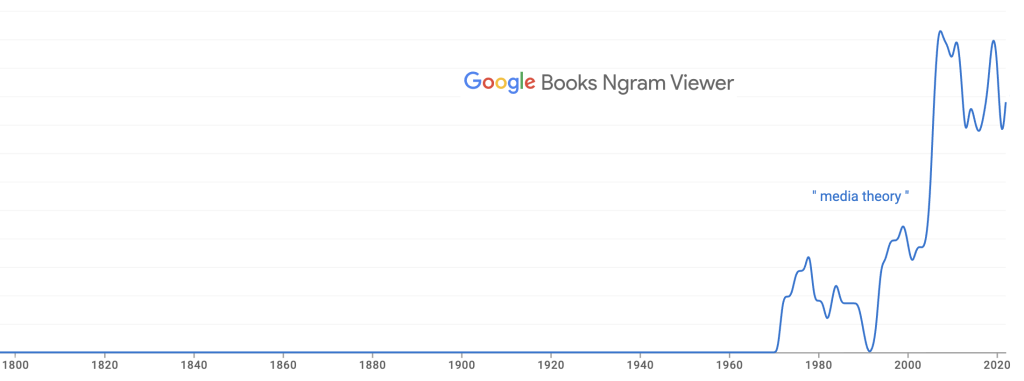
First, “the media” is a modern label, dating from the 1940s. Here’s Google’s Ngram Viewer, which charts mentions in books.
As a topic, “the media” hockey-sticked when Marshall McLuhan made “media theory” a thing in the 1960s:
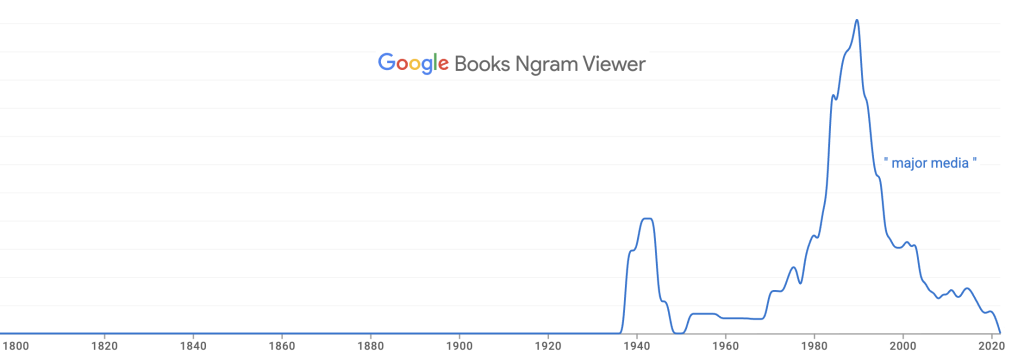
Meanwhile, the expression “major media” seems to have come and gone—
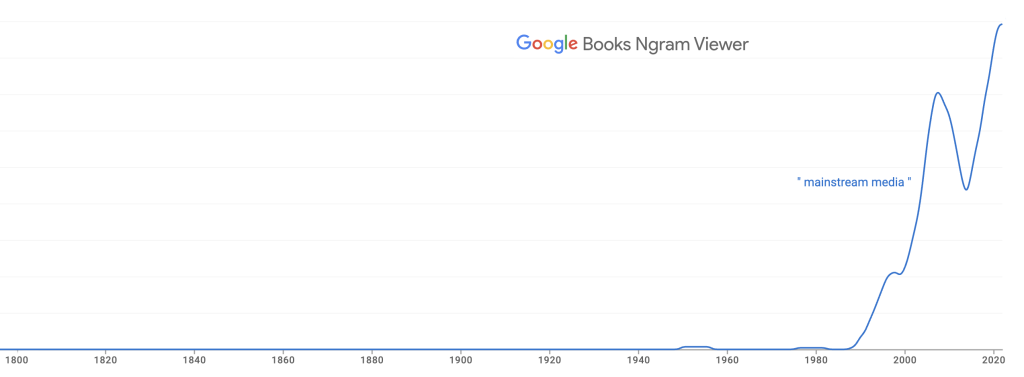
—while “mainstream media” is hot shit:
Why has “mainstream media” gone up while “major media” has gone down?
Politics. Writers and talkers on the right and the left both have lots to say about “the mainstream media.” It seems (at least to me) that talkers on both political wings think the old mainstream media—big newspapers, TV networks, broadcast giants, news wires—are still mountains. Or, to follow the stream metaphor, rivers.
But those old rivers were self-limiting. They controlled the production and the flow. That’s what made them main. It’s also what made them costly. Printing presses were expensive. Broadcast licenses were scarce. Regulations ruled. Editors and producers were gatekeepers because there were gates to keep.
Then came the Internet, followed by the Web, blogging, podcasting, cheap digital photography and video, and all the other means by which anybody with a keyboard, microphone, phone, or just an idea could put something into the world. The threshold for expression has fallen to trivial.
One reason was that RSS—really simple syndication—made distribution simple for everyone. Nobody had to ask permission from a publisher, a platform, or a network. It gave individuals the power to speak and flow into the allstream.
Every creator wants to be valued and followed by at least a few people—especially the right people—rather than by large populations. We each have our own public. (At least for this moment, reader, you’re in mine.)
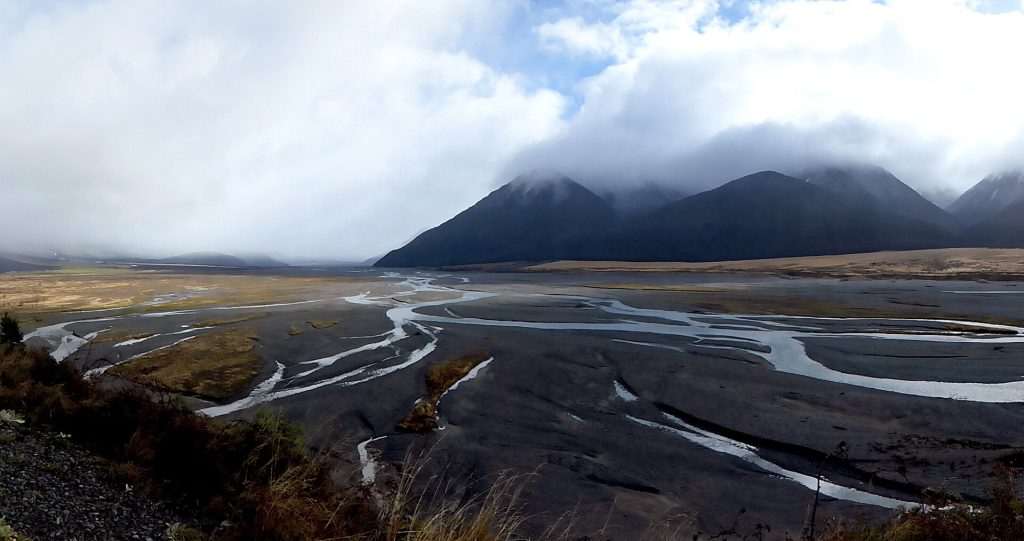
In place of the mainstream, we now have wide slopes of braided rivers:
Canterbury, New Zealand. Photo by Bernard Spragg via Wikimedia Commons.
In the allstream, everybody can publish, distribution is easy, and the number of flows exceeds anyone’s ability to count or follow them all. Their variety is also extreme: blogs, podcasts, newsletters, YouTube channels, TikTok feeds, posts in Mastodon, BlueSky, Threads, X, Reddit, Facebook, LinkedIn, and Instagram. Flickr and Smugmug photos. Substack essays. Discord chats. Group texts. Private forums. Comment sections. Local news outlets (many written and published by just one person). Transcripts. Some are public. Some are semi-public. Some are private. Some are generated by AI or by humans with AI assistance. The scale of each is small by old media standards. But the aggregate is far more immense than what we call “the media” ever were.
In The Redstream Media, I described how partisan flows of news and opinion had already turned the mainstream into a sidestream. But it’s not just happening with politics. Expertise streams around institutions. Communities stream around beats. Hobbyists stream around trade publications. Local knowledge streams around outside authorities. People with cameras, microphones, and keyboards stream around organizations that have long monopolized distribution.
Of course, much of the allstream is noisy, false, manipulative, repetitive, trivial, and thick with propaganda, junk, spam, AI slop, outrage bait, and viral bullshit. It can produce confusion faster than clarity. But the old mainstream had propaganda, junk, exclusions, class filters, geographic biases, advertiser pressures, and institutional blind spots.
But scarcity was the media’s main feature. To see, hear, or read it, you needed a TV, a radio, a subscription, or a newsstand. Through those spincters, the few spoke to the many while the many lacked the means to speak back, or out. Now they have the means. All of them can stream too.
When I look at how far my readership has fallen from the heights it enjoyed in the golden age of blogging (and at Linux Journal in its peak years), I’m glad to have the readers I’ve got. The same goes for my photo collections here and here on Flickr. For two decades, those got ten to fifteen thousand views a day. Now they get a few hundred. I’m fine with that too, because the totality of all the flow on the Net is beyond measure, and growing.
Big AI (ChatGPT, Gemini, CoPilot, Claude, Perplexity, et. al.) stands between you and the allstream and says, “I’ll handle this.” So the sphincter moves from the point of publication to the point of retrieval. (My assistant, ChatGPT, gave me that quote and the sentence that followed. Everything else in this essay is mine.)
When we (David Weinberger, Chris Locke, Rick Levine, and I) wrote The Cluetrain Manifesto, we saw lowering the threshold of public expression as a plus for civilization. We published Cluetrain in March 1999, 27 years ago. Here is the “one clue” (from Chris Locke) that precedes the 95 theses that followed:
And dammit, we are still seats, eyeballs, end users, and consumers. Our reach still fails to exceed the grasp of the surveillance fecosystem. And none of big tech (or big anything) is dealing with it.
But we are more numerous than ever. Our tail is long and wide. What if we get real power? We didn’t have it in 1999. We four Cluetrain authors thought we did. But Web 2.0 came along, and we got all the personal agency the platforms allowed.
And we are still there. All of us can produce video, but if we want it seen, we’ll need to use YouTube, which has a monthly reach of 2.7 billion people. It’s a wide gate, but Google keeps it.
Can we ever get the high degrees of personal and collective agency we saw coming when we wrote The Cluetrain Manifesto?
I think we can, if online service providers agree to our terms, instead of us to theirs. That’s why we created MyTerms, and why I’ve written so much about it. (And I won’t stop.) The case we need to make is that an intention economybuilt on customer agency will be richer, wider, deeper, and larger than what we have here and now, in the final stage of the old industrial age.
Once we have the agency, we will need new and better forms of economic signaling and money flow than we have so far. Everyone who publishes anything should have a piece of the allstream action (whatever that might mean). MyTerms will tee that up as well.
I’ll leave you with a question: What will happen when the landscape across which the allstream flows is a worldwide commons of self-empowered customers?
If you have an answer for that, you can also inform the future of Customer Commons, which we created in 2013 to make good on what I promised in The Intention Economy in 2012. Both pushed forward the body of ideas we started assembling with ProjectVRM in 2006, but actually began forming with the Internet in the 1970s and ’80s, and the Web, Linux, and open source in the ’90s.
Everything takes time. Let’s make a better future happen sooner rather than later.
I fear that guy is, at least in part, me. The sentence fragments, the short paragraphs, the em dashes. (These: —.) As source material, my writing is thick on the Web’s ground, going back to the early ’90s. Example.
I’ll cop to one of his tells: absurd certainty. Some of mine turned out to be the opposite of absurd. Examples: personal computing, outlining, the Net, the Web, Linux, open source, Cluetrain, blogging, smartphones. And some not (at least so far, or not yet in a big way): home Web servers (or “personal clouds”), desktop Linux, VRM, EmanciPay, the intention economy, MyTerms, personal AI, news commons, market intelligence that flows both ways…
Anyway, AI-style writing is now like Received Pronunciation in the UK: the way things are done.
History doesn’t grade on effort. It grades on outcomes. And right now the outcomes are running about 3-to-1 against anything resembling the vision that justified the operation in the first place.
As usual, the postwar is everything.

 Login
Login