Login
LoginWhat’s Our Problem?
2 May 2023 at 10:00
My new book, available now as an e-book, audiobook, or right here on Wait But Why.
The post What’s Our Problem? appeared first on Wait But Why.


My new book, available now as an e-book, audiobook, or right here on Wait But Why.
The post What’s Our Problem? appeared first on Wait But Why.
Back in February, I wrote a post about my upcoming book that included a big visual of the timeline. Just two weeks after the book launch, my first baby would be born. I’d promote the book, catch my breath, and then begin the new adventure.
Thank god for those critical two weeks.
The night before book launch was (obviously) a frantic all-nighter, and I eventually went to bed after 40 hours awake, exhausted and satisfied. We had done it. The book was live. It was over. I’d actually wake up tomorrow without this project hanging over my head. The sky would be blue. I’d finally be free.
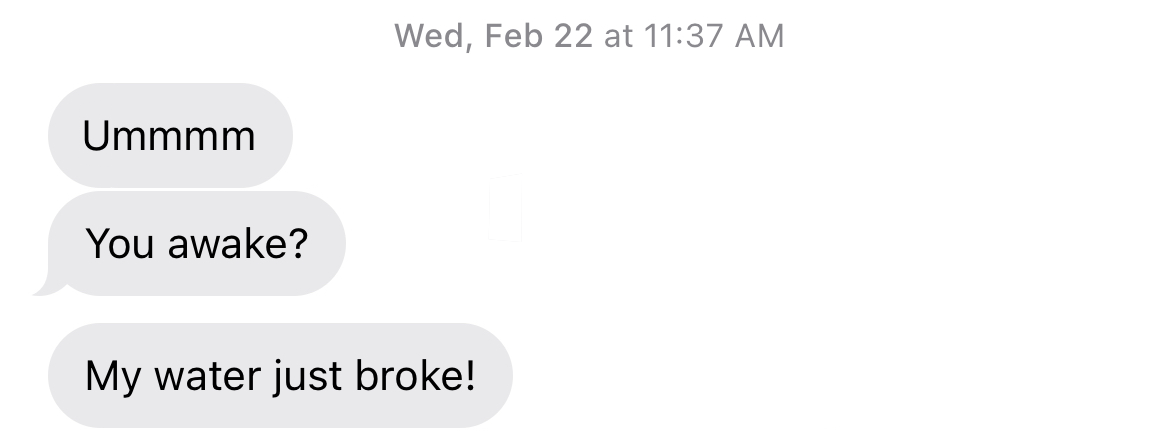
I woke up close to noon and felt at peace for three seconds before opening my phone and seeing three texts from my wife:
Hm?
I knew what water breaking was. But I didn’t know what it meant. Is the baby coming out now? Or was this one of the false alarms I had heard about and the baby is still a couple weeks away? Is there a chance she just peed her pants and is misdiagnosing the situation?
After some rapid-fire googling, one thing was clear: We had to go to the hospital. Now.
The drive was weird. I had pictured myself heroically driving a screaming labor-having wife to the hospital, but here I was driving normally to the hospital with a very normal wife next to me. Apart from her new leaking situation, nothing was different than it was yesterday. There was no way we were actually having a baby today. Right?
Upon arrival, the PA assessed things and yes her water had broken, and yes in order to avoid infection that meant the baby had to come out now. Two hours and 12 canceled book-promoting podcasts later, we’re in our delivery room, where my still-not-in-labor wife would supposedly be producing a baby sometime later today.
Again, there was a major expectations-reality gap. I had pictured the day of my first child’s birth being impossibly frenetic and emotional and intense. But there we were, eating animal crackers and gummies from the treats-you-can-eat-while-in-labor bag, hanging out and chatting like any other day.
My wife was hooked up to a bunch of tubes and machines and the plan was to see if contractions would start on their own as a reaction to her water breaking, but a few hours passed and nothing happened. Eventually, the nurse came in and poured a magical little chemical called Pitocin into her IV bag.
And things started happening.
Contractions began, which my wife described as “a really bad period cramp,” which helped me understand what they felt like 0%. Over the next couple hours they got worse and worse. I was quickly assigned the role of “don’t say or do anything” while contractions were happening, so I’d just kind of sit there awkwardly and watch with this face on:

Her epidural plan was something like “definitely get one but tough it out a little first,” and after a particularly awful contraction, she called it a day and the epidural team came in to do their thing. 45 minutes later, we’re back in the “I know this is the day of the birth of our first child but it sure doesn’t feel like it” zone, chatting and hanging out normally. After a few more hours, a nurse came in and checked on the dilation situation and was like “alright, let’s do this!”
Once again, nothing like I pictured. I thought there would be a big team of doctors and nurses doing a whole big hectic thing and I’d be standing somewhere on the side. Instead, it was me and this nurse, each holding a leg.
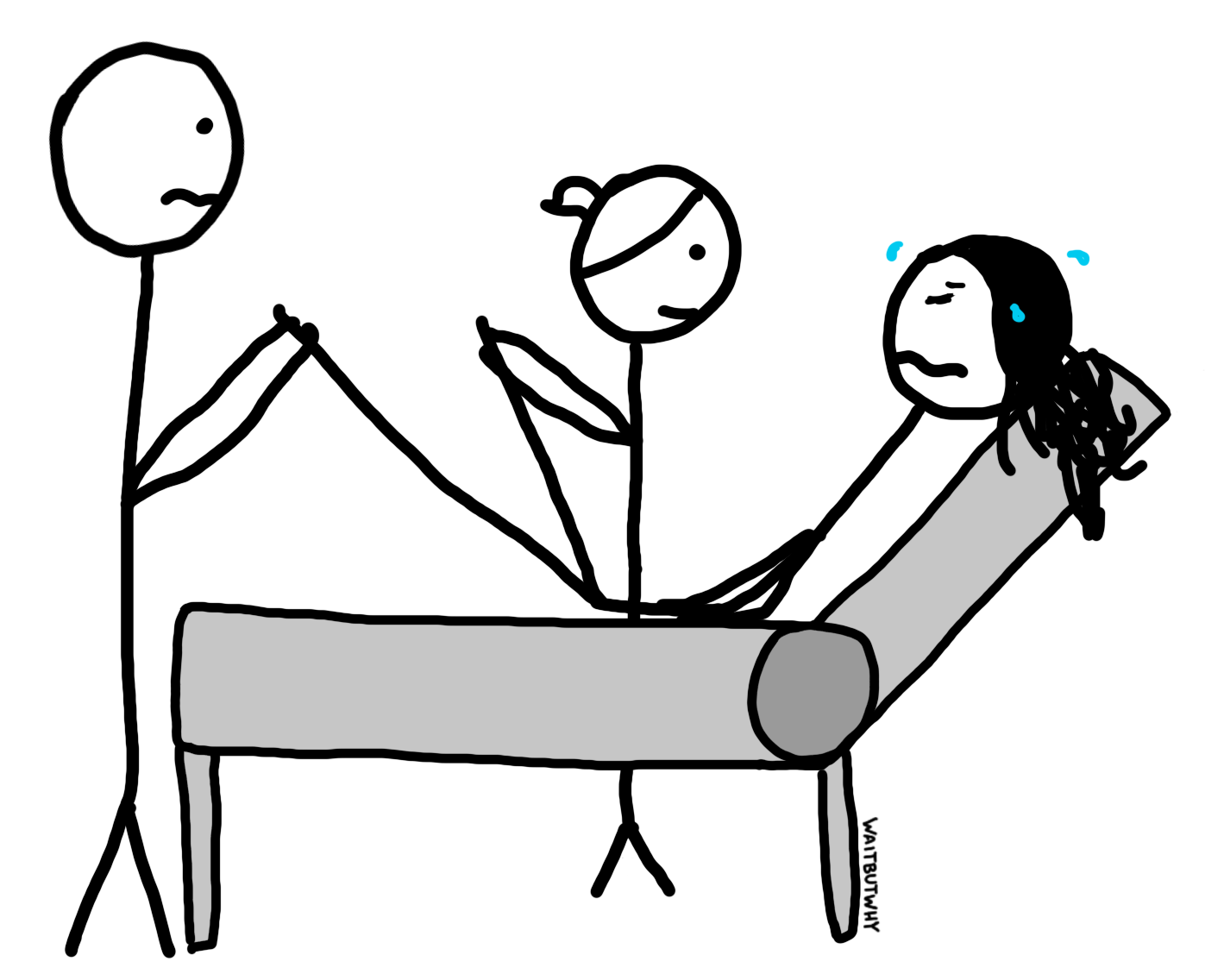
The game went like this: When a contraction starts, we each grab a leg and she pushes really hard for 10 seconds three times in a row. Then everyone chills and hangs out for a few minutes until the next contraction. And repeat.
After a few rounds of this, it was clear this was not gonna work. Nothing was coming out. But we kept trying anyway.
And then I saw it.
The edge of an upsetting slimy pancake.
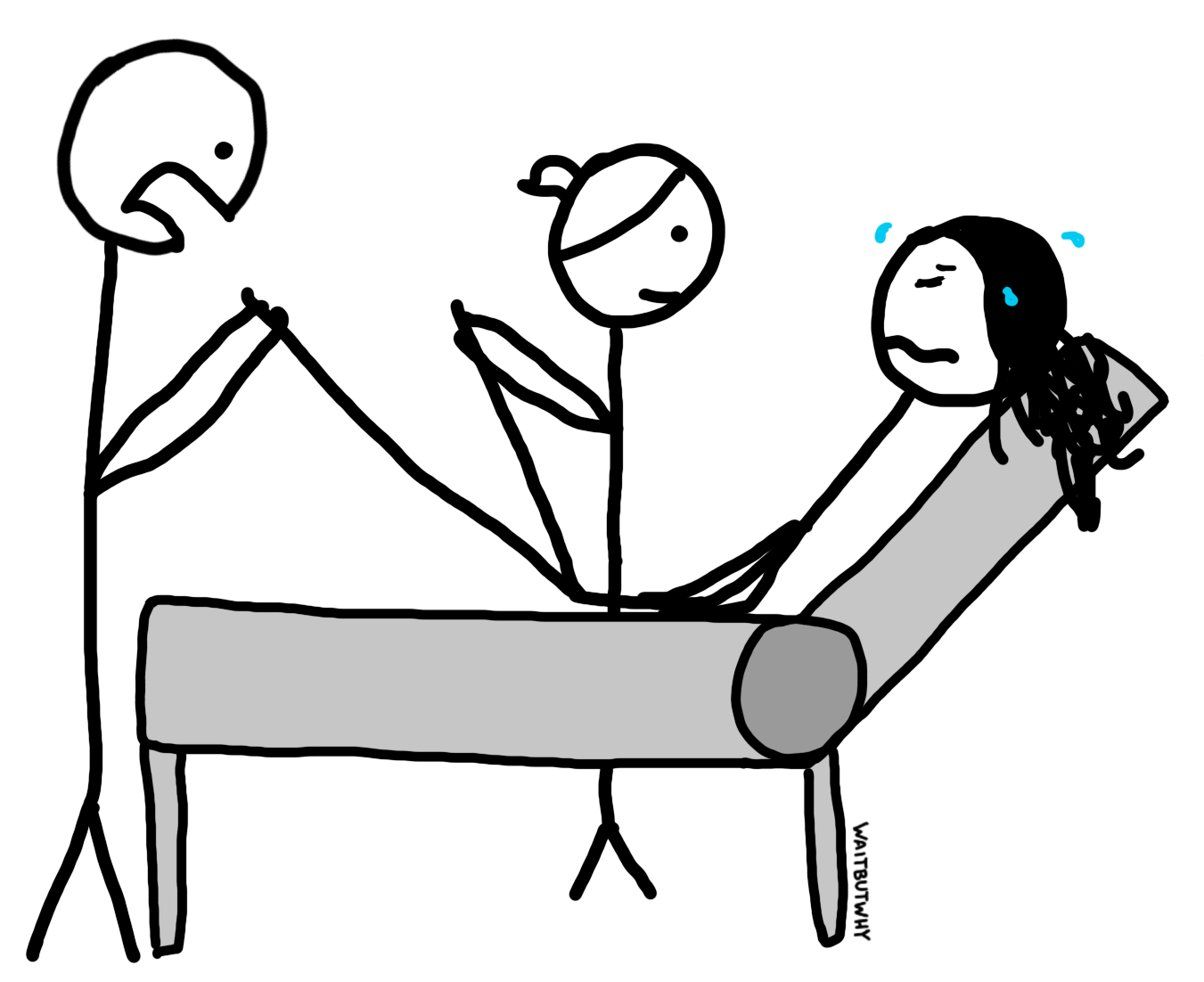
When I asked what the upsetting slimy pancake edge was, the nurse told me it was my daughter.
Uh huh.
This then went on for a while. We’d do a round of pushing, the upsetting pancake thing would come out a centimeter and then go back in, and each round it would come out a few more millimeters. It was increasingly feeling like we really weren’t getting anywhere with this strategy when the nurse suddenly says “okay let’s deliver a baby!”
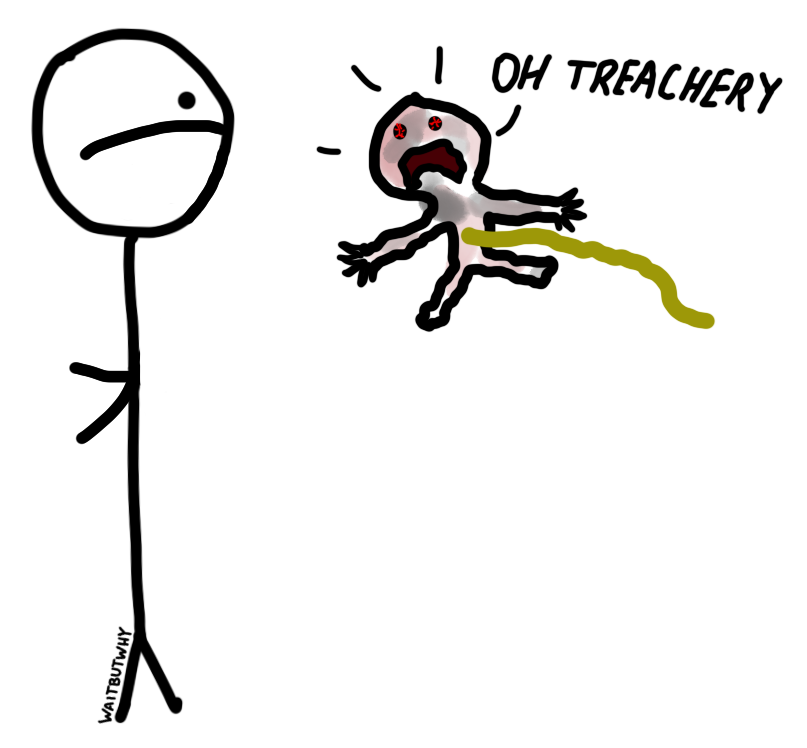
She makes a call and a few minutes later a group of people come in, including the first doctor we had seen that day. The next contraction came along, I leg-held, my wife pushed, and then in the most surreal moment of my life, I was staring at a tiny screaming alien.
___________
That was 3 months ago. I’ve had a lot of thoughts since then. Here are 10 of them:
I thought it was gonna be like this:

But it’s actually like this:

A newborn is not a baby. Babies are cute and roly-poly and can see and are conscious and are normal and a newborn is not any of these things. It is a bizarre human larva that acts super weird and would still be in the womb if it could be. The problem is, when humans went bipedal, our pelvises got smaller, and as humans got smarter, our heads got bigger. So evolution had to get creative. Its solution: all human babies would be premies, born when they were still small enough to pass through a human pelvis. The last couple months as a fetus would happen outside the womb, and everyone would just have to deal with that. This became incredibly obvious during the first month with my daughter. She was a raw human id not remotely ready for primetime. Thankfully, since then, a baby has grown around the id and now she has the figure of a miniature 390-pound 84-year-old woman.1
If I want to drive a car, I have to take driver’s ed first. If I want to provide medical advice, I have to go to med school first. But after we had the baby, the hospital was like “don’t shake it k bye.”
I know a lot of words I didn’t used to know. Meconium. Tummy time. Latching. Bicycling. Swaddle. Colostrum. I know how many ounces of milk and hours of sleep the baby is supposed to have each day. I know baby CPR and the baby Heimlich maneuver. I know how to induce baby burps and shits. I know how warmly to dress a baby. I know what temperature baby bathwater should be. I know what sleep training is and when it’s okay to start it. I know that you can’t just pick a newborn up, you have to pick all the pieces up at the same time or else the pieces fall off.
But I only know all of these things because I read books and articles and am fortunate to have people I can call with questions. And society’s current plan is to just expect/hope that every new parent does the same?? There should obviously be like a mandatory four-hour course every expecting parent has to take before they’re actually in charge of a newborn.
Instead, people like to say things like “you’ll figure it out” and “just use your instincts.” You could apply the same logic to driving and people probably would just figure it out—but we don’t do it that way, because that would be absurd.
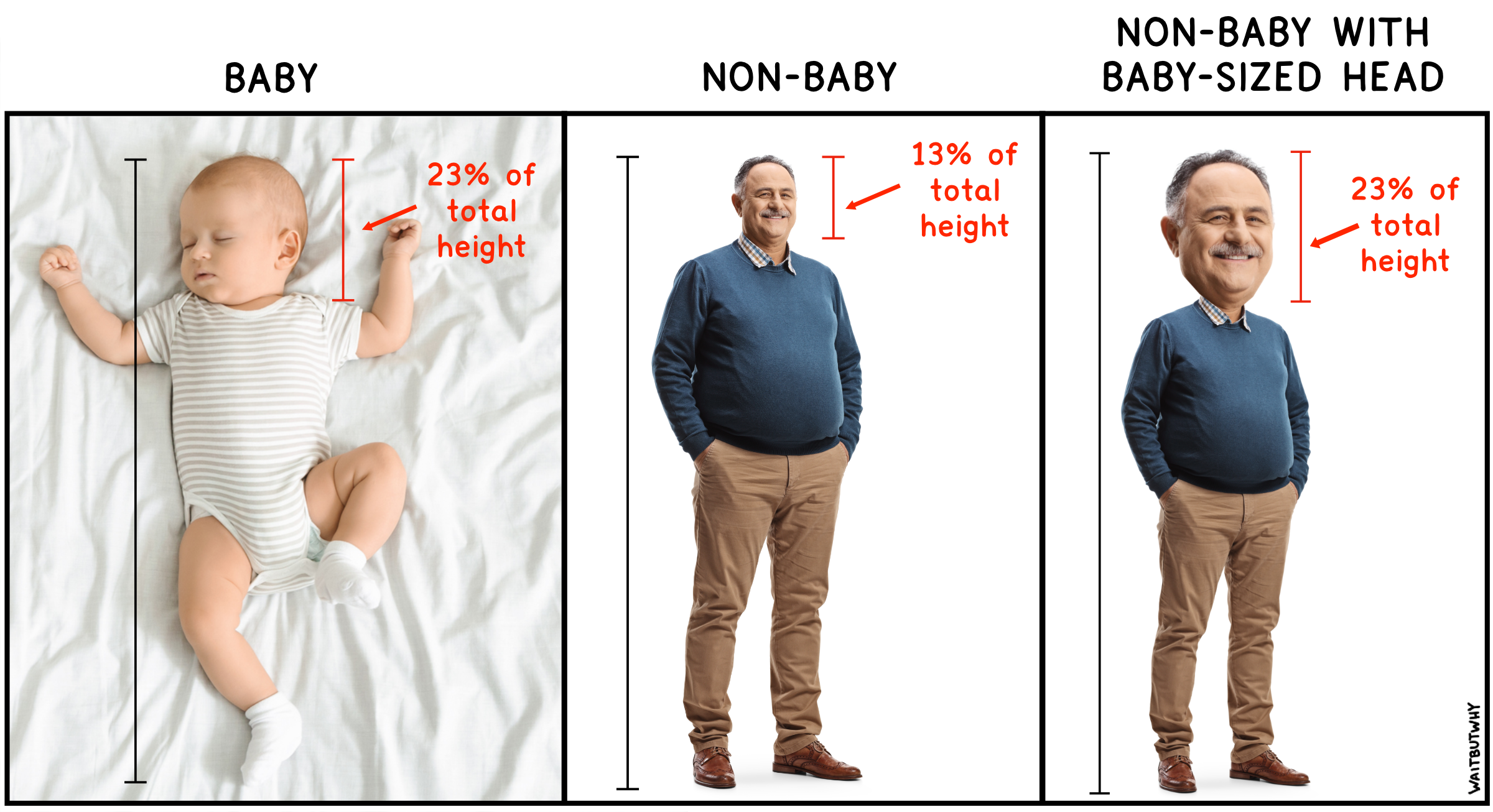
*I made this visual thinking it was gonna emphasize how big baby heads are, but after looking at the big-headed guy on the right for a while, it started to look normal to me, and the normal-headed guy suddenly looked like he had a ridiculously small head. So now I’m realizing that the big takeaway is that baby heads are normal and the rest of our heads are tiny.
When a normal person is hungry, or tired, or needs to burp, they’re a little annoyed. Babies are in Shakespearean agony. And then comes the burp and one second later they’re like “sup.” It’s insane behavior.
For a while, the range of baby emotion runs from Shakespearean agony to neutral, never entering the positive realm. Neutral is a newborn’s best-case scenario.

After six weeks or so, positive emotion begins to make an appearance, but then they still go apoplectic at the slightest inconvenience.2
While we’re here, I know it’s bad but I can’t help it—crying babies are funny. My wife completely disagrees with me on this.


It’s weird—you have all of these intense feelings for this little person* and there’s just nothing to do with those feelings. I could squish her face, but then she’d cry and I’d be abusing a baby. In the early weeks, there’s just not really a satisfying outlet for your baby fondness and it’s annoying.
One other one-sided thing is you’re apparently supposed to talk to your newborn even though they’re an unconscious fetus because it supposedly helps develop their brain. So now my baby has heard multiple versions of my next book outline, the full story of the rise and fall of the Assyrian Empire after I listened to a podcast about it, and a list of every World Series champion going back to 1990. Never once has the baby shown any sign of being affected by any of this.
*That said, I’ve always thought of parental love as the most intense form of love—the kind where if you had a Sophie’s choice where your baby and spouse were both hanging off a cliff and you could only save one, you’d save the baby without a second thought. And…yeah I’m not there yet. I love this little creature a freakish amount, but as of now, I’m definitely saving my wife in that situation. Sorry kiddo. I’m sure Tim the Baby-Saver-Wife-Dropper will at some point emerge, but I guess it takes some time.
Obvious one, I know, but just check this out:1

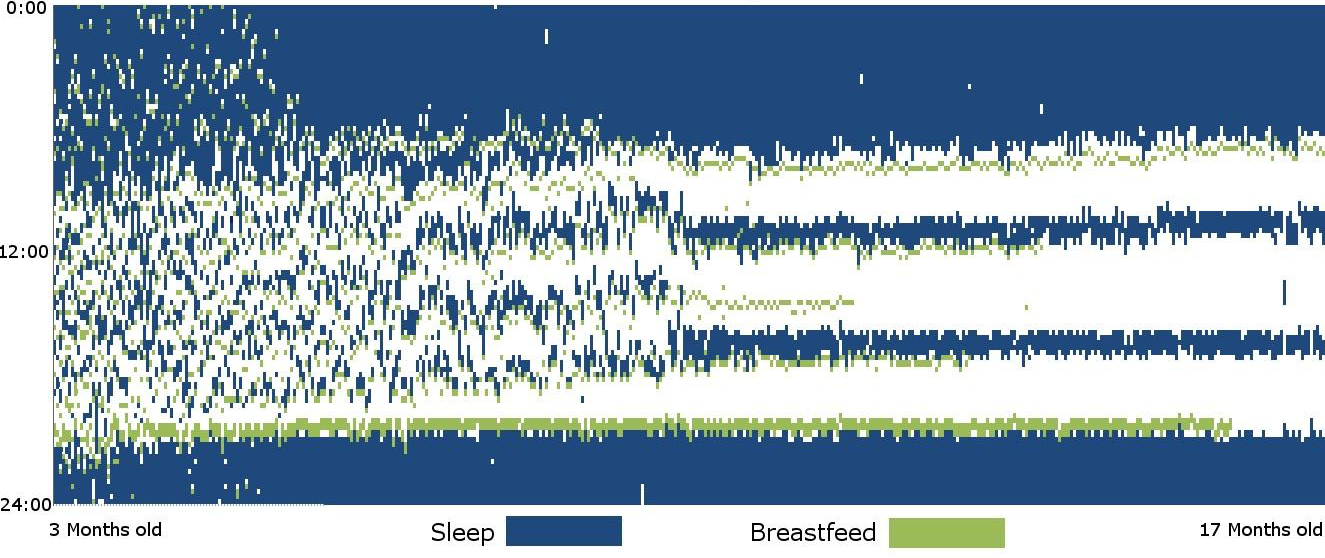

These are the sleep graphs of three different babies, but they all have one thing in common: there’s no rhyme or reason in the early months, because newborns are dicks.
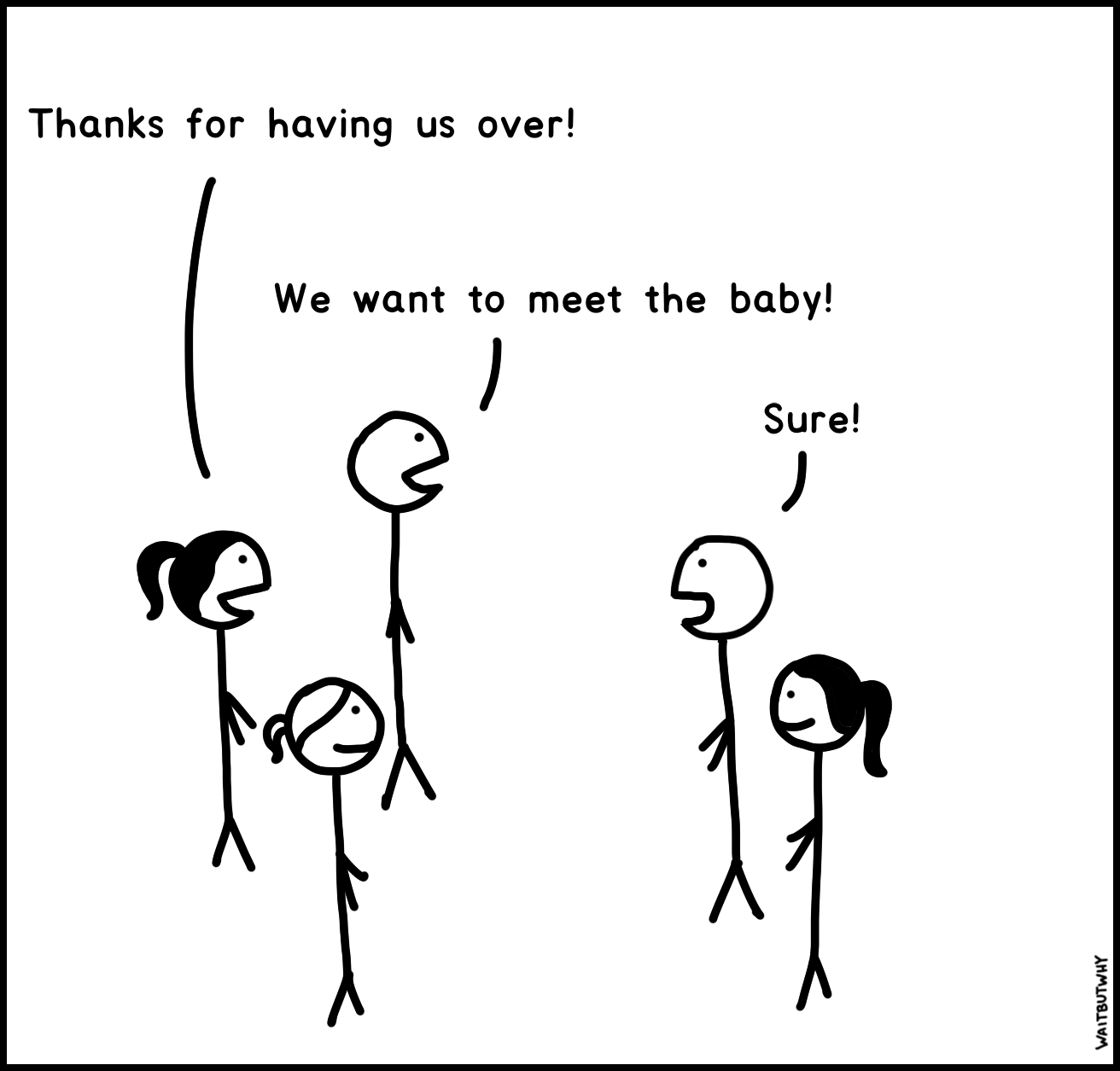
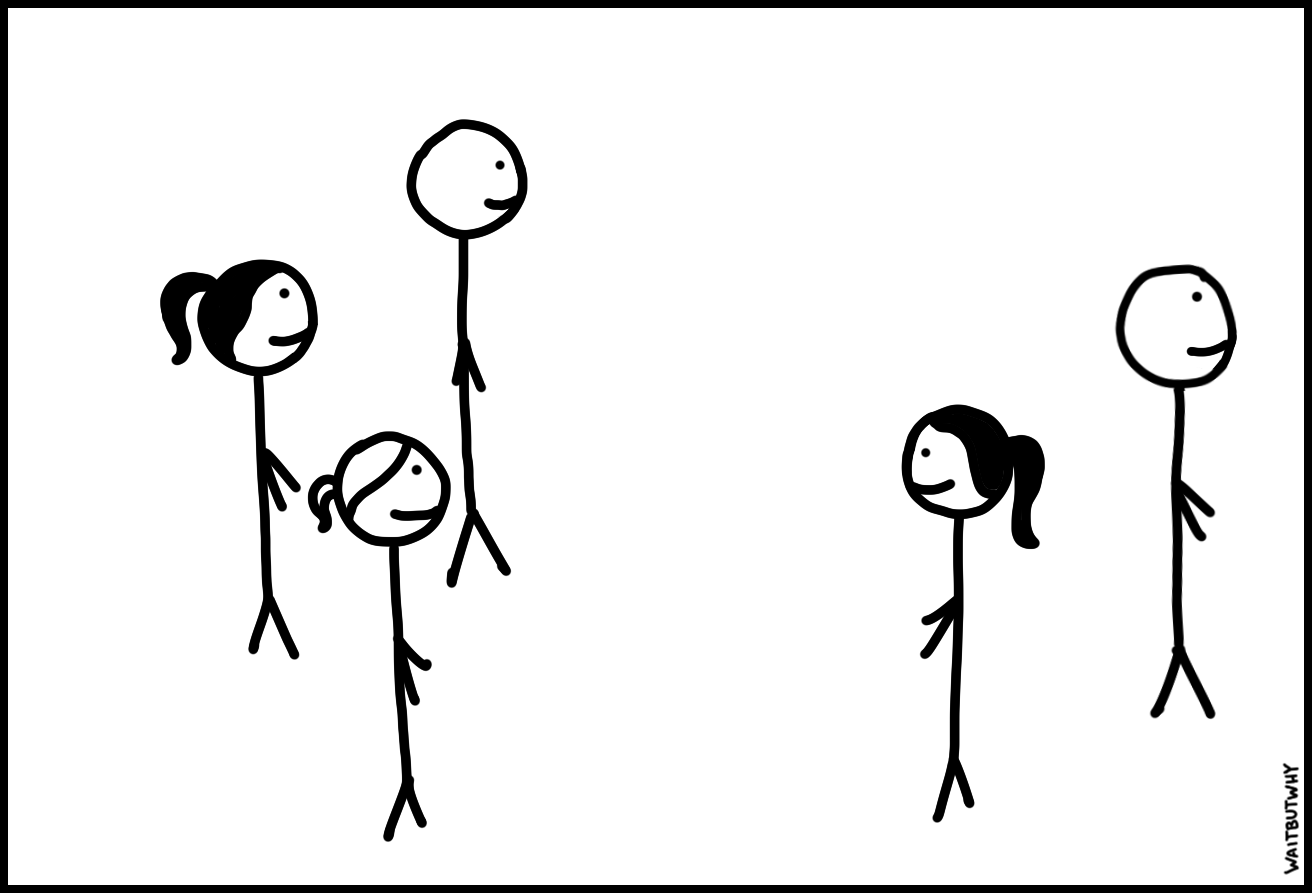
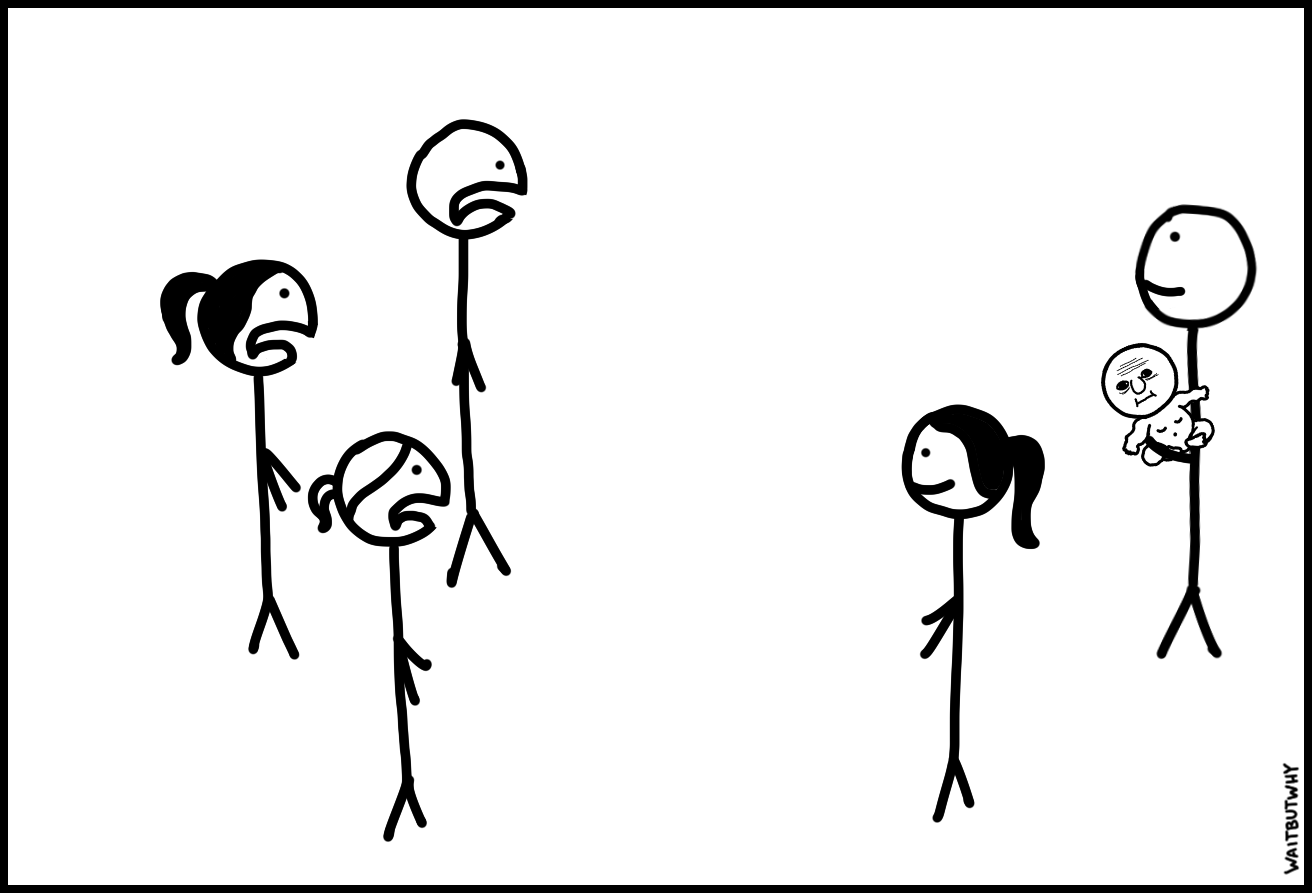
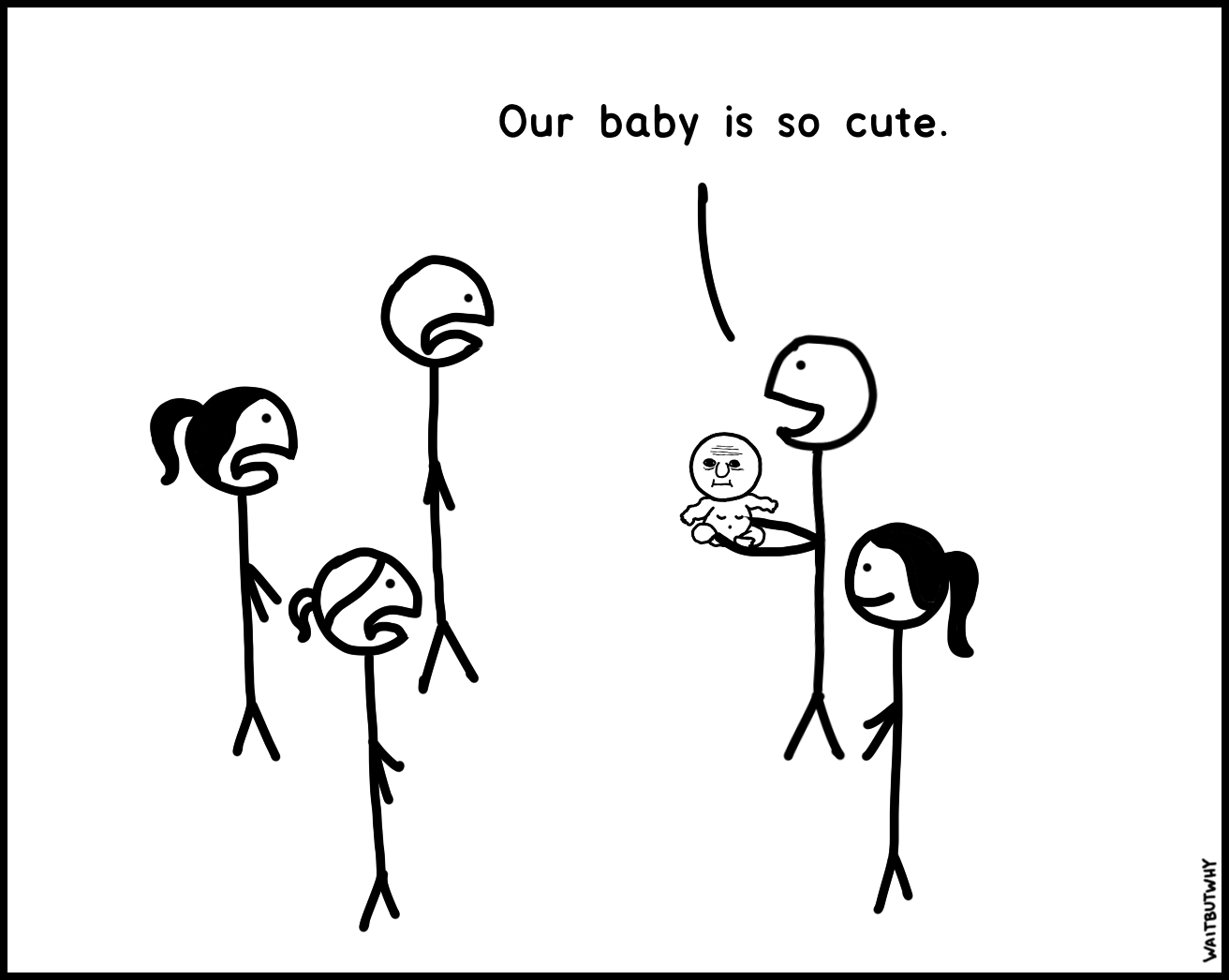
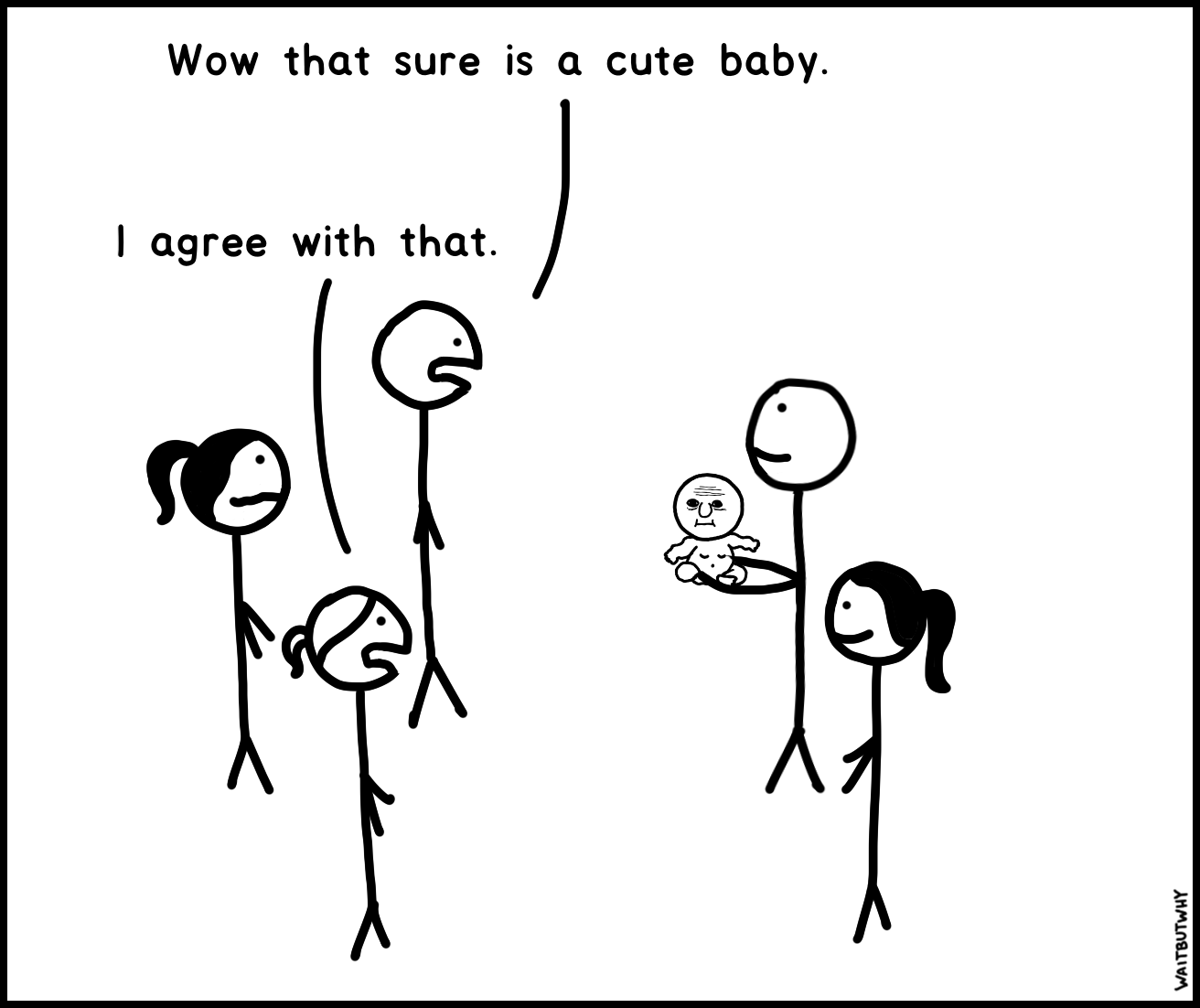
I think my baby is impossibly adorable, of course, but every parent thinks that about their baby, so that offers no information. Everyone who has met her or seen a picture of her has commented on how cute she is, but they’d say that no matter what she looked like—which I know as someone who has commented on the cuteness of babies ranging from perfect to hideous—so there’s no information there either. FYI, I once depicted what happens when friends visit someone with an uncute baby:
It’s pretty amazing how bad babies are at everything. They’re terrible at thinking, at knowing anything, at moving all parts of their body. The cool thing is that spending time with a super unimpressive baby has made me super impressed by myself. Like I’ll watch the baby sitting in a baby bouncer trying to reach for a little wooden flower one foot in front of her and she just flings her arm in the general direction and misses by a lot. Then I’ll reach for a glass of water and all of my joints work together to send my hand on a perfectly straight path through three-dimensional space, gracefully clasp my fingers around it using the perfect amount of pressure, raise it to my mouth, tilt it in perfect sync with the movement of my lips, and then return the glass to the table and gently place it down like an absolute genius.
Some things are just too big for our little human brains to fully absorb. The bigness of the universe. The permanence of death. The magnitude of the marriage decision, which I once described like this:
When you choose a life partner, you’re choosing a lot of things, including your parenting partner and someone who will deeply influence your children, your eating companion for about 20,000 meals, your travel companion for about 100 vacations, your primary leisure time and retirement friend, your career therapist, and someone whose day you’ll hear about 18,000 times. Intense shit.
A few months into fatherhood, this feels like another item in that category. When your baby is born, you will (hopefully) never live another day as a non-parent. For people who make the decision to do this, it is the BC-AD line of their life. It doesn’t mean you can’t still be you, but you are trading in one kind of life for another, with all of the pros and cons that come along with it.
I don’t think I’ve been able to quite wrap my head around the bigness of the situation. A curious childless friend asked me the other day if I feel like a dad, and I surprised myself by answering “not really.” I mostly feel like old me that has this new delightful little thing living in my house. When I see friends with sentient kids actually parenting them, saying things like “that’s not nice, stop it,” whatever that must be like is as much of a mystery to me as it was three months ago. For me at least, it seems like a parent is something you slowly turn into as your first baby slowly turns into a person.
Btw I’m now even more convinced than I was before that this is the most personal of personal decisions and no one should ever try to pressure anyone else to have kids—it’s way too big a thing to be anyone else’s business.
Every parent in history has brought their baby into a world with an uncertain future. But our future is the uncertainest. My baby might live a life a lot like mine, just a little more futuristic. Or she might live to 500. She might live most of her life with a brain-machine interface implanted in her head, thinking with her own superintelligent AI. She might suffer through civilizational collapse. She might live in a world that would seem like utopia to us today. She might live on Mars. She might meet aliens. She might die in the apocalypse. There’s just no way to know. It makes all of those fun, exciting, terrifying conversations about the future hit just a little harder.

_______
If you like Wait But Why, sign up for our email list and we’ll send you new posts when they come out.
To support Wait But Why, visit our Patreon page.
_______
More thoughts with comics:
10 Types of Odd Friendships You’re Probably Part Of
The Great Perils of Social Interaction
11 Awkward Things About Email
If you can’t decide whether to marry your significant other: The Marriage Decision: Everything Forever or Nothing Ever Again
If you’re hearing everyone talk about AI and would like an overview: The AI Revolution: The Road to Superintelligence
The post 10 Thoughts from the Fourth Trimester appeared first on Wait But Why.
I’m writing this on a 30-foot screen on top of a 10,000-foot mountain in Hawaii, at a table in an Austin coffee shop where I’m pretty sure other people are taking photos of me to send to their friends so they can all call me a piece of shit. In the last week, life has gotten weird.
My journey to the Haleakalā shield volcano Austin coffee shop began more than 30 years ago, in 1990, when my parents brought me to something called a “virtual reality exhibit” at the Seaport World Trade Center in Boston. I stood on a little circular pedestal, and the guy handed me a plastic gun and put a big headset on me. Suddenly I was in some cartoon world, in a military uniform, holding a real gun. The person on the pedestal next to me was there, also a cartoon, also holding a gun. After some janky waving and shooting, they kicked me out for the next person in line.
I had recently read The Phantom Tollbooth, where a kid in the real world crosses a magic threshold and enters a cartoon world. This felt like that. I wanted more.
Then VR disappeared for 25 years. Throughout the ‘90s and 2000s, “virtual reality” was a forgotten dream—a cool concept that never made it. But in the mid-2010s, VR made an unexpected comeback. 20-year-old Palmer Luckey’s duct-taped headset prototype had impressed enough investors for Oculus to become a real company. In 2014, Facebook bought Oculus. Google and Sony got involved. It was all finally happening.
In 2016, I decided to write about the VR revolution. I went around Silicon Valley, interviewing people at Google and Facebook to get the full scoop on VR. I even sat down with Mark Zuckerberg.
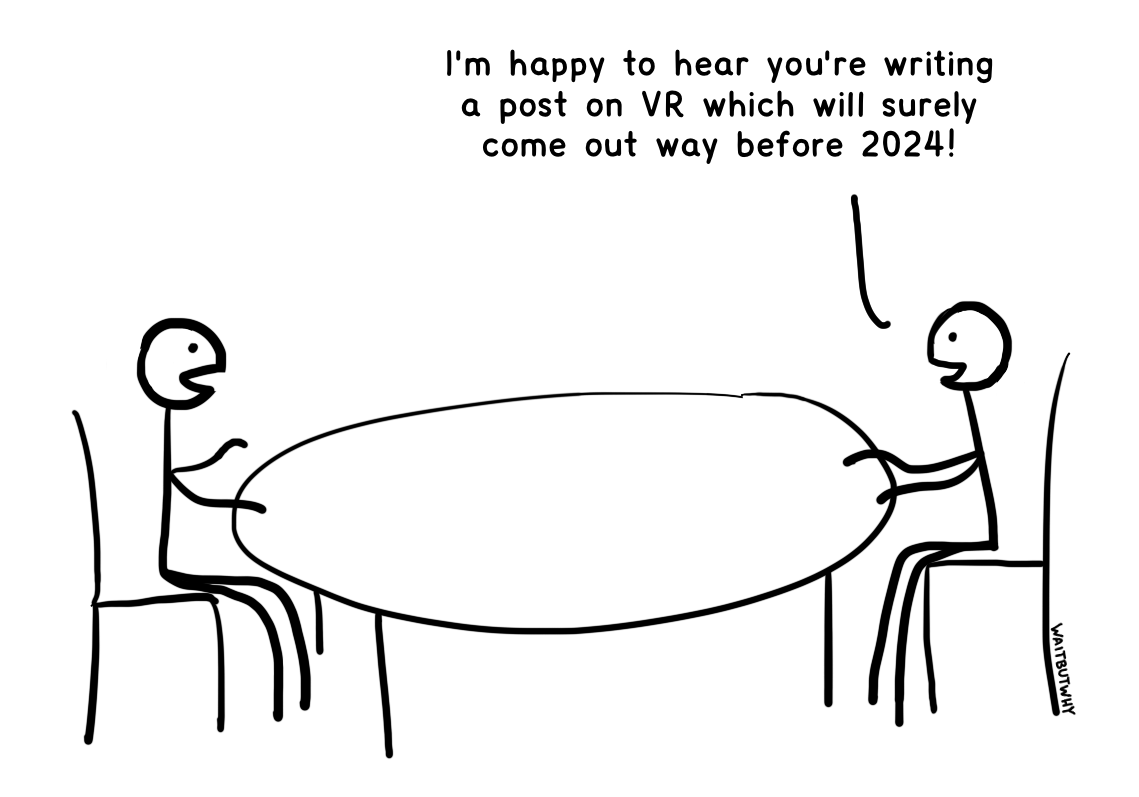
I demoed everything. It was mind-blowing. VR was about to take over the world. And I was gonna be the one to tell everyone.
Then two things happened:
From the bottom of my book hole, I kept following the story. At Facebook’s 2016 developer conference, Zuckerberg had demoed a new bleeding-edge kind of “standalone, inside out” headset. Up until then, there were two ways to do VR: The first was with a cheap headset, maybe using your phone as a screen, that could do primitive head-movement tracking but had no way to see the environment around you. The second was with external sensors on the walls and a headset that attached to a high-powered PC with a cord. “Standalone” meant the new headset would have the computer inside, with no need for a cable. “Inside out” meant the headset could see the room around you, so you didn’t need external sensors. In 2016, this was just a prototype. Three years later, Facebook launched Oculus Quest.
In 2020, standing around during Covid with my dick in my hand like everyone else, I got myself a Quest 2. It was amazing. I loved it. It was my daily post-writing reward activity. I made 3D art. I swam with whales. I went on cartoon vacations. I exercised by slashing music. I beat Trover.
Then, for some reason, I stopped. I can’t really explain why. I really loved being in the Quest 2. I recently dusted it off to give friends a demo and they were floored, reminding me how great it is. It just didn’t hook me. Maybe it was the solo aspect. I don’t have friends who do VR so there’s no one else to play with. Maybe it’s the friction. It’s minor, but charging the headset, putting it on, and creating a boundary1 is still a lot more friction than picking up my phone. Maybe my delight relied more on novelty than I realized.
It’s not just me. VR blows everyone away when they try it, but it seems to have a hard time hooking people for the long run. After a major wave of hype in the mid-2010s, VR receded into the land of subcultures.
And the question is: Is there some fatal flaw to the concept of VR that will always prevent it from achieving mass adoption? Or are we some tipping point away from VR exploding into the stratosphere like the computer and smartphone?
Everyone remembers where they were when they learned that JFK was shot, a man had landed on the moon, or airplanes had flown into the Twin Towers. I remember where I was when I saw Steve Jobs unveil the first iPhone.
I didn’t always like Apple. My family’s first computer was an Apple 2GS. But then, like many early Apple computer users, I became a PC person. I used an IBM ThinkPad in college and thought Apple people were annoying.
Then Steve Jobs came back to Apple and started Making Apple Great Again. My post-college music composing path forced me to get a 2004 PowerBook G4. After getting used to the interface (why the fuck is there no start button?), I realized that Macs were amazing, and I’ve been an annoying Apple person ever since. But it wasn’t until 2007 that I became a fanboy.
In the presentation, when Jobs did the world’s first “swipe to unlock,” the audience made an audible gasp. A minute later, he brought up a list of artists in the phone’s “iPod” app and asked, “Well, how do I scroll through my list of artists? I just take my finger and scroll.” Another audible gasp. It’s weird that something so normal today was jaw-dropping 17 years ago.
The feeling I had watching that presentation had happened before. I felt it when I was five years old and tried Nintendo for the first time at a friend’s house (I can make something on the TV move by clicking this button??). I felt it in the early ‘90s when my friend showed me how to send an email (You can type something on your computer, hit a button, and it shows up on mine??). I felt it the first time I test-drove a Tesla (Why is this car accelerating so futuristically?).
I’ve learned to see a lot of meaning in these holy shit moments. In most cases, they’ve been followed by an entirely new industry sweeping the world—like the smartphone, video game, internet, and electric car revolutions.
In June 2023, Apple announced the VR—sorry, spatial computing—headset that had been long rumored: the Vision Pro.
I watched the presentation, but it wasn’t quite like my experience in 2007. First, I had gotten excited about VR multiple times in the past and ended up disappointed. Second, unlike demoing an iPhone, watching a VR demo on a 2D screen just doesn’t show you what it’s actually like. Oh, also, it was $3,500. I happily shelled out $600 for the first iPhone. But $3,500? For a V1 product that will get way better (and cheaper) in the next few years? When I already have a Meta Quest? Nah. I might be a fanboy but I’m not a chump. It was the obvious grown-up decision to wait it out. Then I ordered one in the first minute after preorders started.
This Monday morning, I went to the Apple Store to put the Vision Pro on my chump face for the first time. The staff member guided me through a demo. And there it was: the holy shit moment.
But it was a holy shit moment with an asterisk. I had experienced full holy shit moments both in 1990 and in 2016 with VR, and these were the notable exceptions to the “holy shit moments are a surefire omen of an industry about to blow up” rule. Was this time different or would history repeat itself?
What I did know was that it was finally time to write a VR post. I wanted to post this week while everyone was hyped up about the Vision Pro. But I didn’t want to write about it before I had used it a lot, so I could experience not only the honeymoon phase but also what it was like to get thoroughly sick of it.
The plan was clear. I went home, told my wife that I would be deeply ignoring her and our baby for the week, and spent twelve hours a day in the headset for four straight days. I’m writing this on Thursday afternoon, having already logged over forty hours. Here are my thoughts.
There are three elements of any VR system: hardware, operating system, and applications. Let’s talk about each.

Apple Vision Pro (AVP)1 is heavy—a decent amount heavier (650 grams) than Meta’s Quest 3 (515 grams). It comes with a fancy band that goes on easily and you tighten with a little knob. It’s awesome. For 12 minutes. Then it started killing my face. With 3,500 regrets, I switched to the other band it comes with, which includes a loop that goes over the top of your head, and thank god for that because it was way better—so good that I am shocked to say that even at the end of a full day wearing it, I didn’t feel a euphoric “ahhh” relief taking it off. At least right now, it seems only a little more uncomfortable than wearing over-ear headphones for long periods of time. This might not apply to everyone, but I have not felt nauseous once while wearing it.
That doesn’t mean there’s nothing that sucks about wearing it. The “field of view” isn’t great, meaning there are thick black walls where your peripheral vision is supposed to be, which is a bummer. I can’t imagine it’s great for your eyes. And there’s no way around the fact that you feel like an asshole when other people are in the room.
There’s an external battery pack that connects to the headset with a cord and typically lives in my pocket. The battery lasts about three hours, but you can plug in the battery to make it last forever, like a computer if the battery only lasted for three hours. (You’re often using it in conjunction with your computer, which makes it a non-issue because you can plug the battery into the computer.)
When you put the headset on, it does the AVP version of Face ID: scanning your irises. This is seamless and very futuristic. Then, you see exactly what you saw before putting the headset on. Lots of reviewers have marveled over AVP’s “pass-through” capabilities, and the second I put it on, I understood why. While it’s not perfect, it’s almost like you’re wearing a transparent snorkeling mask. The headset is in fact opaque—cameras on the outside transmit the world onto screens on the inside. But the screens are so good and the latency so low that it really seems transparent. Then there’s the much less successful attempt to make it look transparent from the outside as well, using cameras on the inside to broadcast your eyes onto the front of the headset. The goal is that if you’re talking to someone while wearing the headset, it feels to both people like you’re wearing a transparent snorkeling mask. But at least in V1, the eyes don’t show up nearly as well as advertised.
The internal screens save energy by doing something clever called “foveated rendering”—i.e. only putting the exact place you’re looking in perfect focus while making the rest of the view lower-res. This is what your actual eyes do, which is why your peripheral vision is blurry. If you watch this viewcast I made, you’ll see that most of it is blurry (the sharp part was where I happened to be looking while taking it)—but as the person in the headset, I only ever saw perfect sharpness.
The way Vision Pro does audio is also cool. There have always been two sound options for me while on my phone or computer: play from the speaker and everyone can hear it or put on headphones and no one can hear it. AVP speakers are somewhere in between. The speakers (which sound great) are small and right above your ears, and while people right next to you can hear what you’re hearing, people in the next room cannot. So in a coffee shop or on an airplane, you still need headphones, but I do a lot of my work in an office in our house with the door open, and it’s been nice to work both without headphones and without bothering anyone in the other room.
This was the biggest holy shit of my holy shit moment. Apple is the king of simple intuitive interfaces. Part of what drew those gasps in 2007 was how natural the iPhone’s interface was. You scrolled down by pushing the page up, just like you would in real life. You zoomed by pinching with two fingers. It seemed like magic. AVP’s interface is gaspworthy for the same reason. The main gesture is what I’ve been calling the “eye pinch.”
When you press the button at the top of the headset, your apps come up, floating in the room in front of you, looking as real as any other object in the room. They’re fixed in space. You can walk right up to them, and the detail is amazing.2
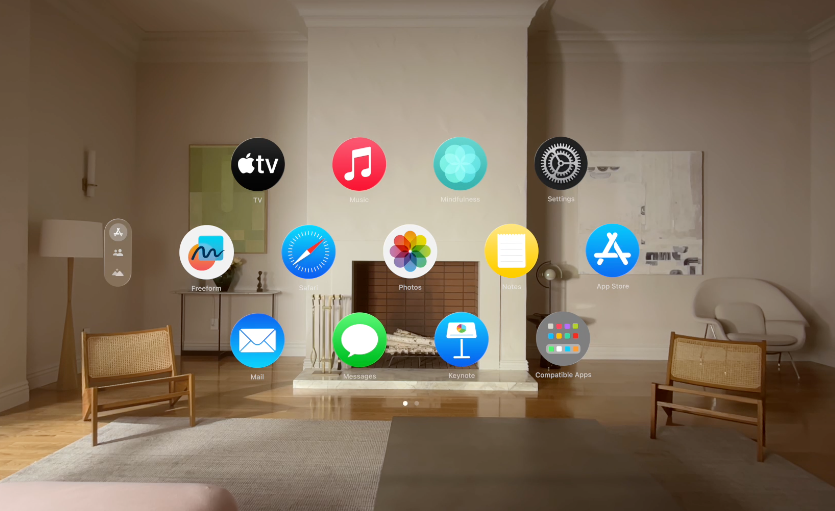
Vision Pro’s eye tracking is outrageously good. It knows precisely where you’re looking. So all you do to select an app is look at it and tap your thumb and index finger together. Your hand doesn’t need to move up to do this, just somewhere the headset can see it. Watching the ads, it seemed like this might be annoying to do, but it’s every bit as easy and intuitive as opening an app on a smartphone.
No matter what you’re doing, the eye pinch is the equivalent of touching a finger to a smartphone screen. To scroll, look anywhere in the window, pinch, and move your hand up. To move a window, look at the little bar below the window, pinch, and move it where you want to. To resize the window, look at the window’s corner, pinch, and resize.
As John Gruber put it in his review:
The fundamental interaction model in VisionOS feels like it will be copied by all future VR/AR headsets, in the same way that all desktop computers work like the Mac, and all phones and tablets now work like the iPhone. And when that happens, some will argue that of course they all work that way, because how else could they work? But personal computers didn’t have point-and-click GUIs before the Mac, and phones didn’t have “it’s all just a big touchscreen” interfaces before the iPhone. No other headset today has a “just look at a target, and tap your finger and thumb” interface today. I suspect in a few years they all will.
Then there’s the fact that everything you see in front of you is available desktop to work with. On my computer, I’m used to my applications being stacked, and I toggle between them. Or maybe I put a few vertical windows side by side. In AVP, I can put one eight-foot window in front of me, two more on either side of it, and a couple more above them in the sky. Then, if I get up to go to the other room, the windows all stay exactly where they are, waiting for me to come back. If I want to switch work spots, I just hold the headset button and the whole configuration jumps to the new location. This is all way cooler than I’m making it sound, so I made a video to show you how it works:
One thing you’ll notice in the video is that I routinely spin the digital crown on the headset to slide between being entirely in reality, partially in reality, and entirely in a virtual landscape. This is ridiculously fun to do. And it’s a general reminder that AR and VR2 being separate categories is a thing of the past. In the Vision Pro, the Quest 3, and any future headset, you can be 100% in the real world (when there’s nothing on the screen and it seems like you’re wearing a snorkeling mask), you can be mostly in the real world except there’s a virtual game board on your kitchen table or a little virtual butterfly fluttering around. You can be halfway between reality and virtual when, say, portals open up in the walls around you during a game. Or you can go full virtual.
There are many categories of spatial computing apps—productivity, entertainment, social, gaming, creative, fitness—and for most of them today, you’ll need a Meta Quest or some other non-Apple headset. There are a small handful of astounding apps for AVP, but they’re more a sampling of what’s possible than an actual app store.
The most “you can absolutely not do this anywhere but a VR headset” thing I did was their little taster menu of immersive entertainment. Entertainment on a headset runs on a spectrum of immersion. The least immersive is watching a normal movie on a massive screen in a virtual space like the moon or a giant theater. Those movies you missed that everyone says are best seen on the big screen—you can see those on a big screen now.
Next are movies that are framed in a normal rectangle, but they’re 3D looking—like when we used to wear those stupid paper glasses but much, much better. Sometimes, these surprise you when something comes out of the screen to fly through the air or stand on the floor between you and the screen. The AVR comes with one of these—“Encounter Dinosaurs”—and it’s delightful.
Finally, there’s full immersion, where the scene entirely surrounds you and you actually feel like you’re there. These are better described as “experiences” than “entertainment.” I saw rhinos up close in person last year. Then, this week, I did one of the Vision Pro experiences that’s an up-close hang with rhinos. These two experiences were very similar. Another experience lets you sit in on an Alicia Keys rehearsal where she sings some songs standing two feet away from you. You can watch her for a while, then look over at what the drummer or keyboardist is doing for a while—just like you would if you were actually there.
Photos and videos are also cool. When you take a panoramic photo, you sweep your phone around in a C-shaped arc—but on a flat phone screen, the result is a flat photo. In AVP, panos are C-shaped, like the photo you actually took. The C wraps around you, which I quickly learned brings the memory back way better than the flat version. You can also turn the headset into a camera and record photos and videos, both of which are immersive. When you later view them in the headset, they’re 3D, putting you right back into the actual scene.
Then there’s the infamous Vision Pro avatars. You get one of these by flipping the headset around and letting it take pictures of you from different angles. Then when you FaceTime someone, your avatar mimics whatever facial expressions you’re making. Here’s mine:
The first person I tested it out on was my wife, who immediately gasped in horror, saying I had “little uncanny valley snake eyes rolling around in my skull,” whatever the fuck that means.
The uncanny valley she’s upset about is this:3

The idea is that we like faces that are somewhat humanlike, and we like faces that are totally humanlike, but we hate faces that are almost-but-not-totally humanlike. Faces that fall just short of being human give us the collective willies.
Avatars used to suck. Then they got better. Now they’ve gotten so good they’ve plunged into the uncanny valley. This was always gonna happen at some point on the road to perfect avatars and that time is now.
To test it out for myself, I FaceTimed my friend Jules Terpak, who also has a Vision Pro. First I put her across from me at this table while we sat around with each other’s uncanny valley faces for a few minutes.
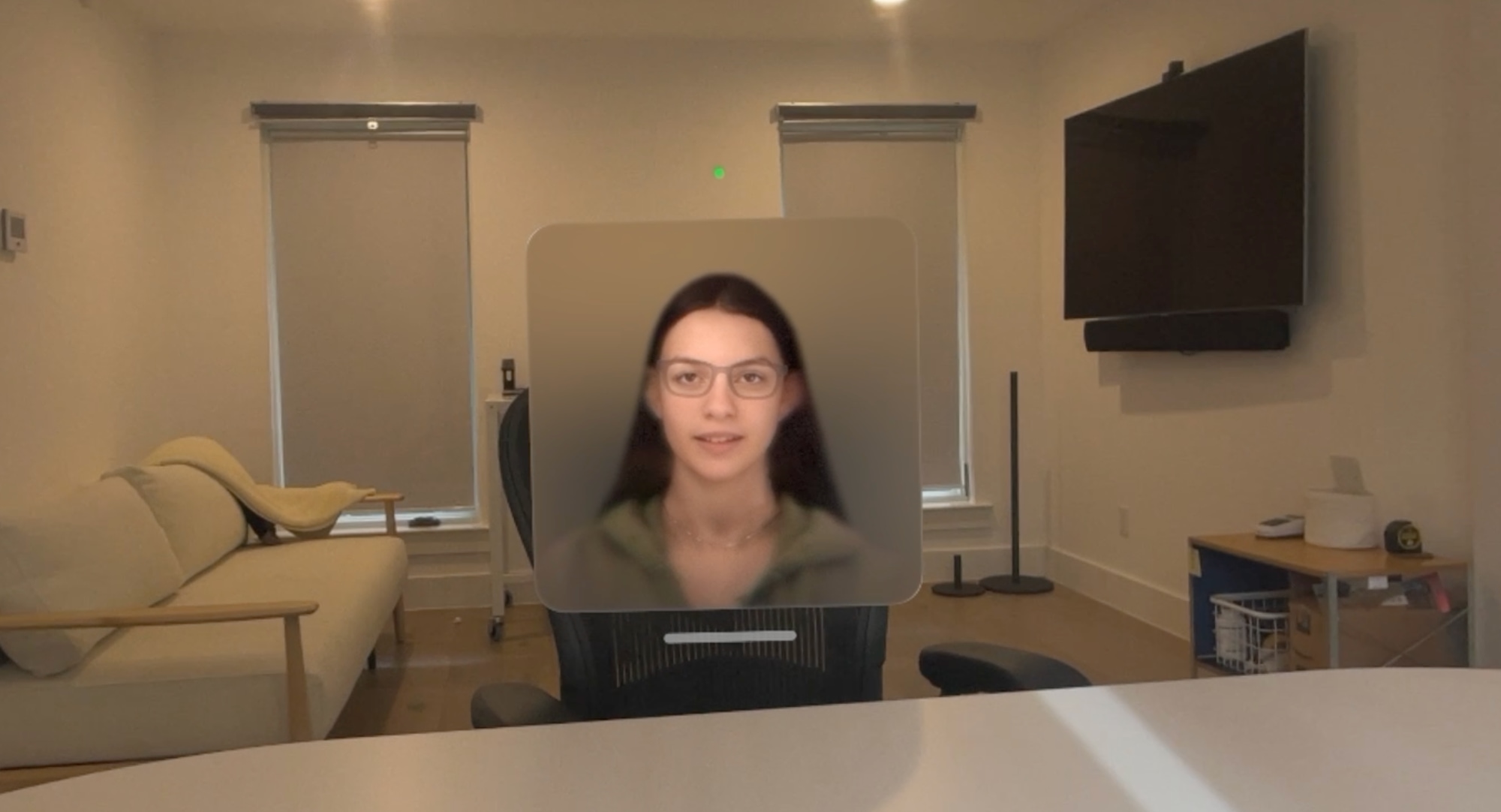
One very cool thing is that when I moved her window to a different seat at the table, her voice shifted locations to that spot. We concluded that this activity was not actually an upgrade over FaceTime, but that if there were more than two people, it could feel like everyone was sitting around a table together, which would be better than talking to a group FaceTime or Zoom.
Then we shifted locations to Mount Hood.

This felt more like we were actually hanging out somewhere, which is an effect you can’t get on FaceTime.
When we started going into apps together, it felt even more like we were actually doing an activity together, in a way you normally can’t do without being in person.

It’s very crude right now, but it’s a primitive version of something we’ll probably all be doing constantly in the 2030s. It’s the next step in a centuries-long human mission to conquer long-distance. First there were letters, then phone calls, then mobile phones3 and video calls. The next step is VR hangouts.
By far the thing I spent the most time doing in the Vision Pro was exactly what I normally do, but the AVP version. When you’re sitting down in front of your computer while wearing the headset, you can open your computer screen as a giant virtual window (which you still control with your normal keyboard and trackpad). Whatever screen you’re used to working on is now much, much bigger. It’s also much more mobile. I don’t usually work on the couch because I prefer my big monitor over my laptop screen. This week, I spent a lot of time working on my couch on a 100-inch monitor. I don’t normally work lying flat in bed because the laptop screen isn’t directly above me. This week I did, putting the screen up on the ceiling. I did some work outside on the porch and some more under a tree. Sometimes I saw the room around me, only with a big screen floating in it. Other times, I went fully immersive, writing on a mountain top, a sand dune, or the moon. And as I mentioned at the beginning of the post, I’m currently using the AVP in a coffee shop, which is officially embarrassing.
For some odd reason, you can’t open multiple desktops (yet), but you can open some of the things on your desktop as their own apps in separate windows. There’s an AVP iMessage app, so I closed iMessage on my desktop and opened it in an adjacent window. I often remotely cowork with Alicia (WBW’s Manager of Lots of Things), putting her in a little window in the corner of my screen. Now, she’s in her own window. If I’m willing to bite the bullet and switch from Chrome to Safari, I can pull my research and web browsing off the desktop too. The end result is that a single small, immobile computer screen has been replaced with a giant mosaic of screens, for the small price of having a snorkeling mask on my face all day. It kind of feels like you stepped into your computer screen, into the beautiful wallpaper landscape, amongst the windows. Very surreal. I wrote this entire post in the headset and have found myself enjoying writing more—and being more focused—than normal.
The best way I can describe how I feel about the Vision Pro is a strange combination of utterly thunderstruck and mildly underwhelmed.
The magical interface, the giant screens, the immersive experiences—they’re just unfathomably cool and awe-inspiring. It feels like a sneak peek at the 2030s.
But after a couple of days, I found myself thinking, “Is that…it?” I had done the small handful of immersive experiences, played some of the small selection of games, looked at a bunch of my panoramic photos, and tried avatar FaceTime—and at the moment, there’s just not that much else to do in the Vision Pro.
The first iPhone left me feeling the same combination of blown away and bored. The phone and I had a torrid honeymoon, but after the novelty of the interface wore off, all it had to offer was the same 16 practical apps.
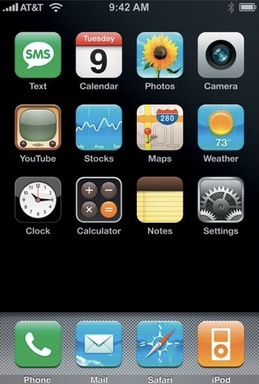
There was no app store yet, it dropped calls constantly, and the cellular internet (which you couldn’t use while on a call) was painfully slow. The iPhone wasn’t a world-changing device yet. It was the seed from which a world-changing device would grow.
If you zoom out on a story of technology, you usually see a big exponential curve.

But if you look at the curve up close, you see that it’s wavy, made of S-curves.
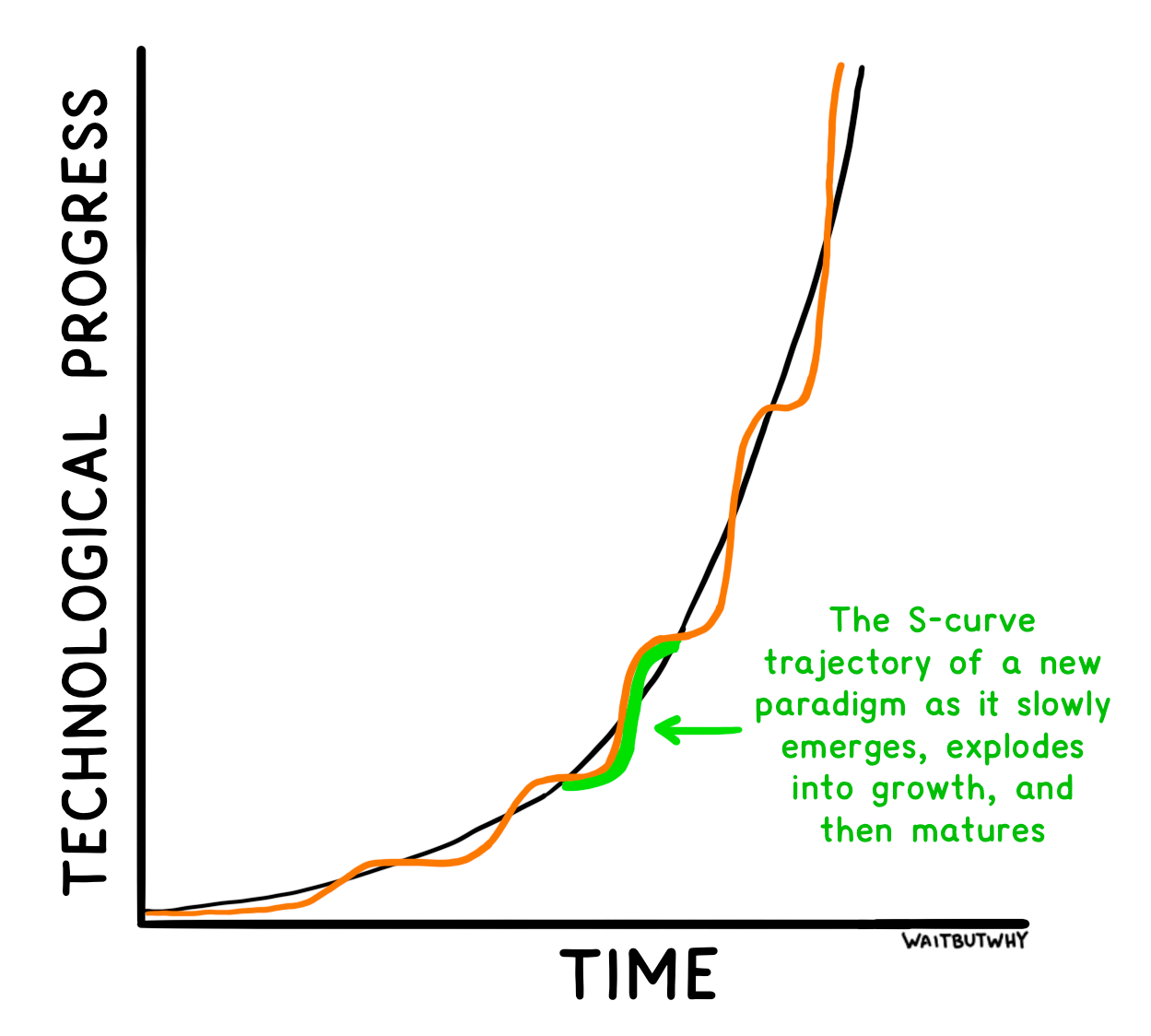
The first iPhone was such a big deal because it launched a new S. Investors had a new place to pour their money. Developers had a new place to pour their efforts. Creators had a new place to pour their talents. As millions of human hours worked on the collective human project, the next five years were a whirlwind of innovation and excitement. Apple’s keynotes became a must-watch for anyone interested in tech, as each jump between the iPhone 1 > 3G > 3GS > 4 > 4S > 5 was a major leap in hardware and software. It was the steep part of the S.
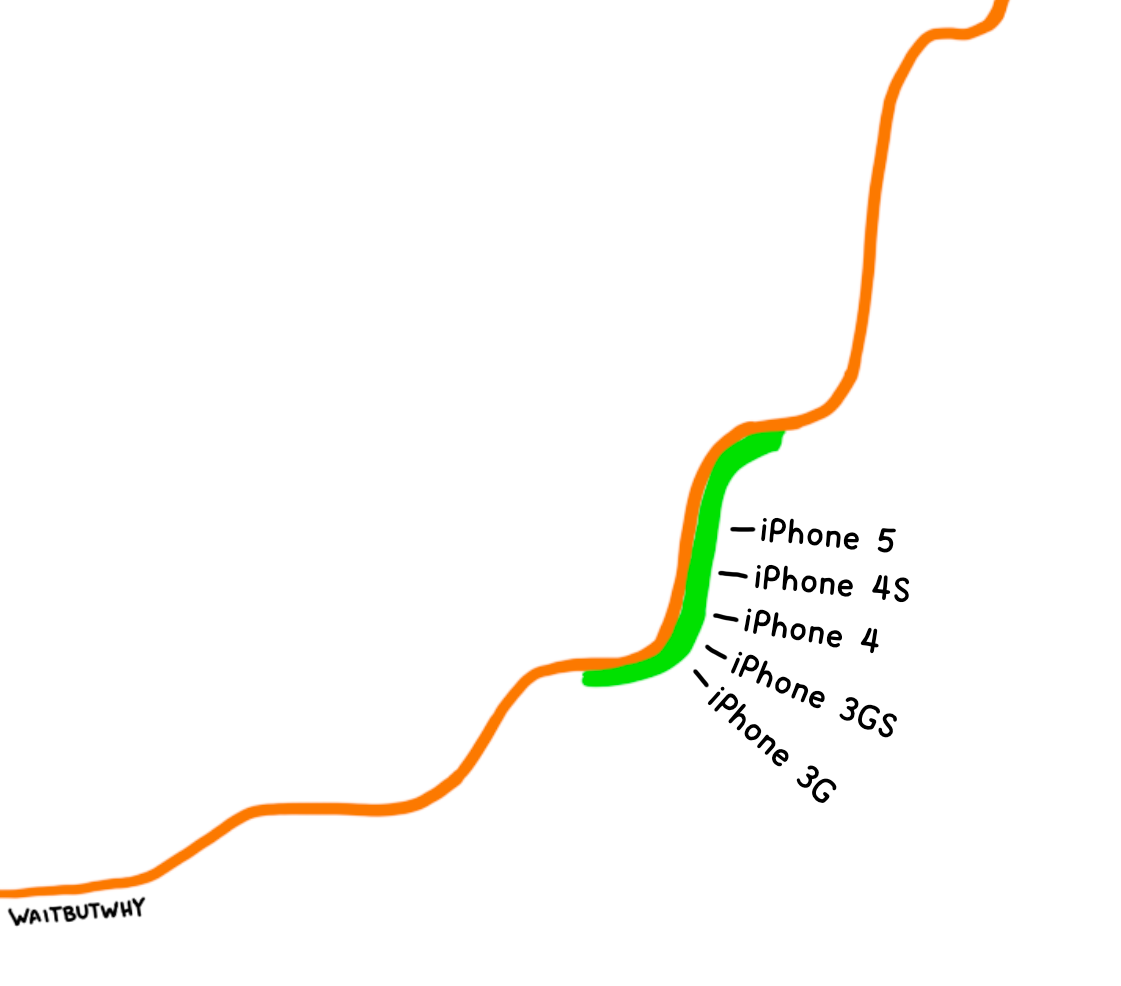
Then, the keynotes got boring. The changes were incremental. Apple stopped innovating and started refining. This coincided with Tim Cook taking over, but it isn’t his fault. The steep part of the S-curve doesn’t go on forever, and companies often reap the biggest rewards in the boring, top part of the S once the industry matures.
Maybe the reason VR has been slow to take off isn’t because there’s something fundamentally wrong with VR. Maybe it’s because, for the last decade, we’ve been working our way through the very early part of the VR S-curve—the slow part where foundational technology is researched and built. My Vision Pro is highly imperfect—overpriced, heavy, slightly glitchy, very limited, creepy-avatared—because that’s exactly what products are like at the bottom of the S. Consumer products aren’t ready for mass adoption during this stage. But it’s the breakthroughs made during these years that set the stage for the explosive exponential phase of the curve.
The lesson from past VR hype cycles is to temper expectations. The VR S-Curve explosion may be many years away or never come at all. But the lesson from past Apple launches is don’t bet against Apple, and Apple’s bet is that the Vision Pro could be a seed like the first iPhone—a platform for innovation that kicks a new S-curve into high gear.4
For someone to regularly use a piece of technology, the benefits have to outweigh the costs. Right now, the Vision Pro benefits are probably less than the costs.

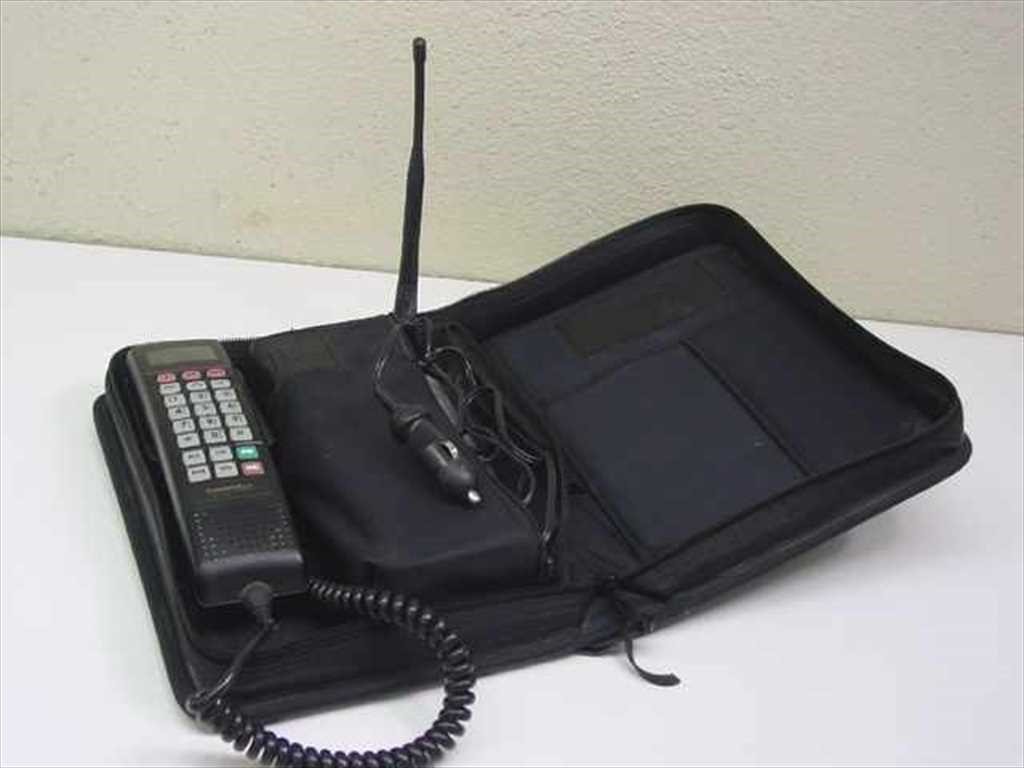
I’ve already paid for mine, which removes one of the costs, and it’s still a question to what extent I’ll choose it over my computer in the long run. In that regard, the AVP might currently be more like those first cell phones you had to carry around with a briefcase than the first iPhone. Would you get a cell phone if the only way they came was attached a briefcase? Maybe, but it’s a close call.
For VR to achieve mass adoption, the good needs to be better and the bad needs to be less bad. It’s easy to imagine a pathway to both.
The operating system will get better each year. The two-finger pinch is currently the only gesture. More will be added. Eventually, there may be dozens of ways to make gestures with our fingers, each one a different command, like today’s keyboard shortcuts. When you spend ten minutes setting up an elaborate configuration of windows, you’ll be able to save (and share) it.
Avatars will go from uncanny valley to indistinguishable from your normal face. When you go into immersive environments, you can currently see only your hands. In the future, you’ll be able to identify other objects to remain visible (like a coffee mug). The environments around you will expand from the six current options to hundreds, including delightful fantasy worlds, and they’ll be interactive, allowing you to change things like the weather.
The hardware will get continually smaller and more comfortable. The resolution and frame rate will become as advanced as the latency. The battery will get way better. So will the look from the outside: to people in the room, the headset will come to look totally transparent. (My personal fantasy: The computer itself becomes detachable, allowing the headset to be a light, sleek, cool-looking visor. The computer and battery snap together into something the size of a smartphone. You’ll be able to snap it to the back of your visor if you don’t want the cord, but most people will prefer the weight to be somewhere other than their heads. The computer/battery rectangle will also have a screen and function as a smartphone for times when you want to do something with the visor off. The visor will fold neatly onto the rectangle to make the whole thing a single compact object.)
Finally, the amount of content, applications, and experiences will multiply by 1,000-fold, just like the apps in the app store did from 2008 to today. There will be a wide array of immersive games and entertainment. People will watch sports from one of many vantage points on the field, sideline, stands, or overhead—next to their friends, who will be able to look at each other and talk as well as if they were actually together in person. Pop stars will play in front of 50,000 people in person and 5 million people virtually. Fitness will become fun, interactive, and social. The best teachers and coaches will reach millions of people. Amazing AI teachers could reach billions. Distance will melt away, allowing people to spend high-quality time with their loved ones, no matter where they are. People who couldn’t dream of traveling the world today will get to enjoy vivid experiences anywhere on the globe. Of course, my silly 2024 imagination can’t scratch the surface any more than people in the briefcase phone days could have predicted Uber, TikTok, or Tinder.
Over time, the price will come down, with some companies making headsets dirt cheap the way they have for smartphones today. As the value proposition gets better and better, more people will have them, enhancing the social component and eradicating any stigma. Mass adoption seems like a very real future possibility.
I know what many of you are thinking: A world where everyone is in VR headsets (or visors, or glasses, or contact lenses) sounds dystopian and awful. And granted, this is coming from a guy who thought that world of glazed over people in moving chairs in Wall-E looked like a great place to live—but I’m excited.
K can I take this thing off my face now?
_______
What to read next:
A post about a technology even more intense than VR
A post about a different technology that’s also even more intense than VR
A post about a third technology that’s even more intense than VR
_______
If you like Wait But Why, sign up for our email list and we’ll send you new posts when they come out.
To support Wait But Why, visit our Patreon page.
When you use the Quest 2 in a new setting, you have to manually show the headset the boundaries of the open space you’re going to be using. This isn’t needed in the more recent Quest 3, which automatically maps out the space.↩
“Virtual Reality” has traditionally referred to totally immersive headset experiences. “Augmented Reality” is when you see the real world around you with virtual elements added in.↩
We’re so used to mobile phones that we forget how insanely cool they are. I can pick up my rectangle and instantly contact you wherever you are on the planet.↩
If this is what happens, unboxed first-generation Vision Pros will be auctioned for a ton of money in 2060. Just saying…↩
The post All My Thoughts After 40 Hours in the Vision Pro appeared first on Wait But Why.
DEBATE TRANSCRIPT:
Jake Tapper: Welcome to the CNN Presidential Debate. I’m Jake Tapper.
Dana Bash: And I’m Dana Bash. Let’s get started.
Tapper: We’ll begin with the economy. President Biden, since you took office, inflation has slowed but prices remain high. What do you say to voters who feel they are worse off under your presidency than they were under President Trump?
Biden: Look at what Mr. Trump left me when I became president. We had an economy in free fall. Everyone was unemployed. Thousands were dying of Covid, it was like a zombie apocalypse, and Trump was just drinking bleach. Then I came to office and put the pieces back together. We brought insulin shots down to 15 dollars. Senior citizens pay no more than 200 dollars a year for healthcare.
Tapper: Mr. Trump?
Trump: We had the greatest economy in the history of this world or any other world. There are some great fictional worlds out there, like the Emerald City, which by the way has a great economy, but not as good as ours. No economy had ever done as well as ours did when I was in office. Everybody was amazed by it. All the other countries said they wished I was their president. In Asia or Europe or Peru, go ask them and they’ll tell you how amazed they were by the job I did. Inflation is killing us.
Biden: A better economy than the Emerald City? I don’t know anyone who thinks that. My friend who I talked to the other day doesn’t think that. He said you were a worse president than Herbert Hoover, and that’s saying something because Herbert Hoover could give a rat’s ass who shows up at the local gooseberry growing contest. I don’t know what happened at last year’s contest but those are some good gooseberries. When Trump was president we were still killing people in Afghanistan. I’m the only president where no one has died anywhere in the world.
Tapper: Mr. Trump, you say you want to extend the tax cuts you put in place. With the U.S. facing trillion dollar deficits and record debt, why should top earners and corporations pay even less in taxes than they do now?
Trump: The tax cuts are why we had the greatest economy in human or animal history. I was just about to zero out the debt when Covid hit. So instead I made the vaccine, and it was a tremendous vaccine, and then he took over and did a very poor job. When I was president the whole world loved America and admired me. Now we’re a disgusting piss-covered Third World country.
Biden: I’m going to fix the tax system. We have a trillion thousandaires in this country—excuse me, a million trillionaires. Billionaires pay only $150 in taxes. I paid more than that when I worked at Padula’s ice cream stand when I was 15. I paid the taxes I owed. If billionaires paid their fair share we’d be able to wipe out the debt. We’d be able to pay for childcare, eldercare, healthcare. We’d be able to make every single solitary person eligible for what I’ve been able to do with, dealing with everything we have to do with everything that we have to be able to deal with.
Trump:
Tapper:
Bash:
Biden: The.
Trump:
Tapper:
Bash:
Biden: We finally beat Medicare.
Tapper: For fuck’s sake. Okay let’s talk about Roe v. Wade.
Trump: Everyone wanted to overturn Roe v. Wade, and I mean everyone. And I did that. These people are sick. They want to abort eight-month fetuses. Nine-month fetuses. Newborn babies. Older fatter babies. Boddlers. Toddlers. There’s no one these people won’t abort. President Biden tries to abort his political opponents. It’s a disaster.
Bash: President Biden?
Biden: It’s ridiculous to say everyone wanted to overturn Roe v. Wade. I didn’t. My friend didn’t. The women didn’t, including that one who was murdered by an immigrant. He went to the funeral. But here’s the deal. There’s a lot of women raped by their in-laws, by their spouses, by their brothers and sisters, by their children and grandmothers, it’s ridiculous, I saw this one video where the pool boy came into the house looking all sweaty and asked for a glass of water, and you know how that goes, you’ve seen the videos, and then they can do nothing about it and they try to arrest them when they cross state lines.
Tapper: President Biden, on the issue of border security, a record number of migrants have illegally crossed the southern border on your watch. Why should voters trust you to solve this crisis?
Biden: I hired more border patrol. I hired more asylum officers. This is why there are no more illegal immigrants. He put babies in cages. I’m going to continue until we get the total initiative relative to what we’re going to do with more border patrol and more asylum officers eating a salami on Wednesday.
Trump: I have no idea what the fuck he said at the end there and I don’t think he knows what he said either. Look, we had the safest border in the history of borders, and then he just opened them right up. He opened them to prisoners and lunatics and rapists and child molesters and terrorists and wildlings and white walkers. These are not good people. We had the safest border in history according to border patrol who, by the way, endorsed me for president, I won’t say that here but they endorsed me, I won’t talk about it but it was Brandon, Brandon from border patrol endorsed me, I won’t mention his name here but it was Brandon R. Knight who lives at 246 Longmeadow Drive in El Paso with his dogs, beautiful dogs by the way, it was the safest border and now we have the worst border in history. And these migrants are staying at the best hotels, great five-star hotels, while our veterans are on the street because he hates veterans.
Biden: Okay everything he just said is a lie. For example, I don’t hate veterans, I’d give my life for a veteran. I’d give a veteran a handjob in a Denny’s bathroom. We’ve done more for veterans than anyone in American history.
Bash: Let’s talk about Russia and Ukraine. Former President Trump, Vladimir Putin says he’ll only end the war if he gets to keep some of Ukraine and Ukraine stops trying to join NATO. Are Putin’s terms acceptable to you?
Trump: Our veterans can’t stand Biden. They think he’s the worst commander-in-chief that we’ve ever had. They wouldn’t take a handjob from him in a Denny’s bathroom even if they were desperate. If we had a real president, Putin never would have invaded Ukraine. And Hamas never would have attacked Israel. When I was president, Hamas liked Israel. You know those silly little caps Jews wear on their head? When I was president, Hamas wore those caps too. Out of respect for me. President Biden is like a Palestinian, and not one of the good ones either, he’s a bad one, he’s a weak Palestinian, he’s not even one of the scary Palestinians, he can’t even yell “Allahu Akbar” correctly and the other Palestinians can’t stand him, they can’t stand this guy.
Biden: I’ve never heard so much malarkey in my life. I’m a great Palestinian.
Bash: Former President Trump, would you support the creation of an independent Palestinian state to achieve peace in the region?
Trump: I make great deals. I made great deals as a kid. As a teenager. As an adult. As an old man. I made NATO put up biyyons and biyyons of dollars. I told them, if you don’t pay, I don’t play. And you know what happened? Biyyons and biyyons of dollars came flowing in the next day. But now we’re paying everyone’s bills again.
Tapper: Mr. Trump, I want to talk about January 6th. After you rallied your supporters that day, some of them stormed the Capitol. As president, you swore an oath to preserve, protect, and defend the Constitution. What do you say to voters who believe you violated that oath on January 6th and worry that you’ll do it again?
Trump: Let me tell you about January 6th. On January 6th, we had a secure border. On January 6th, we were energy independent. On January 6th, somewhere out there, a little boy had his first hamburger because we had made America great.
Tapper: Please answer the question.
Trump: I had nothing to do with anything that happened on On January 6th. Even Nancy Pelosi said that. She said, “President Trump had nothing to do with January 6th, it was all my fault.”
Biden: He’s a convicted felon.
Trump: His son is a convicted felon.
Biden: He had sex with a porn star in the other room while his wife was giving birth. He has the morals of an alley cat.
Alley cats: wtf
Trump: I didn’t have sex with a porn star in the other room while my wife was giving birth, she had sex with me.
Biden: He said fine people on both sides.
Trump: No I didn’t.
Biden: Yes you did. He said Hitler has done good things.
Trump: Only some.
Bash: President Biden, black Americans are struggling. What do you say to black Americans who are disappointed you haven’t made more progress?
Biden: I’ve helped black Americans in all kinds of ways. It’s inflation that’s hurting them, not me.
Trump: You caused the inflation.
Biden: I know you did but what did I do?
Bash: President Trump, will you do anything to slow the climate crisis?
Trump: The blacks love me. They made me an honorary black.
Bash:
Trump: When I was president, I had stopped climate change. I had the best environmental numbers in history.
Biden: I passed the most extensive climate change legislation in history. Blacks love me. I built labs in historically black colleges so they could do science like white colleges.
Trump: Illegals are destroying our country.
Biden: And by the way.
Biden:
Tapper: Mr. Trump, the average cost of childcare in this country has risen past $11,000/year per child. In your second term, what would you do to make childcare more affordable?
Trump: He’s the worst president in this history of this country.
Biden: He’s the worst president in this history of this country.
Trump: He’s the worst president in this history of this country.
Biden: He’s the worst president in this history of this country.
Tapper: Mr. Trump, the question was about childcare.
Trump: He’s the worst president in this history of this country.
Biden: He’s the worst president in this history of this country.
Tapper: Mr. Trump, what will you do to address the opioid crisis?
Trump: China.
Tapper: Mr. Trump, what will you do to address the opioid crisis?
Trump: Illegals are killing this country.
Tapper: Mr. Trump, what will you do to address the opioid crisis?
Trump: Democrats pay too much for hostages. I pay almost nothing.
Bash: K. President Biden, frankly you’re old as cock. How do you address concerns about this?
Biden: I used to be young. America is a great country.
Bash: Former President Trump, you’re also appallingly old. How do you address the same concerns?
Trump: I just won two club championships. To do that you have to be smart and you have to be able to hit the ball a long way. He couldn’t hit a ball 50 yards. I have the body and mind of a 23-year-old.
Biden: I’m a six handicap.
Trump: My tits you are.
Biden: I’m an eight handicap.
Trump: I’ve seen your swing.
Bash: Mr. Trump, will you pledge to accept the results of this election and say political violence of any form is unacceptable?
Trump: Of course political violence is unacceptable. I hated when Nancy Pelosi ushered in all those people to the Capitol on January 6th. I’m running because he’s the worst president in the history of this country.
Bash: Mr. Trump, will you pledge to accept the results of this election?
Trump: Putin never would have attacked Ukraine if I had been president.
Bash: Mr. Trump, will you pledge to accept the results of this election?
Trump: If the election is fair and free and I win of course I’ll accept the results.
Biden: Whiner.
Trump: Complainer.
Tapper: It is blessedly now time for the candidates to deliver their closing statements. Time for the big, lofty, heartfelt speech.
Biden: I didn’t raise taxes on most people. He instituted a 10% tariff, which is the same as raising taxes. He wants to make it so we can’t negotiate with big pharma companies. We got it down to $35 for insulin, which is $20 more than I said earlier in the debate, and a $2,000 cap for senior healthcare spending, which is ten times the figure I said earlier tonight. That’s huge progress in just a couple hours.
Trump: This guy sucks. All he does is let people pour in over the border. We’re living in a hellish rat’s nest. No one likes you. No one respects you. God I’m good. No one’s ever seen anything like it before. We live in a shit country. Because of you, I need to make America great again again.
Bash: Thank you I guess.
_______
Presidential debate transcripts from 2020 and 2016
My book about how our politics got to this state
The American Presidents: Washington to Lincoln
_______
If you like Wait But Why, sign up for our email list and we’ll send you new posts when they come out.
To support Wait But Why, visit our Patreon page.
The post The 2024 Trump-Biden Debate appeared first on Wait But Why.
This post was originally published in The Free Press on October 14, 2024.
Last night, I received two texts from Bari Weiss:
Any interest in writing a short piece about that jaw-dropping launch?
And why you brought your daughter to see it?
The first question is an easy one. I’ve been fascinated by space ever since I gained sentience sometime in the mid-1980s. I had the order of the planets down by age four, and a few years later I could (and did) tell people that you could fit a thousand Earths inside Jupiter and a thousand Jupiters inside the sun.
I remember being amazed watching videos of the moon landing—but also confused. The cars, telephones, TVs, and computers of my childhood were worlds more advanced than anything my parents had as kids. But with space, the normal order of things was reversed: My parents grew up exhilarated by Apollo missions to places no man had gone before, while I was watching the space shuttle take astronauts a little hop above Earth’s surface to do some technical work on the International Space Station. I remember feeling a deep envy of people who were around in the 1960s. It didn’t make sense.
The problem turned out to be this:1
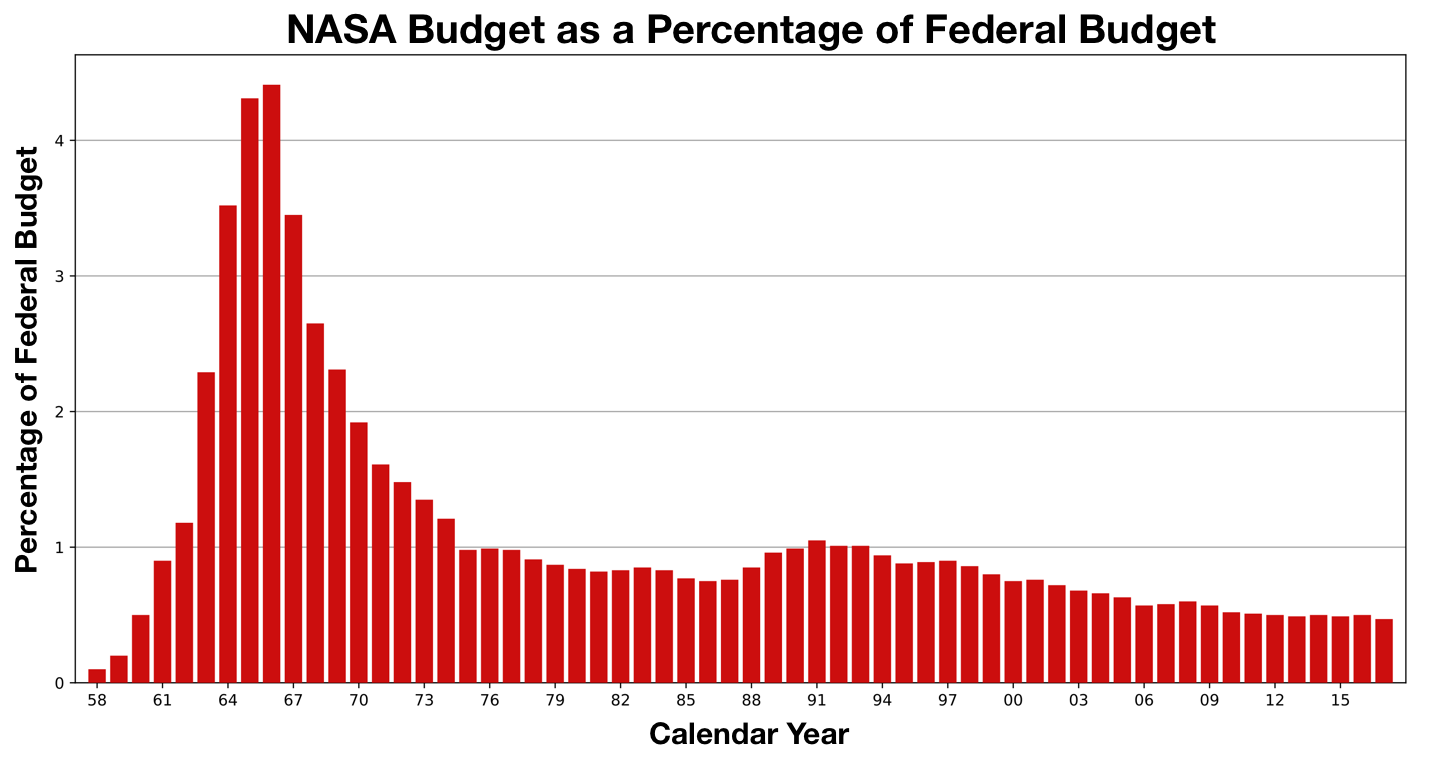
People living in the 1960s thought the moon landing was just the beginning. By 2024, they’d have imagined, there would be a permanent moon base, lots of space tourism, and even people walking around on other planets.
As it turns out, the 1960s were a fluke. It was the height of the Cold War and “desperate times call for desperate measures” justified all kinds of unusual behaviors—including spending five percent of the federal budget to one-up the Soviet Union in the space race. That brief spike in space expenditure put a man on the moon, captivated all of humanity and reminded us of what’s possible when we put our minds together.
Then the Cold War moved on, shifting its tensions to other arenas. Space became less of a critical mission and more of a fun hobby. What had been five percent of the federal budget in the mid-1960s dropped to one percent by the mid-1970s and 0.5 percent in recent decades.
Any hopes I had that the U.S. would decide to become rad about space again were dashed in 2011, when the space shuttle program was shut down for good. Now we couldn’t even launch astronauts into low Earth orbit. When we wanted to send Americans into space, we had to politely ask Russia to do it for us.
I get it. We have many more pressing needs than space. A politician campaigning today on dedicating five percent of the budget to space would be laughed out of the room.
It’s just that it’s such a shame. The moon landing was a tantalizing glimpse into the incredible potential of our species—and a frustrating reminder that without desperate times, that potential remains largely untapped.
Then came SpaceX. I first heard about it in 2012 when 60 Minutes did a segment on the company. Over the next few years, I watched as SpaceX kept defying expectations, successfully launching progressively bigger and more legit rockets into orbit.
In what is still the most surprising day of my life, one day in 2015 Elon Musk reached out to me, said he had read my recent blog post on AI, and asked if I’d be interested in writing about SpaceX. Over the next few months I visited the SpaceX facilities, looked at their rockets up close, interviewed dozens of their engineers, and talked with Musk about the big vision for the company. I wrote about it all in a big blog post.
At the time, SpaceX was singularly focused on one of the space industry’s holy grails: rocket reusability.
Imagine if every commercial airplane flight ended with the passengers parachuting to the ground and the plane crashing into the ocean. With every plane flying exactly once, a brand-new plane would be needed for every flight. Tickets would cost millions of dollars, limiting air travel to billionaires and governments.
Until recently, that was how space travel worked. Every rocket flew once, making space available only to billionaires and governments. What if, somehow, rockets could be like planes, ending each mission by landing instead of crashing the rocket? Each rocket could be used hundreds of times instead of once, dramatically cutting down the price of space travel and revolutionizing the industry.
In late 2015 a SpaceX rocket launched, sent its payload into orbit, and for the first time in human history, came back down and landed. I watched from SpaceX headquarters. The cheer was so deafening you could feel the vibration move through your body. In the face of a million doubts, SpaceX showed that a private company could not only launch rockets but do it better than any government ever had. Soon, the U.S. government was using SpaceX, not Russia, to launch its astronauts.
But reusability was just a stepping stone on the way to SpaceX’s real mission: colonizing Mars. If you have critical information stored on a hard drive, it’s common sense to back up the info on a second hard drive. That’s how Elon Musk views humanity. We currently have all our eggs in one planet. To give our species the best chance of survival in the long run, he believes, we should live on multiple planets. We’re fortunate to have another potentially livable rocky planet nearby. Why not try to use it?
Bringing people to Mars requires a rocket far larger and smarter than any we had ever built. So SpaceX built Starship, a beast the height of a 40-story skyscraper.2
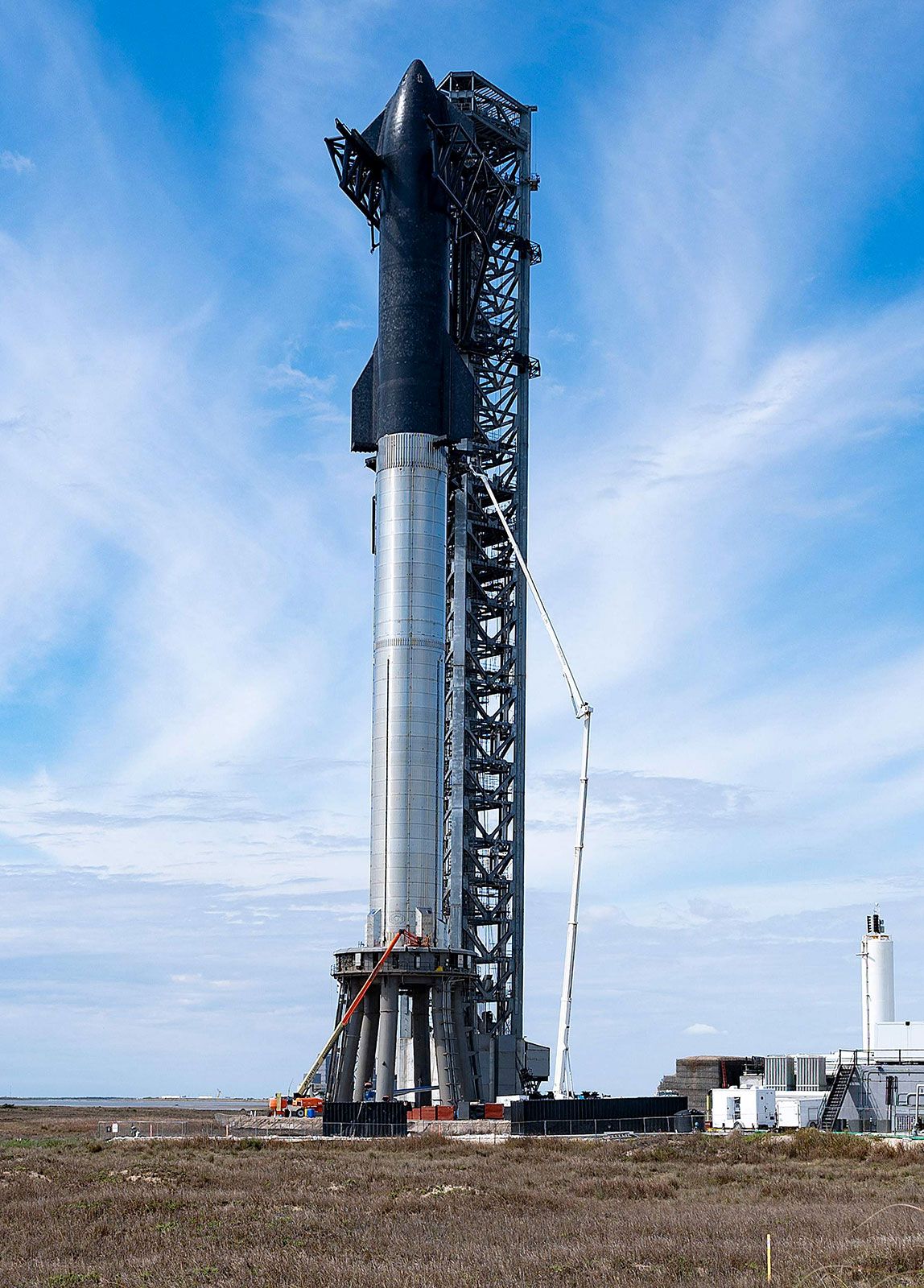
To make trips to Mars affordable, the rocket has to be reusable, which means this thing has to land. So SpaceX got busy innovating, designing a system to catch the landing rocket between two giant arms. Last week, SpaceX announced that on Sunday, October 13, they would perform Starship’s fifth test launch and, for the first time, attempt to catch the gargantuan rocket on the way down.
I knew one thing: I sure as shit wasn’t going to miss this. I made arrangements to travel to Boca Chica, Texas, to watch.
So the answer to Bari’s first text was easy. I love writing about anything related to space. Yes.
But how about the second text?
And why you brought your daughter to see it?
Let me first say that “daughter” is generous. What I have is a little two-foot-tall, 19-month-old gnome. Many times over the course of the weekend journey, I asked myself the same question. Why did I decide to bring a toddler with me?
I asked myself that question at 6:30 a.m. Sunday morning while making the 30-minute walk down the beach from the hotel to the viewing spot, which would have been much easier without lugging a fussy, under-slept, 27-pound medicine ball with me—all for something she won’t begin to understand or appreciate or remember.
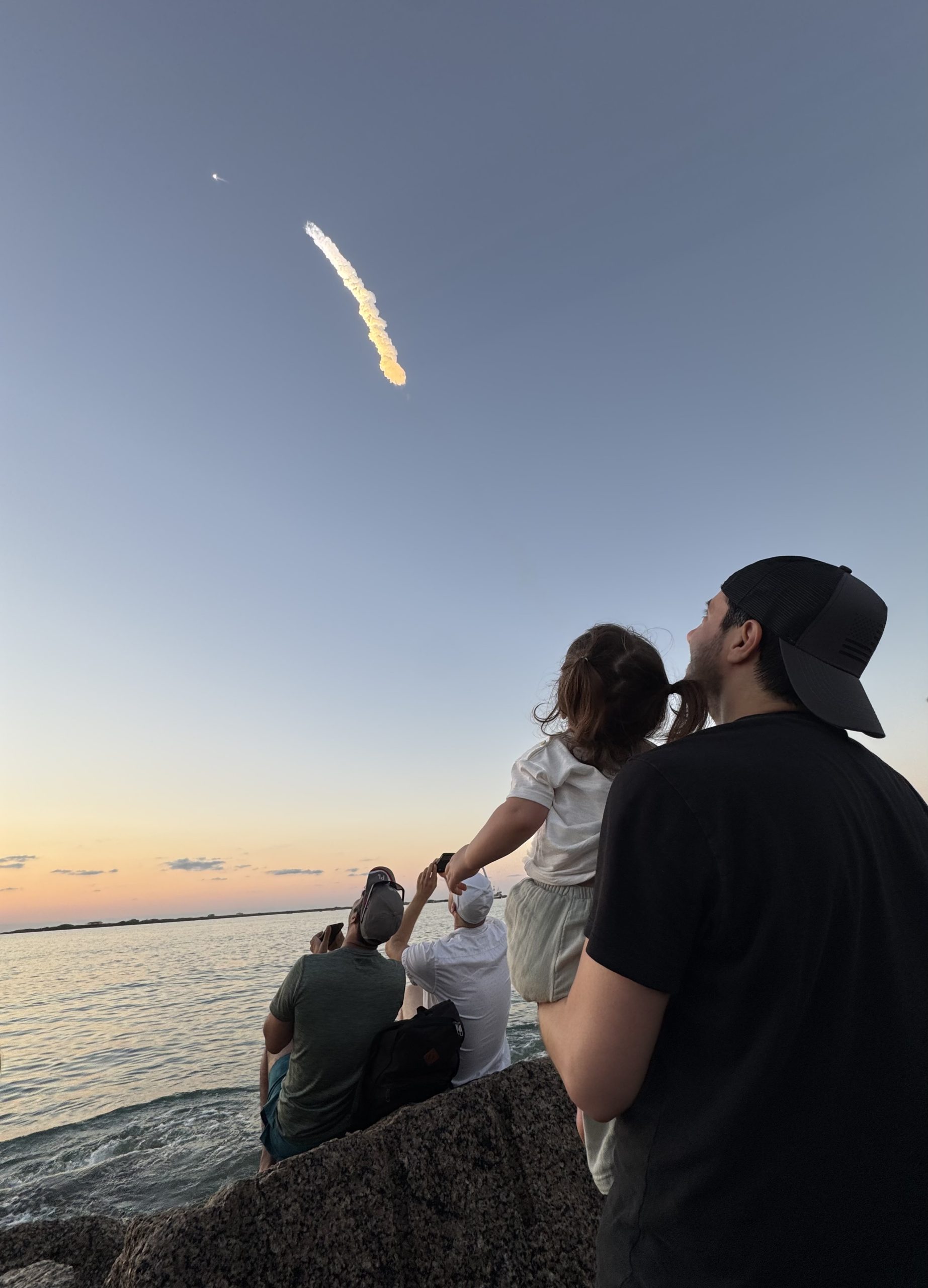
We arrived at our spot and waited. Then, suddenly, the bottom of the rocket exploded into color. The launch began in silence for a few seconds while the roaring sound zipped along the water toward us. Then it got loud. My daughter hated it, saying “No?” repeatedly, which is her way of pleading with me to make it stop.
But soon, like everyone else, she was staring wide-eyed at the flying skyscraper as it bored its way upward through the thick atmosphere, painting a beautiful strip of vivid white and orange cloud across the clear sky. Way above us, we watched it separate into two little dots: The spaceship heading around the world with plans to crash into the Indian Ocean, and the rocket that was—somehow—turning around and coming back toward us.
I can say with confidence: Watching a skyscraper falling from the sky is one of the most surreal things I have ever seen. Noticing my daughter still fixated on the cloud, I redirected her attention to the falling rocket. Near the ground, with a new streak of fire shooting out of its engines, it slowly hovered its way over to the tower and into the gentle embrace of the robot arms. The crowd roared. My wife, who gives one percent as much of a shit as I do about space, was in tears.
It’s hard to wrap your head around SpaceX’s mission. If they actually succeed in putting a single human on Mars, let alone their goal of a million people, it will be one of the major milestones in not just human history but life history—on par with the moment animals first began to walk on land. Whether or not they end up pulling it off, space is officially exciting again.
But the reason rocket launches make people emotional isn’t about that. It’s the feeling of swelling pride that comes from being in awe of your own species. It’s the feeling of hope that comes from being reminded of our insane potential when thousands of people work together toward a goal. It’s the happy version of the post-9/11 feeling of wanting to hug every stranger you see.
These emotions are especially refreshing at a time when we’re surrounded by their polar opposite: the pessimism and petty cynicism that pervade our age of suffocating tribalism.
As the father to a smiley little gnome, I desperately want to shield her from the negativity that will swirl around her as she grows up. I won’t be able to do that. But what I can do is continually redirect her attention to the rocket, showing her all the ways our species is incredible. I can use “rocket launch emotion” as a parenting compass and try, as many times as I can, to give her experiences that fill her with that particular magical, high-minded feeling.
If along the way I also train her to be my little space nerd friend, all the better.
_______
If you like Wait But Why, sign up for our email list and we’ll send you new posts when they come out.
To support Wait But Why, visit our Patreon page.
_______
More Wait But Why space nerdery:
How (and Why) SpaceX Will Colonize Mars
4 Mind-Blowing Things About Stars
The post Why I Lugged My 27-Pound Toddler to a Rocket Launch appeared first on Wait But Why.
Back in 2023, I wrote a post about having my first baby and all the things that confused me about doing so.
Earlier this year, it happened again. Just like that, I was back here:
On one hand, now time doesn’t exist at all.
On the other hand, the second child is…easier than the first.
But I’m not here to talk about the new baby, delightful and obese as she may be. Today, I report to you from the depths of toddler parenthood. I always thought two-year-olds were basically unconscious blobs with a cold, but it turns out they’re actual people you can get to know. Having now spent some time cohabitating with one, I’ve made the following discoveries:
Sometimes when I’m working in my office, my daughter will toddle in, run over to me, and give me a hug. It is by far the best part of my day. Her smile fills me with utter joy. Her little voice is sent straight from heaven. I feel the purest possible love for her.
It’s just that I also find her groundbreakingly boring. A five-minute hangout is one thing, but when I’m deep in an afternoon with her, it’s hard to come to any other conclusion than that I’ve spent my last three hours with a person whose IQ is 20.
It’s well-known that toddlers transform into mid-20th-century totalitarian dictators at the drop of a hat.
But they’re dicks in less obvious ways too. The other day, my toddler was playing with Legos. I sat down next to her and asked her what she was building, and she said, “Daddy needs to work in his office?”—an unsubtle hint that I should leave her the fuck alone.
Or the times I cook a whole thing for her with care and love and she refuses to take a bite, making me feel cluey for myself.
Most recently, I made the mistake of telling her my age, and now she says “Daddy is 43” like 30 times a day, constantly filling me with existential dread.
Toddler parenthood is a reality distortion zone that makes it hard to remember that most people find your toddler breathtakingly uninteresting.1
Friends who have kids the same age as yours are kind of in a cohort together, so parents of toddlers often end up with a whole throng of toddlers in their lives. Amongst my cohort I’ve both been an offender and frequent victim of toddler-video-showing. It’s part of the tax we all pay.2
I try to at least minimize the fallout from my end.
If I took my daughter to China for a year, and we just lived there with no language instruction, I’d come back knowing approximately six Mandarin words and she’d be fluent. It makes no sense to me that toddlers just learn a language by hearing the language, but somehow they do. They’re weird freak geniuses. But then she says stuff like “would you like a strawberry?” when she wants a strawberry, because when we say “you,” it refers to her, so she now thinks “you” is a synonym for her name, which is very unimpressive.
Likewise, the other day I read her a new book for the first time, and then the second time I read it to her, she stopped me in the middle to correct something I said. It turns out I had accidentally skipped a word, which she knew because she somehow memorized the whole book on the first read. But then we’ll pick up another book and she’ll stare at the page for a million years looking for where Curious George is “hiding” even though he’s obviously right the fuck there.
We sometimes take our toddler to story time at the library, where the librarian reads a book to a bunch of kids. The first time we took her, she decided to take matters into her own hands and, mid-story, went and sat in the librarian’s lap. The issue is that she hadn’t quite figured out that the world does not exist entirely for her benefit.
It’s understandable. You’re born into the world and for the first few years, everyone you see smiles and waves at you, so you overestimate your importance. Only slowly do you learn what’s really happening.3
This is part of the broader phenomenon of a toddler not really having any idea what’s going on. They don’t know about death, or money, or history, or sex, or the Big Bang, or basically anything about reality. They just emerged out of nowhere and started being, which for some reason doesn’t strike them as weird or confusing.
(A good “do you have any idea what’s going on?” litmus test is: If you’re walking down the street and an elephant flies down from the sky, hovers ten feet above you and says hello in a silly cartoon voice before flying off, would you be like “OH MY GOD WHAT JUST HAPPENED” or would you shrug and be like “I guess that’s something that happens”? If the latter, you have no idea what’s going on. Most two-year-olds fail this test.)
My daughter is remarkably unfunny. Once when she dropped something, I said “kerplunk,” and she found it fucking hilarious. For the next ten minutes, she kept picking things up, dropping them, and saying “kerplunk,” hysterically laughing each time.
But unintentionally, she’s a comedic genius. When I was in her way recently, she said, “Can you get out of space?” which my wife and I now say to each other whenever we want the other to move. Another time, we had to rip a band-aid off her leg, after which she said, “I am so perfectly sad,” and now my wife and I say that anytime we’re unhappy about something.4
We’ve also discovered an amazing hack: you can just teach a toddler to say whatever you want. We taught her to say “mamma mia” whenever she falls over, which I highly recommend to other toddler parents.
The problem is, for every strong opinion, there’s an equally strong opposite opinion.
I’ve taken to accepting that I’m messing up all kinds of things, and mainly just try to have fun with my little friend. To the extent that I have a strategy, it’s basically:
Toddler parents can take solace in the fact that parenting probably matters less than we think it does. Rather than try to shape our little two-foot-tall companions, we should help guide them to become the best version of who they already are.
Anyway, gotta go. Time to read Squeak the Mouse Likes His House for the 57th time.
___________
More tales from fatherhood: 10 Thoughts from the Fourth Trimester
My favorite toddler books: Flotsam, Little Fur Family, The Giant Jam Sandwich, Little Owl’s Night
If you’d rather read about something other than my fat babies:
The Marriage Decision: Everything Forever or Nothing Ever Again
Taming the Mammoth: Why You Should Stop Caring What Other People Think
_______
If you like Wait But Why, sign up for our email list and we’ll send you new posts when they come out.
To support Wait But Why, visit our Patreon page.
Toddler grandparents may be an exception, though they span a wide range, from “Please go away for a month and leave them with me” on one end, to “I will play with them for five minutes but only because it looks bad if I don’t” on the other. Those on the latter end are as bored by toddler videos as everyone else.↩
There’s a range here. A short, high-quality video of a good friend’s toddler, sent by text (so you can watch on your own time and don’t have to react the whole time) is fine—nice even. A person you barely know showing you a long toddler video, in person, is a nightmare.↩
Some have suggested that the common desire for fame is, in some subconscious sense, an attempt to recapture the long-lost feeling that the whole world knows and loves you.↩
She actually said “Can I get out of space?” and “You are so perfectly sad” because, again, she is confused about pronouns.↩
The post Tales from Toddlerhood appeared first on Wait But Why.
Ever present in my mind is The List: the countries I still haven’t gone to that I most want to visit.
Ethiopia is on The List. So is Indonesia. And South Korea. And Madagascar. And Taiwan.
Early on, my wife and I pledged to visit two new countries every year, and we mostly pulled it off. Then came Covid, followed by two babies, and we fell off the wagon.
This year we remembered that we were gonna die at some point and decided it was time to get things going again. We dusted off The List, picked a country that’s been at the very top for years, tossed the kids to the grandparents for a week, and headed off to Bhutan.1
Bhutan, if you’re not familiar, is a tiny 800,000-person country squashed between two behemoths.
Bhutan was unified in the 17th century after millennia of existing as a collection of warring tribes. In the time since then, it has somehow avoided being annexed by China or India. Today, it is the world’s last Buddhist kingdom, and I can confirm that it is both very Buddhist and very kingdom-y. Temples are everywhere, and the people are highly superstitious—our tour guide seemed to constantly be remarking about good luck and bad luck, promising omens and inauspicious riverbends. (The temples are beautiful, but so are all the other buildings. All architecture in the country, from the airport to the shopping centers, has a uniform Bhutanese style.)
The king is universally beloved and, at least the way they tell it, an exemplary ruler. A typical story we heard: 50,000 people work in the country’s tourist industry, all of whom were suddenly out of work during Covid. So the king gave these families $120/month, enough to get by on until the industry came back. He paid this out of his own pocket, nearly to the point of personal bankruptcy.
(Of course, I was also told in North Korea that it was only by the grace and courage of their magnanimous leaders that the people were prosperous and free, unlike their unfortunate South Korean cousins suffering under American occupation. But the situations are wildly different and I am inclined to mostly believe what I heard in Bhutan.)
One more story to illustrate what a sweetie Bhutan is: The country has a strict policy against killing animals and never euthanizes stray dogs, so there are a lot of them. They mostly live off the detritus of restaurants and hotels. When everything shut down during Covid, the king told people to bring cooked food out to the dogs and even wrap them in blankets during the cold months.
Bhutan does things differently than other countries. Hellbent on preserving their traditional way of life, TV and internet were banned in the country until 1999, and if it weren’t for the cars, I might have been convinced I had taken a time machine back to the 1600s. Tourism is limited, only possible in the form of a guided tour, and immigrating to the country is near impossible. They are so diligent about conservation that Bhutan is the world’s one carbon-negative country—their vast forests absorb more CO2 than their populace emits.
In 1972, Bhutan’s king decided that Gross National Happiness was a more important metric than Gross Domestic Product, and their policies cater to this value.2 It’s why Bhutan is famous for supposedly being the world’s happiest country, which I had no way to verify, but the people were very kind and seemed pretty happy I guess?
Sadly, Bhutan’s way of life is threatened now as many of its young people have left to find opportunity elsewhere. The king is attempting to fix this with plans to construct Gelephu Mindfulness City, an economic hub which will center around innovation, while preserving Bhutanese tradition. It looks like it’ll be incredible, though I was told not to hold my breath as it will probably not be finished for 20 more years.
All of this is to say that Bhutan is a special place—remote, mysterious, and breathtakingly beautiful. Which is why it was always prominently on The List.
A trip to Bhutan is better shown than told, so I kept most of the details to this video:
_______
More posts from The List:
Siberia
Tokyo
Nigeria
Iraq
Greenland
North Korea
And The genie question
_______
If you like Wait But Why, sign up for our email list and we’ll send you new posts when they come out.
To support Wait But Why, visit our Patreon page. (During this book-writing phase, I’ve been doing mini-posts every Friday for patrons.)
It is not quick to get from Austin to Bhutan. We had to get there by way of Chicago, Zurich, and Delhi.↩
In 2011, the UN passed a resolution being like, “all of you other shitty countries should consider focusing on Gross National Happiness too.” Everyone appears to have ignored them.↩
The post The sights and sounds of Bhutan appeared first on Wait But Why.